
Lecture 5 Microbial Nutrition Growth Chapter 7 Foundations
Lecture 5 Microbial Nutrition & Growth Chapter 7 Foundations in Microbiology
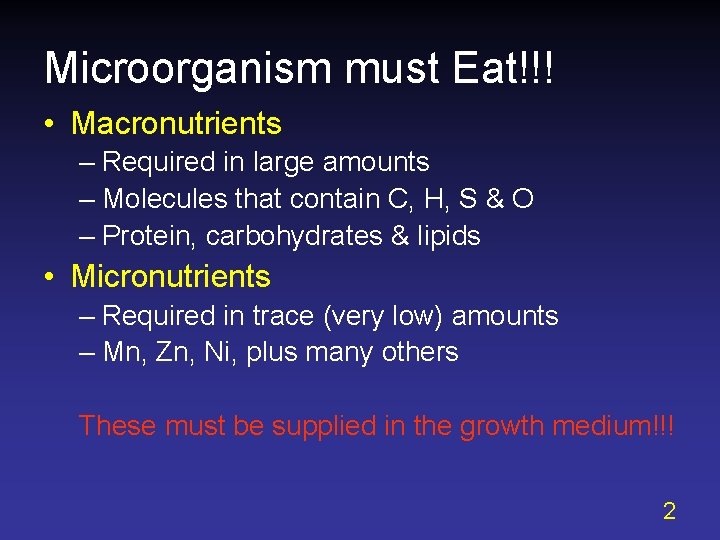
Microorganism must Eat!!! • Macronutrients – Required in large amounts – Molecules that contain C, H, S & O – Protein, carbohydrates & lipids • Micronutrients – Required in trace (very low) amounts – Mn, Zn, Ni, plus many others These must be supplied in the growth medium!!! 2
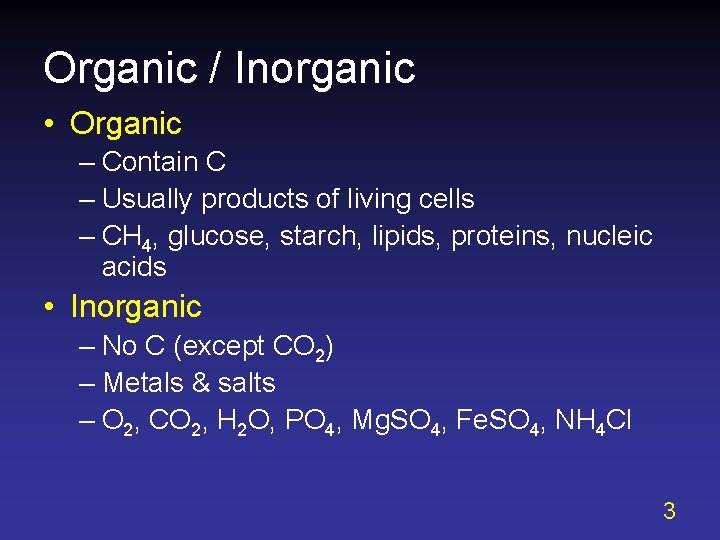
Organic / Inorganic • Organic – Contain C – Usually products of living cells – CH 4, glucose, starch, lipids, proteins, nucleic acids • Inorganic – No C (except CO 2) – Metals & salts – O 2, CO 2, H 2 O, PO 4, Mg. SO 4, Fe. SO 4, NH 4 Cl 3

92 naturally occurring elements 25 are essential for life 6 major elements make up ~96% of the mass of most living organisms O – Oxygen (for almost all organic comp’s) P – Phosphorus (DNA, RNA and ATP (energy)), membranes (phospholipids) C – Carbon (for all organic comp’ds) S – Sulfur (for proteins) H - Hydrogen (for almost all organic comp’s) N – Nitrogen (for proteins, DNA, RNA) 4
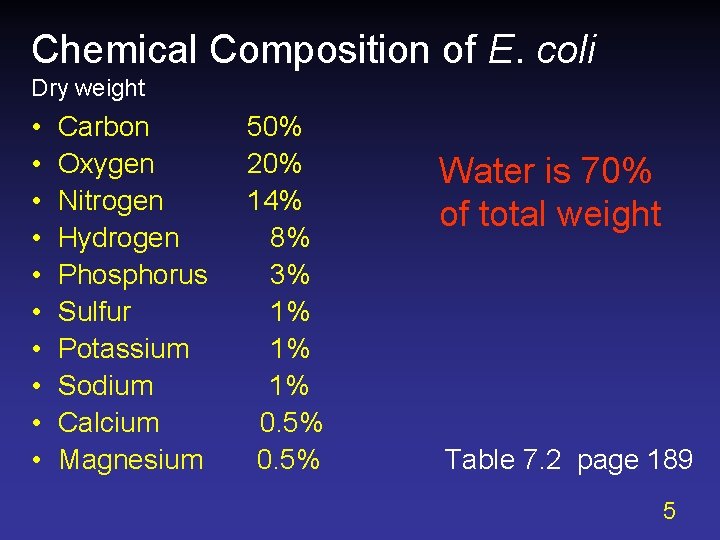
Chemical Composition of E. coli Dry weight • • • Carbon Oxygen Nitrogen Hydrogen Phosphorus Sulfur Potassium Sodium Calcium Magnesium 50% 20% 14% 8% 3% 1% 1% 1% 0. 5% Water is 70% of total weight Table 7. 2 page 189 5
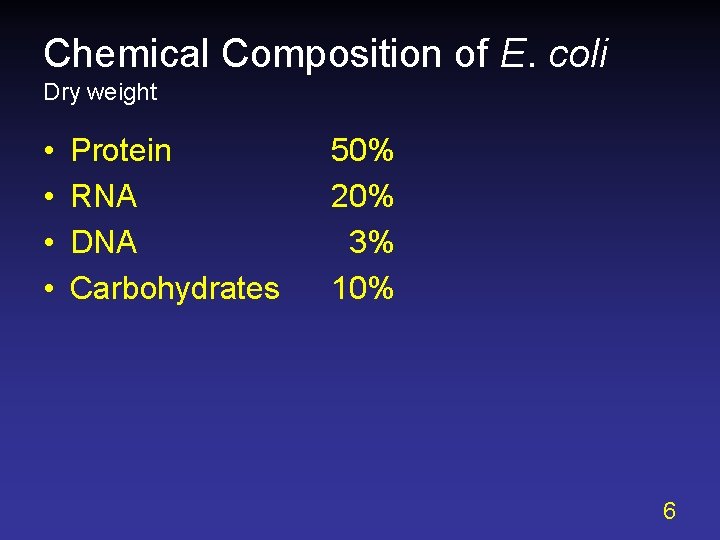
Chemical Composition of E. coli Dry weight • • Protein RNA DNA Carbohydrates 50% 20% 3% 10% 6
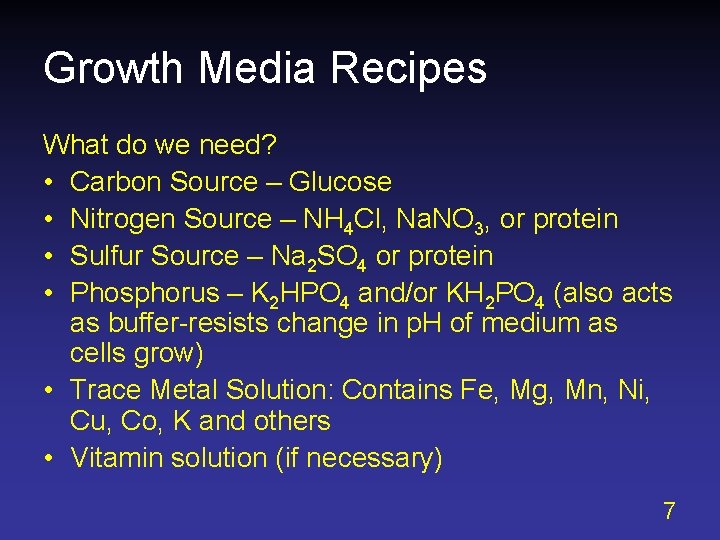
Growth Media Recipes What do we need? • Carbon Source – Glucose • Nitrogen Source – NH 4 Cl, Na. NO 3, or protein • Sulfur Source – Na 2 SO 4 or protein • Phosphorus – K 2 HPO 4 and/or KH 2 PO 4 (also acts as buffer-resists change in p. H of medium as cells grow) • Trace Metal Solution: Contains Fe, Mg, Mn, Ni, Cu, Co, K and others • Vitamin solution (if necessary) 7
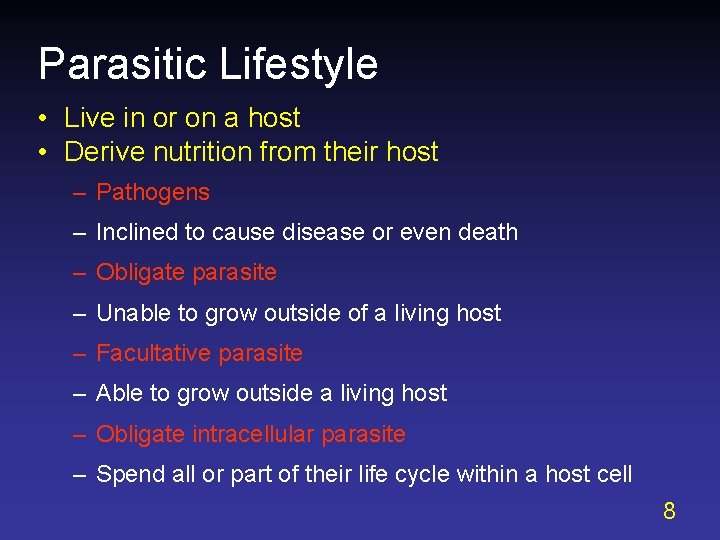
Parasitic Lifestyle • Live in or on a host • Derive nutrition from their host – Pathogens – Inclined to cause disease or even death – Obligate parasite – Unable to grow outside of a living host – Facultative parasite – Able to grow outside a living host – Obligate intracellular parasite – Spend all or part of their life cycle within a host cell 8
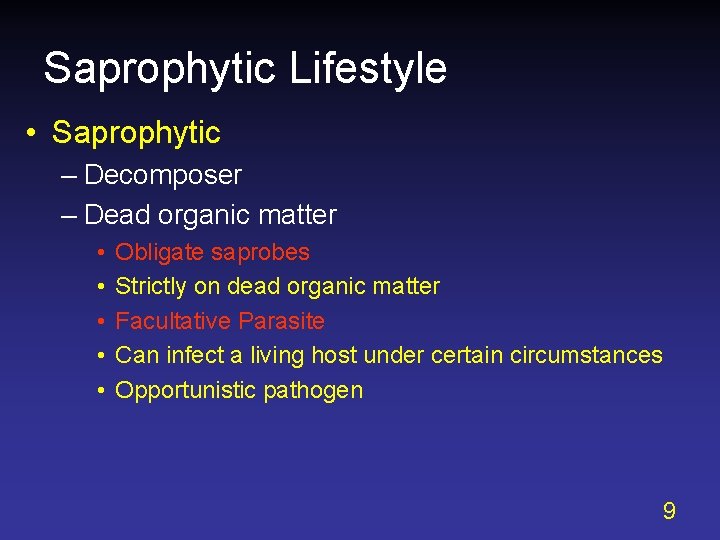
Saprophytic Lifestyle • Saprophytic – Decomposer – Dead organic matter • • • Obligate saprobes Strictly on dead organic matter Facultative Parasite Can infect a living host under certain circumstances Opportunistic pathogen 9

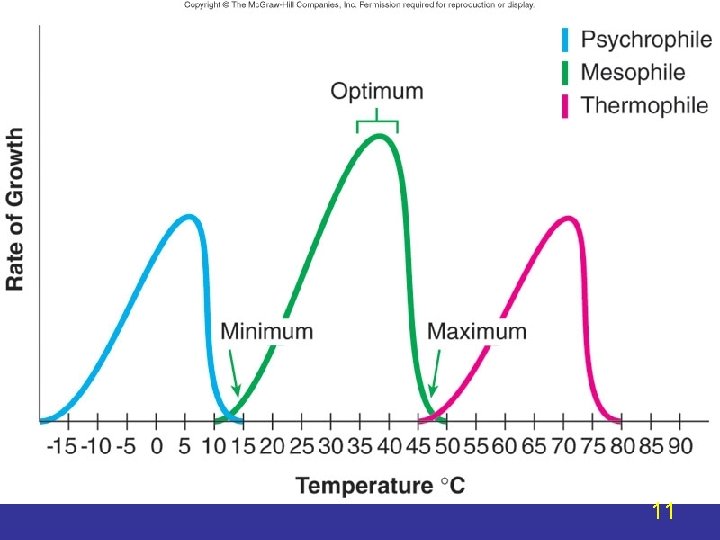
Temperature and Growth • Minimum temperature - Lowest temperature an organism can grow • Maximum temperature - Highest temperature an organism can grow • Optimal temperature – Fastest growth rate & metabolism – Lowest Doubling Time 10
11

Low Temperature • Psychrophile – Optimal temp < 15ºC and capable of growth at OºC – Obligate psychrophiles generally can not grow above 20ºC • Psychrotrophs or facultative psychrophiles – Grow slowly at low temp but have an optimum temp > 20ºC 12

Intermediate Temperature • Mesophiles – Optimal growth temperature 20º to 40ºC – Most human pathogens (human body temperature = 37ºC) – Some mesophiles can with stand short exposure to high temperatures (this is why pour plates work!!!) 13

High Temperature • Optimal temp > 40ºC – Moderate thermophiles – Optimal growth temperature between 40 and 80ºC – Hyperthermophiles – Optimal growth temperature > 80ºC – Hot springs or deep sea thermal vents 14
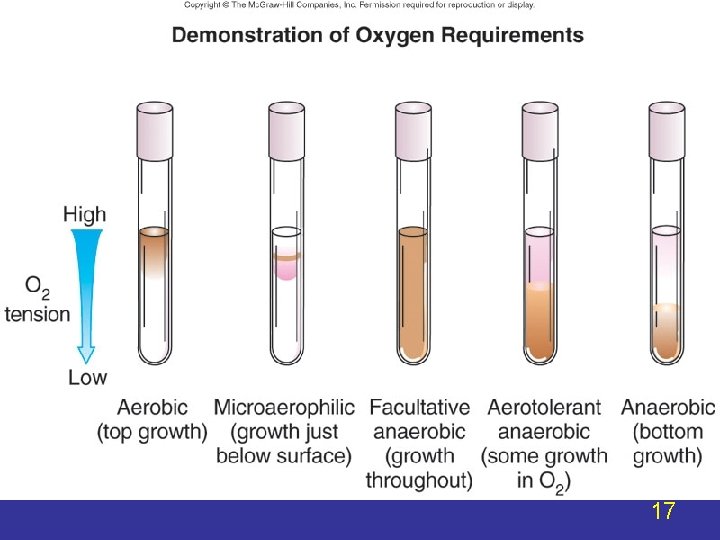
Oxygen (O 2) and Growth • Aerobe or aerobic organism – Use O 2 & can eliminate H 2 O 2 Obligate aerobe – Cannot live without O 2 Facultative aerobes – Capable of growth in the absence of O 2 Microaerophile – Requires O 2 but at low concentration 15
Anaerobic • Anaerobe • Does not require O 2 Strict or Obligate anaerobe – Cannot tolerate any O 2 Aerotolerant anaerobes – Do not utilize O 2 but survive in its presence Capnophiles (usually anerobic or microaerophilic) – Prefer a high [CO 2] ([ ] means concentration) 16
17
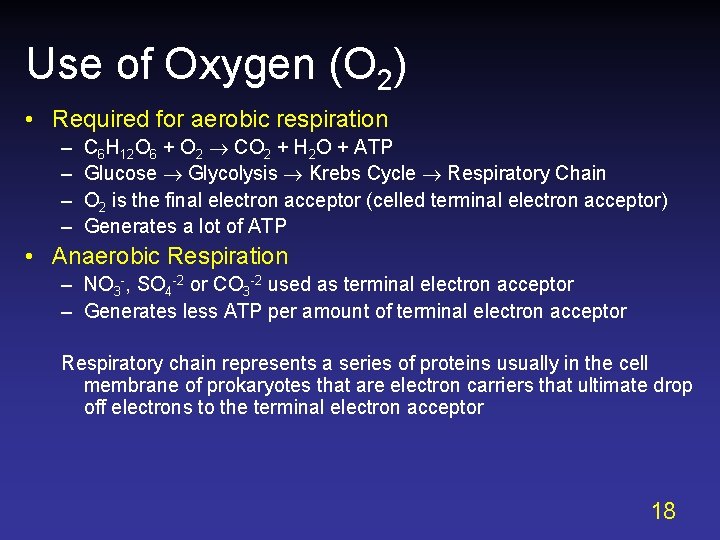
Use of Oxygen (O 2) • Required for aerobic respiration – – C 6 H 12 O 6 + O 2 CO 2 + H 2 O + ATP Glucose Glycolysis Krebs Cycle Respiratory Chain O 2 is the final electron acceptor (celled terminal electron acceptor) Generates a lot of ATP • Anaerobic Respiration – NO 3 -, SO 4 -2 or CO 3 -2 used as terminal electron acceptor – Generates less ATP per amount of terminal electron acceptor Respiratory chain represents a series of proteins usually in the cell membrane of prokaryotes that are electron carriers that ultimate drop off electrons to the terminal electron acceptor 18
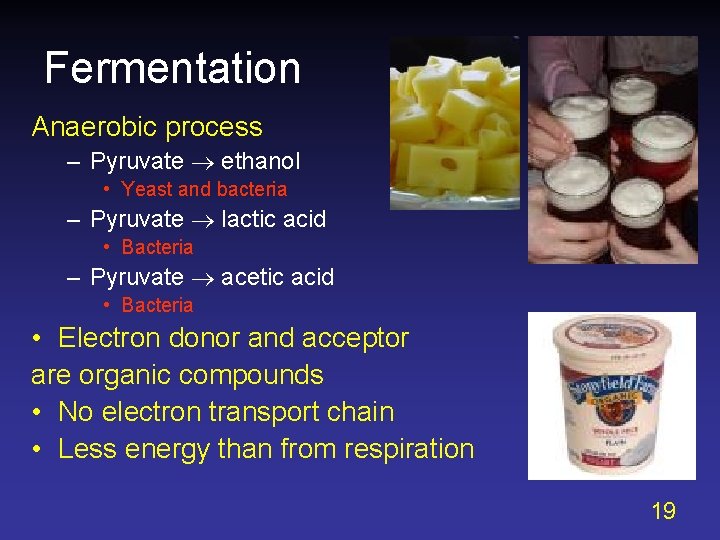
Fermentation Anaerobic process – Pyruvate ethanol • Yeast and bacteria – Pyruvate lactic acid • Bacteria – Pyruvate acetic acid • Bacteria • Electron donor and acceptor are organic compounds • No electron transport chain • Less energy than from respiration 19
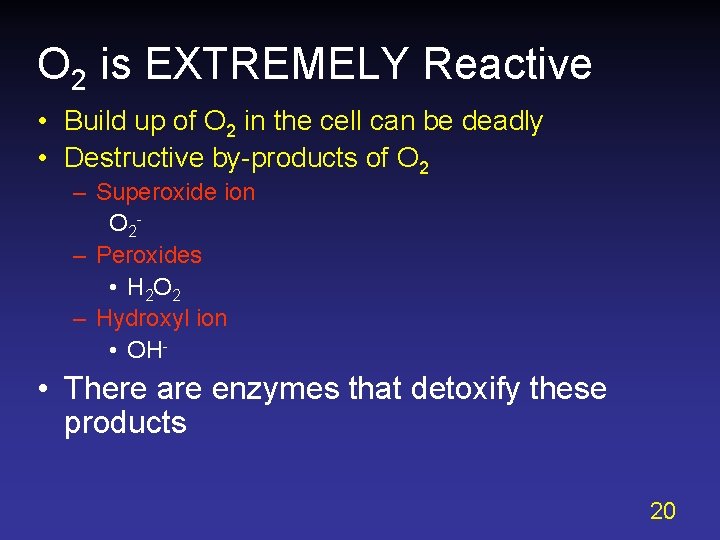
O 2 is EXTREMELY Reactive • Build up of O 2 in the cell can be deadly • Destructive by-products of O 2 – Superoxide ion O 2– Peroxides • H 2 O 2 – Hydroxyl ion • OH- • There are enzymes that detoxify these products 20
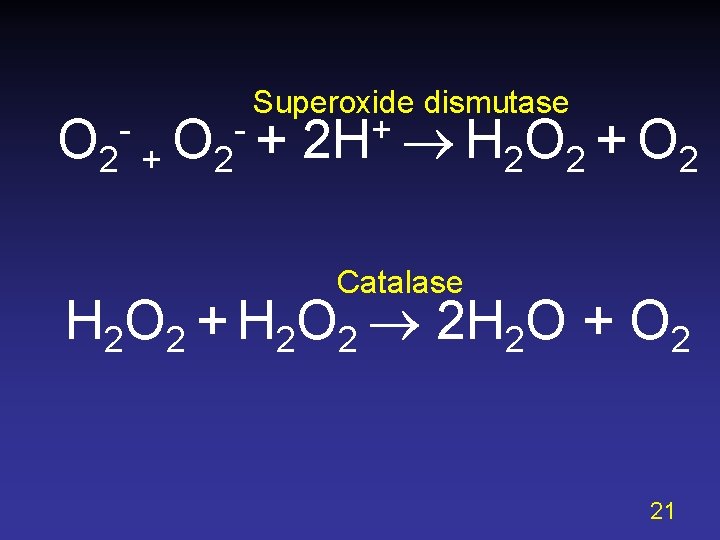
O 2 + O 2 - Superoxide dismutase -+ + 2 H H 2 O 2 + O 2 Catalase H 2 O 2 + H 2 O 2 2 H 2 O + O 2 21
p. H and growth • Most bacteria are neutrophilic and their optimal growth p. H is between p. H 6 and 8 • Acidophiles – optimal p. H < 3 • Obligate acidophile – optimal growth p. H between 0 -1 and can’t grow at 7 Alkalinophiles (alkaliphile) - Optimal growth at high p. H (> 8) - Obligate grows at p. H > 10 but can’t at 7 Note: Fungi are much more tolerant of acidic p. H and the optimum growth p. H for many is around 5 22
Osmotic Pressure (Water Activity) • Water Activity (aw) – For pure water aw = 1. 000 – Affects growth strongly and selects for particular organisms - Human blood – 0. 995 - Bread – 0. 950 - Maple Syrup – 0. 900 - Salt Lakes, Salted Fish – 0. 750 - Cereals, Dried Fruit – 0. 700 23
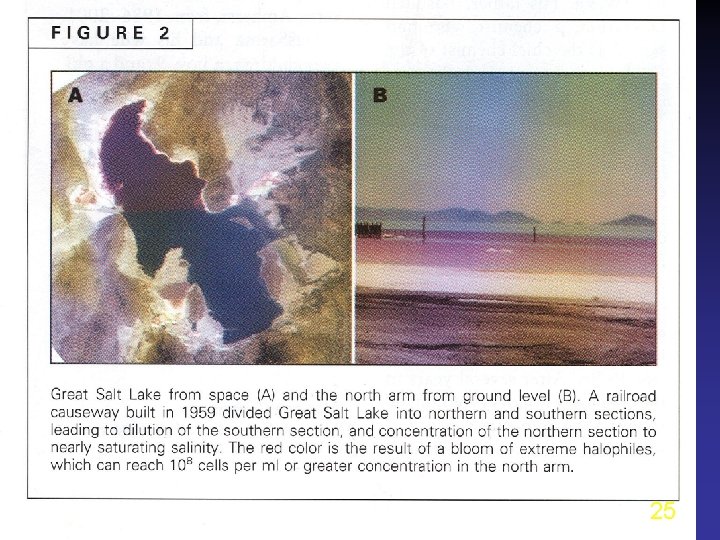
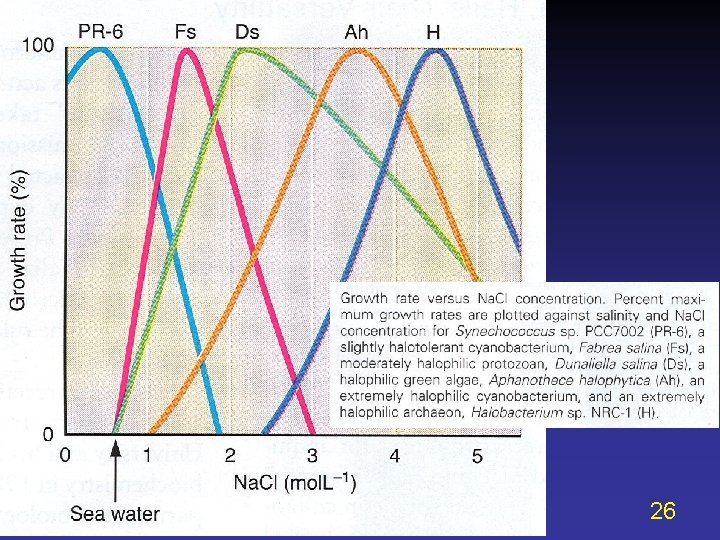
Osmotic Pressure (Water Activity) • • • Water Activity (aw) – For pure water aw = 1. 000 Halophiles – a type of extremophile Osmophile Hypertonic / hypersaline environments Salt lakes, salt ponds – Obligate halophile – Optimal growth ≥ 25% Na. Cl but requires at least 9% Na. Cl – Facultative halophiles – Resistant to salt but don’t normally reside in high salt environments… Staphylococcus aureus (8% salt) 24
25
26
Ecological Associations • Symbiotic – Two organisms live in close association – Required by one or both individuals Mutualism • Mutually beneficial relationship Commensalism • One species derives benefit without harming the other Parasitism • One species derives benefit and the other is harmed 27
Other Associations • Synergism – Interrelationship – 2 or more free-living organisms – Benefits all but is not necessary for survival • Antagonism – One species secretes a substances that inhibits or destroys another species • Antibiotics • Antimicrobial proteins 28
Cell Division & Endospores Binary fission (budding) vs. Sporulation Binary fission and budding are forms of reproduction Sporulation is, in most cases, not a form of reproduction but is used for survival of the cell under harsh conditions. There are some exceptions Note: Endospores are found only in Gram-positive bacteria Implicated in disease… examples Bacillus anthracis, Clostridium botulinum, Clostridum tetani

Binary Fission 30
Binary / Transverse Fission and Budding • One cell becomes two • Division plane forms across the width of the cell • Parent cell enlarges • Replication of the chromosome • Transverse septum • Continuous 31
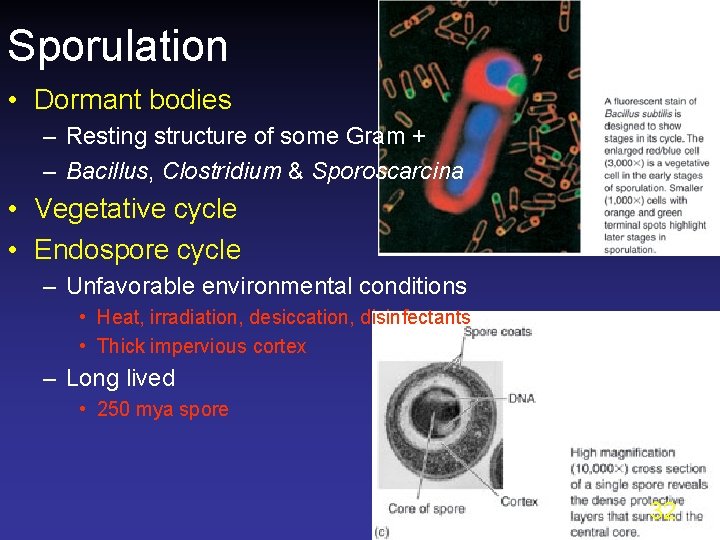
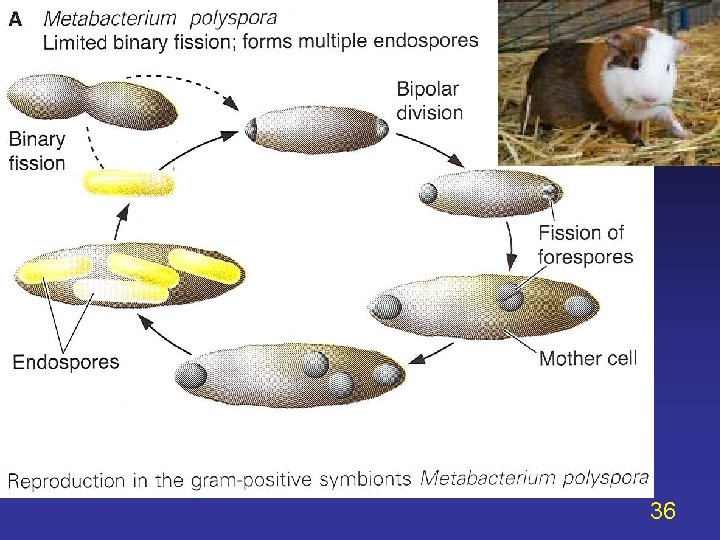
Sporulation • Dormant bodies – Resting structure of some Gram + – Bacillus, Clostridium & Sporoscarcina • Vegetative cycle • Endospore cycle – Unfavorable environmental conditions • Heat, irradiation, desiccation, disinfectants • Thick impervious cortex – Long lived • 250 mya spore 32
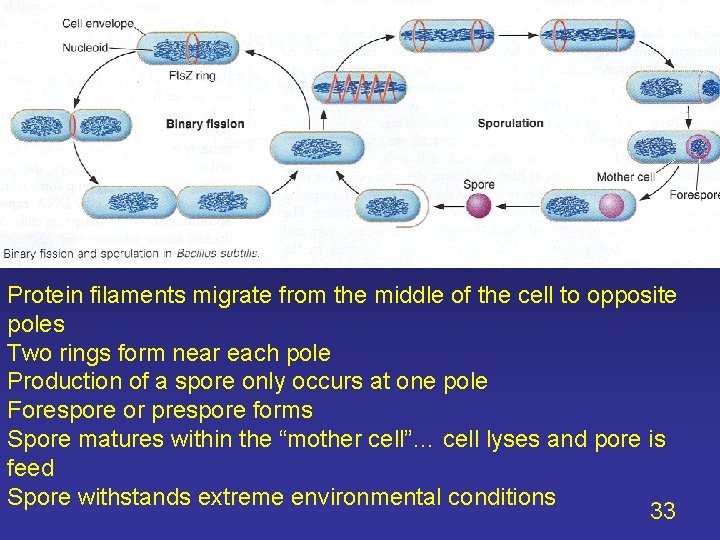
Protein filaments migrate from the middle of the cell to opposite poles Two rings form near each pole Production of a spore only occurs at one pole Forespore or prespore forms Spore matures within the “mother cell”… cell lyses and pore is feed Spore withstands extreme environmental conditions 33
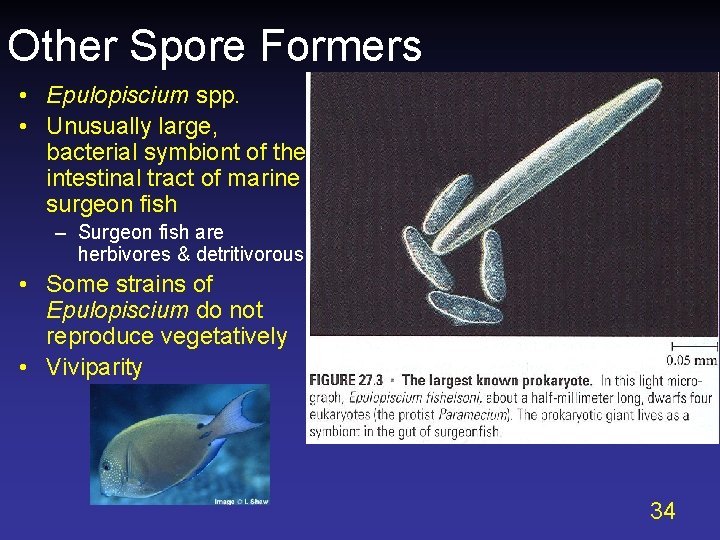
Other Spore Formers • Epulopiscium spp. • Unusually large, bacterial symbiont of the intestinal tract of marine surgeon fish – Surgeon fish are herbivores & detritivorous • Some strains of Epulopiscium do not reproduce vegetatively • Viviparity 34
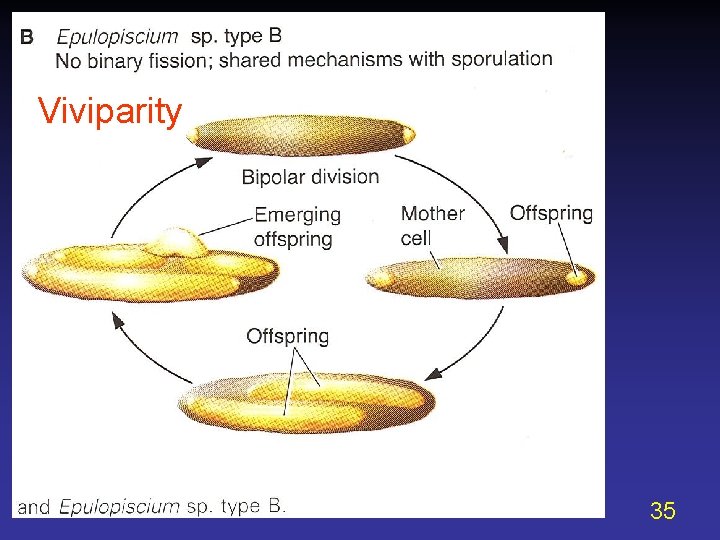
Viviparity 35
36
Estimating the Number of Bacterial Cells in a Sample (e. g. , water, food, soil) Main method is the plate count method which we will go over here…will count only live cells in a sample (Viable count) but not all live cells may form colonies Other methods are microscopic methods but there are limitations… cells could be live or dead unless a “vital” stain is used; and flow cytometry which is expensive… 37

Plate Count Method • Dilute a sample with sterile saline until the microbial cells can be counted accurately – A broad range of dilutions is used since the exact number of bacteria is not known • Plates should have between 30 and 300 colonies – Fewer than 30 colonies is not statistically accurate • Too Few To Count (TFTC) – More than 300 colonies is simply to difficult to count • Colonies are too close together • Too Numerous To Count (TNTC) 38
Colony Forming Units (cfu) • Each viable cell will develop into a colony • There are two assumptions: – Each colony arose from one cell • Can’t be certain that two cells close together produced one colony – Random sample from the population • Statistically accurate 39
Calculate Colony Forming Units • Count the bacterial colonies on the plates the have between 30 & 300 colonies • Divide the number of colonies by the dilution factor – There are 130 colonies on the 10 -6 dilution – 130 / 10 -6 = 1. 3 x 10⁸ or 130, 000 – Report cfu / m. L or cfu / gram 40
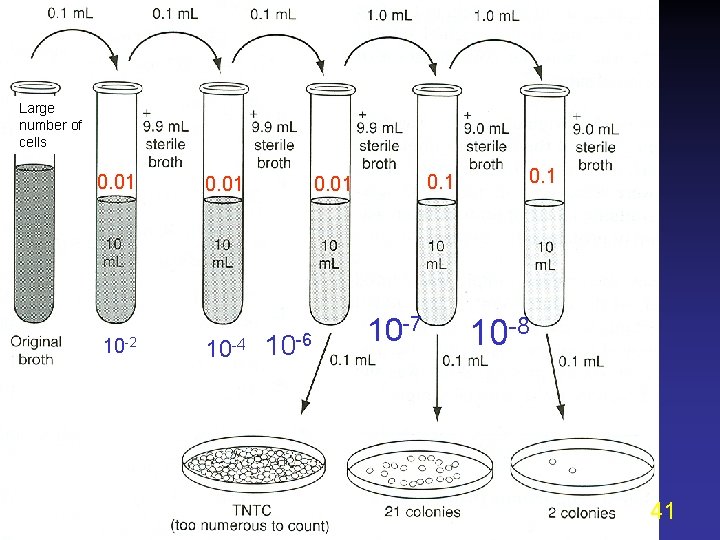
Large number of cells 0. 01 10 -2 0. 01 10 -4 0. 1 0. 01 10 -6 10 -7 0. 1 10 -8 41
• The 1 st plate has TNTC • The 3 rd plate has TFTC • The 2 nd plate has 21 colonies and will be used for the calculations • The concentration of the cells is – 21 / 0. 1 m. L = 210 cells / m. L – 210 X 107 = 2. 1 X 10⁹ 42
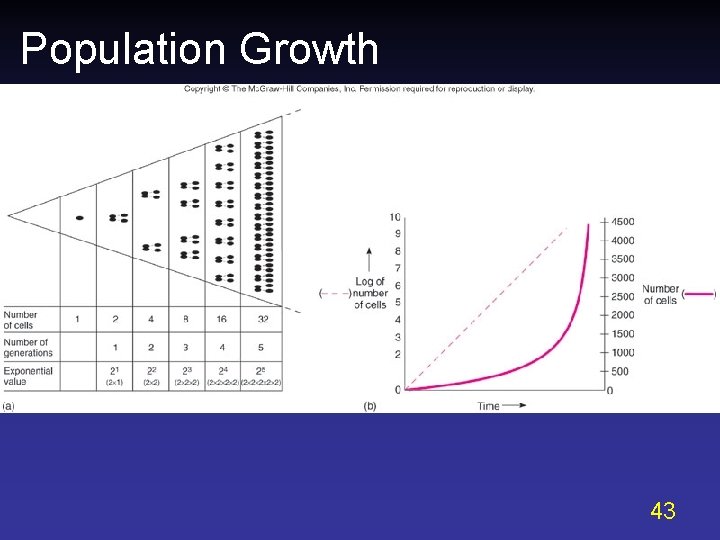
Population Growth 43
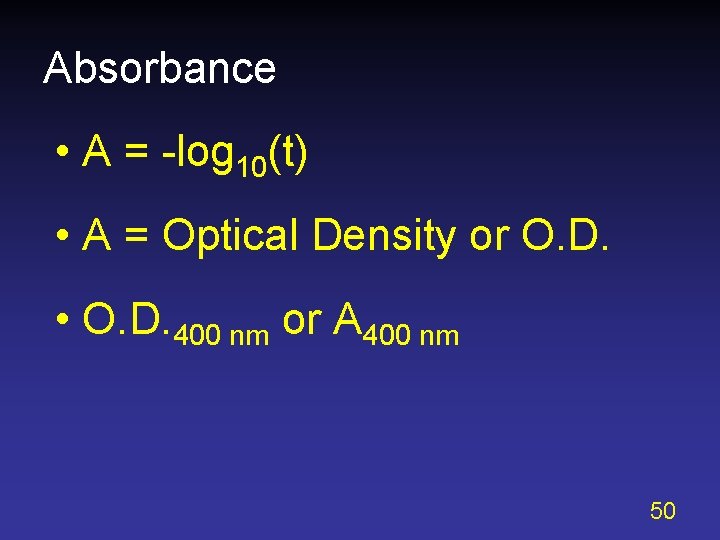
Measurement of Microbial Population • Viable plate count method – Counting colonies on agar medium • Spectrophotometric analysis – Measure of turbidity 44
Growth Curve 45
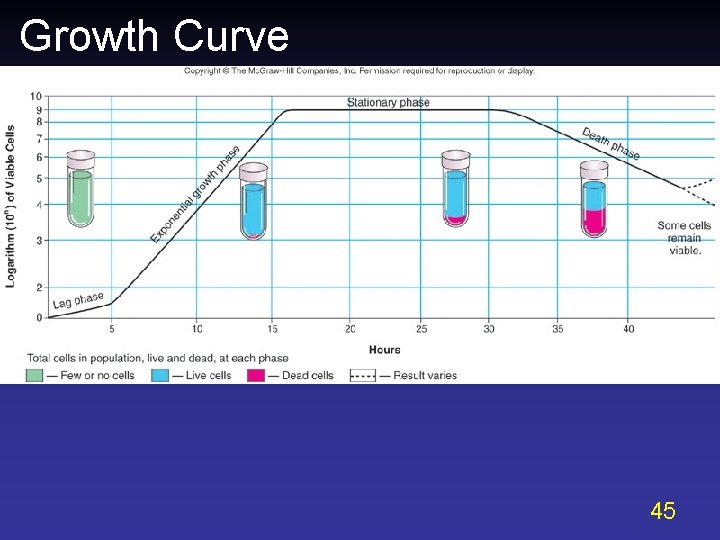
Growth Curve 1. Lag phase – “flat” period of adjustment, enlargement; little growth 2. Exponential growth phase – a period of maximum growth will continue as long as cells have adequate nutrients & a favorable environment 3. Stationary phase – rate of cell growth equals rate of cell death cause by depleted nutrients & O 2, excretion of organic acids & pollutants 4. Death phase – as limiting factors intensify, cells die exponentially in their own wastes 46
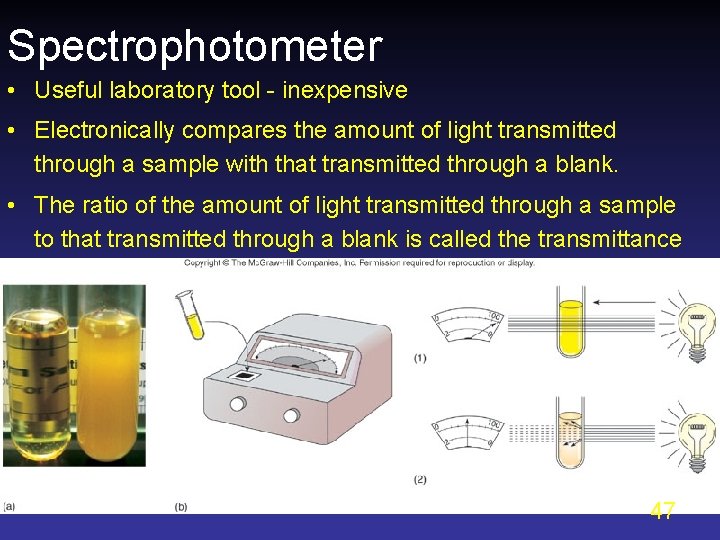
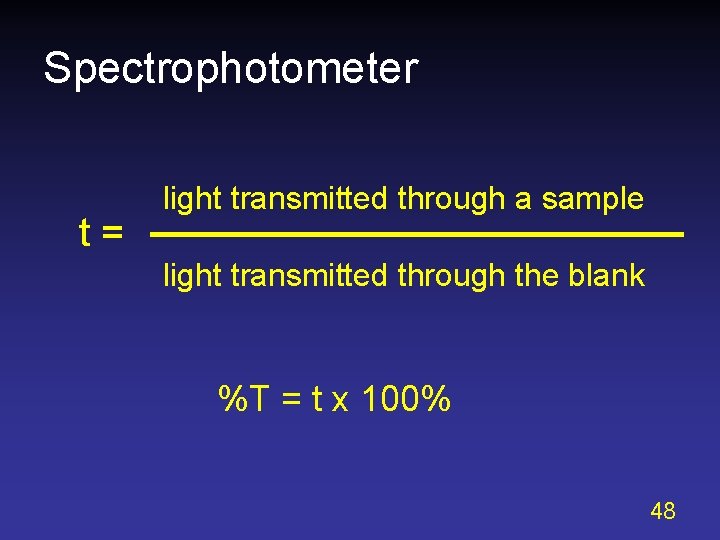
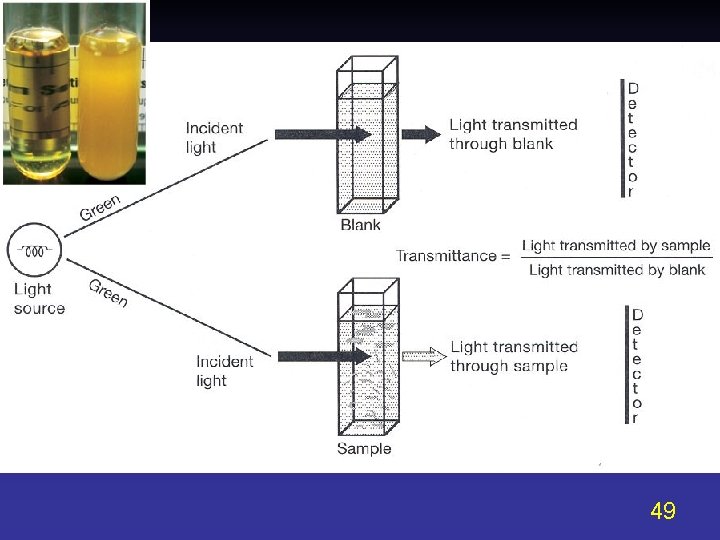
Spectrophotometer • Useful laboratory tool - inexpensive • Electronically compares the amount of light transmitted through a sample with that transmitted through a blank. • The ratio of the amount of light transmitted through a sample to that transmitted through a blank is called the transmittance 47
Spectrophotometer t= light transmitted through a sample light transmitted through the blank %T = t x 100% 48
49
Absorbance • A = -log 10(t) • A = Optical Density or O. D. • O. D. 400 nm or A 400 nm 50
51
- Slides: 51