
Lecture 5 KMap minimization in larger input dimensions
![Reading [Harris] Chapter 3, 3. 1 22](https://slidetodoc.com/presentation_image/513e362d0fe00516de9e1f45646c82f2/image-22.jpg "Reading [Harris] Chapter 3, 3. 1 22")
- Slides: 22
Lecture 5: K-Map minimization in larger input dimensions and K-map minimization using max terms CSE 140: Components and Design Techniques for Digital Systems Fall 2014 CK Cheng Dept. of Computer Science and Engineering University of California, San Diego 1
Part I. Combinational Logic 1. Specification 2. Implementation K-map: Sum of products Product of sums 2
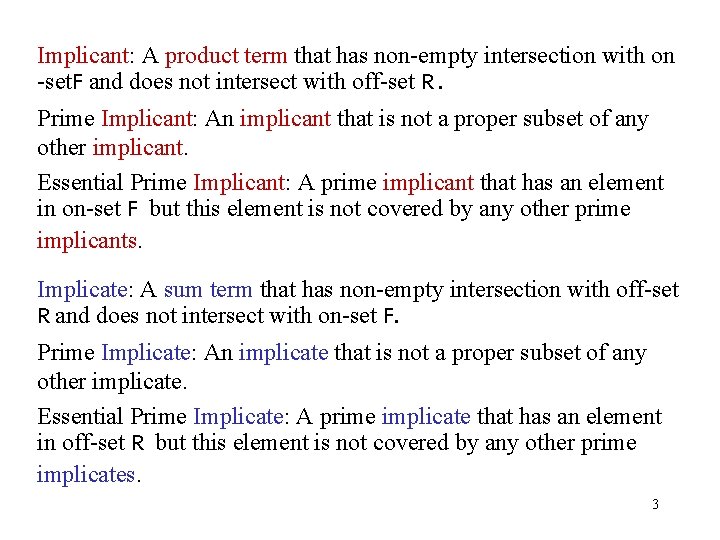
Implicant: A product term that has non-empty intersection with on -set. F and does not intersect with off-set R. Prime Implicant: An implicant that is not a proper subset of any other implicant. Essential Prime Implicant: A prime implicant that has an element in on-set F but this element is not covered by any other prime implicants. Implicate: A sum term that has non-empty intersection with off-set R and does not intersect with on-set F. Prime Implicate: An implicate that is not a proper subset of any other implicate. Essential Prime Implicate: A prime implicate that has an element in off-set R but this element is not covered by any other prime implicates. 3
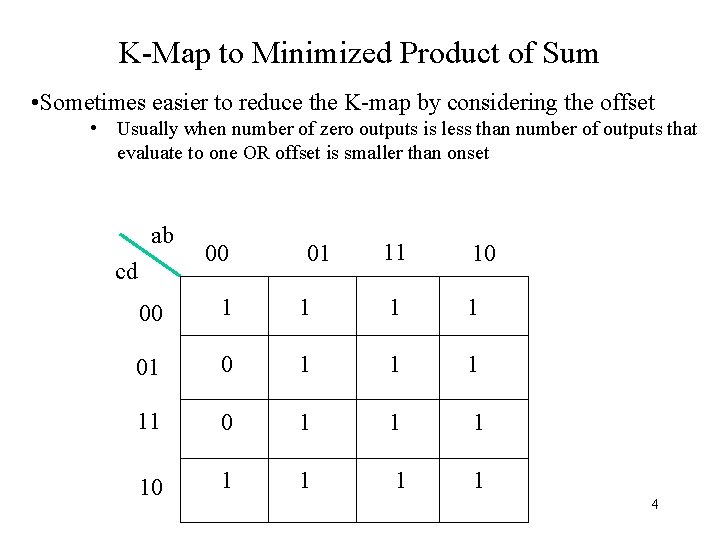
K-Map to Minimized Product of Sum • Sometimes easier to reduce the K-map by considering the offset • Usually when number of zero outputs is less than number of outputs that evaluate to one OR offset is smaller than onset ab cd 00 01 11 10 00 1 1 1 01 0 1 1 1 10 1 1 1 4
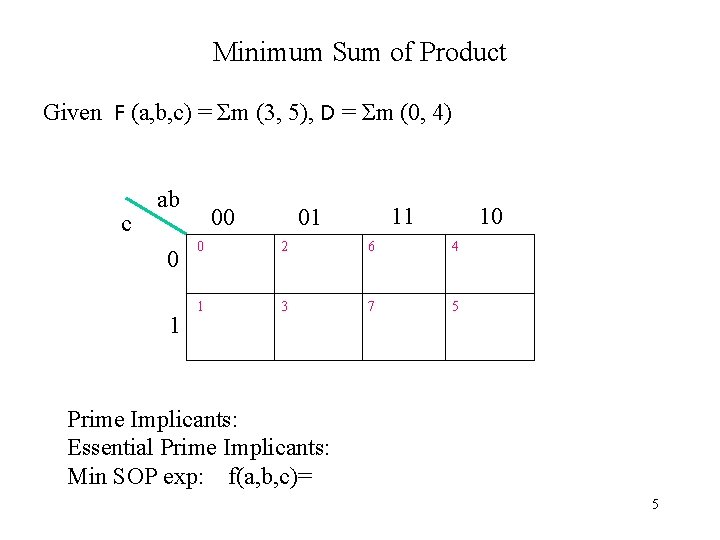
Minimum Sum of Product Given F (a, b, c) = Σm (3, 5), D = Σm (0, 4) c ab 0 1 00 01 11 10 0 2 6 4 1 3 7 5 Prime Implicants: Essential Prime Implicants: Min SOP exp: f(a, b, c)= 5
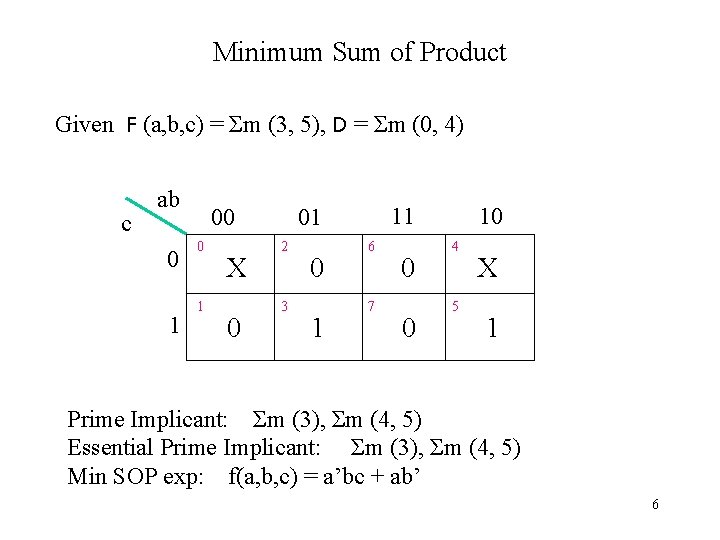
Minimum Sum of Product Given F (a, b, c) = Σm (3, 5), D = Σm (0, 4) c ab 00 01 11 10 0 2 6 4 0 X 0 0 X 1 3 7 5 1 0 1 Prime Implicant: Σm (3), Σm (4, 5) Essential Prime Implicant: Σm (3), Σm (4, 5) Min SOP exp: f(a, b, c) = a’bc + ab’ 6
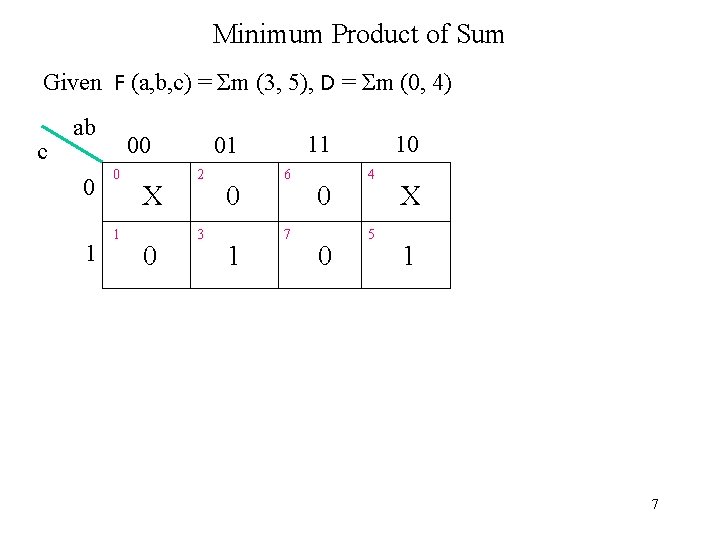
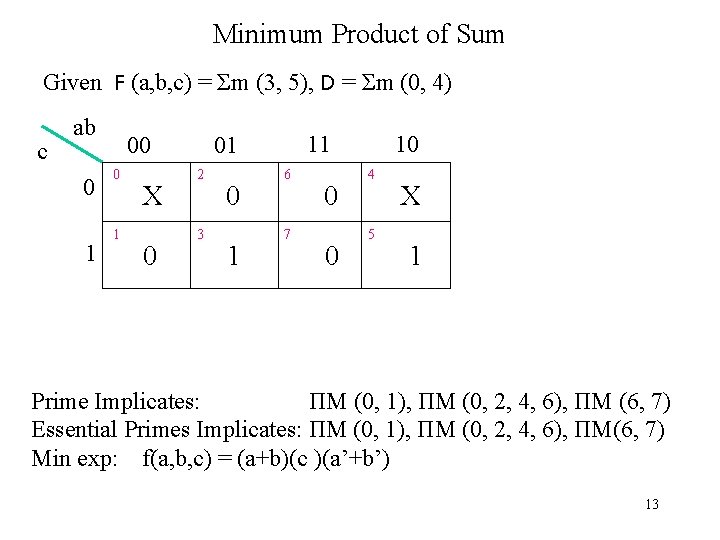
Minimum Product of Sum Given F (a, b, c) = Σm (3, 5), D = Σm (0, 4) c ab 00 01 11 10 0 2 6 4 0 X 0 0 X 1 3 7 5 1 0 1 7
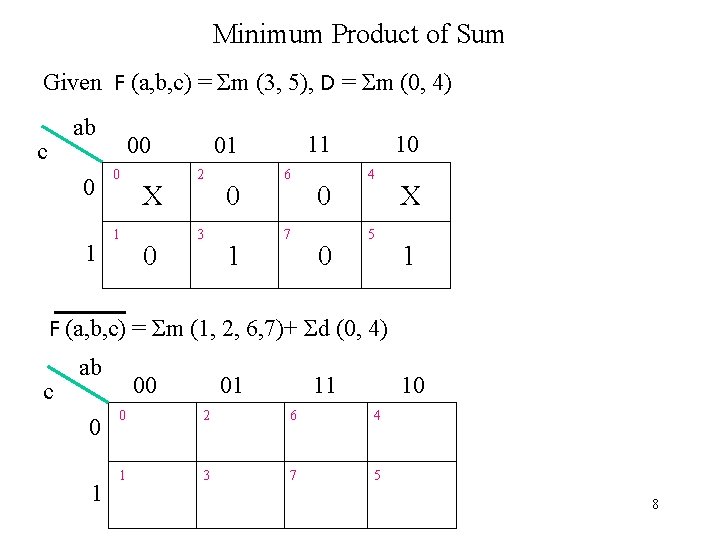
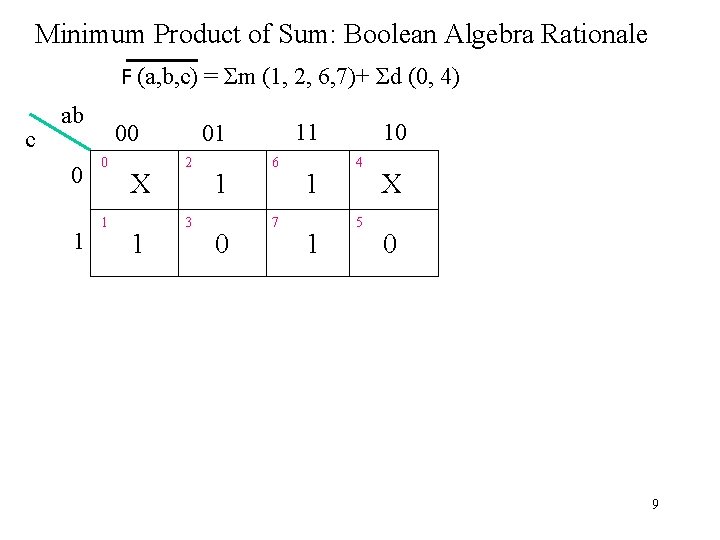
Minimum Product of Sum Given F (a, b, c) = Σm (3, 5), D = Σm (0, 4) c ab 00 01 11 10 0 2 6 4 0 X 0 0 X 1 3 7 5 1 0 1 F (a, b, c) = Σm (1, 2, 6, 7)+ Σd (0, 4) c ab 0 1 00 01 11 10 0 2 6 4 1 3 7 5 8
Minimum Product of Sum: Boolean Algebra Rationale F (a, b, c) = Σm (1, 2, 6, 7)+ Σd (0, 4) c ab 00 01 11 10 0 2 6 4 0 X 1 1 X 1 3 7 5 1 1 0 9
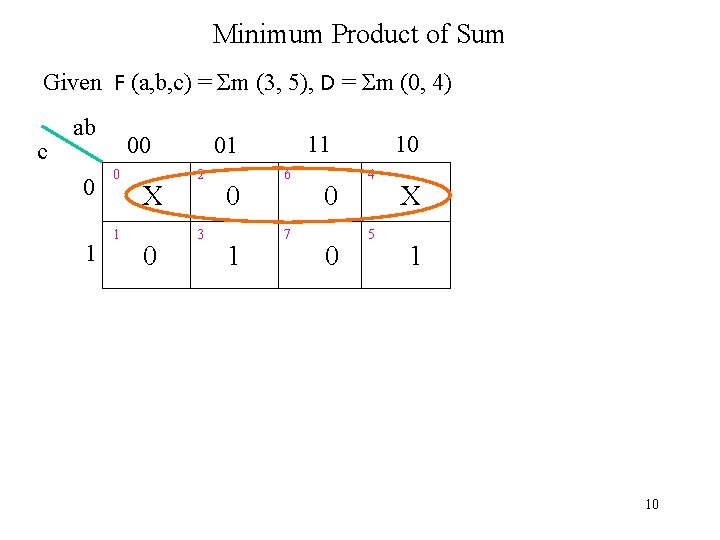
Minimum Product of Sum Given F (a, b, c) = Σm (3, 5), D = Σm (0, 4) c ab 00 01 11 10 0 2 6 4 0 X 0 0 X 1 3 7 5 1 0 1 10
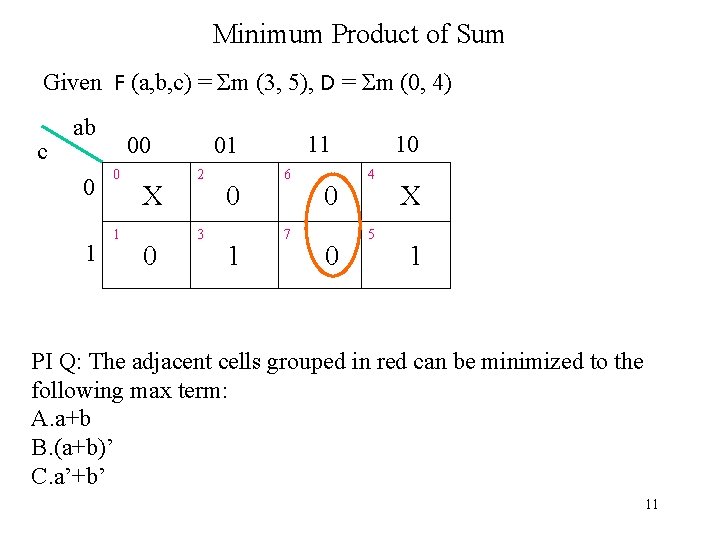
Minimum Product of Sum Given F (a, b, c) = Σm (3, 5), D = Σm (0, 4) c ab 00 01 11 10 0 2 6 4 0 X 0 0 X 1 3 7 5 1 0 1 PI Q: The adjacent cells grouped in red can be minimized to the following max term: A. a+b B. (a+b)’ C. a’+b’ 11
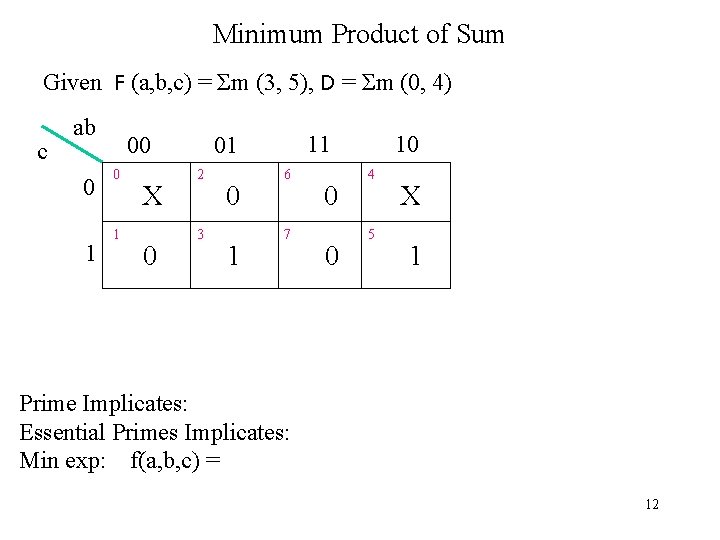
Minimum Product of Sum Given F (a, b, c) = Σm (3, 5), D = Σm (0, 4) c ab 00 01 11 10 0 2 6 4 0 X 0 0 X 1 3 7 5 1 0 1 Prime Implicates: Essential Primes Implicates: Min exp: f(a, b, c) = 12
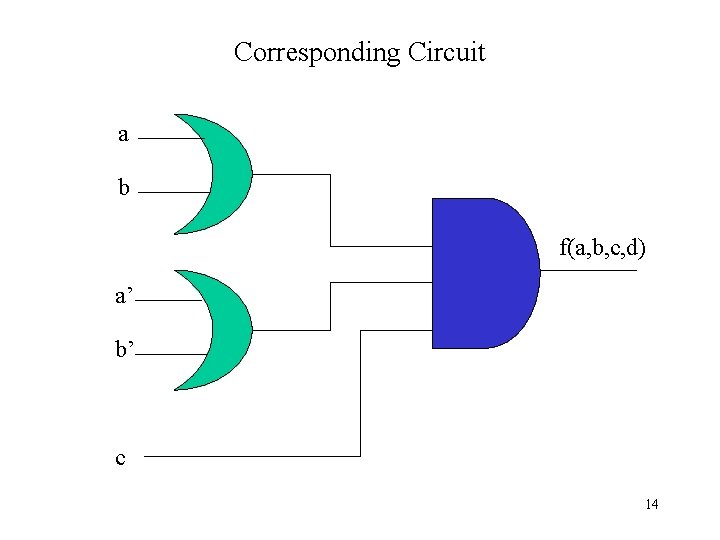
Minimum Product of Sum Given F (a, b, c) = Σm (3, 5), D = Σm (0, 4) c ab 00 01 11 10 0 2 6 4 0 X 0 0 X 1 3 7 5 1 0 1 Prime Implicates: ΠM (0, 1), ΠM (0, 2, 4, 6), ΠM (6, 7) Essential Primes Implicates: ΠM (0, 1), ΠM (0, 2, 4, 6), ΠM(6, 7) Min exp: f(a, b, c) = (a+b)(c )(a’+b’) 13
Corresponding Circuit a b f(a, b, c, d) a’ b’ c 14
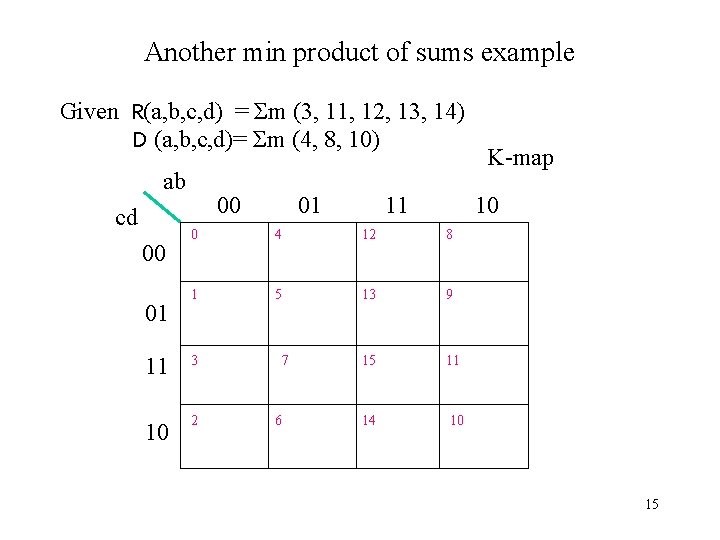
Another min product of sums example Given R(a, b, c, d) = Σm (3, 11, 12, 13, 14) D (a, b, c, d)= Σm (4, 8, 10) ab cd 00 01 11 K-map 10 0 4 12 8 1 5 13 9 11 3 7 15 11 10 2 6 14 10 15
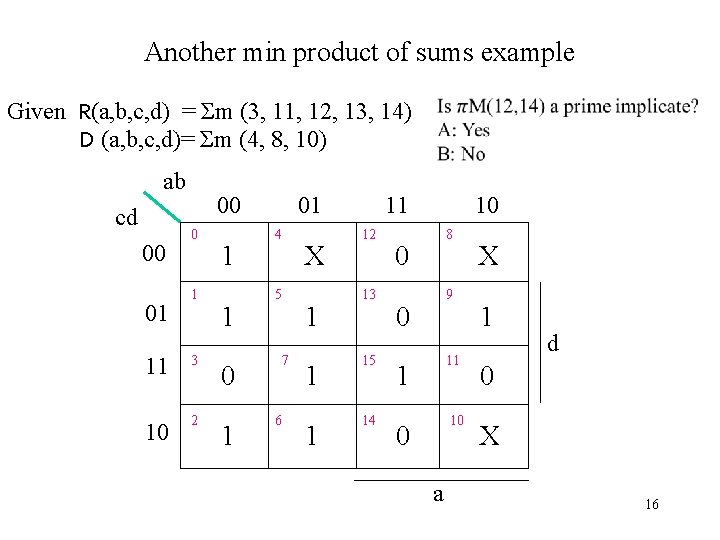
Another min product of sums example Given R(a, b, c, d) = Σm (3, 11, 12, 13, 14) D (a, b, c, d)= Σm (4, 8, 10) ab cd 00 01 11 10 0 4 12 8 1 X 0 X 1 5 13 9 1 0 1 11 3 7 15 11 10 2 6 14 10 d 0 1 1 0 1 0 X a 16
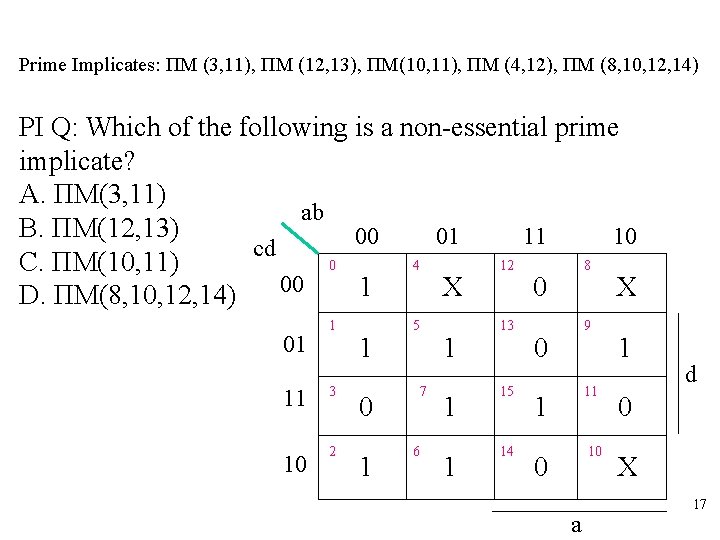
Prime Implicates: ΠM (3, 11), ΠM (12, 13), ΠM(10, 11), ΠM (4, 12), ΠM (8, 10, 12, 14) PI Q: Which of the following is a non-essential prime implicate? A. ΠM(3, 11) ab B. ΠM(12, 13) 00 01 11 10 cd 0 4 12 8 C. ΠM(10, 11) 00 1 X 0 X D. ΠM(8, 10, 12, 14) 01 1 5 13 9 1 0 1 11 3 7 15 11 10 2 6 14 10 d 0 1 1 0 1 0 X a 17
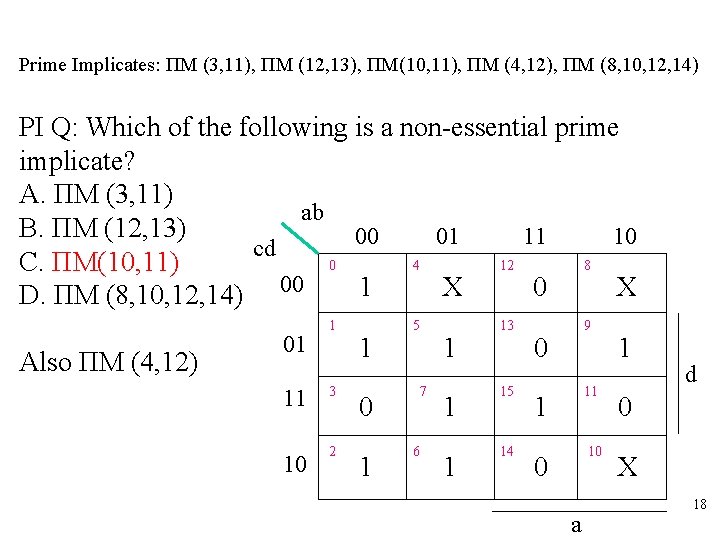
Prime Implicates: ΠM (3, 11), ΠM (12, 13), ΠM(10, 11), ΠM (4, 12), ΠM (8, 10, 12, 14) PI Q: Which of the following is a non-essential prime implicate? A. ΠM (3, 11) ab B. ΠM (12, 13) 00 01 11 10 cd 0 4 12 8 C. ΠM(10, 11) D. ΠM (8, 10, 12, 14) 00 1 X 0 X Also ΠM (4, 12) 01 1 5 13 9 1 0 1 11 3 7 15 11 10 2 6 14 10 d 0 1 1 0 1 0 X a 18
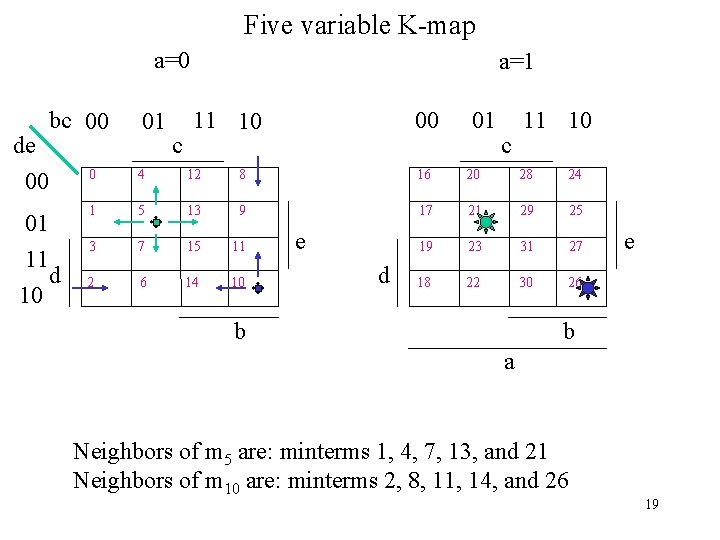
Five variable K-map a=0 bc 00 de 00 01 11 d 10 01 c a=1 11 10 00 01 c 11 10 0 4 12 8 16 20 28 24 1 5 13 9 17 21 29 25 3 7 15 11 2 6 14 10 e 19 23 31 27 d e 18 22 30 26 b b a Neighbors of m 5 are: minterms 1, 4, 7, 13, and 21 Neighbors of m 10 are: minterms 2, 8, 11, 14, and 26 19
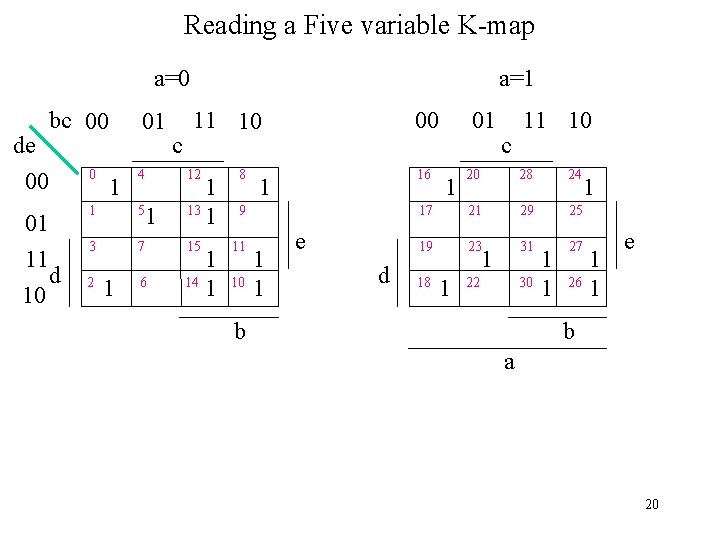
Reading a Five variable K-map a=0 bc 00 de 00 01 11 d 10 01 c a=1 11 10 00 0 4 12 8 1 1 1 1 5 13 9 1 1 3 7 15 11 1 1 2 6 14 10 1 1 1 01 c 11 10 16 20 28 24 1 1 17 21 29 25 e 19 23 31 27 d 1 1 1 18 22 30 26 1 1 1 b e b a 20
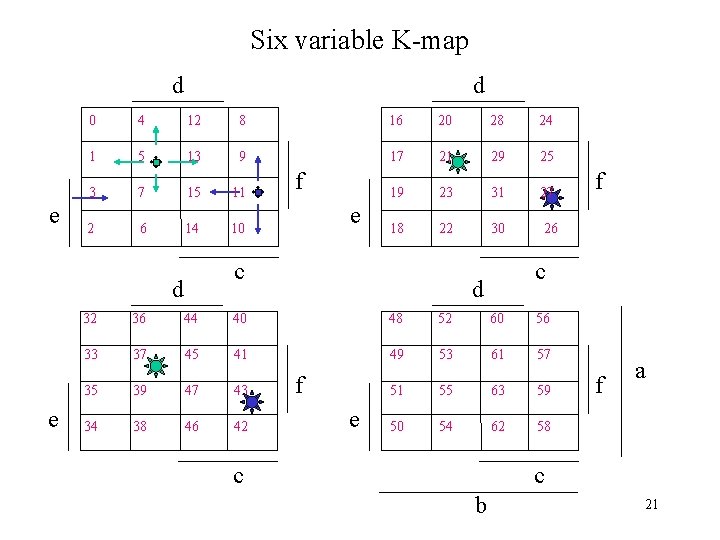
Six variable K-map d d 0 4 12 8 16 20 28 24 1 5 13 9 17 21 29 25 3 7 15 11 e 19 23 31 27 e 2 6 14 10 d c 48 52 60 56 33 37 45 41 49 53 61 57 34 38 46 42 f 51 55 63 59 e f 18 22 30 26 32 36 44 40 35 39 47 43 e f f a 50 54 62 58 c c b 21
Reading [Harris] Chapter 3, 3. 1 22