
LECTURE 5 INTERACTIONS OF RADIATION WITH MATTER Unit
- Slides: 17
LECTURE 5: INTERACTIONS OF RADIATION WITH MATTER Unit 1—the Physics Of Nuclear Medicine CLRS 321 Nuclear Medicine Physics and Instrumentation 1
Discuss the processes of excitation and ionization. Describe the interactions of charged particles with matter. Describe the processes of photoelectric effect, coherent & incoherent scattering, and pair production. LECTURE 5 OBJECTIVES (ADAPTED FROM YOUR TEXTBOOK)
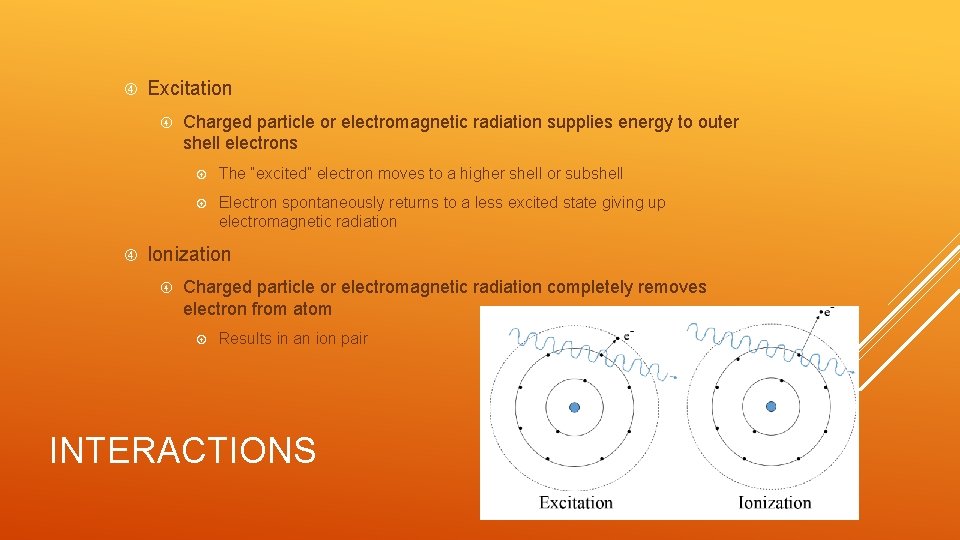
Excitation Charged particle or electromagnetic radiation supplies energy to outer shell electrons The “excited” electron moves to a higher shell or subshell Electron spontaneously returns to a less excited state giving up electromagnetic radiation Ionization Charged particle or electromagnetic radiation completely removes electron from atom Results in an ion pair INTERACTIONS
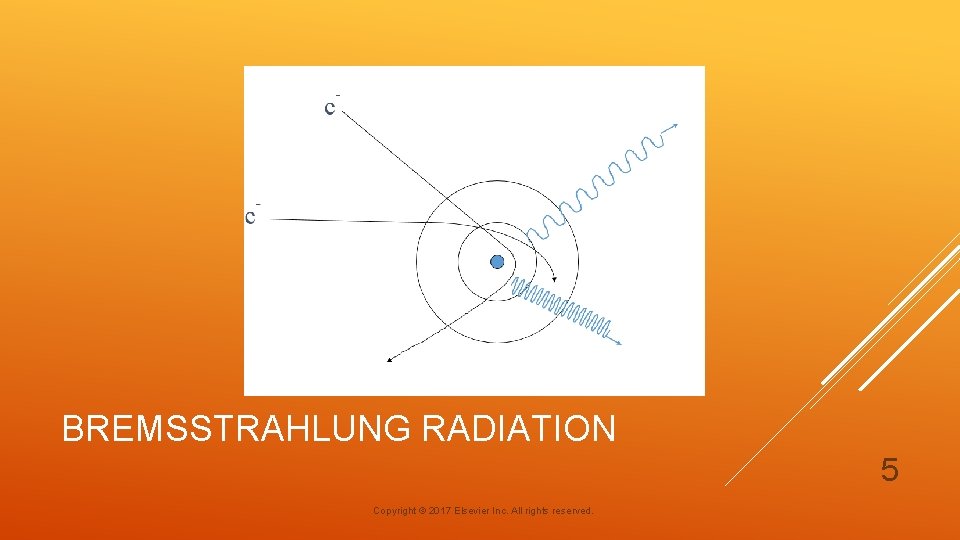
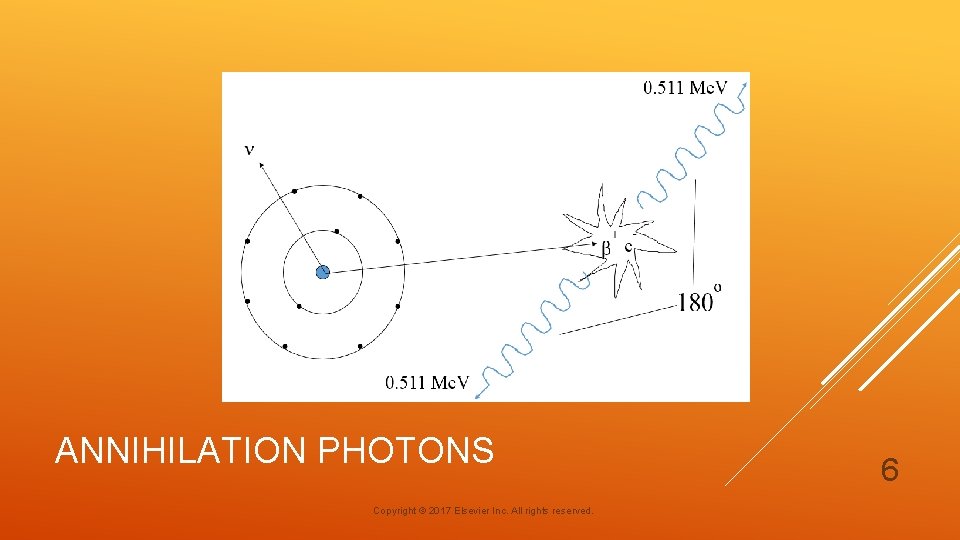
Alpha (+2 charge) Typically have energies between 3 & 8 Me. V Requires about 34 ke. V to strip an electron from an atom Thus alphas can create hundreds of thousands of ion pairs in less than a mm of tissues Beta (minus) Can create Bremsstrahlung radiation (X-rays) when near high Z materials With pure beta emitters, plastic is better shielding than lead to avoid Bremsstrahlung radiation Positron (Beta plus) Tend to quickly undergo an annihilation reaction with an electron CHARGED PARTICLE INTERACTIONS WITH MATTER
BREMSSTRAHLUNG RADIATION 5 Copyright © 2017 Elsevier Inc. All rights reserved.
ANNIHILATION PHOTONS Copyright © 2017 Elsevier Inc. All rights reserved. 6
Represent electromagnetic radiation Visible light Reflected or absorbed X-rays, gamma rays, annihilation photons One of three (really, maybe four) possibilities No interaction (pass through) Scatter (and is usually partially absorbed) Completely absorbed And also may become matter and thus absorbed Rate of absorption increases exponentially with distance travelled through matter PHOTON INTERACTIONS WITH MATTER
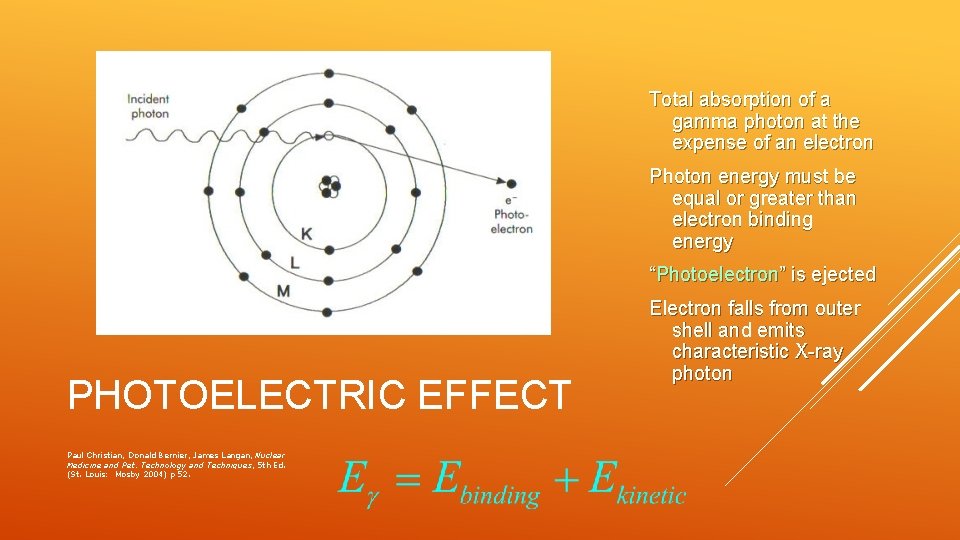
Total absorption of a gamma photon at the expense of an electron Photon energy must be equal or greater than electron binding energy “Photoelectron” is ejected PHOTOELECTRIC EFFECT Paul Christian, Donald Bernier, James Langan, Nuclear Medicine and Pet: Technology and Techniques, 5 th Ed. (St. Louis: Mosby 2004) p 52. Electron falls from outer shell and emits characteristic X-ray photon
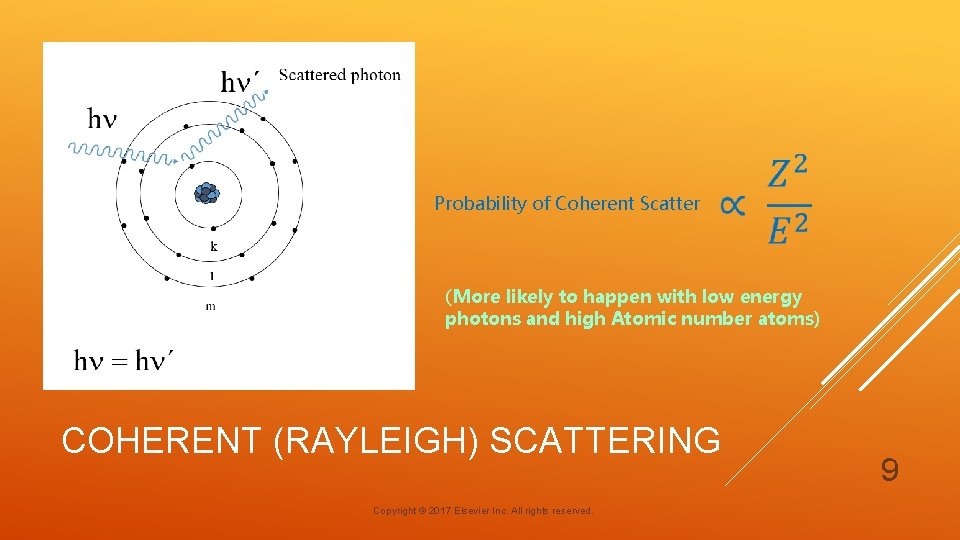
Probability of Coherent Scatter (More likely to happen with low energy photons and high Atomic number atoms) COHERENT (RAYLEIGH) SCATTERING Copyright © 2017 Elsevier Inc. All rights reserved. 9
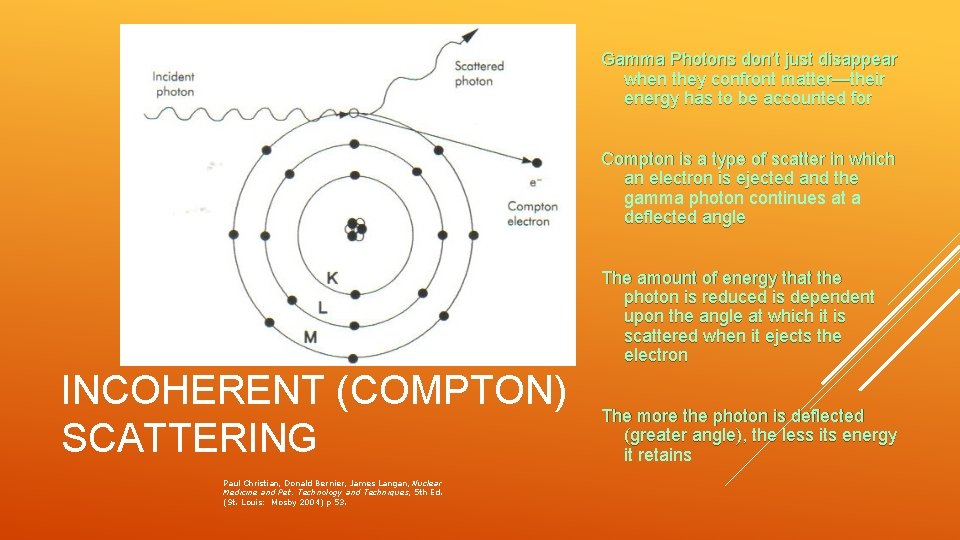
Gamma Photons don’t just disappear when they confront matter—their energy has to be accounted for Compton is a type of scatter in which an electron is ejected and the gamma photon continues at a deflected angle The amount of energy that the photon is reduced is dependent upon the angle at which it is scattered when it ejects the electron INCOHERENT (COMPTON) SCATTERING Paul Christian, Donald Bernier, James Langan, Nuclear Medicine and Pet: Technology and Techniques, 5 th Ed. (St. Louis: Mosby 2004) p 53. The more the photon is deflected (greater angle), the less its energy it retains
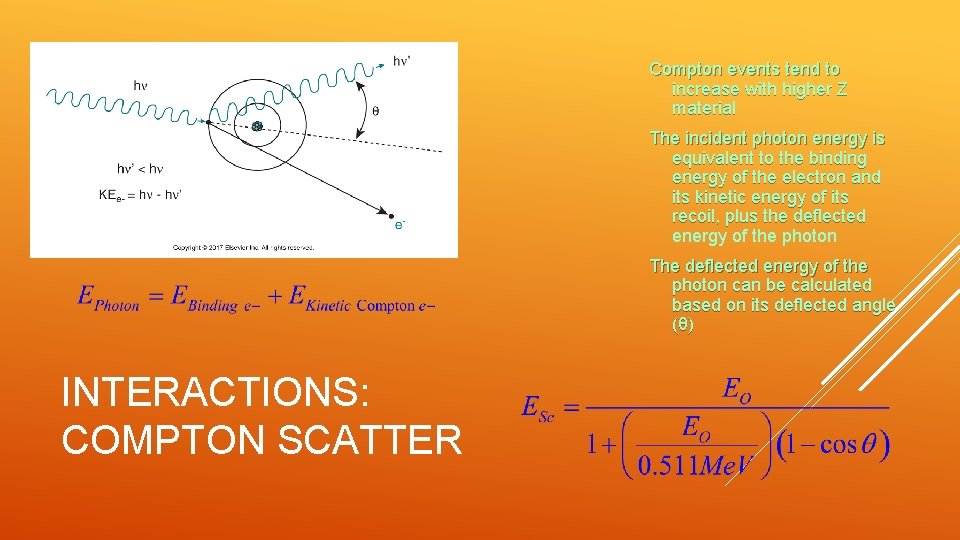
Compton events tend to increase with higher Z material The incident photon energy is equivalent to the binding energy of the electron and its kinetic energy of its recoil, plus the deflected energy of the photon The deflected energy of the photon can be calculated based on its deflected angle (θ ) INTERACTIONS: COMPTON SCATTER
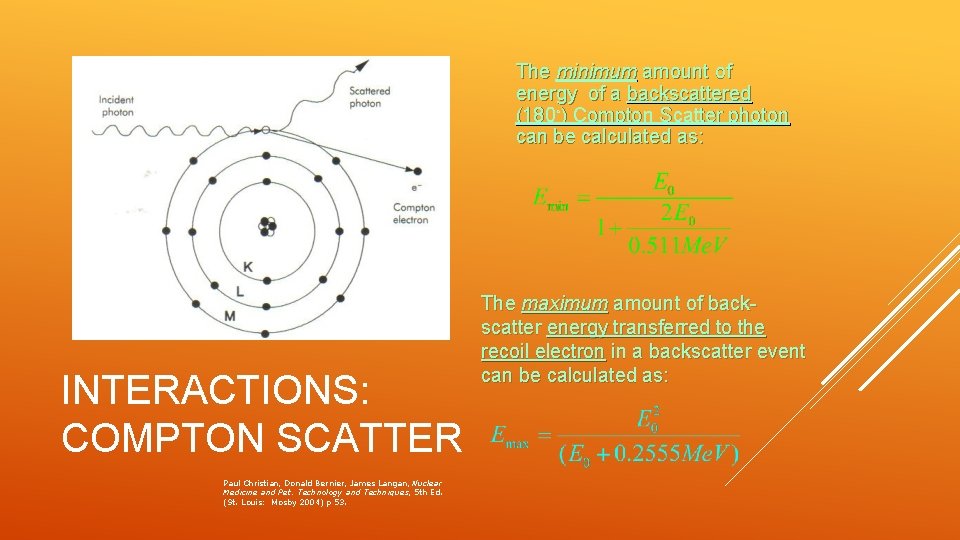
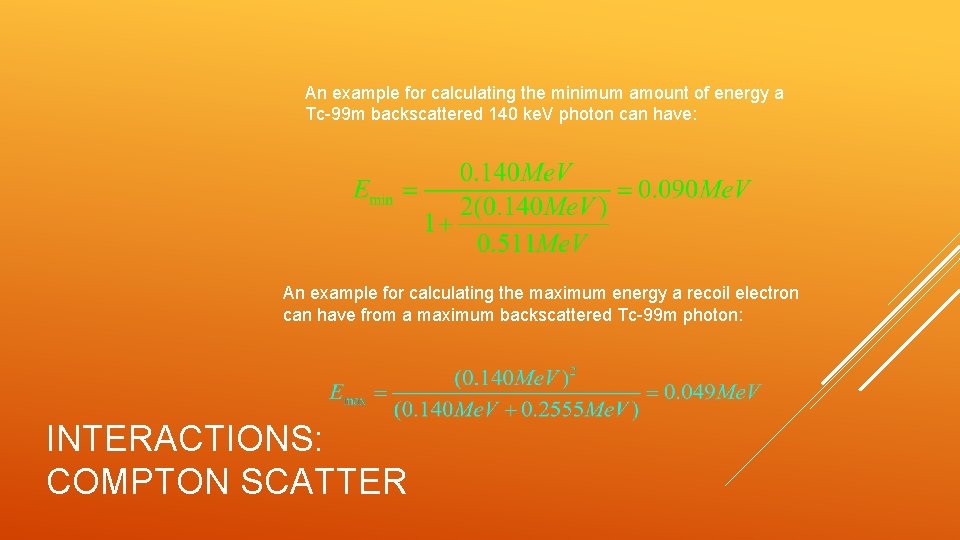
The minimum amount of energy of a backscattered (180◦) Compton Scatter photon can be calculated as: INTERACTIONS: COMPTON SCATTER Paul Christian, Donald Bernier, James Langan, Nuclear Medicine and Pet: Technology and Techniques, 5 th Ed. (St. Louis: Mosby 2004) p 53. The maximum amount of backscatter energy transferred to the recoil electron in a backscatter event can be calculated as:
An example for calculating the minimum amount of energy a Tc-99 m backscattered 140 ke. V photon can have: An example for calculating the maximum energy a recoil electron can have from a maximum backscattered Tc-99 m photon: INTERACTIONS: COMPTON SCATTER
What does all this mean? ? ? The minimal energy of a backscattered photon will form something called the “Backscattered peak” on the energy spectrum (we’ll cover that later). Emin of the backscatter photon and Emax of the recoil electron is energydependent and the difference between the two increases with incident photon energy INTERACTIONS: COMPTON SCATTER
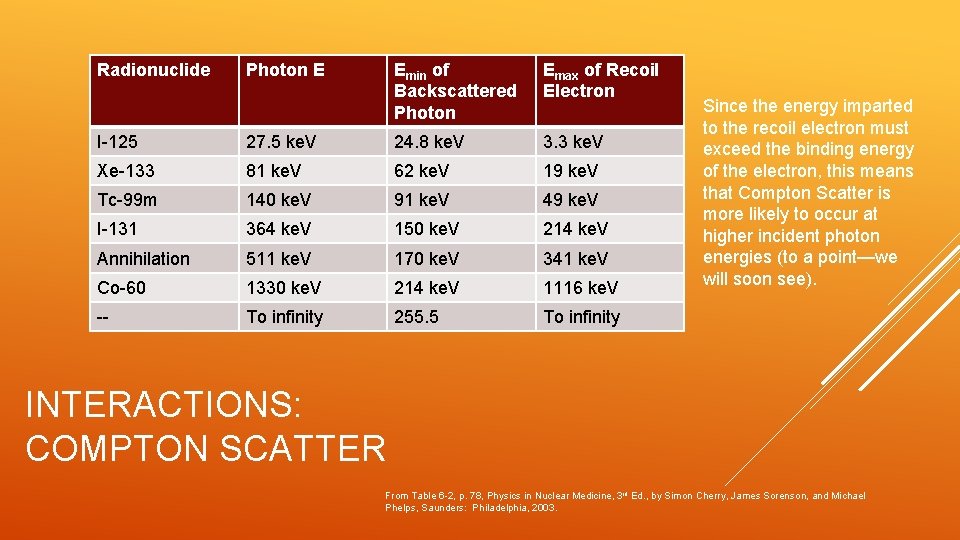
Radionuclide Photon E Emin of Backscattered Photon Emax of Recoil Electron I-125 27. 5 ke. V 24. 8 ke. V 3. 3 ke. V Xe-133 81 ke. V 62 ke. V 19 ke. V Tc-99 m 140 ke. V 91 ke. V 49 ke. V I-131 364 ke. V 150 ke. V 214 ke. V Annihilation 511 ke. V 170 ke. V 341 ke. V Co-60 1330 ke. V 214 ke. V 1116 ke. V -- To infinity 255. 5 To infinity Since the energy imparted to the recoil electron must exceed the binding energy of the electron, this means that Compton Scatter is more likely to occur at higher incident photon energies (to a point—we will soon see). INTERACTIONS: COMPTON SCATTER From Table 6 -2, p. 78, Physics in Nuclear Medicine, 3 rd Ed. , by Simon Cherry, James Sorenson, and Michael Phelps, Saunders: Philadelphia, 2003.
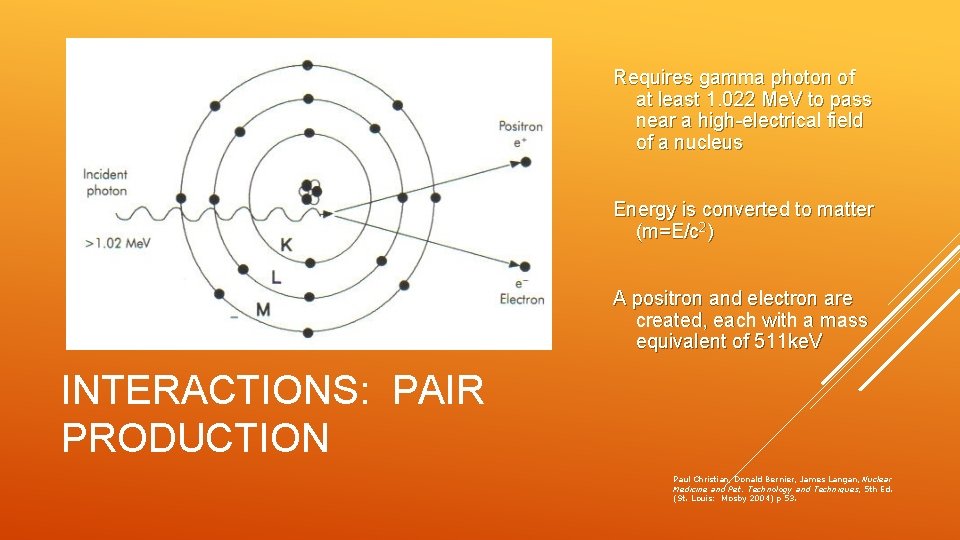
Requires gamma photon of at least 1. 022 Me. V to pass near a high-electrical field of a nucleus Energy is converted to matter (m=E/c 2) A positron and electron are created, each with a mass equivalent of 511 ke. V INTERACTIONS: PAIR PRODUCTION Paul Christian, Donald Bernier, James Langan, Nuclear Medicine and Pet: Technology and Techniques, 5 th Ed. (St. Louis: Mosby 2004) p 53.
Next time: Attenuation and Transmission of Photons