
Lecture 5 GNSS error sources Application of GNSS


- Slides: 38
Lecture 5. GNSS error sources. Application of GNSS in Surveying. GNSS infrastructure. Transformation into national reference system. Sz. Rózsa – Gy. Busics – L. Földváry
Contents • Accuracies / Error sources • Differential GPS (DGPS) • Applications in Surveying • GNSS infrastructure • Transformation into national reference system
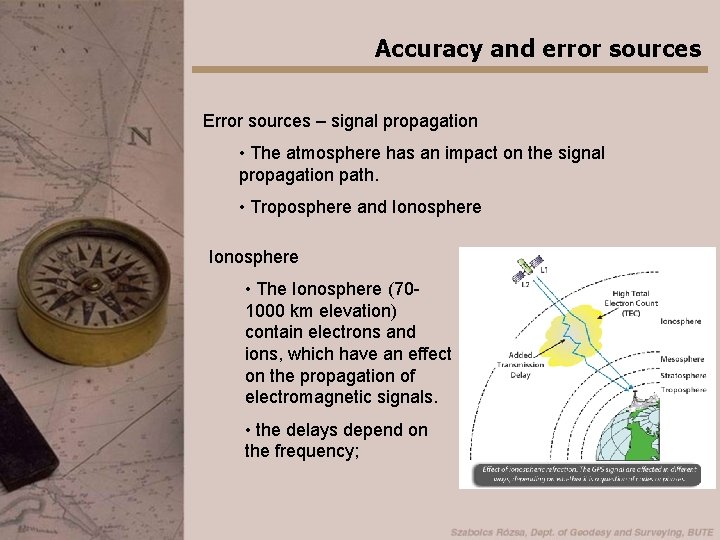
Accuracy and error sources Error sources – signal propagation • The atmosphere has an impact on the signal propagation path. • Troposphere and Ionosphere • The Ionosphere (701000 km elevation) contain electrons and ions, which have an effect on the propagation of electromagnetic signals. • the delays depend on the frequency;
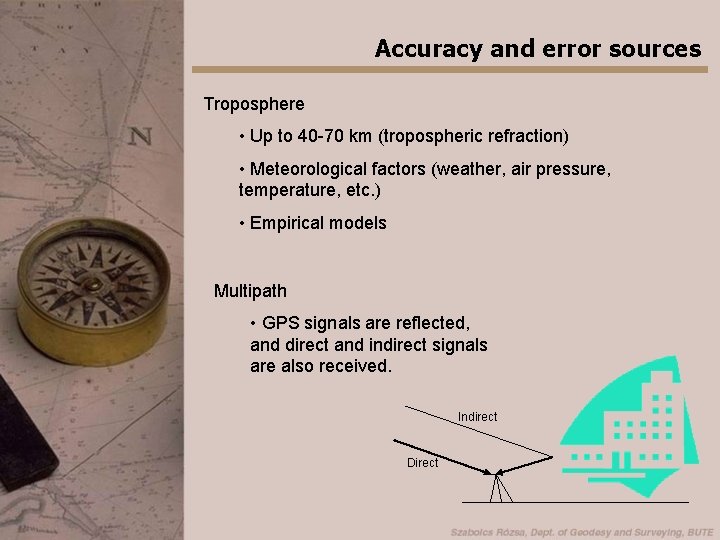
Accuracy and error sources Troposphere • Up to 40 -70 km (tropospheric refraction) • Meteorological factors (weather, air pressure, temperature, etc. ) • Empirical models Multipath • GPS signals are reflected, and direct and indirect signals are also received. Indirect Direct
Accuracy and error sources Error sources – receiver error • thermal noise • receiver clock corrections • antenna phase center offsets and variations
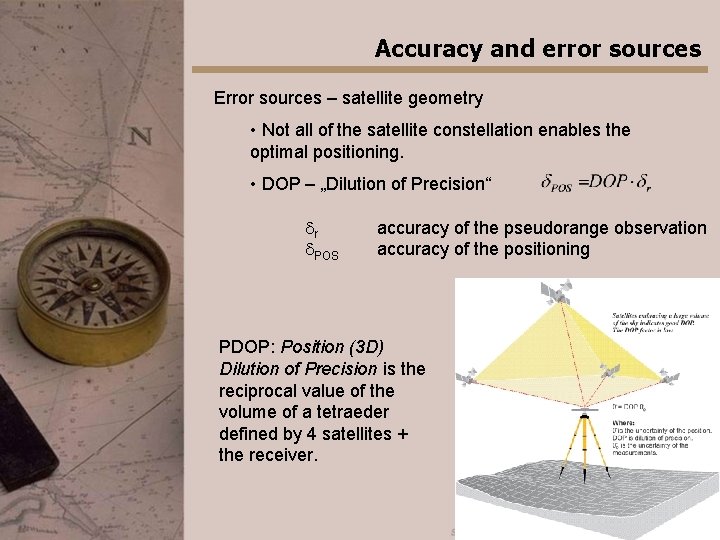
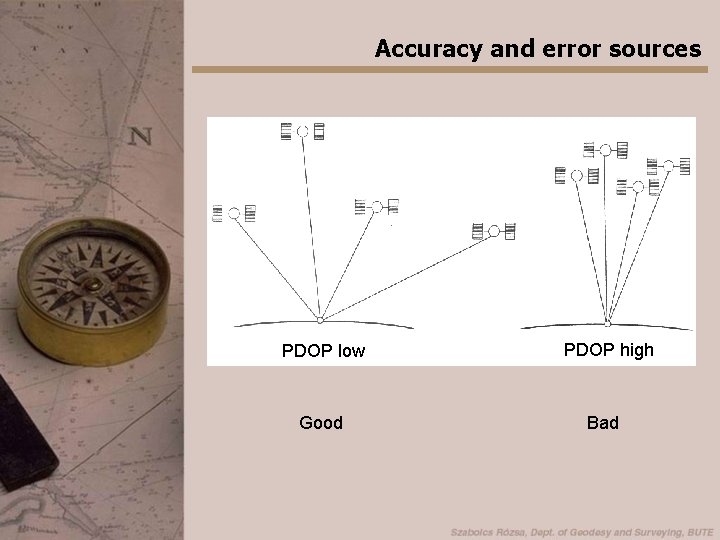
Accuracy and error sources Error sources – satellite geometry • Not all of the satellite constellation enables the optimal positioning. • DOP – „Dilution of Precision“ dr d. POS accuracy of the pseudorange observation accuracy of the positioning PDOP: Position (3 D) Dilution of Precision is the reciprocal value of the volume of a tetraeder defined by 4 satellites + the receiver.
Accuracy and error sources PDOP low Good PDOP high Bad
Contents • Accuracies / Error sources • Differential GPS (DGPS) • Applications in Surveying • GNSS infrastructure • Transformation into national reference system
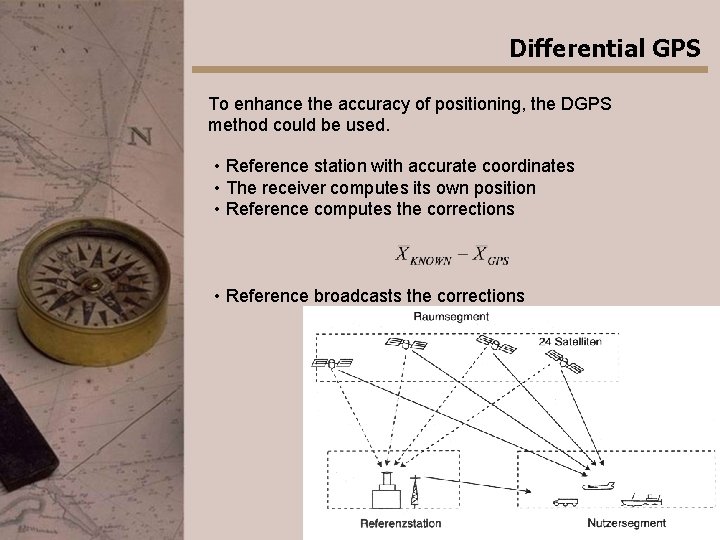
Differential GPS To enhance the accuracy of positioning, the DGPS method could be used. • Reference station with accurate coordinates • The receiver computes its own position • Reference computes the corrections • Reference broadcasts the corrections
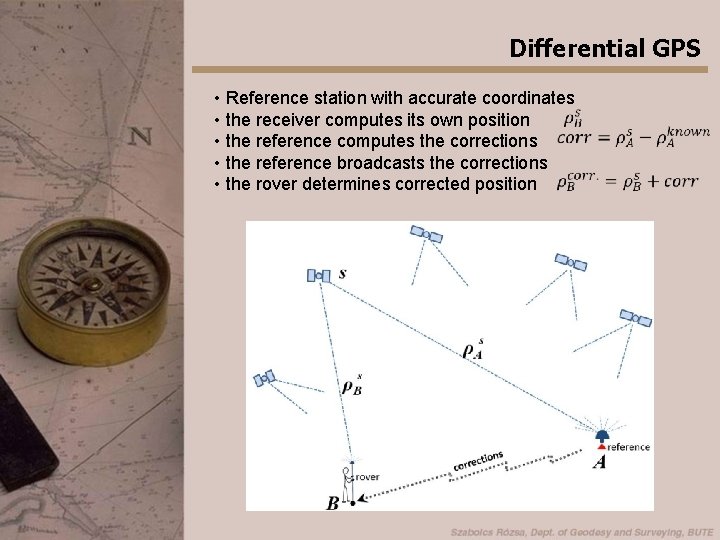
Differential GPS • Reference station with accurate coordinates • the receiver computes its own position • the reference computes the corrections • the reference broadcasts the corrections • the rover determines corrected position
Contents • Accuracies / Error sources • Differential GPS (DGPS) • Applications in Surveying • GNSS infrastructure • Transformation into national reference system
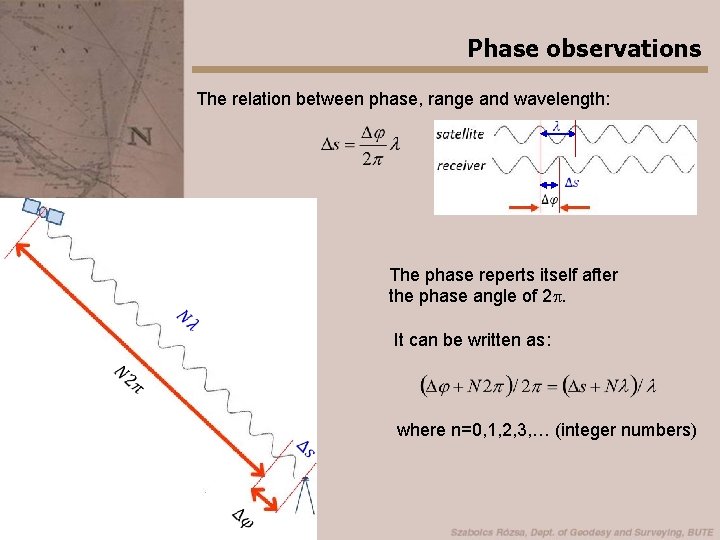
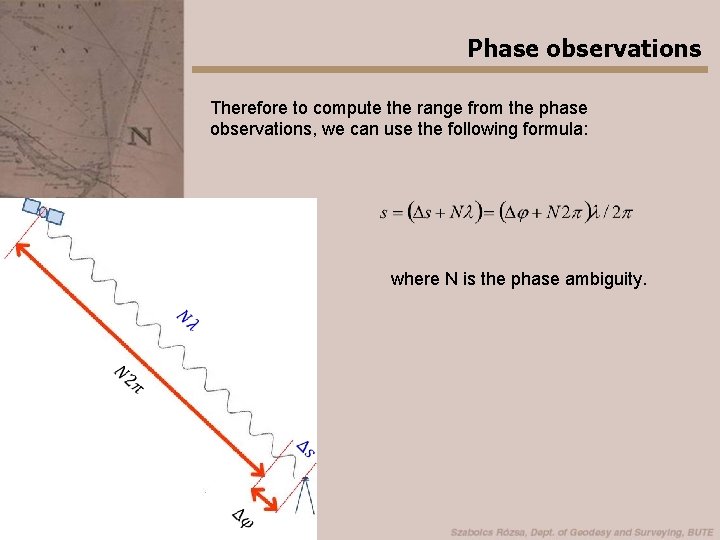
Phase observations The relation between phase, range and wavelength: The phase reperts itself after the phase angle of 2 p. It can be written as: where n=0, 1, 2, 3, … (integer numbers)
Phase observations Therefore to compute the range from the phase observations, we can use the following formula: where N is the phase ambiguity.
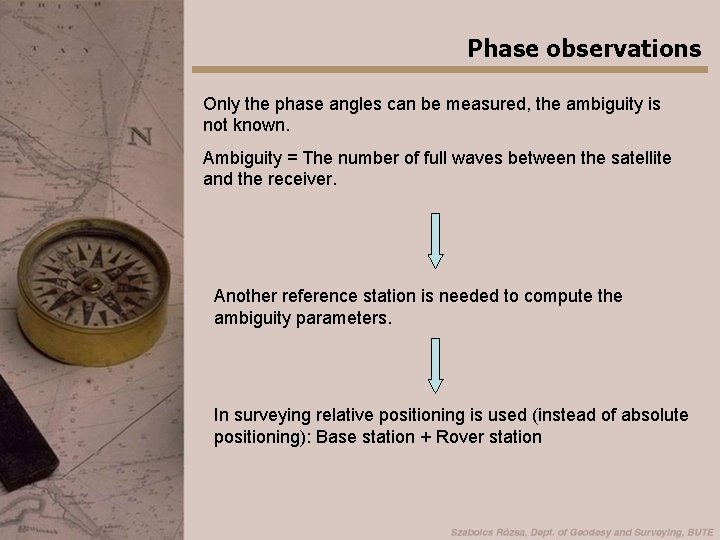
Phase observations Only the phase angles can be measured, the ambiguity is not known. Ambiguity = The number of full waves between the satellite and the receiver. Another reference station is needed to compute the ambiguity parameters. In surveying relative positioning is used (instead of absolute positioning): Base station + Rover station
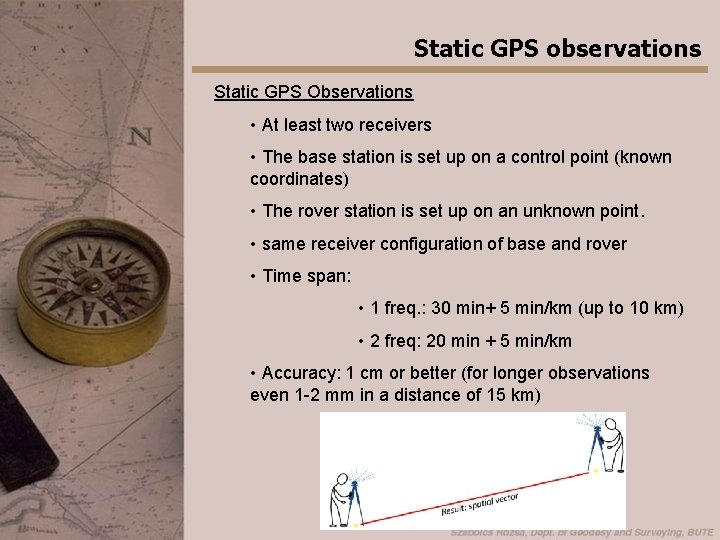
Static GPS observations Static GPS Observations • At least two receivers • The base station is set up on a control point (known coordinates) • The rover station is set up on an unknown point. • same receiver configuration of base and rover • Time span: • 1 freq. : 30 min+ 5 min/km (up to 10 km) • 2 freq: 20 min + 5 min/km • Accuracy: 1 cm or better (for longer observations even 1 -2 mm in a distance of 15 km)
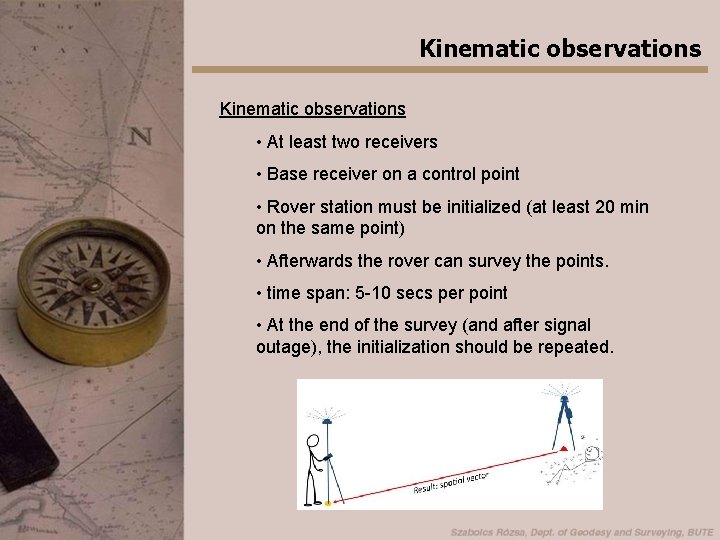
Kinematic observations • At least two receivers • Base receiver on a control point • Rover station must be initialized (at least 20 min on the same point) • Afterwards the rover can survey the points. • time span: 5 -10 secs per point • At the end of the survey (and after signal outage), the initialization should be repeated.
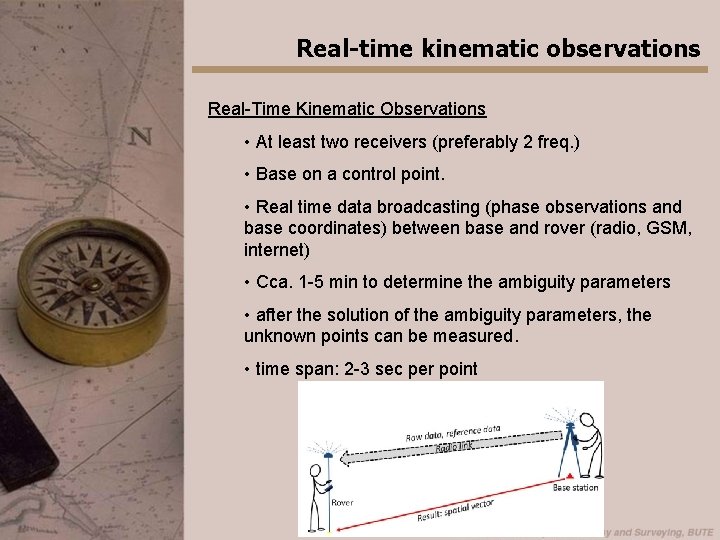
Real-time kinematic observations Real-Time Kinematic Observations • At least two receivers (preferably 2 freq. ) • Base on a control point. • Real time data broadcasting (phase observations and base coordinates) between base and rover (radio, GSM, internet) • Cca. 1 -5 min to determine the ambiguity parameters • after the solution of the ambiguity parameters, the unknown points can be measured. • time span: 2 -3 sec per point
Post-processing vs real-time Post processing: • static observations • kinematic observations Real-time: • real time kinematic
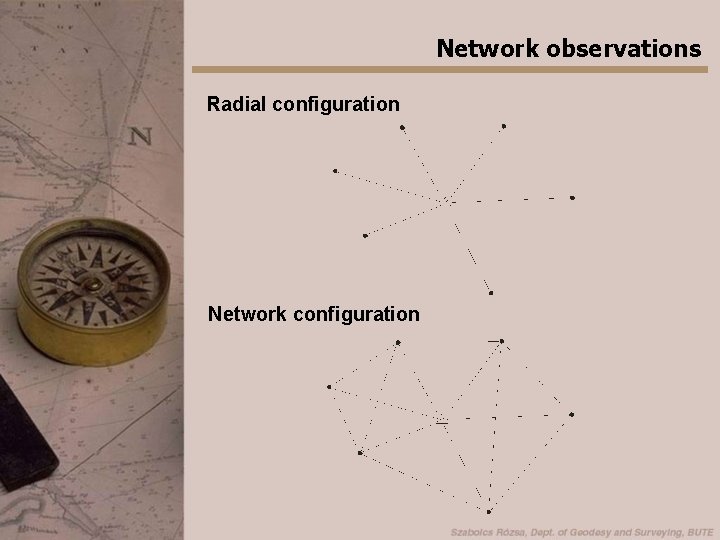
Network observations Radial configuration Network configuration
Point reconnaissance How should the place of the points be selected? • a clear view to the sky; • free of electromagnetic interference (no high voltage wires in the vicinity); • the point should be in public area, close to roads; • the stability of the points should be ensured. The selected stations should be marked, the position of the obstructing objects should be noted
Planning the observations • in case of obstructing objects, or high accuracy requirements, the observations can be planned; • planning software predicts the number of visible satellites, the PDOP values by knowing the approximate positions of the satellites and the approximate station coordinate. • The position of obstructed objects can be added to the planner software, thus the effect of the obstructed sky can be estimated. • Using the PDOP values, the suitable time window can be selected for the observations.
Contents • Accuracies / Error sources • Differential GPS (DGPS) • Applications in Surveying • GNSS infrastructure • Transformation into national reference system
GNSS Infrastructure Positioning in Surveying: • relative positioning can provide the sufficient accuracy; • base stations are required; • using a base-rover pair for positioning is not effective; Solution: • continuously operating reference stations (CORS); • act as a base station, but broadcasts corrections to many rovers at the same time;
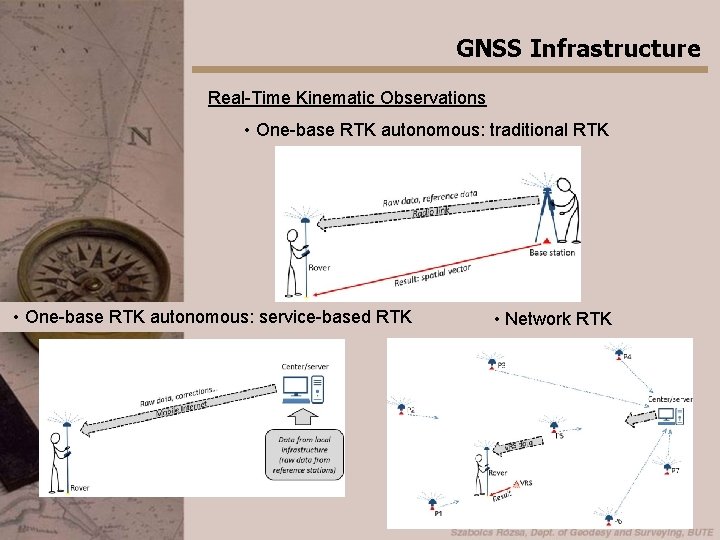
GNSS Infrastructure Real-Time Kinematic Observations • One-base RTK autonomous: traditional RTK • One-base RTK autonomous: service-based RTK • Network RTK
Generations of GNSS Infrastructure 1 st Generation: Permanent stations, which log the received data for post processing only. Data can be downloaded from the internet, and rover observations can be processed with these downloaded data. 2 nd Generation: Permanent stations, which log the received data, but broadcast it in real-time, too. Data can be used for post processing and real-time application as well. Real-time kinematic positioning is achieved by a single base station. RTK (3 cm) up to 35 km from the reference stations (in case of 2 frequencies)
Generations of GNSS Infrastructure 3 rd Generation: A network of permanent stations, which broadcasts the data to a processing facility. This facility monitors and models the systematic error of positioning (ionosphere, troposphere, orbit and clock error, etc. ). These models are used for the positioning as well. Two concepts: • Area Correction Parameters (ACP): The effect of the error sources are interpolated on a surface. The parameters of the surface is broadcasted to the rover receiver, thus it can apply the correction by knowing its own position • Virtual Reference Station (VRS): The observations of a virtual reference station in the vicinity of the rover are estimated, and broadcasted to the user.
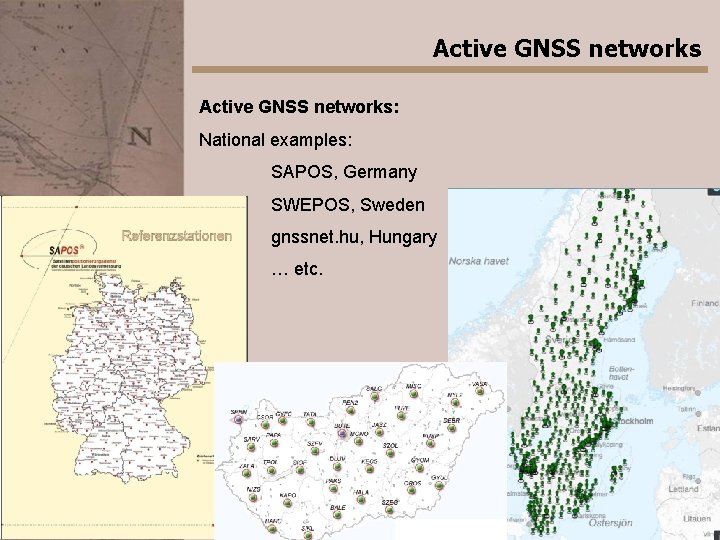
Active GNSS networks: National examples: SAPOS, Germany SWEPOS, Sweden gnssnet. hu, Hungary … etc.
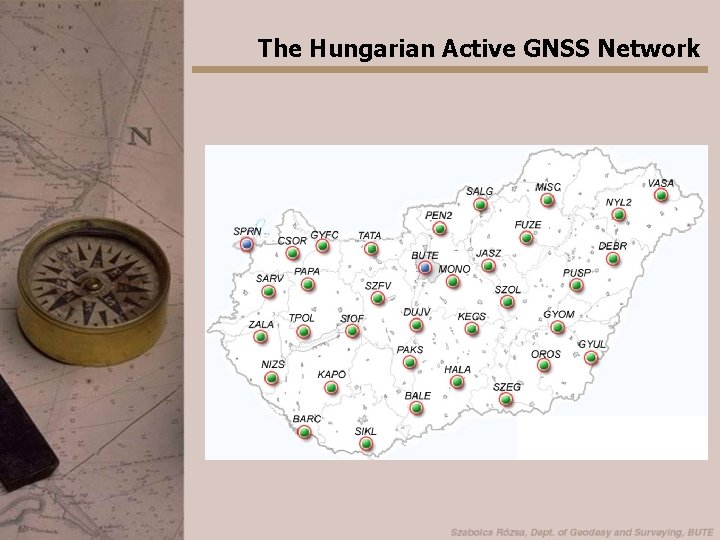
The Hungarian Active GNSS Network
Augmentation Systems Ground based (GBAS): The GNSS Infrastructure, the network of continuously operating reference stations and the processing facility. The corrections are broadcasted through radiolink or the internet. Satellite based (SBAS): A network of ground based stations to monitor the systematic error sources, effects are modelled, and corrections are broadcasted to geostationary satellites, which transmit a GPS like signal to the GNSS receivers (EGNOS, WAAS, etc. )
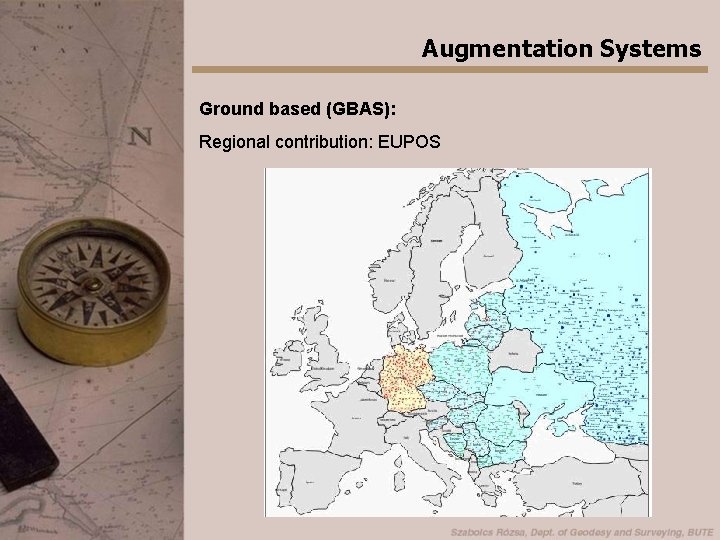
Augmentation Systems Ground based (GBAS): Regional contribution: EUPOS
Augmentation Systems
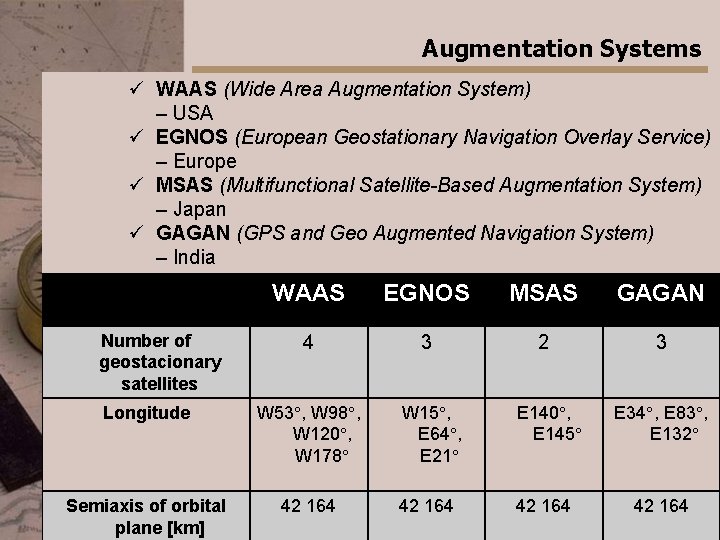
Augmentation Systems ü WAAS (Wide Area Augmentation System) – USA ü EGNOS (European Geostationary Navigation Overlay Service) – Europe ü MSAS (Multifunctional Satellite-Based Augmentation System) – Japan ü GAGAN (GPS and Geo Augmented Navigation System) – India Number of geostacionary satellites WAAS EGNOS MSAS GAGAN 4 3 2 3 Longitude W 53 , W 98 , W 120 , W 178 Semiaxis of orbital plane [km] 42 164 W 15 , E 64 , E 21 E 140 , E 145 42 164 E 34 , E 83 , E 132 42 164
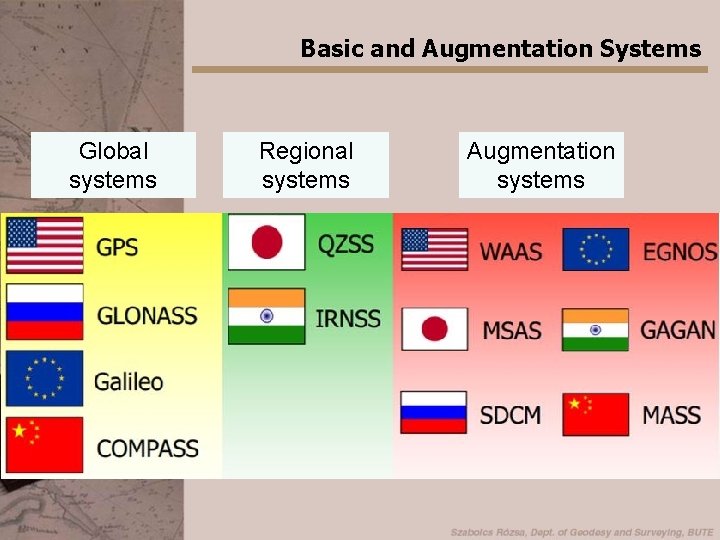
Basic and Augmentation Systems Global systems Regional systems Augmentation systems
Contents • Accuracies / Error sources • Differential GPS (DGPS) • Applications in Surveying • GNSS infrastructure • Transformation into national reference system
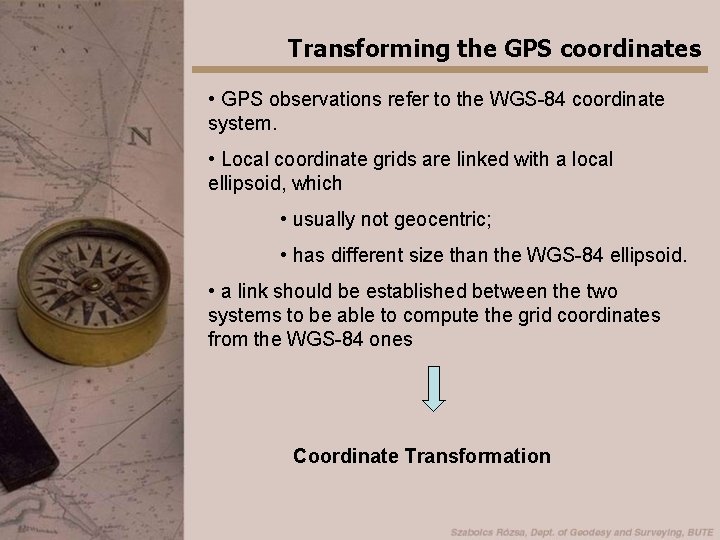
Transforming the GPS coordinates • GPS observations refer to the WGS-84 coordinate system. • Local coordinate grids are linked with a local ellipsoid, which • usually not geocentric; • has different size than the WGS-84 ellipsoid. • a link should be established between the two systems to be able to compute the grid coordinates from the WGS-84 ones Coordinate Transformation
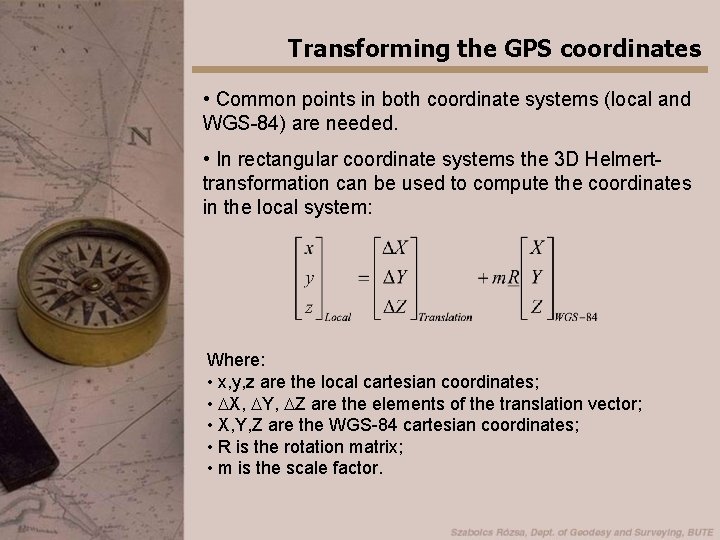
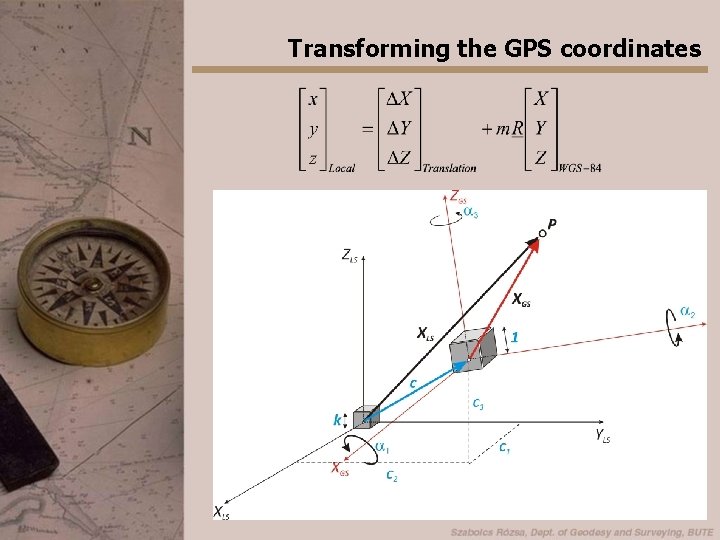
Transforming the GPS coordinates • Common points in both coordinate systems (local and WGS-84) are needed. • In rectangular coordinate systems the 3 D Helmerttransformation can be used to compute the coordinates in the local system: Where: • x, y, z are the local cartesian coordinates; • DX, DY, DZ are the elements of the translation vector; • X, Y, Z are the WGS-84 cartesian coordinates; • R is the rotation matrix; • m is the scale factor.
Transforming the GPS coordinates
Thank You for Your attention!