
Lecture 5 Dependence Analysis and Superscalar Techniques Overview
- Slides: 24
Lecture 5: Dependence Analysis and Superscalar Techniques Overview Instruction dependences, correctness, inst scheduling examples, renaming, speculation, generic superscalar pipelines 1
Sequential Execution Model Any program execution is “correct” if the final architectural states (registers and memory contents) is the same as by sequential execution Single-cycle implementation is intuitively correct If instructions are not executed sequentially, what is “correct” execution? 2
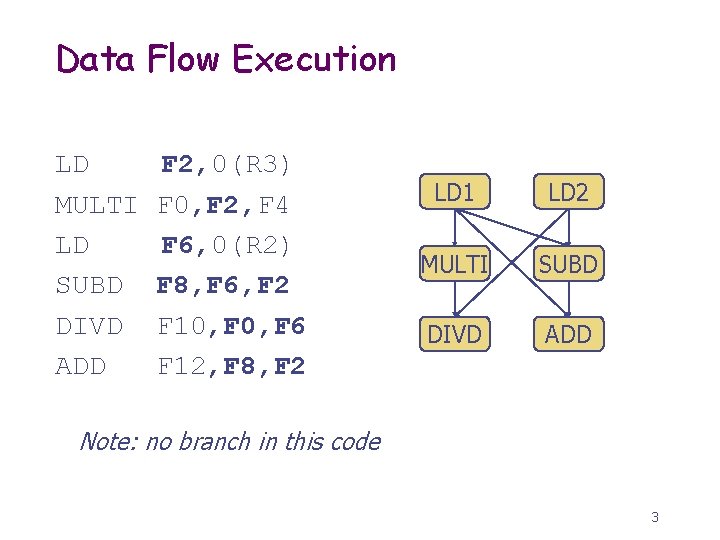
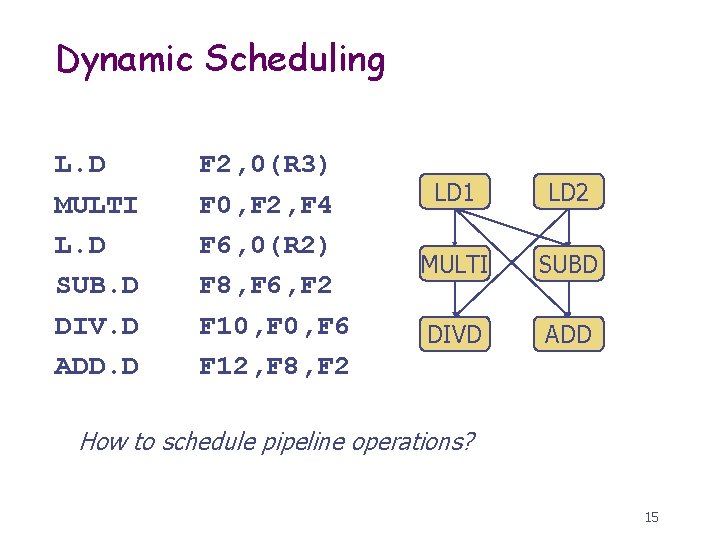
Data Flow Execution LD MULTI LD SUBD DIVD ADD F 2, 0(R 3) F 0, F 2, F 4 F 6, 0(R 2) F 8, F 6, F 2 F 10, F 6 F 12, F 8, F 2 LD 1 LD 2 MULTI SUBD DIVD ADD Note: no branch in this code 3
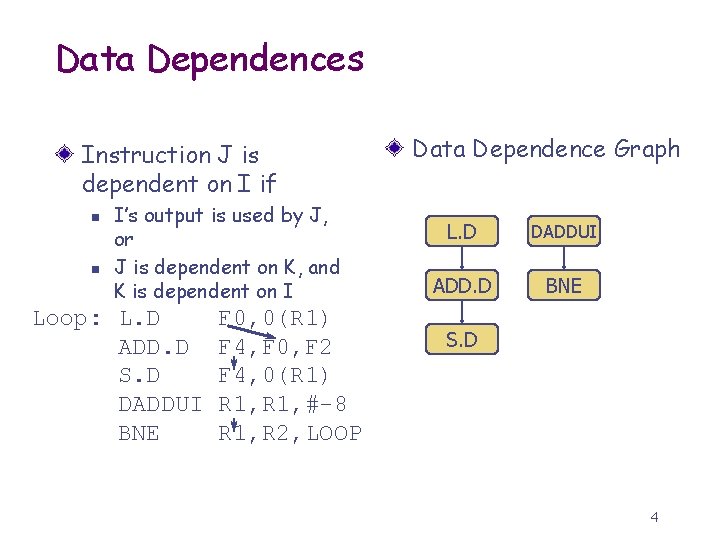
Data Dependences Instruction J is dependent on I if n n I’s output is used by J, or J is dependent on K, and K is dependent on I Loop: L. D ADD. D S. D DADDUI BNE F 0, 0(R 1) F 4, F 0, F 2 F 4, 0(R 1) R 1, #-8 R 1, R 2, LOOP Data Dependence Graph L. D DADDUI ADD. D BNE S. D 4
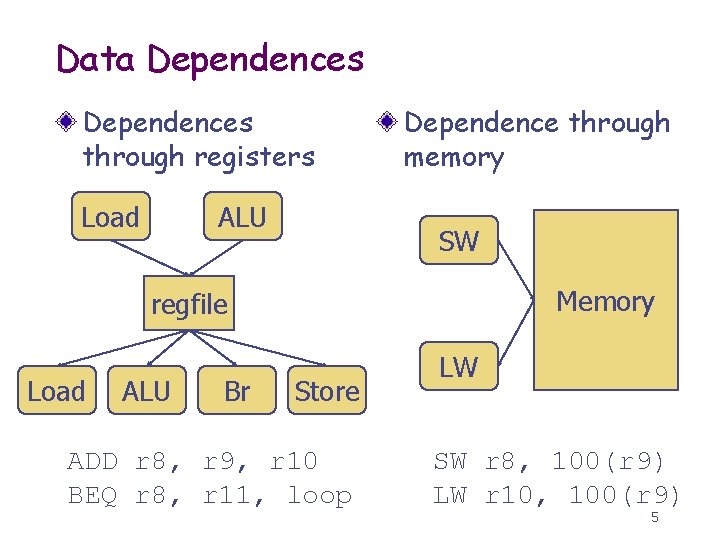
Data Dependences through registers Load ALU Dependence through memory SW Memory regfile Load ALU Br Store ADD r 8, r 9, r 10 BEQ r 8, r 11, loop LW SW r 8, 100(r 9) LW r 10, 100(r 9) 5
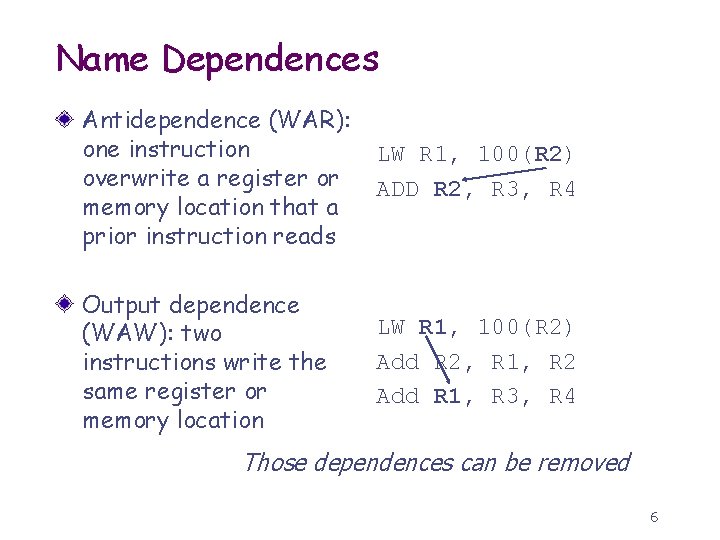
Name Dependences Antidependence (WAR): one instruction overwrite a register or memory location that a prior instruction reads LW R 1, 100(R 2) ADD R 2, R 3, R 4 Output dependence (WAW): two instructions write the same register or memory location LW R 1, 100(R 2) Add R 2, R 1, R 2 Add R 1, R 3, R 4 Those dependences can be removed 6
Dependences vs Hazards Dependences are properties of programs Hazards are properties of pipelines Dependences indicates the potential of hazards Pipeline implementations determine actual hazards and the length of any stall What hazards are exposed by MIPS 5 -stage pipeline? 7
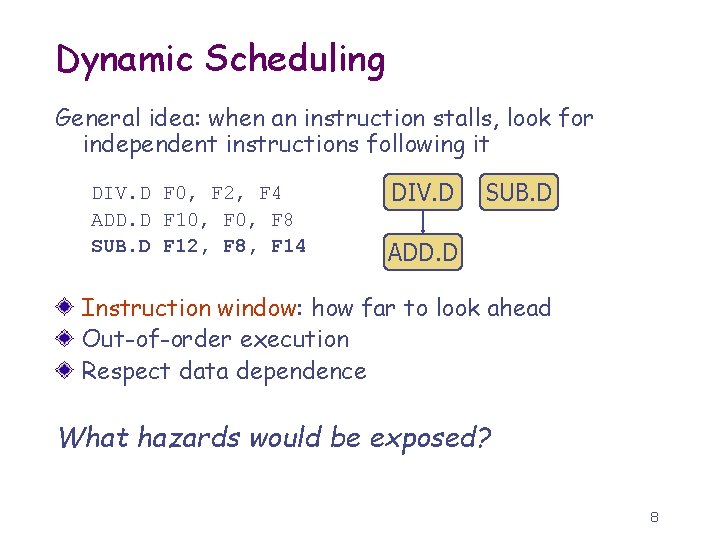
Dynamic Scheduling General idea: when an instruction stalls, look for independent instructions following it DIV. D F 0, F 2, F 4 ADD. D F 10, F 8 SUB. D F 12, F 8, F 14 DIV. D SUB. D ADD. D Instruction window: how far to look ahead Out-of-order execution Respect data dependence What hazards would be exposed? 8
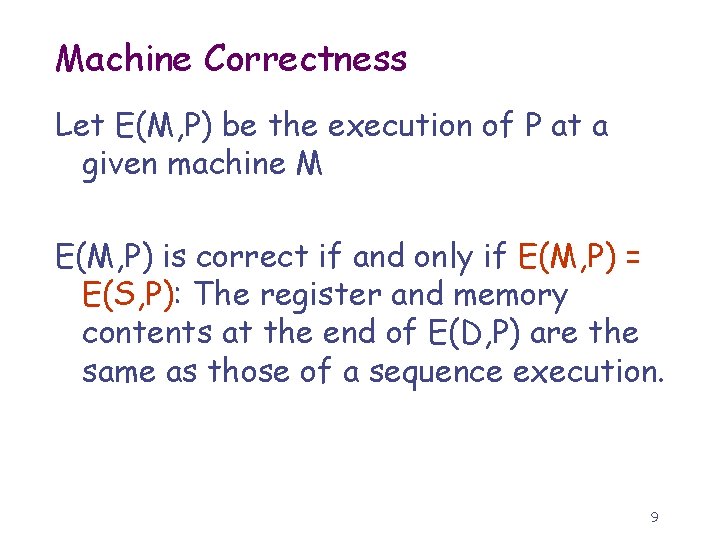
Machine Correctness Let E(M, P) be the execution of P at a given machine M E(M, P) is correct if and only if E(M, P) = E(S, P): The register and memory contents at the end of E(D, P) are the same as those of a sequence execution. 9
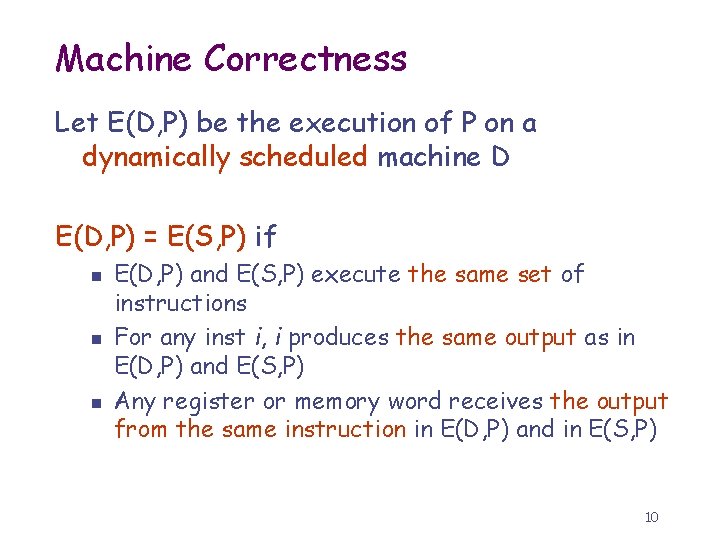
Machine Correctness Let E(D, P) be the execution of P on a dynamically scheduled machine D E(D, P) = E(S, P) if n n n E(D, P) and E(S, P) execute the same set of instructions For any inst i, i produces the same output as in E(D, P) and E(S, P) Any register or memory word receives the output from the same instruction in E(D, P) and in E(S, P) 10
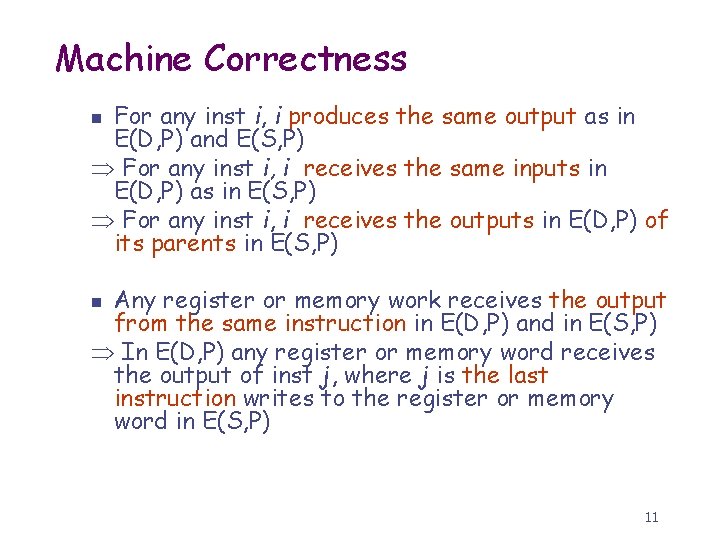
Machine Correctness For any inst i, i produces the same output as in E(D, P) and E(S, P) For any inst i, i receives the same inputs in E(D, P) as in E(S, P) For any inst i, i receives the outputs in E(D, P) of its parents in E(S, P) n Any register or memory work receives the output from the same instruction in E(D, P) and in E(S, P) In E(D, P) any register or memory word receives the output of inst j, where j is the last instruction writes to the register or memory word in E(S, P) n 11
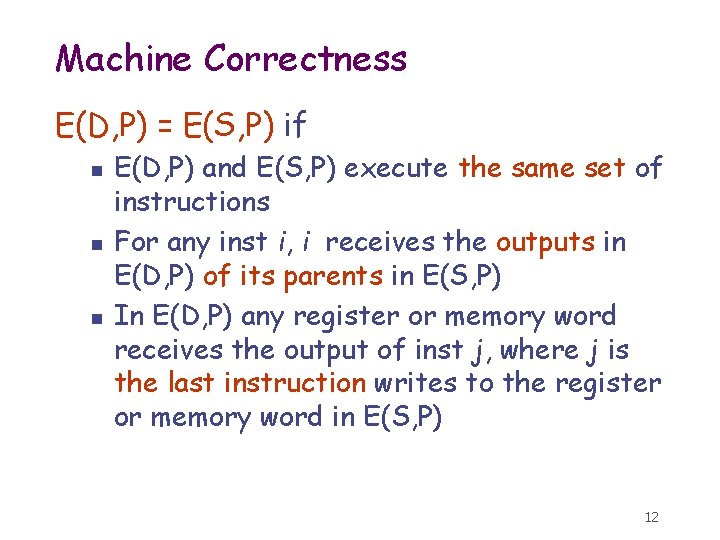
Machine Correctness E(D, P) = E(S, P) if n n n E(D, P) and E(S, P) execute the same set of instructions For any inst i, i receives the outputs in E(D, P) of its parents in E(S, P) In E(D, P) any register or memory word receives the output of inst j, where j is the last instruction writes to the register or memory word in E(S, P) 12
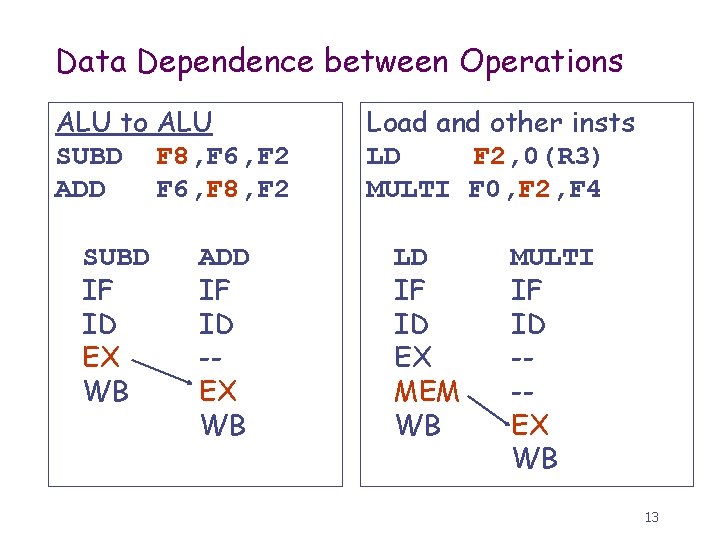
Data Dependence between Operations ALU to ALU SUBD F 8, F 6, F 2 ADD F 6, F 8, F 2 SUBD IF ID EX WB ADD IF ID -EX WB Load and other insts LD F 2, 0(R 3) MULTI F 0, F 2, F 4 LD IF ID EX MEM WB MULTI IF ID --EX WB 13
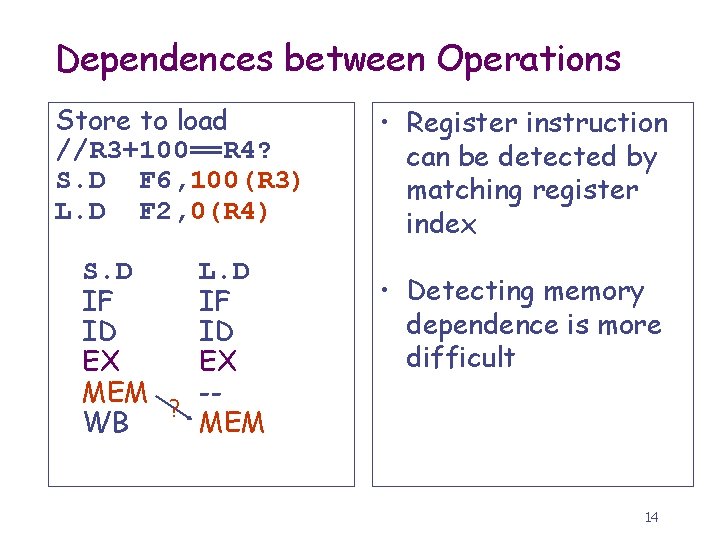
Dependences between Operations Store to load //R 3+100==R 4? S. D F 6, 100(R 3) L. D F 2, 0(R 4) • Register instruction can be detected by matching register index S. D L. D IF IF ID ID EX EX MEM -? WB MEM • Detecting memory dependence is more difficult 14
Dynamic Scheduling L. D MULTI L. D SUB. D DIV. D ADD. D F 2, 0(R 3) F 0, F 2, F 4 F 6, 0(R 2) F 8, F 6, F 2 F 10, F 6 F 12, F 8, F 2 LD 1 LD 2 MULTI SUBD DIVD ADD How to schedule pipeline operations? 15
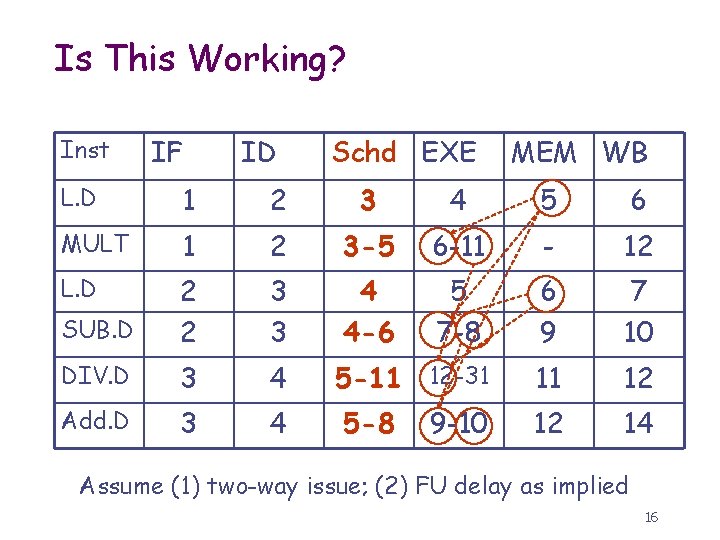
Is This Working? Inst IF ID Schd EXE MEM WB L. D 1 2 3 4 5 6 MULT 1 2 3 -5 6 -11 - 12 L. D SUB. D 2 2 3 3 4 4 -6 5 7 -8 6 9 7 10 DIV. D 3 4 5 -11 12 -31 11 12 Add. D 3 4 12 14 5 -8 9 -10 Assume (1) two-way issue; (2) FU delay as implied 16
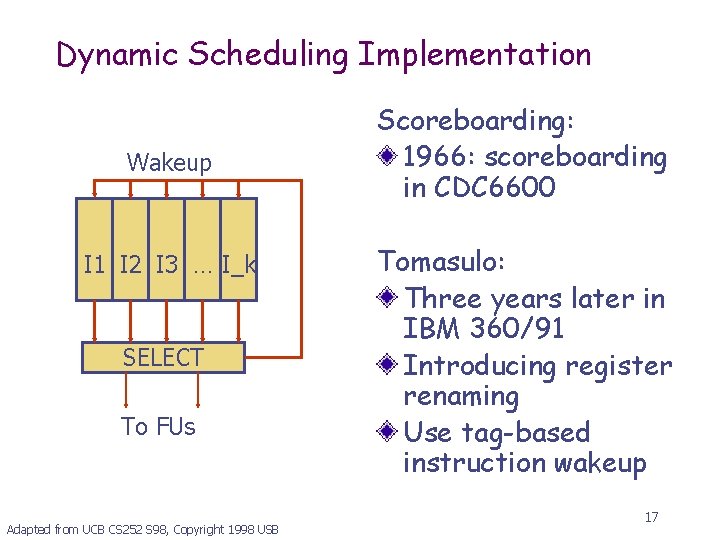
Dynamic Scheduling Implementation Wakeup I 1 I 2 I 3 … I_k SELECT To FUs Adapted from UCB CS 252 S 98, Copyright 1998 USB Scoreboarding: 1966: scoreboarding in CDC 6600 Tomasulo: Three years later in IBM 360/91 Introducing register renaming Use tag-based instruction wakeup 17
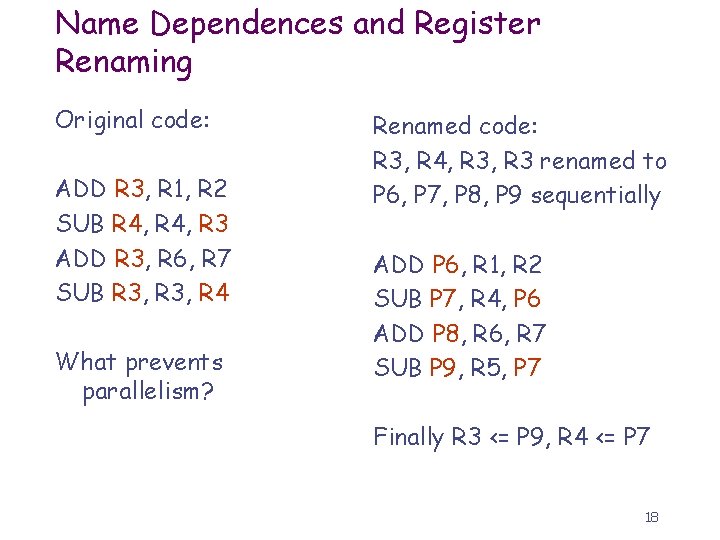
Name Dependences and Register Renaming Original code: ADD R 3, R 1, R 2 SUB R 4, R 3 ADD R 3, R 6, R 7 SUB R 3, R 4 What prevents parallelism? Renamed code: R 3, R 4, R 3 renamed to P 6, P 7, P 8, P 9 sequentially ADD P 6, R 1, R 2 SUB P 7, R 4, P 6 ADD P 8, R 6, R 7 SUB P 9, R 5, P 7 Finally R 3 <= P 9, R 4 <= P 7 18
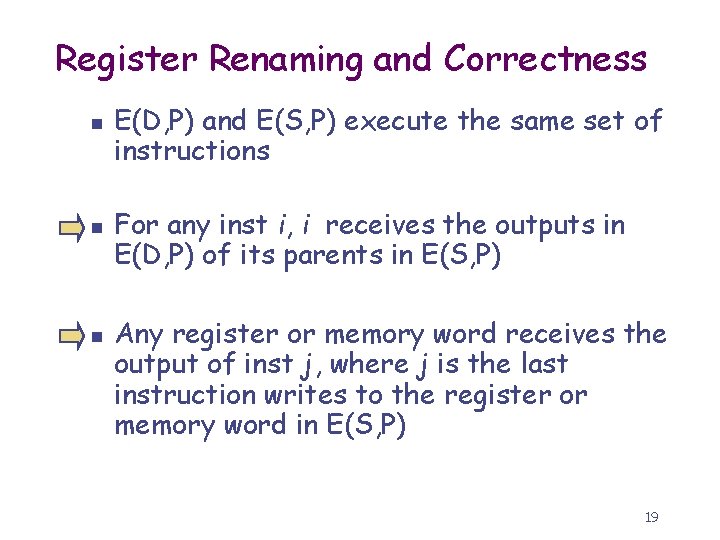
Register Renaming and Correctness n n n E(D, P) and E(S, P) execute the same set of instructions For any inst i, i receives the outputs in E(D, P) of its parents in E(S, P) Any register or memory word receives the output of inst j, where j is the last instruction writes to the register or memory word in E(S, P) 19
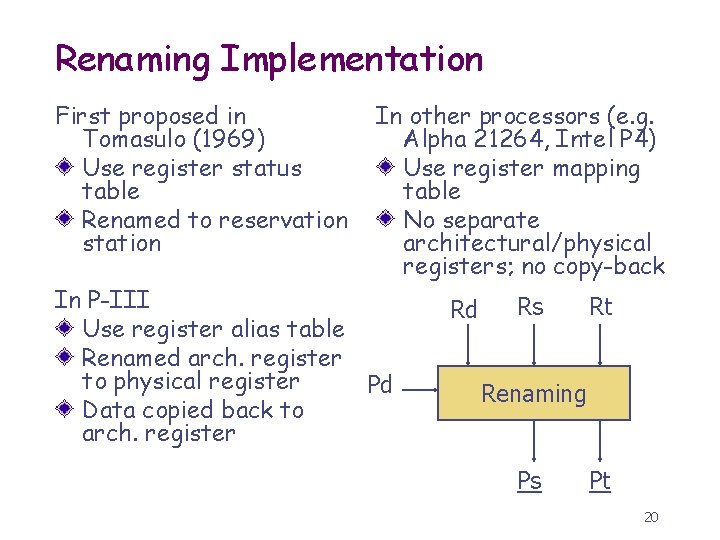
Renaming Implementation First proposed in Tomasulo (1969) Use register status table Renamed to reservation station In other processors (e. g. Alpha 21264, Intel P 4) Use register mapping table No separate architectural/physical registers; no copy-back In P-III Use register alias table Renamed arch. register to physical register Pd Data copied back to arch. register Rd Rs Rt Renaming Ps Pt 20
Speculative Execution Modern processors must speculate! n n Branch prediction: SPEC 2 k INT has one branch per seven instructions! Precise interrupt Memory disambiguation More performance-oriented speculations Two disjointed but connected issues: 1. 2. How to make the best prediction What to do when the speculation is wrong 21
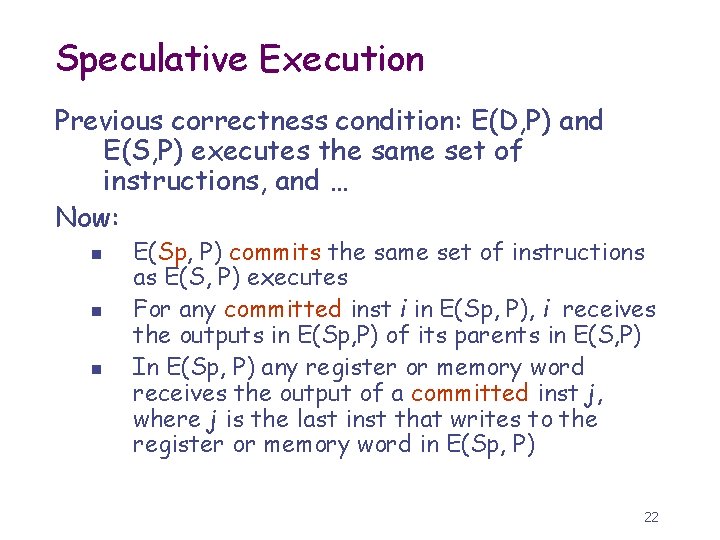
Speculative Execution Previous correctness condition: E(D, P) and E(S, P) executes the same set of instructions, and … Now: n n n E(Sp, P) commits the same set of instructions as E(S, P) executes For any committed inst i in E(Sp, P), i receives the outputs in E(Sp, P) of its parents in E(S, P) In E(Sp, P) any register or memory word receives the output of a committed inst j, where j is the last inst that writes to the register or memory word in E(Sp, P) 22
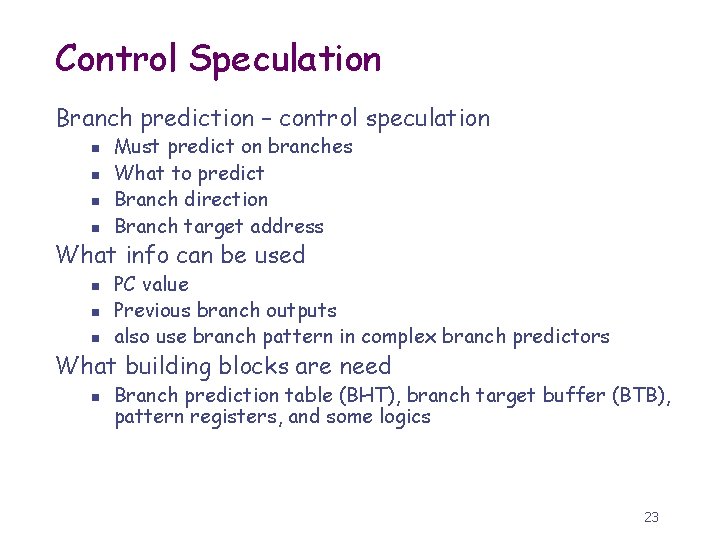
Control Speculation Branch prediction – control speculation n n Must predict on branches What to predict Branch direction Branch target address What info can be used n n n PC value Previous branch outputs also use branch pattern in complex branch predictors What building blocks are need n Branch prediction table (BHT), branch target buffer (BTB), pattern registers, and some logics 23
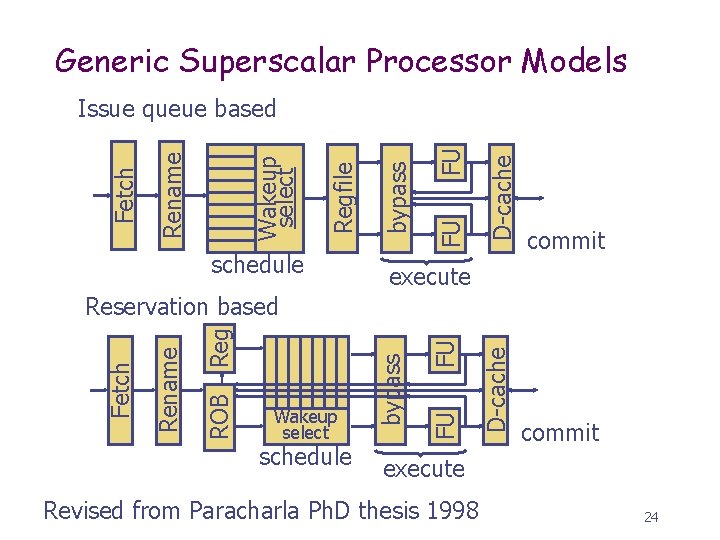
Generic Superscalar Processor Models schedule D-cache FU FU bypass Regfile Wakeup select Rename Fetch Issue queue based commit execute schedule D-cache FU FU Wakeup select bypass Reg ROB Rename Fetch Reservation based commit execute Revised from Paracharla Ph. D thesis 1998 24