
Lecture 5 Constraint Satisfaction Problems ICS 271 Fall
Lecture 5: Constraint Satisfaction Problems ICS 271 Fall 2008 ICS-271: Notes 5: 1

Outline • • The constraint network model – Variables, domains, constraint graph, solutions Examples: – graph-coloring, 8 -queen, cryptarithmetic, crossword puzzles, vision problems, scheduling, design The search space and naive backtracking, The constraint graph Consistency enforcing algorithms – arc-consistency, AC-1, AC-3 Backtracking strategies – Forward-checking, dynamic variable orderings Special case: solving tree problems Local search for CSPs ICS-271: Notes 5: 2
ICS-271: Notes 5: 3

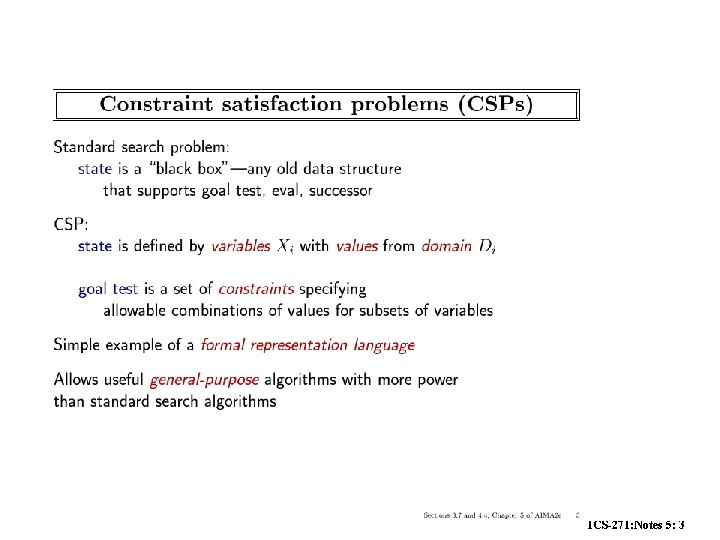
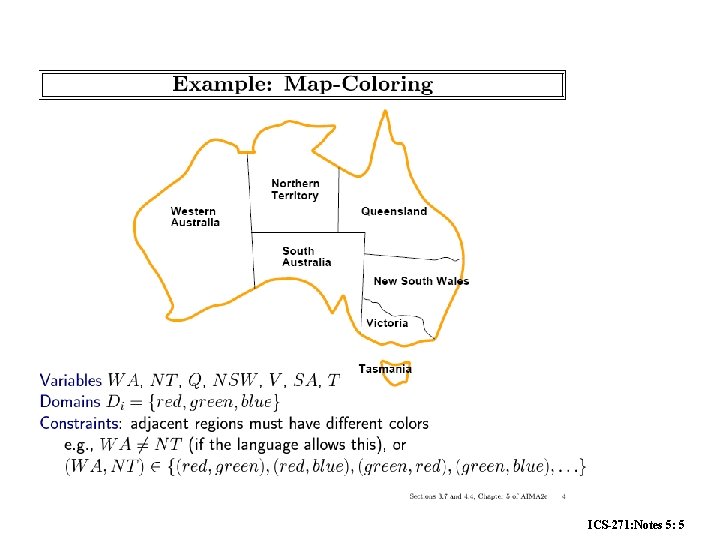
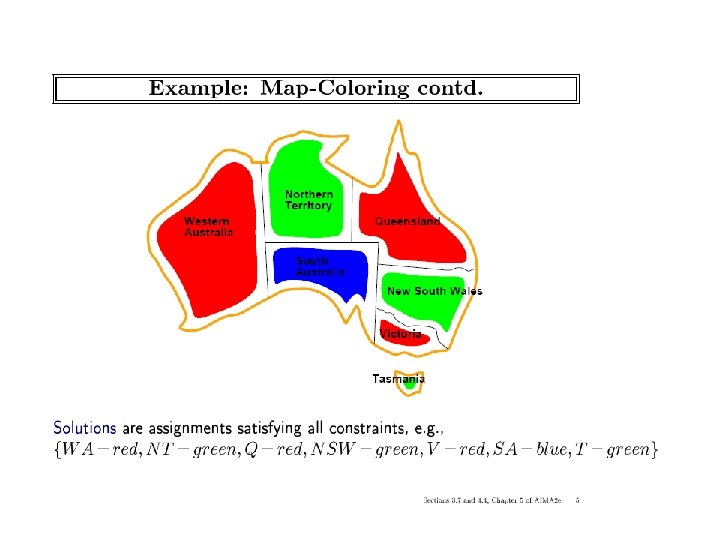
Constraint Satisfaction Example: map coloring Variables - countries (A, B, C, etc. ) Values - colors (e. g. , red, green, yellow) Constraints: A B red green yellow red yellow green red E A D B F C G ICS-271: Notes 5: 4
ICS-271: Notes 5: 5
ICS-271: Notes 5: 6
ICS-271: Notes 5: 7
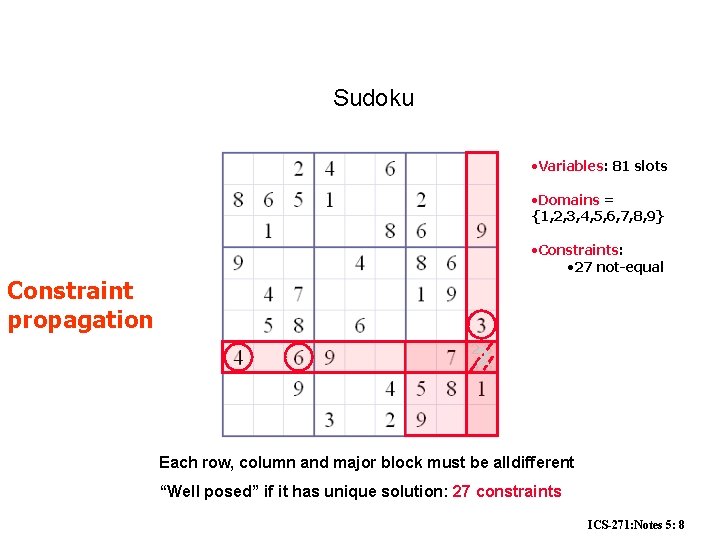
Sudoku • Variables: 81 slots • Domains = {1, 2, 3, 4, 5, 6, 7, 8, 9} • Constraints: • 27 not-equal Constraint propagation 23 426 Each row, column and major block must be alldifferent “Well posed” if it has unique solution: 27 constraints ICS-271: Notes 5: 8
ICS-271: Notes 5: 9
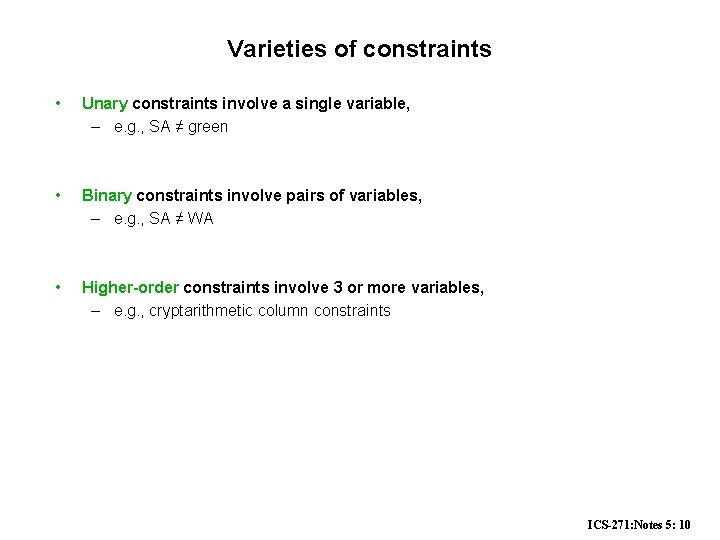
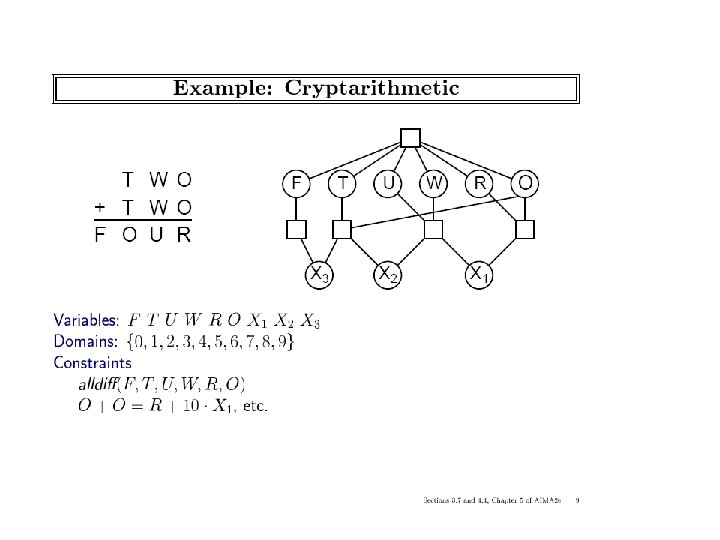
Varieties of constraints • Unary constraints involve a single variable, – e. g. , SA ≠ green • Binary constraints involve pairs of variables, – e. g. , SA ≠ WA • Higher-order constraints involve 3 or more variables, – e. g. , cryptarithmetic column constraints ICS-271: Notes 5: 10
ICS-271: Notes 5: 11
ICS-271: Notes 5: 13
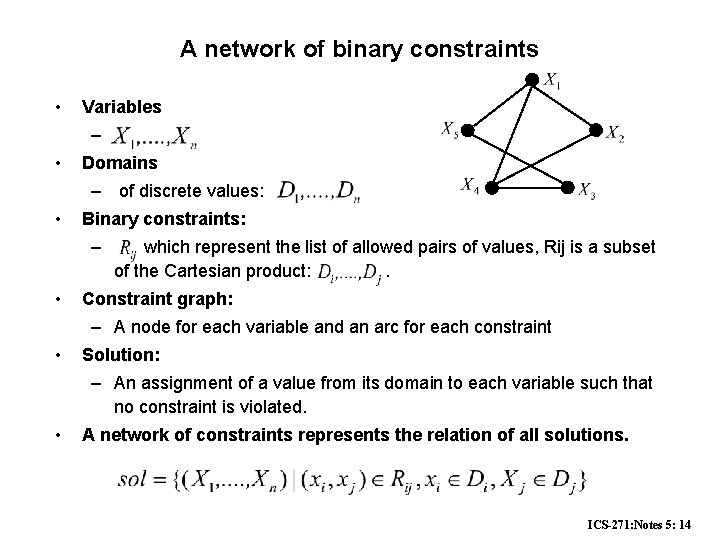
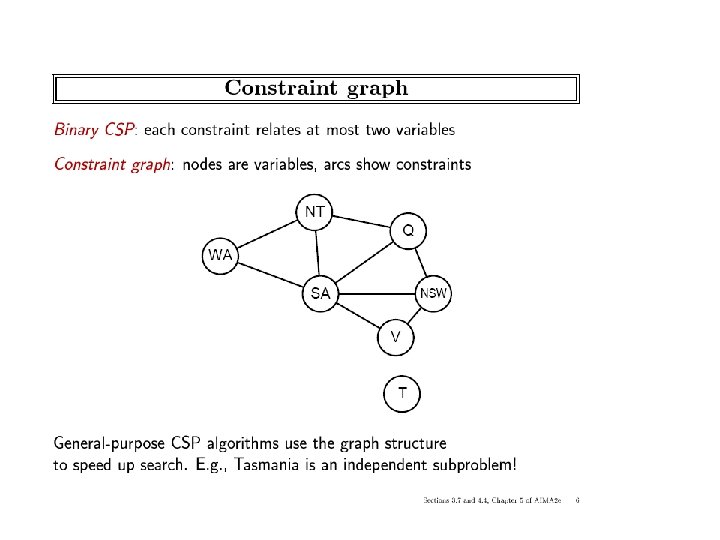
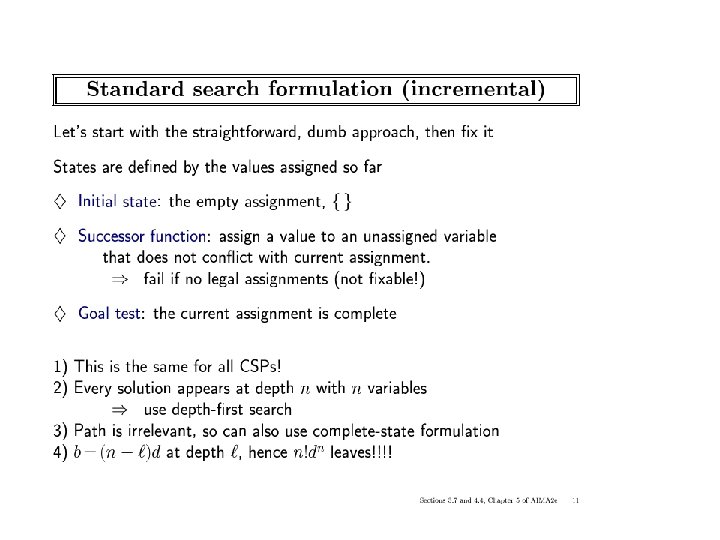
A network of binary constraints • Variables – • Domains – of discrete values: • Binary constraints: – • which represent the list of allowed pairs of values, Rij is a subset of the Cartesian product: . Constraint graph: – A node for each variable and an arc for each constraint • Solution: – An assignment of a value from its domain to each variable such that no constraint is violated. • A network of constraints represents the relation of all solutions. ICS-271: Notes 5: 14
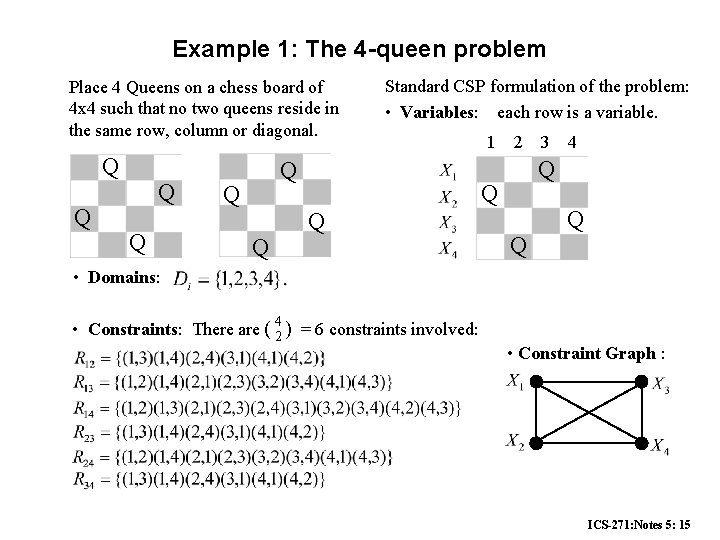
Example 1: The 4 -queen problem Place 4 Queens on a chess board of 4 x 4 such that no two queens reside in the same row, column or diagonal. Q Q Standard CSP formulation of the problem: • Variables: each row is a variable. Q Q Q 1 2 4 Q Q Q 3 Q Q • Domains: • Constraints: There are ( 42 ) = 6 constraints involved: • Constraint Graph : ICS-271: Notes 5: 15
ICS-271: Notes 5: 16
ICS-271: Notes 5: 17
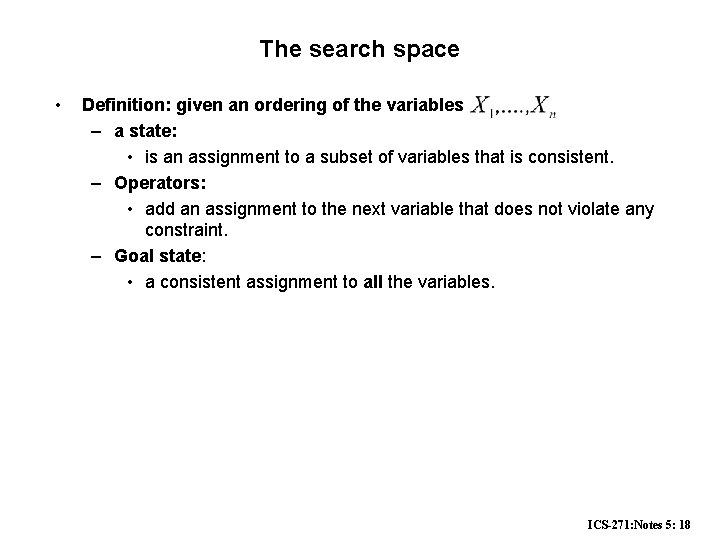
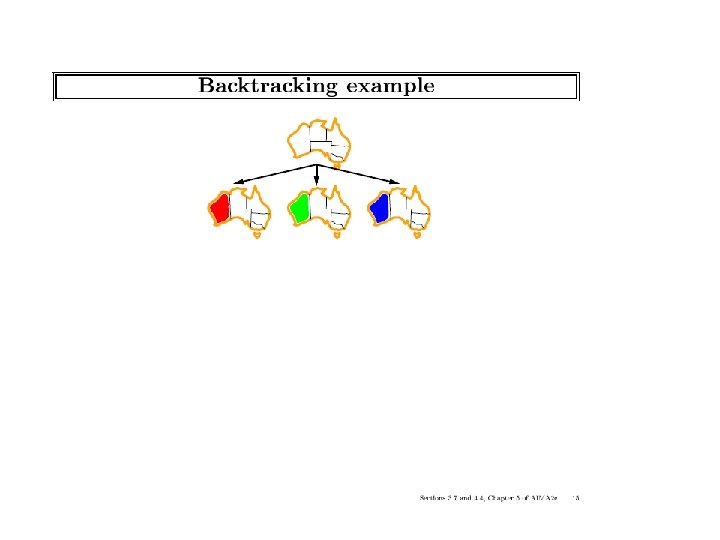
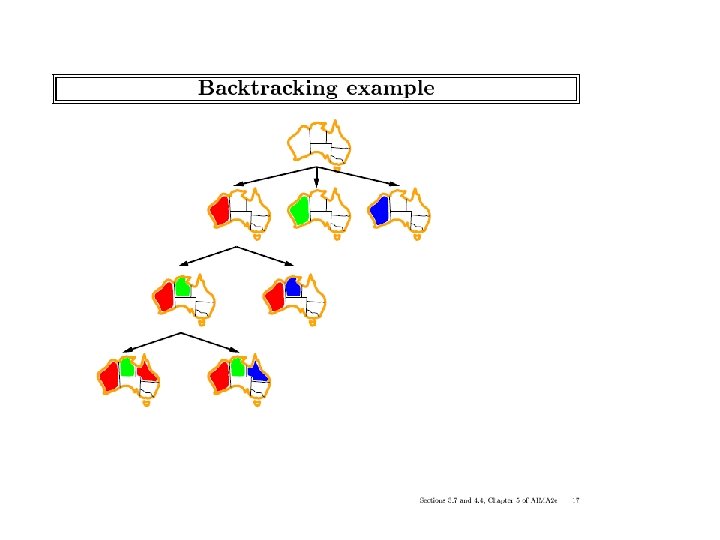
The search space • Definition: given an ordering of the variables – a state: • is an assignment to a subset of variables that is consistent. – Operators: • add an assignment to the next variable that does not violate any constraint. – Goal state: • a consistent assignment to all the variables. ICS-271: Notes 5: 18
ICS-271: Notes 5: 19
ICS-271: Notes 5: 20

ICS-271: Notes 5: 21
ICS-271: Notes 5: 22
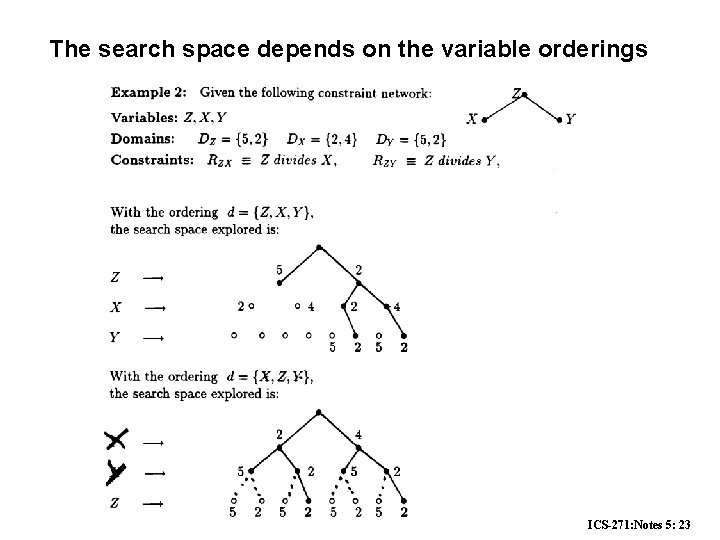
The search space depends on the variable orderings ICS-271: Notes 5: 23
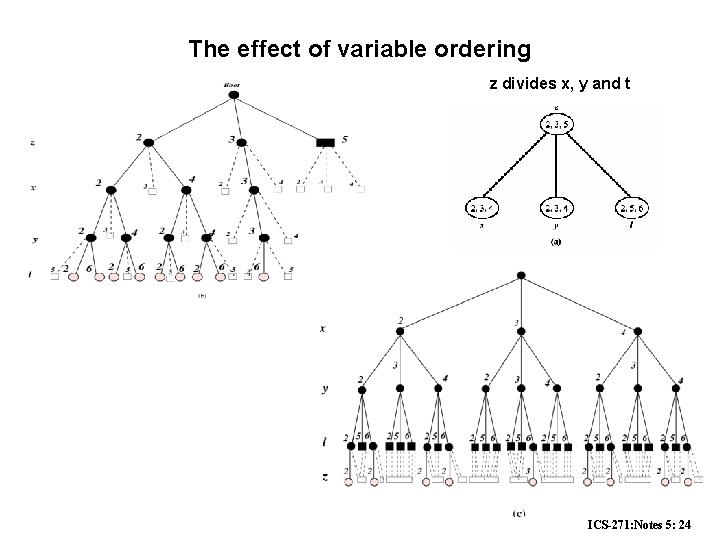
The effect of variable ordering z divides x, y and t ICS-271: Notes 5: 24
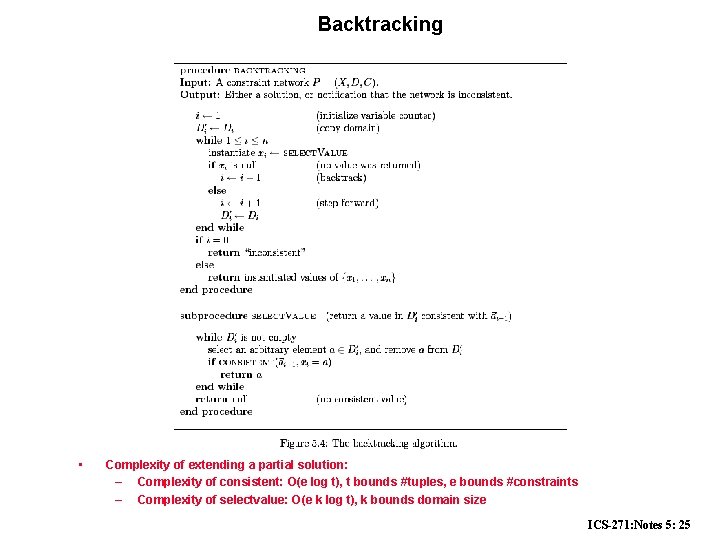
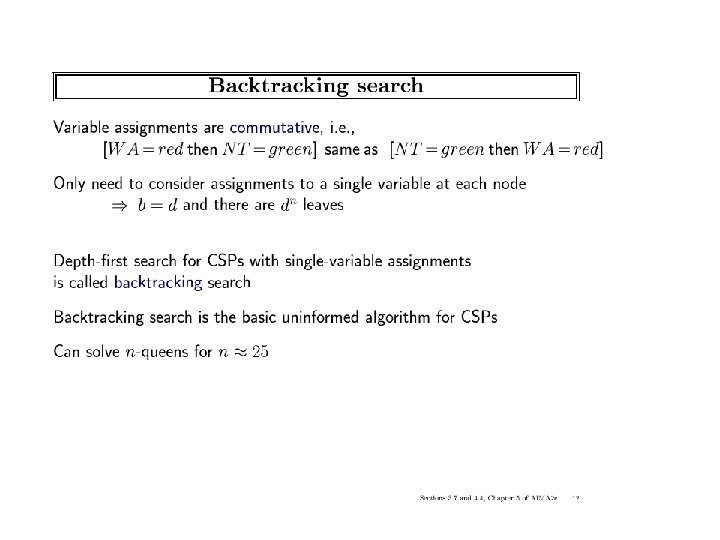
Backtracking • Complexity of extending a partial solution: – Complexity of consistent: O(e log t), t bounds #tuples, e bounds #constraints – Complexity of selectvalue: O(e k log t), k bounds domain size ICS-271: Notes 5: 25
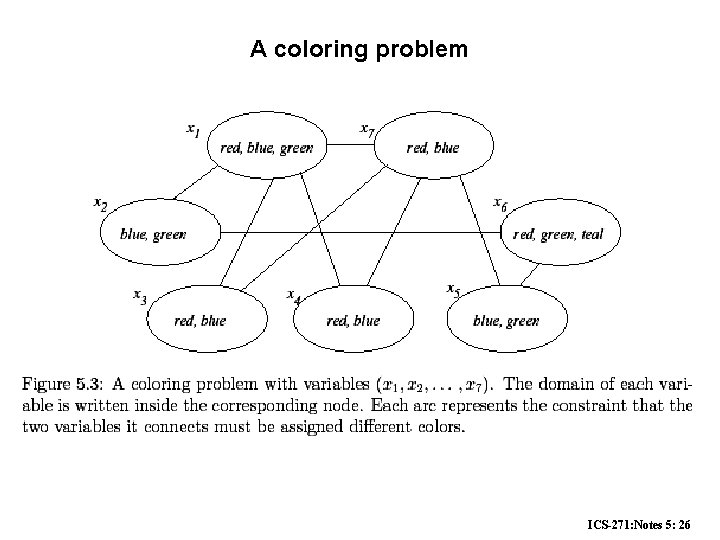
A coloring problem ICS-271: Notes 5: 26
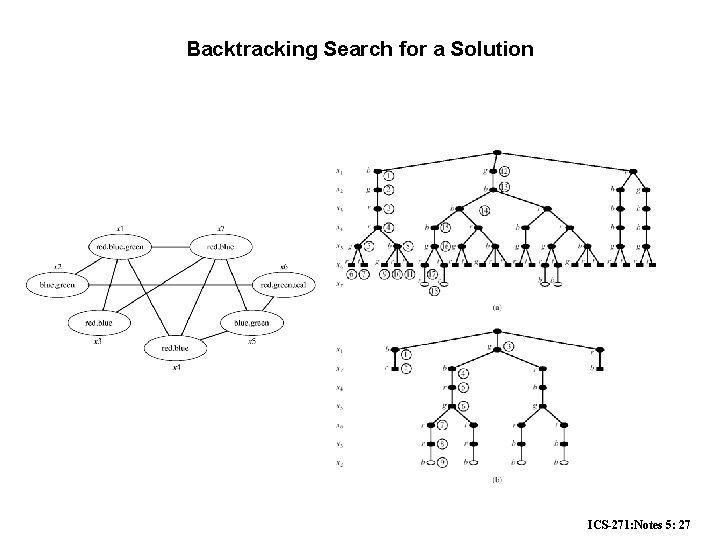
Backtracking Search for a Solution ICS-271: Notes 5: 27
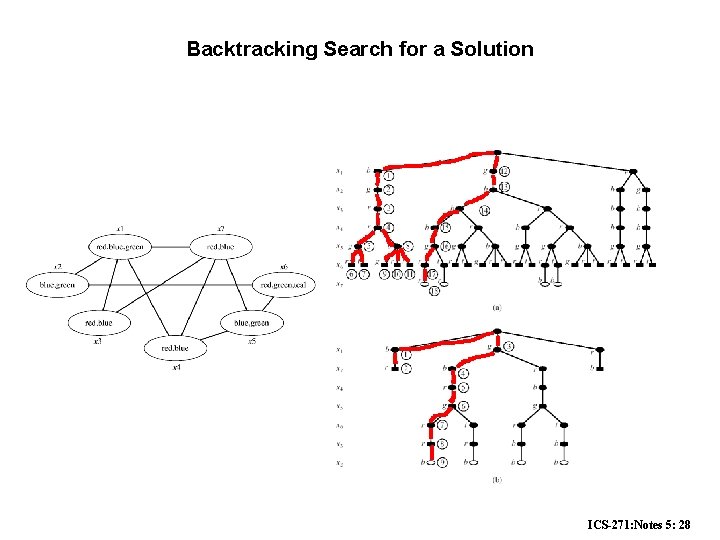
Backtracking Search for a Solution ICS-271: Notes 5: 28
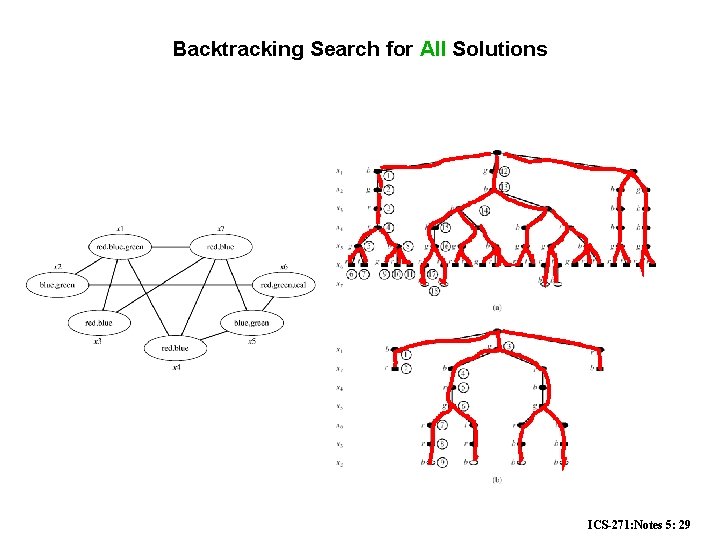
Backtracking Search for All Solutions ICS-271: Notes 5: 29
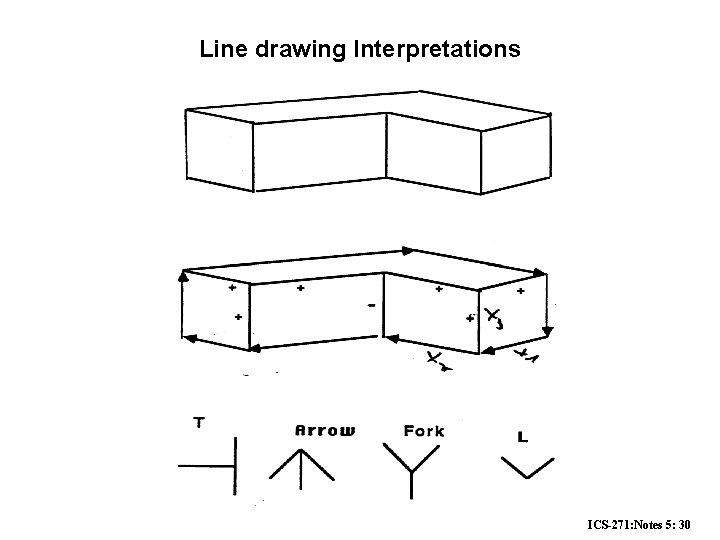
Line drawing Interpretations ICS-271: Notes 5: 30
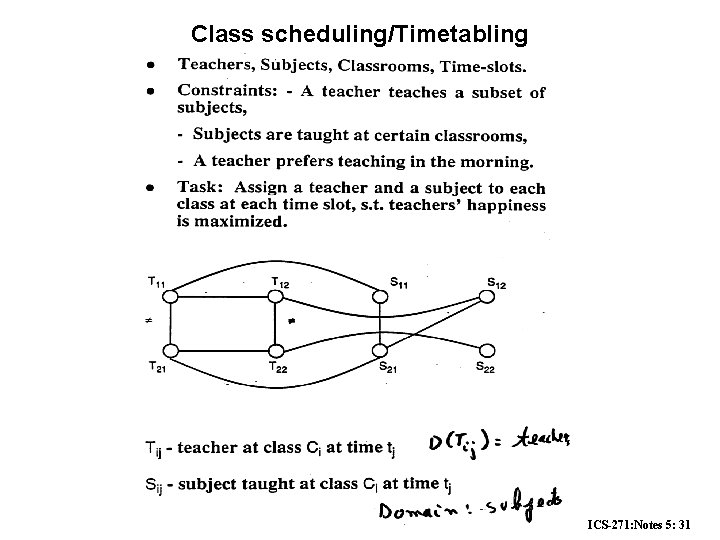
Class scheduling/Timetabling ICS-271: Notes 5: 31
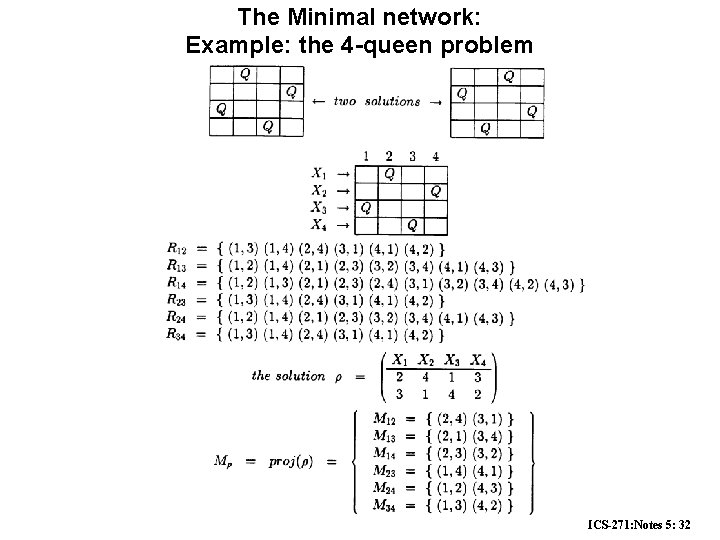
The Minimal network: Example: the 4 -queen problem ICS-271: Notes 5: 32
Approximation algorithms • • Arc-consistency (Waltz, 1972) Path-consistency (Montanari 1974, Mackworth 1977) I-consistency (Freuder 1982) Transform the network into smaller and smaller networks. ICS-271: Notes 5: 33
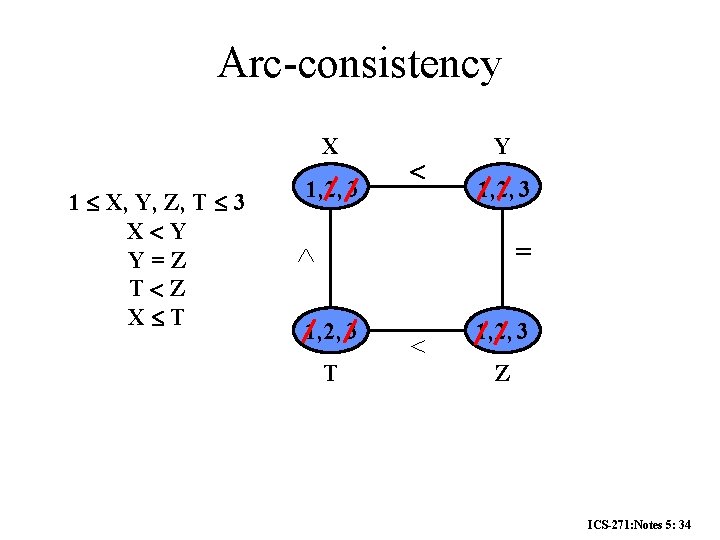
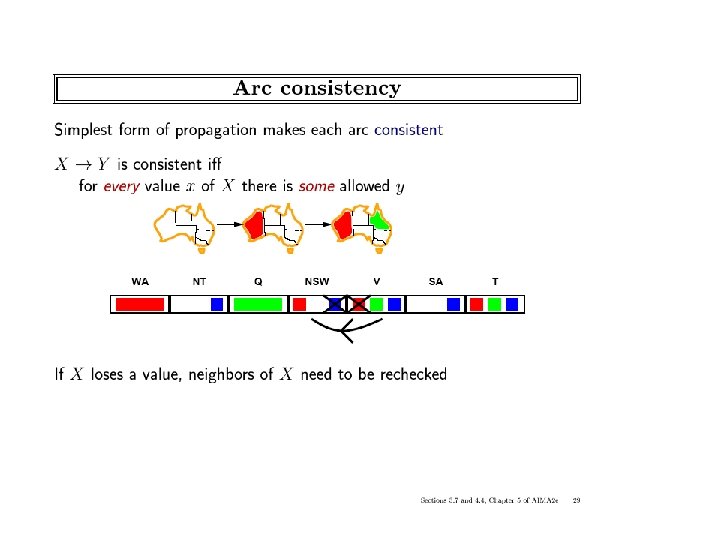
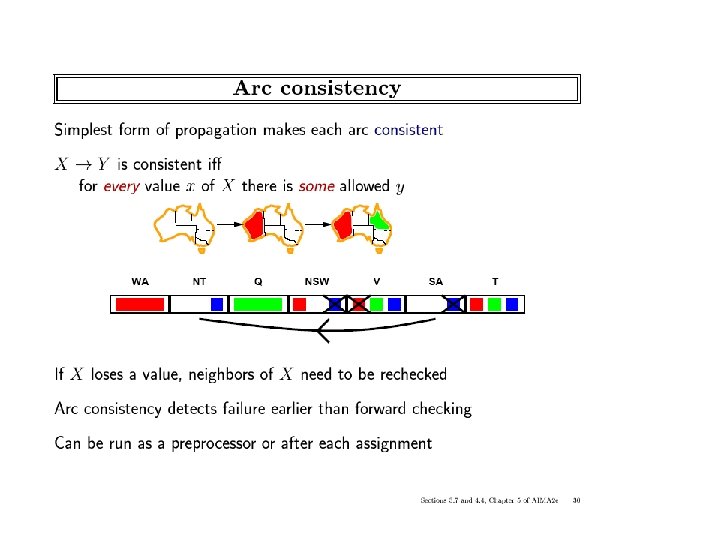
Arc-consistency X 1 X, Y, Z, T 3 X Y Y=Z T Z X T 1, 2, 3 Y 1, 2, 3 = 1, 2, 3 T 1, 2, 3 Z ICS-271: Notes 5: 34
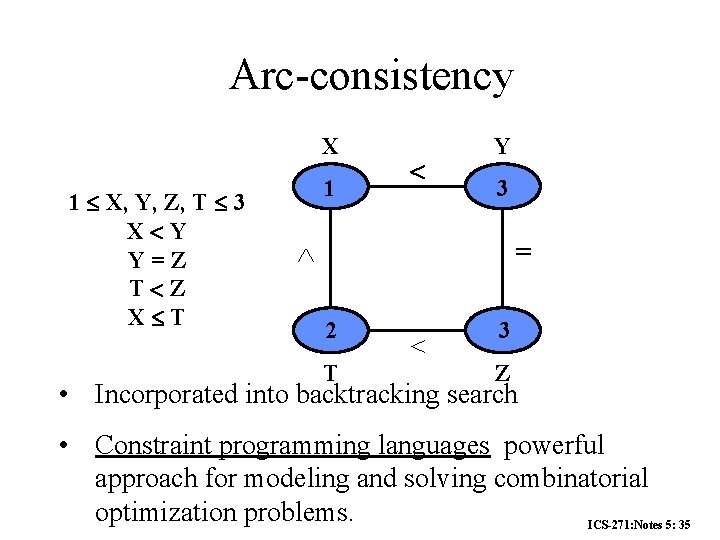
Arc-consistency X 1 X, Y, Z, T 3 X Y Y=Z T Z X T 1 Y 3 = 2 T 3 Z • Incorporated into backtracking search • Constraint programming languages powerful approach for modeling and solving combinatorial optimization problems. ICS-271: Notes 5: 35
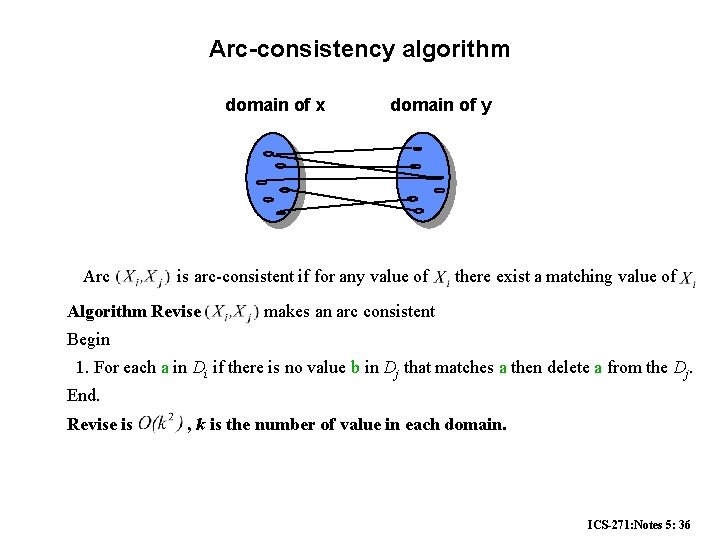
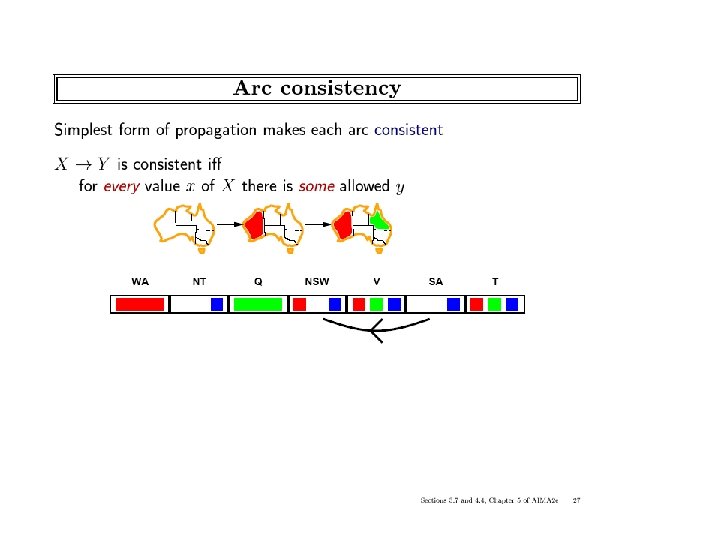
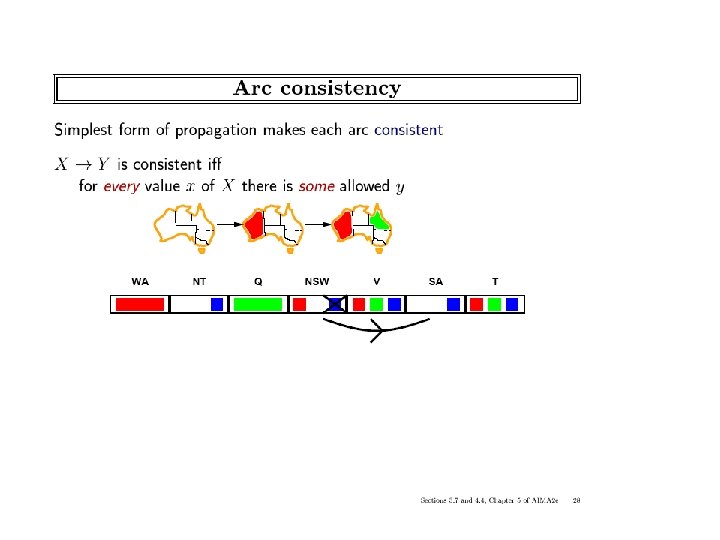
Arc-consistency algorithm domain of x Arc domain of y is arc-consistent if for any value of Algorithm Revise there exist a matching value of makes an arc consistent Begin 1. For each a in Di if there is no value b in Dj that matches a then delete a from the Dj. End. Revise is , k is the number of value in each domain. ICS-271: Notes 5: 36
Algorithm AC-3 • • • Begin – 1. Q <--- put all arcs in the queue in both directions – 2. While Q is not empty do, – 3. Select and delete an arc from the queue Q • 4. Revise • 5. If Revise cause a change then add to the queue all arcs that touch Xi (namely (Xi, Xm) and (Xl, Xi)). – 6. end-while End Complexity: – Processing an arc requires O(k^2) steps – The number of times each arc can be processed is 2·k – Total complexity is ICS-271: Notes 5: 37
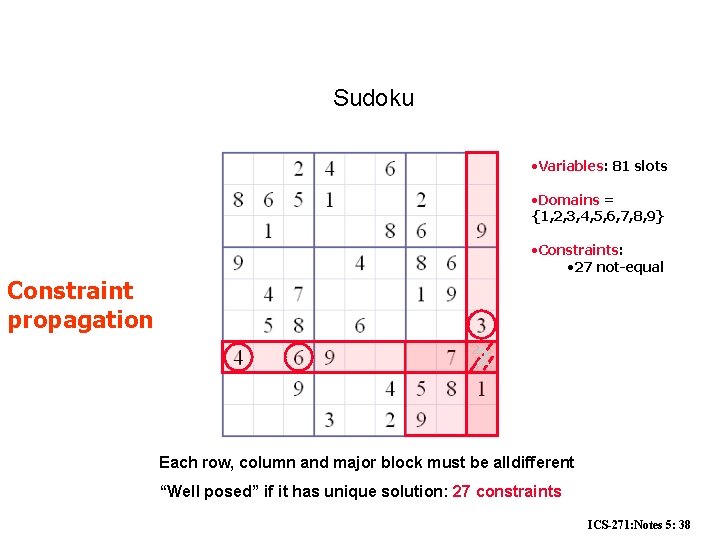
Sudoku • Variables: 81 slots • Domains = {1, 2, 3, 4, 5, 6, 7, 8, 9} • Constraints: • 27 not-equal Constraint propagation 23 426 Each row, column and major block must be alldifferent “Well posed” if it has unique solution: 27 constraints ICS-271: Notes 5: 38
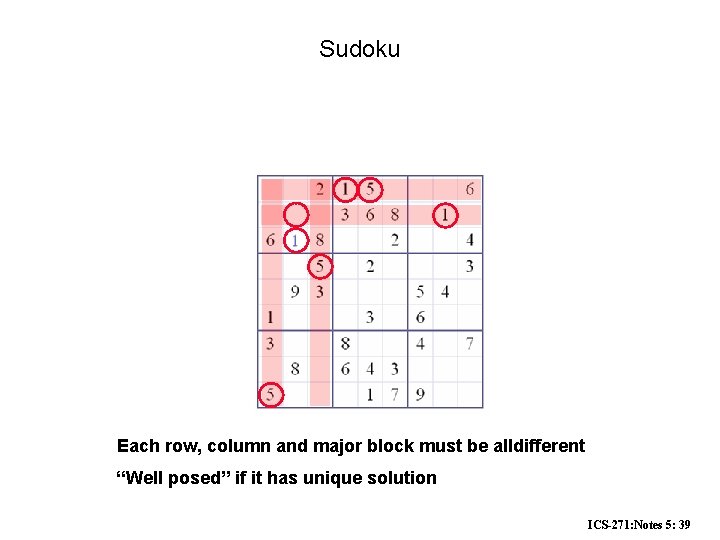
Sudoku Each row, column and major block must be alldifferent “Well posed” if it has unique solution ICS-271: Notes 5: 39
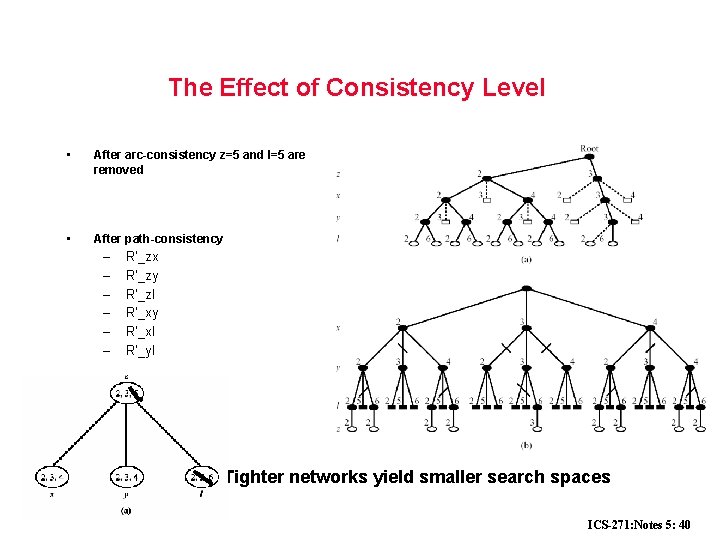
The Effect of Consistency Level • After arc-consistency z=5 and l=5 are removed • After path-consistency – – – R’_zx R’_zy R’_zl R’_xy R’_xl R’_yl Tighter networks yield smaller search spaces ICS-271: Notes 5: 40
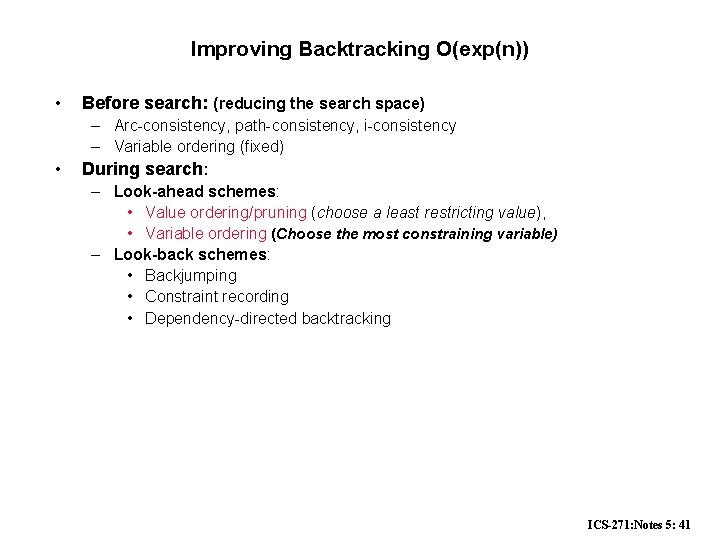
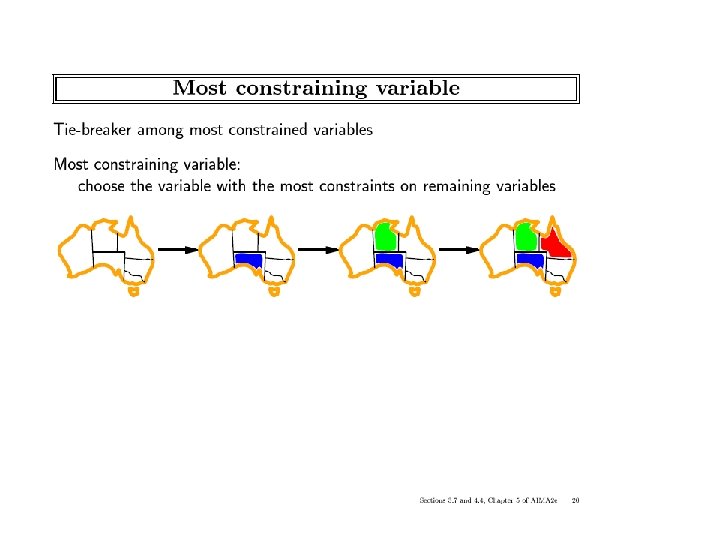
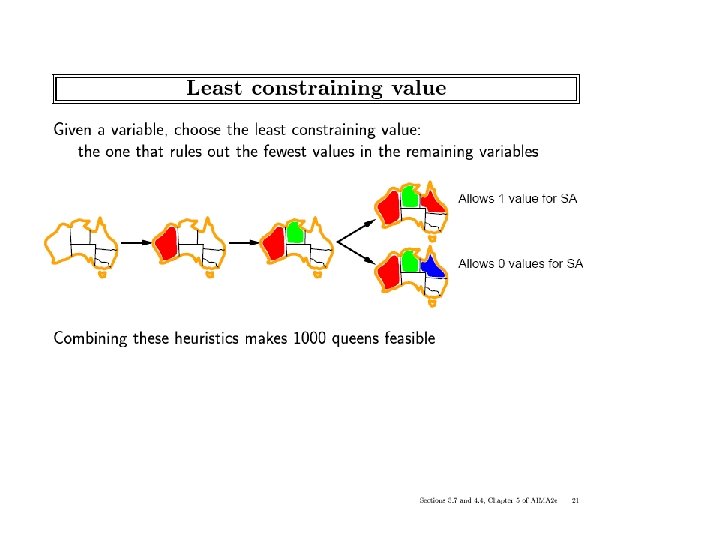
Improving Backtracking O(exp(n)) • • Before search: (reducing the search space) – Arc-consistency, path-consistency, i-consistency – Variable ordering (fixed) During search: – Look-ahead schemes: • Value ordering/pruning (choose a least restricting value), • Variable ordering (Choose the most constraining variable) – Look-back schemes: • Backjumping • Constraint recording • Dependency-directed backtracking ICS-271: Notes 5: 41
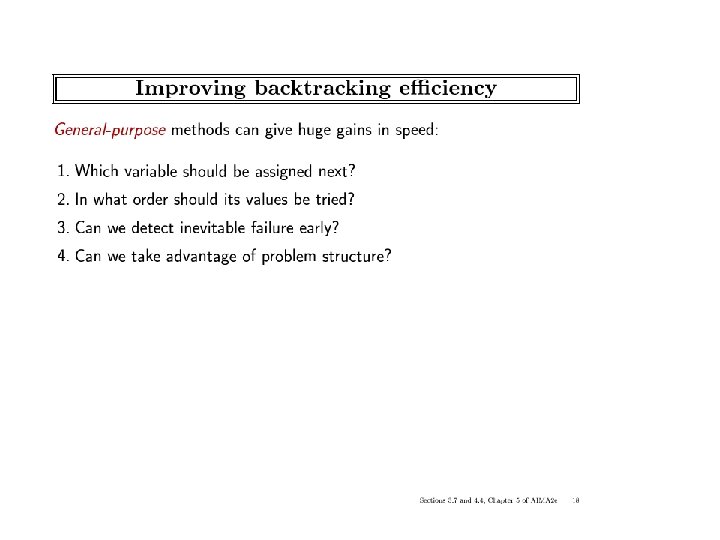
ICS-271: Notes 5: 42
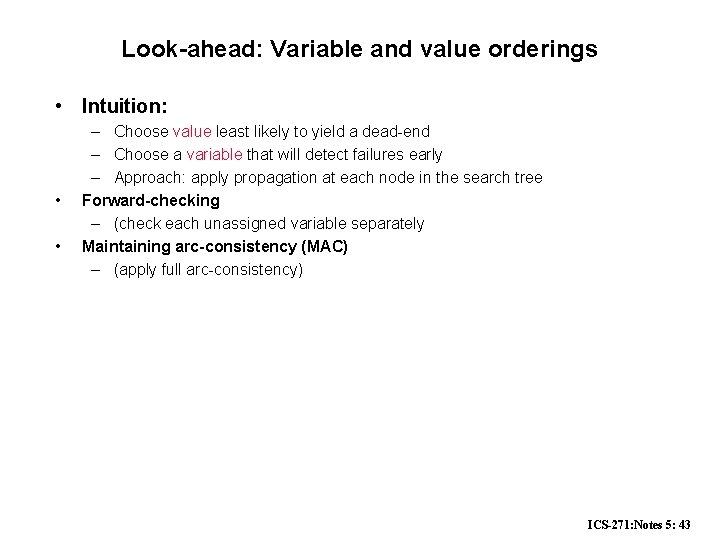
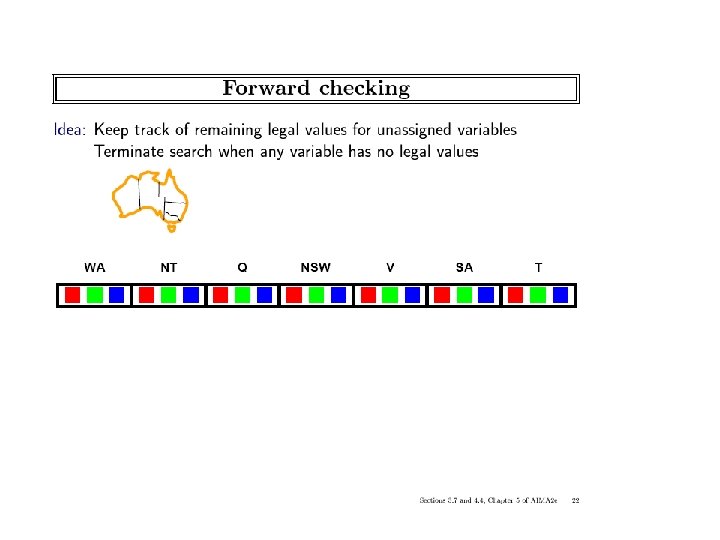
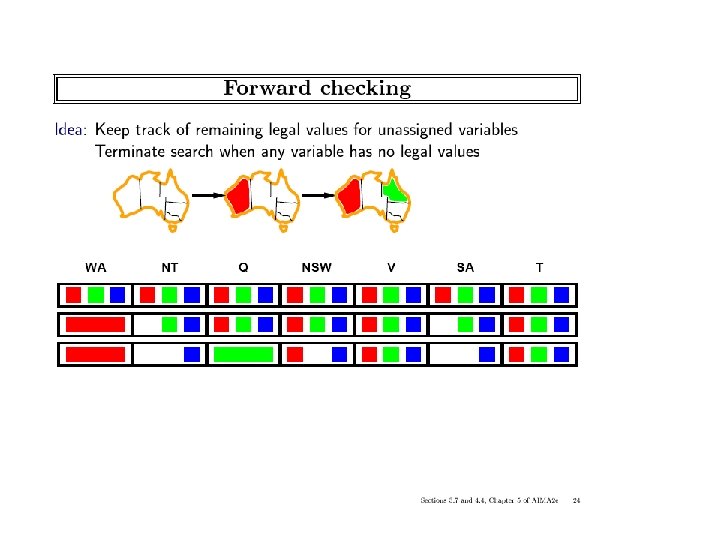
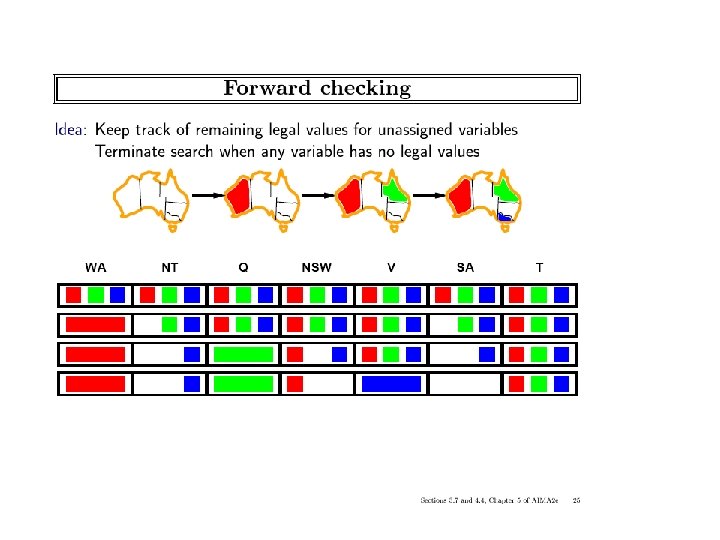
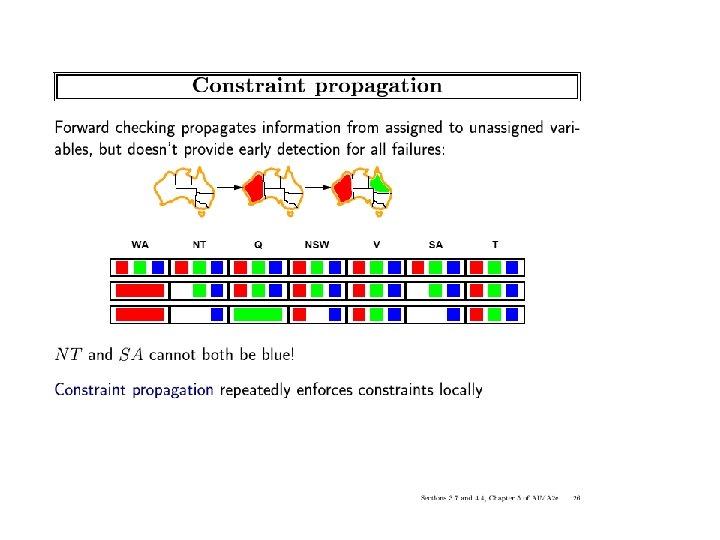
Look-ahead: Variable and value orderings • Intuition: • • – Choose value least likely to yield a dead-end – Choose a variable that will detect failures early – Approach: apply propagation at each node in the search tree Forward-checking – (check each unassigned variable separately Maintaining arc-consistency (MAC) – (apply full arc-consistency) ICS-271: Notes 5: 43
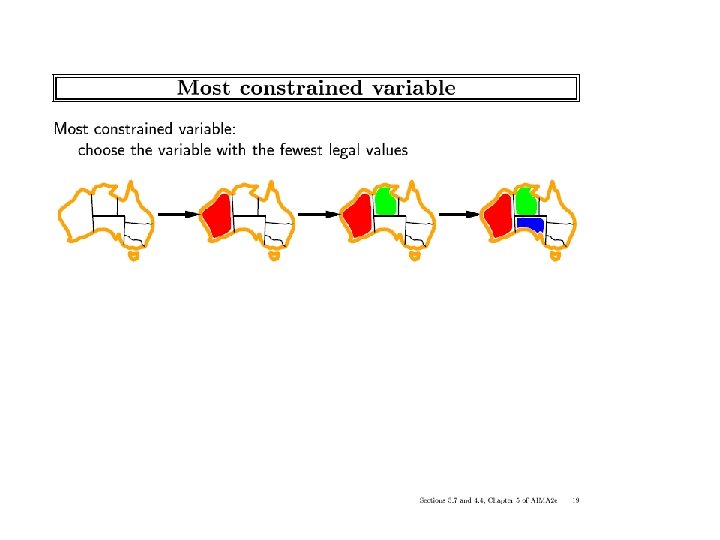
ICS-271: Notes 5: 44
ICS-271: Notes 5: 45
ICS-271: Notes 5: 46
ICS-271: Notes 5: 47

ICS-271: Notes 5: 48
ICS-271: Notes 5: 49
ICS-271: Notes 5: 50
ICS-271: Notes 5: 51
ICS-271: Notes 5: 52
ICS-271: Notes 5: 53
ICS-271: Notes 5: 54
ICS-271: Notes 5: 55
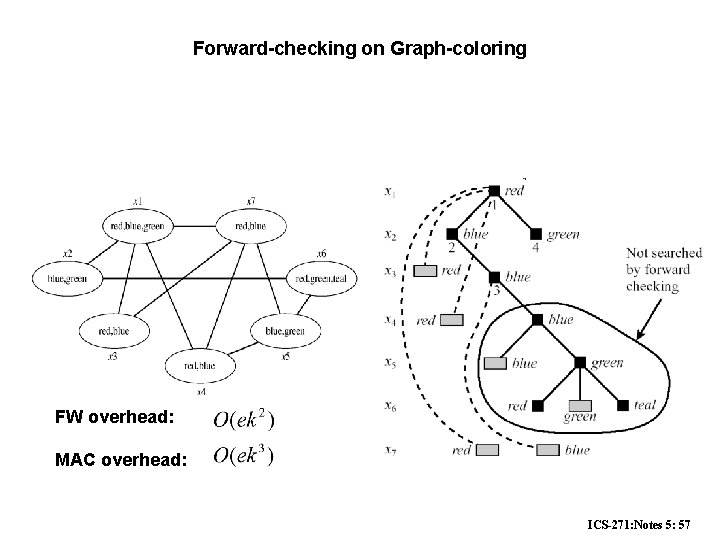
Forward-checking on Graph-coloring FW overhead: MAC overhead: ICS-271: Notes 5: 57
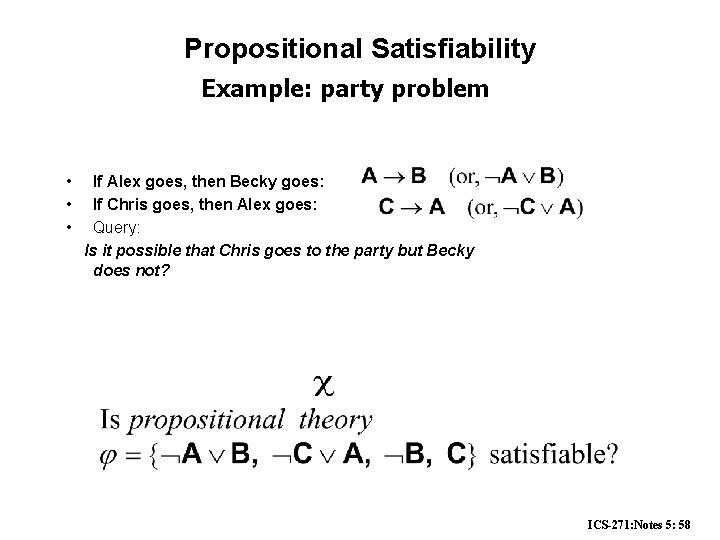
Propositional Satisfiability Example: party problem • • • If Alex goes, then Becky goes: If Chris goes, then Alex goes: Query: Is it possible that Chris goes to the party but Becky does not? ICS-271: Notes 5: 58
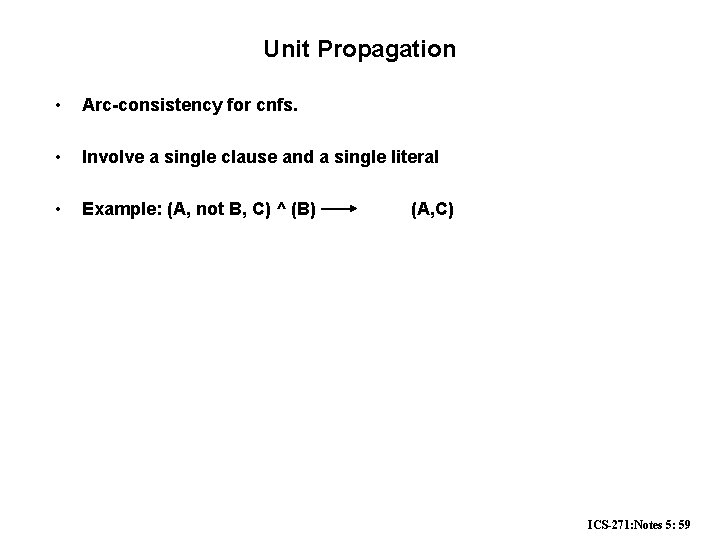
Unit Propagation • Arc-consistency for cnfs. • Involve a single clause and a single literal • Example: (A, not B, C) ^ (B) (A, C) ICS-271: Notes 5: 59
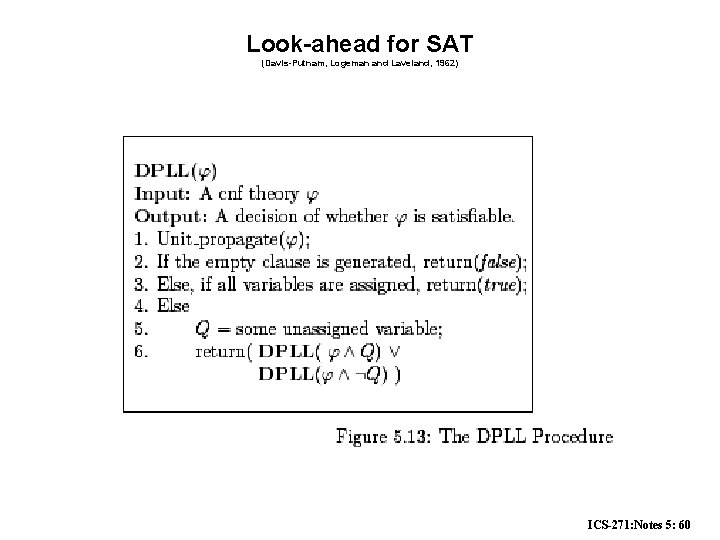
Look-ahead for SAT (Davis-Putnam, Logeman and Laveland, 1962) ICS-271: Notes 5: 60

Look-ahead for SAT: DPLL example: (~AVB)(~CVA)(AVBVD)(C) (Davis-Putnam, Logeman and Laveland, 1962) Backtracking look-ahead with Unit propagation= Generalized arc-consistency Only enclosed area will be explored with unit-propagation ICS-271: Notes 5: 61
Look-back: Backjumping / Learning • • Backjumping: – In deadends, go back to the most recent culprit. Learning: – constraint-recording, no-good recording. – good-recording ICS-271: Notes 5: 62

Backjumping • • • (X 1=r, x 2=b, x 3=b, x 4=b, x 5=g, x 6=r, x 7={r, b}) (r, b, b, b, g, r) conflict set of x 7 (r, -, b, b, g, -) c. s. of x 7 (r, -, b, -, -) minimal conflict-set Leaf deadend: (r, b, b, b, g, r) Every conflict-set is a no-good ICS-271: Notes 5: 63
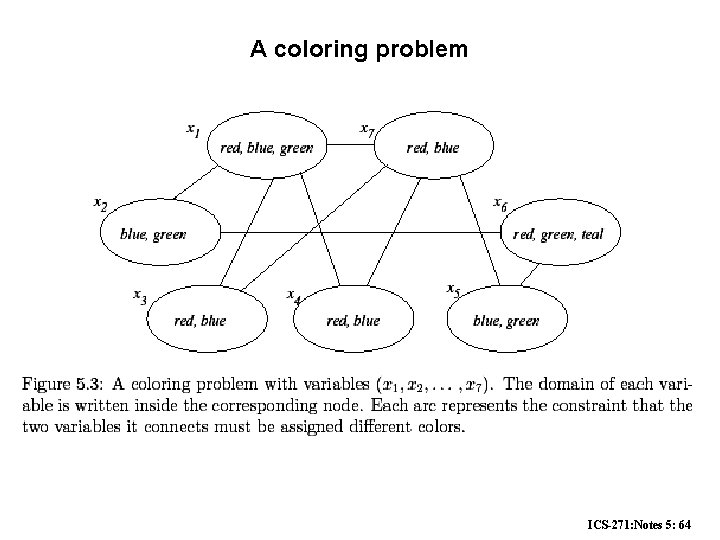
A coloring problem ICS-271: Notes 5: 64
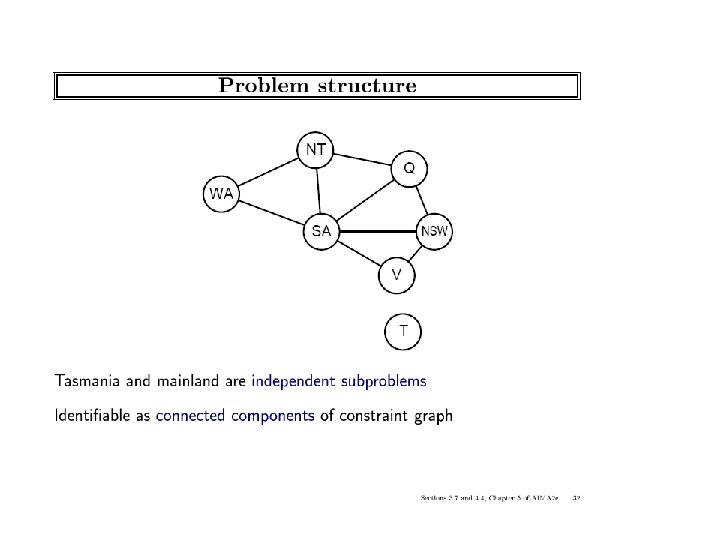
ICS-271: Notes 5: 66
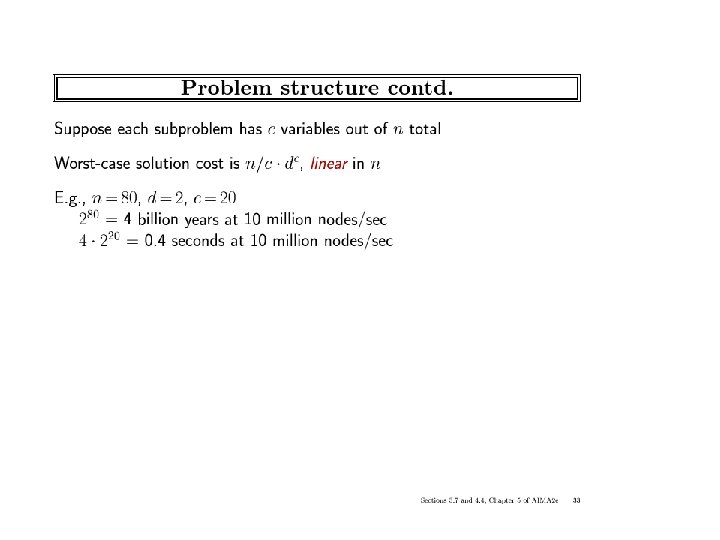
ICS-271: Notes 5: 67
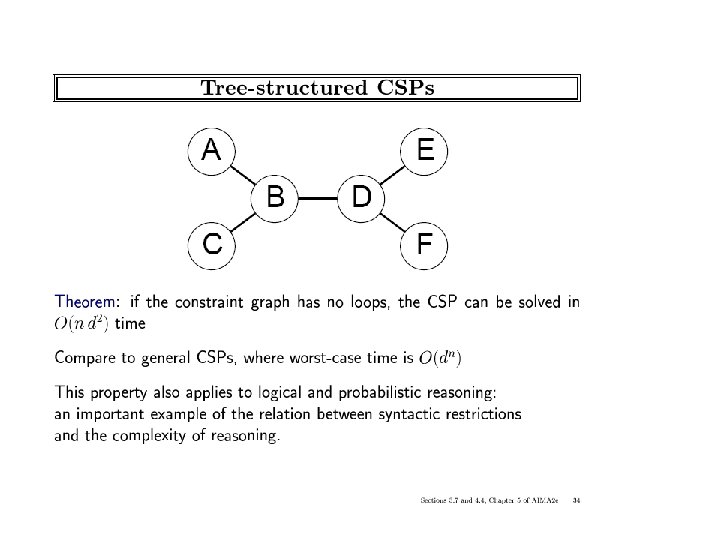
ICS-271: Notes 5: 68
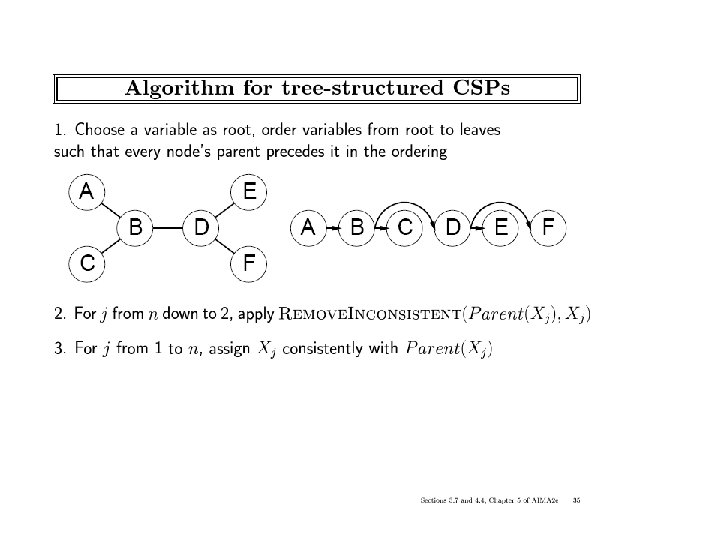
ICS-271: Notes 5: 69
ICS-271: Notes 5: 70
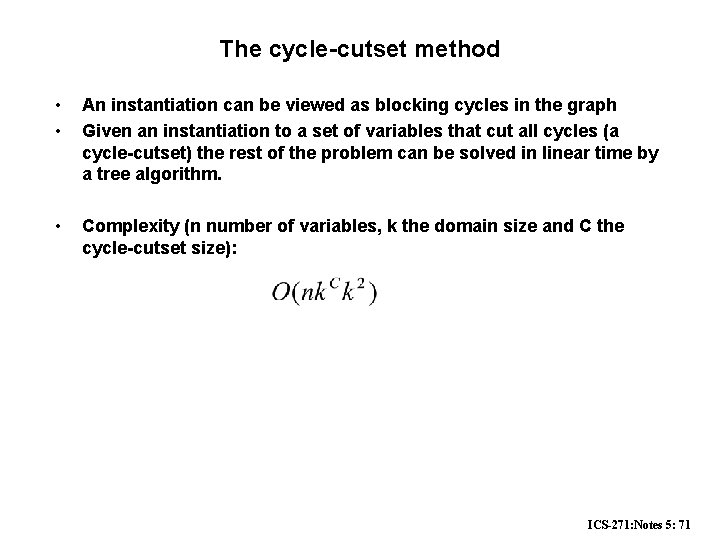
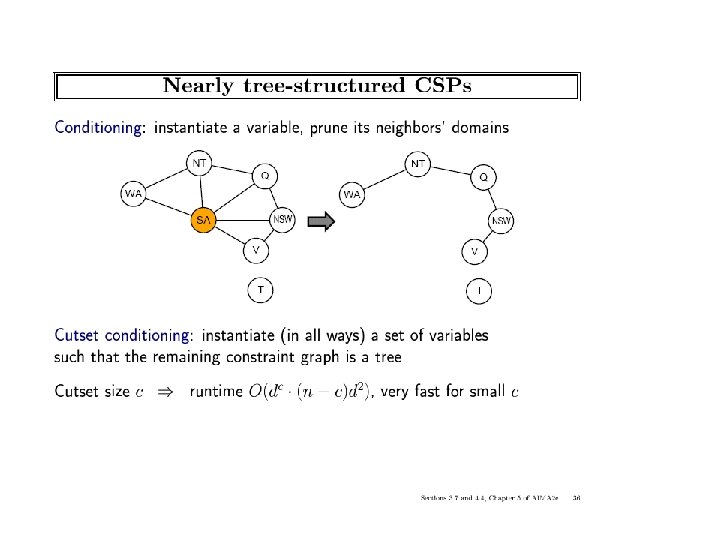
The cycle-cutset method • • An instantiation can be viewed as blocking cycles in the graph Given an instantiation to a set of variables that cut all cycles (a cycle-cutset) the rest of the problem can be solved in linear time by a tree algorithm. • Complexity (n number of variables, k the domain size and C the cycle-cutset size): ICS-271: Notes 5: 71
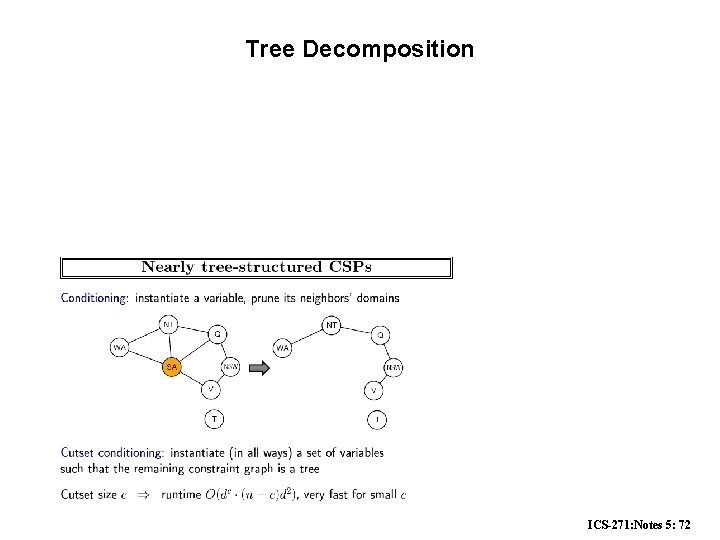
Tree Decomposition ICS-271: Notes 5: 72
ICS-271: Notes 5: 73
ICS-271: Notes 5: 74
ICS-271: Notes 5: 75
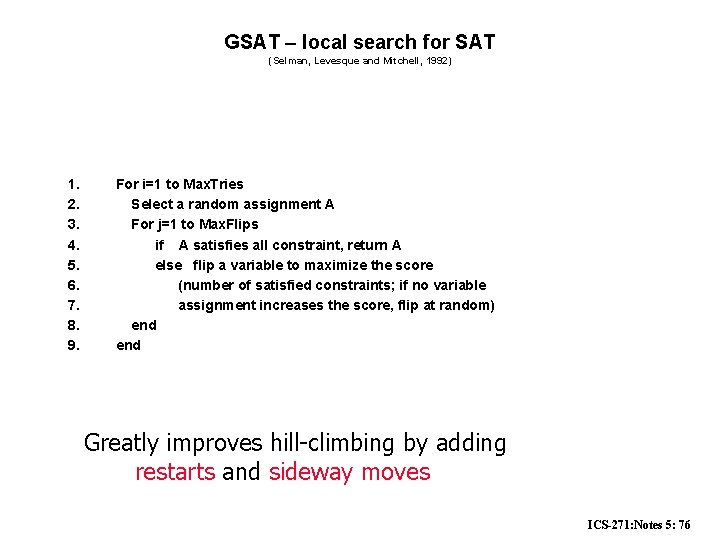
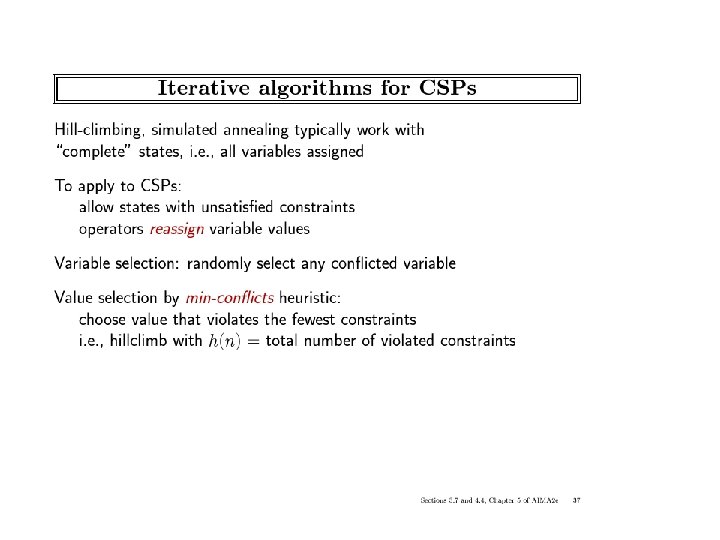
GSAT – local search for SAT (Selman, Levesque and Mitchell, 1992) 1. 2. 3. 4. 5. 6. 7. 8. 9. For i=1 to Max. Tries Select a random assignment A For j=1 to Max. Flips if A satisfies all constraint, return A else flip a variable to maximize the score (number of satisfied constraints; if no variable assignment increases the score, flip at random) end Greatly improves hill-climbing by adding restarts and sideway moves ICS-271: Notes 5: 76
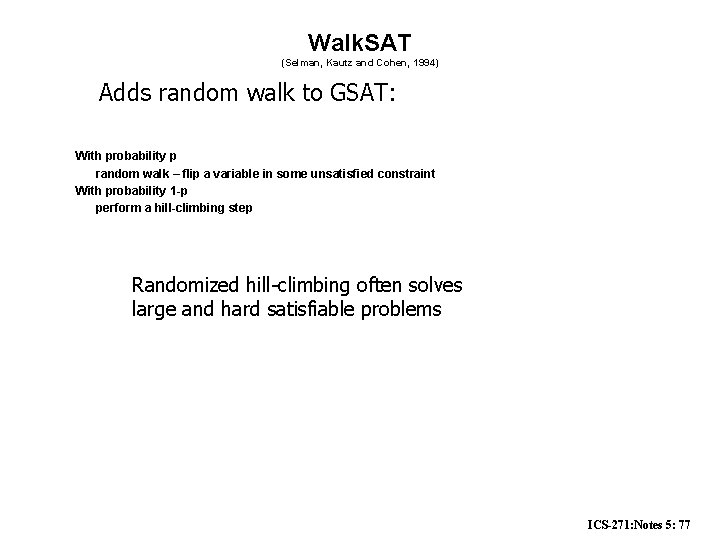
Walk. SAT (Selman, Kautz and Cohen, 1994) Adds random walk to GSAT: With probability p random walk – flip a variable in some unsatisfied constraint With probability 1 -p perform a hill-climbing step Randomized hill-climbing often solves large and hard satisfiable problems ICS-271: Notes 5: 77
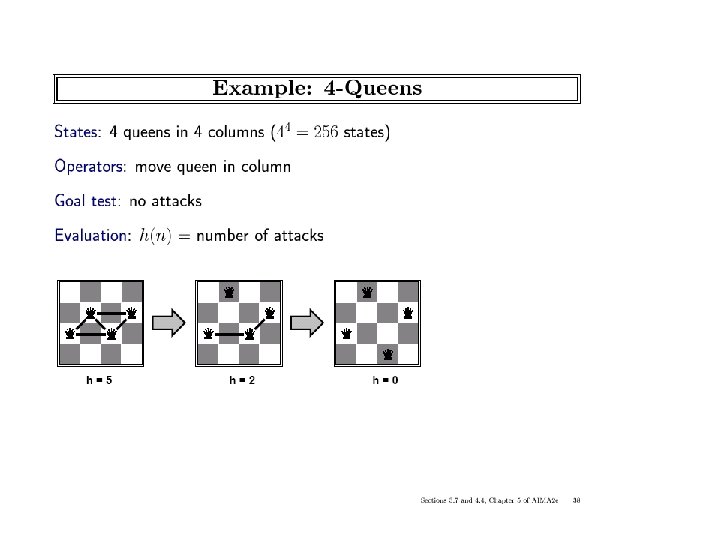
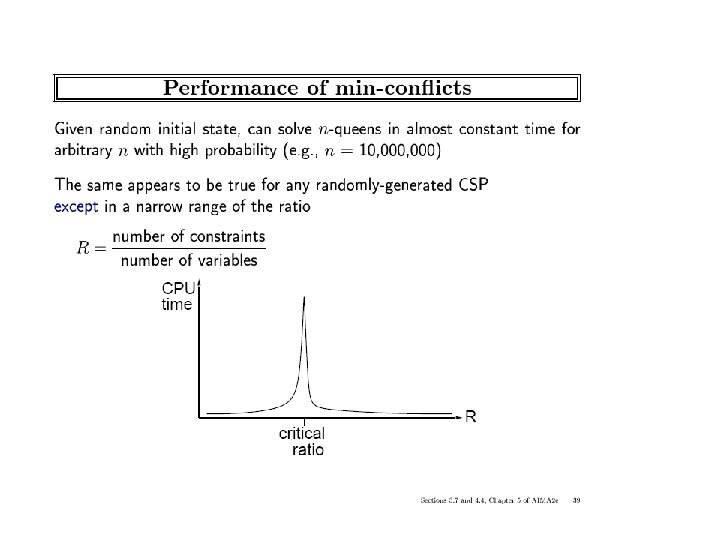
More Stochastic Search: Simulated Annealing, reweighting • Simulated annealing: – A method for overcoming local minimas – Allows bad moves with some probability: • With some probability related to a temperature parameter T the next move is picked randomly. – Theoretically, with a slow enough cooling schedule, this algorithm will find the optimal solution. But so will searching randomly. • Breakout method (Morris, 1990): adjust the weights of the violated constraints ICS-271: Notes 5: 78
ICS-271: Notes 5: 79
- Slides: 76