
Lecture 5 Arithmetic Patrick Blackburn Johan Bos Kristina
Lecture 5: Arithmetic © Patrick Blackburn, Johan Bos & Kristina Striegnitz • Theory – Introduce Prolog`s built-in abilities for performing arithmetic – Apply these to simple list processing problems, using accumulators – Look at tail-recursive predicates and explain why they are more efficient than predicates that are not tail-recursive • Exercises – Correction exercises LPN chapter 4 – Exercises LPN chapter 5
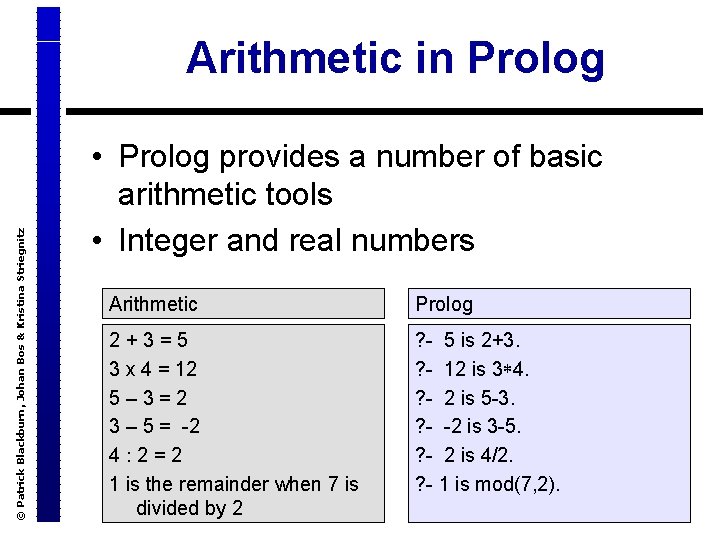
© Patrick Blackburn, Johan Bos & Kristina Striegnitz Arithmetic in Prolog • Prolog provides a number of basic arithmetic tools • Integer and real numbers Arithmetic Prolog 2 + 3 = 5 3 x 4 = 12 5 – 3 = 2 3 – 5 = -2 4 2 = 2 1 is the remainder when 7 is divided by 2 ? - 5 is 2+3. ? - 12 is 3 4. ? - 2 is 5 -3. ? - -2 is 3 -5. ? - 2 is 4/2. ? - 1 is mod(7, 2).
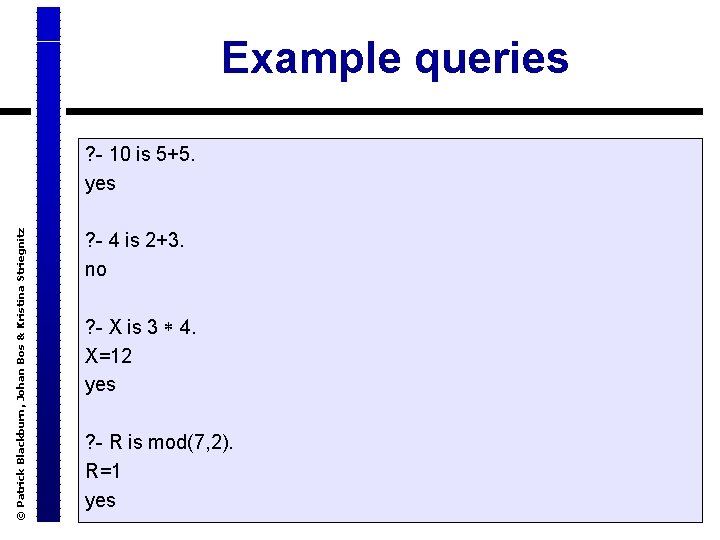
Example queries © Patrick Blackburn, Johan Bos & Kristina Striegnitz ? - 10 is 5+5. yes ? - 4 is 2+3. no ? - X is 3 4. X=12 yes ? - R is mod(7, 2). R=1 yes
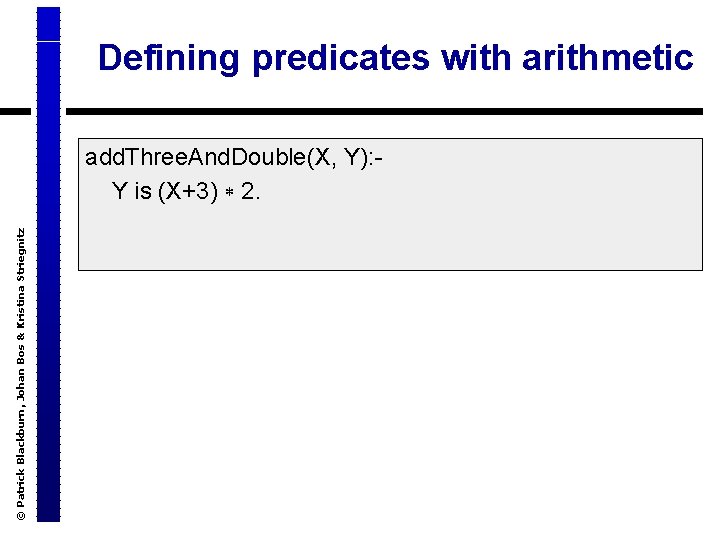
Defining predicates with arithmetic © Patrick Blackburn, Johan Bos & Kristina Striegnitz add. Three. And. Double(X, Y): - Y is (X+3) 2.
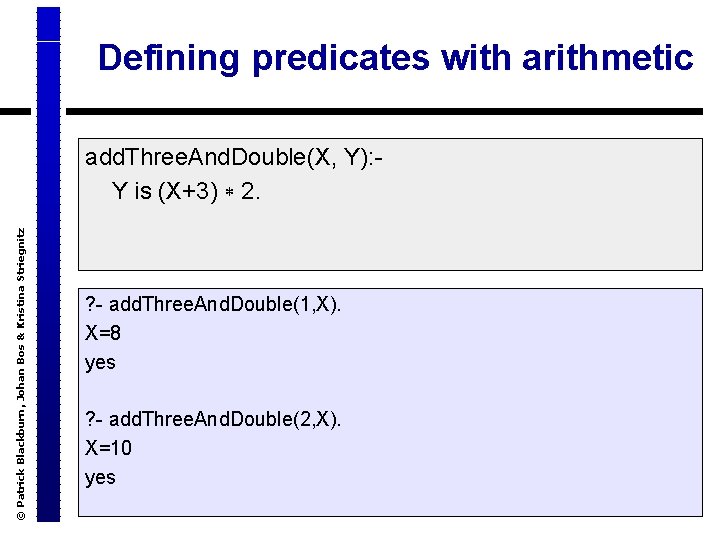
Defining predicates with arithmetic © Patrick Blackburn, Johan Bos & Kristina Striegnitz add. Three. And. Double(X, Y): - Y is (X+3) 2. ? - add. Three. And. Double(1, X). X=8 yes ? - add. Three. And. Double(2, X). X=10 yes
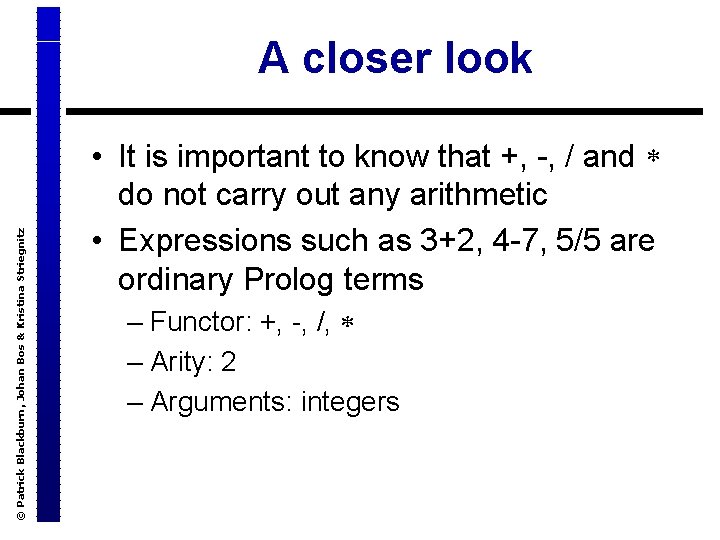
© Patrick Blackburn, Johan Bos & Kristina Striegnitz A closer look • It is important to know that +, -, / and do not carry out any arithmetic • Expressions such as 3+2, 4 -7, 5/5 are ordinary Prolog terms – Functor: +, -, /, – Arity: 2 – Arguments: integers
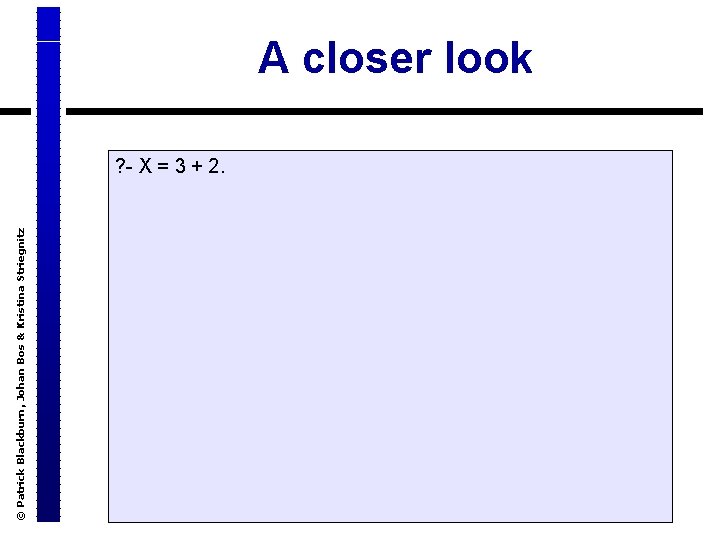
© Patrick Blackburn, Johan Bos & Kristina Striegnitz A closer look ? - X = 3 + 2.
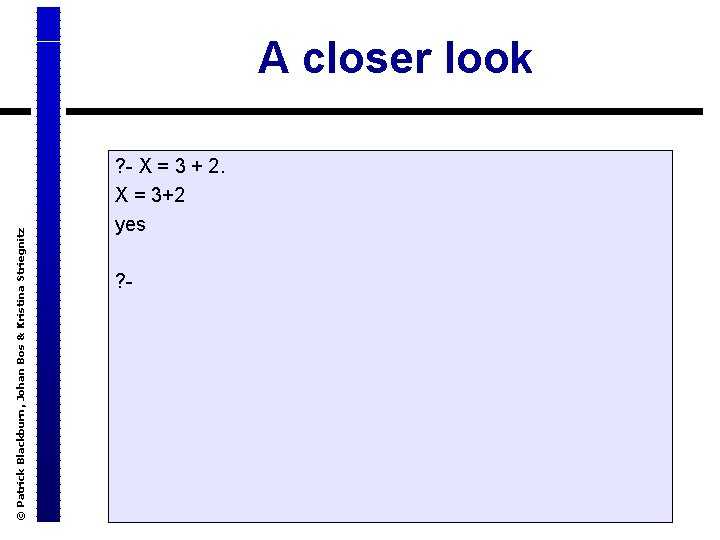
© Patrick Blackburn, Johan Bos & Kristina Striegnitz A closer look ? - X = 3 + 2. X = 3+2 yes ? -
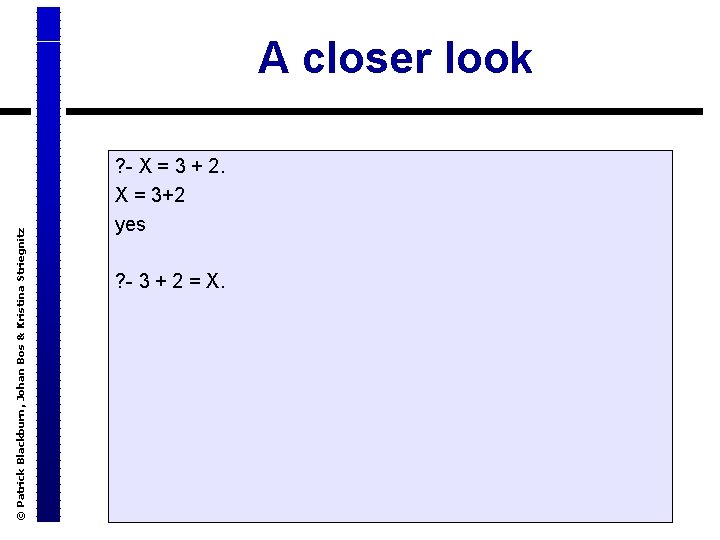
© Patrick Blackburn, Johan Bos & Kristina Striegnitz A closer look ? - X = 3 + 2. X = 3+2 yes ? - 3 + 2 = X.
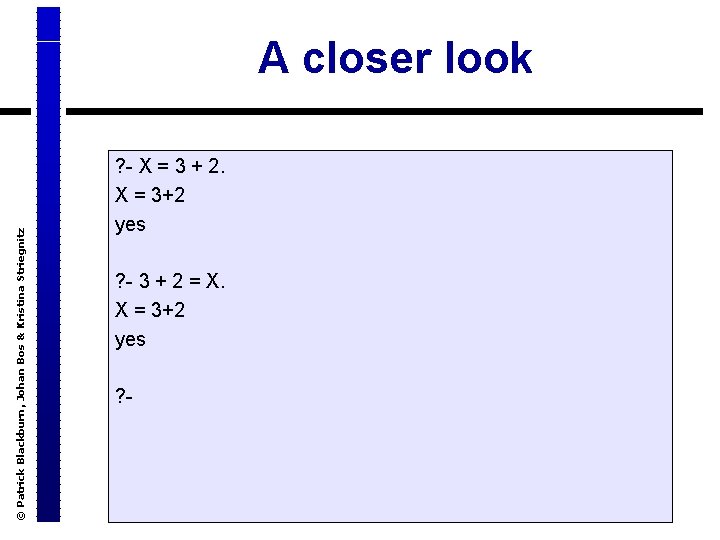
© Patrick Blackburn, Johan Bos & Kristina Striegnitz A closer look ? - X = 3 + 2. X = 3+2 yes ? - 3 + 2 = X. X = 3+2 yes ? -
The is/2 predicate © Patrick Blackburn, Johan Bos & Kristina Striegnitz • To force Prolog to actually evaluate arithmetic expressions, we have to use is just as we did in the other examples • This is an instruction for Prolog to carry out calculations • Because this is not an ordinary Prolog predicate, there are some restrictions
© Patrick Blackburn, Johan Bos & Kristina Striegnitz The is/2 predicate ? - X is 3 + 2.
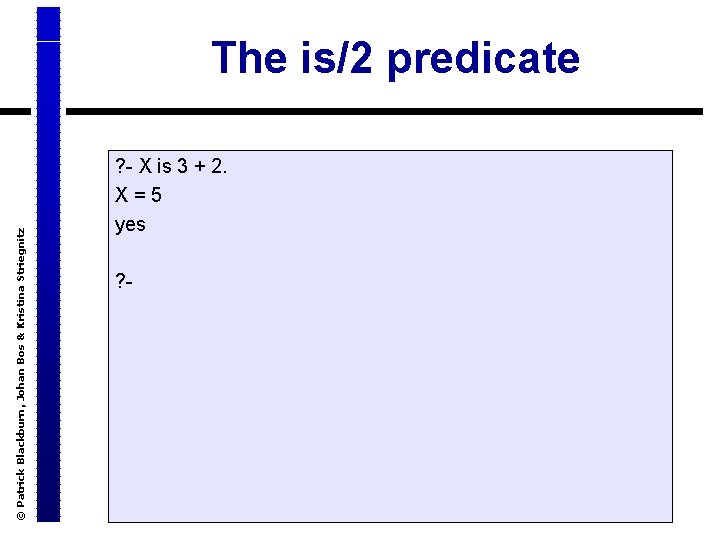
© Patrick Blackburn, Johan Bos & Kristina Striegnitz The is/2 predicate ? - X is 3 + 2. X = 5 yes ? -
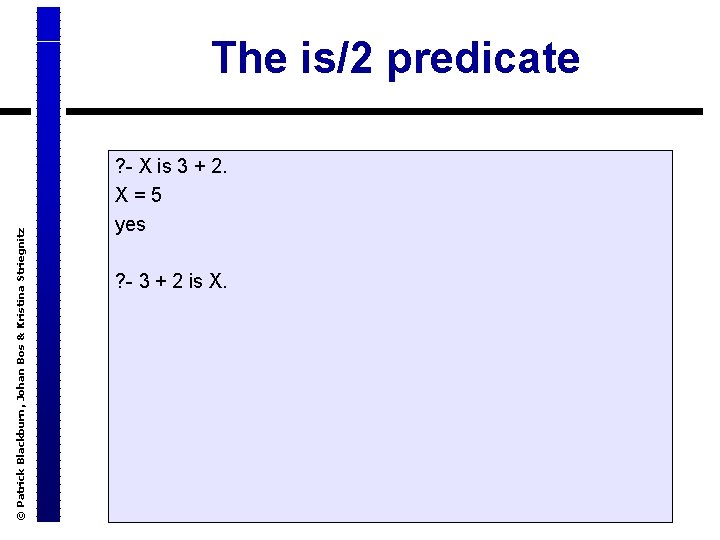
© Patrick Blackburn, Johan Bos & Kristina Striegnitz The is/2 predicate ? - X is 3 + 2. X = 5 yes ? - 3 + 2 is X.
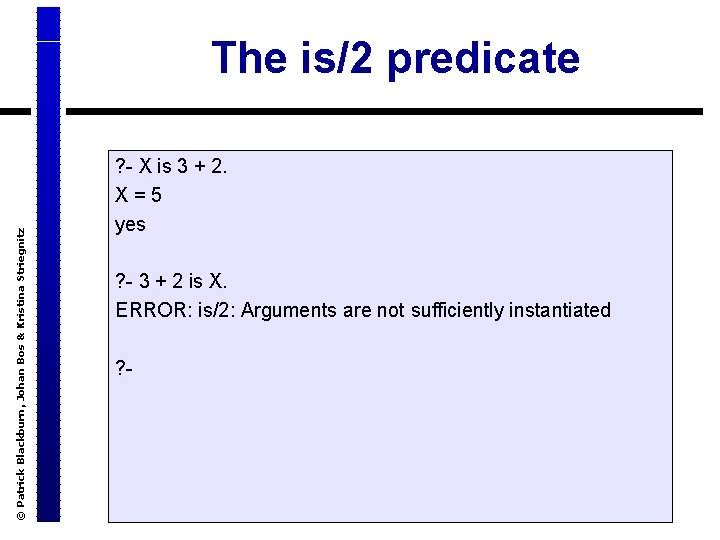
© Patrick Blackburn, Johan Bos & Kristina Striegnitz The is/2 predicate ? - X is 3 + 2. X = 5 yes ? - 3 + 2 is X. ERROR: is/2: Arguments are not sufficiently instantiated ? -
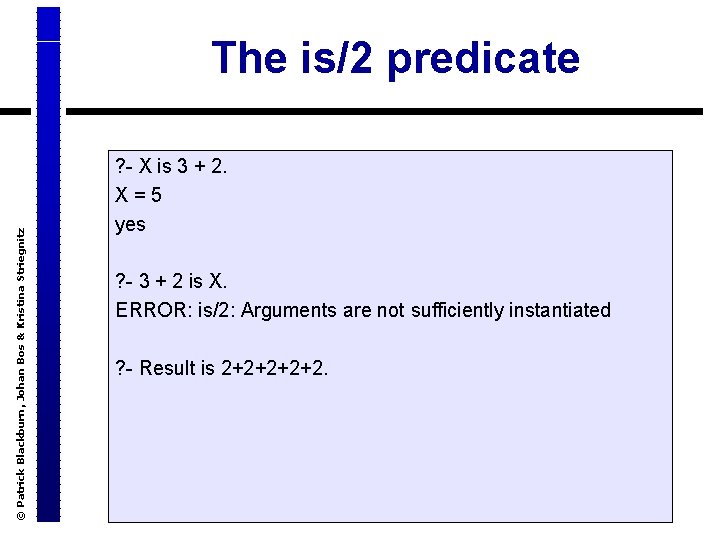
© Patrick Blackburn, Johan Bos & Kristina Striegnitz The is/2 predicate ? - X is 3 + 2. X = 5 yes ? - 3 + 2 is X. ERROR: is/2: Arguments are not sufficiently instantiated ? - Result is 2+2+2.
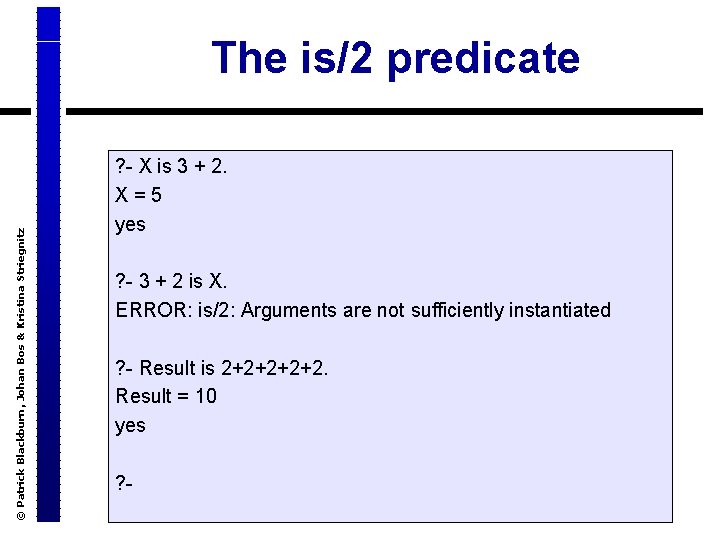
© Patrick Blackburn, Johan Bos & Kristina Striegnitz The is/2 predicate ? - X is 3 + 2. X = 5 yes ? - 3 + 2 is X. ERROR: is/2: Arguments are not sufficiently instantiated ? - Result is 2+2+2. Result = 10 yes ? -
© Patrick Blackburn, Johan Bos & Kristina Striegnitz Restrictions on use of is/2 • We are free to use variables on the right hand side of the is predicate • But when Prolog actually carries out the evaluation, the variables must be instantiated with a variable-free Prolog term • This Prolog term must be an arithmetic expression
Notation © Patrick Blackburn, Johan Bos & Kristina Striegnitz • Two final remarks on arithmetic expressions – 3+2, 4/2, 4 -5 are just ordinary Prolog terms in a user-friendly notation: 3+2 is really +(3, 2) and so on. – Also the is predicate is a two-place Prolog predicate
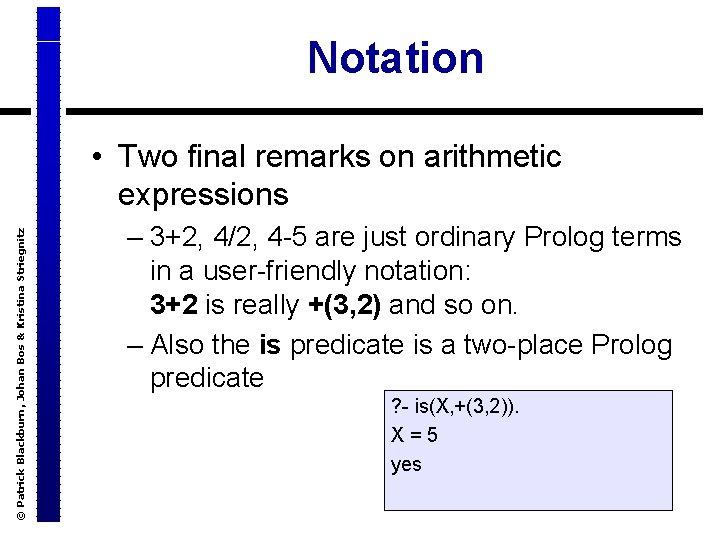
Notation © Patrick Blackburn, Johan Bos & Kristina Striegnitz • Two final remarks on arithmetic expressions – 3+2, 4/2, 4 -5 are just ordinary Prolog terms in a user-friendly notation: 3+2 is really +(3, 2) and so on. – Also the is predicate is a two-place Prolog predicate ? - is(X, +(3, 2)). X = 5 yes
Arithmetic and Lists © Patrick Blackburn, Johan Bos & Kristina Striegnitz • How long is a list? – The empty list has length: zero; – A non-empty list has length: one plus length of its tail.
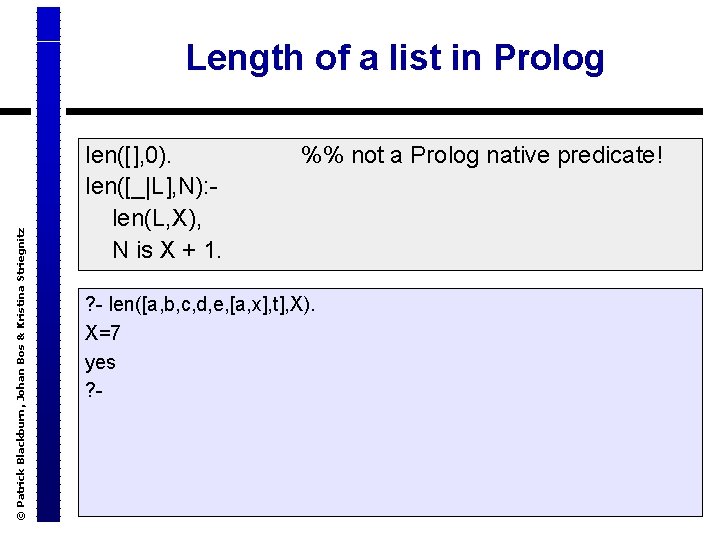
© Patrick Blackburn, Johan Bos & Kristina Striegnitz Length of a list in Prolog len([], 0). len([_|L], N): - len(L, X), N is X + 1. %% not a Prolog native predicate! ? - len([a, b, c, d, e, [a, x], t], X). X=7 yes ? -
Accumulators © Patrick Blackburn, Johan Bos & Kristina Striegnitz • This is quite a good program – Easy to understand – Relatively efficient • But there is another method of finding the length of a list – Introduce the idea of accumulators – Accumulators are variables that hold intermediate results
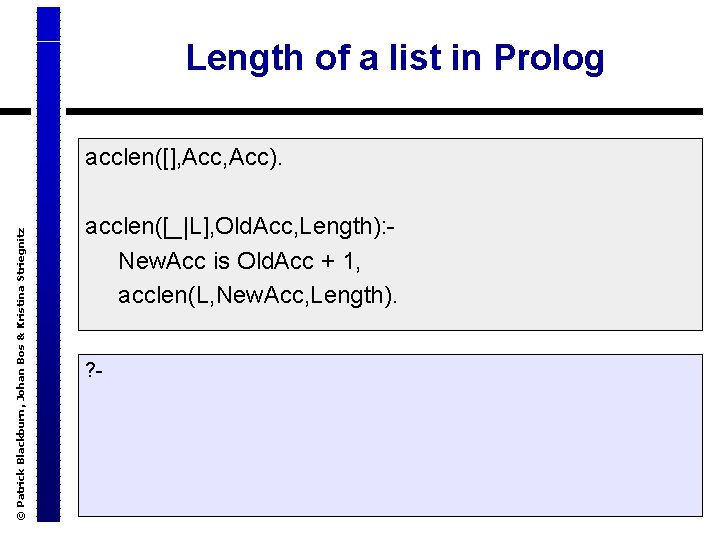
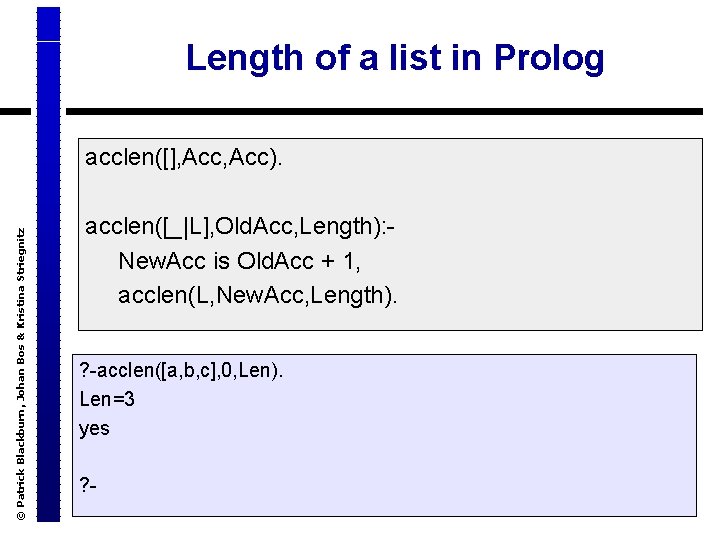
Defining acclen/3 © Patrick Blackburn, Johan Bos & Kristina Striegnitz • The predicate acclen/3 has three arguments – The list whose length we want to find – The length of the list, an integer – An accumulator, keeping track of the intermediate values for the length
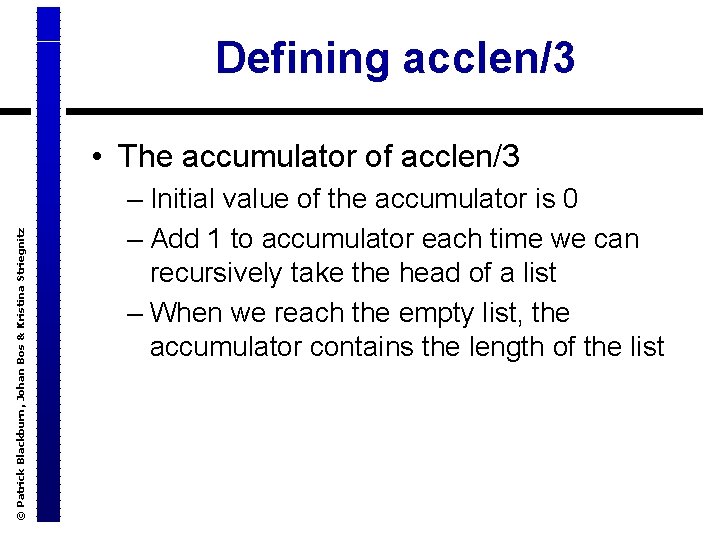
Defining acclen/3 © Patrick Blackburn, Johan Bos & Kristina Striegnitz • The accumulator of acclen/3 – Initial value of the accumulator is 0 – Add 1 to accumulator each time we can recursively take the head of a list – When we reach the empty list, the accumulator contains the length of the list
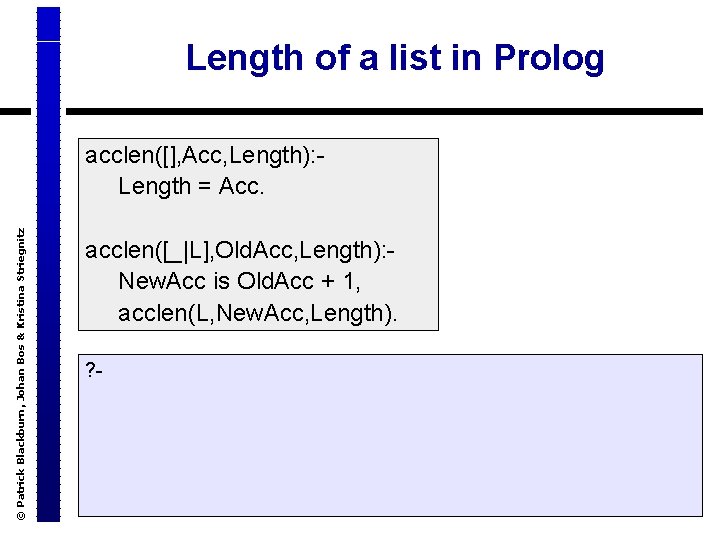
Length of a list in Prolog © Patrick Blackburn, Johan Bos & Kristina Striegnitz acclen([], Acc, Length): - Length = Acc. acclen([_|L], Old. Acc, Length): - New. Acc is Old. Acc + 1, acclen(L, New. Acc, Length). ? -
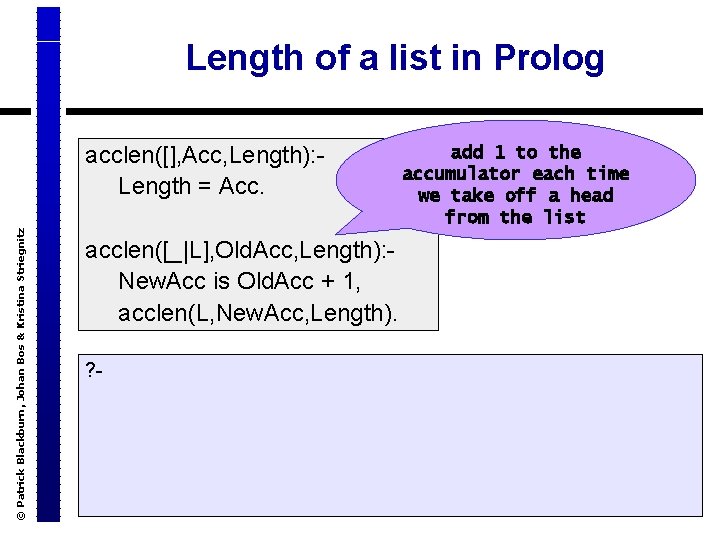
Length of a list in Prolog © Patrick Blackburn, Johan Bos & Kristina Striegnitz acclen([], Acc, Length): - Length = Acc. acclen([_|L], Old. Acc, Length): - New. Acc is Old. Acc + 1, acclen(L, New. Acc, Length). ? - add 1 to the accumulator each time we take off a head from the list
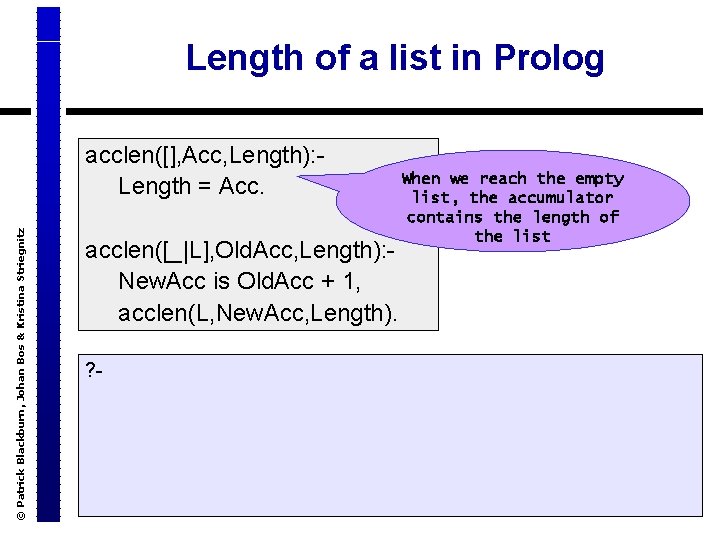
Length of a list in Prolog © Patrick Blackburn, Johan Bos & Kristina Striegnitz acclen([], Acc, Length): - Length = Acc. acclen([_|L], Old. Acc, Length): - New. Acc is Old. Acc + 1, acclen(L, New. Acc, Length). ? - When we reach the empty list, the accumulator contains the length of the list
© Patrick Blackburn, Johan Bos & Kristina Striegnitz Length of a list in Prolog acclen([], Acc). acclen([_|L], Old. Acc, Length): - New. Acc is Old. Acc + 1, acclen(L, New. Acc, Length). ? -
© Patrick Blackburn, Johan Bos & Kristina Striegnitz Length of a list in Prolog acclen([], Acc). acclen([_|L], Old. Acc, Length): - New. Acc is Old. Acc + 1, acclen(L, New. Acc, Length). ? -acclen([a, b, c], 0, Len). Len=3 yes ? -
Search tree for acclen/3 © Patrick Blackburn, Johan Bos & Kristina Striegnitz ? - acclen([a, b, c], 0, Len). acclen([ ], Acc). acclen([_|L], Old. Acc, Length): - New. Acc is Old. Acc + 1, acclen(L, New. Acc, Length).
© Patrick Blackburn, Johan Bos & Kristina Striegnitz Search tree for acclen/3 ? - acclen([a, b, c], 0, Len). / acclen([ ], Acc). acclen([_|L], Old. Acc, Length): - New. Acc is Old. Acc + 1, acclen(L, New. Acc, Length).
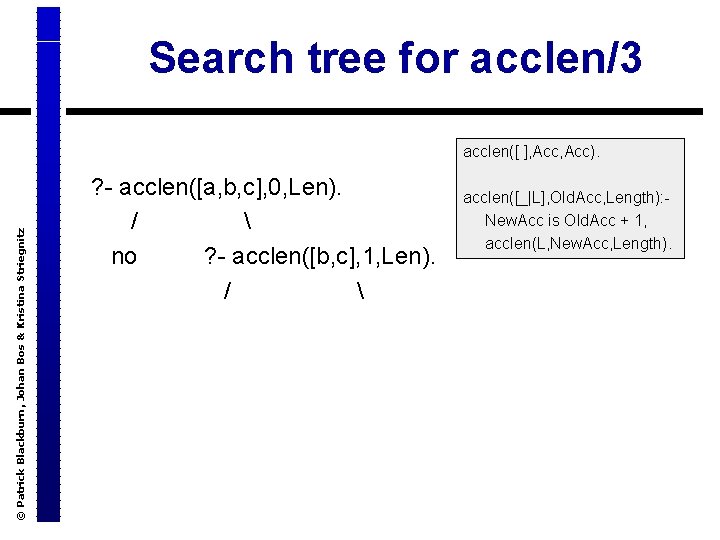
© Patrick Blackburn, Johan Bos & Kristina Striegnitz Search tree for acclen/3 ? - acclen([a, b, c], 0, Len). / no ? - acclen([b, c], 1, Len). / acclen([ ], Acc). acclen([_|L], Old. Acc, Length): - New. Acc is Old. Acc + 1, acclen(L, New. Acc, Length).
![© Patrick Blackburn, Johan Bos & Kristina Striegnitz Search tree for acclen/3 acclen([ ],](http://slidetodoc.com/presentation_image/352786677c6aa30839365d3745d4856f/image-34.jpg "© Patrick Blackburn, Johan Bos & Kristina Striegnitz Search tree for acclen/3 acclen([ ],")
© Patrick Blackburn, Johan Bos & Kristina Striegnitz Search tree for acclen/3 acclen([ ], Acc). acclen([_|L], Old. Acc, Length): - New. Acc is Old. Acc + 1, acclen(L, New. Acc, Length). ? - acclen([a, b, c], 0, Len). / no ? - acclen([b, c], 1, Len). / no ? - acclen([c], 2, Len). /
![© Patrick Blackburn, Johan Bos & Kristina Striegnitz Search tree for acclen/3 acclen([ ],](http://slidetodoc.com/presentation_image/352786677c6aa30839365d3745d4856f/image-35.jpg "© Patrick Blackburn, Johan Bos & Kristina Striegnitz Search tree for acclen/3 acclen([ ],")
© Patrick Blackburn, Johan Bos & Kristina Striegnitz Search tree for acclen/3 acclen([ ], Acc). acclen([_|L], Old. Acc, Length): - New. Acc is Old. Acc + 1, acclen(L, New. Acc, Length). ? - acclen([a, b, c], 0, Len). / no ? - acclen([b, c], 1, Len). / no ? - acclen([c], 2, Len). / no ? - acclen([], 3, Len). /
![© Patrick Blackburn, Johan Bos & Kristina Striegnitz Search tree for acclen/3 acclen([ ],](http://slidetodoc.com/presentation_image/352786677c6aa30839365d3745d4856f/image-36.jpg "© Patrick Blackburn, Johan Bos & Kristina Striegnitz Search tree for acclen/3 acclen([ ],")
© Patrick Blackburn, Johan Bos & Kristina Striegnitz Search tree for acclen/3 acclen([ ], Acc). acclen([_|L], Old. Acc, Length): - New. Acc is Old. Acc + 1, acclen(L, New. Acc, Length). ? - acclen([a, b, c], 0, Len). / no ? - acclen([b, c], 1, Len). / no ? - acclen([c], 2, Len). / no ? - acclen([], 3, Len). / Len=3 no
![© Patrick Blackburn, Johan Bos & Kristina Striegnitz Adding a wrapper predicate acclen([ ],](http://slidetodoc.com/presentation_image/352786677c6aa30839365d3745d4856f/image-37.jpg "© Patrick Blackburn, Johan Bos & Kristina Striegnitz Adding a wrapper predicate acclen([ ],")
© Patrick Blackburn, Johan Bos & Kristina Striegnitz Adding a wrapper predicate acclen([ ], Acc). acclen([ _|L], Old. Acc, Length): - New. Acc is Old. Acc + 1, acclen(L, New. Acc, Length). length(List, Length): - acclen(List, 0, Length). ? -length([a, b, c], X). X=3 yes %% native Prolog predicate
Tail recursion • Why is acclen/3 better than len/2 ? © Patrick Blackburn, Johan Bos & Kristina Striegnitz – acclen/3 is tail-recursive, and len/2 is not • Difference: – In tail recursive predicates the results is fully calculated once we reach the base clause – In recursive predicates that are not tail recursive, there are still goals on the stack when we reach the base clause
![Comparison © Patrick Blackburn, Johan Bos & Kristina Striegnitz Not tail-recursive len([], 0). len([_|L],](http://slidetodoc.com/presentation_image/352786677c6aa30839365d3745d4856f/image-39.jpg "Comparison © Patrick Blackburn, Johan Bos & Kristina Striegnitz Not tail-recursive len([], 0). len([_|L],")
Comparison © Patrick Blackburn, Johan Bos & Kristina Striegnitz Not tail-recursive len([], 0). len([_|L], New. Length): - len(L, Length), New. Length is Length + 1. Tail-recursive acclen([], Acc). acclen([_|L], Old. Acc, Length): - New. Acc is Old. Acc + 1, acclen(L, New. Acc, Length).
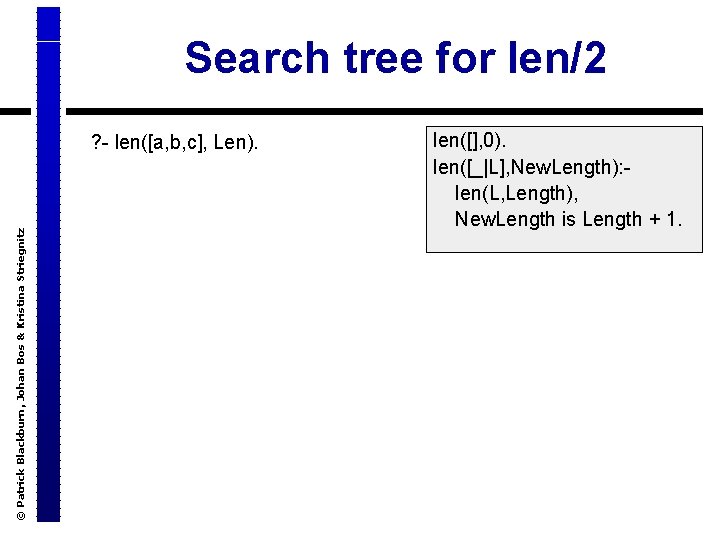
Search tree for len/2 © Patrick Blackburn, Johan Bos & Kristina Striegnitz ? - len([a, b, c], Len). len([], 0). len([_|L], New. Length): - len(L, Length), New. Length is Length + 1.
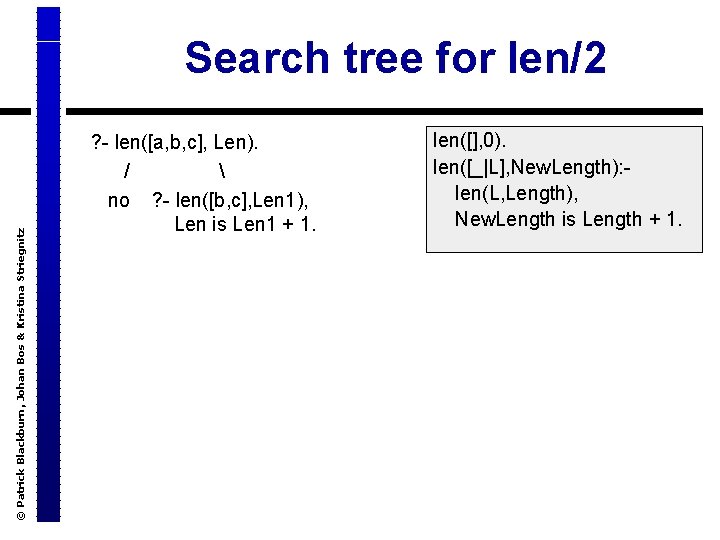
© Patrick Blackburn, Johan Bos & Kristina Striegnitz Search tree for len/2 ? - len([a, b, c], Len). / no ? - len([b, c], Len 1), Len is Len 1 + 1. len([], 0). len([_|L], New. Length): - len(L, Length), New. Length is Length + 1.
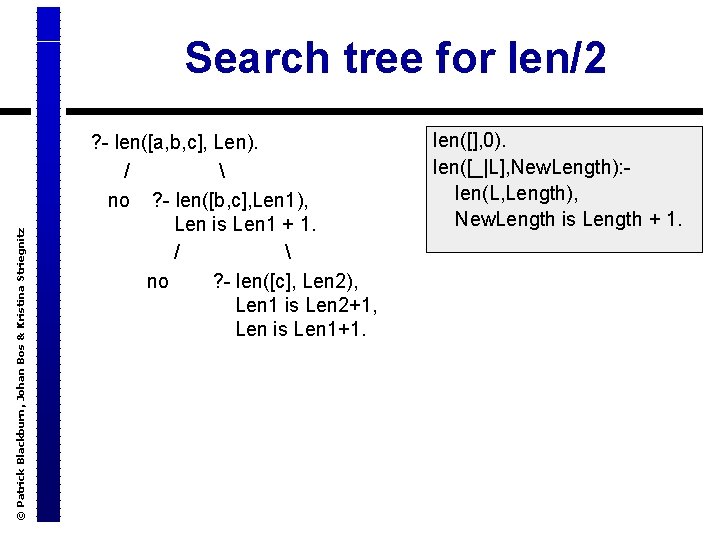
© Patrick Blackburn, Johan Bos & Kristina Striegnitz Search tree for len/2 ? - len([a, b, c], Len). / no ? - len([b, c], Len 1), Len is Len 1 + 1. / no ? - len([c], Len 2), Len 1 is Len 2+1, Len is Len 1+1. len([], 0). len([_|L], New. Length): - len(L, Length), New. Length is Length + 1.
![© Patrick Blackburn, Johan Bos & Kristina Striegnitz Search tree for len/2 len([], 0).](http://slidetodoc.com/presentation_image/352786677c6aa30839365d3745d4856f/image-43.jpg "© Patrick Blackburn, Johan Bos & Kristina Striegnitz Search tree for len/2 len([], 0).")
© Patrick Blackburn, Johan Bos & Kristina Striegnitz Search tree for len/2 len([], 0). ? - len([a, b, c], Len). len([_|L], New. Length): - / len(L, Length), no ? - len([b, c], Len 1), New. Length is Length + 1. Len is Len 1 + 1. / no ? - len([c], Len 2), Len 1 is Len 2+1, Len is Len 1+1. / no ? - len([], Len 3), Len 2 is Len 3+1, Len 1 is Len 2+1, Len is Len 1 + 1.
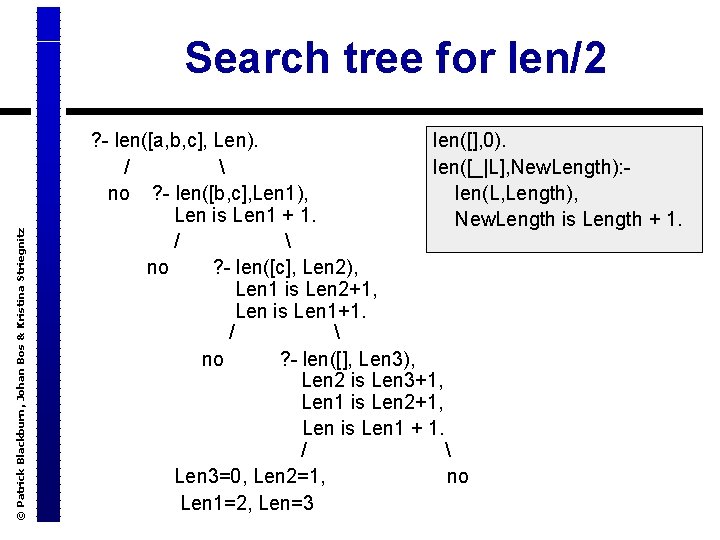
© Patrick Blackburn, Johan Bos & Kristina Striegnitz Search tree for len/2 ? - len([a, b, c], Len). len([], 0). / len([_|L], New. Length): - no ? - len([b, c], Len 1), len(L, Length), Len is Len 1 + 1. New. Length is Length + 1. / no ? - len([c], Len 2), Len 1 is Len 2+1, Len is Len 1+1. / no ? - len([], Len 3), Len 2 is Len 3+1, Len 1 is Len 2+1, Len is Len 1 + 1. / Len 3=0, Len 2=1, no Len 1=2, Len=3
![© Patrick Blackburn, Johan Bos & Kristina Striegnitz Search tree for acclen/3 acclen([ ],](http://slidetodoc.com/presentation_image/352786677c6aa30839365d3745d4856f/image-45.jpg "© Patrick Blackburn, Johan Bos & Kristina Striegnitz Search tree for acclen/3 acclen([ ],")
© Patrick Blackburn, Johan Bos & Kristina Striegnitz Search tree for acclen/3 acclen([ ], Acc). acclen([_|L], Old. Acc, Length): - New. Acc is Old. Acc + 1, acclen(L, New. Acc, Length). ? - acclen([a, b, c], 0, Len). / no ? - acclen([b, c], 1, Len). / no ? - acclen([c], 2, Len). / no ? - acclen([], 3, Len). / Len=3 no
© Patrick Blackburn, Johan Bos & Kristina Striegnitz Comparing Integers • Some Prolog arithmetic predicates actually do carry out arithmetic by themselves • These are the operators that compare integers
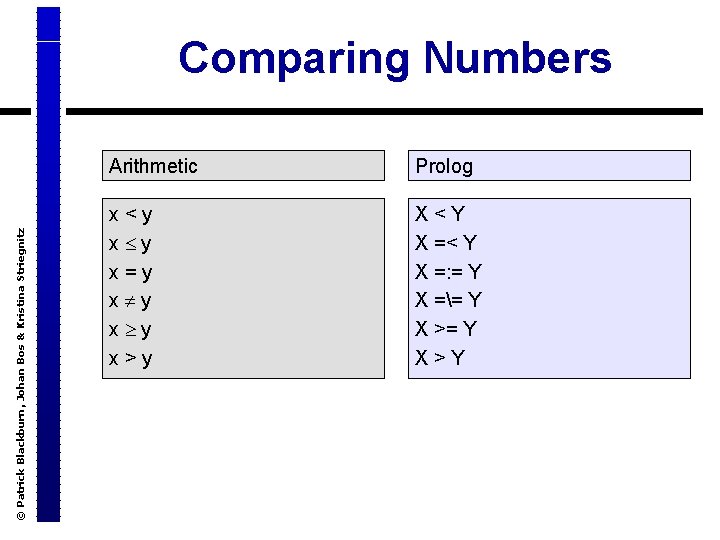
© Patrick Blackburn, Johan Bos & Kristina Striegnitz Comparing Numbers Arithmetic Prolog x < y x = y x > y X < Y X =: = Y X == Y X > Y
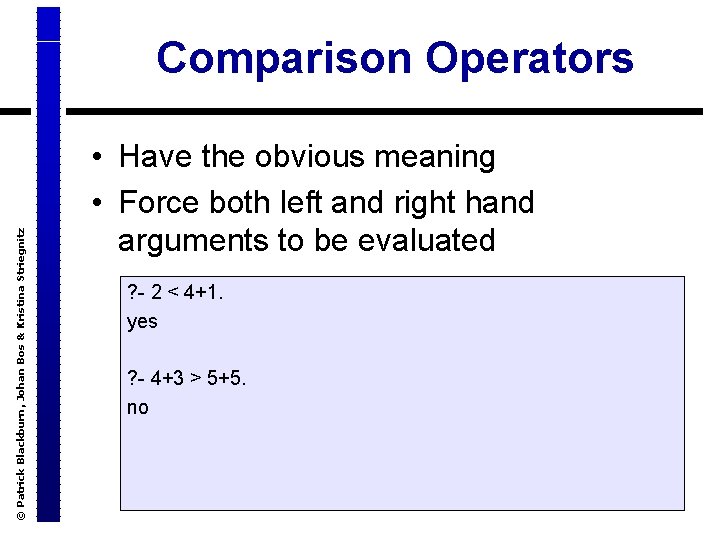
© Patrick Blackburn, Johan Bos & Kristina Striegnitz Comparison Operators • Have the obvious meaning • Force both left and right hand arguments to be evaluated ? - 2 < 4+1. yes ? - 4+3 > 5+5. no
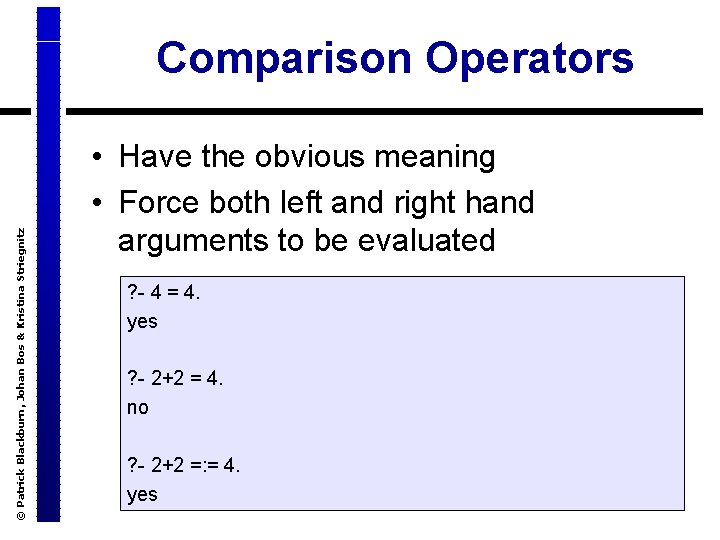
© Patrick Blackburn, Johan Bos & Kristina Striegnitz Comparison Operators • Have the obvious meaning • Force both left and right hand arguments to be evaluated ? - 4 = 4. yes ? - 2+2 = 4. no ? - 2+2 =: = 4. yes
Comparing Numbers © Patrick Blackburn, Johan Bos & Kristina Striegnitz • We are going to define a predicate that takes two arguments, and is true when: – The first argument is a list of integers – The second argument is the highest integer in the list • Basic idea – We will use an accumulator – The accumulator keeps track of the highest value encountered so far – If we find a higher value, the accumulator will be updated
![Definition of acc. Max/3 © Patrick Blackburn, Johan Bos & Kristina Striegnitz acc. Max([H|T],](http://slidetodoc.com/presentation_image/352786677c6aa30839365d3745d4856f/image-51.jpg "Definition of acc. Max/3 © Patrick Blackburn, Johan Bos & Kristina Striegnitz acc. Max([H|T],")
Definition of acc. Max/3 © Patrick Blackburn, Johan Bos & Kristina Striegnitz acc. Max([H|T], A, Max): - H > A, acc. Max(T, H, Max). acc. Max([H|T], A, Max): - H =< A, acc. Max(T, A, Max). acc. Max([], A, A). ? - acc. Max([1, 0, 5, 4], 0, Max). Max=5 yes
![© Patrick Blackburn, Johan Bos & Kristina Striegnitz Adding a wrapper max/2 acc. Max([H|T],](http://slidetodoc.com/presentation_image/352786677c6aa30839365d3745d4856f/image-52.jpg "© Patrick Blackburn, Johan Bos & Kristina Striegnitz Adding a wrapper max/2 acc. Max([H|T],")
© Patrick Blackburn, Johan Bos & Kristina Striegnitz Adding a wrapper max/2 acc. Max([H|T], A, Max): - H > A, acc. Max(T, H, Max). ? - max([1, 0, 5, 4], Max). Max=5 yes acc. Max([H|T], A, Max): - H =< A, acc. Max(T, A, Max). ? - max([-3, -1, -5, -4], Max). Max= -1 yes acc. Max([], A, A). ? - max([H|T], Max): acc. Max(T, H, Max).
© Patrick Blackburn, Johan Bos & Kristina Striegnitz Summary of this lecture • In this lecture we showed how Prolog does arithmetic • We demonstrated the difference between tail-recursive predicates and predicates that are not tail-recursive • We introduced the programming technique of using accumulators • We also introduced the idea of using wrapper predicates
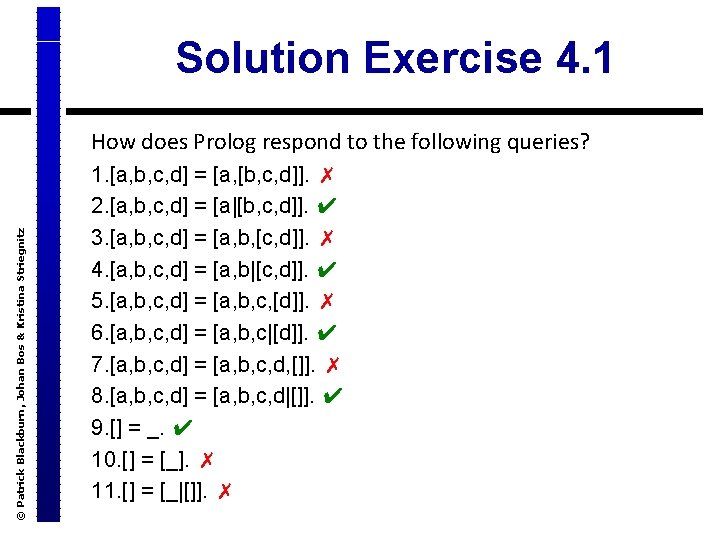
Solution Exercise 4. 1 © Patrick Blackburn, Johan Bos & Kristina Striegnitz How does Prolog respond to the following queries? 1. [a, b, c, d] = [a, [b, c, d]]. ✗ 2. [a, b, c, d] = [a|[b, c, d]]. ✔ 3. [a, b, c, d] = [a, b, [c, d]]. ✗ 4. [a, b, c, d] = [a, b|[c, d]]. ✔ 5. [a, b, c, d] = [a, b, c, [d]]. ✗ 6. [a, b, c, d] = [a, b, c|[d]]. ✔ 7. [a, b, c, d] = [a, b, c, d, []]. ✗ 8. [a, b, c, d] = [a, b, c, d|[]]. ✔ 9. [] = _. ✔ 10. [] = [_]. ✗ 11. [] = [_|[]]. ✗
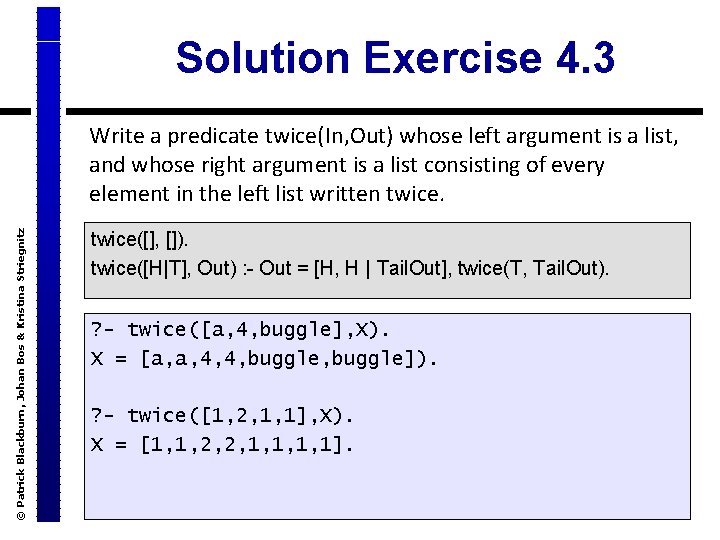
Solution Exercise 4. 3 © Patrick Blackburn, Johan Bos & Kristina Striegnitz Write a predicate twice(In, Out) whose left argument is a list, and whose right argument is a list consisting of every element in the left list written twice([], []). twice([H|T], Out) : - Out = [H, H | Tail. Out], twice(T, Tail. Out). ? - twice([a, 4, buggle], X). X = [a, a, 4, 4, buggle]). ? - twice([1, 2, 1, 1], X). X = [1, 1, 2, 2, 1, 1].
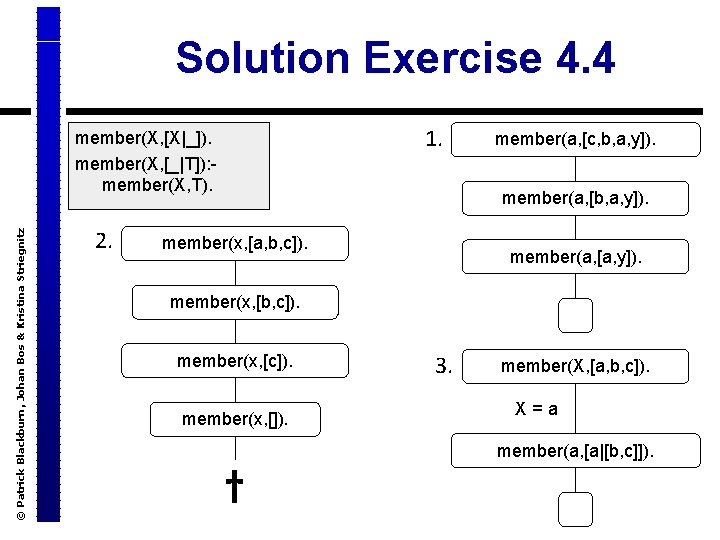
Solution Exercise 4. 4 1. © Patrick Blackburn, Johan Bos & Kristina Striegnitz member(X, [X|_]). member(X, [_|T]): - member(X, T). 2. member(a, [c, b, a, y]). member(a, [b, a, y]). member(x, [a, b, c]). member(a, [a, y]). member(x, [b, c]). member(x, []). 3. member(X, [a, b, c]). X = a member(a, [a|[b, c]]). †
© Patrick Blackburn, Johan Bos & Kristina Striegnitz Exercise LPN Chapter 5 • 5. 1, 5. 2, 5. 3
Next lecture © Patrick Blackburn, Johan Bos & Kristina Striegnitz • Yes, more lists! – Defining the append/3, a predicate that concatenates two lists – Discuss the idea of reversing a list, first naively using append/3, then with a more efficient way using accumulators
- Slides: 58