
Lecture 5 Algorithm Analysis and Modeling CSE 373

![O, Omega, Theta [oh my? ] Big-O is an upper bound - My code](https://slidetodoc.com/presentation_image_h2/cbdefda54cf55d5aa1172714bc489094/image-16.jpg "O, Omega, Theta [oh my? ] Big-O is an upper bound - My code")
- Slides: 19
Lecture 5: Algorithm Analysis and Modeling CSE 373: Data Structures and Algorithms CSE 373 19 WI - KASEY CHAMPION 1
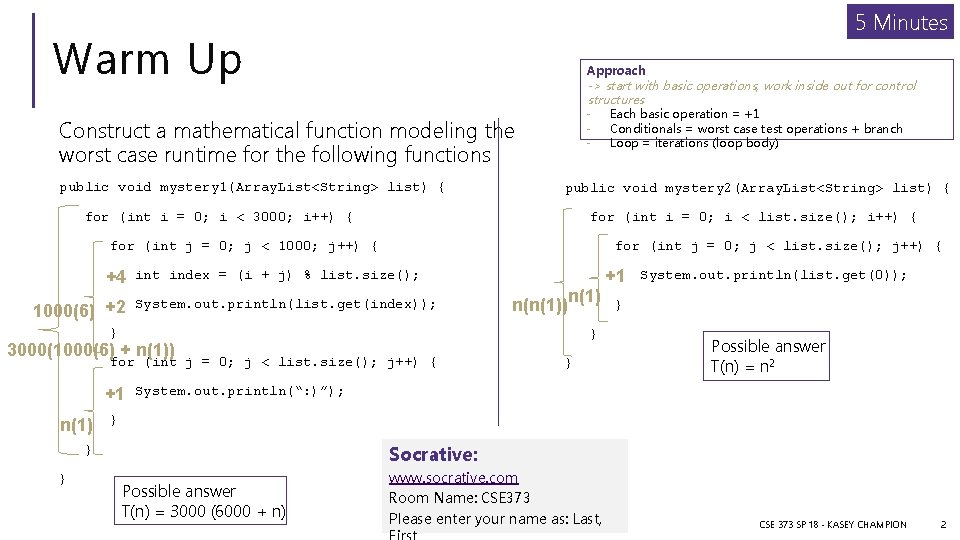
5 Minutes Warm Up Approach -> start with basic operations, work inside out for control structures - Each basic operation = +1 - Conditionals = worst case test operations + branch - Loop = iterations (loop body) Construct a mathematical function modeling the worst case runtime for the following functions public void mystery 1(Array. List<String> list) { public void mystery 2(Array. List<String> list) { for (int i = 0; i < 3000; i++) { for (int i = 0; i < list. size(); i++) { for (int j = 0; j < 1000; j++) { +4 1000(6) +2 for (int j = 0; j < list. size(); j++) { int index = (i + j) % list. size(); System. out. println(list. get(index)); n(1) n(n(1)) } } 3000(1000(6) + n(1)) for (int j = 0; j < list. size(); j++) { +1 n(1) System. out. println(list. get(0)); } Possible answer T(n) = n 2 System. out. println(“: )”); } Socrative: } } } +1 Possible answer T(n) = 3000 (6000 + n) www. socrative. com Room Name: CSE 373 Please enter your name as: Last, CSE 373 SP 18 - KASEY CHAMPION 2
Adminstrivia HW 1 Due Friday at 11: 59 pm HW 2 goes live Friday FILL OUT PARTNER FORM 1 partner Netid NOT student number Please fill out class survey Assign me a partner form CSE 373 SP 18 - KASEY CHAMPION 3
Why don’t we care about exact constants? Not enough information to compute precise constants Depends on too many factors (underlying hardware, background processes, temperature etc…) We really care about the growth of the function Big O… CSE 373 SP 18 - KASEY CHAMPION 4
Comparing Functions CSE 373 SP 18 - KASEY CHAMPION 5
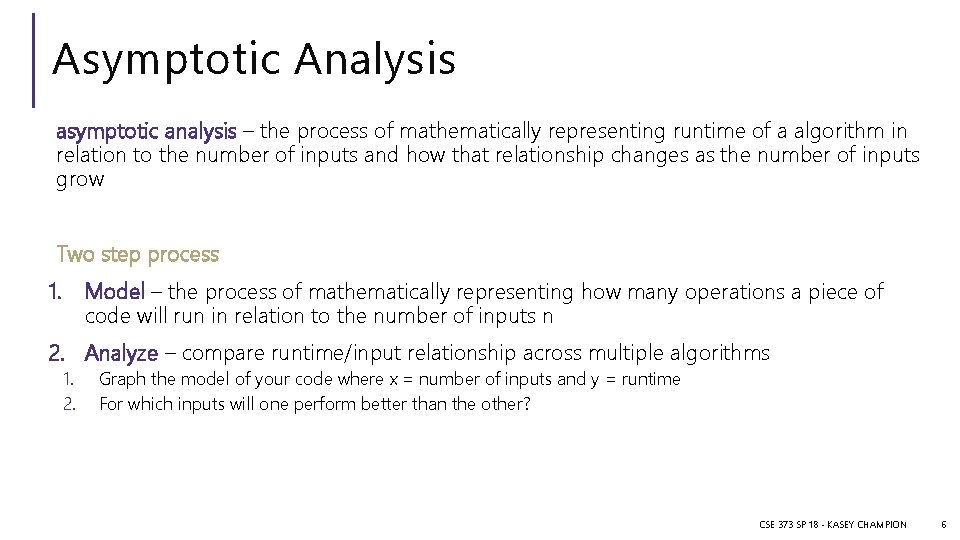
Asymptotic Analysis asymptotic analysis – the process of mathematically representing runtime of a algorithm in relation to the number of inputs and how that relationship changes as the number of inputs grow Two step process 1. Model – the process of mathematically representing how many operations a piece of code will run in relation to the number of inputs n 2. Analyze – compare runtime/input relationship across multiple algorithms 1. 2. Graph the model of your code where x = number of inputs and y = runtime For which inputs will one perform better than the other? CSE 373 SP 18 - KASEY CHAMPION 6
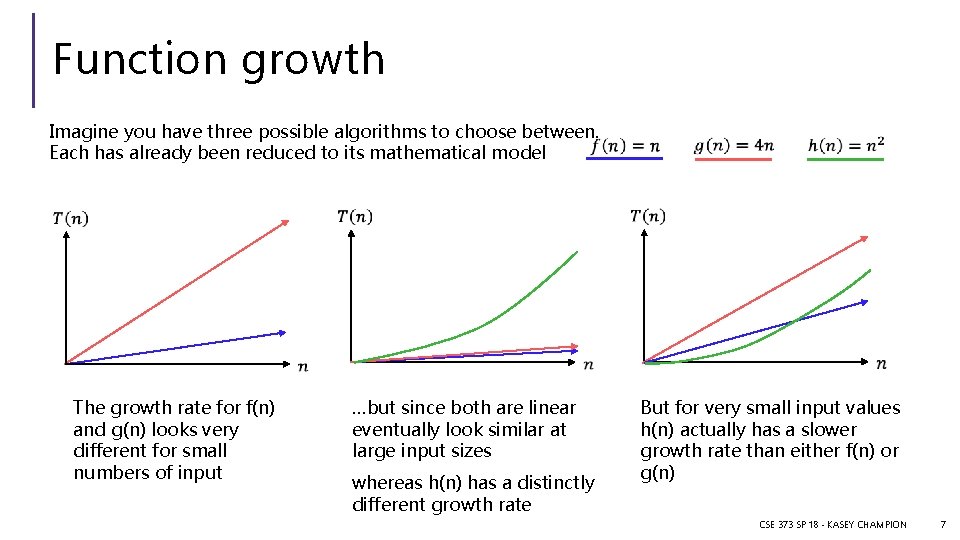
Function growth Imagine you have three possible algorithms to choose between. Each has already been reduced to its mathematical model The growth rate for f(n) and g(n) looks very different for small numbers of input …but since both are linear eventually look similar at large input sizes whereas h(n) has a distinctly different growth rate But for very small input values h(n) actually has a slower growth rate than either f(n) or g(n) CSE 373 SP 18 - KASEY CHAMPION 7
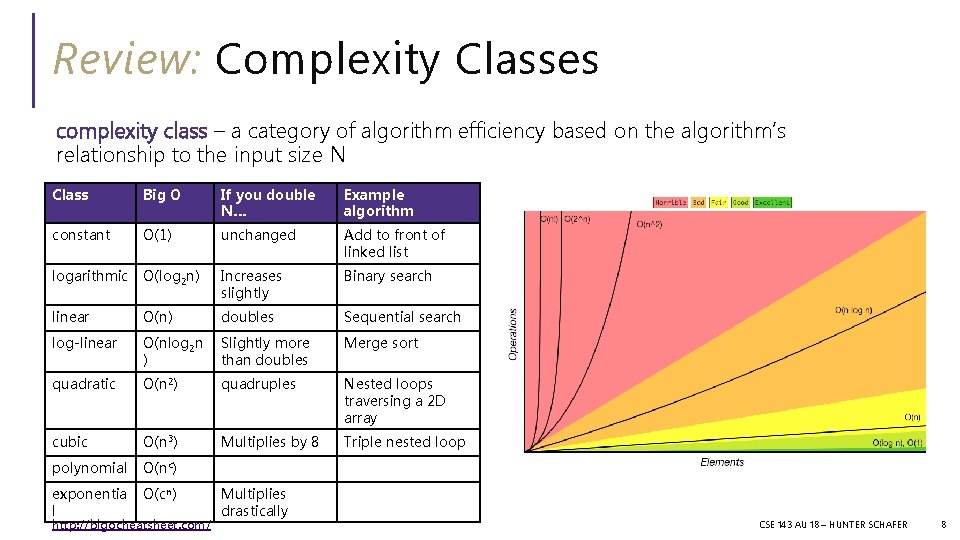
Review: Complexity Classes complexity class – a category of algorithm efficiency based on the algorithm’s relationship to the input size N Class Big O If you double N… Example algorithm constant O(1) unchanged Add to front of linked list logarithmic O(log 2 n) Increases slightly Binary search linear O(n) doubles Sequential search log-linear O(nlog 2 n ) Slightly more than doubles Merge sort quadratic O(n 2) quadruples Nested loops traversing a 2 D array cubic O(n 3) Multiplies by 8 Triple nested loop polynomial O(nc) exponentia l O(cn) http: //bigocheatsheet. com/ Multiplies drastically CSE 143 AU 18 – HUNTER SCHAFER 8
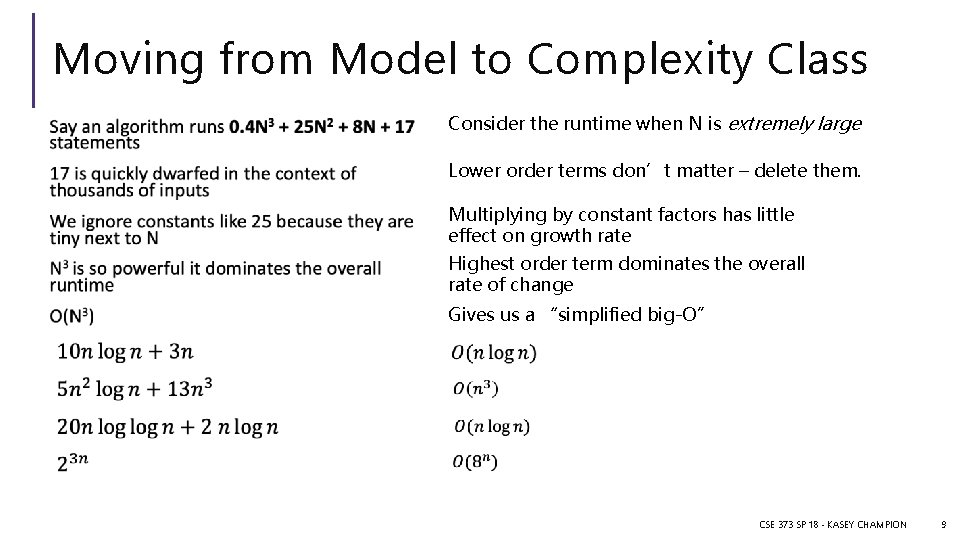
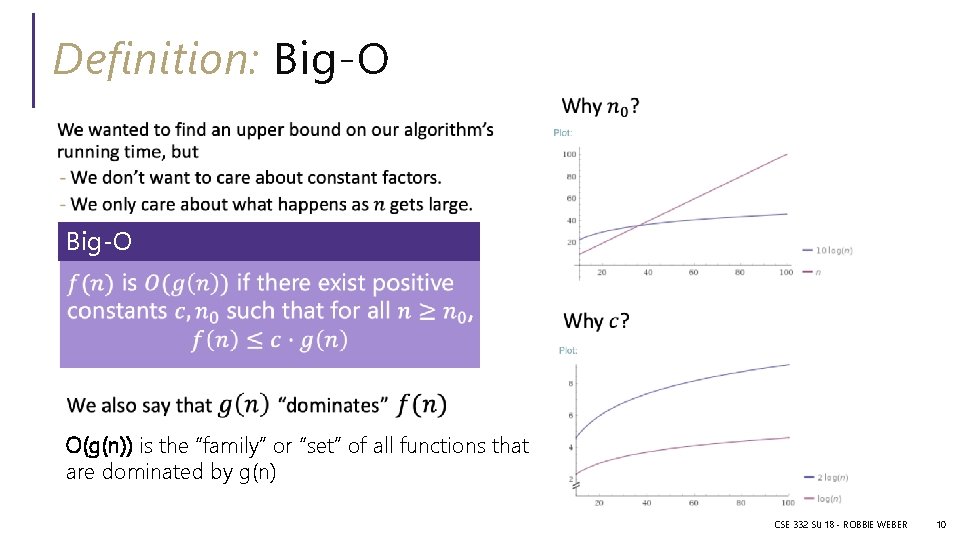
Moving from Model to Complexity Class Consider the runtime when N is extremely large Lower order terms don’t matter – delete them. Multiplying by constant factors has little effect on growth rate Highest order term dominates the overall rate of change Gives us a “simplified big-O” CSE 373 SP 18 - KASEY CHAMPION 9
Definition: Big-O O(g(n)) is the “family” or “set” of all functions that are dominated by g(n) CSE 332 SU 18 - ROBBIE WEBER 10
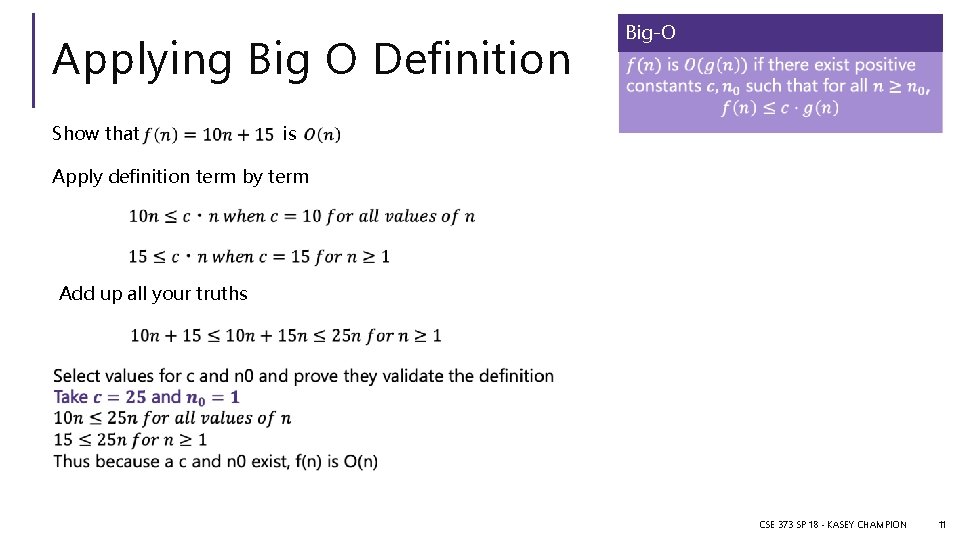
Applying Big O Definition Show that Big-O is Apply definition term by term Add up all your truths CSE 373 SP 18 - KASEY CHAMPION 11
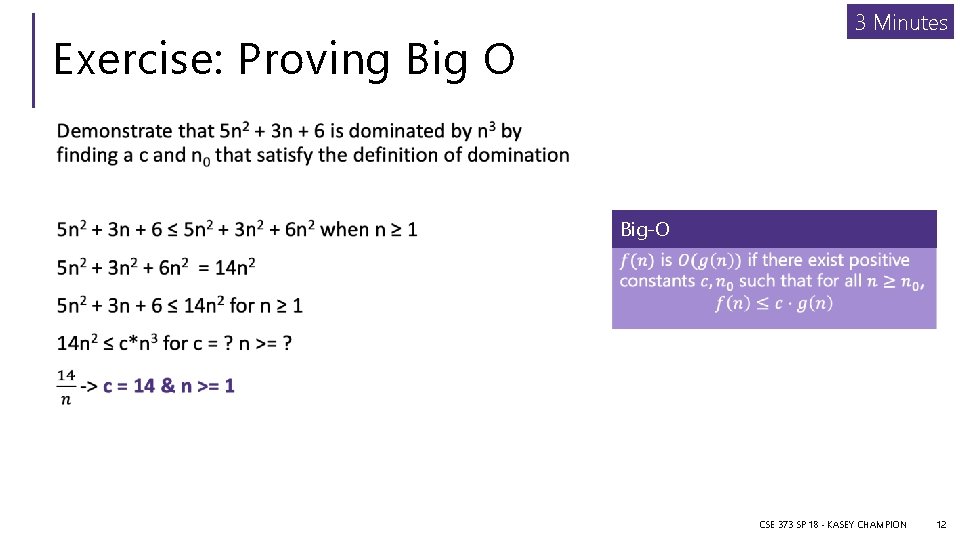
3 Minutes Exercise: Proving Big O Big-O CSE 373 SP 18 - KASEY CHAMPION 12
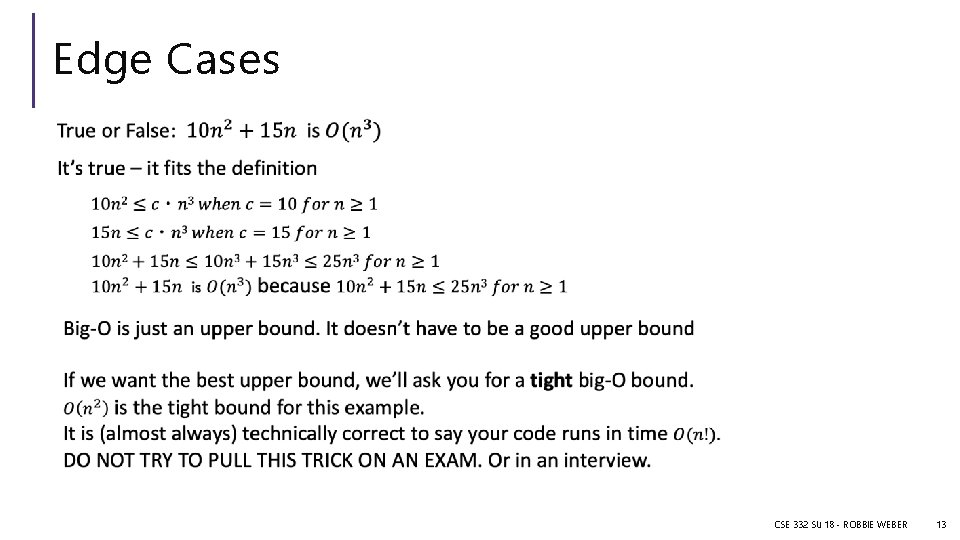
Edge Cases CSE 332 SU 18 - ROBBIE WEBER 13
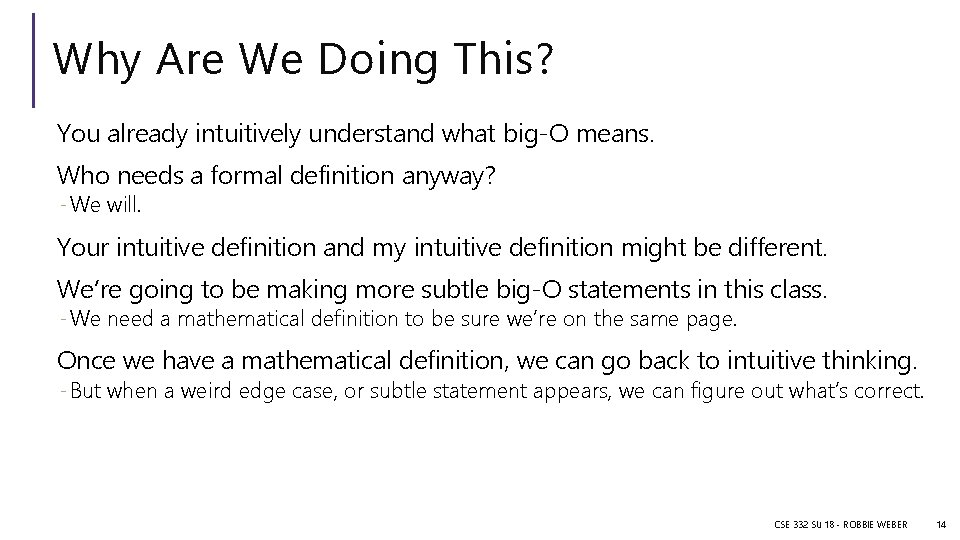
Why Are We Doing This? You already intuitively understand what big-O means. Who needs a formal definition anyway? - We will. Your intuitive definition and my intuitive definition might be different. We’re going to be making more subtle big-O statements in this class. - We need a mathematical definition to be sure we’re on the same page. Once we have a mathematical definition, we can go back to intuitive thinking. - But when a weird edge case, or subtle statement appears, we can figure out what’s correct. CSE 332 SU 18 - ROBBIE WEBER 14
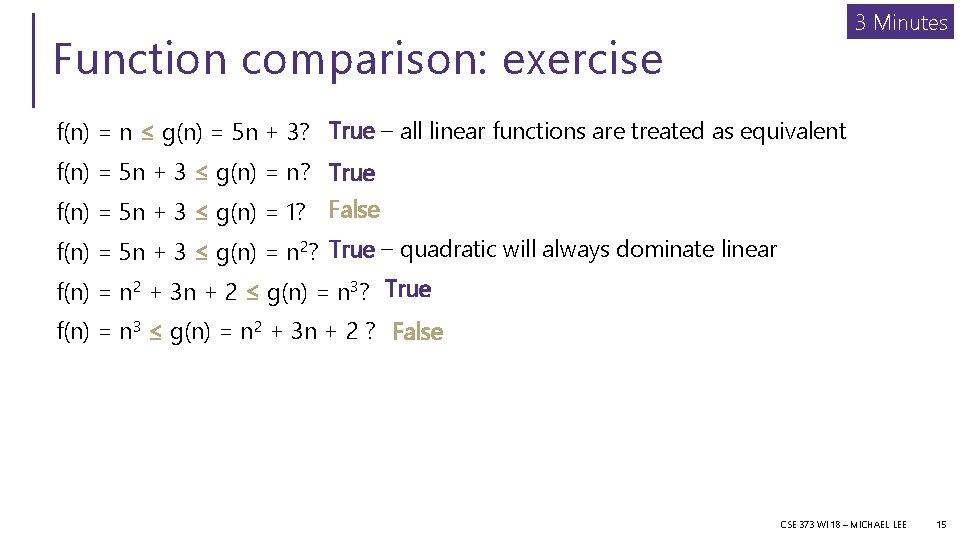
3 Minutes Function comparison: exercise f(n) = n ≤ g(n) = 5 n + 3? True – all linear functions are treated as equivalent f(n) = 5 n + 3 ≤ g(n) = n? True f(n) = 5 n + 3 ≤ g(n) = 1? False f(n) = 5 n + 3 ≤ g(n) = n 2? True – quadratic will always dominate linear f(n) = n 2 + 3 n + 2 ≤ g(n) = n 3? True f(n) = n 3 ≤ g(n) = n 2 + 3 n + 2 ? False CSE 373 WI 18 – MICHAEL LEE 15
O, Omega, Theta [oh my? ] Big-O is an upper bound - My code takes at most this long to run Big-Omega is a lower bound Big-Omega Is dominated by f(n) ∈ O(g(n)) Dominates f(n) ∈ Ω(g(n)) Big Theta is “equal to” Big-Theta CSE 332 SU 18 - ROBBIE WEBER 16
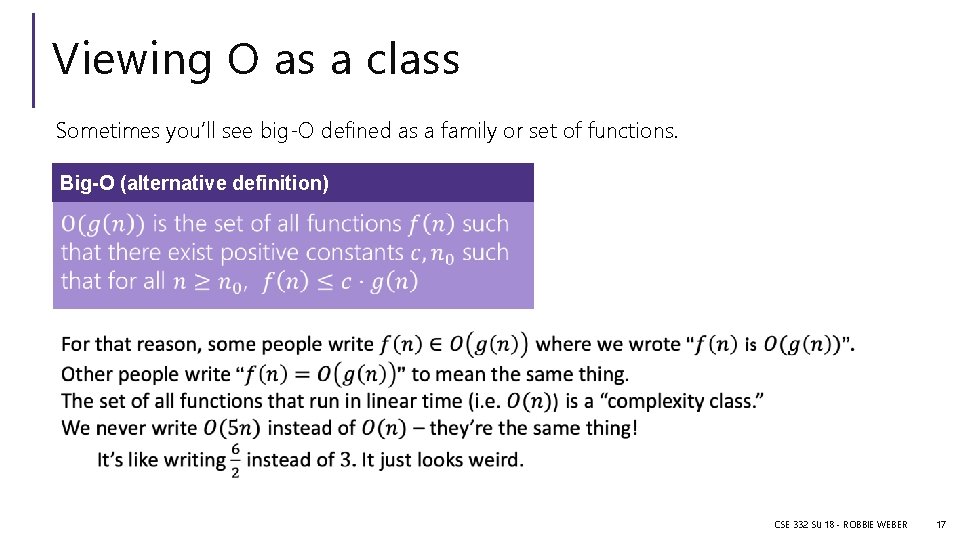
Viewing O as a class Sometimes you’ll see big-O defined as a family or set of functions. Big-O (alternative definition) CSE 332 SU 18 - ROBBIE WEBER 17
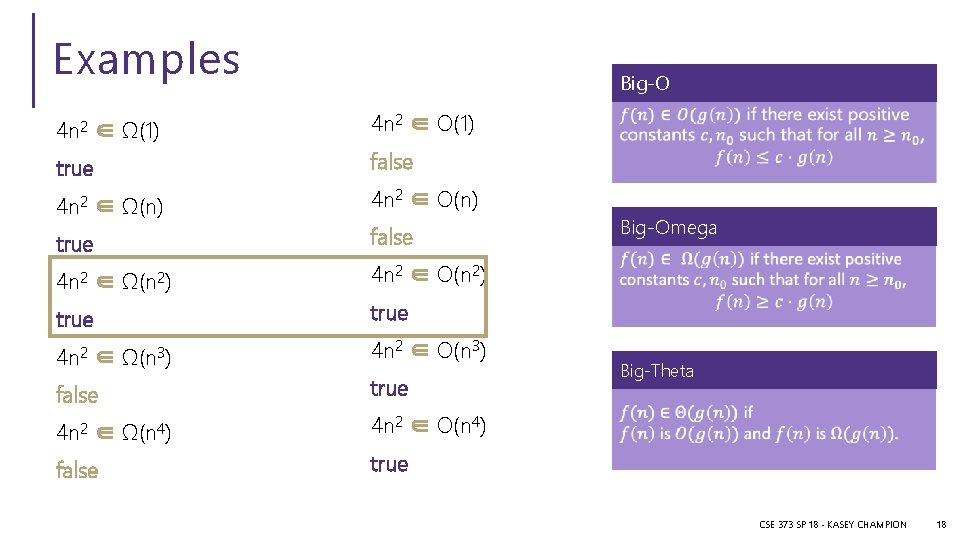
Examples Big-O 4 n 2 ∈ Ω(1) 4 n 2 ∈ O(1) true false 4 n 2 ∈ Ω(n) 4 n 2 ∈ O(n) true false 4 n 2 ∈ Ω(n 2) ∈ Ω(n 3) ∈ false 4 n 2 ∈ O(n 3) true false 4 n 2 ∈ O(n 2) true 4 n 2 Big-Omega Ω(n 4) Big-Theta 4 n 2 ∈ O(n 4) true CSE 373 SP 18 - KASEY CHAMPION 18
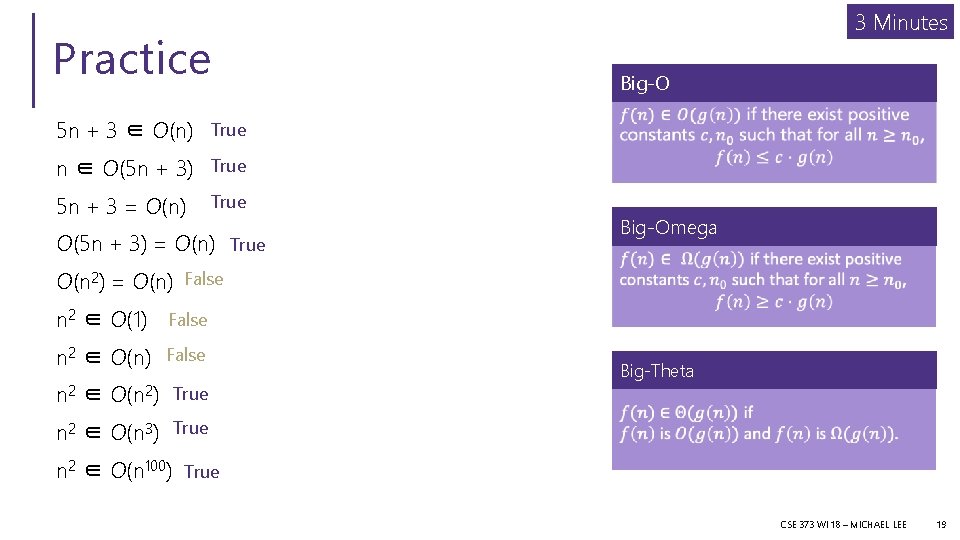
Practice 3 Minutes Big-O 5 n + 3 ∈ O(n) True n ∈ O(5 n + 3) True 5 n + 3 = O(n) True O(5 n + 3) = O(n) True Big-Omega O(n 2) = O(n) False n 2 ∈ O(1) False n 2 ∈ O(n 2) True Big-Theta n 2 ∈ O(n 3) True n 2 ∈ O(n 100) True CSE 373 WI 18 – MICHAEL LEE 19