
Lecture 5 1 Probability 90 min Definition Bayes
Lecture 5 1 Probability (90 min. ) Definition, Bayes’ theorem, probability densities and their properties, catalogue of pdfs, Monte Carlo 2 Statistical tests (90 min. ) general concepts, test statistics, multivariate methods, goodness-of-fit tests 3 Parameter estimation (90 min. ) general concepts, maximum likelihood, variance of estimators, least squares 4 Interval estimation (60 min. ) setting limits 5 Further topics (60 min. ) systematic errors, MCMC. . . G. Cowan Lectures on Statistical Data Analysis 1
Statistical vs. systematic errors Statistical errors: How much would the result fluctuate upon repetition of the measurement? Implies some set of assumptions to define probability of outcome of the measurement. Systematic errors: What is the uncertainty in my result due to uncertainty in my assumptions, e. g. , model (theoretical) uncertainty; modelling of measurement apparatus. The sources of error do not vary upon repetition of the measurement. Often result from uncertain value of, e. g. , calibration constants, efficiencies, etc. G. Cowan Lectures on Statistical Data Analysis 2
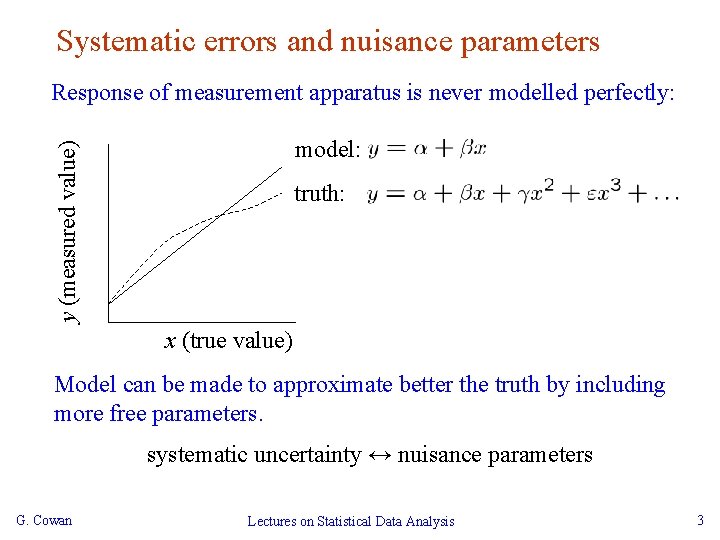
Systematic errors and nuisance parameters Response of measurement apparatus is never modelled perfectly: y (measured value) model: truth: x (true value) Model can be made to approximate better the truth by including more free parameters. systematic uncertainty ↔ nuisance parameters G. Cowan Lectures on Statistical Data Analysis 3
Nuisance parameters Suppose the outcome of the experiment is some set of data values x (here shorthand for e. g. x 1, . . . , xn). We want to determine a parameter , (could be a vector of parameters 1, . . . , n). The probability law for the data x depends on : L(x| ) (the likelihood function) E. g. maximize L to find estimator Now suppose, however, that the vector of parameters: contains some that are of interest, and others that are not of interest: Symbolically: The G. Cowan are called nuisance parameters. Lectures on Statistical Data Analysis 4
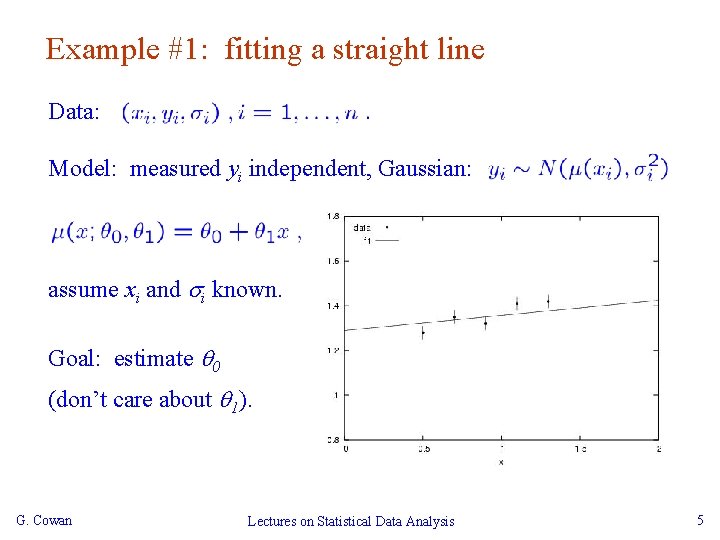
Example #1: fitting a straight line Data: Model: measured yi independent, Gaussian: assume xi and i known. Goal: estimate 0 (don’t care about 1). G. Cowan Lectures on Statistical Data Analysis 5
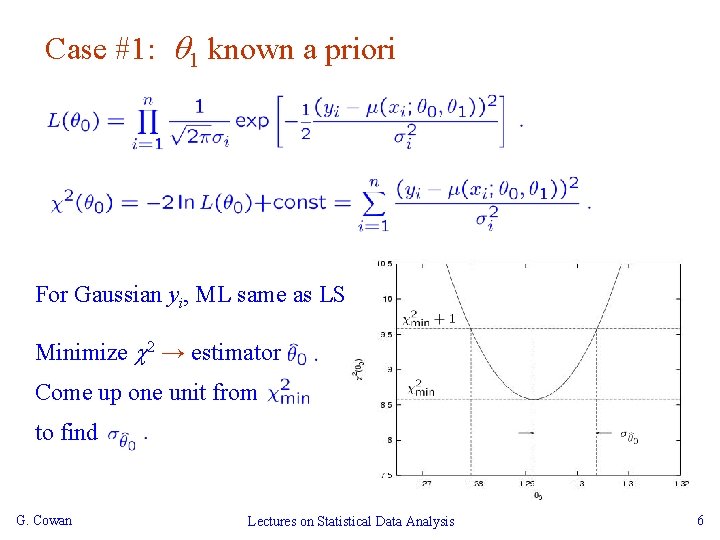
Case #1: 1 known a priori For Gaussian yi, ML same as LS Minimize 2 → estimator Come up one unit from to find G. Cowan Lectures on Statistical Data Analysis 6
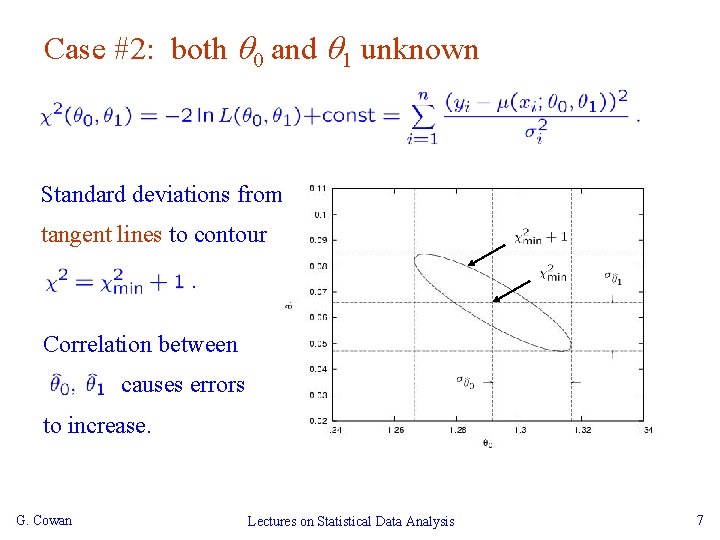
Case #2: both 0 and 1 unknown Standard deviations from tangent lines to contour Correlation between causes errors to increase. G. Cowan Lectures on Statistical Data Analysis 7
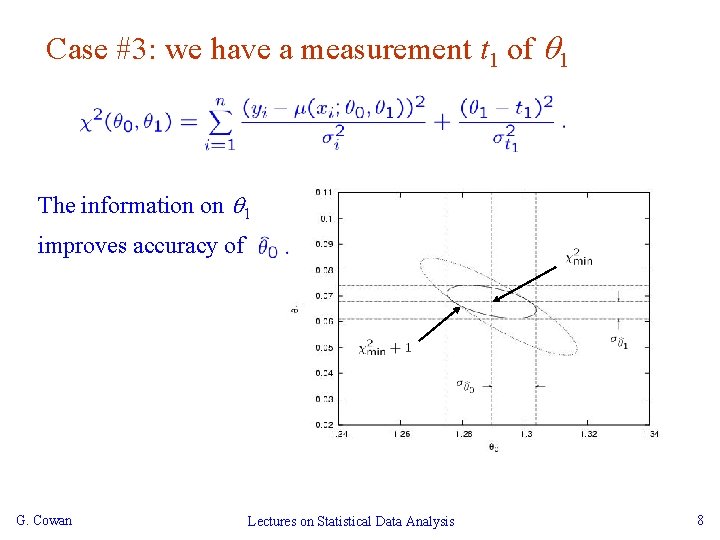
Case #3: we have a measurement t 1 of 1 The information on 1 improves accuracy of G. Cowan Lectures on Statistical Data Analysis 8
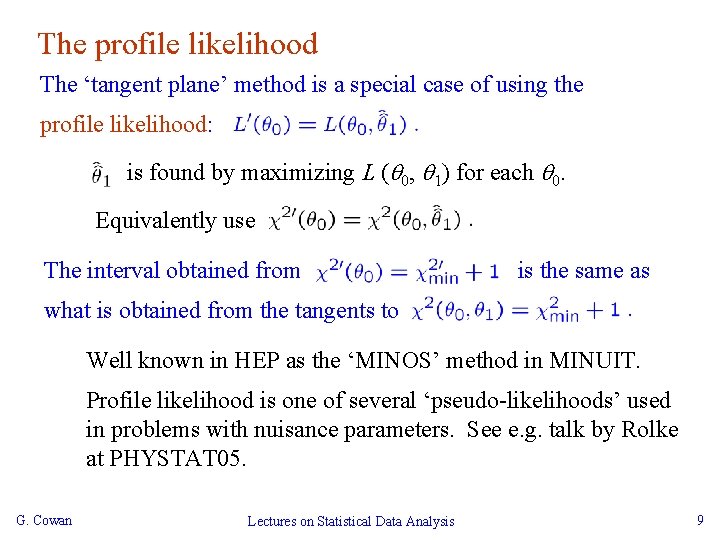
The profile likelihood The ‘tangent plane’ method is a special case of using the profile likelihood: is found by maximizing L ( 0, 1) for each 0. Equivalently use The interval obtained from is the same as what is obtained from the tangents to Well known in HEP as the ‘MINOS’ method in MINUIT. Profile likelihood is one of several ‘pseudo-likelihoods’ used in problems with nuisance parameters. See e. g. talk by Rolke at PHYSTAT 05. G. Cowan Lectures on Statistical Data Analysis 9
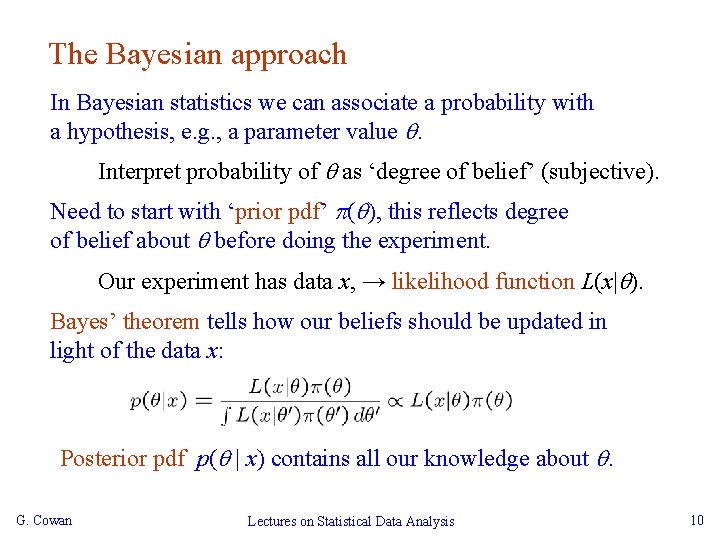
The Bayesian approach In Bayesian statistics we can associate a probability with a hypothesis, e. g. , a parameter value . Interpret probability of as ‘degree of belief’ (subjective). Need to start with ‘prior pdf’ ( ), this reflects degree of belief about before doing the experiment. Our experiment has data x, → likelihood function L(x| ). Bayes’ theorem tells how our beliefs should be updated in light of the data x: Posterior pdf p( | x) contains all our knowledge about . G. Cowan Lectures on Statistical Data Analysis 10

Case #4: Bayesian method We need to associate prior probabilities with 0 and 1, e. g. , reflects ‘prior ignorance’, in any case much broader than ← based on previous measurement Putting this into Bayes’ theorem gives: posterior G. Cowan Q likelihood Lectures on Statistical Data Analysis prior 11
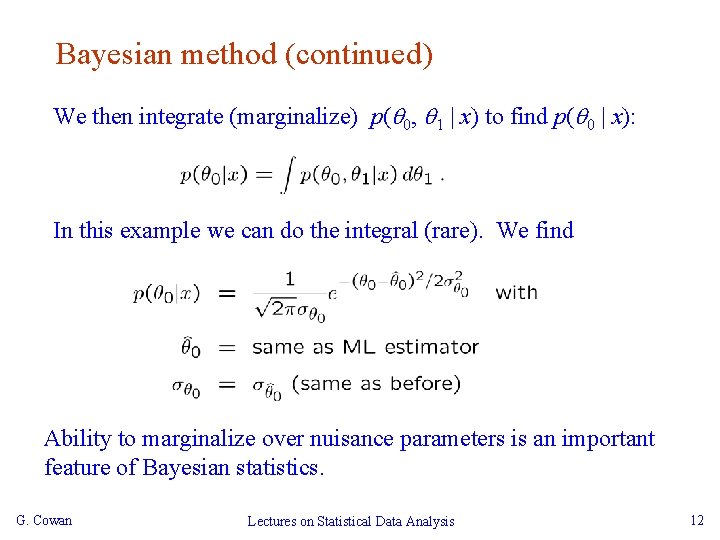
Bayesian method (continued) We then integrate (marginalize) p( 0, 1 | x) to find p( 0 | x): In this example we can do the integral (rare). We find Ability to marginalize over nuisance parameters is an important feature of Bayesian statistics. G. Cowan Lectures on Statistical Data Analysis 12
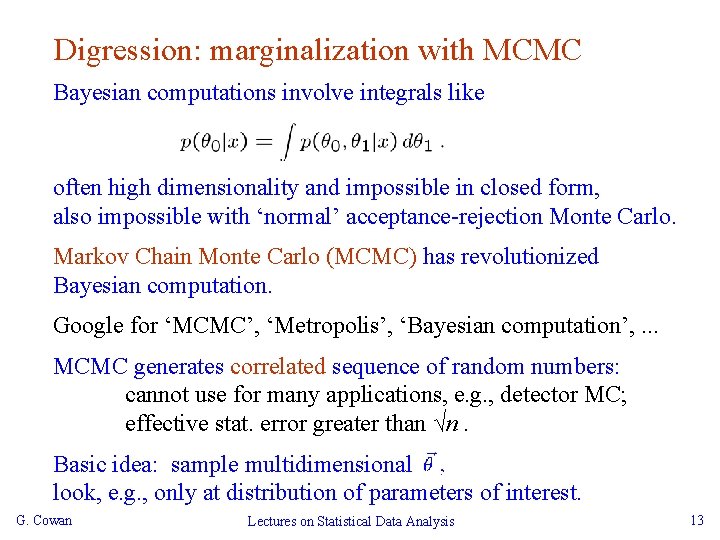
Digression: marginalization with MCMC Bayesian computations involve integrals like often high dimensionality and impossible in closed form, also impossible with ‘normal’ acceptance-rejection Monte Carlo. Markov Chain Monte Carlo (MCMC) has revolutionized Bayesian computation. Google for ‘MCMC’, ‘Metropolis’, ‘Bayesian computation’, . . . MCMC generates correlated sequence of random numbers: cannot use for many applications, e. g. , detector MC; effective stat. error greater than √n. Basic idea: sample multidimensional look, e. g. , only at distribution of parameters of interest. G. Cowan Lectures on Statistical Data Analysis 13
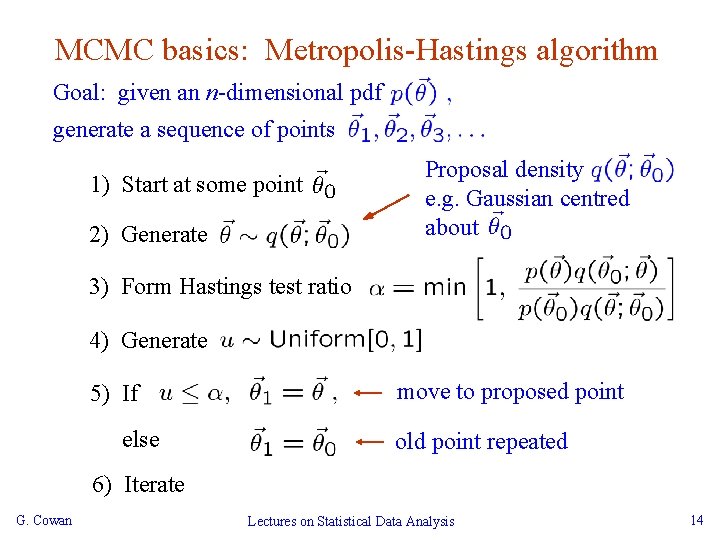
MCMC basics: Metropolis-Hastings algorithm Goal: given an n-dimensional pdf generate a sequence of points 1) Start at some point 2) Generate Proposal density e. g. Gaussian centred about 3) Form Hastings test ratio 4) Generate 5) If else move to proposed point old point repeated 6) Iterate G. Cowan Lectures on Statistical Data Analysis 14
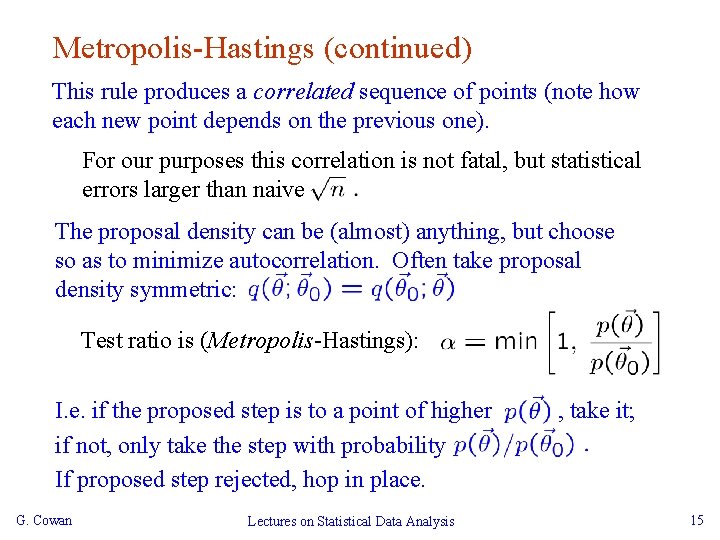
Metropolis-Hastings (continued) This rule produces a correlated sequence of points (note how each new point depends on the previous one). For our purposes this correlation is not fatal, but statistical errors larger than naive The proposal density can be (almost) anything, but choose so as to minimize autocorrelation. Often take proposal density symmetric: Test ratio is (Metropolis-Hastings): I. e. if the proposed step is to a point of higher if not, only take the step with probability If proposed step rejected, hop in place. G. Cowan Lectures on Statistical Data Analysis , take it; 15
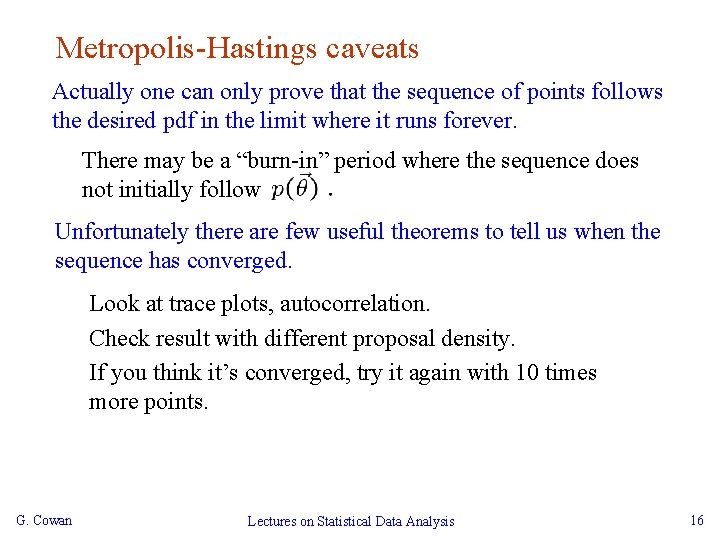
Metropolis-Hastings caveats Actually one can only prove that the sequence of points follows the desired pdf in the limit where it runs forever. There may be a “burn-in” period where the sequence does not initially follow Unfortunately there are few useful theorems to tell us when the sequence has converged. Look at trace plots, autocorrelation. Check result with different proposal density. If you think it’s converged, try it again with 10 times more points. G. Cowan Lectures on Statistical Data Analysis 16
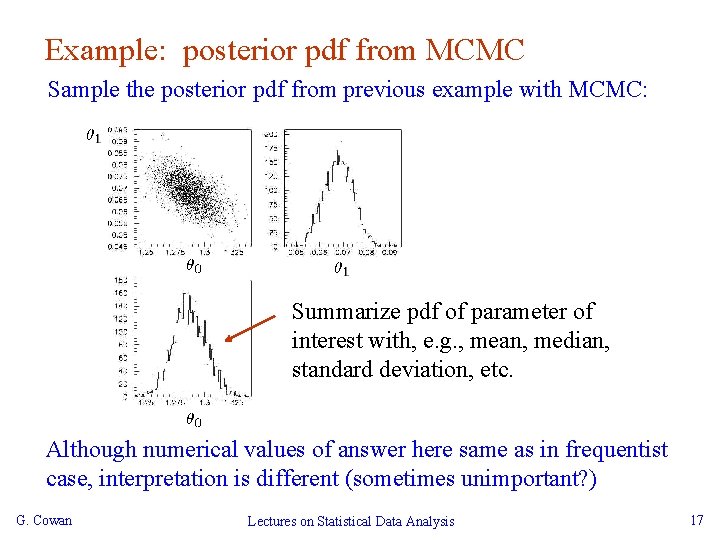
Example: posterior pdf from MCMC Sample the posterior pdf from previous example with MCMC: Summarize pdf of parameter of interest with, e. g. , mean, median, standard deviation, etc. Although numerical values of answer here same as in frequentist case, interpretation is different (sometimes unimportant? ) G. Cowan Lectures on Statistical Data Analysis 17
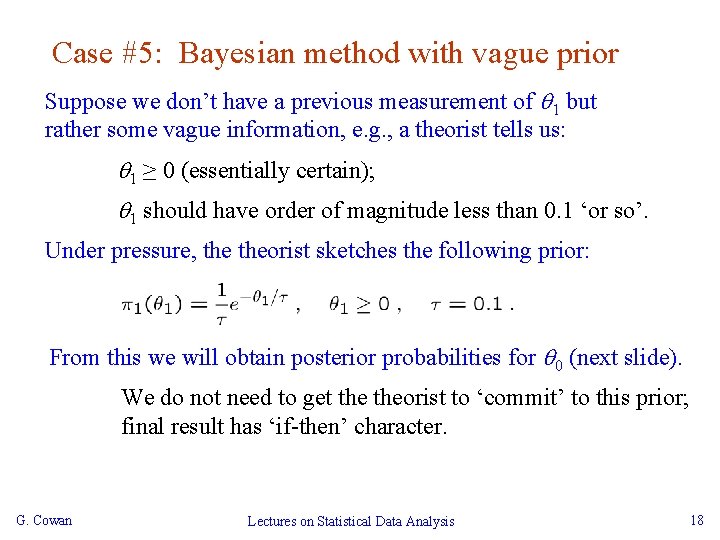
Case #5: Bayesian method with vague prior Suppose we don’t have a previous measurement of 1 but rather some vague information, e. g. , a theorist tells us: 1 ≥ 0 (essentially certain); 1 should have order of magnitude less than 0. 1 ‘or so’. Under pressure, theorist sketches the following prior: From this we will obtain posterior probabilities for 0 (next slide). We do not need to get theorist to ‘commit’ to this prior; final result has ‘if-then’ character. G. Cowan Lectures on Statistical Data Analysis 18
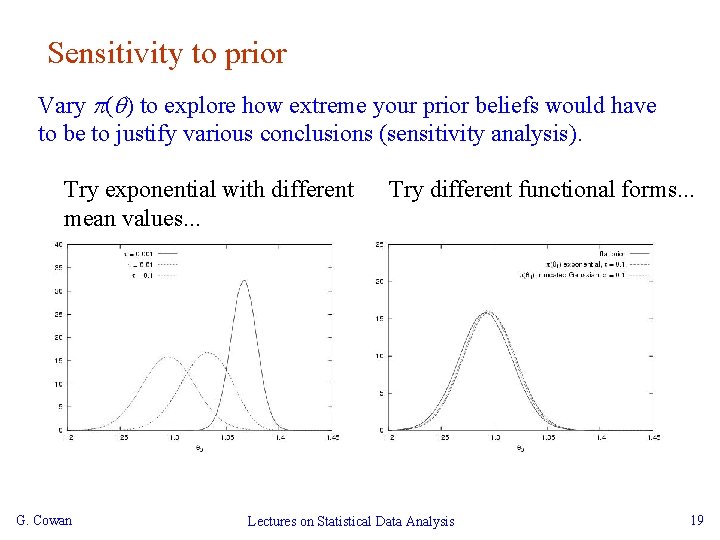
Sensitivity to prior Vary ( ) to explore how extreme your prior beliefs would have to be to justify various conclusions (sensitivity analysis). Try exponential with different mean values. . . G. Cowan Try different functional forms. . . Lectures on Statistical Data Analysis 19
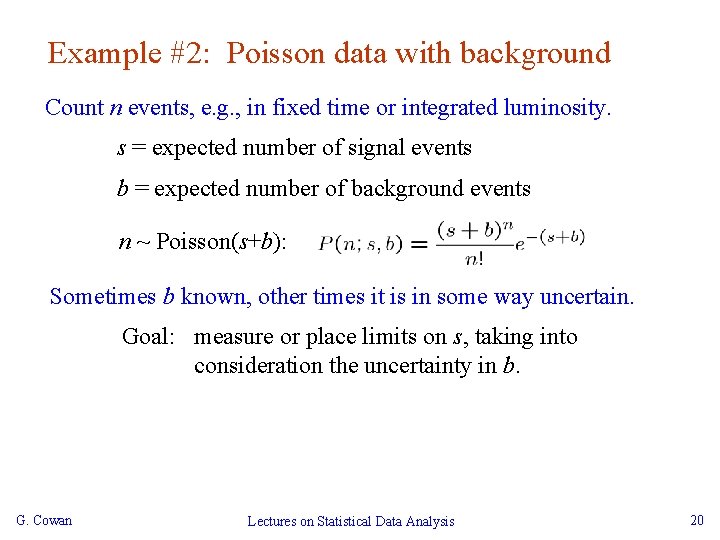
Example #2: Poisson data with background Count n events, e. g. , in fixed time or integrated luminosity. s = expected number of signal events b = expected number of background events n ~ Poisson(s+b): Sometimes b known, other times it is in some way uncertain. Goal: measure or place limits on s, taking into consideration the uncertainty in b. G. Cowan Lectures on Statistical Data Analysis 20
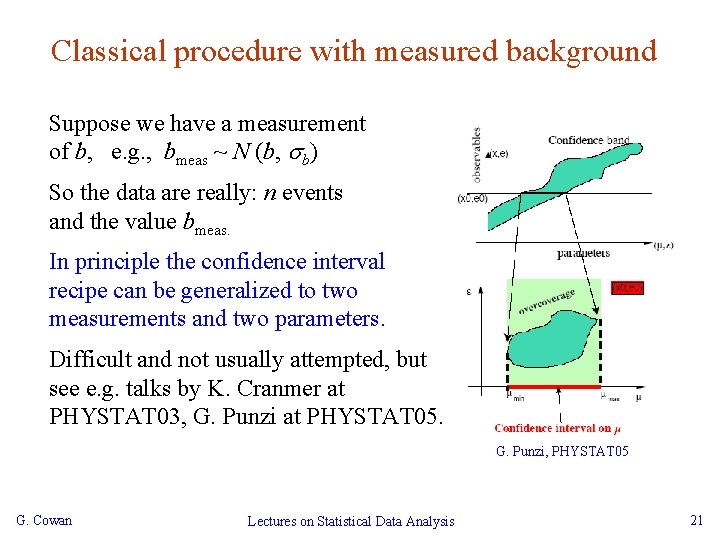
Classical procedure with measured background Suppose we have a measurement of b, e. g. , bmeas ~ N (b, b) So the data are really: n events and the value bmeas. In principle the confidence interval recipe can be generalized to two measurements and two parameters. Difficult and not usually attempted, but see e. g. talks by K. Cranmer at PHYSTAT 03, G. Punzi at PHYSTAT 05. G. Punzi, PHYSTAT 05 G. Cowan Lectures on Statistical Data Analysis 21
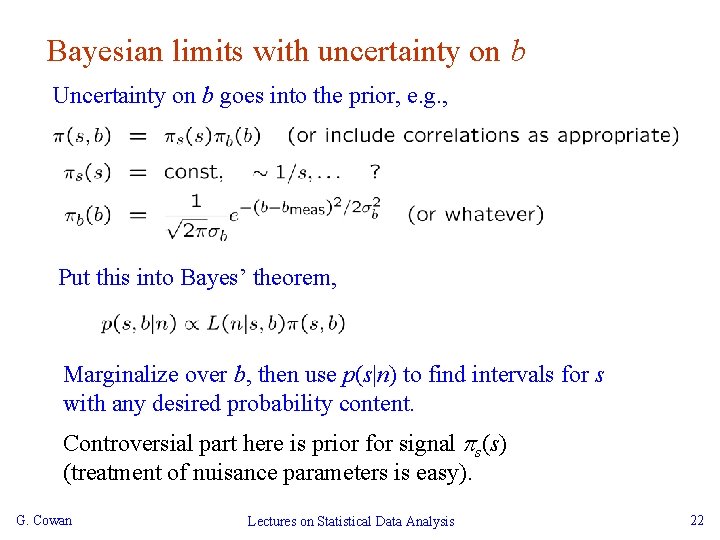
Bayesian limits with uncertainty on b Uncertainty on b goes into the prior, e. g. , Put this into Bayes’ theorem, Marginalize over b, then use p(s|n) to find intervals for s with any desired probability content. Controversial part here is prior for signal s(s) (treatment of nuisance parameters is easy). G. Cowan Lectures on Statistical Data Analysis 22
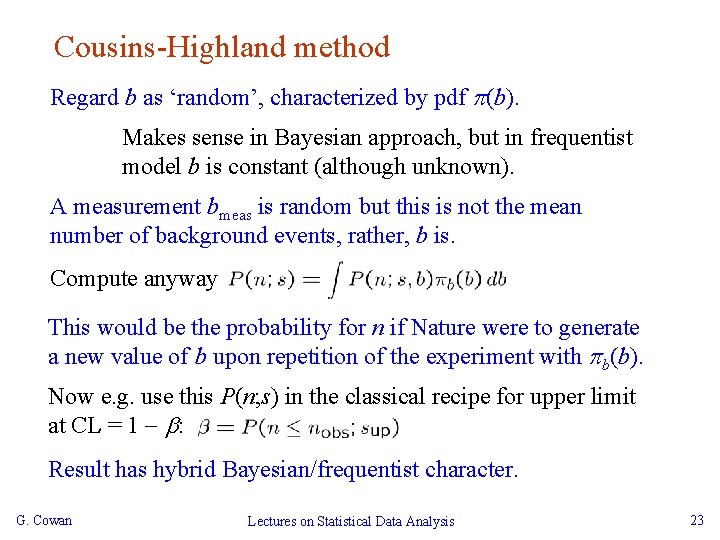
Cousins-Highland method Regard b as ‘random’, characterized by pdf (b). Makes sense in Bayesian approach, but in frequentist model b is constant (although unknown). A measurement bmeas is random but this is not the mean number of background events, rather, b is. Compute anyway This would be the probability for n if Nature were to generate a new value of b upon repetition of the experiment with b(b). Now e. g. use this P(n; s) in the classical recipe for upper limit at CL = 1 - b: Result has hybrid Bayesian/frequentist character. G. Cowan Lectures on Statistical Data Analysis 23
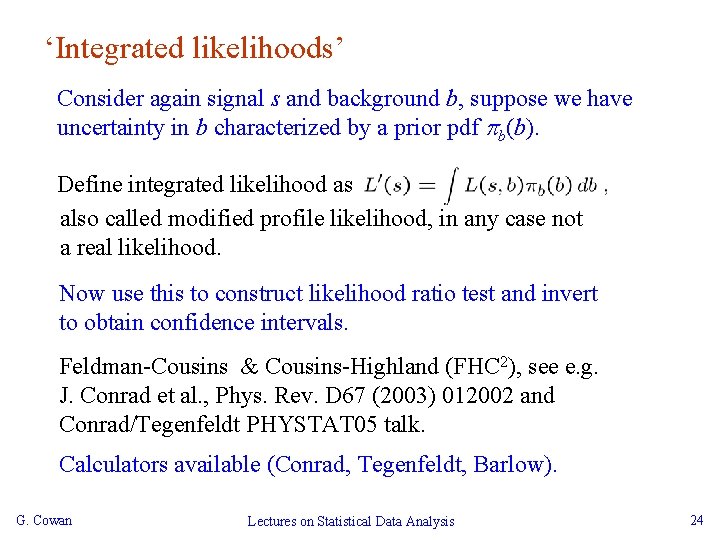
‘Integrated likelihoods’ Consider again signal s and background b, suppose we have uncertainty in b characterized by a prior pdf b(b). Define integrated likelihood as also called modified profile likelihood, in any case not a real likelihood. Now use this to construct likelihood ratio test and invert to obtain confidence intervals. Feldman-Cousins & Cousins-Highland (FHC 2), see e. g. J. Conrad et al. , Phys. Rev. D 67 (2003) 012002 and Conrad/Tegenfeldt PHYSTAT 05 talk. Calculators available (Conrad, Tegenfeldt, Barlow). G. Cowan Lectures on Statistical Data Analysis 24
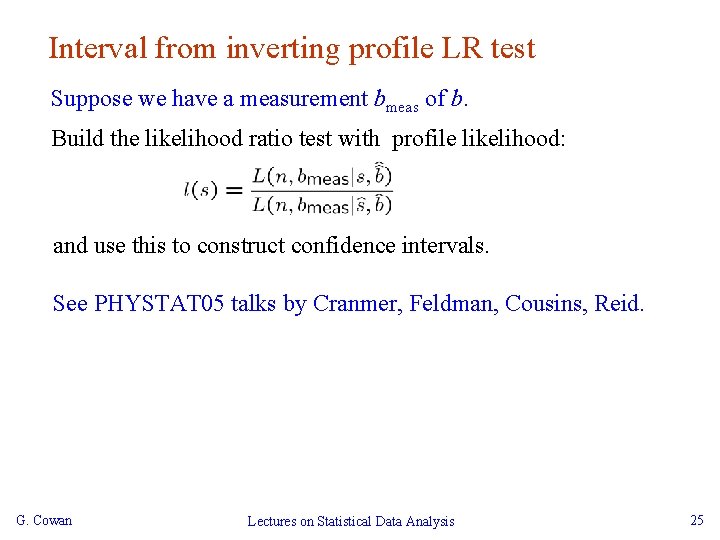
Interval from inverting profile LR test Suppose we have a measurement bmeas of b. Build the likelihood ratio test with profile likelihood: and use this to construct confidence intervals. See PHYSTAT 05 talks by Cranmer, Feldman, Cousins, Reid. G. Cowan Lectures on Statistical Data Analysis 25
Wrapping up lecture 5 We’ve seen some main ideas about systematic errors, uncertainties in result arising from model assumptions; can be quantified by assigning corresponding uncertainties to additional (nuisance) parameters. Different ways to quantify systematics Bayesian approach in many ways most natural; marginalize over nuisance parameters; important tool: MCMC Frequentist methods rely on a hypothetical sample space for often non-repeatable phenomena G. Cowan Lectures on Statistical Data Analysis 26
Lecture 5 — extra slides G. Cowan Lectures on Statistical Data Analysis 27
The error on the error Some systematic errors are well determined Error from finite Monte Carlo sample Some are less obvious Do analysis in n ‘equally valid’ ways and extract systematic error from ‘spread’ in results. Some are educated guesses Guess possible size of missing terms in perturbation series; vary renormalization scale Can we incorporate the ‘error on the error’? (cf. G. D’Agostini 1999; Dose & von der Linden 1999) G. Cowan Lectures on Statistical Data Analysis 28
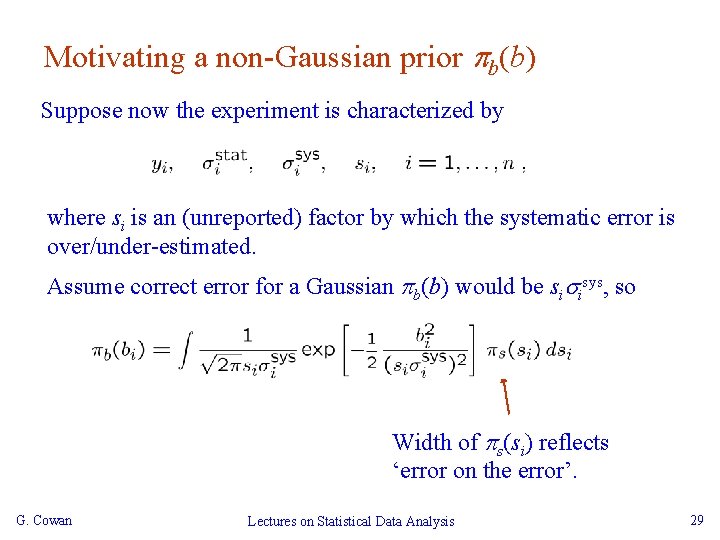
Motivating a non-Gaussian prior b(b) Suppose now the experiment is characterized by where si is an (unreported) factor by which the systematic error is over/under-estimated. Assume correct error for a Gaussian b(b) would be si isys, so Width of s(si) reflects ‘error on the error’. G. Cowan Lectures on Statistical Data Analysis 29
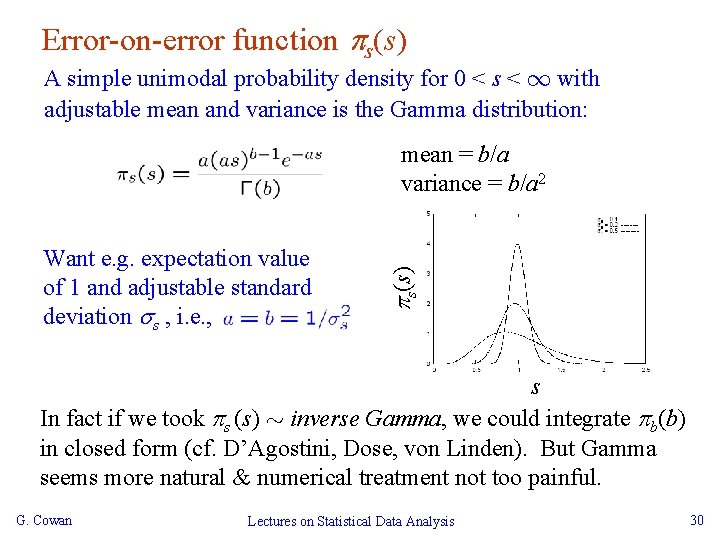
Error-on-error function s(s) A simple unimodal probability density for 0 < s < 1 with adjustable mean and variance is the Gamma distribution: Want e. g. expectation value of 1 and adjustable standard deviation s , i. e. , s(s) mean = b/a variance = b/a 2 s In fact if we took s (s) » inverse Gamma, we could integrate b(b) in closed form (cf. D’Agostini, Dose, von Linden). But Gamma seems more natural & numerical treatment not too painful. G. Cowan Lectures on Statistical Data Analysis 30
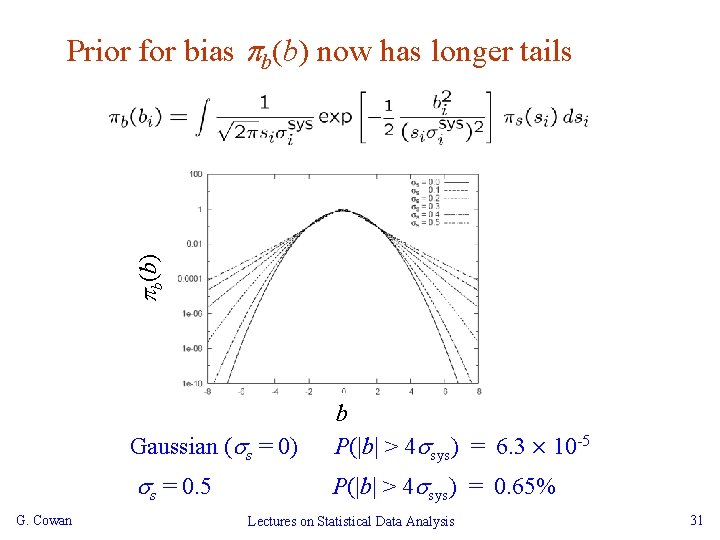
b(b) Prior for bias b(b) now has longer tails G. Cowan Gaussian ( s = 0) b P(|b| > 4 sys) = 6. 3 £ 10 -5 s = 0. 5 P(|b| > 4 sys) = 0. 65% Lectures on Statistical Data Analysis 31
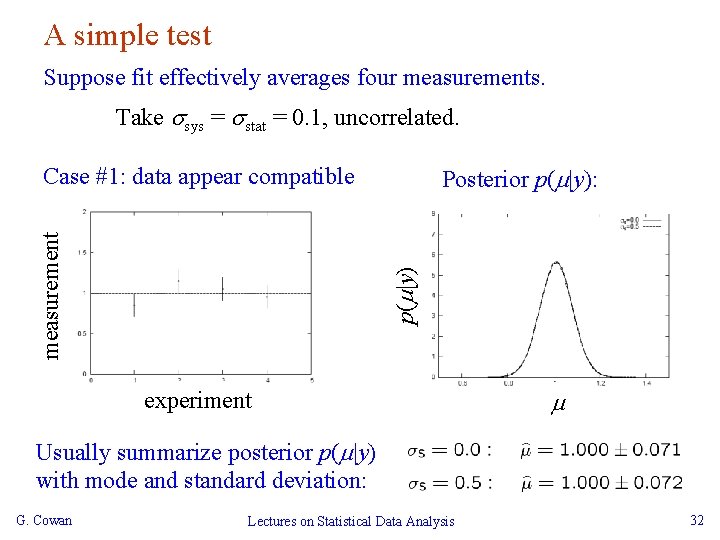
A simple test Suppose fit effectively averages four measurements. Take sys = stat = 0. 1, uncorrelated. Posterior p( |y): p( |y) measurement Case #1: data appear compatible experiment Usually summarize posterior p( |y) with mode and standard deviation: G. Cowan Lectures on Statistical Data Analysis 32
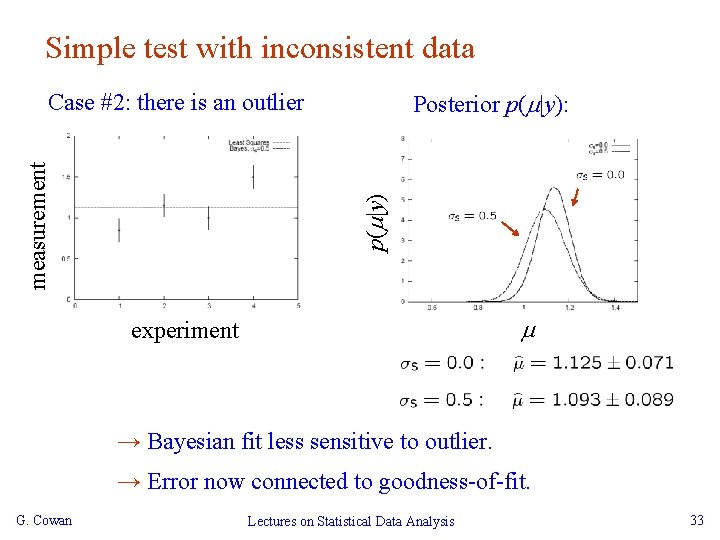
Simple test with inconsistent data Posterior p( |y): p( |y) measurement Case #2: there is an outlier experiment → Bayesian fit less sensitive to outlier. → Error now connected to goodness-of-fit. G. Cowan Lectures on Statistical Data Analysis 33
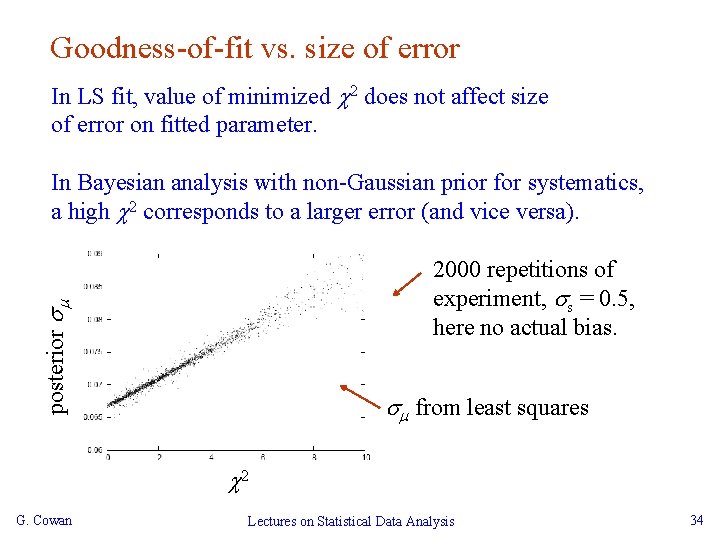
Goodness-of-fit vs. size of error In LS fit, value of minimized 2 does not affect size of error on fitted parameter. In Bayesian analysis with non-Gaussian prior for systematics, a high 2 corresponds to a larger error (and vice versa). posterior 2000 repetitions of experiment, s = 0. 5, here no actual bias. from least squares 2 G. Cowan Lectures on Statistical Data Analysis 34
Is this workable for PDF fits? Straightforward to generalize to include correlations Prior on correlation coefficients ~ ( ) (Myth: = 1 is “conservative”) Can separate out different systematic for same measurement Some will have small s, others larger. Remember the “if-then” nature of a Bayesian result: We can (should) vary priors and see what effect this has on the conclusions. G. Cowan Lectures on Statistical Data Analysis 35
- Slides: 35