
Lecture 43 OUTLINE Shortchannel MOSFET reprise SOI technology

- Slides: 5
Lecture #43 • • OUTLINE Short-channel MOSFET (reprise) SOI technology Reading: Finish Chapter 19. 2 1 Spring 2007 EE 130 Lecture 43, Slide 1
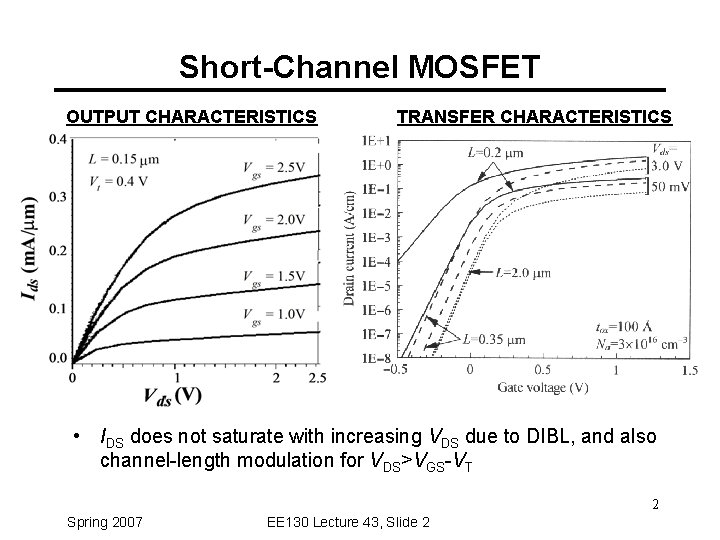
Short-Channel MOSFET OUTPUT CHARACTERISTICS TRANSFER CHARACTERISTICS • IDS does not saturate with increasing VDS due to DIBL, and also channel-length modulation for VDS>VGS-VT 2 Spring 2007 EE 130 Lecture 43, Slide 2
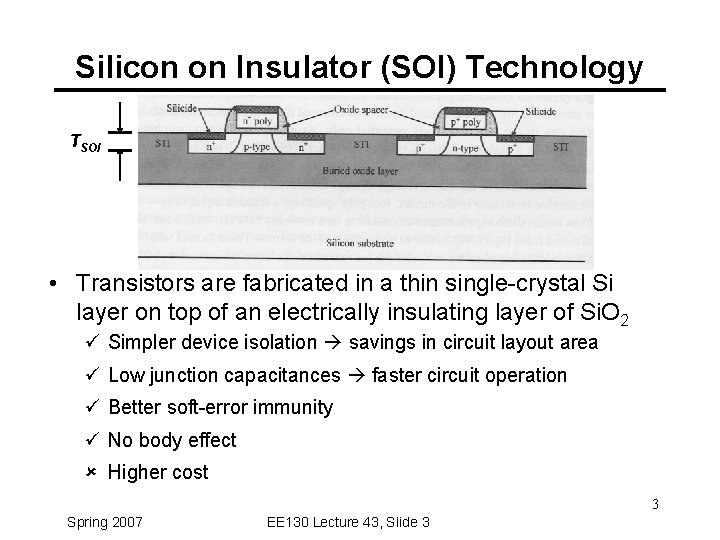
Silicon on Insulator (SOI) Technology TSOI • Transistors are fabricated in a thin single-crystal Si layer on top of an electrically insulating layer of Si. O 2 ü Simpler device isolation savings in circuit layout area ü Low junction capacitances faster circuit operation ü Better soft-error immunity ü No body effect û Higher cost 3 Spring 2007 EE 130 Lecture 43, Slide 3
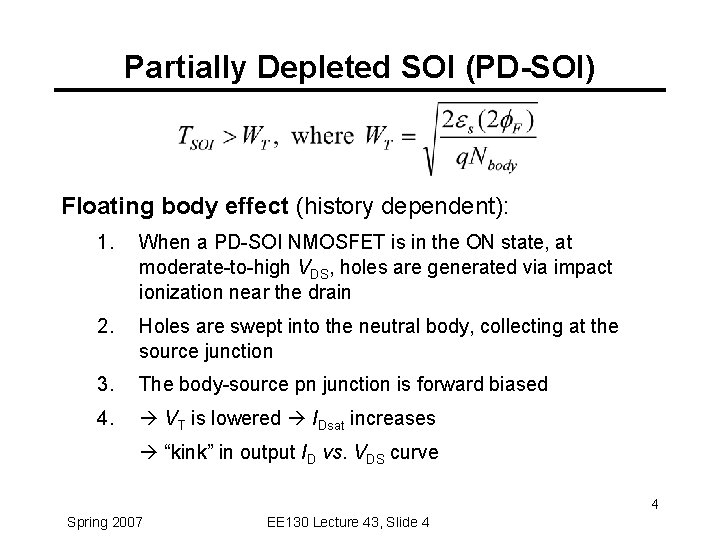
Partially Depleted SOI (PD-SOI) Floating body effect (history dependent): 1. When a PD-SOI NMOSFET is in the ON state, at moderate-to-high VDS, holes are generated via impact ionization near the drain 2. Holes are swept into the neutral body, collecting at the source junction 3. The body-source pn junction is forward biased 4. VT is lowered IDsat increases “kink” in output ID vs. VDS curve 4 Spring 2007 EE 130 Lecture 43, Slide 4
Fully Depleted SOI (FD-SOI) • No floating body effect! • VT is sensitive to SOI film thickness • Poorer control of short-channel effects due to fringing electric field from drain • Elevated S/D contact structure needed to reduce RS, RD Gate Source SOI Drain Si. O 2 Silicon Substrate 5 Spring 2007 EE 130 Lecture 43, Slide 5