
Lecture 41 OUTLINE Modern MOSFETs The shortchannel effect

- Slides: 15
Lecture #41 OUTLINE Modern MOSFETs: • • The short-channel effect Source/drain structure Drain-induced barrier lowering Excess current effects Reading: Chapter 19. 1, 19. 2 1 Spring 2007 EE 130 Lecture 41, Slide 1
The Short Channel Effect (SCE) “VT roll-off” • |VT| decreases with L – Effect is exacerbated by high values of |VDS| • This is undesirable (i. e. we want to minimize it!) because circuit designers would like VT to be invariant with transistor dimensions and biasing conditions 2 Spring 2007 EE 130 Lecture 41, Slide 2
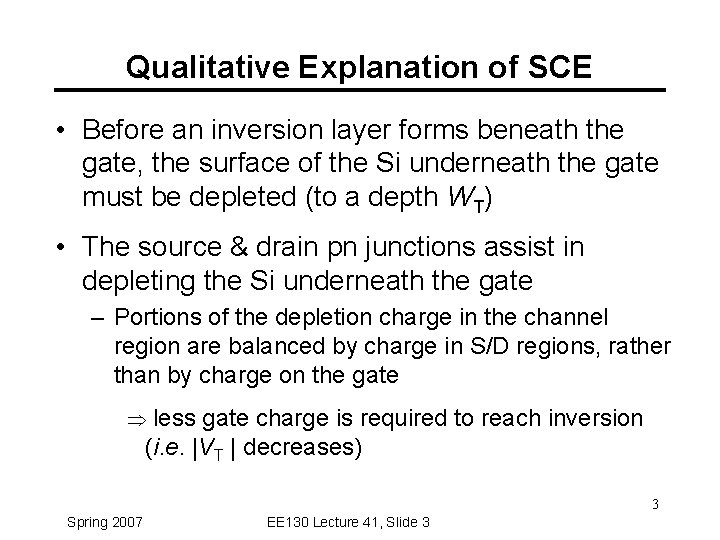
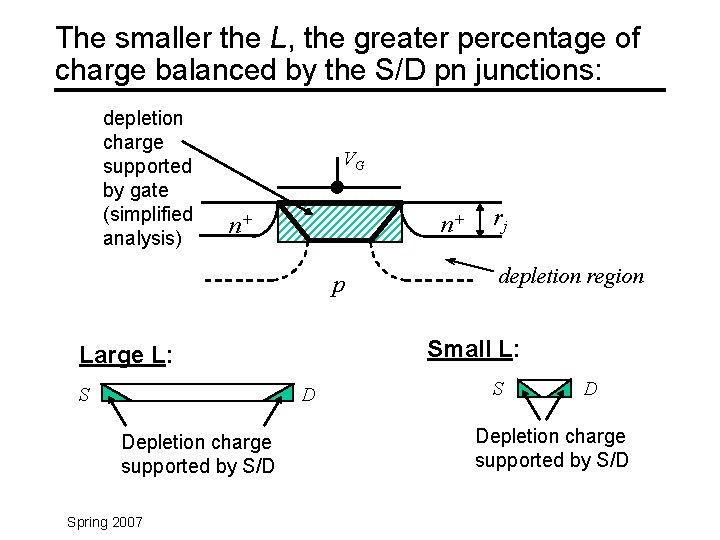
Qualitative Explanation of SCE • Before an inversion layer forms beneath the gate, the surface of the Si underneath the gate must be depleted (to a depth WT) • The source & drain pn junctions assist in depleting the Si underneath the gate – Portions of the depletion charge in the channel region are balanced by charge in S/D regions, rather than by charge on the gate Þ less gate charge is required to reach inversion (i. e. |VT | decreases) 3 Spring 2007 EE 130 Lecture 41, Slide 3
The smaller the L, the greater percentage of charge balanced by the S/D pn junctions: depletion charge supported by gate (simplified analysis) VG n+ n+ p D Depletion charge supported by S/D Spring 2007 depletion region Small L: Large L: S rj S D Depletion charge supported by S/D
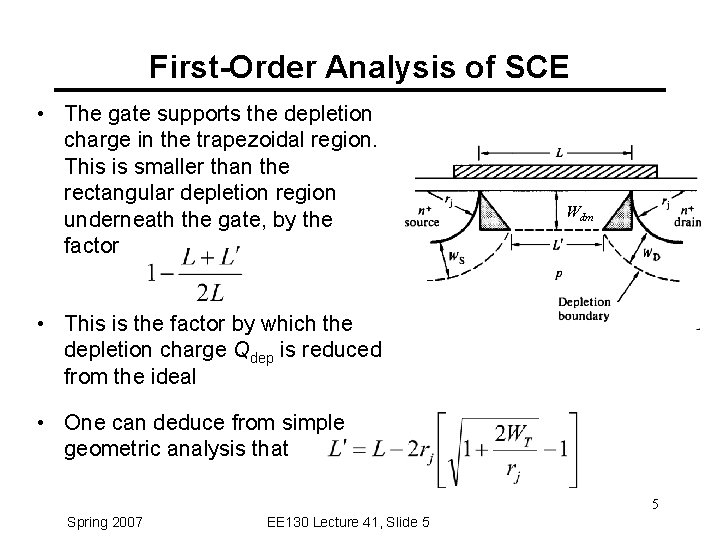
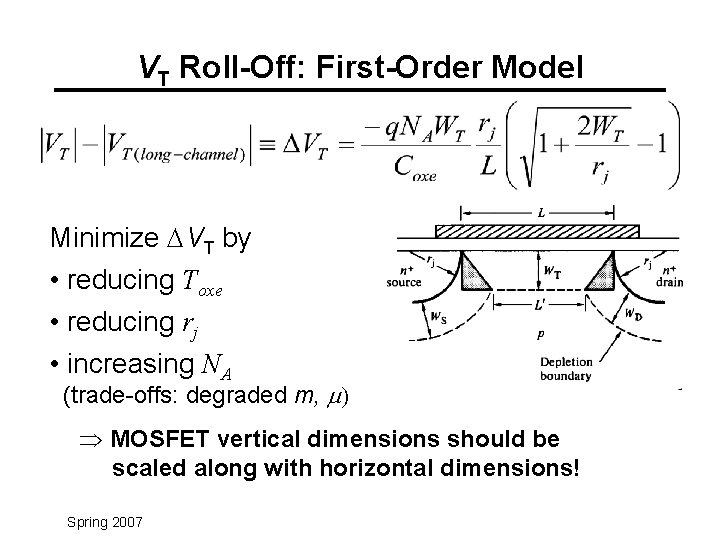
First-Order Analysis of SCE • The gate supports the depletion charge in the trapezoidal region. This is smaller than the rectangular depletion region underneath the gate, by the factor Wdm • This is the factor by which the depletion charge Qdep is reduced from the ideal • One can deduce from simple geometric analysis that 5 Spring 2007 EE 130 Lecture 41, Slide 5
VT Roll-Off: First-Order Model Minimize DVT by • reducing Toxe • reducing rj • increasing NA (trade-offs: degraded m, m) Þ MOSFET vertical dimensions should be scaled along with horizontal dimensions! Spring 2007
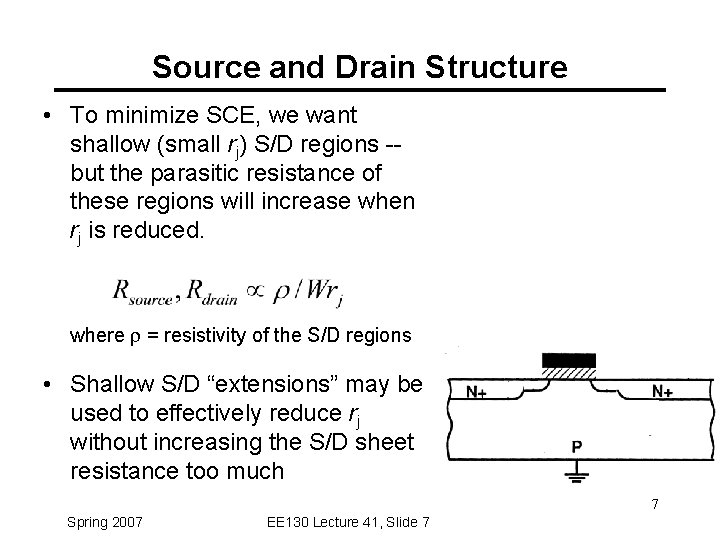
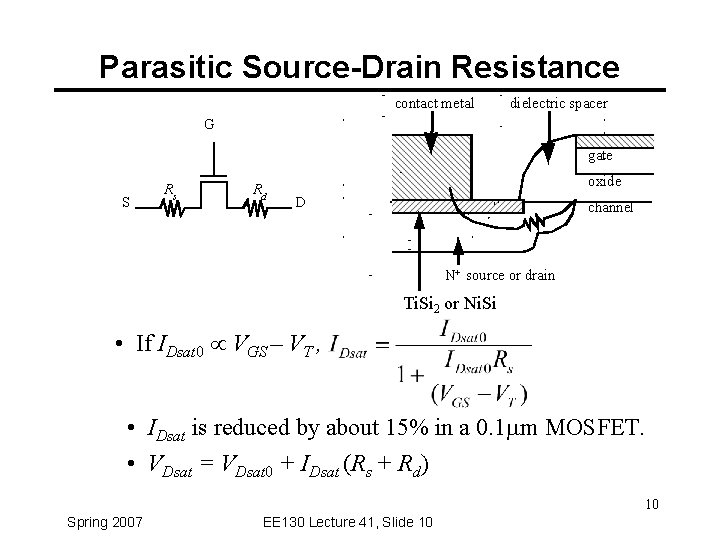
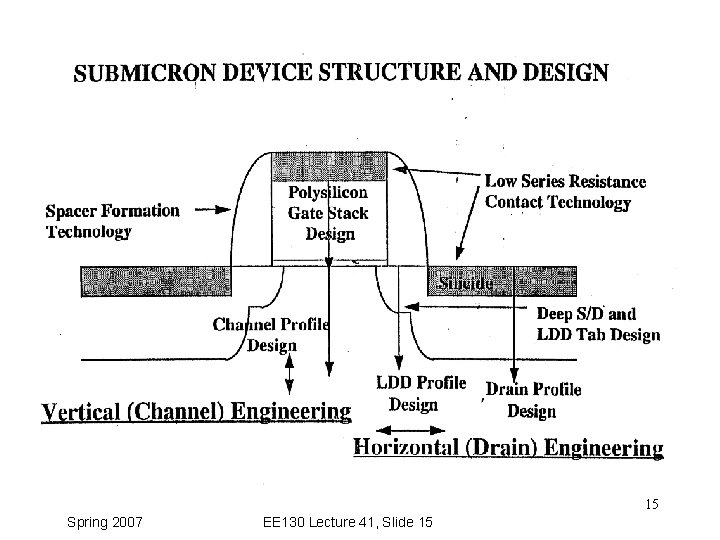
Source and Drain Structure • To minimize SCE, we want shallow (small rj) S/D regions -but the parasitic resistance of these regions will increase when rj is reduced. where r = resistivity of the S/D regions • Shallow S/D “extensions” may be used to effectively reduce rj without increasing the S/D sheet resistance too much 7 Spring 2007 EE 130 Lecture 41, Slide 7
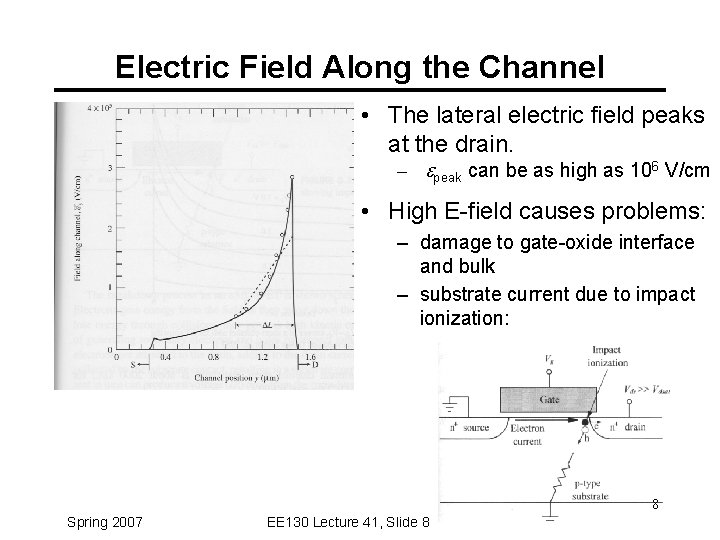
Electric Field Along the Channel • The lateral electric field peaks at the drain. – epeak can be as high as 106 V/cm • High E-field causes problems: – damage to gate-oxide interface and bulk – substrate current due to impact ionization: 8 Spring 2007 EE 130 Lecture 41, Slide 8
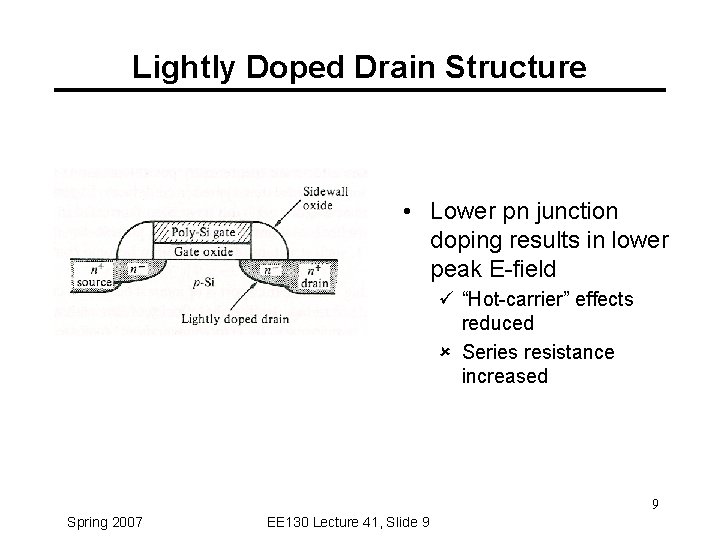
Lightly Doped Drain Structure • Lower pn junction doping results in lower peak E-field ü “Hot-carrier” effects reduced û Series resistance increased 9 Spring 2007 EE 130 Lecture 41, Slide 9
Parasitic Source-Drain Resistance contact metal dielectric spacer G gate S Rs Rd oxide D channel N+ source or drain Ti. Si 2 or Ni. Si • If IDsat 0 VGS – VT , • IDsat is reduced by about 15% in a 0. 1 mm MOSFET. • VDsat = VDsat 0 + IDsat (Rs + Rd) 10 Spring 2007 EE 130 Lecture 41, Slide 10
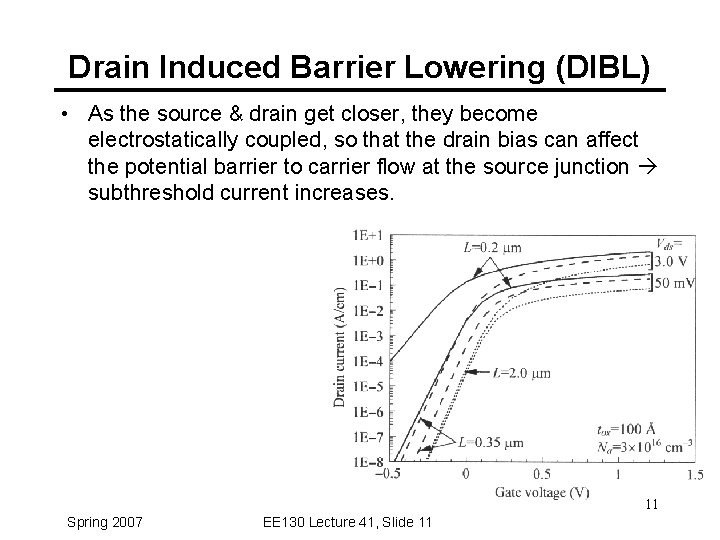
Drain Induced Barrier Lowering (DIBL) • As the source & drain get closer, they become electrostatically coupled, so that the drain bias can affect the potential barrier to carrier flow at the source junction subthreshold current increases. 11 Spring 2007 EE 130 Lecture 41, Slide 11
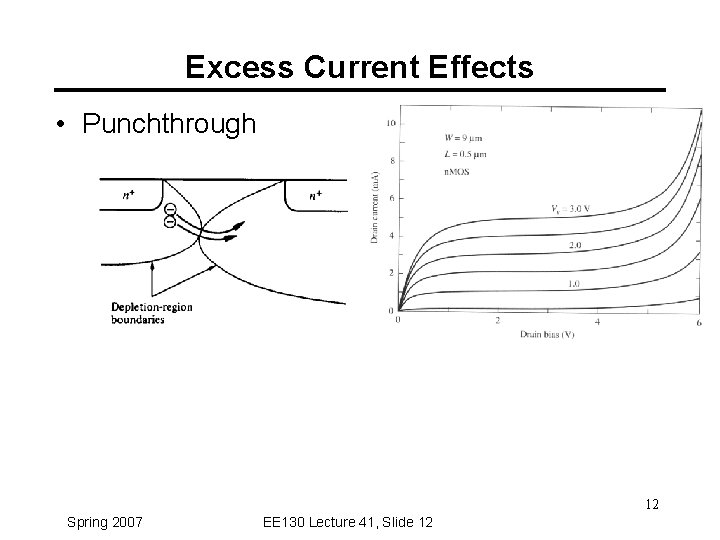
Excess Current Effects • Punchthrough 12 Spring 2007 EE 130 Lecture 41, Slide 12
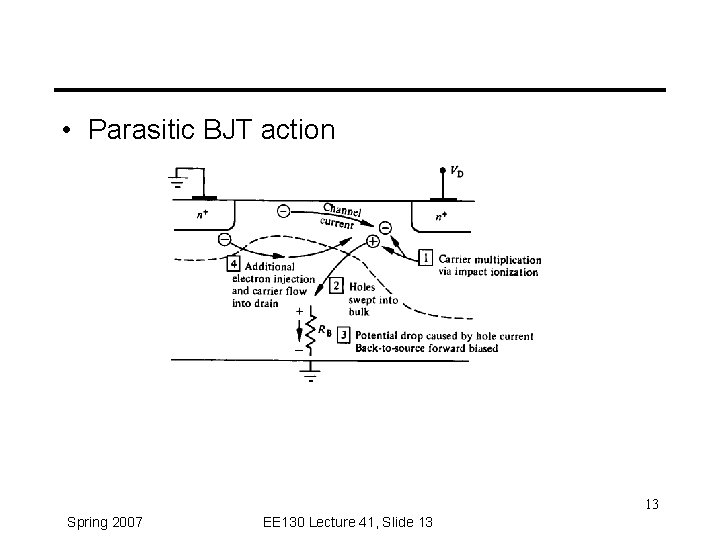
• Parasitic BJT action 13 Spring 2007 EE 130 Lecture 41, Slide 13
Summary: MOSFET OFF State vs. ON State • OFF state (VGS < VT): – IDS is limited by the rate at which carriers diffuse across the source pn junction – Sub-threshold swing S, DIBL are issues • ON state (VGS > VT): – IDS is limited by the rate at which carriers drift across the channel – Punchthrough and parasitic BJT effects are of concern at high drain bias • IDsat increases rapidly with VDS – Parasitic series resistances reduce drive current • source resistance RS reduces effective VGS • source and drain resistances RS and RD reduce effective VDS 14 Spring 2007 EE 130 Lecture 41, Slide 14
15 Spring 2007 EE 130 Lecture 41, Slide 15