
Lecture 4 Weather Measuring Equipment Rain Gauge Amount
- Slides: 42
Lecture 4: Weather Measuring Equipment • • • Rain Gauge – Amount of precipitation Thermometers – Air temperature Hydrometer – Moisture content or humidity of the air Wind vane – Direction of the wind Anemometer- Wind speed or Velocity Barometer - atmosphere air pressure Pyranometers - Radiation Evaporating pans –Evaporation and Lysimeters - Evapotranspiration
Weather Station Weather is "the state of the atmosphere at a given time and place, with respect to variables such as temperature, moisture, wind velocity, and barometric pressure. " Weather Station: A weather station is a facility (either on land or sea) with instruments and equipment for observing atmospheric conditions to provide information • for weather forecasts and • study the weather and climate. The measurements taken include temperature, barometric pressure, humidity, wind speed, wind direction and precipitation amounts.
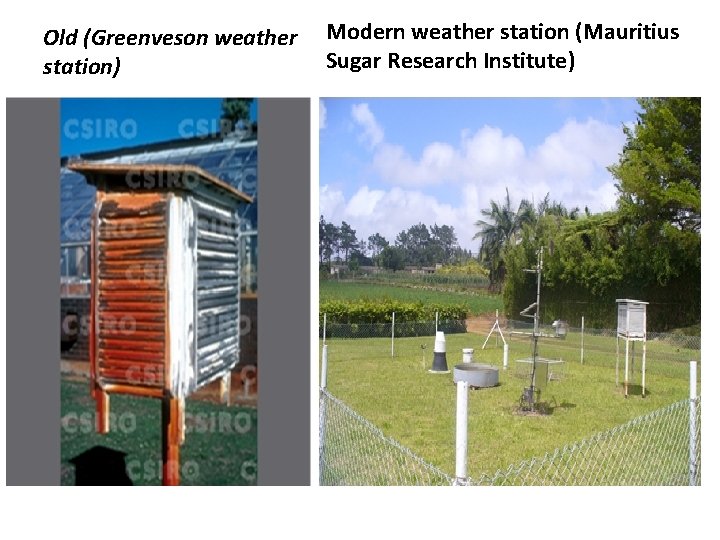
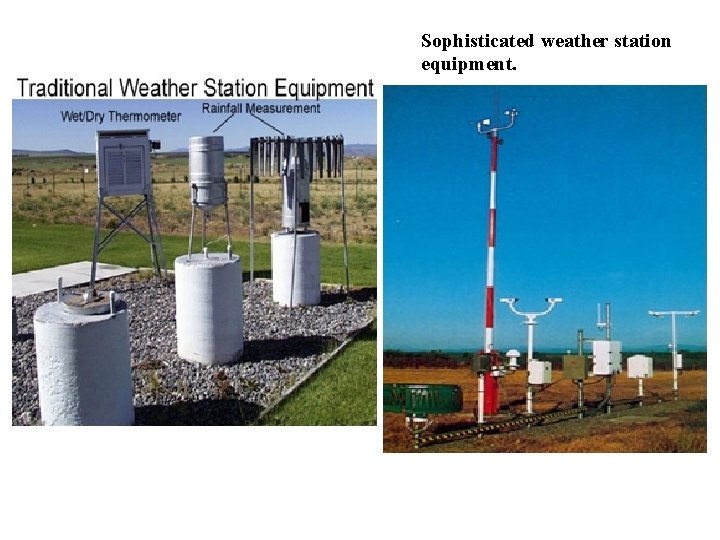
Old (Greenveson weather station) Modern weather station (Mauritius Sugar Research Institute)
Components of a Weather Station • Thermometers for measuring air temperature, • Hydrometer for measuring relative humidity, • Barometer detects atmospheric pressure, • Anemometer for measuring wind speed and • Gauges measure rain and snow.
Sophisticated weather station equipment.
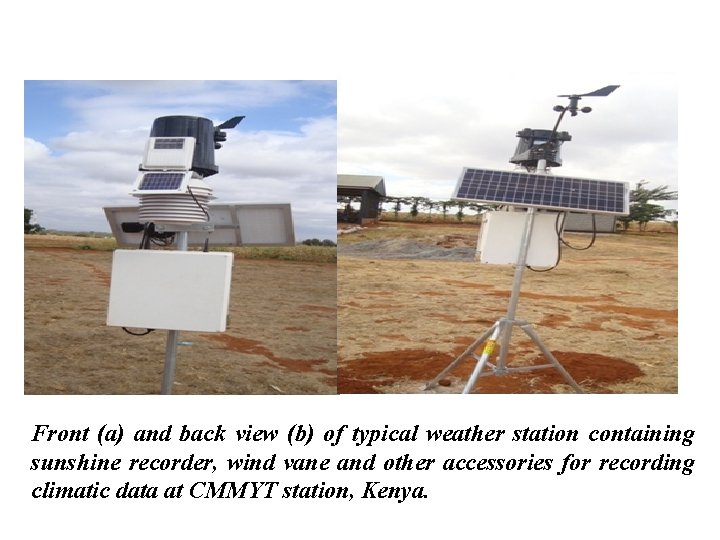
Front (a) and back view (b) of typical weather station containing sunshine recorder, wind vane and other accessories for recording climatic data at CMMYT station, Kenya.
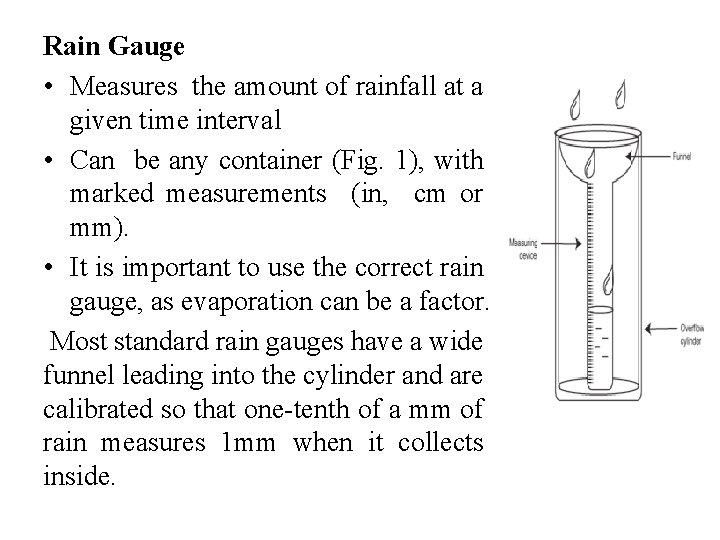
Rain Gauge • Measures the amount of rainfall at a given time interval • Can be any container (Fig. 1), with marked measurements (in, cm or mm). • It is important to use the correct rain gauge, as evaporation can be a factor. Most standard rain gauges have a wide funnel leading into the cylinder and are calibrated so that one-tenth of a mm of rain measures 1 mm when it collects inside.
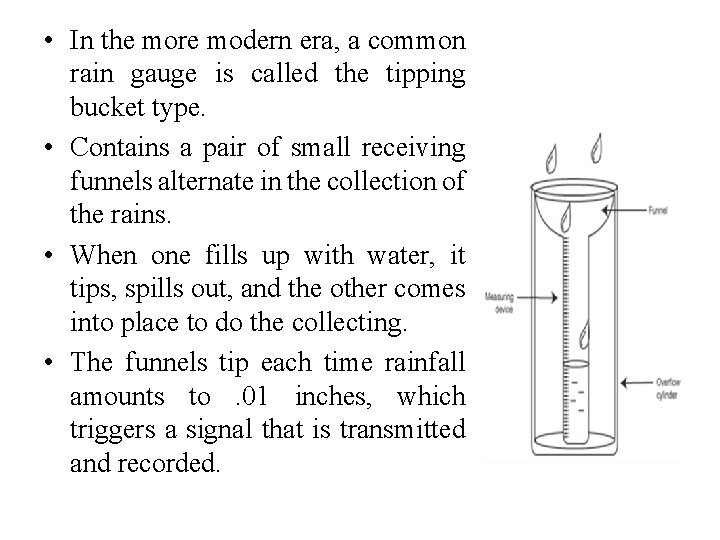
• In the more modern era, a common rain gauge is called the tipping bucket type. • Contains a pair of small receiving funnels alternate in the collection of the rains. • When one fills up with water, it tips, spills out, and the other comes into place to do the collecting. • The funnels tip each time rainfall amounts to. 01 inches, which triggers a signal that is transmitted and recorded.
Thermometers • Thermometers measure air temperature by using materials that change in some way when they are heated or cooled. • More specifically, the device measures the air’s heat content. • Temperatures are measured in degrees Celsius or degrees Fahrenheit, depending on location. • There is a combination of maximum and minimum thermometers
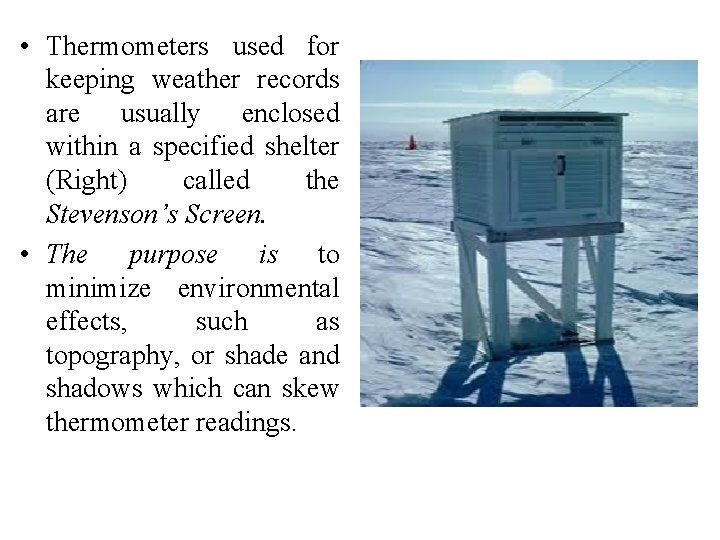
• Thermometers used for keeping weather records are usually enclosed within a specified shelter (Right) called the Stevenson’s Screen. • The purpose is to minimize environmental effects, such as topography, or shade and shadows which can skew thermometer readings.
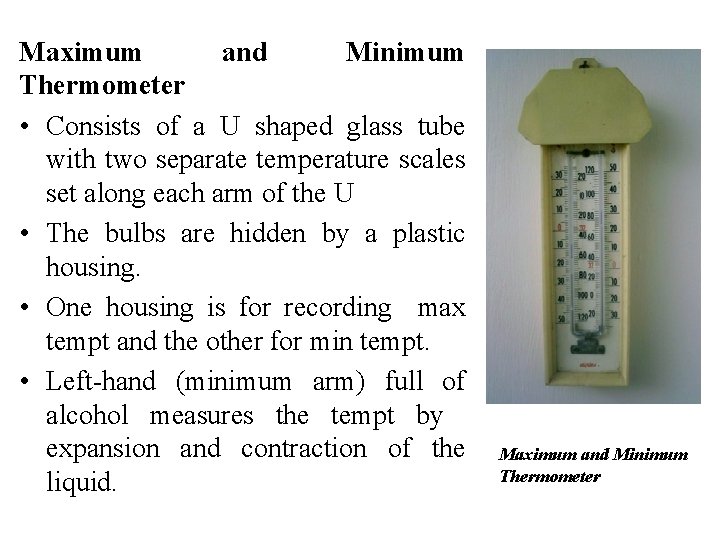
Maximum and Minimum Thermometer • Consists of a U shaped glass tube with two separate temperature scales set along each arm of the U • The bulbs are hidden by a plastic housing. • One housing is for recording max tempt and the other for min tempt. • Left-hand (minimum arm) full of alcohol measures the tempt by expansion and contraction of the liquid. Maximum and Minimum Thermometer
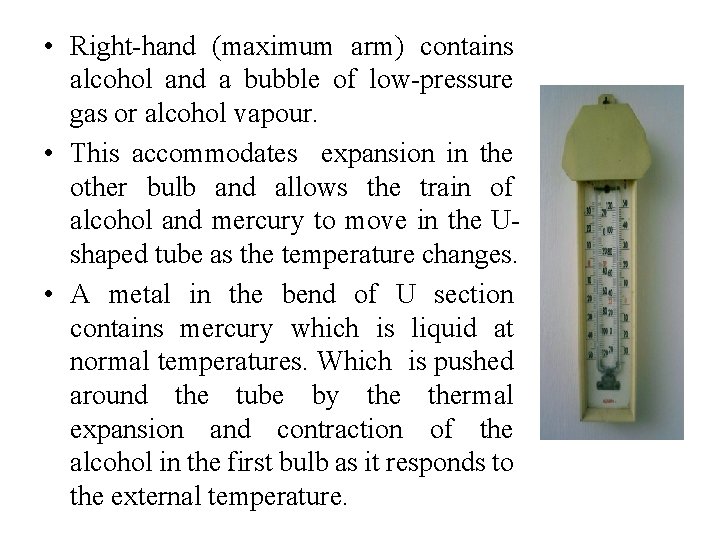
• Right-hand (maximum arm) contains alcohol and a bubble of low-pressure gas or alcohol vapour. • This accommodates expansion in the other bulb and allows the train of alcohol and mercury to move in the Ushaped tube as the temperature changes. • A metal in the bend of U section contains mercury which is liquid at normal temperatures. Which is pushed around the tube by thermal expansion and contraction of the alcohol in the first bulb as it responds to the external temperature.
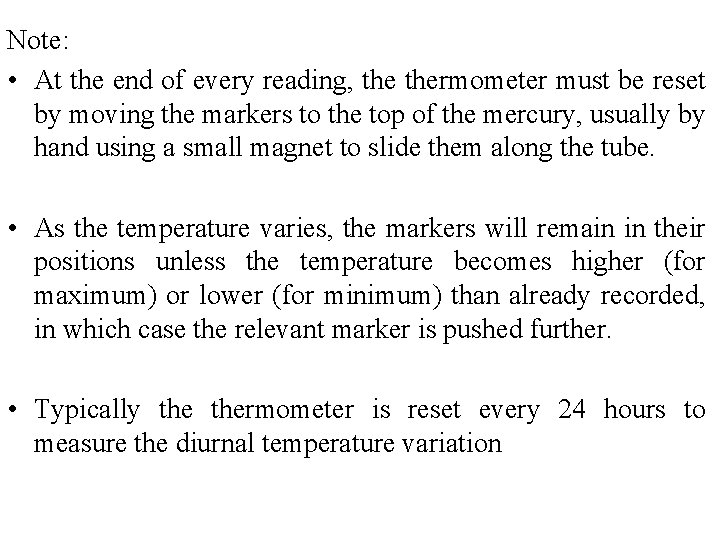
Note: • At the end of every reading, thermometer must be reset by moving the markers to the top of the mercury, usually by hand using a small magnet to slide them along the tube. • As the temperature varies, the markers will remain in their positions unless the temperature becomes higher (for maximum) or lower (for minimum) than already recorded, in which case the relevant marker is pushed further. • Typically thermometer is reset every 24 hours to measure the diurnal temperature variation
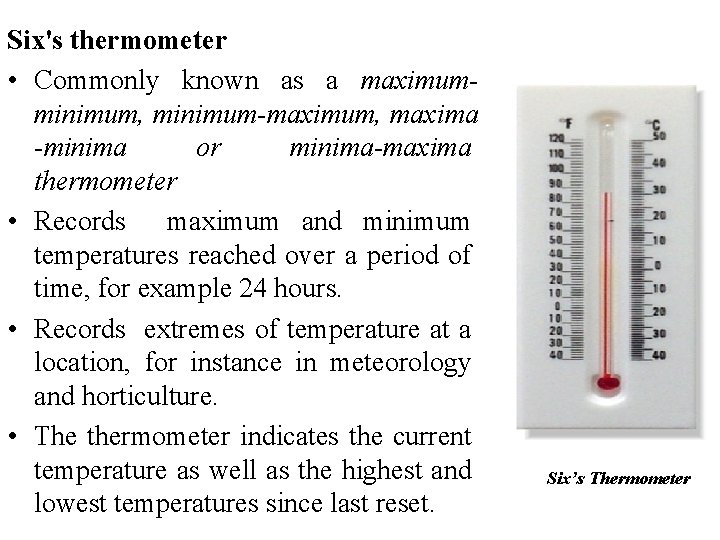
Six's thermometer • Commonly known as a maximumminimum, minimum-maximum, maxima -minima or minima-maxima thermometer • Records maximum and minimum temperatures reached over a period of time, for example 24 hours. • Records extremes of temperature at a location, for instance in meteorology and horticulture. • The thermometer indicates the current temperature as well as the highest and lowest temperatures since last reset. Six’s Thermometer
Soil Thermometer • Soil temperatures are usually measured at various depths – 5 cm, 10 cm, 20 cm, 50 cm and 100 cm. • Soil Thermometer is used for this purpose. • It is a mercurial thermometer with bulbs embedded in paraffin wax. • The thermometer is suspended in steel tubes and inserted into the soil at various depths.
Relative Humidity Definitions • The moisture content or the humidity of air or any gas • Measure of comfort at different temperatures or expression of how the temperature feels. . • Saturation point of water vapour in the air. • Often recorded as the “amount as a percentage of that required to saturate the air completely” (BBC, 2008). • More humidity, like in Lagos (Nigeria) which is very close to the sea, equals more discomfort.
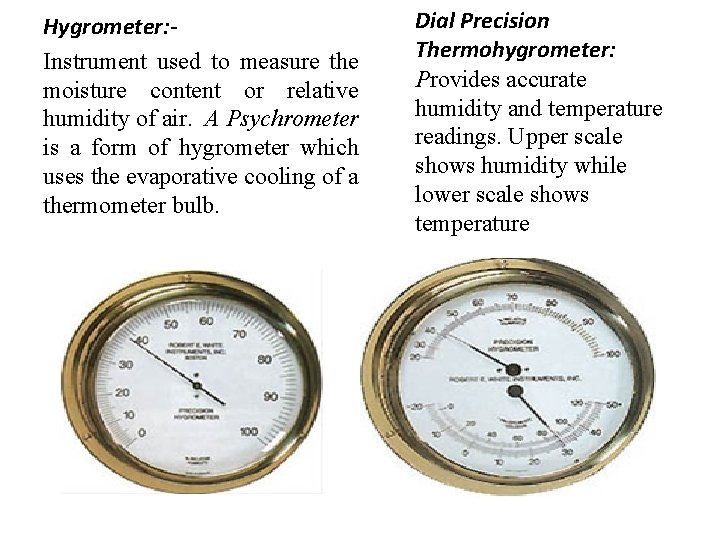
Hygrometer: Instrument used to measure the moisture content or relative humidity of air. A Psychrometer is a form of hygrometer which uses the evaporative cooling of a thermometer bulb. Dial Precision Thermohygrometer: Provides accurate humidity and temperature readings. Upper scale shows humidity while lower scale shows temperature
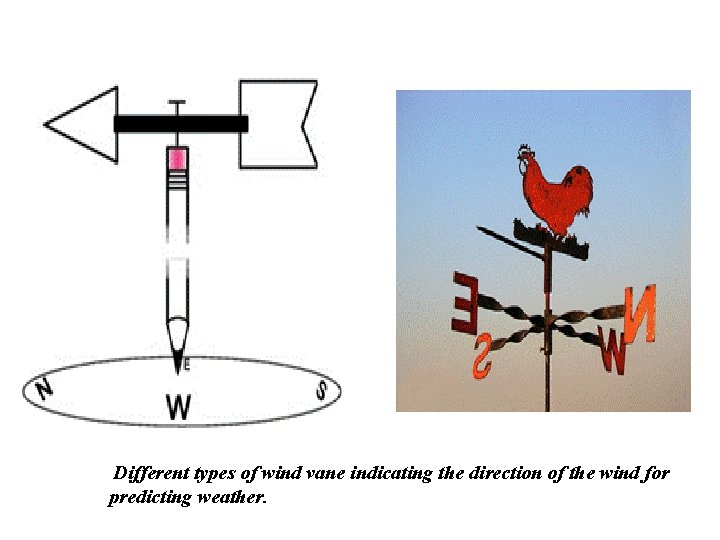
Wind (Weather) Vane: • Measures direction of wind using arrows that point out the direction of motion as it spins and points in the direction from which the wind is coming • The arrow points to the direction the wind is blowing from indicating where the wind is blowing from. Note: (i) Knowing the direction of the wind is an important part of predicting weather because wind brings us our weather. (ii) Wind direction indicates where the wind is blowing from. For example, a west wind is blowing from the west. (iii) To use a wind vane, you must know where north, south, east and west are.
Different types of wind vane indicating the direction of the wind for predicting weather.
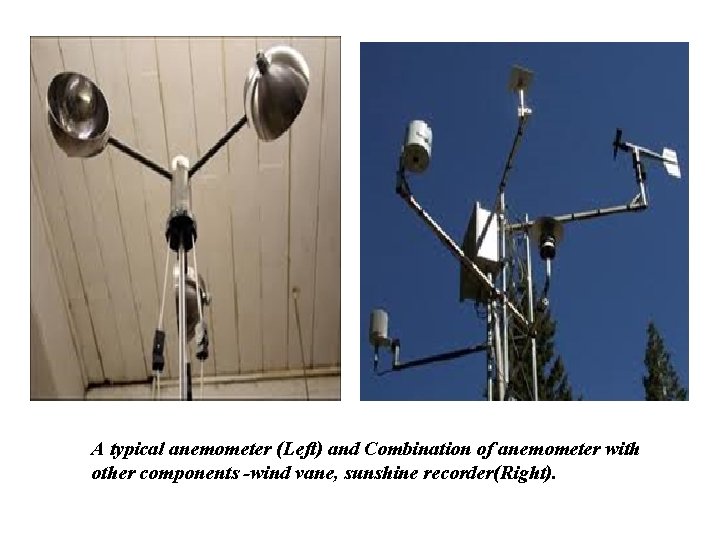
Anemometer • Measures wind speed or velocity (i. e. the strength of the air’s motion). • It is an instrument with three or four small hollow metal hemispheres set so that they catch the wind and revolve about a vertical rod • Several cups catch the wind, spinning them around a vertical pole and the wind speed is calculated by the number of revolutions per minute. • An electrical device records the revolutions of the cups and calculates the wind velocity.
A typical anemometer (Left) and Combination of anemometer with other components -wind vane, sunshine recorder(Right).
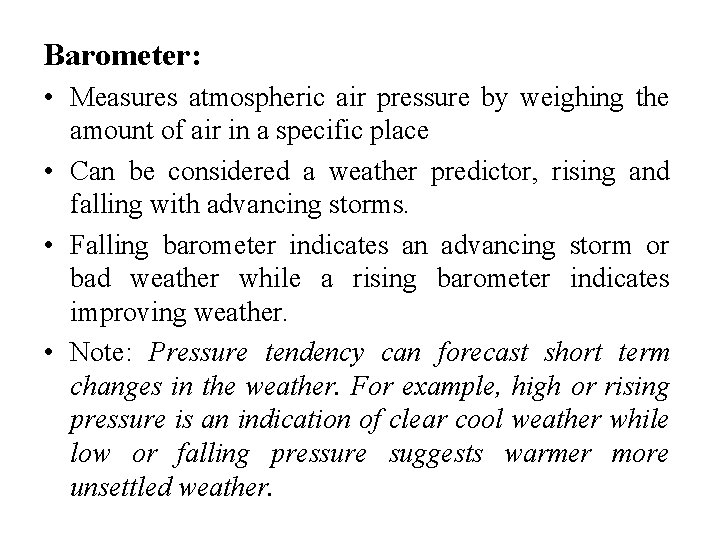
Barometer: • Measures atmospheric air pressure by weighing the amount of air in a specific place • Can be considered a weather predictor, rising and falling with advancing storms. • Falling barometer indicates an advancing storm or bad weather while a rising barometer indicates improving weather. • Note: Pressure tendency can forecast short term changes in the weather. For example, high or rising pressure is an indication of clear cool weather while low or falling pressure suggests warmer more unsettled weather.
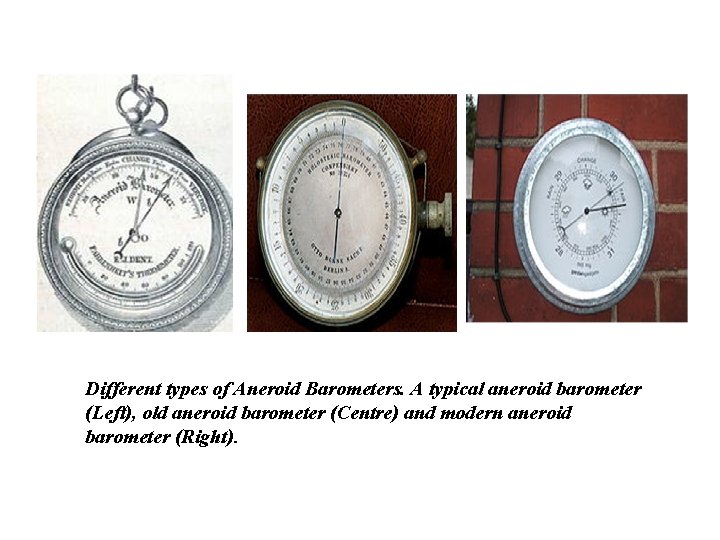
Different types of Aneroid Barometers. A typical aneroid barometer (Left), old aneroid barometer (Centre) and modern aneroid barometer (Right).
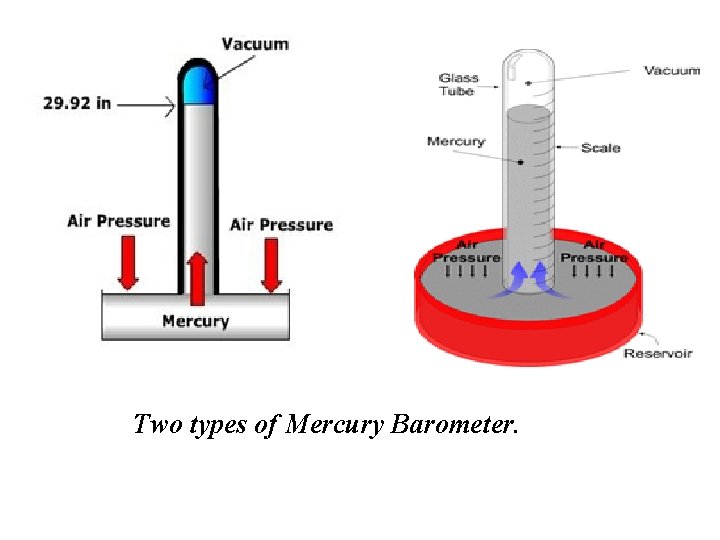
Mercury Barometers • A very early and traditional method for measuring air pressure is to observe a column of mercury within a vertical glass tube. • Barometer works by balancing the weight of mercury in the glass tube against the atmospheric pressure just like a set of scales –where mercury is lower than the atmospheric pressure, the mercury level in the glass tube rises and where weight of mercury is more than the atmospheric pressure, the mercury level falls. • Atmospheric pressure is basically the weight of air in the atmosphere above the reservoir. So the level of mercury continues to change until the weight of mercury in the glass tube is exactly equal to the weight of air above the reservoir.
Two types of Mercury Barometer.
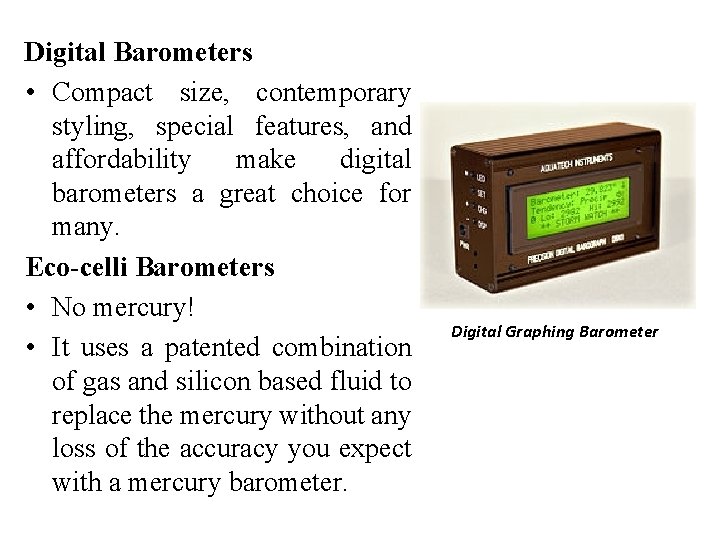
Digital Barometers • Compact size, contemporary styling, special features, and affordability make digital barometers a great choice for many. Eco-celli Barometers • No mercury! • It uses a patented combination of gas and silicon based fluid to replace the mercury without any loss of the accuracy you expect with a mercury barometer. Digital Graphing Barometer
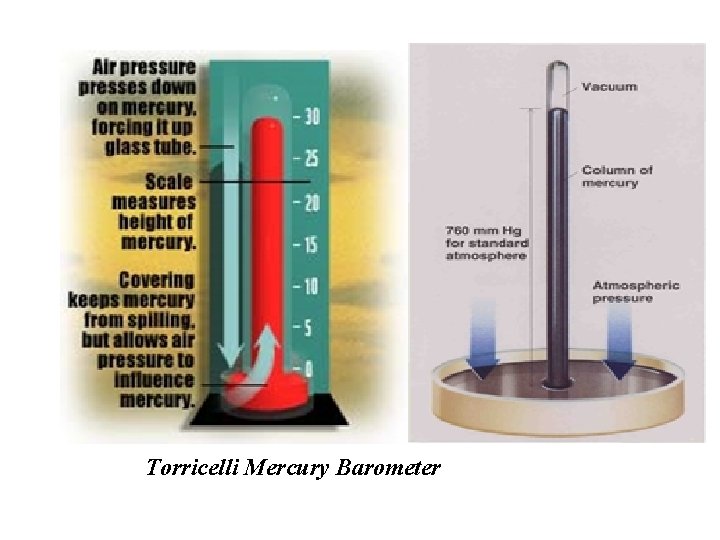
Torricelli Mercury Barometer • A glass tube from which the air has been removed is inserted into a dish of mercury. • The air pressing down on the mercury in the dish forces some of the mercury up into the glass tube. • The height that the mercury rises in the glass tube is directly related to the atmospheric pressure. • This pressure is usually measured in inches of mercury but can be converted to millibars. For example, a measurement of 29. 92 inches of mercury is equivalent to 1013. 25 millibars.
Torricelli Mercury Barometer
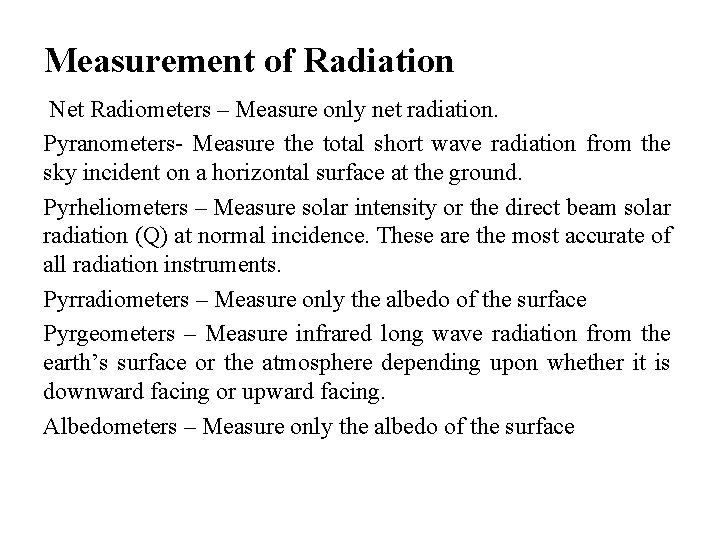
Measurement of Radiation Net Radiometers – Measure only net radiation. Pyranometers- Measure the total short wave radiation from the sky incident on a horizontal surface at the ground. Pyrheliometers – Measure solar intensity or the direct beam solar radiation (Q) at normal incidence. These are the most accurate of all radiation instruments. Pyrradiometers – Measure only the albedo of the surface Pyrgeometers – Measure infrared long wave radiation from the earth’s surface or the atmosphere depending upon whether it is downward facing or upward facing. Albedometers – Measure only the albedo of the surface
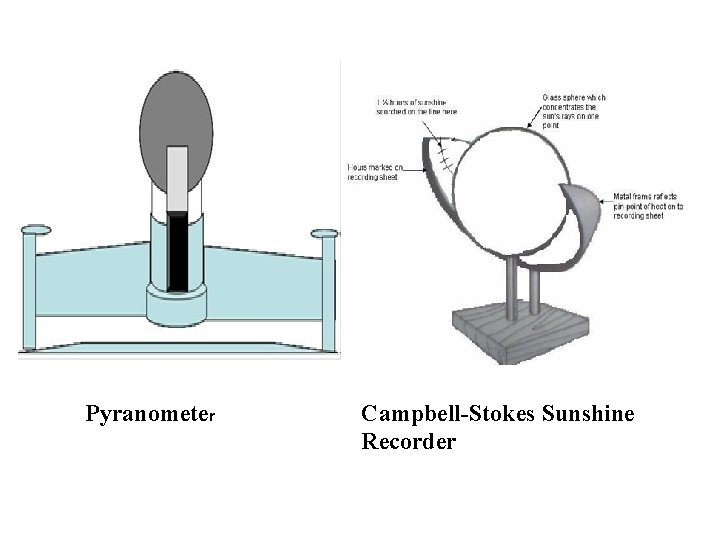
Pyranometer Campbell-Stokes Sunshine Recorder
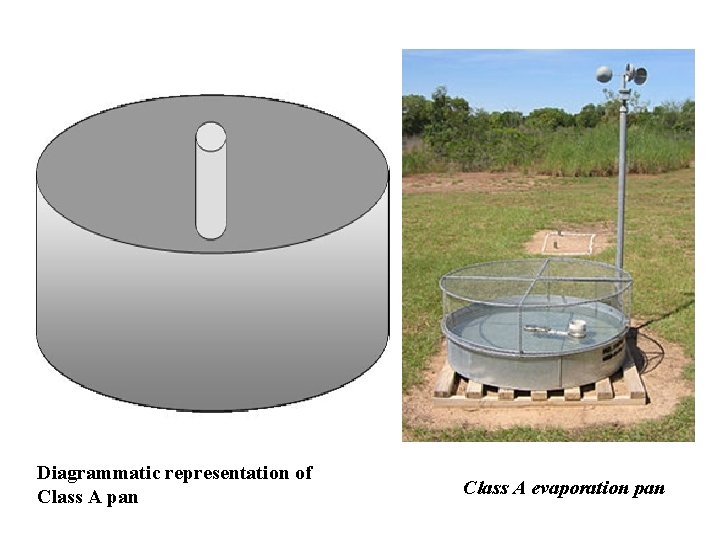
• An evaporation pan is used to hold water during observations for the determination of the quantity of evaporation at a given location. • Measurement from Pan evaporation combines or integrates the effects of several climatic variablestemperature, humidity, rainfall, drought dispersion, solar radiation, and wind. Note: • Evaporation is greatest on hot, windy, dry, sunny days; but greatly reduced when clouds block the sun and when air is cool, calm, and humid. • Pan evaporation measurements enable farmers and ranchers to understand how much water their crops will need.
• LECTURE 5: MEASUREMENT OF EVAPORATION AND EVAPOTRANSPIRATION
Diagrammatic representation of Class A pan Class A evaporation pan
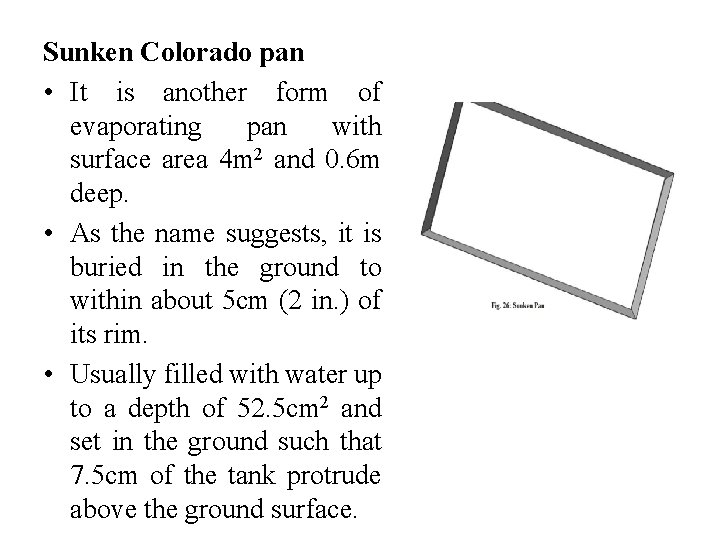
Sunken Colorado pan • It is another form of evaporating pan with surface area 4 m 2 and 0. 6 m deep. • As the name suggests, it is buried in the ground to within about 5 cm (2 in. ) of its rim. • Usually filled with water up to a depth of 52. 5 cm 2 and set in the ground such that 7. 5 cm of the tank protrude above the ground surface.
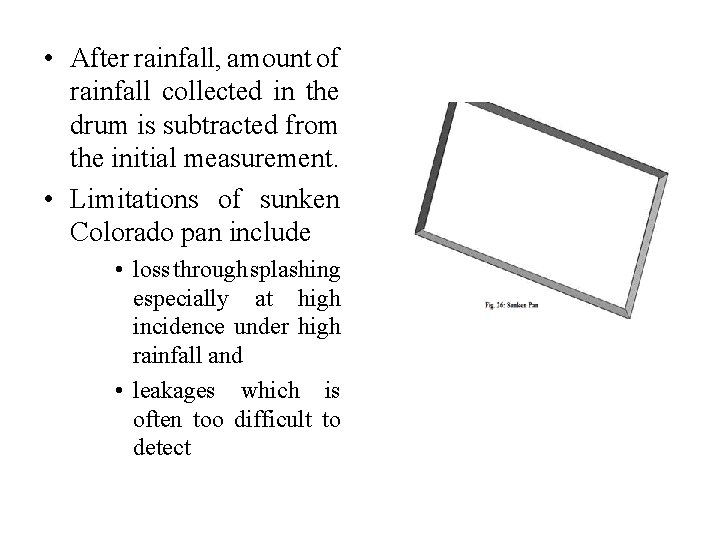
• After rainfall, amount of rainfall collected in the drum is subtracted from the initial measurement. • Limitations of sunken Colorado pan include • loss through splashing especially at high incidence under high rainfall and • leakages which is often too difficult to detect
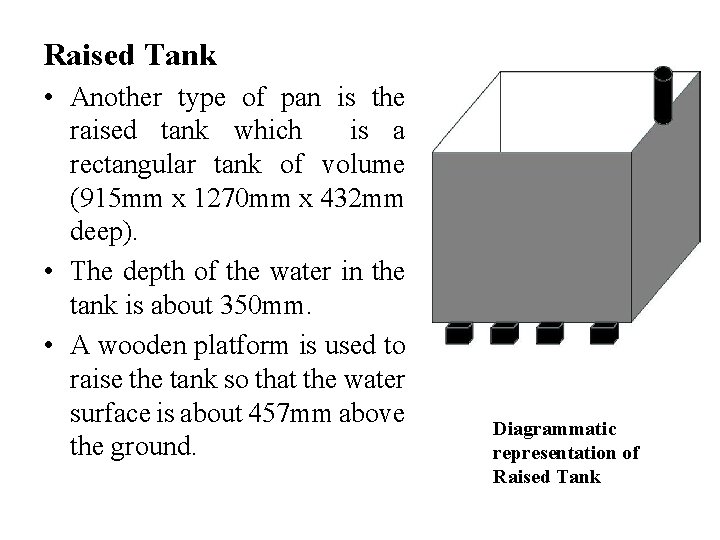
Raised Tank • Another type of pan is the raised tank which is a rectangular tank of volume (915 mm x 1270 mm x 432 mm deep). • The depth of the water in the tank is about 350 mm. • A wooden platform is used to raise the tank so that the water surface is about 457 mm above the ground. Diagrammatic representation of Raised Tank
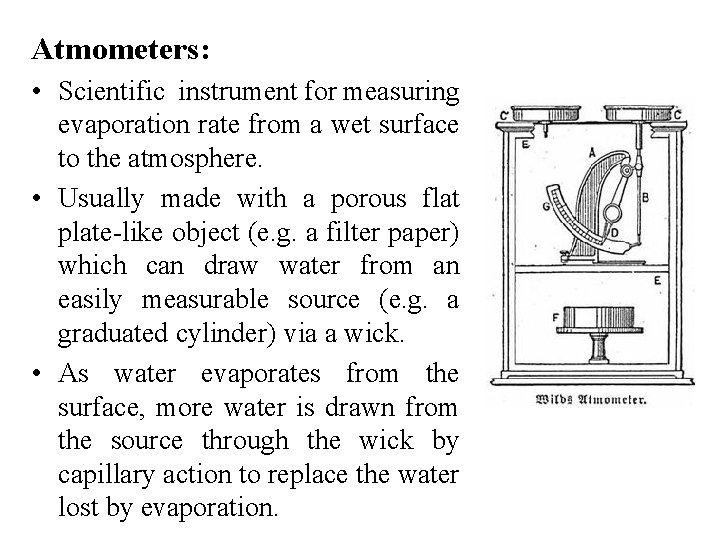
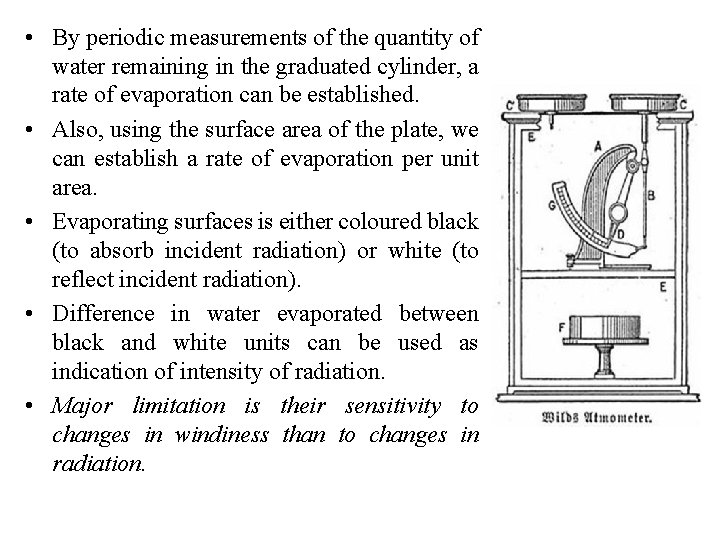
Atmometers: • Scientific instrument for measuring evaporation rate from a wet surface to the atmosphere. • Usually made with a porous flat plate-like object (e. g. a filter paper) which can draw water from an easily measurable source (e. g. a graduated cylinder) via a wick. • As water evaporates from the surface, more water is drawn from the source through the wick by capillary action to replace the water lost by evaporation.
• By periodic measurements of the quantity of water remaining in the graduated cylinder, a rate of evaporation can be established. • Also, using the surface area of the plate, we can establish a rate of evaporation per unit area. • Evaporating surfaces is either coloured black (to absorb incident radiation) or white (to reflect incident radiation). • Difference in water evaporated between black and white units can be used as indication of intensity of radiation. • Major limitation is their sensitivity to changes in windiness than to changes in radiation.
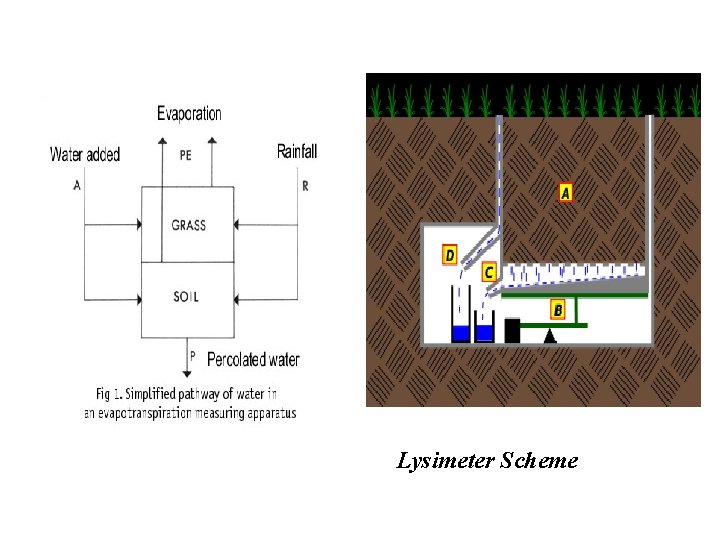
Measurement of Evapotranspiration- Lysimeter • A lysimeter is used to measure the amount of actual evapotranspiration (which is released by plants, usually crops or trees). • By recording the amount of precipitation that an area receives and the amount lost through the soil, the amount of water lost to evapotranspiration can be calculated. • Early devices, called pan lysimeters, collect soil water as it percolates down via gravity through saturated soils. • Modern automatic instrumentation is relatively straightforward to calculate evaporation and is done so by professional hydrologists and others.
• A lysimeter is most accurate when vegetation is grown in a large soil tank which allows the rainfall input and water lost through the soil to be easily calculated. • The amount of water lost by evapotranspiration can be worked out by calculating the difference between the weight before and after the precipitation input. • Lysimeters can be expensive and are a poor representation of conditions outside of a laboratory especially with for trees, • For farm crops, it can represent field conditions well since it is done outside the laboratory.
Lysimeter Scheme
Maintenance of Meteorological Station • Maintain a clear viewing area around the station ( i. e. Buildings should not be located close to the meteorological station. • Remove big trees around the station. • Keep the grass low at all times. • Evaporating pans and tanks should be protected from animals and birds • Replace malfunctioning equipment promptly.