
Lecture 4 Tomasulo Algorithm and Dynamic Branch Prediction
Lecture 4: Tomasulo Algorithm and Dynamic Branch Prediction Professor David A. Patterson Computer Science 252 Spring 1998 DAP Spr. ‘ 98 ©UCB 1
Review: Summary • Instruction Level Parallelism (ILP) in SW or HW • Loop level parallelism is easiest to see • SW parallelism dependencies defined for program, hazards if HW cannot resolve • SW dependencies/compiler sophistication determine if compiler can unroll loops – Memory dependencies hardest to determine • HW exploiting ILP – Works when can’t know dependence at run time – Code for one machine runs well on another • Key idea of Scoreboard: Allow instructions behind stall to proceed (Decode => Issue instr & read operands) – Enables out-of-order execution => out-of-order completion DAP Spr. ‘ 98 ©UCB 2 – ID stage checked both for structural
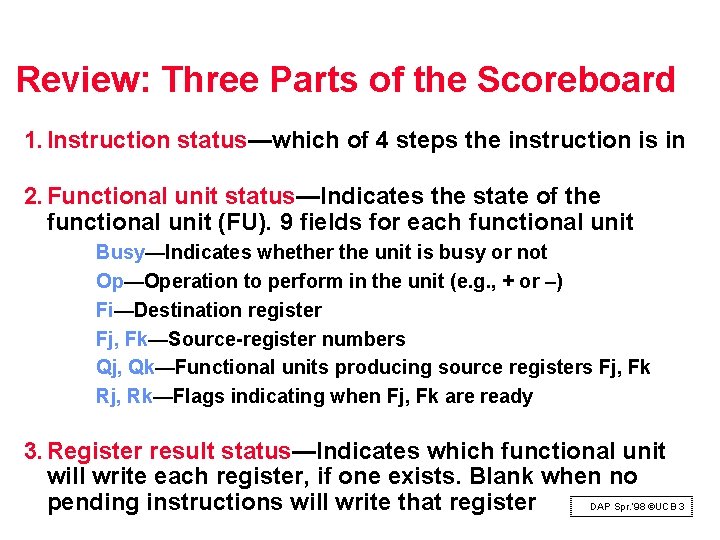
Review: Three Parts of the Scoreboard 1. Instruction status—which of 4 steps the instruction is in 2. Functional unit status—Indicates the state of the functional unit (FU). 9 fields for each functional unit Busy—Indicates whether the unit is busy or not Op—Operation to perform in the unit (e. g. , + or –) Fi—Destination register Fj, Fk—Source-register numbers Qj, Qk—Functional units producing source registers Fj, Fk Rj, Rk—Flags indicating when Fj, Fk are ready 3. Register result status—Indicates which functional unit will write each register, if one exists. Blank when no DAP Spr. ‘ 98 ©UCB 3 pending instructions will write that register
Review: Scoreboard Example Cycle 3 • Issue MULT? No, stall on structural hazard DAP Spr. ‘ 98 ©UCB 4
Review: Scoreboard Example Cycle 9 • Read operands for MULT & SUBD? Issue ADDD? DAP Spr. ‘ 98 ©UCB 5
Review: Scoreboard Example Cycle 17 • Write result of ADDD? No, WAR hazard DAP Spr. ‘ 98 ©UCB 6
Review: Scoreboard Example Cycle 62 • In-order issue; out-of-order execute & commit DAP Spr. ‘ 98 ©UCB 7
Review: Scoreboard Summary • Speedup 1. 7 from compiler; 2. 5 by hand BUT slow memory (no cache) • Limitations of 6600 scoreboard – No forwarding (First write regsiter then read it) – Limited to instructions in basic block (small window) – Number of functional units(structural hazards) – Wait for WAR hazards – Prevent WAW hazards DAP Spr. ‘ 98 ©UCB 8
Another Dynamic Algorithm: Tomasulo Algorithm • For IBM 360/91 about 3 years after CDC 6600 (1966) • Goal: High Performance without special compilers • Differences between IBM 360 & CDC 6600 ISA – IBM has only 2 register specifiers/instr vs. 3 in CDC 6600 – IBM has 4 FP registers vs. 8 in CDC 6600 • Why Study? lead to Alpha 21264, HP 8000, MIPS 10000, Pentium II, Power. PC 604, … DAP Spr. ‘ 98 ©UCB 9
Tomasulo Algorithm vs. Scoreboard • Control & buffers distributed with Function Units (FU) vs. centralized in scoreboard; – FU buffers called “reservation stations”; have pending operands • Registers in instructions replaced by values or pointers to reservation stations(RS); called register renaming ; – avoids WAR, WAW hazards – More reservation stations than registers, so can do optimizations compilers can’t • Results to FU from RS, not through registers, over Common Data Bus that broadcasts results to all FUs • Load and Stores treated as FUs with RSs as well • Integer instructions can go past branches, allowing DAP Spr. ‘ 98 ©UCB 10 FP ops beyond basic block in FP queue
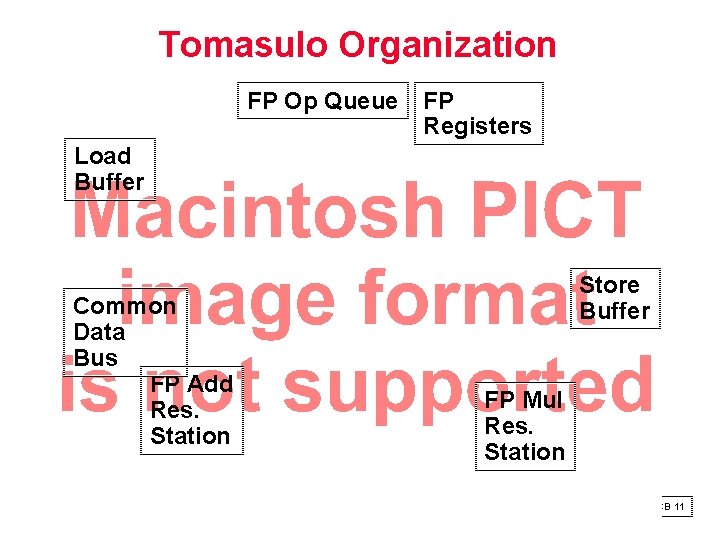
Tomasulo Organization FP Op Queue FP Registers Load Buffer Common Data Bus FP Add Res. Station Store Buffer FP Mul Res. Station DAP Spr. ‘ 98 ©UCB 11
Reservation Station Components Op—Operation to perform in the unit (e. g. , + or –) Vj, Vk—Value of Source operands – Store buffers has V field, result to be stored Qj, Qk—Reservation stations producing source registers (value to be written) – Note: No ready flags as in Scoreboard; Qj, Qk=0 => ready – Store buffers only have Qi for RS producing result Busy—Indicates reservation station or FU is busy Register result status—Indicates which functional unit will write each register, if one exists. Blank when no pending instructions that will write that register. DAP Spr. ‘ 98 ©UCB 12
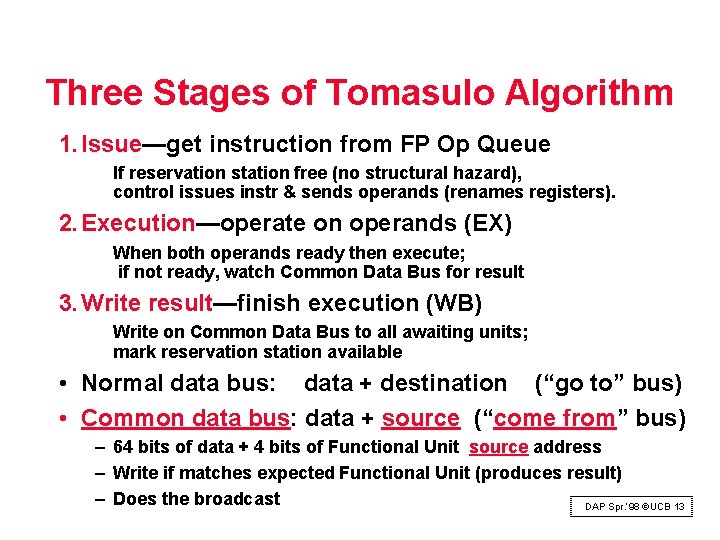
Three Stages of Tomasulo Algorithm 1. Issue—get instruction from FP Op Queue If reservation station free (no structural hazard), control issues instr & sends operands (renames registers). 2. Execution—operate on operands (EX) When both operands ready then execute; if not ready, watch Common Data Bus for result 3. Write result—finish execution (WB) Write on Common Data Bus to all awaiting units; mark reservation station available • Normal data bus: data + destination (“go to” bus) • Common data bus: data + source (“come from” bus) – 64 bits of data + 4 bits of Functional Unit source address – Write if matches expected Functional Unit (produces result) – Does the broadcast DAP Spr. ‘ 98 ©UCB 13
Tomasulo Example Cycle 0 DAP Spr. ‘ 98 ©UCB 14
Tomasulo Example Cycle 1 Yes DAP Spr. ‘ 98 ©UCB 15
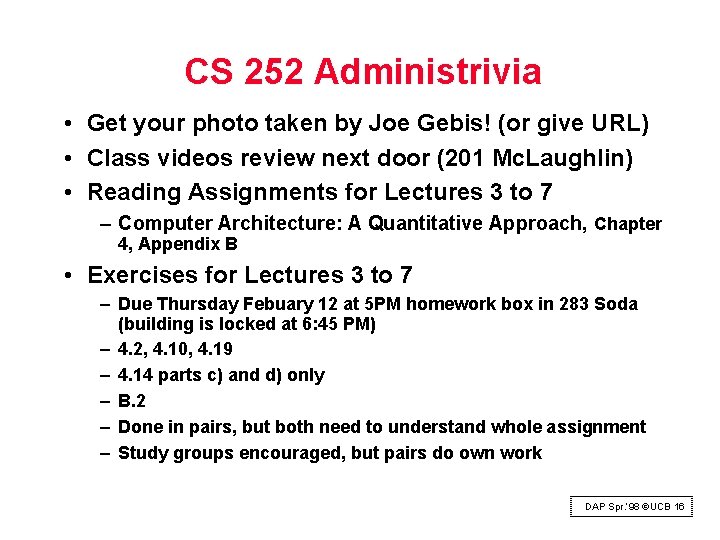
CS 252 Administrivia • Get your photo taken by Joe Gebis! (or give URL) • Class videos review next door (201 Mc. Laughlin) • Reading Assignments for Lectures 3 to 7 – Computer Architecture: A Quantitative Approach, Chapter 4, Appendix B • Exercises for Lectures 3 to 7 – Due Thursday Febuary 12 at 5 PM homework box in 283 Soda (building is locked at 6: 45 PM) – 4. 2, 4. 10, 4. 19 – 4. 14 parts c) and d) only – B. 2 – Done in pairs, but both need to understand whole assignment – Study groups encouraged, but pairs do own work DAP Spr. ‘ 98 ©UCB 16
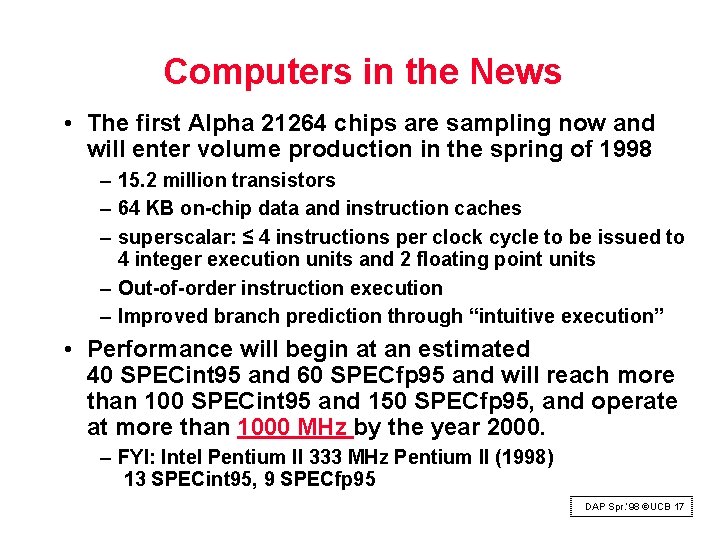
Computers in the News • The first Alpha 21264 chips are sampling now and will enter volume production in the spring of 1998 – 15. 2 million transistors – 64 KB on-chip data and instruction caches – superscalar: ≤ 4 instructions per clock cycle to be issued to 4 integer execution units and 2 floating point units – Out-of-order instruction execution – Improved branch prediction through “intuitive execution” • Performance will begin at an estimated 40 SPECint 95 and 60 SPECfp 95 and will reach more than 100 SPECint 95 and 150 SPECfp 95, and operate at more than 1000 MHz by the year 2000. – FYI: Intel Pentium II 333 MHz Pentium II (1998) 13 SPECint 95, 9 SPECfp 95 DAP Spr. ‘ 98 ©UCB 17
Tomasulo Example Cycle 2 Note: Unlike 6600, can have multiple loads outstanding DAP Spr. ‘ 98 ©UCB 18
Tomasulo Example Cycle 3 • Note: registers names are removed (“renamed”) in Reservation Stations; MULT issued vs. scoreboard DAP Spr. ‘ 98 ©UCB 19 • Load 1 completing; what is waiting for Load 1?
Tomasulo Example Cycle 4 • Load 2 completing; what is waiting for it? DAP Spr. ‘ 98 ©UCB 20
Tomasulo Example Cycle 5 DAP Spr. ‘ 98 ©UCB 21
Tomasulo Example Cycle 6 • Issue ADDD here vs. scoreboard? DAP Spr. ‘ 98 ©UCB 22
Tomasulo Example Cycle 7 • Add 1 completing; what is waiting for it? DAP Spr. ‘ 98 ©UCB 23
Tomasulo Example Cycle 8 DAP Spr. ‘ 98 ©UCB 24
Tomasulo Example Cycle 9 DAP Spr. ‘ 98 ©UCB 25
Tomasulo Example Cycle 10 • Add 2 completing; what is waiting for it? DAP Spr. ‘ 98 ©UCB 26
Tomasulo Example Cycle 11 • Write result of ADDD here vs. scoreboard? DAP Spr. ‘ 98 ©UCB 27
Tomasulo Example Cycle 12 • Note: all quick instructions complete already DAP Spr. ‘ 98 ©UCB 28
Tomasulo Example Cycle 13 DAP Spr. ‘ 98 ©UCB 29
Tomasulo Example Cycle 14 DAP Spr. ‘ 98 ©UCB 30
Tomasulo Example Cycle 15 • Mult 1 completing; what is waiting for it? DAP Spr. ‘ 98 ©UCB 31
Tomasulo Example Cycle 16 • Note: Just waiting for divide DAP Spr. ‘ 98 ©UCB 32
Tomasulo Example Cycle 55 DAP Spr. ‘ 98 ©UCB 33
Tomasulo Example Cycle 56 • Mult 2 completing; what is waiting for it? DAP Spr. ‘ 98 ©UCB 34
Tomasulo Example Cycle 57 • Again, in-oder issue, out-of-order execution, completion DAP Spr. ‘ 98 ©UCB 35
Compare to Scoreboard Cycle 62 • Why takes longer on Scoreboard/6600? DAP Spr. ‘ 98 ©UCB 36
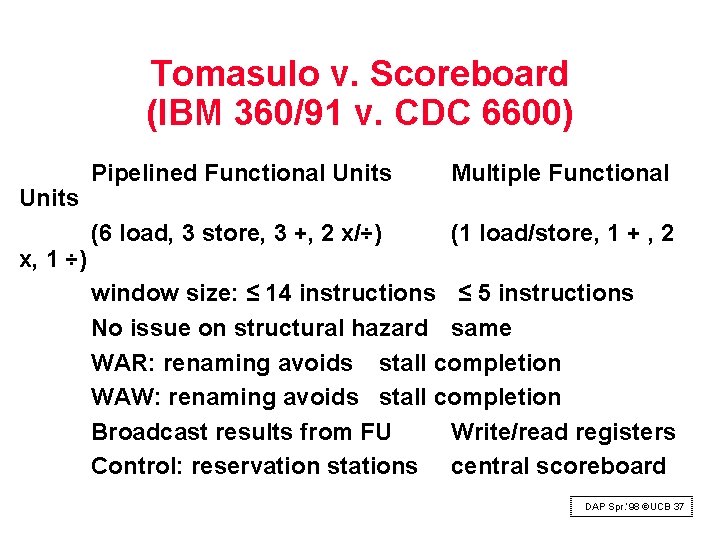
Tomasulo v. Scoreboard (IBM 360/91 v. CDC 6600) Units x, 1 ÷) Pipelined Functional Units Multiple Functional (6 load, 3 store, 3 +, 2 x/÷) (1 load/store, 1 + , 2 window size: ≤ 14 instructions ≤ 5 instructions No issue on structural hazard same WAR: renaming avoids stall completion WAW: renaming avoids stall completion Broadcast results from FU Write/read registers Control: reservation stations central scoreboard DAP Spr. ‘ 98 ©UCB 37
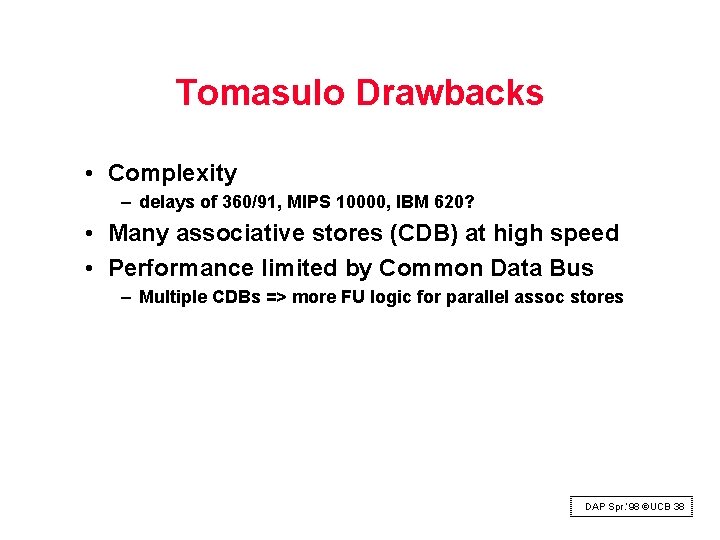
Tomasulo Drawbacks • Complexity – delays of 360/91, MIPS 10000, IBM 620? • Many associative stores (CDB) at high speed • Performance limited by Common Data Bus – Multiple CDBs => more FU logic for parallel assoc stores DAP Spr. ‘ 98 ©UCB 38
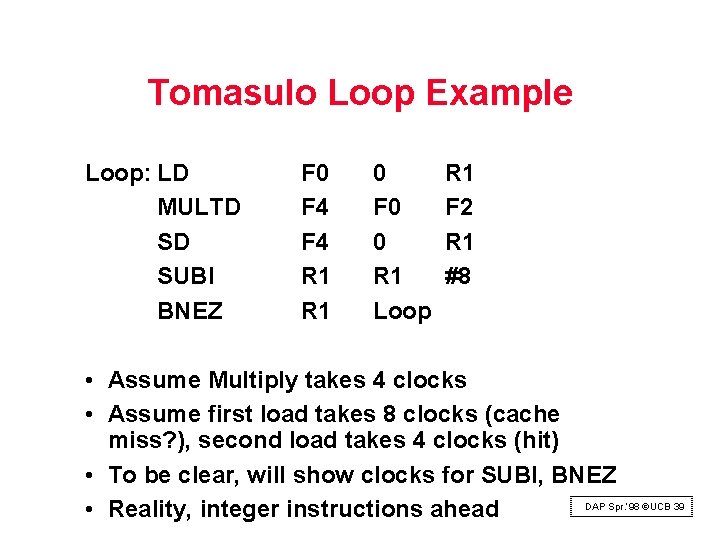
Tomasulo Loop Example Loop: LD MULTD SD SUBI BNEZ F 0 F 4 R 1 0 F 0 0 R 1 Loop R 1 F 2 R 1 #8 • Assume Multiply takes 4 clocks • Assume first load takes 8 clocks (cache miss? ), second load takes 4 clocks (hit) • To be clear, will show clocks for SUBI, BNEZ DAP Spr. ‘ 98 ©UCB 39 • Reality, integer instructions ahead
Loop Example Cycle 0 DAP Spr. ‘ 98 ©UCB 40
Loop Example Cycle 1 DAP Spr. ‘ 98 ©UCB 41
Loop Example Cycle 2 DAP Spr. ‘ 98 ©UCB 42
Loop Example Cycle 3 • Note: MULT 1 has no registers names in RS DAP Spr. ‘ 98 ©UCB 43
Loop Example Cycle 4 DAP Spr. ‘ 98 ©UCB 44
Loop Example Cycle 5 DAP Spr. ‘ 98 ©UCB 45
Loop Example Cycle 6 • Note: F 0 never sees Load 1 result DAP Spr. ‘ 98 ©UCB 46
Loop Example Cycle 7 • Note: MULT 2 has no registers names in RS DAP Spr. ‘ 98 ©UCB 47
Loop Example Cycle 8 DAP Spr. ‘ 98 ©UCB 48
Loop Example Cycle 9 • Load 1 completing; what is waiting for it? DAP Spr. ‘ 98 ©UCB 49
Loop Example Cycle 10 • Load 2 completing; what is waiting for it? DAP Spr. ‘ 98 ©UCB 50
Loop Example Cycle 11 DAP Spr. ‘ 98 ©UCB 51
Loop Example Cycle 12 DAP Spr. ‘ 98 ©UCB 52
Loop Example Cycle 13 DAP Spr. ‘ 98 ©UCB 53
Loop Example Cycle 14 • Mult 1 completing; what is waiting for it? DAP Spr. ‘ 98 ©UCB 54
Loop Example Cycle 15 • Mult 2 completing; what is waiting for it? DAP Spr. ‘ 98 ©UCB 55
Loop Example Cycle 16 DAP Spr. ‘ 98 ©UCB 56
Loop Example Cycle 17 DAP Spr. ‘ 98 ©UCB 57
Loop Example Cycle 18 DAP Spr. ‘ 98 ©UCB 58
Loop Example Cycle 19 DAP Spr. ‘ 98 ©UCB 59
Loop Example Cycle 20 DAP Spr. ‘ 98 ©UCB 60
Loop Example Cycle 21 DAP Spr. ‘ 98 ©UCB 61
Tomasulo Summary • Reservations stations: renaming to larger set of registers + buffering source operands – Prevents registers as bottleneck – Avoids WAR, WAW hazards of Scoreboard – Allows loop unrolling in HW • Not limited to basic blocks (integer units gets ahead, beyond branches) • Helps cache misses as well • Lasting Contributions – Dynamic scheduling – Register renaming – Load/store disambiguation • 360/91 descendants are Pentium II; Power. PC 604; MIPS R 10000; HP-PA 8000; Alpha 21264 DAP Spr. ‘ 98 ©UCB 62
- Slides: 62