
Lecture 4 The Vertical Boundaries of the Firm
Lecture #4: The Vertical Boundaries of the Firm Alexander Schibuola ECON 308 Besanko et al Ch. 3, pp. 98 -101, 106 -128 1
Outline Make versus Buy n Reasons to Make n 2

Outline n Horizontal versus Vertical Boundaries Berkshire Hathaway Boundaries (Warren Buffet’s company) Computer Manufacturer Geico Vertical Boundaries (lecture #4) Cotton Agriculture Aircraft Manufacturer Fruit of the Loom Net. Jets Horizontal Boundaries (lecture #3) 3
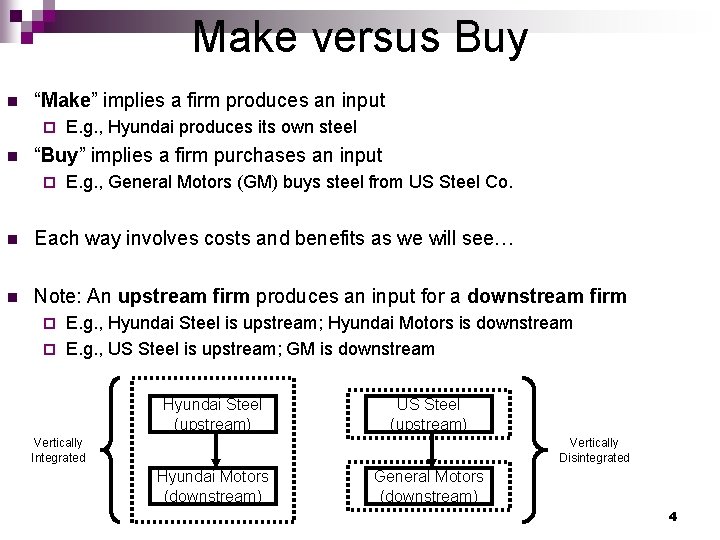
Make versus Buy n “Make” implies a firm produces an input ¨ n E. g. , Hyundai produces its own steel “Buy” implies a firm purchases an input ¨ E. g. , General Motors (GM) buys steel from US Steel Co. n Each way involves costs and benefits as we will see… n Note: An upstream firm produces an input for a downstream firm E. g. , Hyundai Steel is upstream; Hyundai Motors is downstream ¨ E. g. , US Steel is upstream; GM is downstream ¨ Hyundai Steel (upstream) US Steel (upstream) Vertically Integrated Vertically Disintegrated Hyundai Motors (downstream) General Motors (downstream) 4
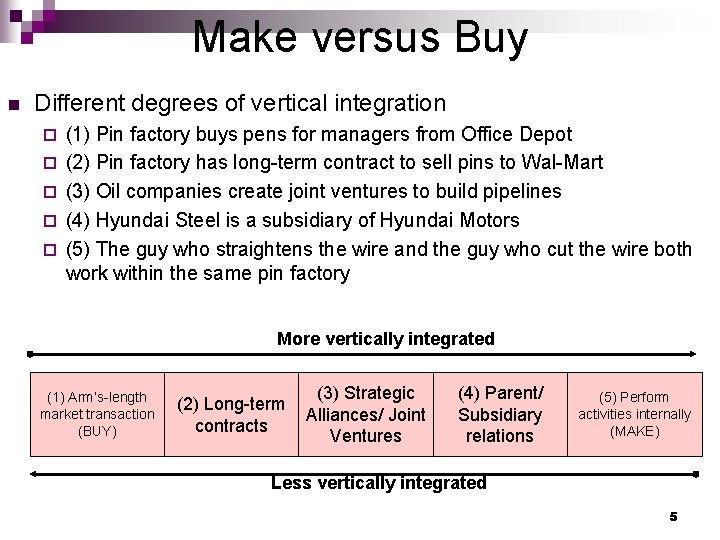
Make versus Buy n Different degrees of vertical integration ¨ ¨ ¨ (1) Pin factory buys pens for managers from Office Depot (2) Pin factory has long-term contract to sell pins to Wal-Mart (3) Oil companies create joint ventures to build pipelines (4) Hyundai Steel is a subsidiary of Hyundai Motors (5) The guy who straightens the wire and the guy who cut the wire both work within the same pin factory More vertically integrated (1) Arm’s-length market transaction (BUY) (2) Long-term contracts (3) Strategic Alliances/ Joint Ventures (4) Parent/ Subsidiary relations (5) Perform activities internally (MAKE) Less vertically integrated 5
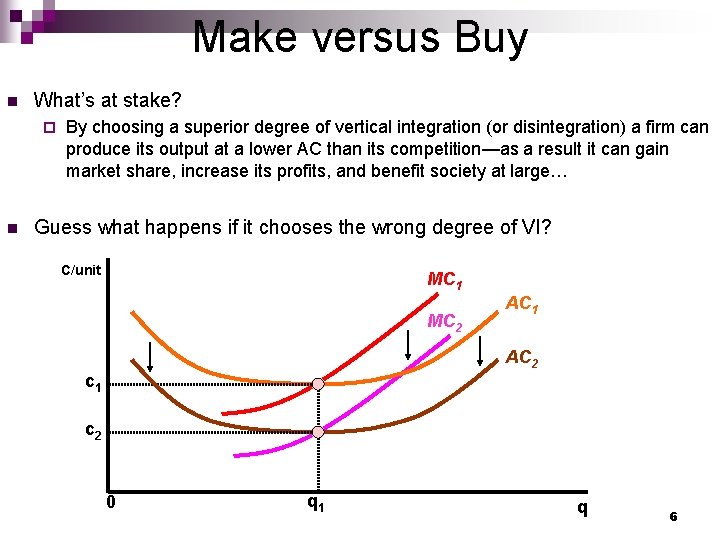
Make versus Buy n What’s at stake? ¨ n By choosing a superior degree of vertical integration (or disintegration) a firm can produce its output at a lower AC than its competition—as a result it can gain market share, increase its profits, and benefit society at large… Guess what happens if it chooses the wrong degree of VI? C/unit MC 1 MC 2 AC 1 AC 2 c 1 c 2 0 q 1 q 6

Make versus Buy n Benefits of vertical disintegration ¨ I. e. , buying rather than making, or “using n (1) Exploit scale and learning economies n (2) Avoid agency and influence costs n the market” Benefits of vertical integration ¨ I. e. , making rather than buying, or “using n (1) Avoid double marginalization problems n (2) Avoid incomplete contracts n (3) Minimize coordination issues n (4) Prevent leakages of private information n (5) Avoid hold-up problems the firm” 7
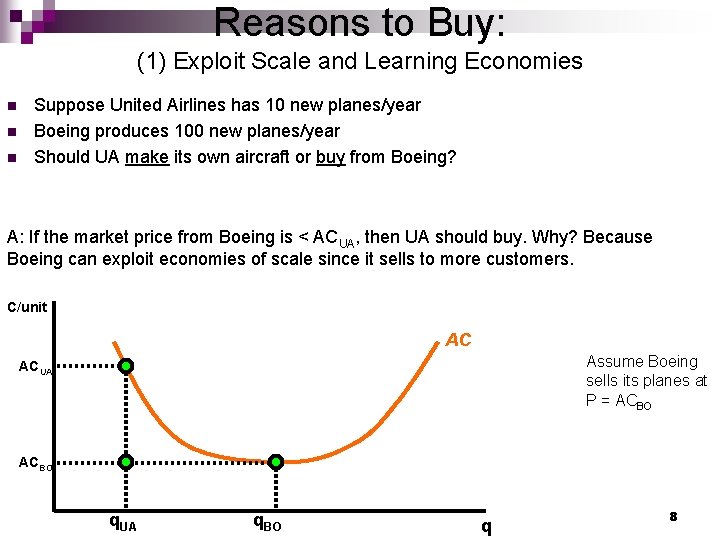
Reasons to Buy: (1) Exploit Scale and Learning Economies n n n Suppose United Airlines has 10 new planes/year Boeing produces 100 new planes/year Should UA make its own aircraft or buy from Boeing? A: If the market price from Boeing is < ACUA, then UA should buy. Why? Because Boeing can exploit economies of scale since it sells to more customers. C/unit AC Assume Boeing sells its planes at P = ACBO ACUA ACBO q. UA q. BO q 8
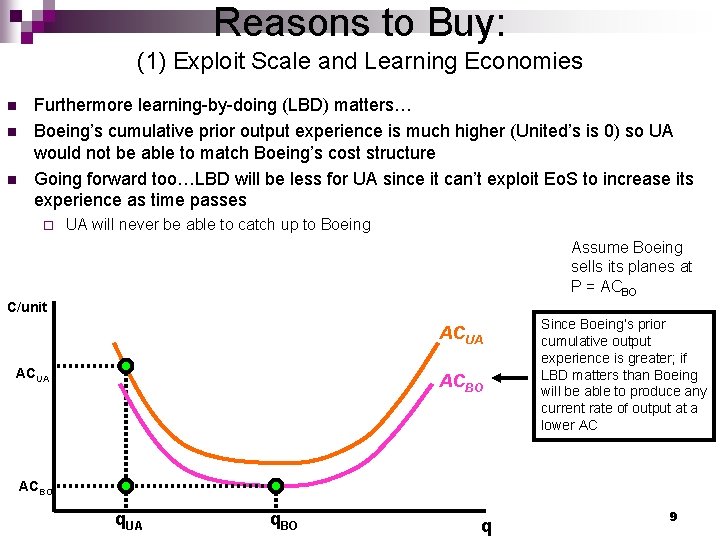
Reasons to Buy: (1) Exploit Scale and Learning Economies n n n Furthermore learning-by-doing (LBD) matters… Boeing’s cumulative prior output experience is much higher (United’s is 0) so UA would not be able to match Boeing’s cost structure Going forward too…LBD will be less for UA since it can’t exploit Eo. S to increase its experience as time passes ¨ UA will never be able to catch up to Boeing Assume Boeing sells its planes at P = ACBO C/unit ACUA ACBO Since Boeing’s prior cumulative output experience is greater; if LBD matters than Boeing will be able to produce any current rate of output at a lower AC ACBO q. UA q. BO q 9
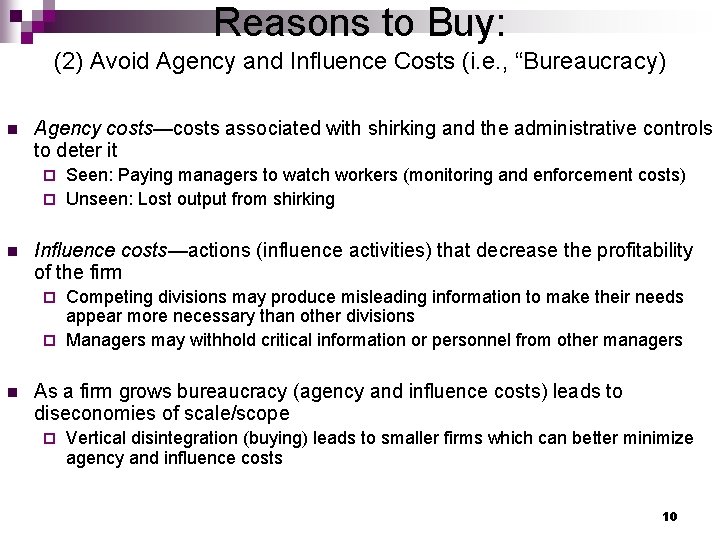
Reasons to Buy: (2) Avoid Agency and Influence Costs (i. e. , “Bureaucracy) n Agency costs—costs associated with shirking and the administrative controls to deter it Seen: Paying managers to watch workers (monitoring and enforcement costs) ¨ Unseen: Lost output from shirking ¨ n Influence costs—actions (influence activities) that decrease the profitability of the firm Competing divisions may produce misleading information to make their needs appear more necessary than other divisions ¨ Managers may withhold critical information or personnel from other managers ¨ n As a firm grows bureaucracy (agency and influence costs) leads to diseconomies of scale/scope ¨ Vertical disintegration (buying) leads to smaller firms which can better minimize agency and influence costs 10

Reasons to Make: (1) Avoid Double Marginalization Problems Case A: Upstream perfect competition; downstream perfect competition. Under perfect competition P = MC in equilibrium; outcome is “efficient”. Assume here that for every output the downstream firm produces it needs to buy one input from the upstream firm. PU Upstream (Perfect Competition) 36 12 PD Downstream (Perfect Competition) 36 A 24 MC 12 A MC = Pu DD DU QU 24 QD 11
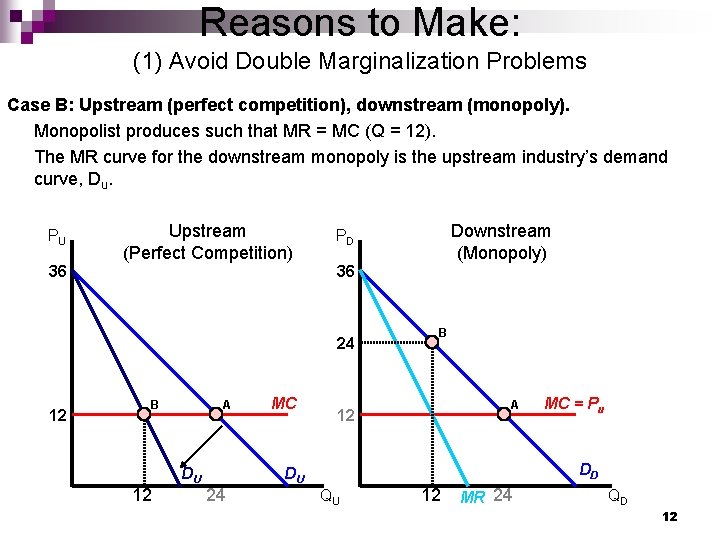
Reasons to Make: (1) Avoid Double Marginalization Problems Case B: Upstream (perfect competition), downstream (monopoly). Monopolist produces such that MR = MC (Q = 12). The MR curve for the downstream monopoly is the upstream industry’s demand curve, Du. PU Upstream (Perfect Competition) 36 36 24 12 Downstream (Monopoly) PD B 12 A DU 24 MC B A 12 MC = Pu DD DU QU 12 MR 24 QD 12
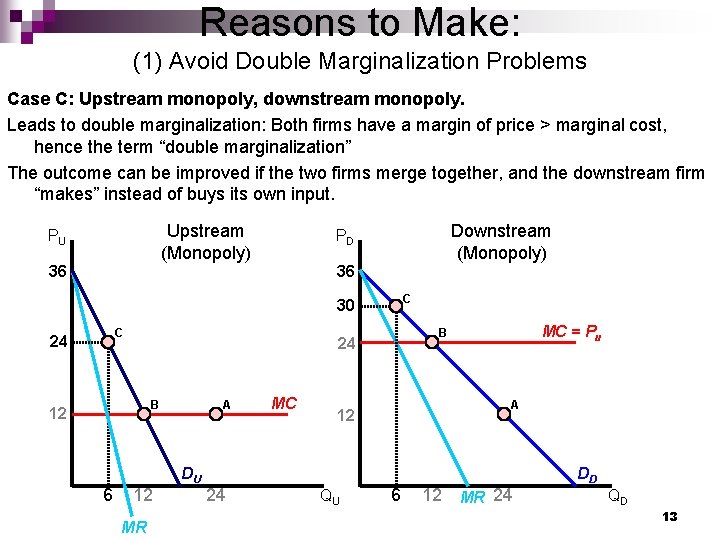
Reasons to Make: (1) Avoid Double Marginalization Problems Case C: Upstream monopoly, downstream monopoly. Leads to double marginalization: Both firms have a margin of price > marginal cost, hence the term “double marginalization” The outcome can be improved if the two firms merge together, and the downstream firm “makes” instead of buys its own input. Upstream (Monopoly) PU Downstream (Monopoly) PD 36 36 C 30 C 24 B 12 6 12 MR A DU 24 MC A 12 QU MC = Pu B 24 6 12 MR 24 DD QD 13
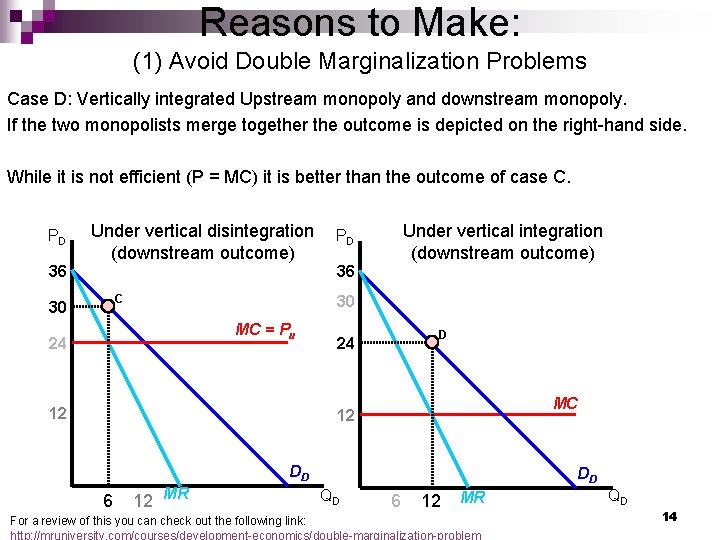
Reasons to Make: (1) Avoid Double Marginalization Problems Case D: Vertically integrated Upstream monopoly and downstream monopoly. If the two monopolists merge together the outcome is depicted on the right-hand side. While it is not efficient (P = MC) it is better than the outcome of case C. PD Under vertical disintegration (downstream outcome) 36 Under vertical integration (downstream outcome) PD 36 C 30 30 MC = Pu 24 12 D 24 MC 12 DD 6 12 MR DD QD 6 12 MR For a review of this you can check out the following link: http: //mruniversity. com/courses/development-economics/double-marginalization-problem QD 14
Reasons to Make: n (2) Avoid Incomplete Contracts ¨ What are incomplete contracts? n n The result of not being able to specify in advance every single contingency that may occur Incomplete contracts may result from: ¨ ¨ ¨ n (3) Avoid Coordination Issues ¨ What are coordination issues? n n n (A) Asymmetric information (B) Bounded rationality (C) Difficulties in specifying or measuring performance (A) Timing Fit (B) Sequence Fit (C) Technical Specification Fit (D) Color Fit (4) Avoid Leakages of Private Information ¨ What is private information? n Private info from which a firm derives value (e. g. , a secret recipe) may be compromised 15
Reasons to Make: (5) Avoid Hold-up Problems (5) Avoid Holdup Problems n n Relationship-specific assets (RSA) + incomplete contracts quasi-rents holdup problems Sources of asset specificity: Site specificity ¨ Physical asset specificity ¨ Dedicated assets ¨ Human asset specificity ¨ n The issue with RSAs is that if the relationship disintegrates the value of the asset declines 16
Reasons to Make: (5) Avoid Hold-up Problems (5) Holdup Problems n n The issue with RSA is that if the relationship disintegrates the value of the asset declines… E. g. , RSA: Produce coffee cups for Dunkin Donuts Have DD logo printed on them ¨ After production, DD decides not to buy them ¨ Their value declines ¨ n n RSA: asset value decreases if the relationship disintegrates E. g. , non-RSA: Produce sugar packets for DD No DD logo ¨ After production, DD decides not to buy them ¨ Just sell them to Starbucks or someone else ¨ n Non-RSA: asset value unchanged if the relationship disintegrates 17
Reasons to Make: (5) Avoid Hold-up Problems (5) Holdup Problems n n Before investing in RSAs, you have a large number of potential trading partners After investing in RSAs, you have a smaller number of potential trading partners ¨ n the “fundamental transformation” After the fundamental transformation occurs, a firm investing in RSAs can only trade with one or a few firms, rather than many 18
Reasons to Make: (5) Avoid Hold-up Problems (5) Holdup Problems n GM offers Fisher Body (FB) a deal to produce new car bodies n FB must invest F dollars in R&D for the new bodies Expect Q units and price, PA, from GM ¨ Next-best opportunity: modify the bodies and sell to Ford at price, PB where PB < PA ¨ 19
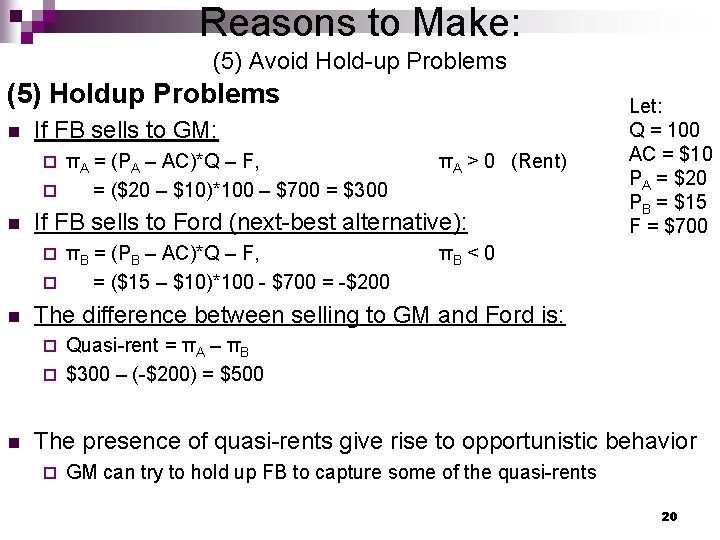
Reasons to Make: (5) Avoid Hold-up Problems (5) Holdup Problems n If FB sells to GM: πA = (PA – AC)*Q – F, ¨ = ($20 – $10)*100 – $700 = $300 ¨ n If FB sells to Ford (next-best alternative): πB = (PB – AC)*Q – F, ¨ = ($15 – $10)*100 - $700 = -$200 ¨ n πA > 0 (Rent) Let: Q = 100 AC = $10 PA = $20 PB = $15 F = $700 πB < 0 The difference between selling to GM and Ford is: Quasi-rent = πA – πB ¨ $300 – (-$200) = $500 ¨ n The presence of quasi-rents give rise to opportunistic behavior ¨ GM can try to hold up FB to capture some of the quasi-rents 20
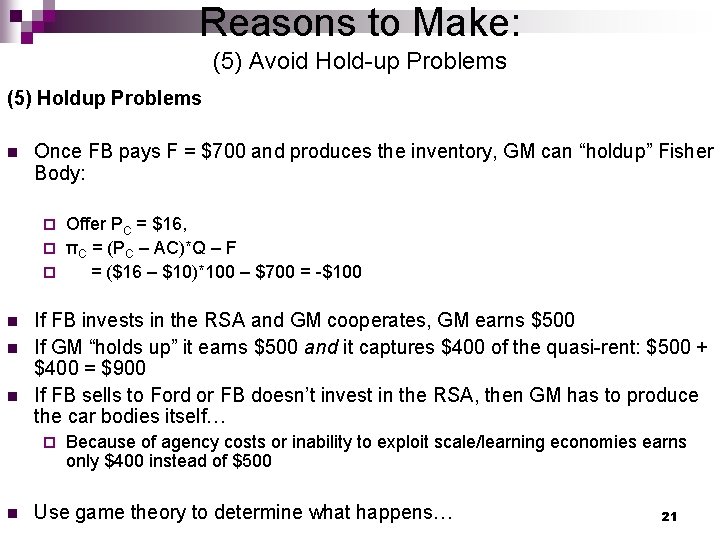
Reasons to Make: (5) Avoid Hold-up Problems (5) Holdup Problems n Once FB pays F = $700 and produces the inventory, GM can “holdup” Fisher Body: Offer PC = $16, ¨ πC = (PC – AC)*Q – F ¨ = ($16 – $10)*100 – $700 = -$100 ¨ n n n If FB invests in the RSA and GM cooperates, GM earns $500 If GM “holds up” it earns $500 and it captures $400 of the quasi-rent: $500 + $400 = $900 If FB sells to Ford or FB doesn’t invest in the RSA, then GM has to produce the car bodies itself… ¨ n Because of agency costs or inability to exploit scale/learning economies earns only $400 instead of $500 Use game theory to determine what happens… 21
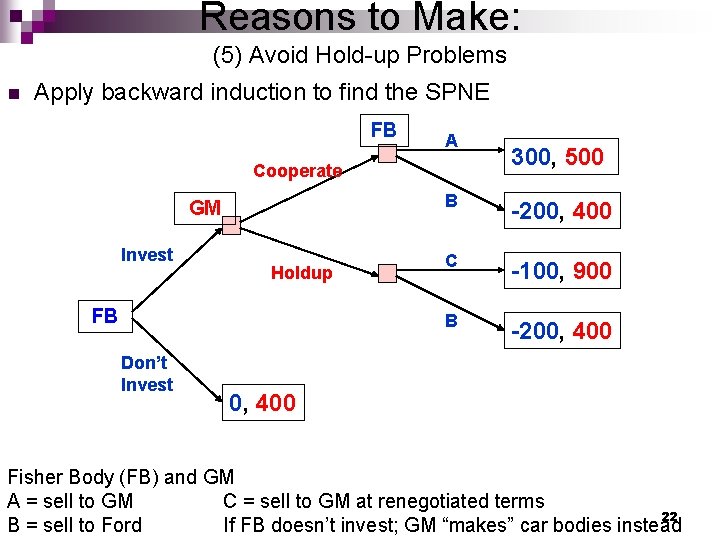
Reasons to Make: (5) Avoid Hold-up Problems n Apply backward induction to find the SPNE FB A Cooperate GM Invest Holdup FB Don’t Invest 300, 500 B -200, 400 C -100, 900 B -200, 400 Fisher Body (FB) and GM A = sell to GM C = sell to GM at renegotiated terms 22 B = sell to Ford If FB doesn’t invest; GM “makes” car bodies instead
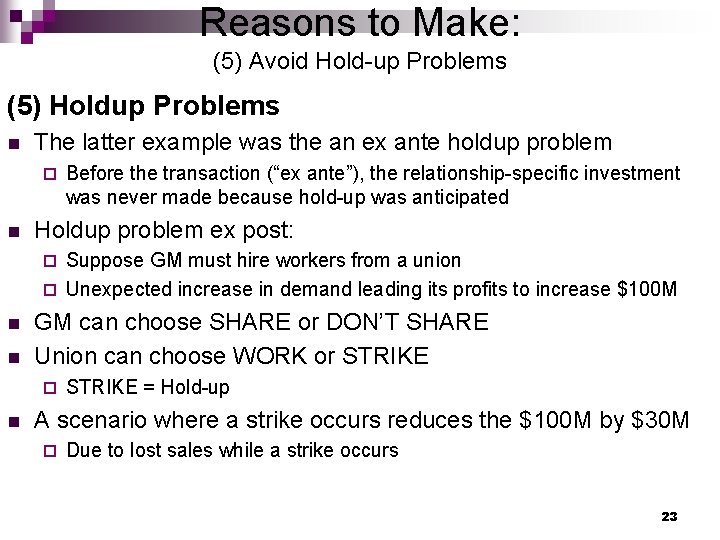
Reasons to Make: (5) Avoid Hold-up Problems (5) Holdup Problems n The latter example was the an ex ante holdup problem ¨ n Before the transaction (“ex ante”), the relationship-specific investment was never made because hold-up was anticipated Holdup problem ex post: Suppose GM must hire workers from a union ¨ Unexpected increase in demand leading its profits to increase $100 M ¨ n n GM can choose SHARE or DON’T SHARE Union can choose WORK or STRIKE ¨ n STRIKE = Hold-up A scenario where a strike occurs reduces the $100 M by $30 M ¨ Due to lost sales while a strike occurs 23
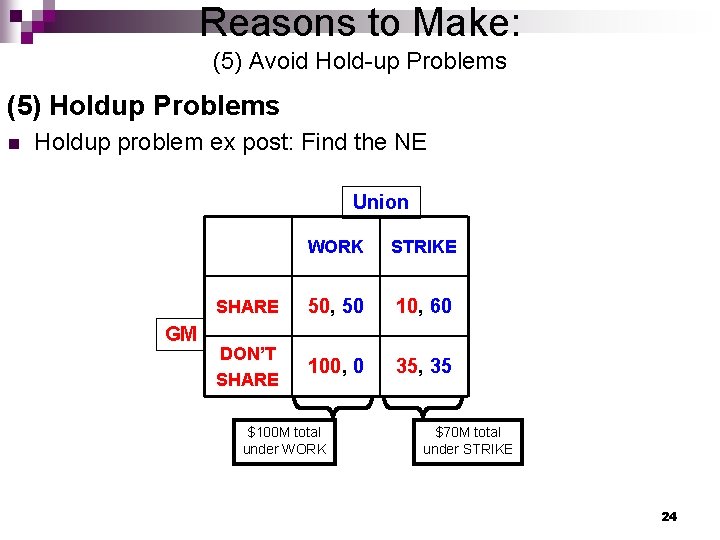
Reasons to Make: (5) Avoid Hold-up Problems (5) Holdup Problems n Holdup problem ex post: Find the NE Union GM WORK STRIKE SHARE 50, 50 10, 60 DON’T SHARE 100, 0 35, 35 $100 M total under WORK $70 M total under STRIKE 24
Reasons to Make: (5) Avoid Hold-up Problems (5) Holdup Problems n If potential or actual holdup problems are significant firms may choose to vertically integrate (make) rather than cooperate with an upstream firm (buy) n Such as in the GM-Fisher Body example above…it would be best for the two firms to merge in order to eliminate hold-up problems 25
Managerial Takeaway n If a firm is making an input but cannot take advantage of Eo. S/LBD or if making an input entails large agency and influence costs, then vertical disintegration may be a better strategy n If a firm is buying an input under conditions where incomplete contracts, coordination, or there is sensitive private information issues involved, vertical integration may be a better strategy n Regarding relationship-specific assets: If there an upstream firm is unwilling to make an investment because of the ex ante holdup problem, then vertical integration may be warranted ¨ If there are ex post holdup problems vertical integration will eliminate this ¨ n Note a firms vertical relationships must be consistently reviewed since technology may change the costs and benefits of integrating 26
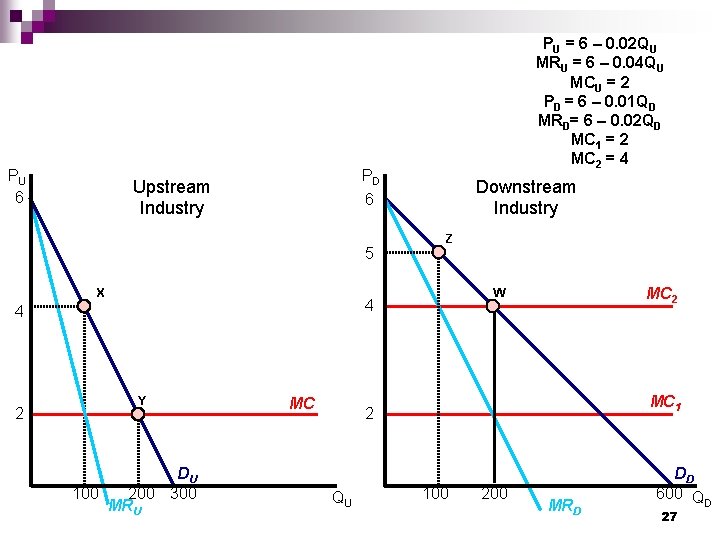
PU 6 PD Upstream Industry Downstream Industry 6 5 X Z Y DU 100 200 300 MRU MC MC 2 W 4 4 2 PU = 6 – 0. 02 QU MRU = 6 – 0. 04 QU MCU = 2 PD = 6 – 0. 01 QD MRD= 6 – 0. 02 QD MC 1 = 2 MC 2 = 4 MC 1 2 QU 100 200 MRD DD 600 QD 27
- Slides: 27