
Lecture 4 Stock pricing With Dividend Growth Model

- Slides: 18
Lecture 4 Stock pricing With Dividend Growth Model
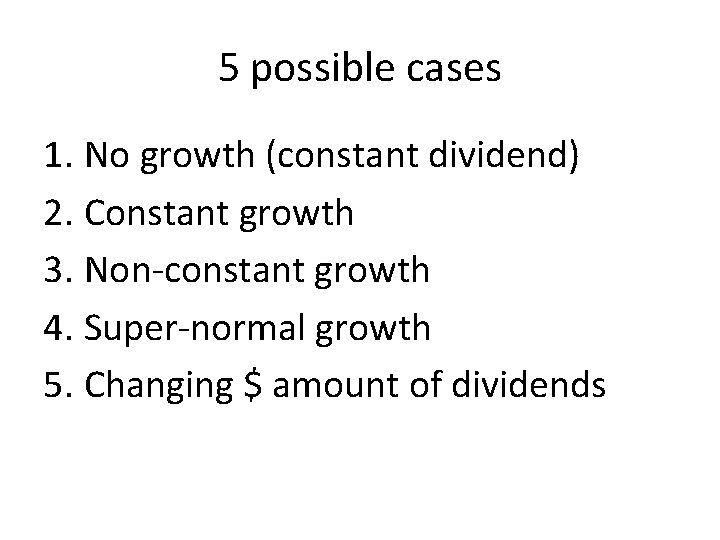
5 possible cases 1. No growth (constant dividend) 2. Constant growth 3. Non-constant growth 4. Super-normal growth 5. Changing $ amount of dividends
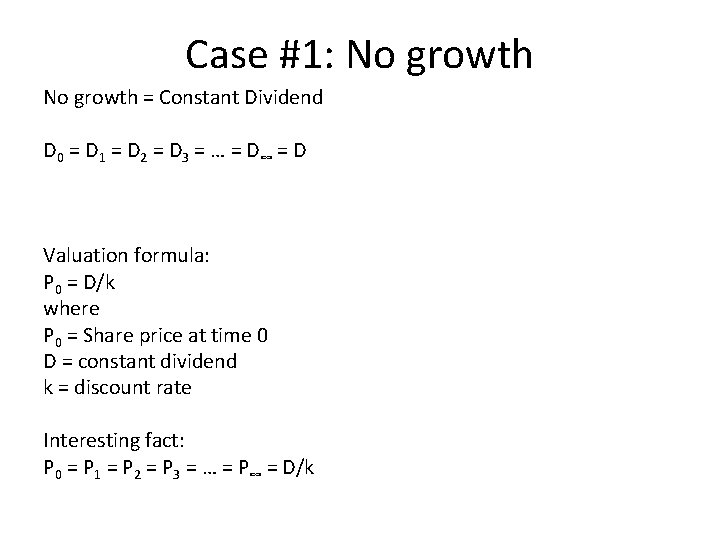
Case #1: No growth = Constant Dividend D 0 = D 1 = D 2 = D 3 = … = D ∞ = D Valuation formula: P 0 = D/k where P 0 = Share price at time 0 D = constant dividend k = discount rate Interesting fact: P 0 = P 1 = P 2 = P 3 = … = P∞ = D/k
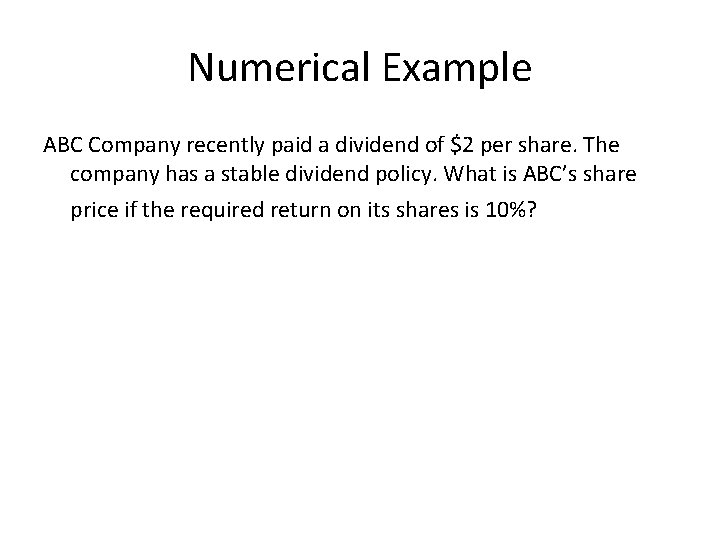
Numerical Example ABC Company recently paid a dividend of $2 per share. The company has a stable dividend policy. What is ABC’s share price if the required return on its shares is 10%?
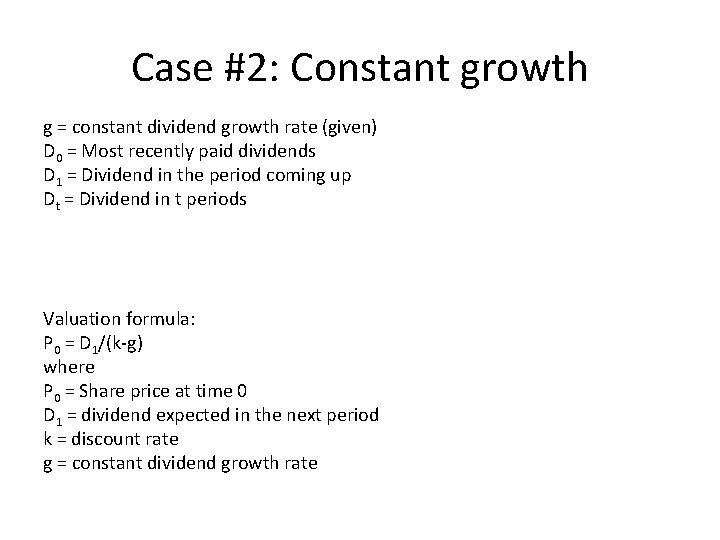
Case #2: Constant growth g = constant dividend growth rate (given) D 0 = Most recently paid dividends D 1 = Dividend in the period coming up Dt = Dividend in t periods Valuation formula: P 0 = D 1/(k-g) where P 0 = Share price at time 0 D 1 = dividend expected in the next period k = discount rate g = constant dividend growth rate
Numerical Example DEF Corporation has just paid a dividend of $1. 50. Stock market pundits anticipate that the company’s dividends will grow by 2% per year. What is DEF’s share price given that investors require a return of 11% on its stocks?
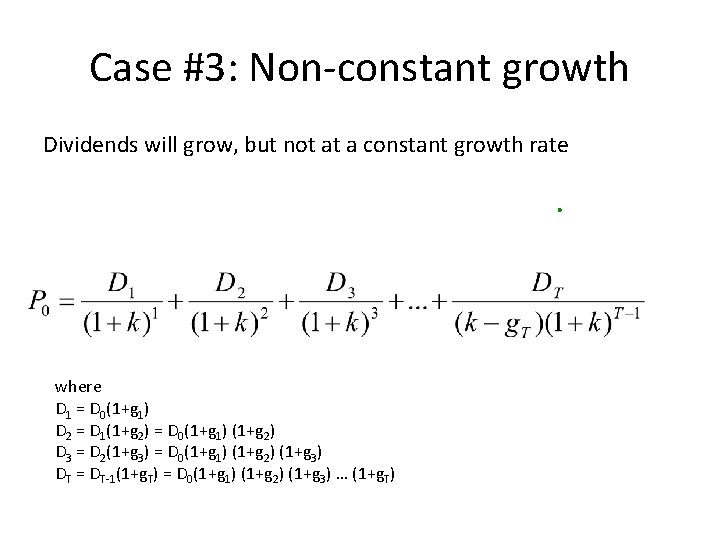
Case #3: Non-constant growth Dividends will grow, but not at a constant growth rate where D 1 = D 0(1+g 1) D 2 = D 1(1+g 2) = D 0(1+g 1) (1+g 2) D 3 = D 2(1+g 3) = D 0(1+g 1) (1+g 2) (1+g 3) DT = DT-1(1+g. T) = D 0(1+g 1) (1+g 2) (1+g 3) … (1+g. T)
Numerical Example GHI Inc. , has just paid a $1. 20 per share dividend. Due to a new project taken on by GHI, the company’s dividends are expected to grow by 5% next year, 7% in two years, and 9% in three years, and 3% thereafter. What is GHI’s current share price given that the required return on its stocks is 12%?
Non-constant growth example (cont. )
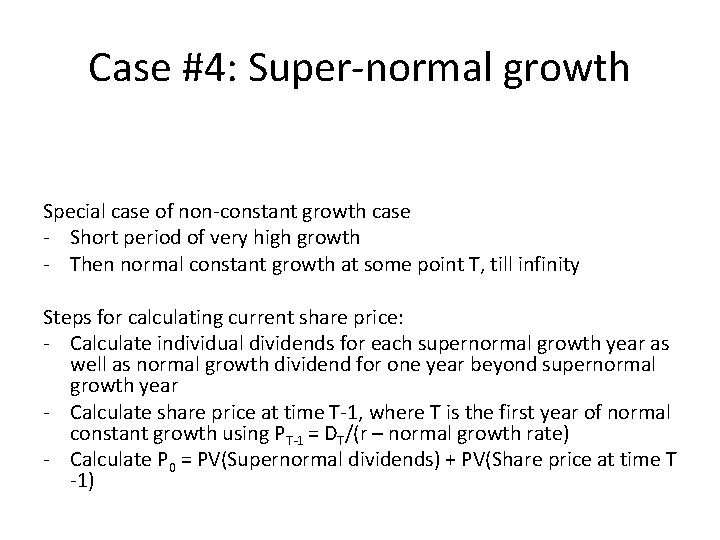
Case #4: Super-normal growth Special case of non-constant growth case - Short period of very high growth - Then normal constant growth at some point T, till infinity Steps for calculating current share price: - Calculate individual dividends for each supernormal growth year as well as normal growth dividend for one year beyond supernormal growth year - Calculate share price at time T-1, where T is the first year of normal constant growth using PT-1 = DT/(r – normal growth rate) - Calculate P 0 = PV(Supernormal dividends) + PV(Share price at time T -1)
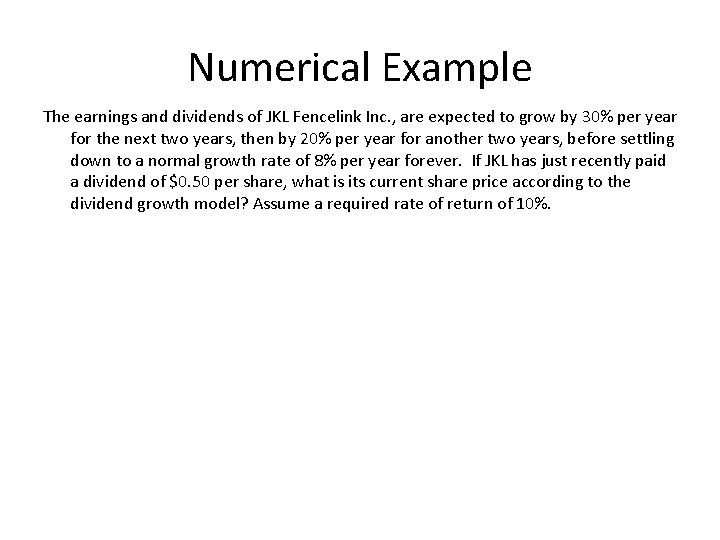
Numerical Example The earnings and dividends of JKL Fencelink Inc. , are expected to grow by 30% per year for the next two years, then by 20% per year for another two years, before settling down to a normal growth rate of 8% per year forever. If JKL has just recently paid a dividend of $0. 50 per share, what is its current share price according to the dividend growth model? Assume a required rate of return of 10%.
Supernormal growth example (cont. )
Supernormal growth example (cont. )
Case #5: Changing $ dividends Usually given: - $ dividends for a few eriods into the future - $ price at the end period, T Steps for calculating current share price with changing dollar dividends: - Calculate present value using PV(lump sum) for each of the given dividends - Calculate present value of share price at time T - Calculate P 0 = PV(dividends) + PV(ending share price)
Numerical Example MN Omnipresence Ltd. has just paid a dividend of $2. 50 per share. The company has undertaken a new project which will require certain levels of cash investments over the next 5 years, and therefore the company has announced that it will reduce dividends to $1. 00 , $1. 20, $1. 40. $1. 60, and $1. 80 per share for each of the next 5 years, respectively. At the end of the 5 years, MNO estimates that its share price will rise to $75 per share. What is the current share price of MNO given a required return of 10%?
Nonconstant dividends example (cont. )
General process of calculating stock price Step 1: Write down all the available information Step 2: Figure out if it is a case of zero-growth, constant growth, non-constant growth, supernormal growth, or different $ dividends. Step 3: Do calculations according to the case type: P 0 = PV(all future dividends or cash flows)
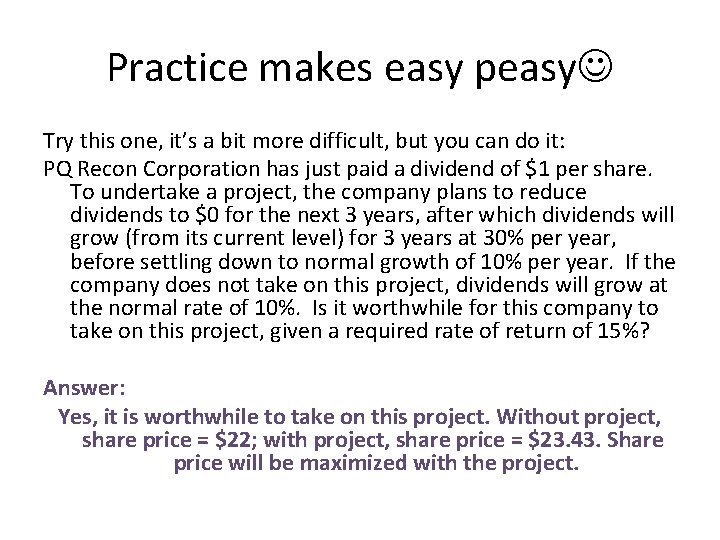
Practice makes easy peasy Try this one, it’s a bit more difficult, but you can do it: PQ Recon Corporation has just paid a dividend of $1 per share. To undertake a project, the company plans to reduce dividends to $0 for the next 3 years, after which dividends will grow (from its current level) for 3 years at 30% per year, before settling down to normal growth of 10% per year. If the company does not take on this project, dividends will grow at the normal rate of 10%. Is it worthwhile for this company to take on this project, given a required rate of return of 15%? Answer: Yes, it is worthwhile to take on this project. Without project, share price = $22; with project, share price = $23. 43. Share price will be maximized with the project.