
Lecture 4 Properties of cryogenic Materials Part 1
- Slides: 23
Lecture 4 Properties of cryogenic Materials (Part 1) Refrigeration & Liquefaction (Part 1) J. G. Weisend II
Electrical Resistivity § Ohm’s Law V=IR • R=r. L/A where r is the electrical resistivity § Conduction electrons carry the current & there are 2 scattering mechanisms • Scattering of electrons off phonons • Scattering of electrons off impurities or defects (e. g. dislocations) 2
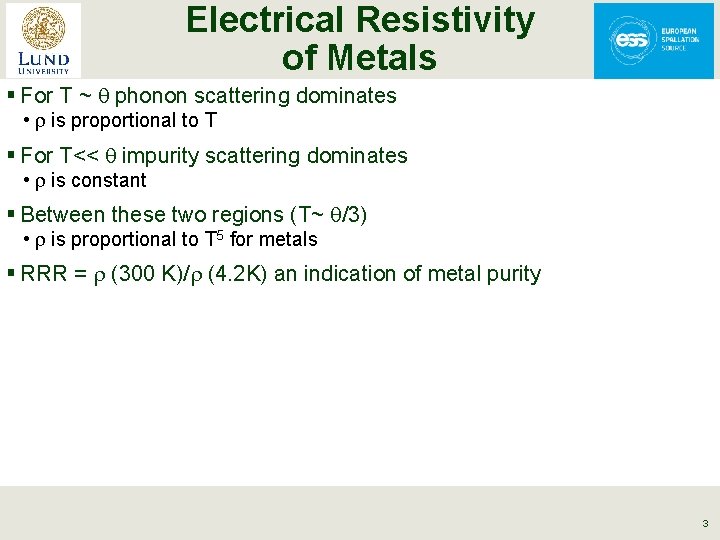
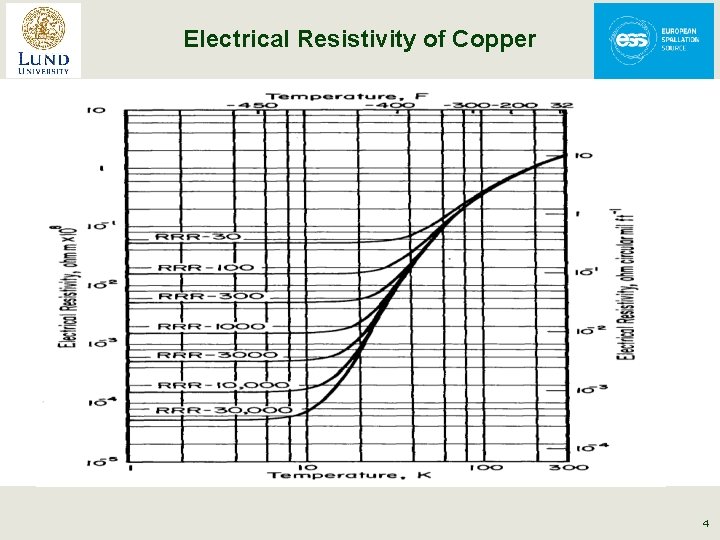
Electrical Resistivity of Metals § For T ~ q phonon scattering dominates • r is proportional to T § For T<< q impurity scattering dominates • r is constant § Between these two regions (T~ q/3) • r is proportional to T 5 for metals § RRR = r (300 K)/r (4. 2 K) an indication of metal purity 3
Electrical Resistivity of Copper From Handbook of Materials for Superconducting Machinery (1974) 4
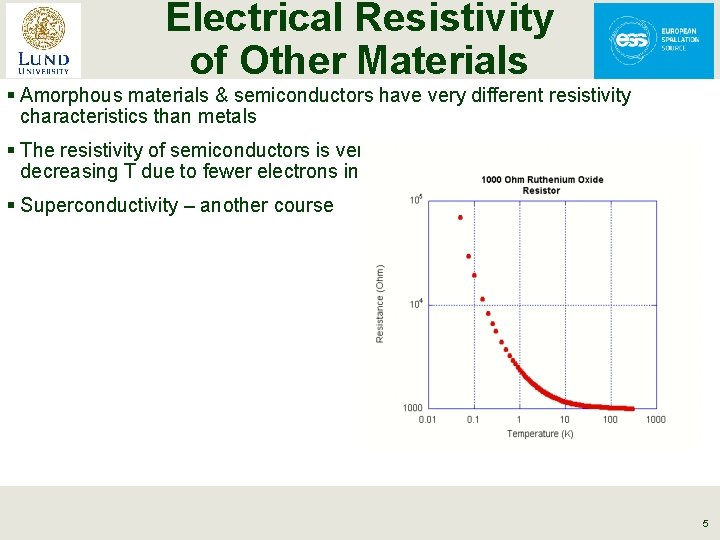
Electrical Resistivity of Other Materials § Amorphous materials & semiconductors have very different resistivity characteristics than metals § The resistivity of semiconductors is very non linear & typically increases with decreasing T due to fewer electrons in the conduction band § Superconductivity – another course 5
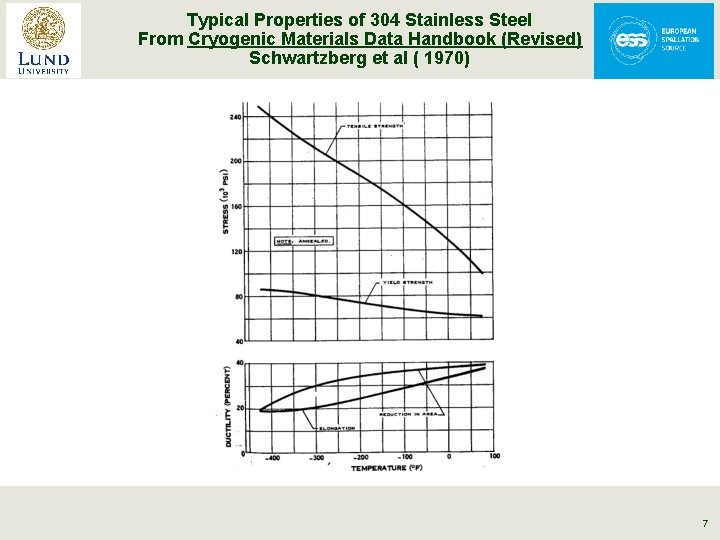
Material Strength § Tends to increase at low temperatures (as long as there is no ductile to brittle transition) § 300 K values are typically used for conservative design. Remember all systems start out at 300 K & may unexpectedly return to 300 K. § Always look up values or test materials of interest 6
Typical Properties of 304 Stainless Steel From Cryogenic Materials Data Handbook (Revised) Schwartzberg et al ( 1970) 7
Refrigeration & Liquefaction (Part 1) J. G. Weisend II
Goals § Introduce basic concepts of cryogenic refrigeration & liquefaction § Describe the Carnot cycle § Define Coefficient of Performance and Figure of Merit Slide 9
Introduction How do we get things cold? § In general, cooling is done by using a working fluid (in cryogenics this is almost always helium) and making it under go a closed thermodynamic cycle that removes heat at low temperature and rejects the heat at room temperature. • This process requires work • There are many thermodynamic cycles – we will only examine a few key ones § Here we will concentrate of refrigeration systems of ~ 100 W or greater • Systems of less than ~ 100 W are known as cryocoolers and tend to use different cycles. Slide 10
Introduction § There are other approaches to cooling • Non cryogenic refrigeration e. g. home refrigerators, AC etc – not covered here • Very low temperature (<1. 5 K ) approaches : Magnetic refrigerators, adiabatic demagnetization refrigerators, dilution refrigerators etc – will be mentioned (at least) later § Remember – no matter the technique, the Laws of Thermodynamics apply Slide 11
Catching Cold § Before we get involved in thermodynamic cycles, let’s go over the basics § There are really only a few ways in which to make a pure fluid such as helium colder • Cause the fluid to do work by making it expand against a piston or turbine while keeping it thermally isolated from the outside environment Isentropic Expansion • Transfer heat from the fluid to a colder surface • Cause the fluid to do “internal work” by expanding it through a valve while keeping it thermally isolated Isenthalpic Expansion » Joule-Thomson expansion (more later) • Once the fluid is a liquid, reduce the pressure above the fluid below atmospheric pressure thus reducing the saturation temperature § All modern cryogenic plants do the first 3. Ones that provide cooling below 4. 2 K also do the last item Slide 12
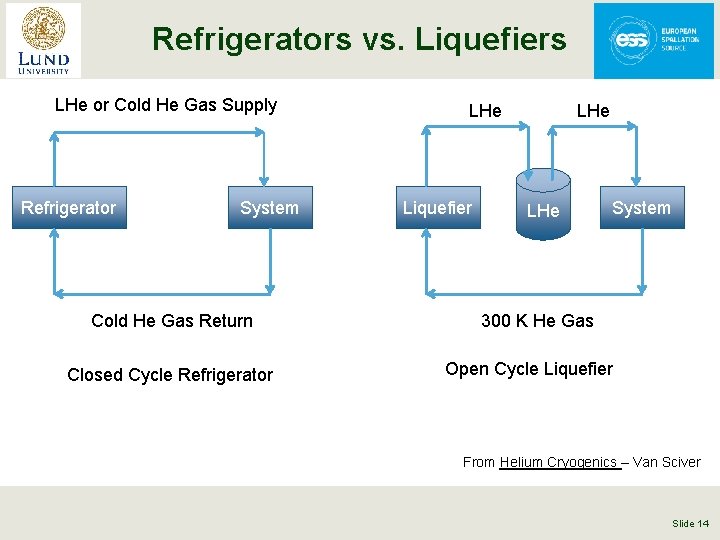
Refrigerators vs. Liquefiers § Refrigerators are closed cycle systems • They provide cooling and can create liquids but all the mass flow is returned to the start of the cycle • Such systems are said to have “balanced flow” § Liquefiers are open cycle systems • They provide a liquid which is then drawn off and used elsewhere • These have “unbalanced flows” the amount of mass returned to the start of the cycle is less than the amount that started by the mass that was converted to liquid. • In order to keep the cycle running this mass would have to be added as room temperature gas. Slide 13
Refrigerators vs. Liquefiers LHe or Cold He Gas Supply Refrigerator System Cold He Gas Return Closed Cycle Refrigerator LHe Liquefier LHe System 300 K He Gas Open Cycle Liquefier From Helium Cryogenics – Van Sciver Slide 14
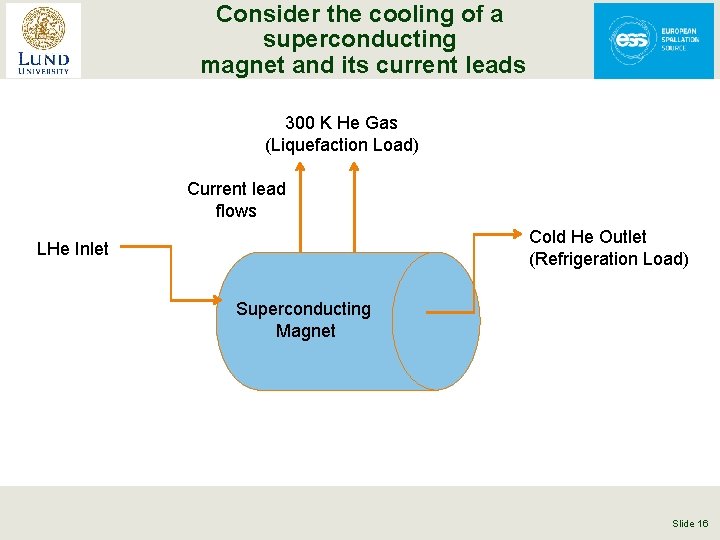
Refrigerators vs. Liquefiers § In practice, this distinction is less clear cut • Modern cryogenic plants can operate either as refrigerators or liquefiers and in fact, generally operate as a mixture of the two. • We talk about refrigeration loads & liquefaction loads • A key issue is at what temperature is the boil off gas from a cryogenic liquid returned to the cycle? » If brought back at a cryogenic temperature and used to cool incoming warmer gas then this is a refrigeration load » If brought back warm and not used to cool incoming warmer gas this is a liquefaction load § The thermodynamic rules are the same for refrigerators and liquefiers Slide 15
Consider the cooling of a superconducting magnet and its current leads 300 K He Gas (Liquefaction Load) Superconducting Magnet Current lead flows Cold He Outlet (Refrigeration Load) LHe Inlet Superconducting Magnet Slide 16
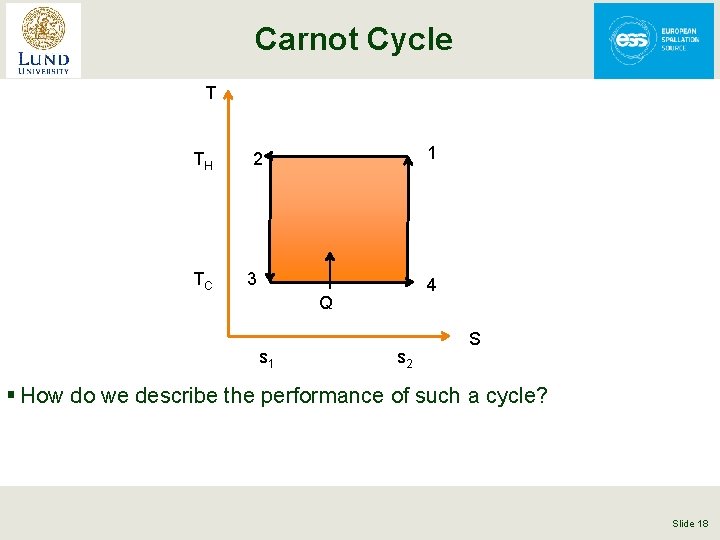
Carnot Cycle § This is an ideal cycle: all processes are reversible • Entropy is only changed by absorbing or removing heat at constant temperature • 2 nd law of Thermodynamics, in a reversible process d. Q = -Td. S § The Carnot Consists of 4 steps • Compress the working fluid isothermally at TH (1 -2) • Expand the working fluid isentropically from TH to TC (2 -3) • Absorb heat into the working fluid isothermally and reversibly at TC (3 -4) • Compress the working fluid isentropically from TC to TH (4 -1) • Note isentropically = reversibly and adiabatically Slide 17
Carnot Cycle T TH TC 1 2 3 4 Q s 1 s 2 S § How do we describe the performance of such a cycle? Slide 18
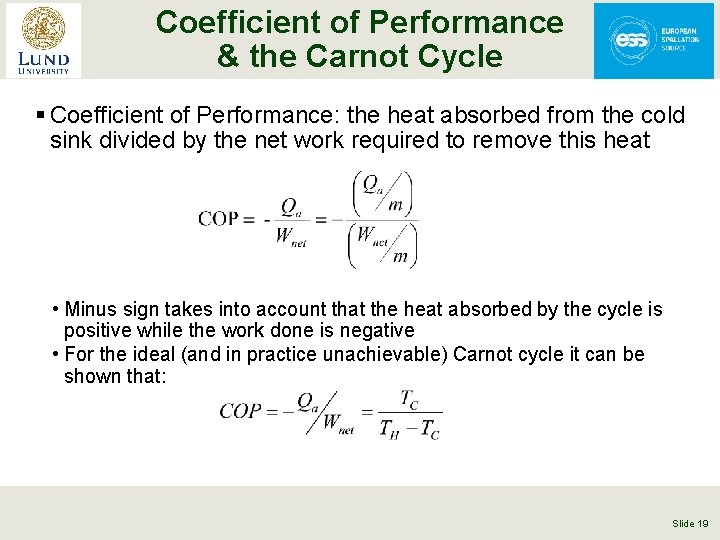
Coefficient of Performance & the Carnot Cycle § Coefficient of Performance: the heat absorbed from the cold sink divided by the net work required to remove this heat • Minus sign takes into account that the heat absorbed by the cycle is positive while the work done is negative • For the ideal (and in practice unachievable) Carnot cycle it can be shown that: Slide 19
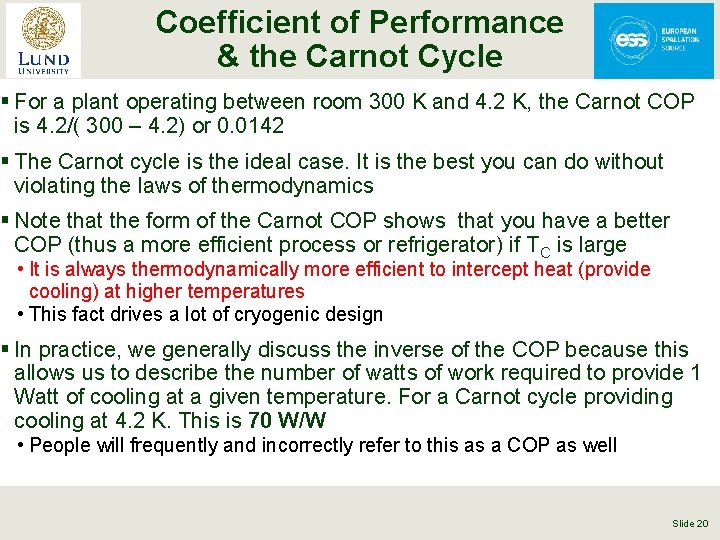
Coefficient of Performance & the Carnot Cycle § For a plant operating between room 300 K and 4. 2 K, the Carnot COP is 4. 2/( 300 – 4. 2) or 0. 0142 § The Carnot cycle is the ideal case. It is the best you can do without violating the laws of thermodynamics § Note that the form of the Carnot COP shows that you have a better COP (thus a more efficient process or refrigerator) if TC is large • It is always thermodynamically more efficient to intercept heat (provide cooling) at higher temperatures • This fact drives a lot of cryogenic design § In practice, we generally discuss the inverse of the COP because this allows us to describe the number of watts of work required to provide 1 Watt of cooling at a given temperature. For a Carnot cycle providing cooling at 4. 2 K. This is 70 W/W • People will frequently and incorrectly refer to this as a COP as well Slide 20
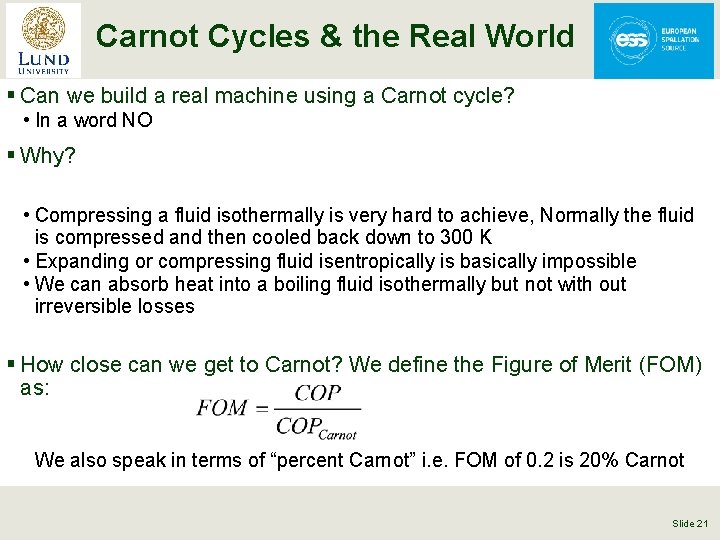
Carnot Cycles & the Real World § Can we build a real machine using a Carnot cycle? • In a word NO § Why? • Compressing a fluid isothermally is very hard to achieve, Normally the fluid is compressed and then cooled back down to 300 K • Expanding or compressing fluid isentropically is basically impossible • We can absorb heat into a boiling fluid isothermally but not with out irreversible losses § How close can we get to Carnot? We define the Figure of Merit (FOM) as: We also speak in terms of “percent Carnot” i. e. FOM of 0. 2 is 20% Carnot Slide 21
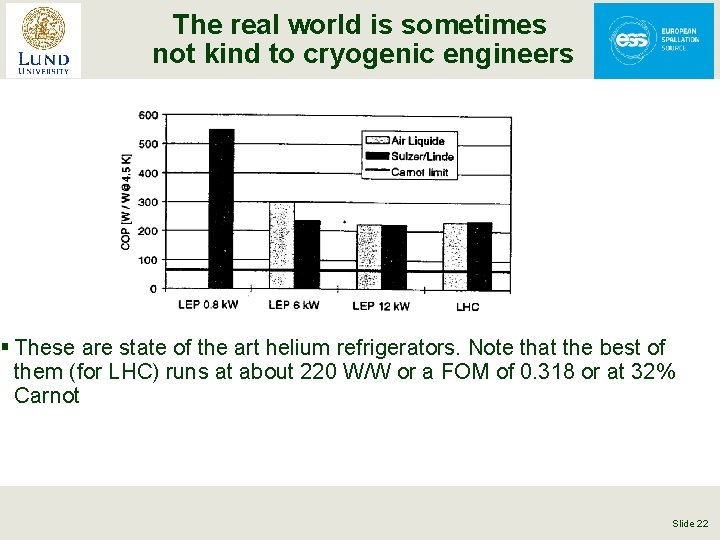
The real world is sometimes not kind to cryogenic engineers § These are state of the art helium refrigerators. Note that the best of them (for LHC) runs at about 220 W/W or a FOM of 0. 318 or at 32% Carnot Slide 22
Practical Impact of Plant Performance § How much power does it take to operate a large cryogenic refrigeration plant? § AT ESS we expect to have a refrigeration plant capable of removing as much as 9. 5 k. W at 4. 5 K. The FOM of the plant is expected to be 0. 26 If the plant operates as expected this means we will need: (66/0. 26) x 9500 = 2. 4 MW of mechanical power § We are adding some additional margin to the electrical power requirements and have asked for at least 2. 6 MW available for powering the compressors Slide 23