
Lecture 4 Production and Costs Learning Outcomes By
Lecture 4: Production and Costs
Learning Outcomes By the end of this unit, you should be able to: § Distinguish between the Short-run (SR) and Long-run (LR) time § § § periods; Explain the Law of Diminishing Marginal Returns; Identify Fixed factors of production and Variable factors of production; Understand the various production cost elements and cost behaviour; Explain the Law of Returns to Scale; Provide examples of the sources of Economies of Scale. Unit 5 Copyright © 2017 MDIS. All rights reserved. 2
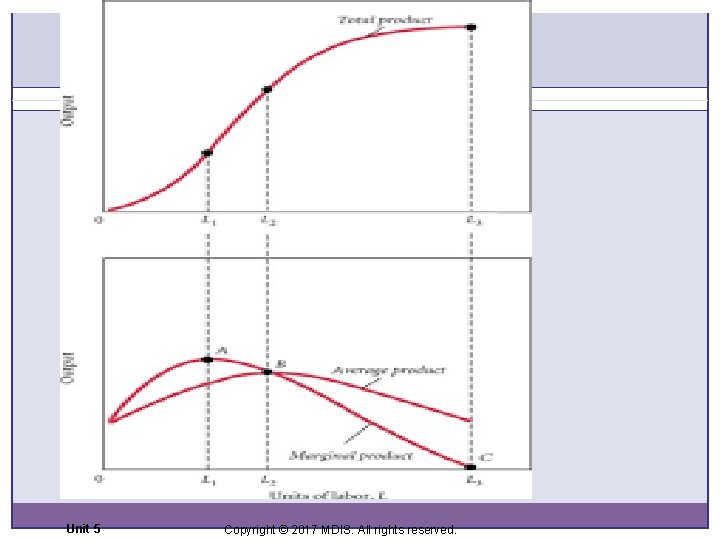
Short-run Costs Short-run and long-run changes in production ¡ fixed and variable factors of production ¡ the short run ¡ the long run Production in the short run ¡ the law of diminishing returns ÷ when one of more factors are held fixed, there will come a point beyond which the extra output from additional units of the variable factor will diminish
The Law of Diminishing Marginal Returns Unit 5 Copyright © 2017 MDIS. All rights reserved.
Unit 5 Copyright © 2017 MDIS. All rights reserved.
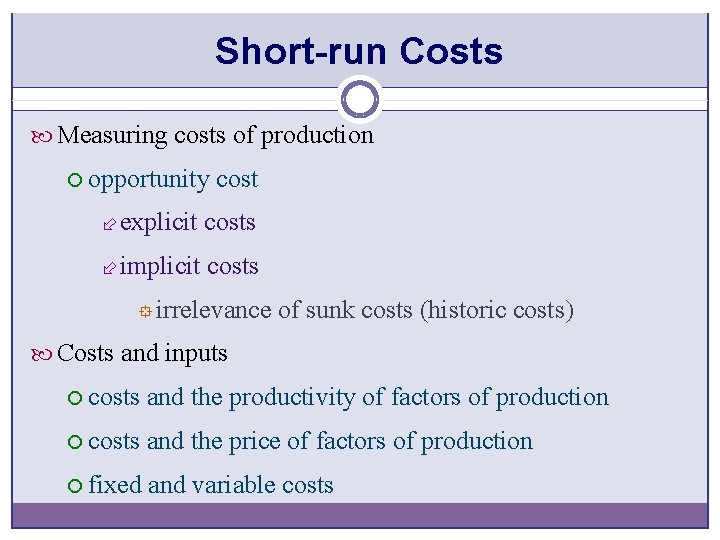
Short-run Costs Measuring costs of production ¡ opportunity cost ÷ explicit costs ÷ implicit costs ° irrelevance of sunk costs (historic costs) Costs and inputs ¡ costs and the productivity of factors of production ¡ costs and the price of factors of production ¡ fixed and variable costs
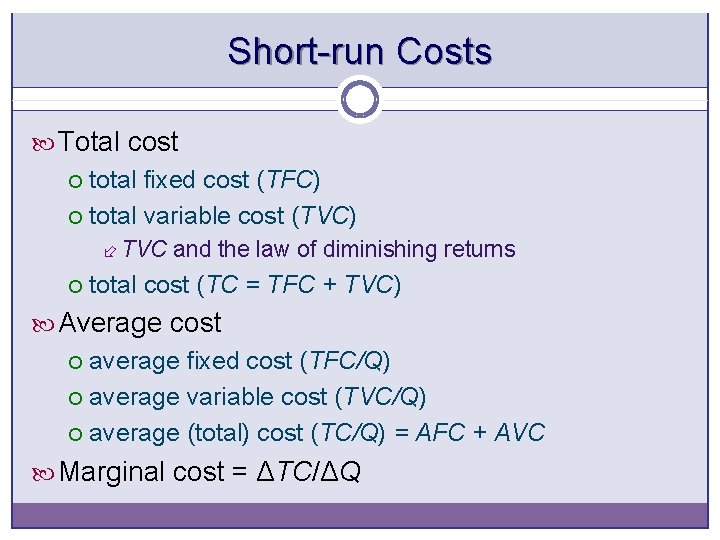
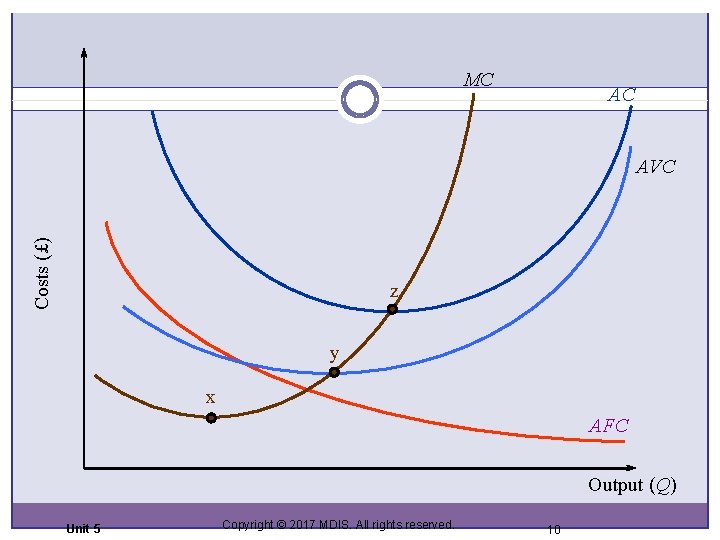
Short-run Costs Total cost total fixed cost (TFC) ¡ total variable cost (TVC) ¡ ÷ TVC ¡ and the law of diminishing returns total cost (TC = TFC + TVC) Average cost average fixed cost (TFC/Q) ¡ average variable cost (TVC/Q) ¡ average (total) cost (TC/Q) = AFC + AVC ¡ Marginal cost = ΔTC/ΔQ
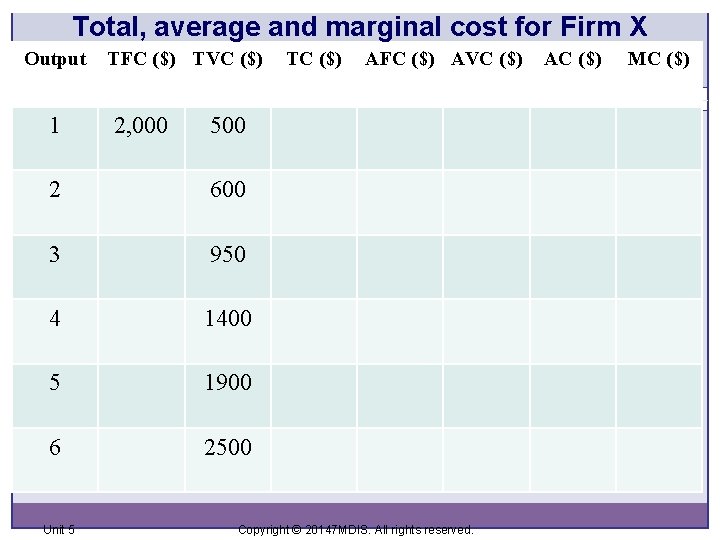
Total, average and marginal cost for Firm X Output 1 TFC ($) TVC ($) 2, 000 AFC ($) AVC ($) 500 2 600 3 950 4 1400 5 1900 6 2500 Unit 5 TC ($) Copyright © 20147 MDIS. All rights reserved. AC ($) MC ($)

Unit 5 Copyright © 2017 MDIS. All rights reserved. 9
MC AC Costs (£) AVC z y x AFC Output (Q) Unit 5 Copyright © 2017 MDIS. All rights reserved. 10
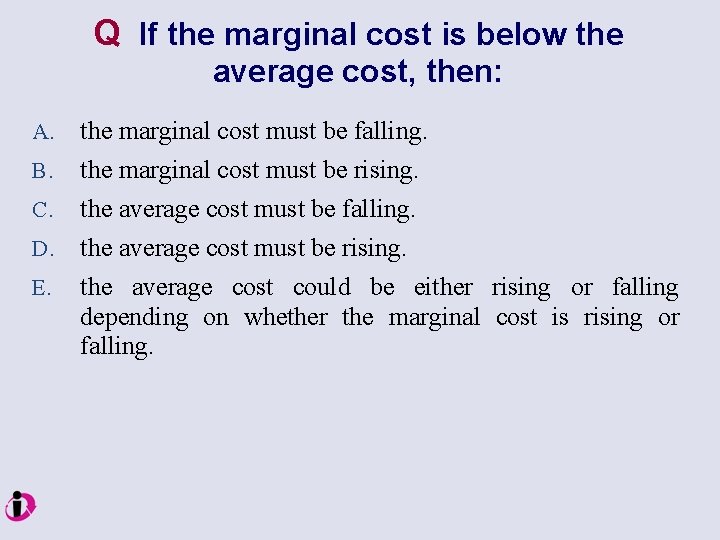
Q If the marginal cost is below the average cost, then: A. B. C. D. E. the marginal cost must be falling. the marginal cost must be rising. the average cost must be falling. the average cost must be rising. the average cost could be either rising or falling depending on whether the marginal cost is rising or falling.

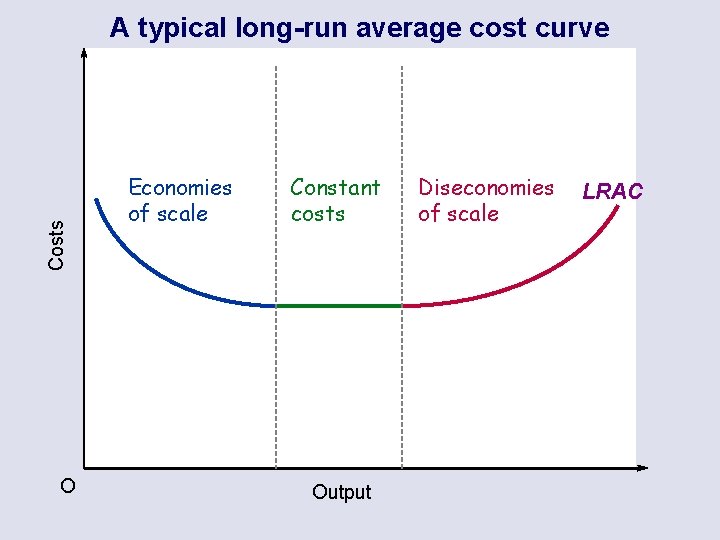
Long-run Costs Production in the long run ¡ meaning of the ‘long run’ ¡ returns to scale ÷ constant returns to scale ÷ increasing returns to scale ÷ decreasing returns to scale

Production in the Long-run 3 Stages of the Law of returns to scale § Increasing returns to scale/ Economies of Scale an increase in factor inputs bring about a more than proportional increase in output. § Constant returns to scale/ Constant Economies of Scale an increase in factor inputs bring about an equal and proportional increase in output. § Decreasing returns to scale/ Diseconomies of Scale an increase in factor inputs brings about a less than proportionate increase in output. Unit 5 Copyright © 2017 MDIS. All rights reserved. 13
Short-run and long-run increases in output
Short-run and long-run increases in output
Short-run and long-run increases in output
Short-run and long-run increases in output
Long-run Costs Production in the long run (cont. ) ¡ economies of scale ÷ specialisation and the division of labour ÷ indivisibilities ÷ container principle ÷ greater efficiency of large machines ÷ by-products ÷ multi-stage production ÷ spreading overheads ÷ financial economies ÷ economies of scope
Long-run Costs Economies of Scale: The average total cost of producing a good decreases as the volume of output increases, whilst producing with the optimal mix of inputs. It occurs when increasing production allows greater specialization. (workers more efficient when focusing on a narrow task) Diseconomies of Scale: The average total cost of producing a good increases as the volume of output increases, whilst producing with the optimal mix of inputs. It is due to coordination problems in large organizations (management becomes stretched, can’t control costs) Unit 5 Copyright © 2017 MDIS. All rights reserved. 19
ECONOMIES OF SCALE: Internal & External Economies of Scale § Economies of scale occur when average cost (AC) falls as the quantity of output increase in the long-run. § A doubling inputs of labour and capital more than doubles output. § Therefore, average costs fall as we go from a small size firm to a medium size firm. This may be due to greater specialisation of labour, capital and so forth. § Internal Economies of scale: These are the benefits that are enjoyed by the firm as a result of having a larger scale of production. Unit 5 Copyright © 2017 MDIS. All rights reserved. 20
Why are economies of scale important? - Firstly, because a large business can pass on lower costs to customers through lower prices and increase its share of a market. - Secondly, a business could choose to maintain its current price for its product and accept higher profit margins. Unit 5 Copyright © 2017 MDIS. All rights reserved. 21
Sources of Economies of scale § Division of labour or specialization § Financial economies: It arises due to the interest rate for getting a loan is higher for smaller firm than the larger one. The larger firms have large assets and banks trust them more. Therefore, it is relatively easier for large firms to obtain loans. Small firms often find it harder to obtain finance and when they do obtain it, the cost of the finance is often quite high. This is due to small firms are perceived as being risker than larger businesses. Unit 5 Copyright © 2017 MDIS. All rights reserved.
Sources of Economies of scale § Purchasing economies: As businesses grow they need to order larger quantities of production inputs. As the order value increases, it obtains more bargaining power, therefore, obtains lower price of the raw materials and components. § Technical economies: Businesses with large-scale production can use more advanced machinery for more efficiencies and in production. Unit 5 Copyright © 2015 MDIS. All rights reserved.
Sources of Economies of scale § Marketing economies: Many of these marketing costs are fixed costs and so as a business gets larger, it is able to spread the cost of marketing over a wider range of products and sales. § Managerial economies: As a firm grows, there is greater potential for manager to specialise in particular tasks (e. g. marketing, human resource management, finance). Specialist managers are likely to be more efficient as they possess a high level of expertise, experience and qualifications compared to one person in a smaller firm trying to perform all these roles. Unit 5 Copyright © 2017 MDIS. All rights reserved.
External Economies of scale This refers to the advantages enjoyed by the firm and the industry as a whole. 1. Access to skilled labour 2. Access to firms providing support services 3. Infrastructure Unit 5 Copyright © 2014 MDIS. All rights reserved. 25
Diseconomies of scale occur when average cost rises as the quantity of output increases in the long-run. Doubling inputs of labour and capital less than doubles outputs. This may be due to managerial inefficiencies caused by many layers of management. § Control – monitoring how productive each worker is within a large business is both imperfect and costly. § Co-ordination – it is difficult to co-ordinate complicated production processes and they may break down. § Co-operation – workers in big firms may feel a sense of alienation, perhaps perceiving that they don’t really belong and this may affect their productivity adversely Unit 5 Copyright © 2017 MDIS. All rights reserved. 26
Q Economies of scale can be defined as large-scale production leading to: A. B. C. D. E. bigger profits. lower costs per unit of production. greater marginal productivity of factors. greater output per unit of input a better organisation of the factors of production.
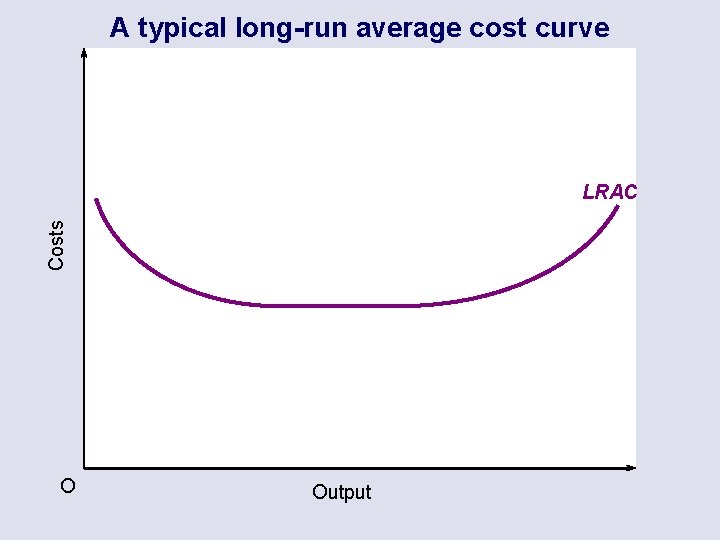
Long-run Costs Long-run average costs ¡ assumptions behind the curve ÷ factor ÷ state of technology and factor quality are given ÷ firms ¡ prices are given choose least-cost combination of factors shape of the LRAC curve
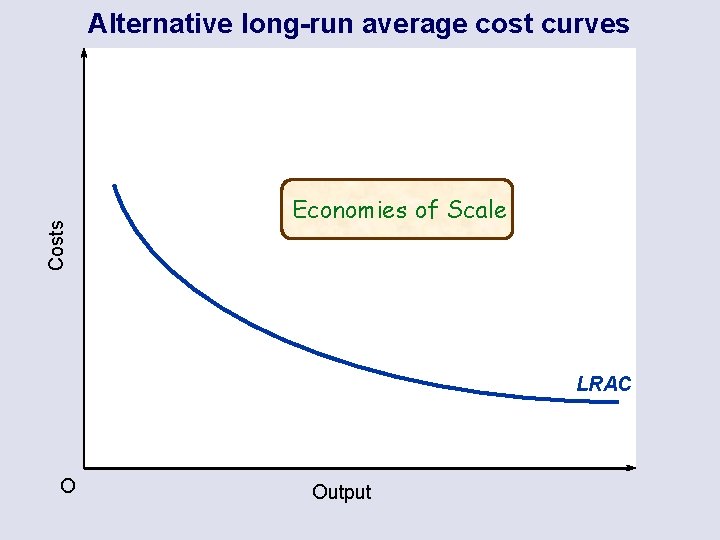
Costs Alternative long-run average cost curves Economies of Scale LRAC O Output
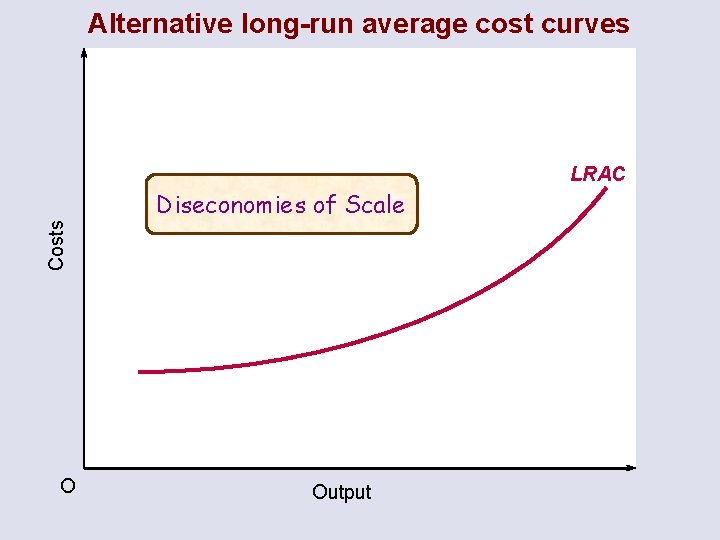
Alternative long-run average cost curves LRAC Costs Diseconomies of Scale O Output
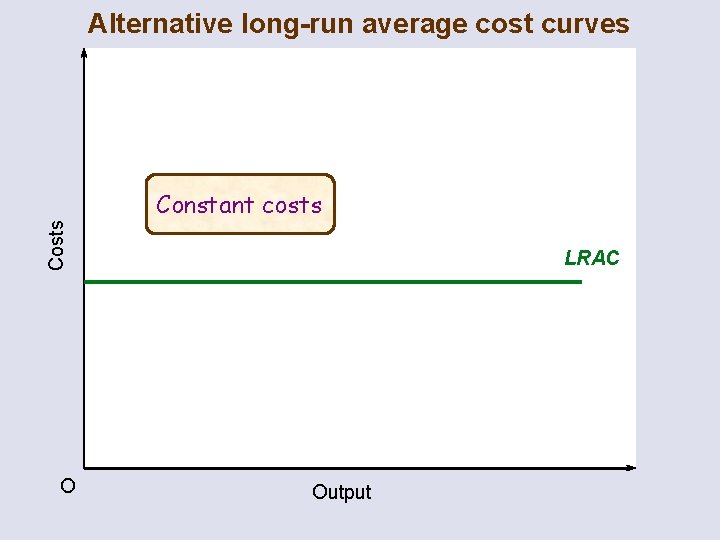
Alternative long-run average cost curves Costs Constant costs O LRAC Output
Long-run Costs Long-run average costs ¡ assumptions ÷ factor ÷ state ¡a prices are given of technology and factor quality are given ÷ firms ¡ shape behind the curve choose least-cost combination of factors of the LRAC curve typical LRAC curve
A typical long-run average cost curve Costs LRAC O Output
Costs A typical long-run average cost curve O Economies of scale Constant costs Output Diseconomies of scale LRAC
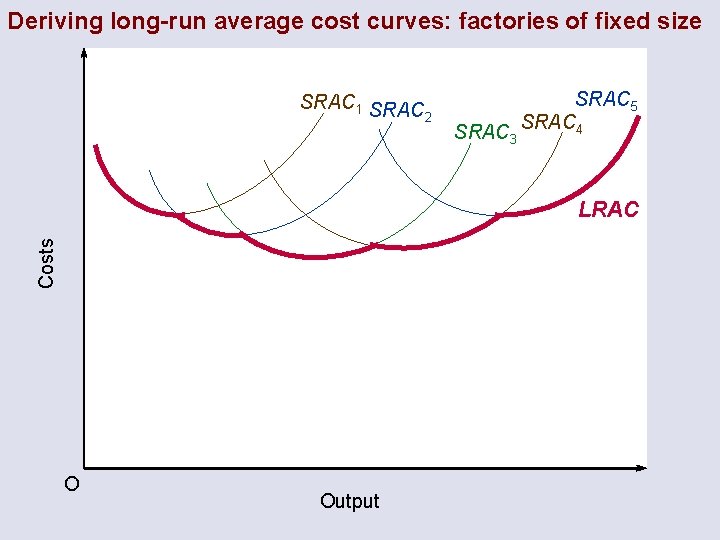
Deriving long-run average cost curves: factories of fixed size Costs SRAC 1 factory 2 factories O 2 SRAC 3 SRAC 5 SRAC 4 5 factories 3 factories 4 factories Output
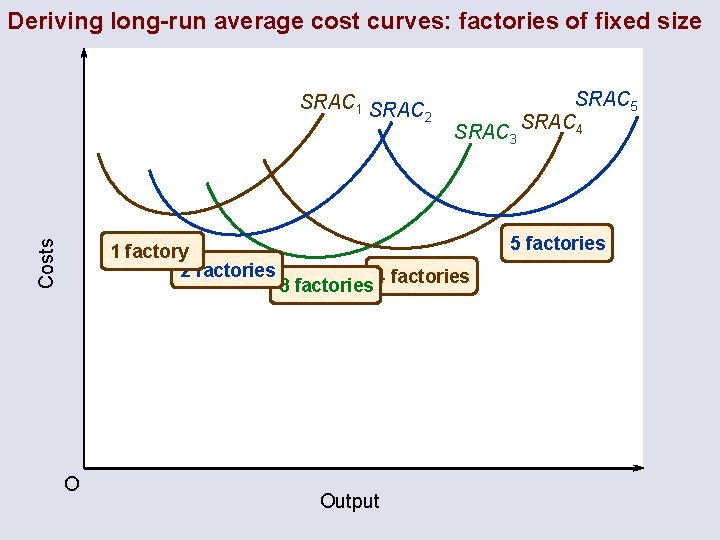
Deriving long-run average cost curves: factories of fixed size SRAC 1 SRAC 2 SRAC 3 SRAC 5 SRAC 4 Costs LRAC O Output
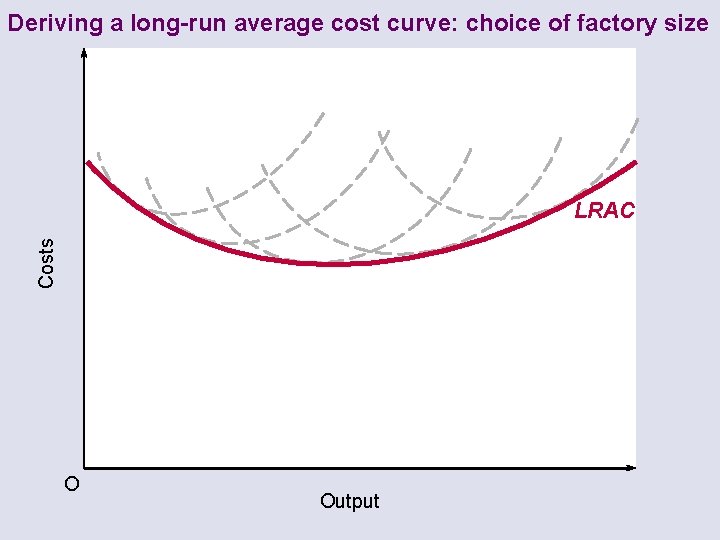
Deriving a long-run average cost curve: choice of factory size Costs LRAC O Output
Profit Maximisation Finding the profit-maximising output
Revenue, cost and profit for Firm X
Revenue, cost and profit for Firm X
Profit Maximisation Finding the profit-maximising output ¡ profit maximised where MR = MC
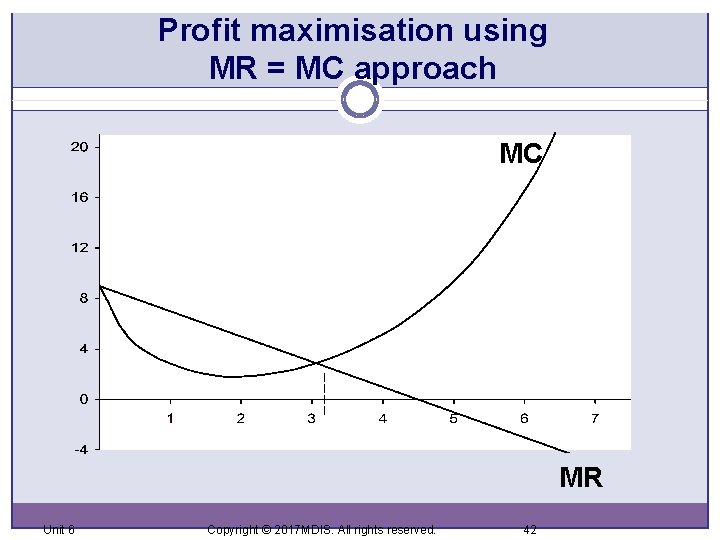
Profit maximisation using MR = MC approach MC MR Unit 6 Copyright © 2017 MDIS. All rights reserved. 42
Using AR and AC curves to measure maximum profit Unit 6 Copyright © 2017 MDIS. All rights reserved. 43
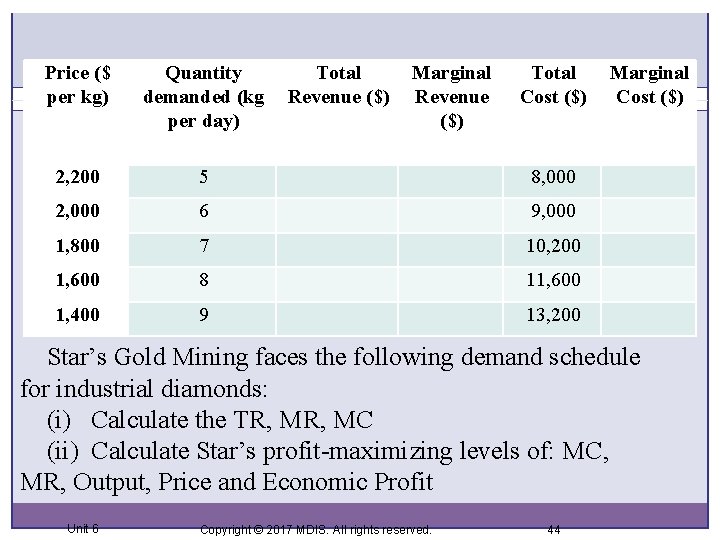
Price ($ per kg) Quantity demanded (kg per day) Total Revenue ($) Marginal Revenue ($) Total Cost ($) 2, 200 5 8, 000 2, 000 6 9, 000 1, 800 7 10, 200 1, 600 8 11, 600 1, 400 9 13, 200 Marginal Cost ($) Star’s Gold Mining faces the following demand schedule for industrial diamonds: (i) Calculate the TR, MC (ii) Calculate Star’s profit-maximizing levels of: MC, MR, Output, Price and Economic Profit Unit 6 Copyright © 2017 MDIS. All rights reserved. 44
The end… (kind of!)
- Slides: 45