
Lecture 4 Operations on Values CS 105 February
Lecture 4: Operations on Values CS 105 February 3, 2020
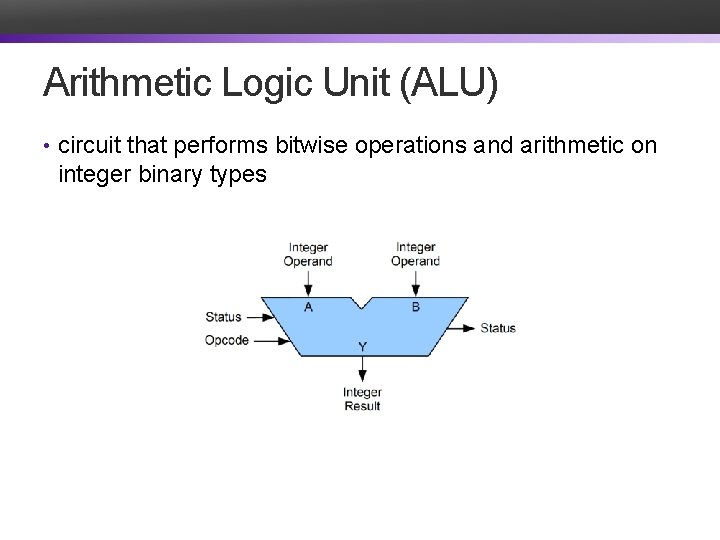
Arithmetic Logic Unit (ALU) • circuit that performs bitwise operations and arithmetic on integer binary types
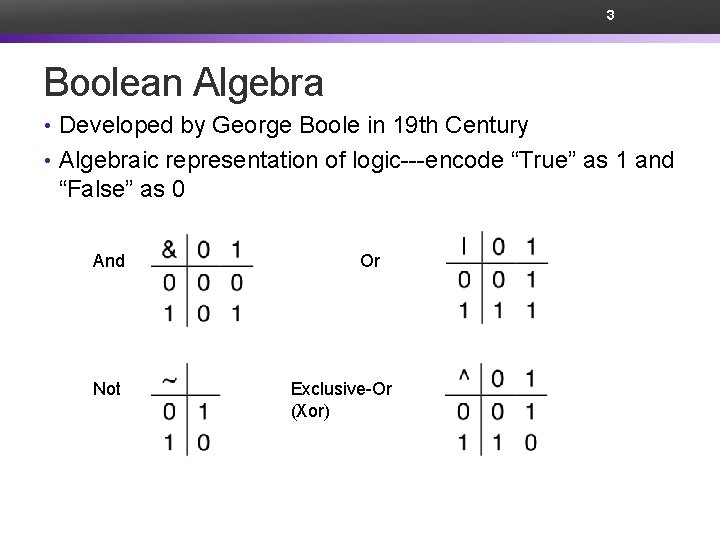
3 Boolean Algebra • Developed by George Boole in 19 th Century • Algebraic representation of logic---encode “True” as 1 and “False” as 0 And Not Or Exclusive-Or (Xor)
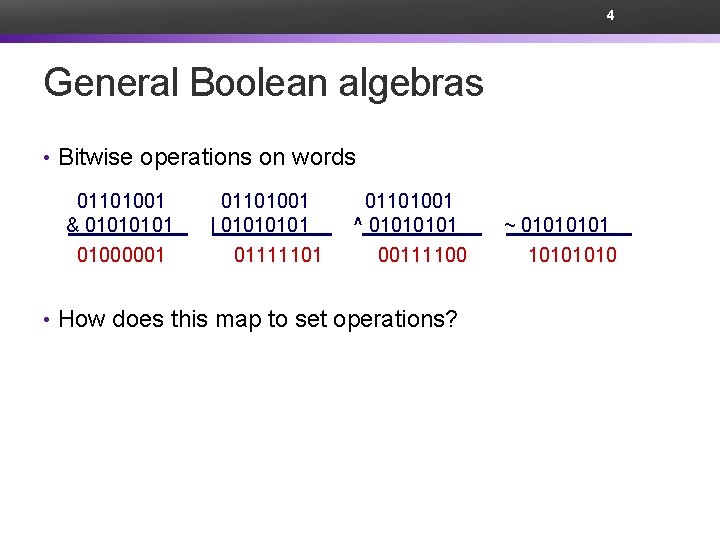
4 General Boolean algebras • Bitwise operations on words 01101001 & 0101 01000001 01101001 | 0101 01111101 01101001 ^ 0101 00111100 • How does this map to set operations? ~ 0101 10101010
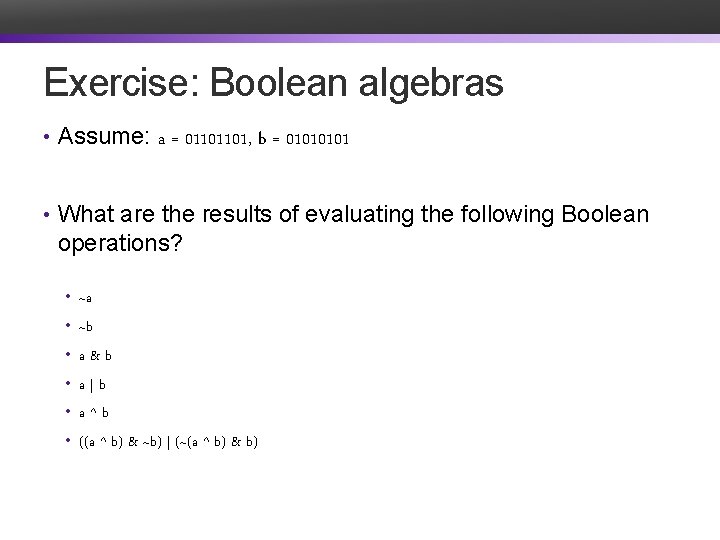
Exercise: Boolean algebras • Assume: a = 01101101, b = 0101 • What are the results of evaluating the following Boolean operations? • ~a • ~b • a&b • a|b • a^b • ((a ^ b) & ~b) | (~(a ^ b) & b)
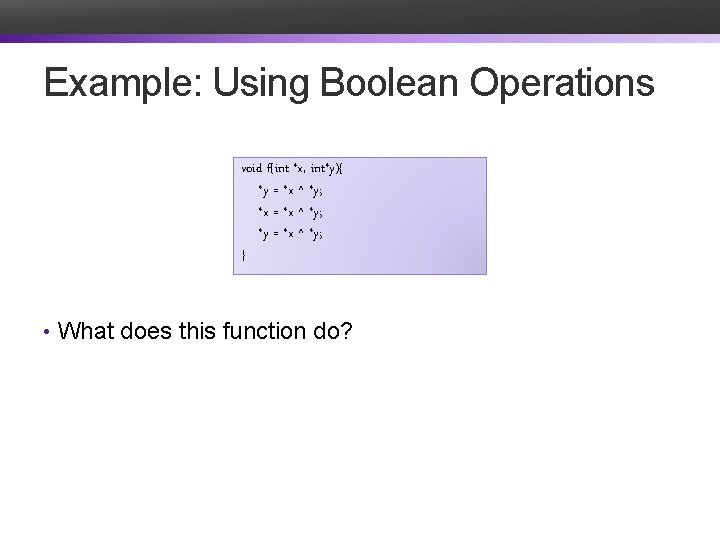
Example: Using Boolean Operations void f(int *x, int*y){ *y = *x ^ *y; *x = *x ^ *y; *y = *x ^ *y; } • What does this function do?
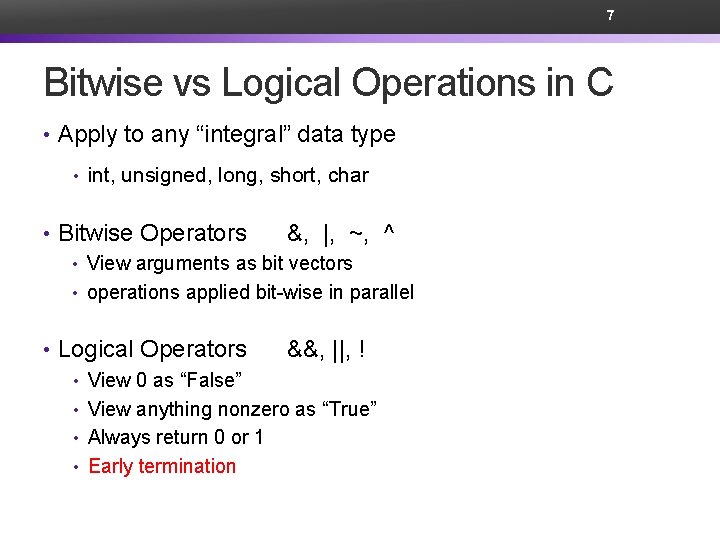
7 Bitwise vs Logical Operations in C • Apply to any “integral” data type • int, unsigned, long, short, char • Bitwise Operators &, |, ~, ^ • View arguments as bit vectors • operations applied bit-wise in parallel • Logical Operators &&, ||, ! • View 0 as “False” • View anything nonzero as “True” • Always return 0 or 1 • Early termination
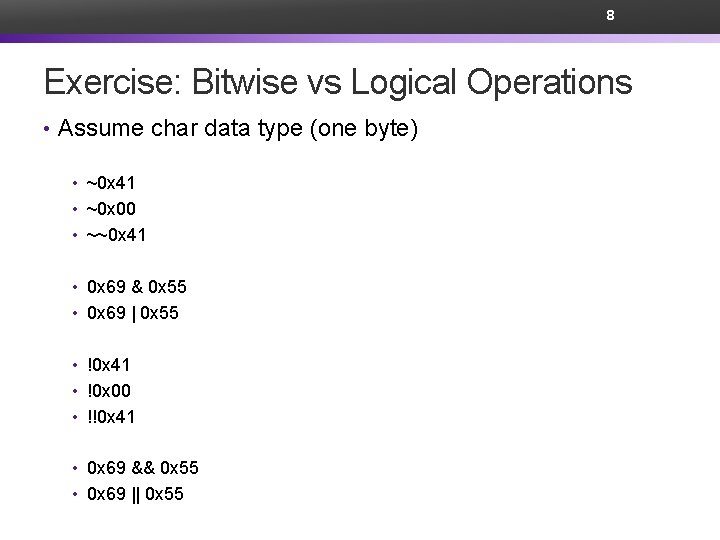
8 Exercise: Bitwise vs Logical Operations • Assume char data type (one byte) • ~0 x 41 • ~0 x 00 • ~~0 x 41 • 0 x 69 & 0 x 55 • 0 x 69 | 0 x 55 • !0 x 41 • !0 x 00 • !!0 x 41 • 0 x 69 && 0 x 55 • 0 x 69 || 0 x 55
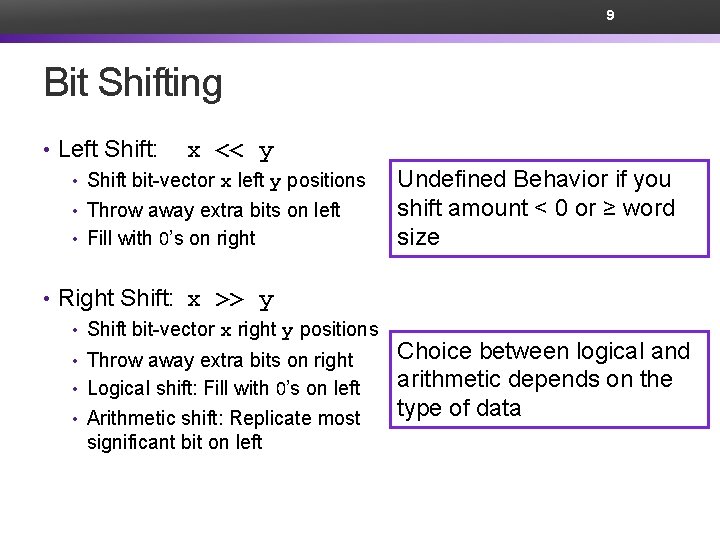
9 Bit Shifting • Left Shift: x << y • Shift bit-vector x left y positions • Throw away extra bits on left • Fill with 0’s on right Undefined Behavior if you shift amount < 0 or ≥ word size • Right Shift: x >> y • Shift bit-vector x right y positions Choice between logical and • Throw away extra bits on right arithmetic depends on the • Logical shift: Fill with 0’s on left type of data • Arithmetic shift: Replicate most significant bit on left
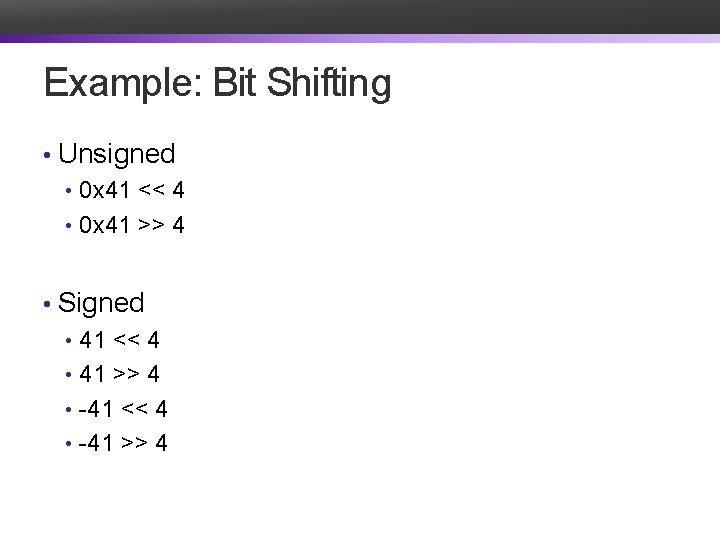
Example: Bit Shifting • Unsigned • 0 x 41 << 4 • 0 x 41 >> 4 • Signed • 41 << 4 • 41 >> 4 • -41 << 4 • -41 >> 4
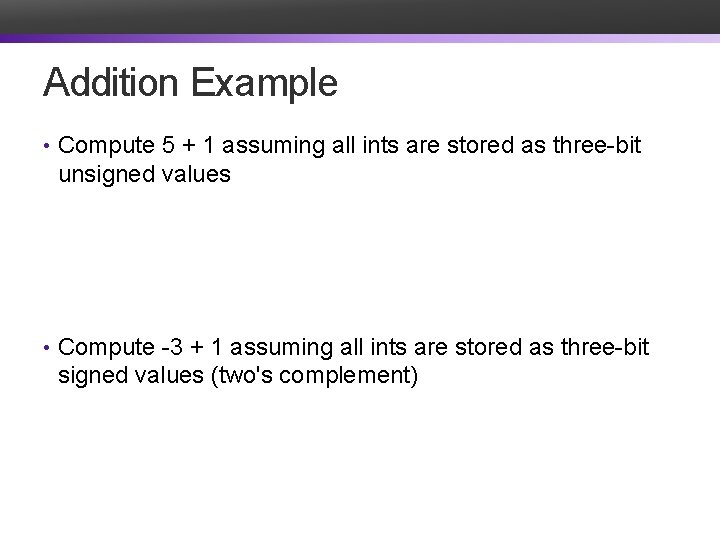
Addition Example • Compute 5 + 1 assuming all ints are stored as three-bit unsigned values • Compute -3 + 1 assuming all ints are stored as three-bit signed values (two's complement)
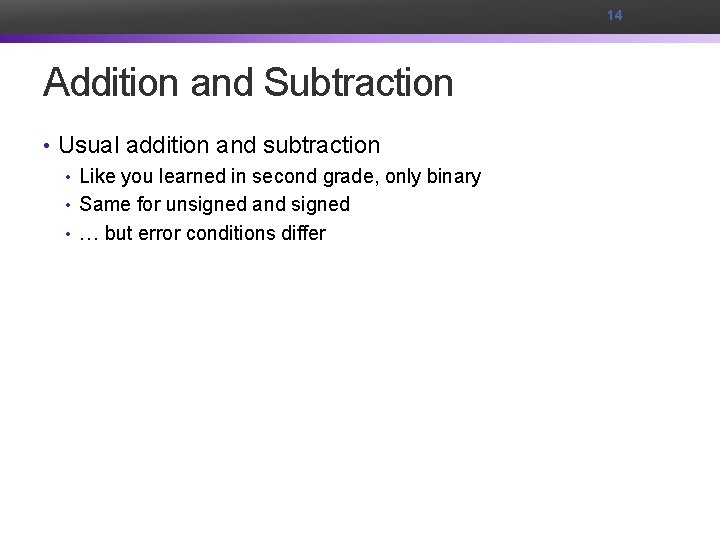
14 Addition and Subtraction • Usual addition and subtraction • Like you learned in second grade, only binary • Same for unsigned and signed • … but error conditions differ

Error Cases •
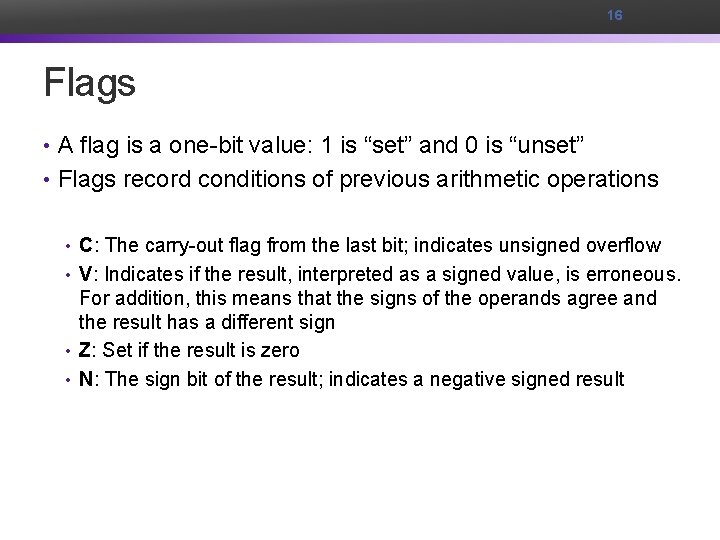
16 Flags • A flag is a one-bit value: 1 is “set” and 0 is “unset” • Flags record conditions of previous arithmetic operations • C: The carry-out flag from the last bit; indicates unsigned overflow • V: Indicates if the result, interpreted as a signed value, is erroneous. For addition, this means that the signs of the operands agree and the result has a different sign • Z: Set if the result is zero • N: The sign bit of the result; indicates a negative signed result
Multiplication Example • Compute 5 * 3 assuming all ints are stored as three-bit unsigned values • Compute -3 * 3 assuming all ints are stored as three-bit signed values (two's complement)
18 Multiplication • Usual Multiplication • Like elementary school, only in binary • Product can be two words long; it may be truncated to one word • Bit level equivalence for unsigned and signed
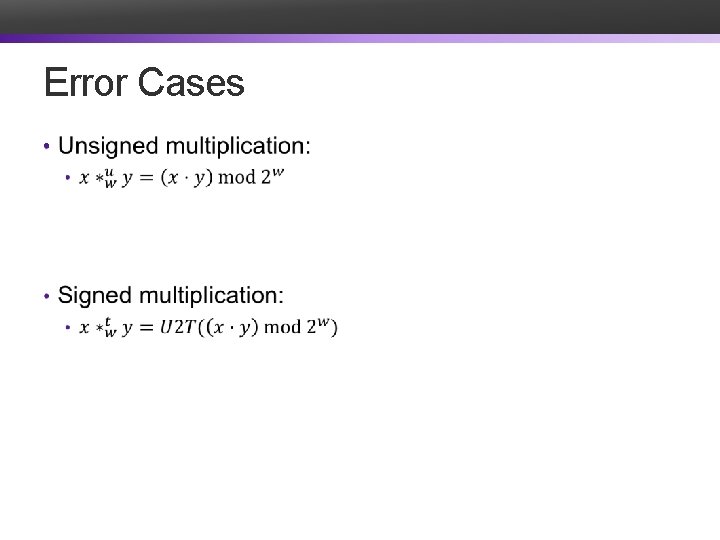
Error Cases •
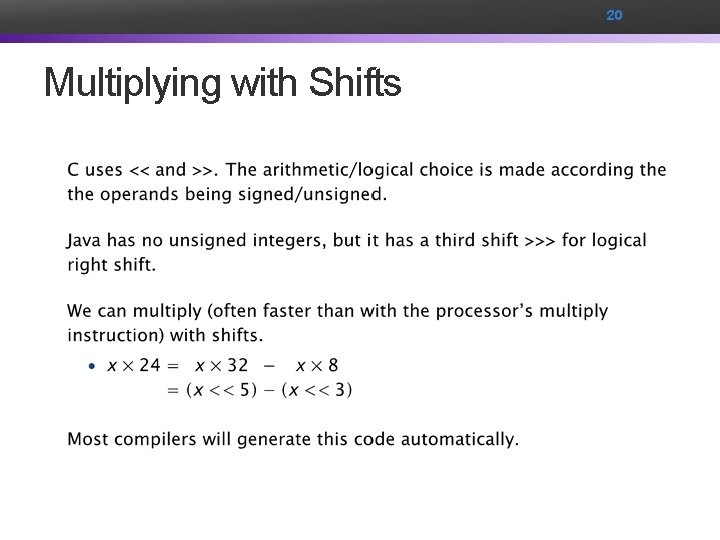
20 Multiplying with Shifts
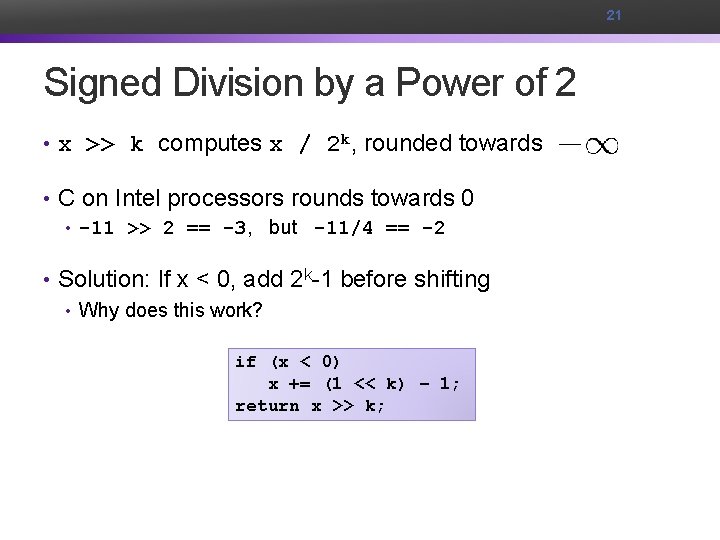
21 Signed Division by a Power of 2 • x >> k computes x / 2 k, rounded towards • C on Intel processors rounds towards 0 • -11 >> 2 == -3, but -11/4 == -2 • Solution: If x < 0, add 2 k-1 before shifting • Why does this work? if (x < 0) x += (1 << k) – 1; return x >> k;
- Slides: 19