
Lecture 4 Nuclear Stability The Shell Model Nuclear
Lecture 4 Nuclear Stability, The Shell Model
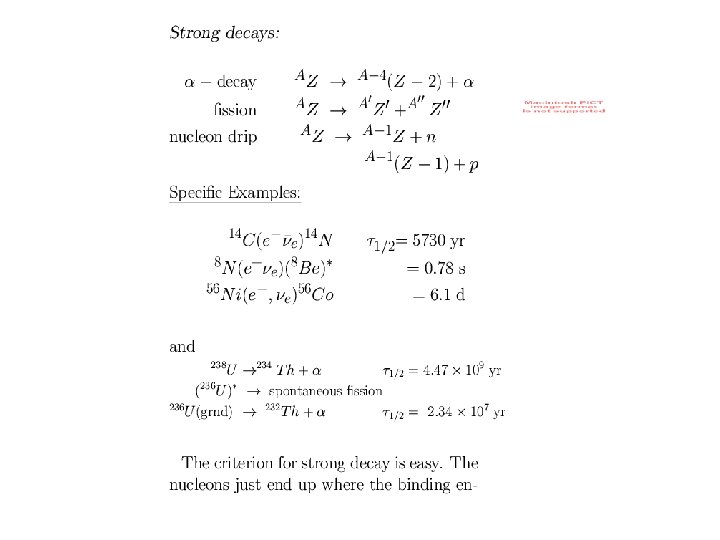
Nuclear Stability A sufficient condition for nuclear stability is that, for a collection of A nucleons, there exists no more tightly bound aggregate. • E. g. , one 8 Be nucleus has less binding energy than two 4 He nuclei, hence 8 Be quickly decays into two heliums. • An equivalent statement is that the nucleus AZ is stable if there is no collection of A nucleons that weighs less. • However, one must take care in applying this criterion, because while unstable, some nuclei live a very long time. An operational definition of “unstable” is that the isotope has a measurable abundance and no decay has ever been observed (ultimately all nuclei heavier than the iron group are unstable, but it takes almost forever for them to decay).
Protons 2. 46 x 105 yr 93 α α 87 α 85 206 Pb 83 β- α 89 α 238 U 234 U 91 210 Po 4. 47 x 109 yr ββ- α β- 81 β- 214 Po α β- 230 Th α 234 Th 226 Ra 222 Rn 218 Po 214 Pb 210 Tl 79 126 128 130 132 134 238 U last stable isotope 136 series 138 140 142 144 146 Neutrons
must add energy
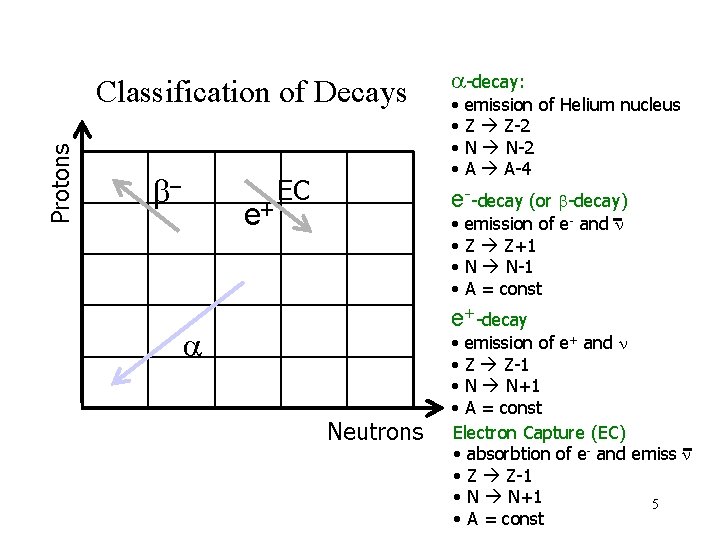
Protons Classification of Decays - e+ EC a-decay: • • emission of Helium nucleus Z Z-2 N N-2 A A-4 e--decay (or -decay) • • emission of e- and n Z Z+1 N N-1 A = const e+-decay a Neutrons • emission of e+ and n • Z Z-1 • N N+1 • A = const Electron Capture (EC) • absorbtion of e- and emiss n • Z Z-1 • N N+1 5 • A = const
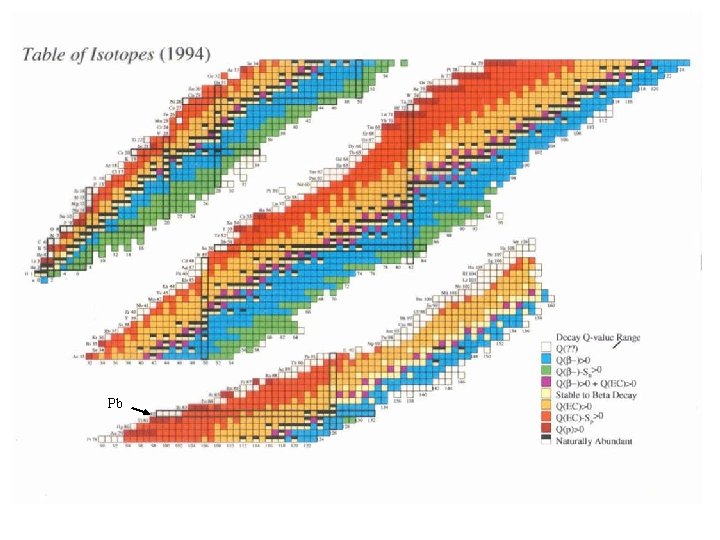
Pb
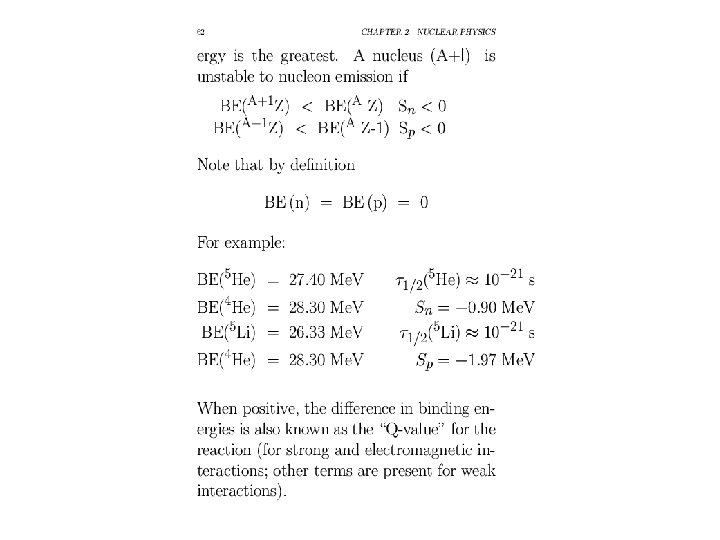
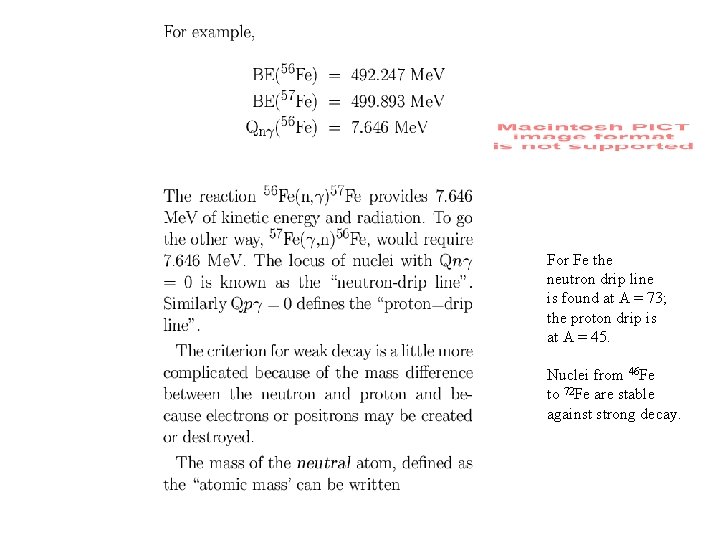
For Fe the neutron drip line is found at A = 73; the proton drip is at A = 45. Nuclei from 46 Fe to 72 Fe are stable against strong decay.
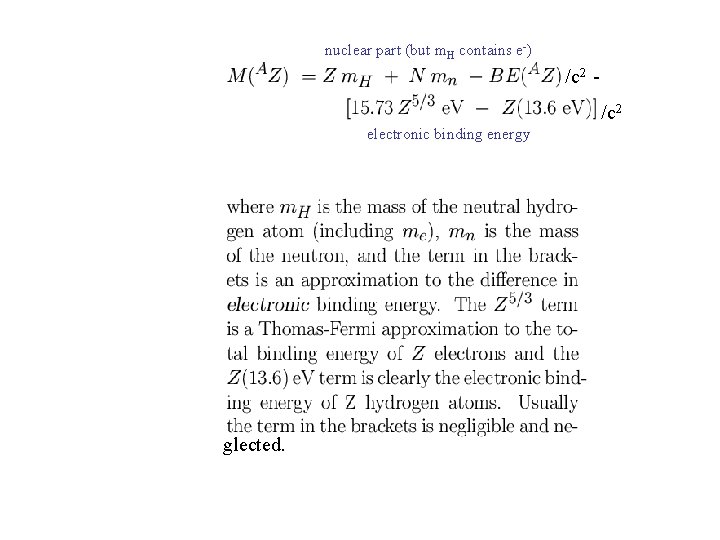
nuclear part (but m. H contains e-) /c 2 electronic binding energy glected.
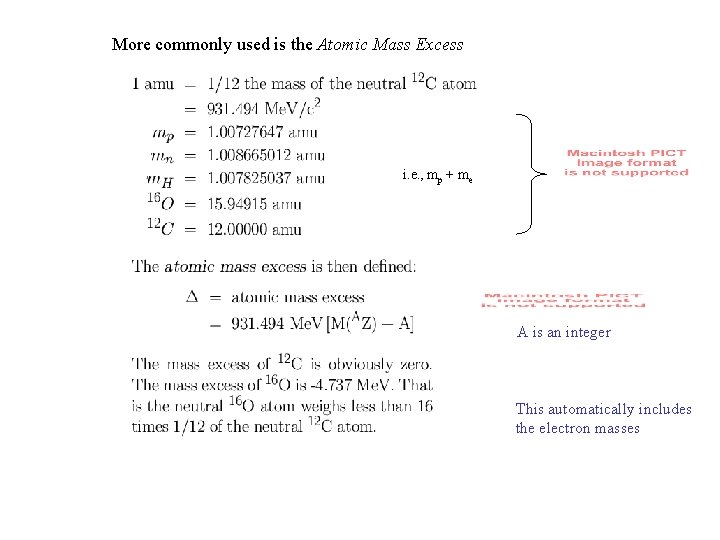
More commonly used is the Atomic Mass Excess i. e. , mp + me A is an integer This automatically includes the electron masses
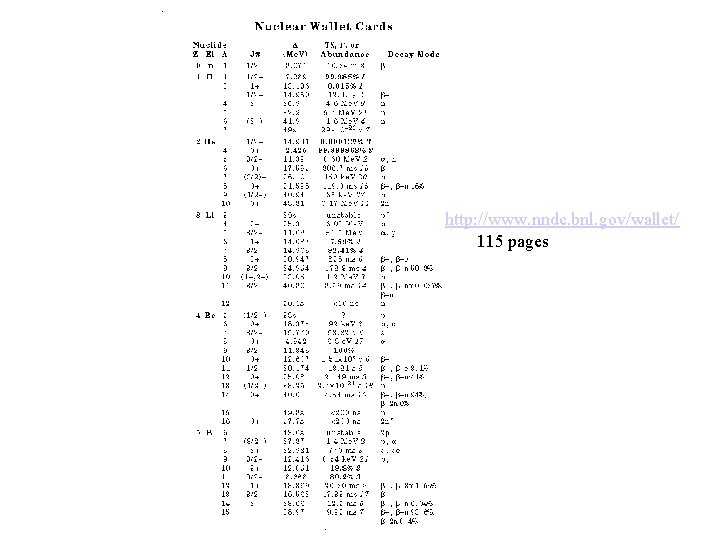
http: //www. nndc. bnl. gov/wallet/ 115 pages

BE Audi and Wapstra, Buc. Phys A. , 595, 409 (1995)
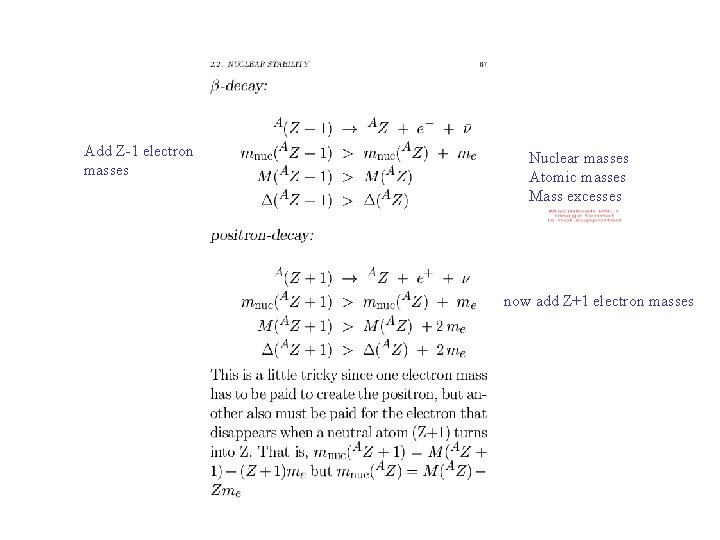
Add Z-1 electron masses Nuclear masses Atomic masses Mass excesses now add Z+1 electron masses
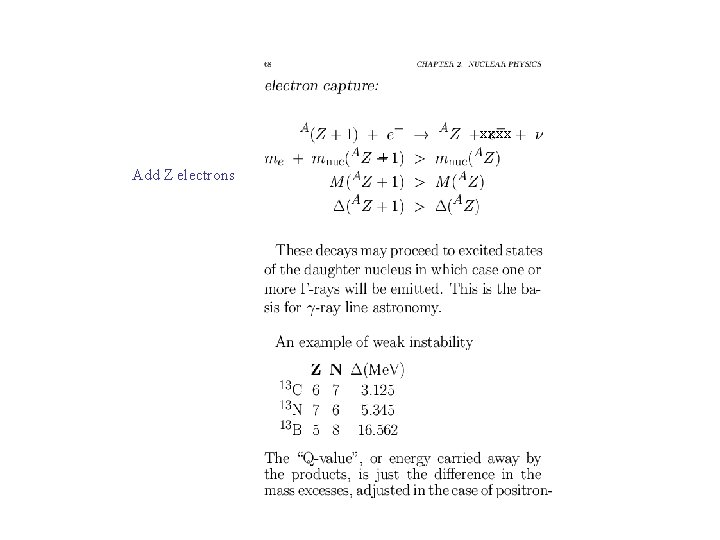
xxxx Add Z electrons +
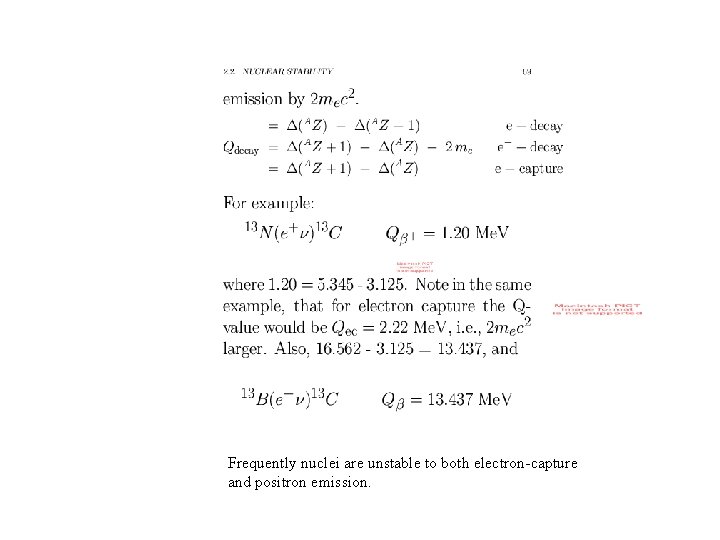
Frequently nuclei are unstable to both electron-capture and positron emission.
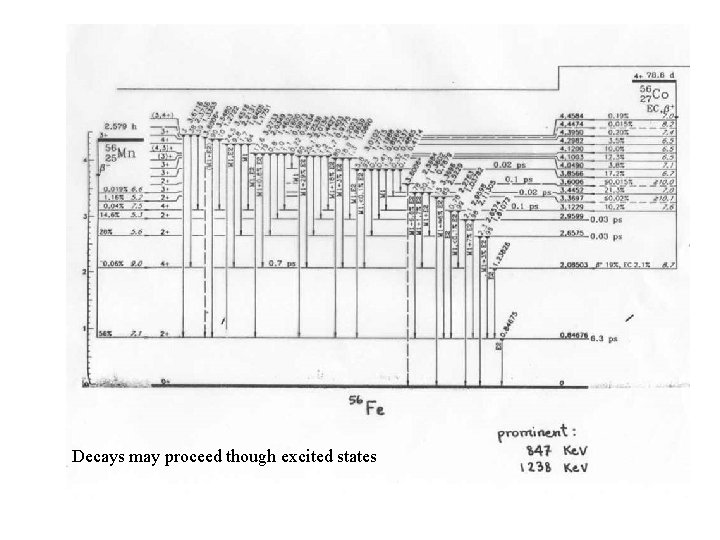
Decays may proceed though excited states
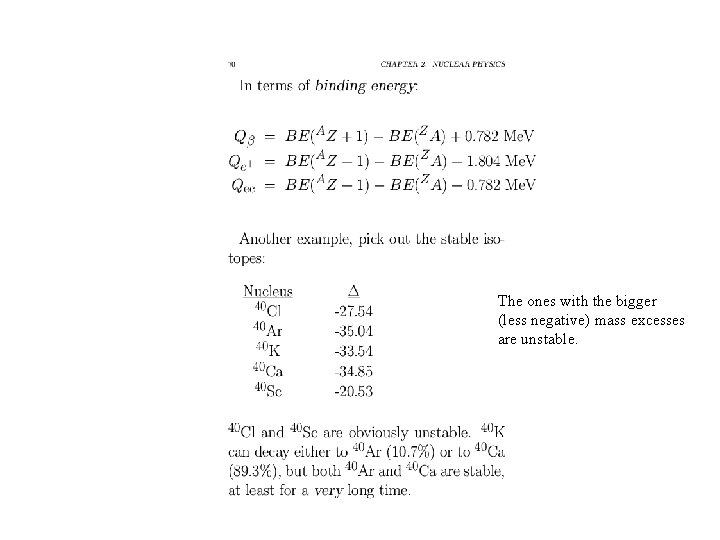
The ones with the bigger (less negative) mass excesses are unstable.
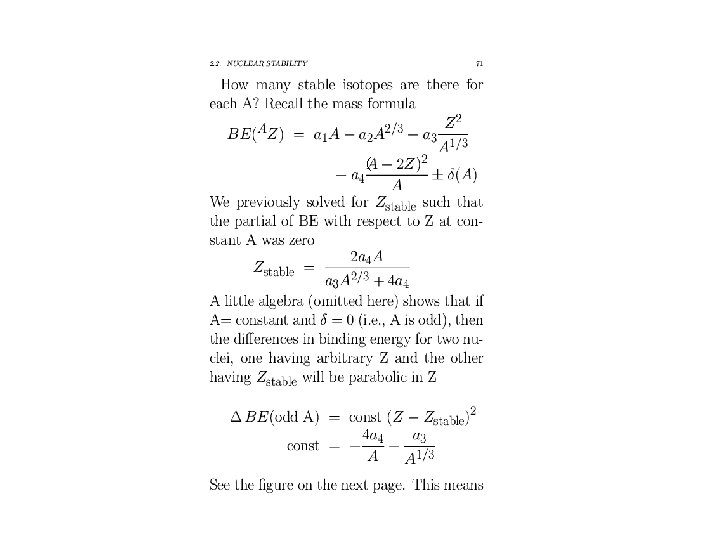
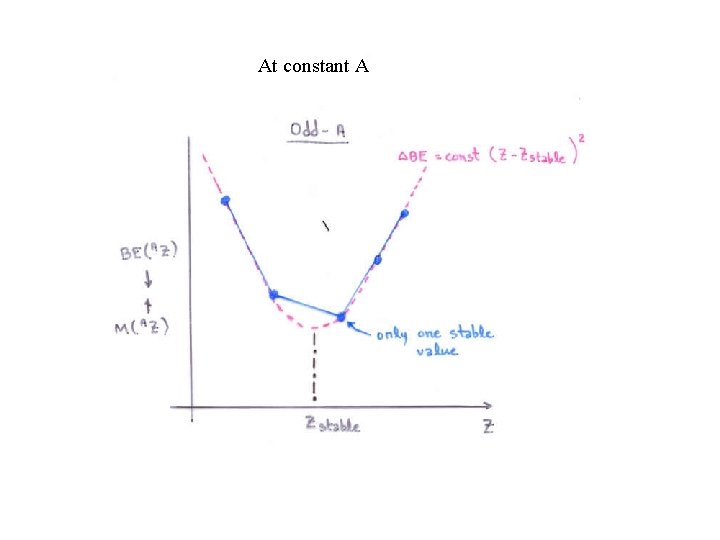
At constant A
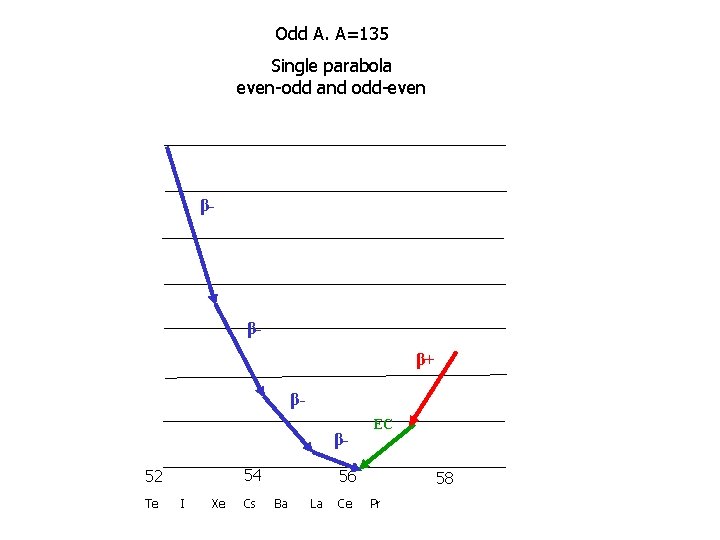
Odd A. A=135 Single parabola even-odd and odd-even β- ββ+ ββ 54 52 Te I Xe Cs EC 56 Ba La Ce 58 Pr
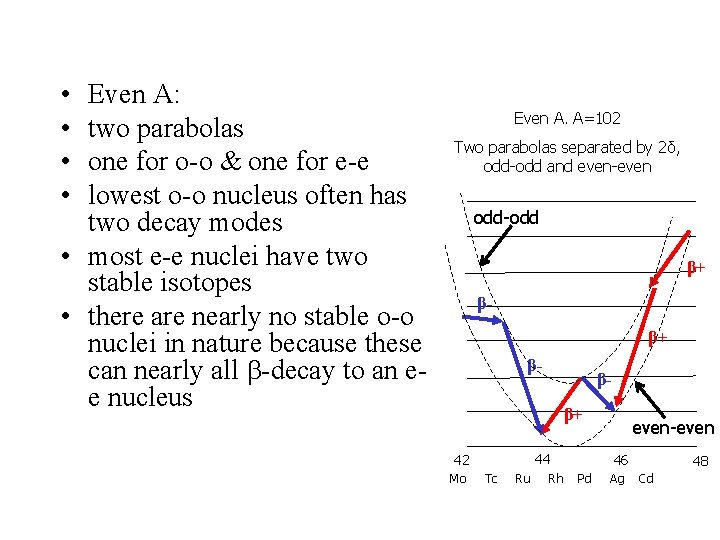
• • Even A: two parabolas one for o-o & one for e-e lowest o-o nucleus often has two decay modes • most e-e nuclei have two stable isotopes • there are nearly no stable o-o nuclei in nature because these can nearly all -decay to an ee nucleus Even A. A=102 Two parabolas separated by 2δ, odd-odd and even-even odd-odd β+ β- ββ+ 44 42 Mo Tc Ru Rh even-even 46 Pd Ag 48 Cd
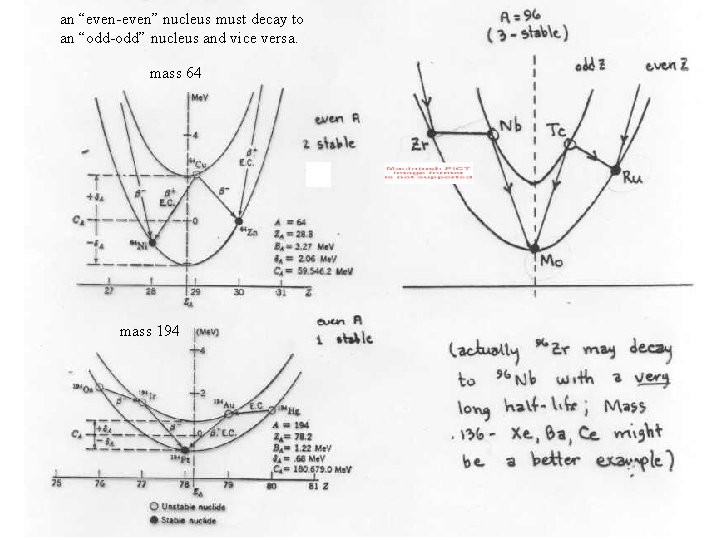
an “even-even” nucleus must decay to an “odd-odd” nucleus and vice versa. mass 64 mass 194
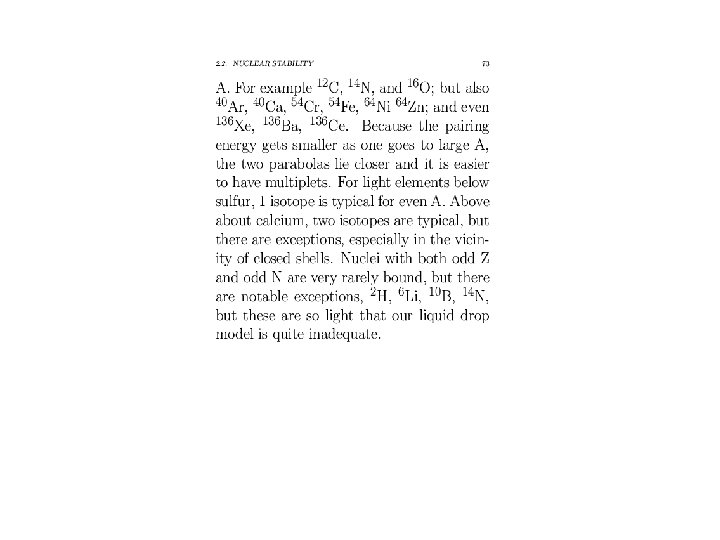
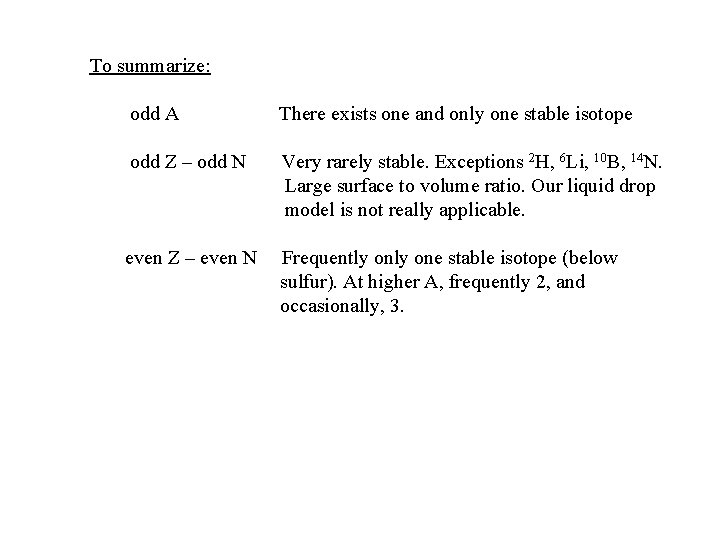
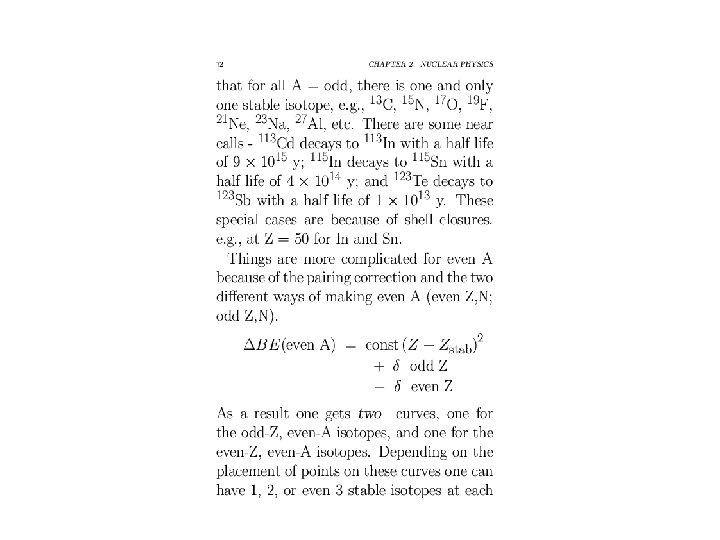
To summarize: odd A There exists one and only one stable isotope odd Z – odd N Very rarely stable. Exceptions 2 H, 6 Li, 10 B, 14 N. Large surface to volume ratio. Our liquid drop model is not really applicable. even Z – even N Frequently one stable isotope (below sulfur). At higher A, frequently 2, and occasionally, 3.
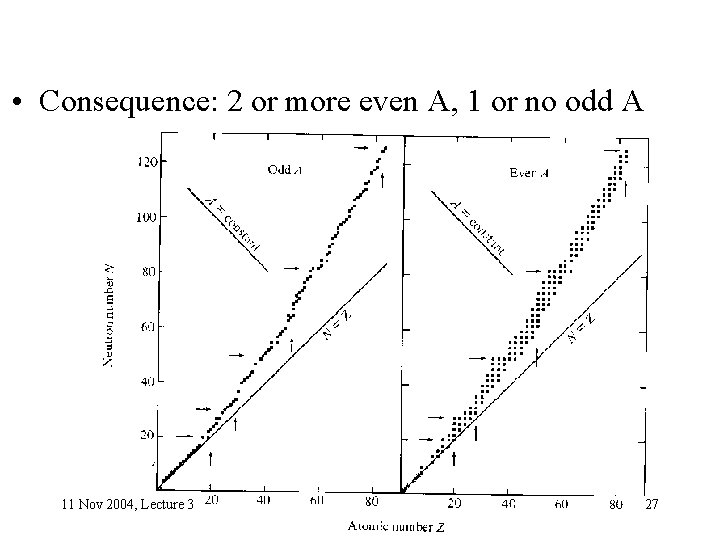
• Consequence: 2 or more even A, 1 or no odd A 11 Nov 2004, Lecture 3 27
The Shell Model
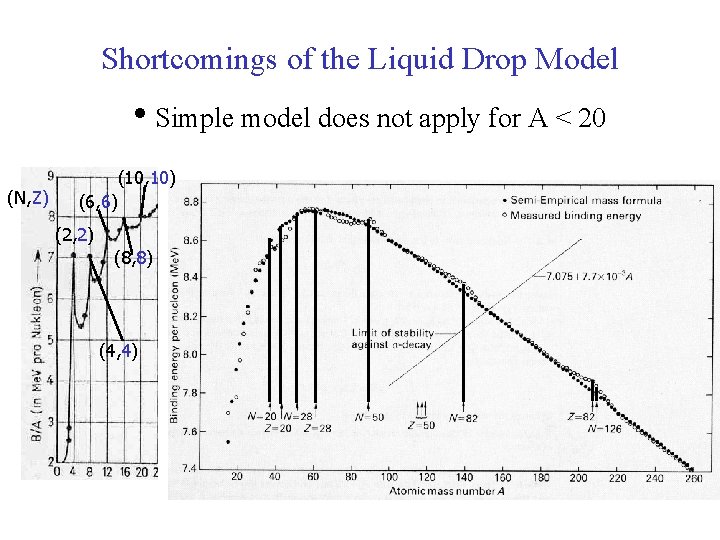
Shortcomings of the Liquid Drop Model • Simple model does not apply for A < 20 (N, Z) (10, 10) (6, 6) (2, 2) (8, 8) (4, 4)
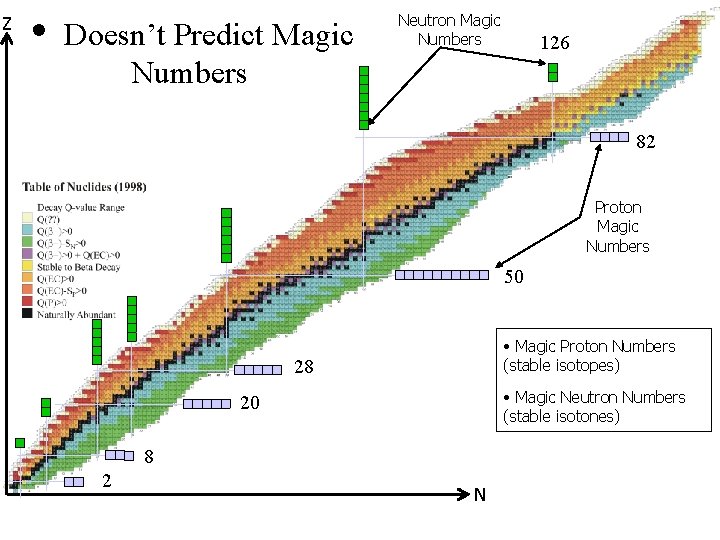
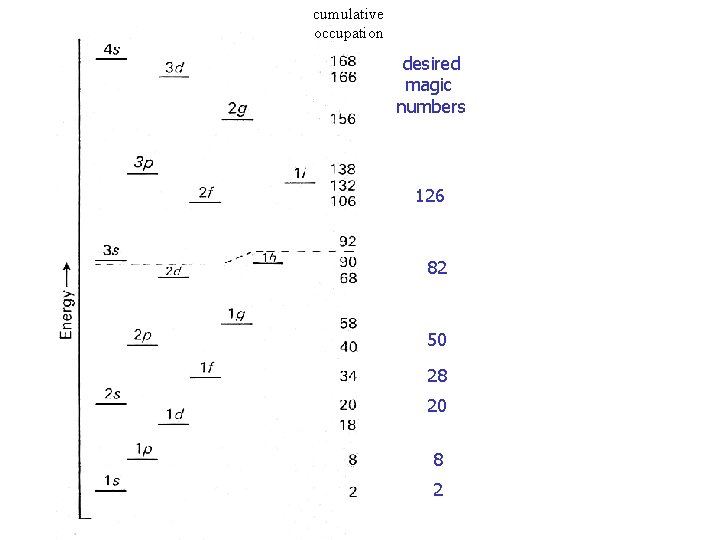
Z • Doesn’t Predict Magic Numbers Neutron Magic Numbers 126 82 Proton Magic Numbers 50 • Magic Proton Numbers (stable isotopes) 28 • Magic Neutron Numbers (stable isotones) 20 8 2 N
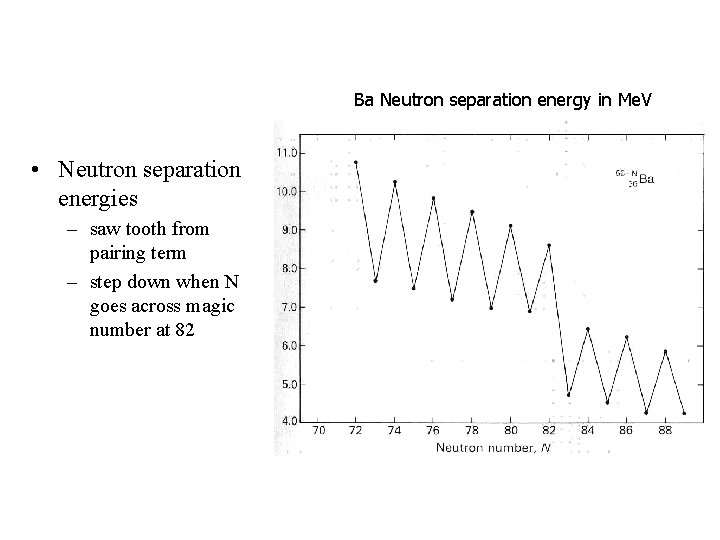
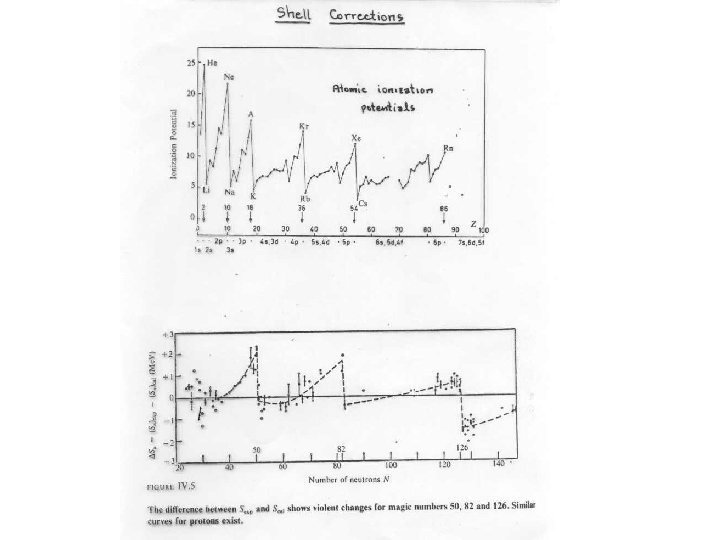
Ba Neutron separation energy in Me. V • Neutron separation energies – saw tooth from pairing term – step down when N goes across magic number at 82
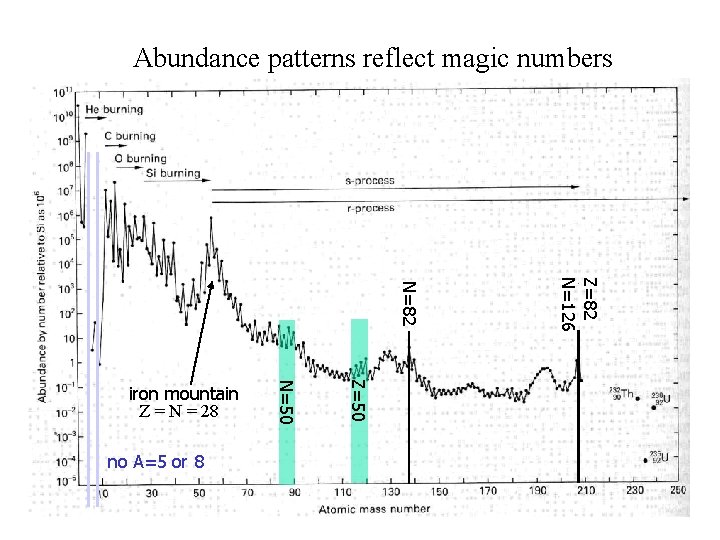
Abundance patterns reflect magic numbers Z=82 N=126 N=82 Z=50 no A=5 or 8 N=50 iron mountain Z = N = 28
Shell Model – Mayer and Jensen 1963 Nobel Prize Our earlier discussions treated the nucleus as sets of identical nucleons and protons comprising two degenerate Fermi gases. That is OK so far as it goes, but now we shall consider the fact that the nucleons have spin and angular momentum and that, in analogy to electrons in an atom, are in ordered discrete energy levels characterized by conserved quantized variables – energy, angular momentum and spin. Clayton 311 – 319 De. Shalit and Feshbach , Theoretical Nuclear Physics, 191 - 237
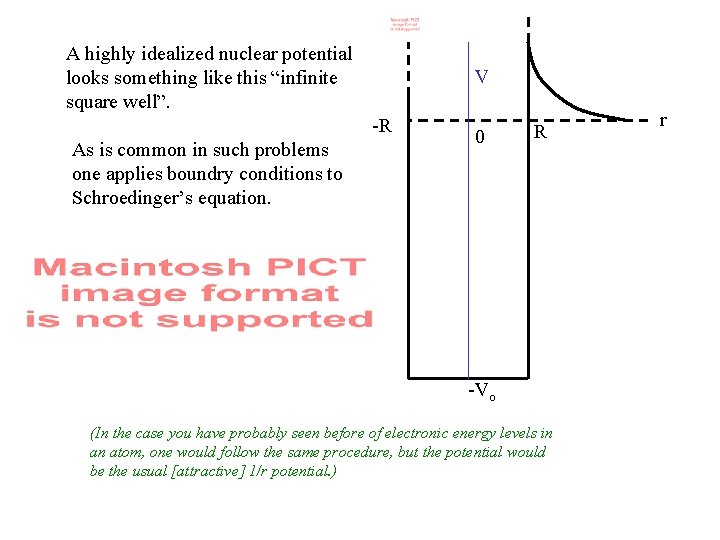
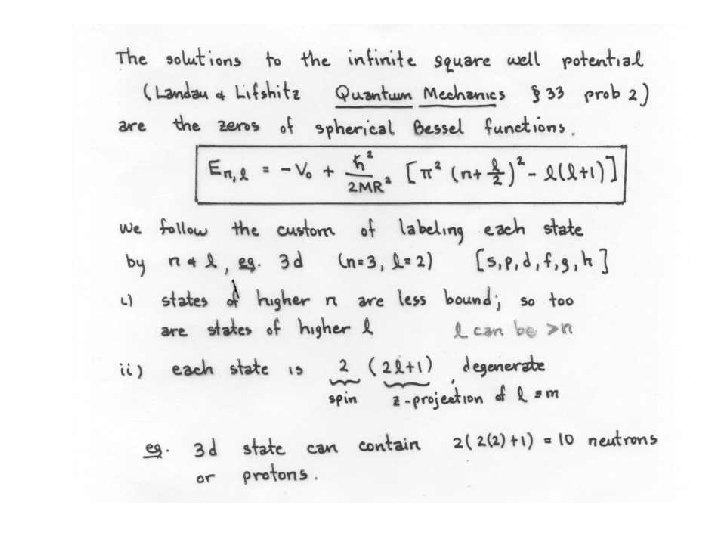
A highly idealized nuclear potential looks something like this “infinite square well”. V -R As is common in such problems one applies boundry conditions to Schroedinger’s equation. 0 R -Vo (In the case you have probably seen before of electronic energy levels in an atom, one would follow the same procedure, but the potential would be the usual [attractive] 1/r potential. ) r
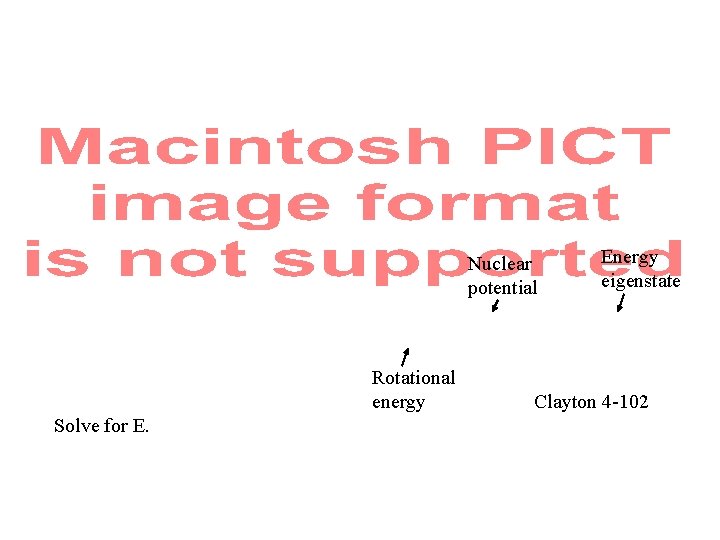
Nuclear potential Rotational energy Solve for E. Energy eigenstate Clayton 4 -102

Abramowitz and Stegun 10. 1. 1
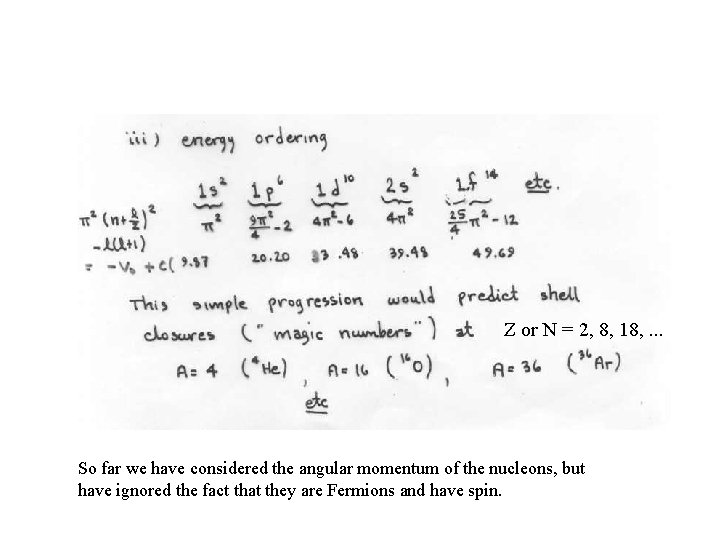
Z or N = 2, 8, 18, . . . So far we have considered the angular momentum of the nucleons, but have ignored the fact that they are Fermions and have spin.
cumulative occupation desired magic numbers 126 82 50 28 20 8 2
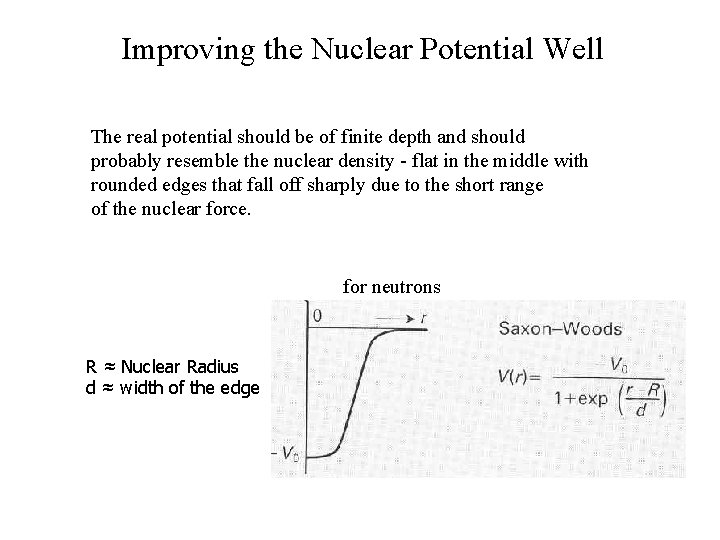
Improving the Nuclear Potential Well The real potential should be of finite depth and should probably resemble the nuclear density - flat in the middle with rounded edges that fall off sharply due to the short range of the nuclear force. for neutrons R ≈ Nuclear Radius d ≈ width of the edge
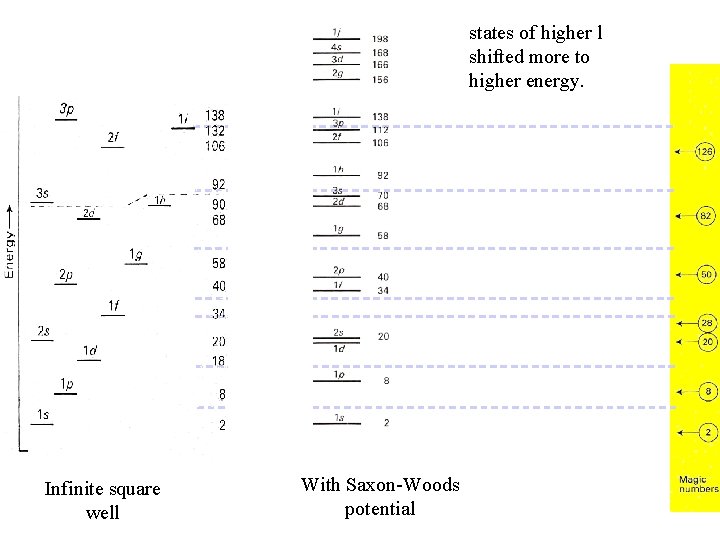
states of higher l shifted more to higher energy. Infinite square well With Saxon-Woods potential
But this still is not very accurate because: • Spin is very important to the nuclear force • The Coulomb force becomes important for protons but not for neutrons.
This interaction is quite different from the fine structure splitting in atoms. It is much larger and lowers the state of larger j (parallel l and s) compared to one with smaller j. See Clayton p. 311 ff) These can be large compared even to the spacing between the principal levels. The state with higher j is more tightly bound; the splitting is bigger as l gets larger.
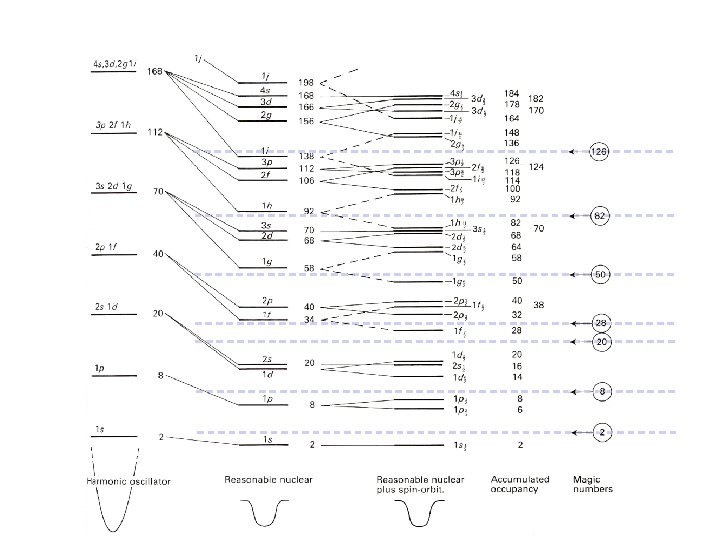
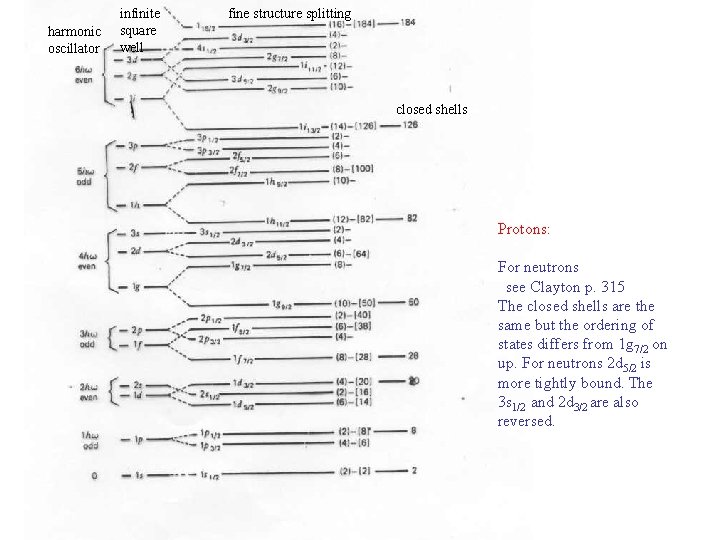
harmonic oscillator infinite square well fine structure splitting closed shells Protons: For neutrons see Clayton p. 315 The closed shells are the same but the ordering of states differs from 1 g 7/2 on up. For neutrons 2 d 5/2 is more tightly bound. The 3 s 1/2 and 2 d 3/2 are also reversed.
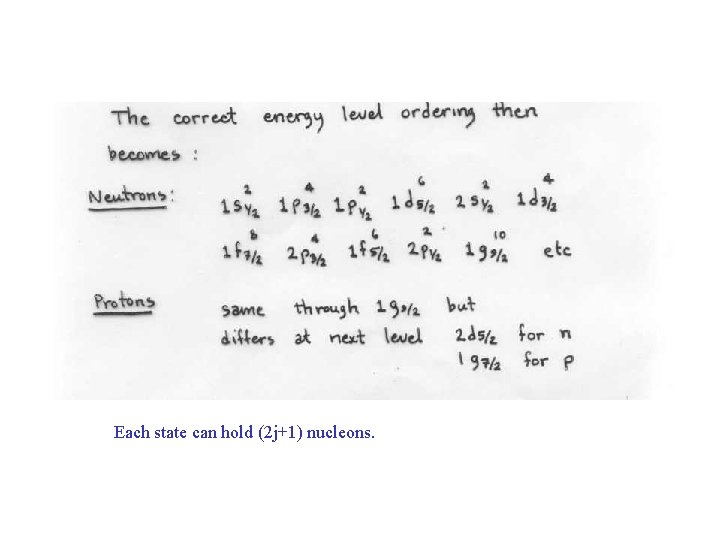
Each state can hold (2 j+1) nucleons.
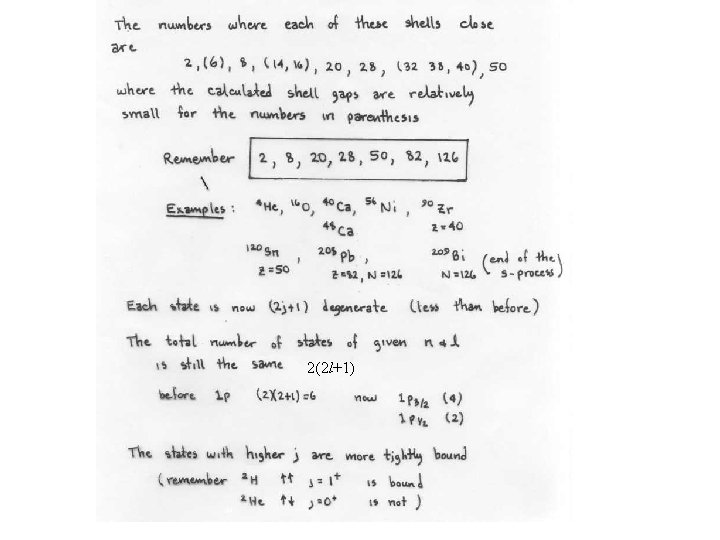
2(2 l+1)
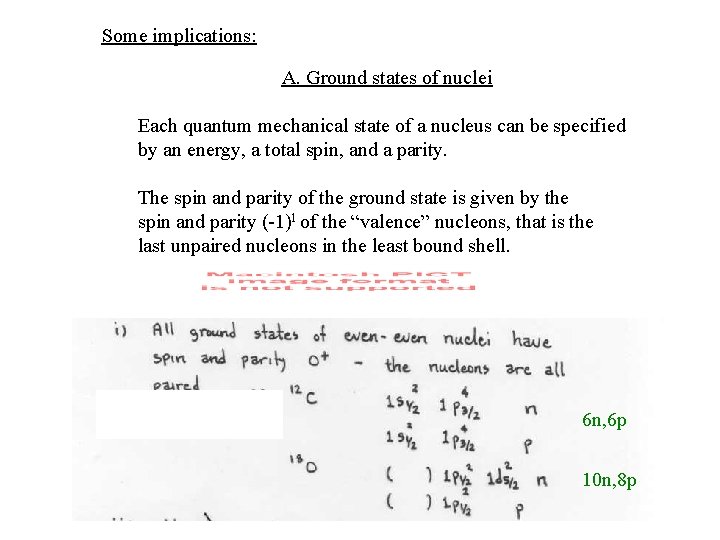
Some implications: A. Ground states of nuclei Each quantum mechanical state of a nucleus can be specified by an energy, a total spin, and a parity. The spin and parity of the ground state is given by the spin and parity (-1)l of the “valence” nucleons, that is the last unpaired nucleons in the least bound shell. 6 n, 6 p 10 n, 8 p
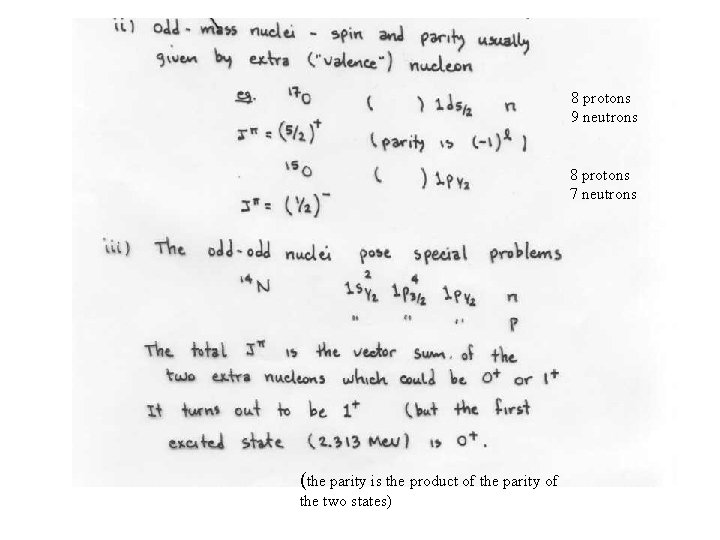
8 protons 9 neutrons 8 protons 7 neutrons (the parity is the product of the parity of the two states)
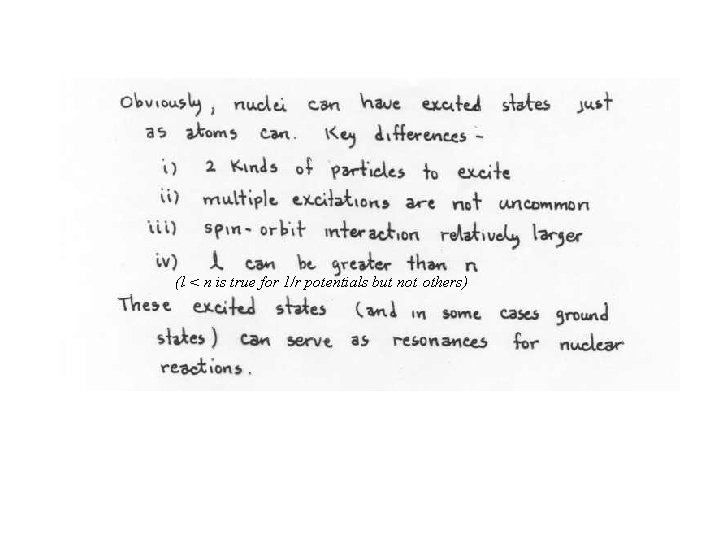
(l < n is true for 1/r potentials but not others)
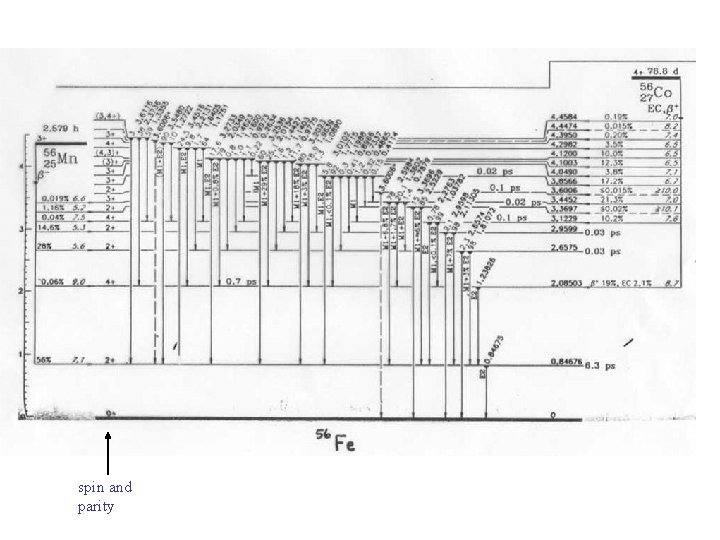
spin and parity
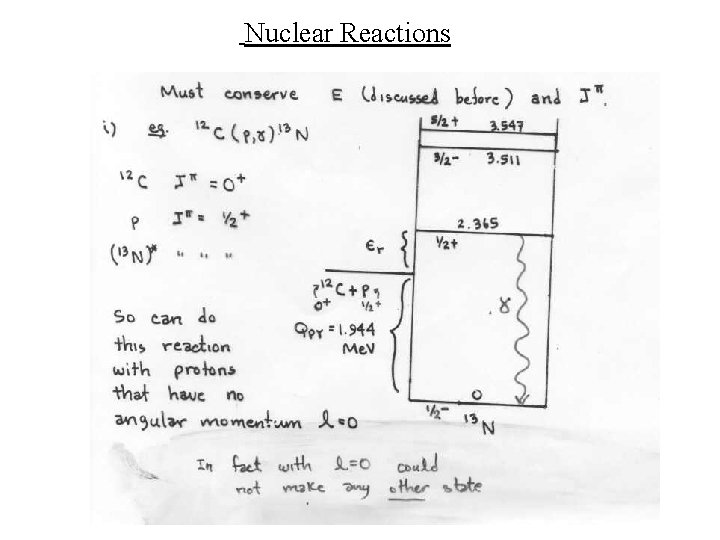
Nuclear Reactions
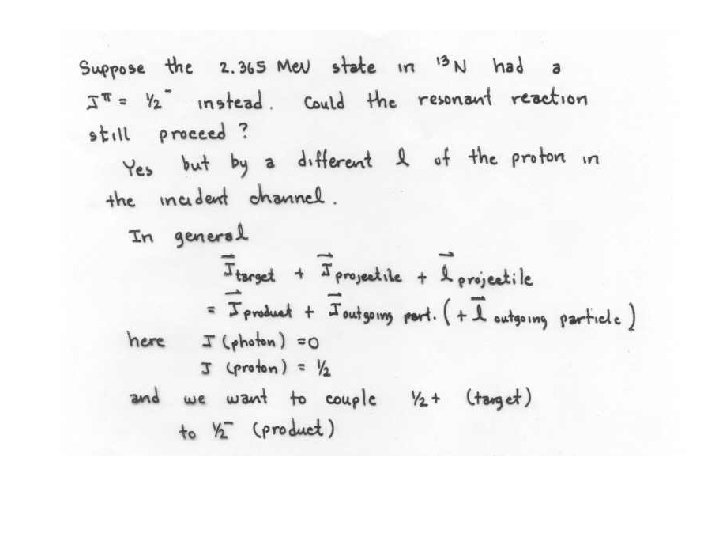
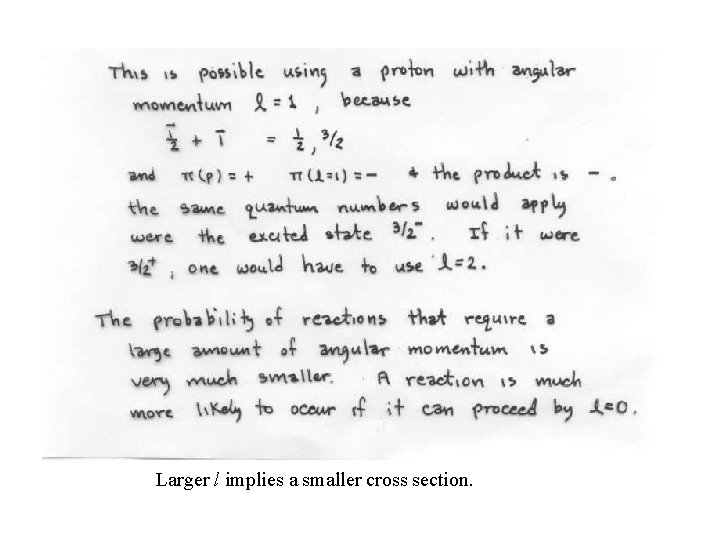
Larger l implies a smaller cross section.
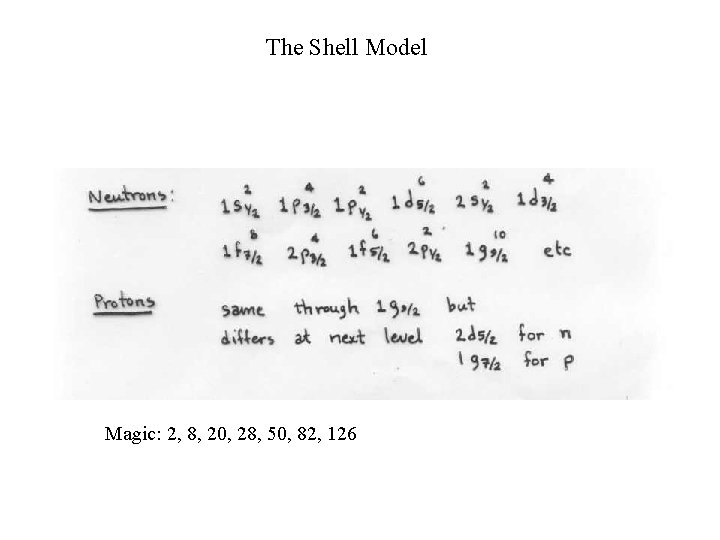
The Shell Model Magic: 2, 8, 20, 28, 50, 82, 126
- Slides: 56