
LECTURE 4 MICROECONOMICS CHAPTER 5 Elasticity of Demand




- Slides: 24
LECTURE #4: MICROECONOMICS CHAPTER 5 Elasticity of Demand Elasticity of Supply Applications 1
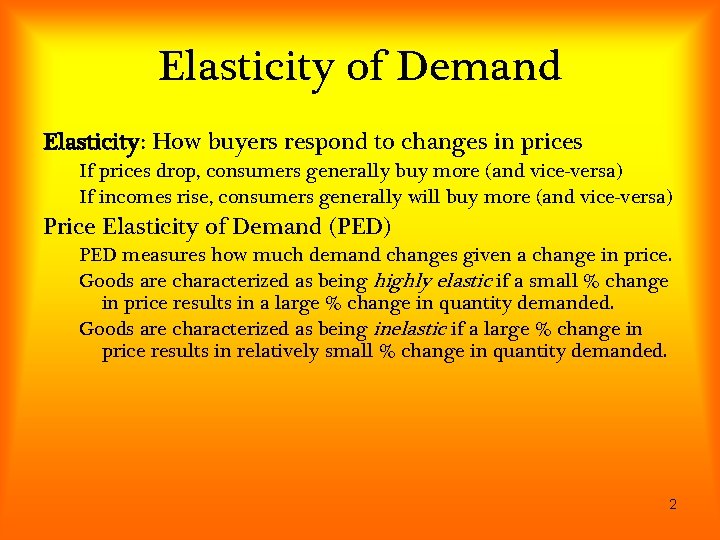
Elasticity of Demand Elasticity: How buyers respond to changes in prices If prices drop, consumers generally buy more (and vice-versa) If incomes rise, consumers generally will buy more (and vice-versa) Price Elasticity of Demand (PED) PED measures how much demand changes given a change in price. Goods are characterized as being highly elastic if a small % change in price results in a large % change in quantity demanded. Goods are characterized as being inelastic if a large % change in price results in relatively small % change in quantity demanded. 2
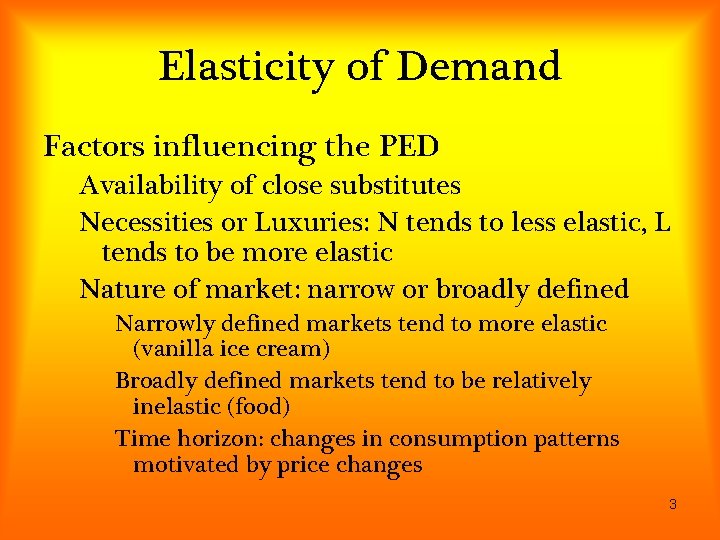
Elasticity of Demand Factors influencing the PED Availability of close substitutes Necessities or Luxuries: N tends to less elastic, L tends to be more elastic Nature of market: narrow or broadly defined Narrowly defined markets tend to more elastic (vanilla ice cream) Broadly defined markets tend to be relatively inelastic (food) Time horizon: changes in consumption patterns motivated by price changes 3
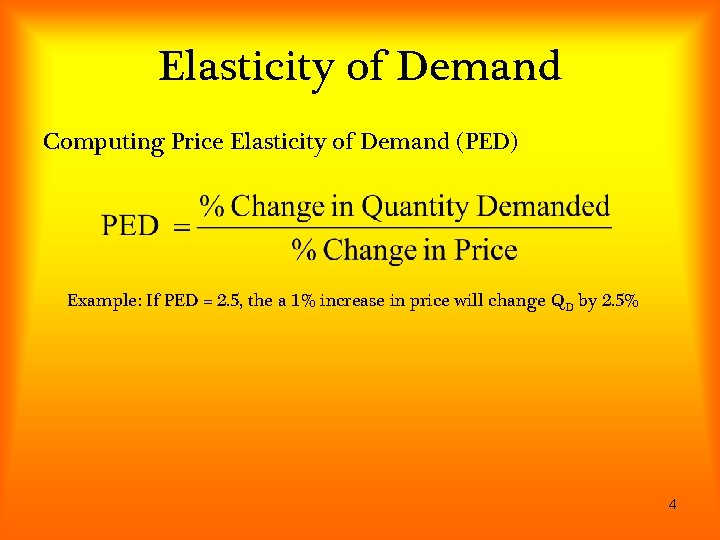
Elasticity of Demand Computing Price Elasticity of Demand (PED) Example: If PED = 2. 5, the a 1% increase in price will change Q D by 2. 5% 4
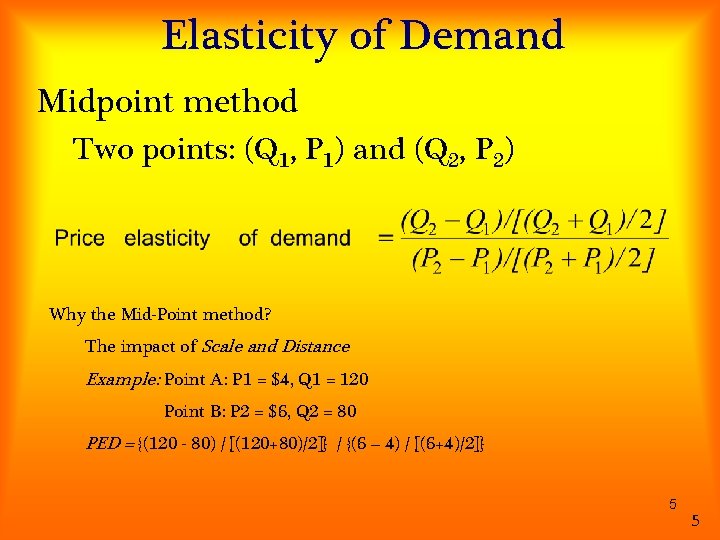
Elasticity of Demand Midpoint method Two points: (Q 1, P 1) and (Q 2, P 2) Why the Mid-Point method? The impact of Scale and Distance Example: Point A: P 1 = $4, Q 1 = 120 Point B: P 2 = $6, Q 2 = 80 PED = {(120 - 80) / [(120+80)/2]} / {(6 – 4) / [(6+4)/2]} 5 5
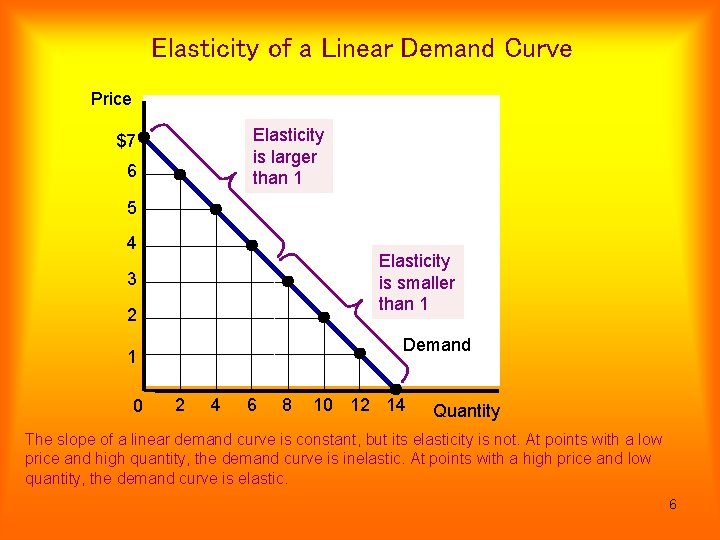
Elasticity of a Linear Demand Curve Price Elasticity is larger than 1 $7 6 5 1. an 4 3 2 Demand 1 0 Elasticity is smaller than 1 2 4 6 8 10 12 14 Quantity The slope of a linear demand curve is constant, but its elasticity is not. At points with a low price and high quantity, the demand curve is inelastic. At points with a high price and low quantity, the demand curve is elastic. 6
CONTINUE CHAPTER 5 7
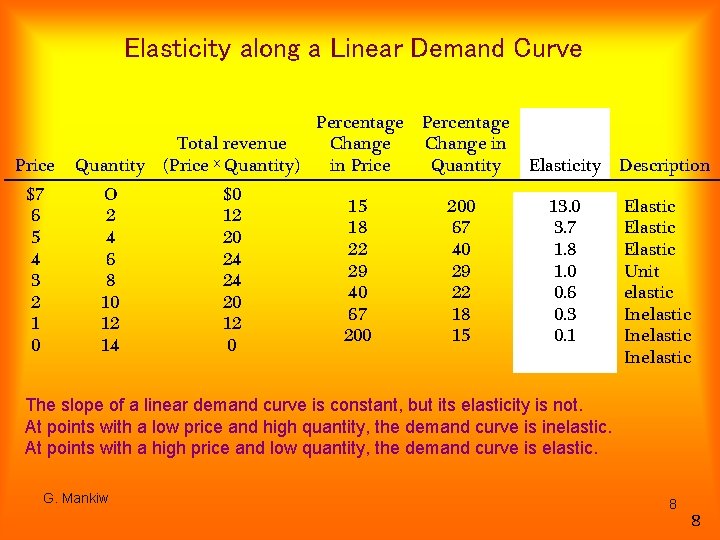
Elasticity along a Linear Demand Curve Price Quantity $7 6 5 4 3 2 1 0 O 2 4 6 8 10 12 14 Percentage Total revenue Change (Price ˣ Quantity) in Price $0 12 20 24 24 20 12 0 15 18 22 29 40 67 200 Percentage Change in Quantity Elasticity 200 67 40 29 22 18 15 13. 0 3. 7 1. 8 1. 0 0. 6 0. 3 0. 1 Description Elastic Unit elastic Inelastic The slope of a linear demand curve is constant, but its elasticity is not. At points with a low price and high quantity, the demand curve is inelastic. At points with a high price and low quantity, the demand curve is elastic. G. Mankiw 8 8
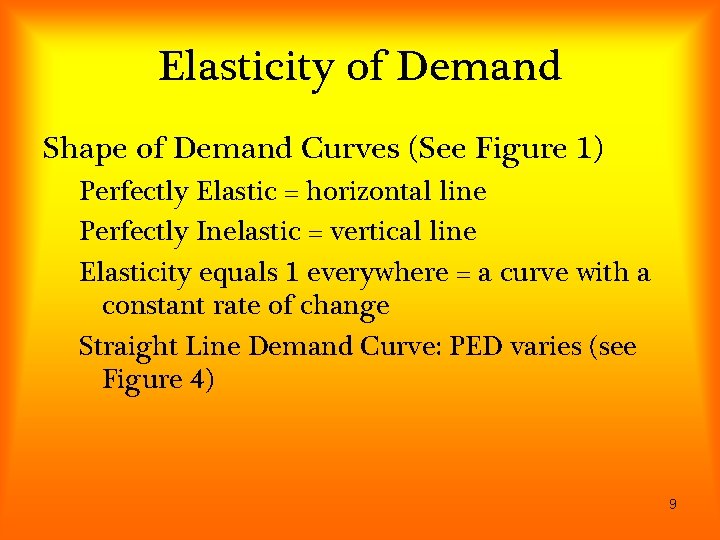
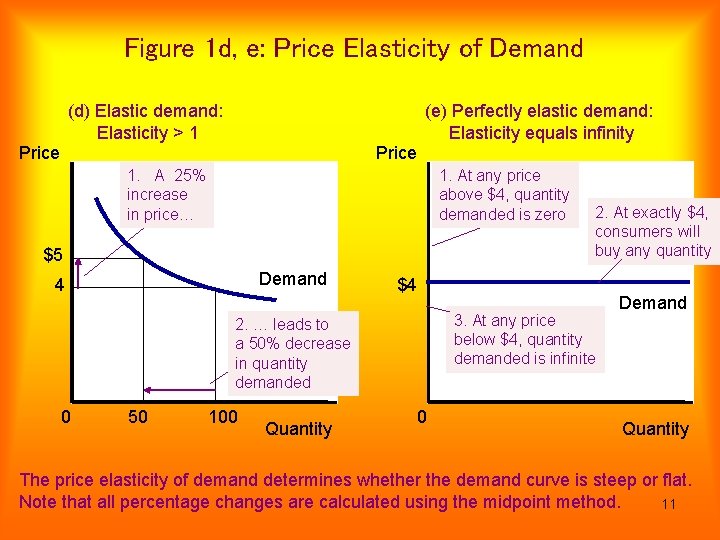
Elasticity of Demand Shape of Demand Curves (See Figure 1) Perfectly Elastic = horizontal line Perfectly Inelastic = vertical line Elasticity equals 1 everywhere = a curve with a constant rate of change Straight Line Demand Curve: PED varies (see Figure 4) 9
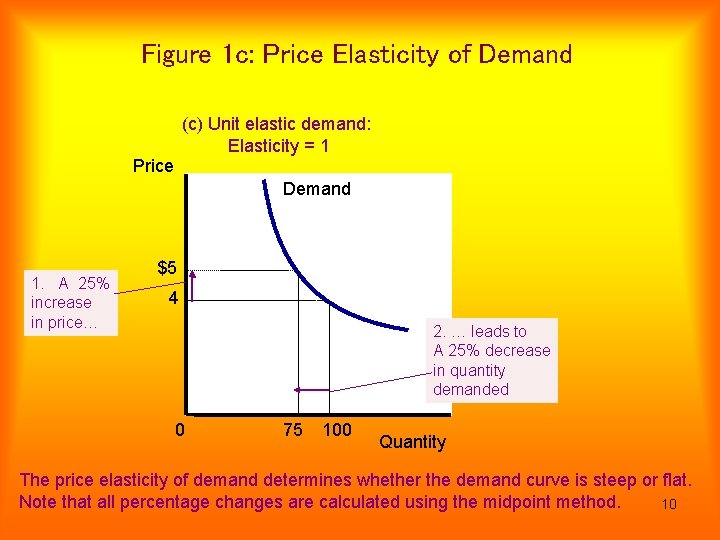
Figure 1 c: Price Elasticity of Demand (c) Unit elastic demand: Elasticity = 1 Price Demand 1. A 25% increase in price… $5 4 1. an 2. … leads to A 25% decrease in quantity demanded 0 75 100 Quantity The price elasticity of demand determines whether the demand curve is steep or flat. Note that all percentage changes are calculated using the midpoint method. 10
Figure 1 d, e: Price Elasticity of Demand (d) Elastic demand: Elasticity > 1 (e) Perfectly elastic demand: Elasticity equals infinity Price 1. A 25% increase in price… 1. At any price above $4, quantity demanded is zero $5 Demand 1. an 4 1. an $4 3. At any price below $4, quantity demanded is infinite 2. … leads to a 50% decrease in quantity demanded 0 50 100 Quantity 2. At exactly $4, consumers will buy any quantity 0 Demand Quantity The price elasticity of demand determines whether the demand curve is steep or flat. Note that all percentage changes are calculated using the midpoint method. 11
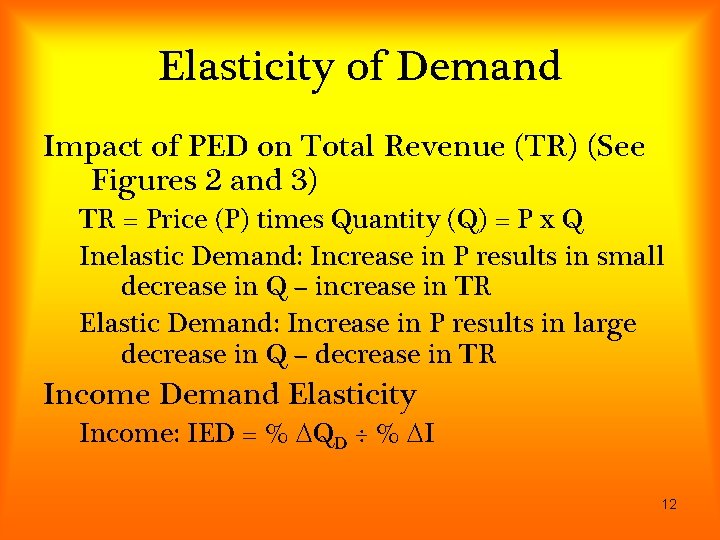
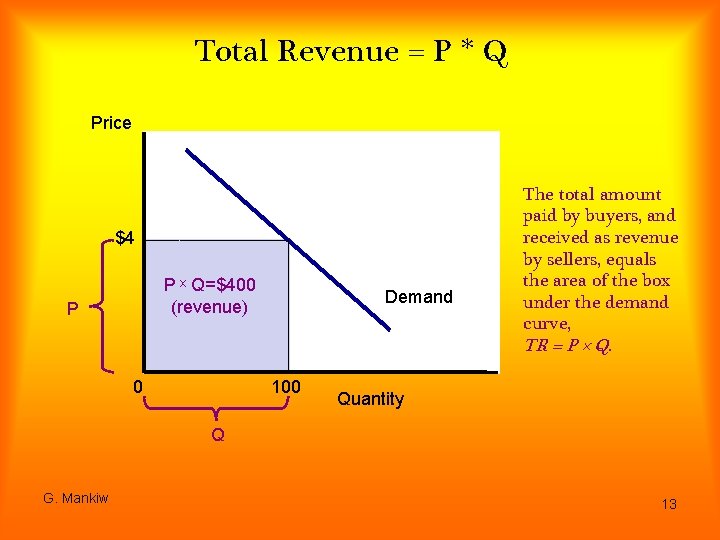
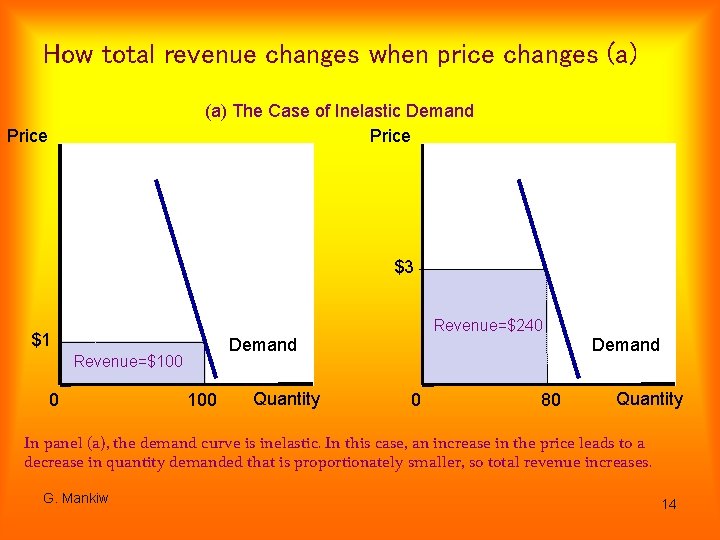
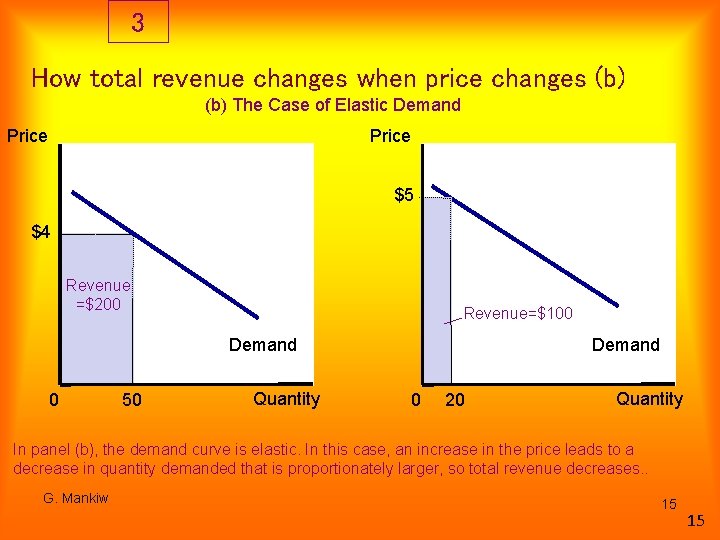
Elasticity of Demand Impact of PED on Total Revenue (TR) (See Figures 2 and 3) TR = Price (P) times Quantity (Q) = P x Q Inelastic Demand: Increase in P results in small decrease in Q – increase in TR Elastic Demand: Increase in P results in large decrease in Q – decrease in TR Income Demand Elasticity Income: IED = % DQD ÷ % DI 12
Total Revenue = P * Q Price $4 1. an P ˣ Q=$400 (revenue) P Demand The total amount paid by buyers, and received as revenue by sellers, equals the area of the box under the demand curve, TR = P × Q. 0 100 Quantity Q G. Mankiw 13
How total revenue changes when price changes (a) The Case of Inelastic Demand Price 1. an $3 1. an Revenue=$240 $1 Demand Revenue=$100 0 100 Quantity Demand 0 80 Quantity In panel (a), the demand curve is inelastic. In this case, an increase in the price leads to a decrease in quantity demanded that is proportionately smaller, so total revenue increases. G. Mankiw 14
3 How total revenue changes when price changes (b) The Case of Elastic Demand Price $5 $4 1. an Revenue =$200 Revenue=$100 Demand 0 50 Quantity Demand 0 20 Quantity In panel (b), the demand curve is elastic. In this case, an increase in the price leads to a decrease in quantity demanded that is proportionately larger, so total revenue decreases. . G. Mankiw 15 15
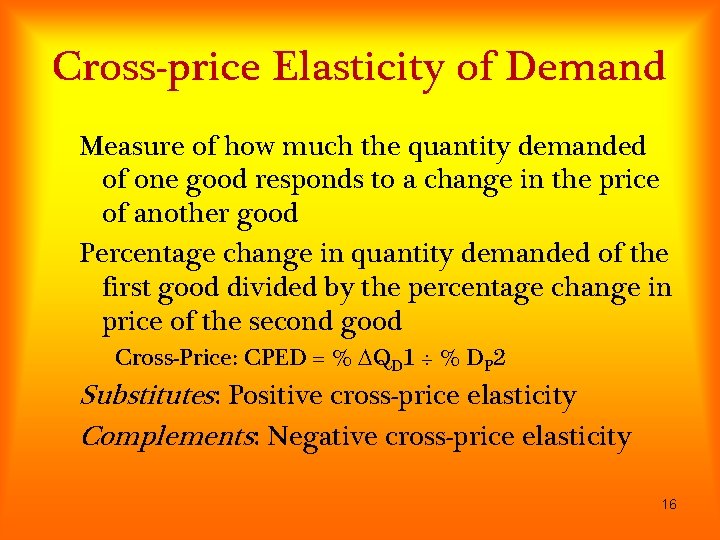
Cross-price Elasticity of Demand Measure of how much the quantity demanded of one good responds to a change in the price of another good Percentage change in quantity demanded of the first good divided by the percentage change in price of the second good Cross-Price: CPED = % DQD 1 ÷ % DP 2 Substitutes: Positive cross-price elasticity Complements: Negative cross-price elasticity 16
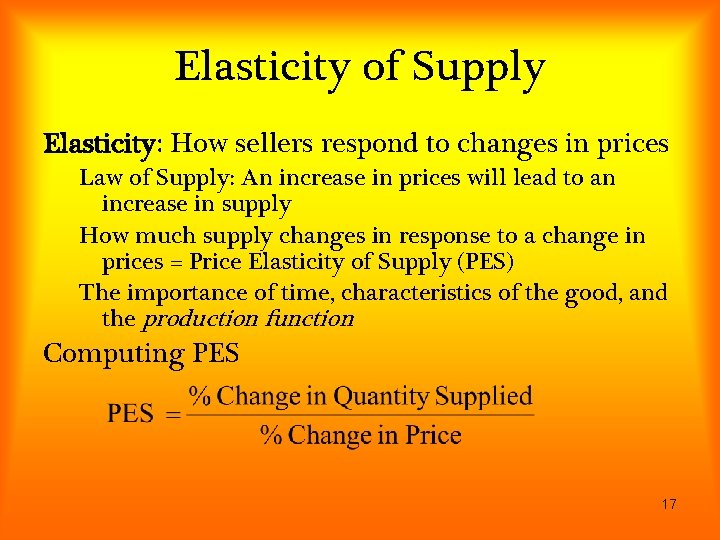
Elasticity of Supply Elasticity: How sellers respond to changes in prices Law of Supply: An increase in prices will lead to an increase in supply How much supply changes in response to a change in prices = Price Elasticity of Supply (PES) The importance of time, characteristics of the good, and the production function Computing PES 17
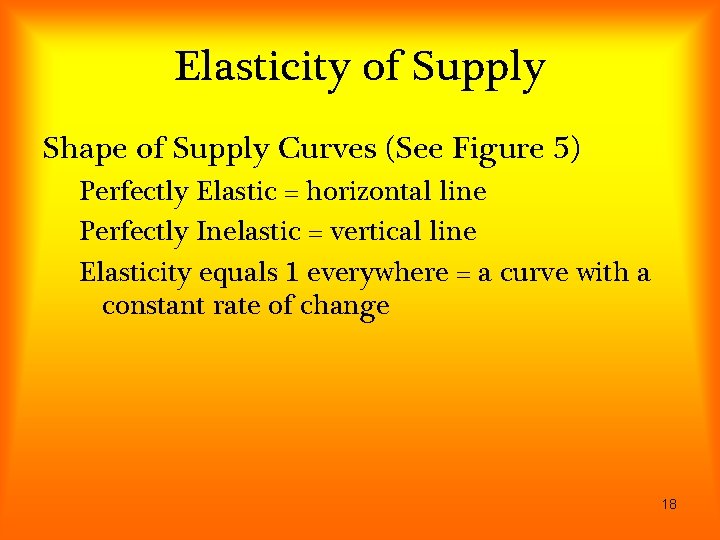
Elasticity of Supply Shape of Supply Curves (See Figure 5) Perfectly Elastic = horizontal line Perfectly Inelastic = vertical line Elasticity equals 1 everywhere = a curve with a constant rate of change 18
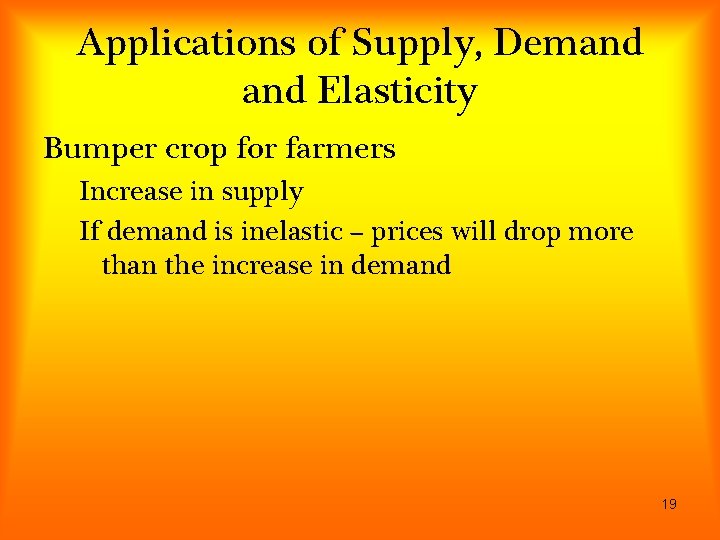
Applications of Supply, Demand Elasticity Bumper crop for farmers Increase in supply If demand is inelastic – prices will drop more than the increase in demand 19
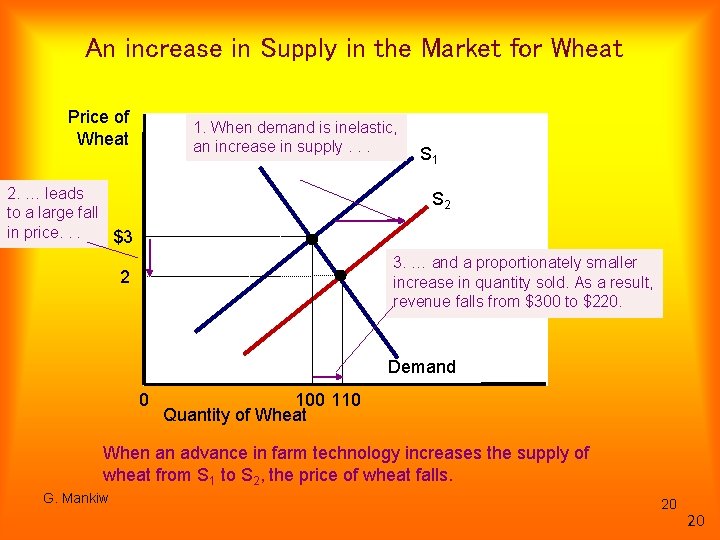
An increase in Supply in the Market for Wheat Price of Wheat 1. When demand is inelastic, an increase in supply. . . 2. … leads to a large fall in price. . . $3 S 1 S 2 3. … and a proportionately smaller increase in quantity sold. As a result, revenue falls from $300 to $220. 2 Demand 0 100 110 Quantity of Wheat When an advance in farm technology increases the supply of wheat from S 1 to S 2, the price of wheat falls. G. Mankiw 20 20
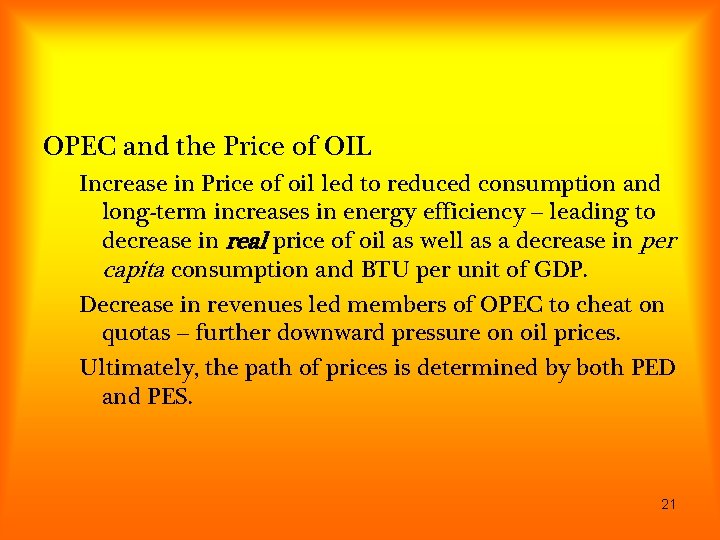
OPEC and the Price of OIL Increase in Price of oil led to reduced consumption and long-term increases in energy efficiency – leading to decrease in real price of oil as well as a decrease in per capita consumption and BTU per unit of GDP. Decrease in revenues led members of OPEC to cheat on quotas – further downward pressure on oil prices. Ultimately, the path of prices is determined by both PED and PES. 21
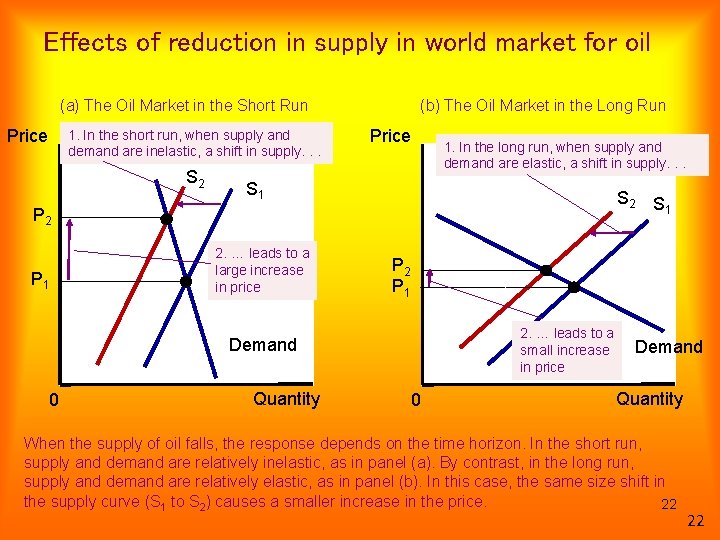
Effects of reduction in supply in world market for oil (a) The Oil Market in the Short Run Price 1. In the short run, when supply and demand are inelastic, a shift in supply. . . S 2 (b) The Oil Market in the Long Run Price 1. In the long run, when supply and demand are elastic, a shift in supply. . . S 1 S 2 P 1 1. an 2. … leads to a large increase in price 1. an P 2 P 1 2. … leads to a small increase in price Demand 0 Quantity S 1 0 Demand Quantity When the supply of oil falls, the response depends on the time horizon. In the short run, supply and demand are relatively inelastic, as in panel (a). By contrast, in the long run, supply and demand are relatively elastic, as in panel (b). In this case, the same size shift in the supply curve (S 1 to S 2) causes a smaller increase in the price. 22 22
Homework Questions for Review: 1, 2, 3, 4 Problems and Applications: 2, 3, 9, 11 23
Break Time 3: 47 AM 24