
LECTURE 4 MEASURING MEMBRANE CONDUCTANCE AND CAPACITANCE VOLTAGECLAMP
LECTURE 4: MEASURING MEMBRANE CONDUCTANCE AND CAPACITANCE & VOLTAGE-CLAMP RECORDING REQUIRED READING: Kandel text, Chapters 8, 9 (beginning), pgs 140 -153 We have talked about the properties of solid-state RC electrical circuits. We have also learned that the resting membrane consists of electrical components: The membrane is a capacitor Channels create ion-specific conductances Concentration gradients establish ion-specific battery potentials We show here that a cell at rest exposed to a transition in transmembrane voltage responds as a simple RC circuit SO LONG AS THE VOLTAGE CHANGES DO NOT ALTER THE OPEN/CLOSED STATES OF ANY MEMBRANE CHANNELS !!!

In an RC electrical circuit, we can measure the resistance (conductance) and capacitance of components by analyzing currents and component voltages induced by applying a voltage step. IA RA + IC RB IB VBat -= 10 m. V IA SWITCH CLOSED t = 0 sec C 0 time IA IA IC C= QC / VC = QC (RA + RB) /10 m. V RB IA=10 m. V/(RA + RB) 0 0 time WHEN RA <<< RB IA=10 m. V/RB AND time C = QC / 10 m. V

GRAPHIC AND CIRCUIT REPRESENTATIONS OF ION FLOWS ACROSS THE MEMBRANE AT THE RESTING POTENTIAL K+ K+ K+ Na+ K+ out +++ +++ +++ in - - - - - K+ EK = - 82 m. V K+ K+ Na+ AT STEADY STATE: ENa = + 85 m. V IK = - INa g. K = 2 n. S RK = 0. 5 GW + - EK = - 82 m. V +++ out --- in Vm= -71 m. V in out INa = - 22 p. A out IK = 22 p. A K+ Vm = - 71 m. V g. Na = 0. 14 n. S RNa = 7. 1 GW + ENa = + 85 m. V in EK + IKRK = Vm = ENa + INa. RNa -82 m. V + (22 p. A)(0. 5 GW) = -71 m. V = +85 m. V + (-22 p. A)(7. 1 GW)
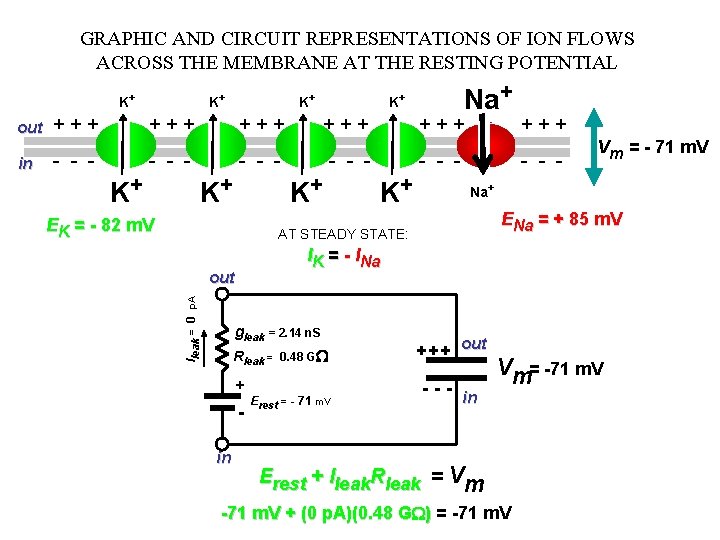
GRAPHIC AND CIRCUIT REPRESENTATIONS OF ION FLOWS ACROSS THE MEMBRANE AT THE RESTING POTENTIAL K+ K+ K+ Na+ K+ out +++ +++ +++ in - - - - - K+ K+ K+ EK = - 82 m. V K+ Na+ ENa = + 85 m. V AT STEADY STATE: IK = - INa Ileak = 0 p. A out gleak = 2. 14 n. S Rleak = 0. 48 GW + in Vm = - 71 m. V Erest = - 71 m. V +++ out --- in Vm= -71 m. V Erest + Ileak. Rleak = Vm -71 m. V + (0 p. A)(0. 48 GW) = -71 m. V

VOLTAGE STEP, TOTAL CHANNEL CONDUCTANCE, AND LEAK CURRENT OBEY OHM’S LAW Ileak For simplicity, we can combine all of the channels and gradients contributing to resting potential into one circuit containing: a resting potential battery slope = gleak Erest and the total conductance of all channels Vcommand gtotal Erest Vcommand out Ileak + - gleak + - Cmem Erest in (Vcommand - Erest ) x gleak = Ileak

A VOLTAGE CHANGE ACROSS THE MEMBRANE ACTS INDEPENDENTLY ON EACH COMPONENT OF THE MEMBRANE CIRCUIT - 61 m. V out g. K = 2 n. S RK = + - out 0. 5 GW +++ V --EK = - 82 m. V in m= -71 m. V INa = - 22 p. A IK = 22 p. A out g. Na = 0. 14 n. S RNa = 7. 1 GW + in in 10 m. V out IK = 42 p. A ABOVE RESTING POTENTIAL - 61 m. V g. K = 2 n. S RK = 0. 5 GW + - + in + + out. V - EK = - 82 m. V in m= -61 m. V INa = -20. 6 p. A IMPOSE COMMAND VOLTAGE ENa = + 85 m. V g. Na = 0. 14 n. S RNa = 7. 1 GW + in ENa = + 85 m. V
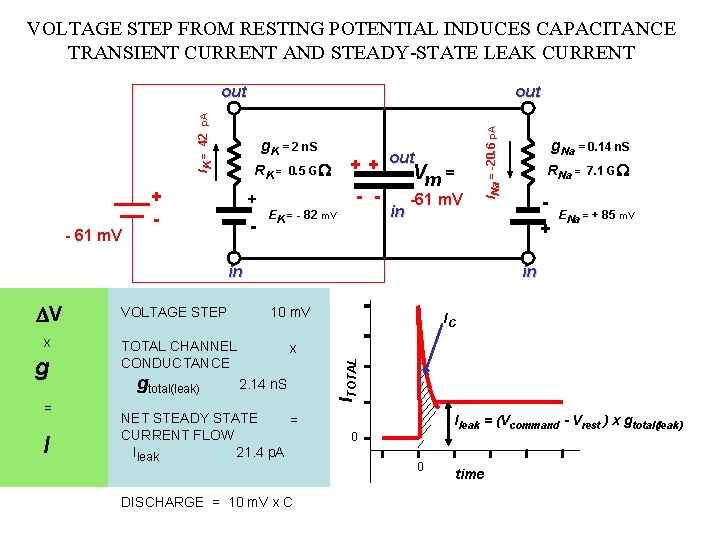
VOLTAGE STEP FROM RESTING POTENTIAL INDUCES CAPACITANCE TRANSIENT CURRENT AND STEADY-STATE LEAK CURRENT - 61 m. V out g. K = 2 n. S + + out. V RK = 0. 5 GW + - - EK = - 82 m. V in m= -61 m. V INa = -20. 6 p. A IK = 42 p. A out g = I ENa = + 85 m. V in 10 m. V TOTAL CHANNEL CONDUCTANCE gtotal(leak) - IC x 2. 14 n. S NET STEADY STATE = CURRENT FLOW Ileak 21. 4 p. A DISCHARGE = 10 m. V x C ITOTAL x VOLTAGE STEP RNa = 7. 1 GW + in DV g. Na = 0. 14 n. S Ileak = (Vcommand - Vrest ) x gtotal(leak) 0 0 time

EFFECT OF VOLTAGE STEP ON CURRENTS AND VOLTAGE AT A DIFFERENT SITE WITHIN NEURON Vcom - Erest SITE OF COMMAND DIFFERENT SITE out + Rmem - Cmem in Rmem Cmem Raxial IC ITOTAL IC Ileak = (Vcommand - Erest ) / Rmem 0 0 time / Ileak = (Vcommand - Erest ) (R mem + Raxial ) 0 0 time If Raxial is significant, Ileak and voltage divergence from Erest at different site is less and voltage divergence is delayed by Raxial x C time constant
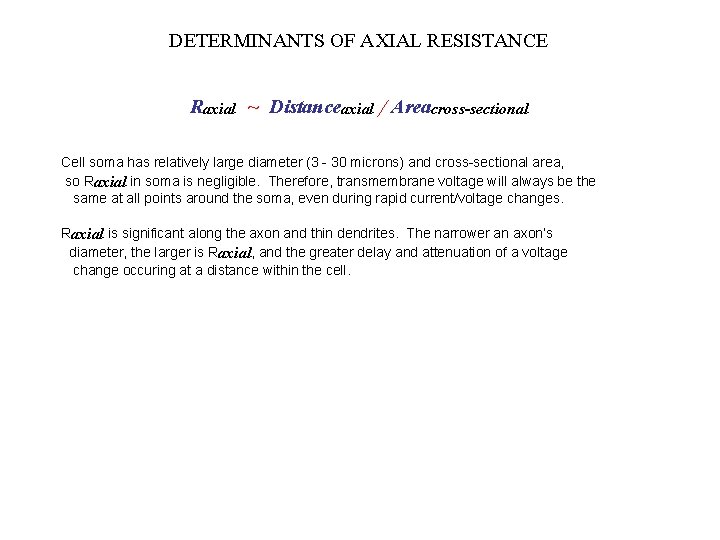
DETERMINANTS OF AXIAL RESISTANCE Raxial ~ Distanceaxial / Areacross-sectional Cell soma has relatively large diameter (3 - 30 microns) and cross-sectional area, so Raxial in soma is negligible. Therefore, transmembrane voltage will always be the same at all points around the soma, even during rapid current/voltage changes. Raxial is significant along the axon and thin dendrites. The narrower an axon’s diameter, the larger is Raxial, and the greater delay and attenuation of a voltage change occuring at a distance within the cell.
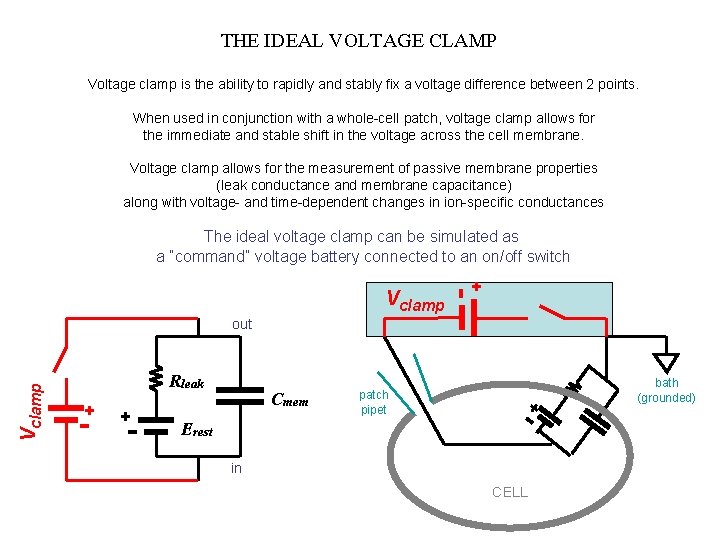
THE IDEAL VOLTAGE CLAMP Voltage clamp is the ability to rapidly and stably fix a voltage difference between 2 points. When used in conjunction with a whole-cell patch, voltage clamp allows for the immediate and stable shift in the voltage across the cell membrane. Voltage clamp allows for the measurement of passive membrane properties (leak conductance and membrane capacitance) along with voltage- and time-dependent changes in ion-specific conductances The ideal voltage clamp can be simulated as a “command” voltage battery connected to an on/off switch + - Vclamp out Rleak + - Cmem Erest patch pipet -+ in CELL bath (grounded)
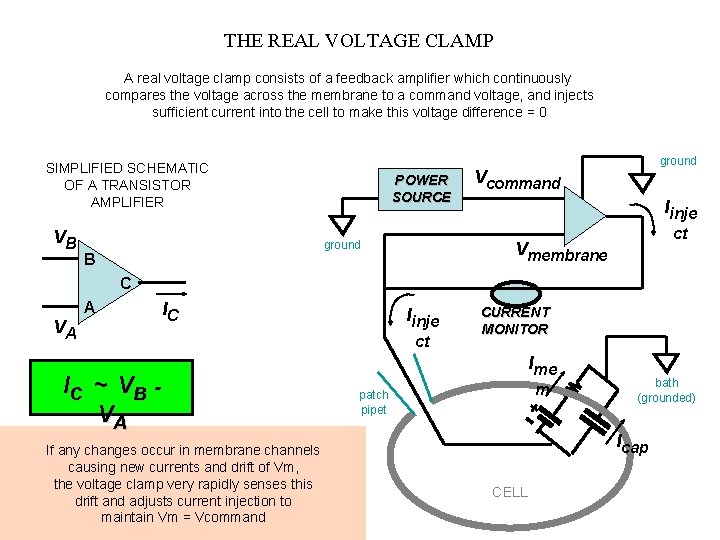
THE REAL VOLTAGE CLAMP A real voltage clamp consists of a feedback amplifier which continuously compares the voltage across the membrane to a command voltage, and injects sufficient current into the cell to make this voltage difference = 0 SIMPLIFIED SCHEMATIC OF A TRANSISTOR AMPLIFIER VB POWER SOURCE ground B ground Vcommand Iinje ct Vmembrane C A IC VA IC ~ VB VA Iinje ct - If any changes occur in membrane channels causing new currents and drift of Vm, the voltage clamp very rapidly senses this drift and adjusts current injection to maintain Vm = Vcommand CURRENT MONITOR Ime patch pipet -+ m bath (grounded) Icap CELL
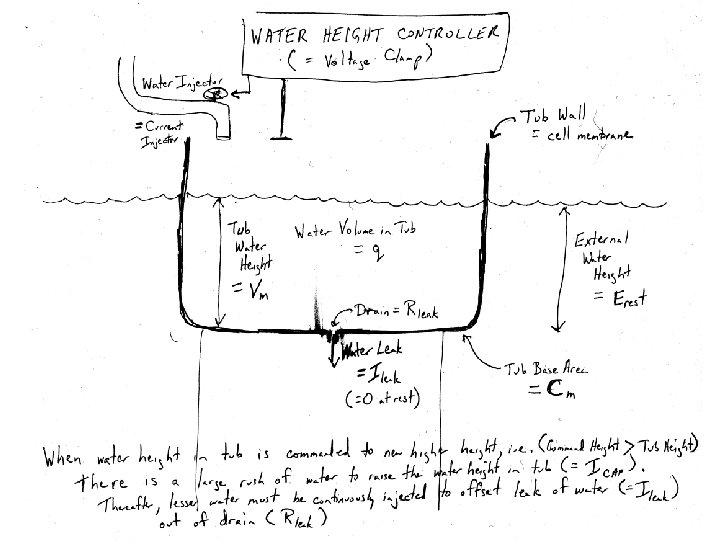
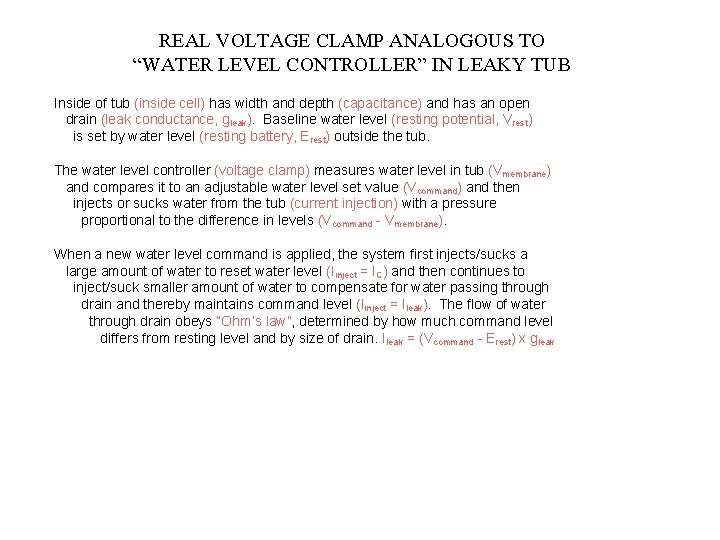
REAL VOLTAGE CLAMP ANALOGOUS TO “WATER LEVEL CONTROLLER” IN LEAKY TUB Inside of tub (inside cell) has width and depth (capacitance) and has an open drain (leak conductance, gleak). Baseline water level (resting potential, Vrest) is set by water level (resting battery, Erest) outside the tub. The water level controller (voltage clamp) measures water level in tub (Vmembrane) and compares it to an adjustable water level set value (Vcommand) and then injects or sucks water from the tub (current injection) with a pressure proportional to the difference in levels (Vcommand - Vmembrane). When a new water level command is applied, the system first injects/sucks a large amount of water to reset water level (Iinject = IC) and then continues to inject/suck smaller amount of water to compensate for water passing through drain and thereby maintains command level (Iinject = Ileak). The flow of water through drain obeys “Ohm’s law”, determined by how much command level differs from resting level and by size of drain. Ileak = (Vcommand - Erest) x gleak
Next Lecture: ION CHANNELS: STRUCTURES AND FUNCTIONS REQUIRED READING: Kandel text, Chapters 6, 9
- Slides: 14