
Lecture 4 Levitical Priesthood Dr Ann T Orlando
- Slides: 17
Lecture 4: Levitical Priesthood Dr. Ann T. Orlando 15 February 2019
Outline � Biblical � Origen Background: Exodus and Leviticus ◦ Homilies on Leviticus � Augustine � Apostolic on Exodus and Leviticus Constitutions
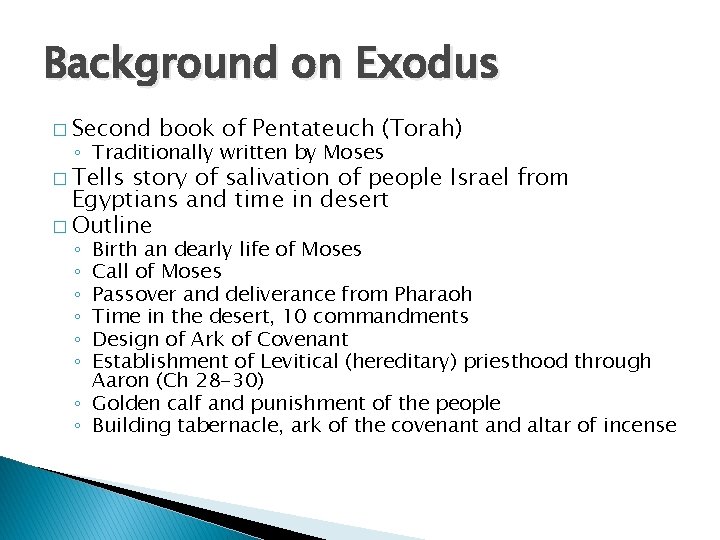
Background on Exodus � Second book of Pentateuch (Torah) ◦ Traditionally written by Moses � Tells story of salivation of people Israel from Egyptians and time in desert � Outline Birth an dearly life of Moses Call of Moses Passover and deliverance from Pharaoh Time in the desert, 10 commandments Design of Ark of Covenant Establishment of Levitical (hereditary) priesthood through Aaron (Ch 28 -30) ◦ Golden calf and punishment of the people ◦ Building tabernacle, ark of the covenant and altar of incense ◦ ◦ ◦
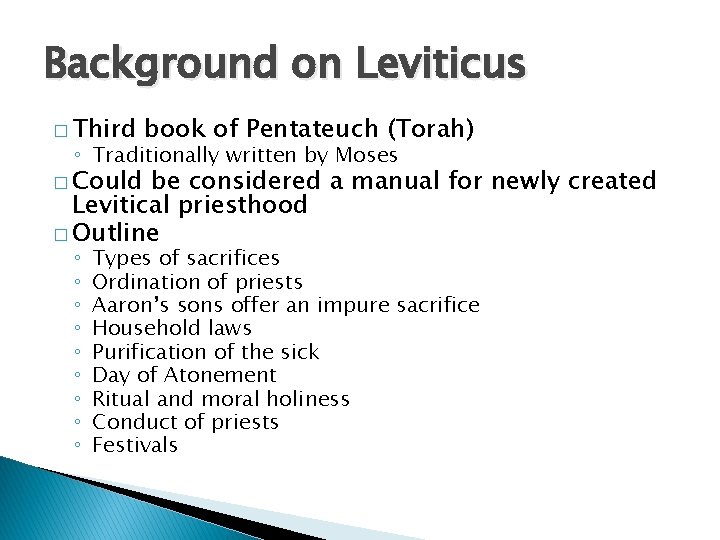
Background on Leviticus � Third book of Pentateuch (Torah) ◦ Traditionally written by Moses � Could be considered a manual for newly created Levitical priesthood � Outline ◦ ◦ ◦ ◦ ◦ Types of sacrifices Ordination of priests Aaron’s sons offer an impure sacrifice Household laws Purification of the sick Day of Atonement Ritual and moral holiness Conduct of priests Festivals
Scriptural Exegesis Reminder � Since Scripture is fundamentally ‘one book’, various disparate sections can be used to explain other sections � Use NT to fully understand the OT � Use OT figures as a model for Church
Collection of OT Books as Referenced by Fathers � Pentateuch: Genesis, Exodus, Leviticus, Numbers, Deuteronomy ◦ Origen � Heptateuch: Judges ◦ Augustine � Octateuch: ◦ Theodoret Pentateuch plus Joshua and Heptateuch plus Ruth
Origen � Born in Alexandria in 185, died (a martyr) in 254 ◦ Born into a Christian family ◦ His father, Leonides, martyred when Origen was a teenager ◦ Influenced by Philo of Alexandria � Prominent Alexandria in the catechetical school in ◦ Wrote an important apology opposing philosophical arguments against Christianity, Contra Celsum � Although he suffered heroically for the faith, later controversies led to his condemnation ◦ For political/theological reasons Origen was condemned by Justinian in the 6 th C and at the Second Council of Constantinople
Origen and Scripture � ‘Systematic’ approach to Scripture described in On First Principles ◦ Literal ◦ Moral ◦ Spiritual � Hexapla � Wrote many complete commentaries and homilies on almost all books of Scripture ◦ Majority of books lost as a result of 6 th C condemnations ◦ Most surviving works reconstructed from Latin or other translations
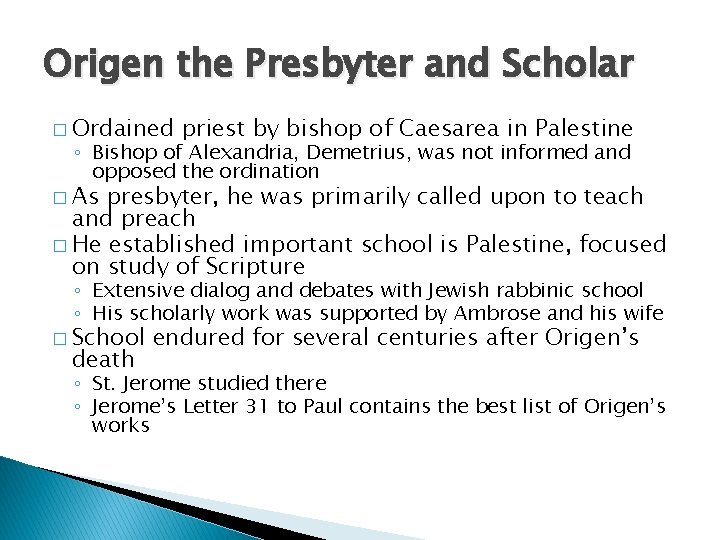
Origen the Presbyter and Scholar � Ordained priest by bishop of Caesarea in Palestine ◦ Bishop of Alexandria, Demetrius, was not informed and opposed the ordination � As presbyter, he was primarily called upon to teach and preach � He established important school is Palestine, focused on study of Scripture ◦ Extensive dialog and debates with Jewish rabbinic school ◦ His scholarly work was supported by Ambrose and his wife � School death endured for several centuries after Origen’s ◦ St. Jerome studied there ◦ Jerome’s Letter 31 to Paul contains the best list of Origen’s works
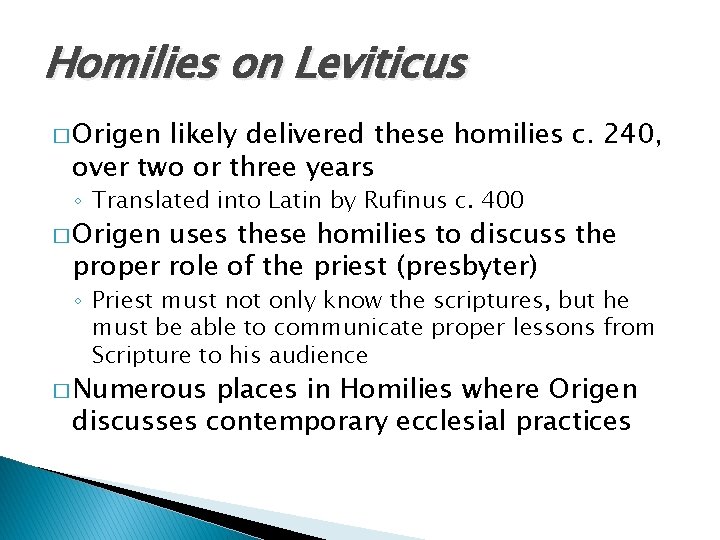
Homilies on Leviticus � Origen likely delivered these homilies c. 240, over two or three years ◦ Translated into Latin by Rufinus c. 400 � Origen uses these homilies to discuss the proper role of the priest (presbyter) ◦ Priest must not only know the scriptures, but he must be able to communicate proper lessons from Scripture to his audience � Numerous places in Homilies where Origen discusses contemporary ecclesial practices
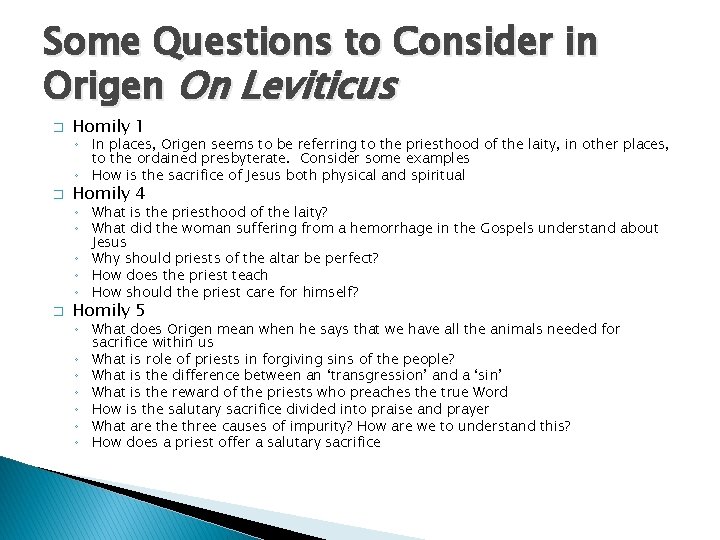
Some Questions to Consider in Origen On Leviticus � Homily 1 ◦ In places, Origen seems to be referring to the priesthood of the laity, in other places, to the ordained presbyterate. Consider some examples ◦ How is the sacrifice of Jesus both physical and spiritual � Homily 4 ◦ What is the priesthood of the laity? ◦ What did the woman suffering from a hemorrhage in the Gospels understand about Jesus ◦ Why should priests of the altar be perfect? ◦ How does the priest teach ◦ How should the priest care for himself? � Homily 5 ◦ What does Origen mean when he says that we have all the animals needed for sacrifice within us ◦ What is role of priests in forgiving sins of the people? ◦ What is the difference between an ‘transgression’ and a ‘sin’ ◦ What is the reward of the priests who preaches the true Word ◦ How is the salutary sacrifice divided into praise and prayer ◦ What are three causes of impurity? How are we to understand this? ◦ How does a priest offer a salutary sacrifice
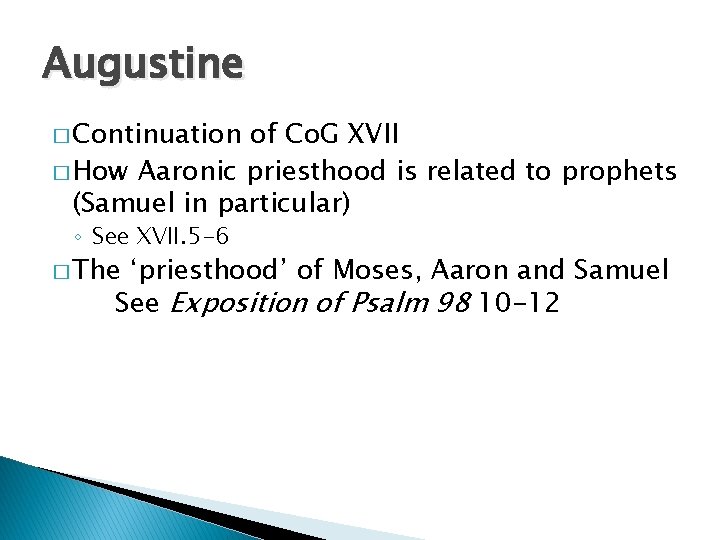
Augustine � Continuation of Co. G XVII � How Aaronic priesthood is related to prophets (Samuel in particular) ◦ See XVII. 5 -6 � The ‘priesthood’ of Moses, Aaron and Samuel See Exposition of Psalm 98 10 -12
Questions to Consider for Augustinian Readings � Augustine, Co. G XVII � Augustine, Explosions of the Psalms, Ps 98 ◦ Why does Augustine place such importance on Samuel’s priesthood? ◦ What does Augustine say about the priesthood of the laity and the priesthood of Aaron ◦ How do Moses, Aaron and Samuel represent all Christian faithful? ◦ Is anyone sinless? Are all liable to punishment? What about Samuel? ◦ What is the punishment of servants (ministers) of the Church?
Apostolic Constitutions � (Early? ) Fourth Century collection of sayings, decrees, liturgies which purport to be from the Apostles ◦ Organized in 8 (unrelated) books ◦ Contains elements of other works such as Didache and Liturgy recorded by Hippolytus � Unknown in Latin, West, until Renaissance � Explores another line of thought on deacons (and deaconesses) as Levites
Book II: Church Hierarchy and Organization � On role of bishops and deacons see Book II. xxv-xxxv � Describes deacons as ‘levites’ � Attempts to establish a metaphor of bishops (and priests) related to Moses while deacons are associated with Aaron and Levites � Seems to be an attempt to reconcile Order of Melchizedek with Order of Levites
Questions to Consider in the Apostolic Constitutions � How does AC describe the relationship between bishops and the people of the Church? How does it use the Old Testament to do this? � Who selects priests? � What are some of the Church ‘offices’ mentioned here?
Assignments Origen, Homilies on Leviticus Homilies 1, 4, 5 Augustine, Co. G, XVII. 5 -6 _____Exposition of Psalm 98. 10 -12 Apostolic Constitutions II. xxv-xxxv Prepare Paper #4