
Lecture 4 Introducing Recursive Definitions CS 200 Computer
![The Patented RGB RMS Method rt = rmas[i] - image->r[i]; gt = gmas[i] -](https://slidetodoc.com/presentation_image_h2/6664a7a84bf5c45c6198ff11506b2557/image-22.jpg "The Patented RGB RMS Method rt = rmas[i] - image->r[i]; gt = gmas[i] -")
- Slides: 26
Lecture 4: Introducing Recursive Definitions CS 200: Computer Science David Evans University of Virginia 23 January 2004 CS 200 Spring 2004 http: //www. cs. virginia. edu/evans Computer Science
Menu • Rules of Evaluation – PS 1 Question 2 • Defining Recursive Procedures 23 January 2004 CS 200 Spring 2004 2
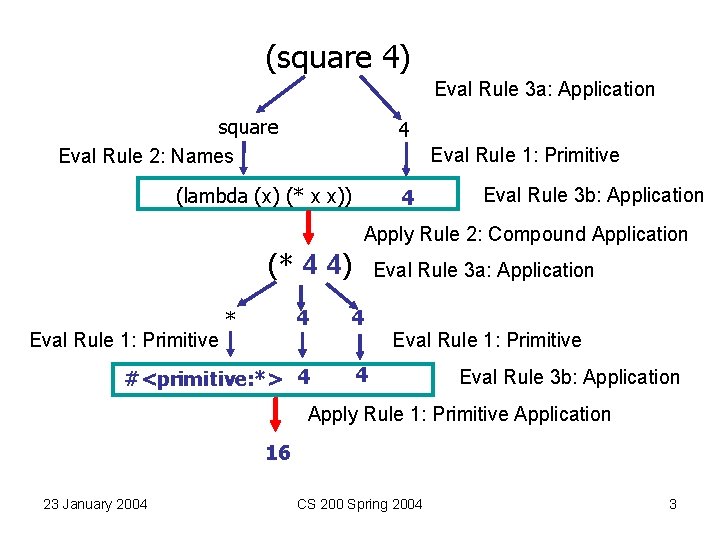
(square 4) Eval Rule 3 a: Application square Eval Rule 2: Names 4 Eval Rule 1: Primitive (lambda (x) (* x x)) 4 Eval Rule 3 b: Application Apply Rule 2: Compound Application (* 4 4) Eval Rule 3 a: Application 4 4 #<primitive: *> 4 4 Eval Rule 1: Primitive * Eval Rule 1: Primitive Eval Rule 3 b: Application Apply Rule 1: Primitive Application 16 23 January 2004 CS 200 Spring 2004 3
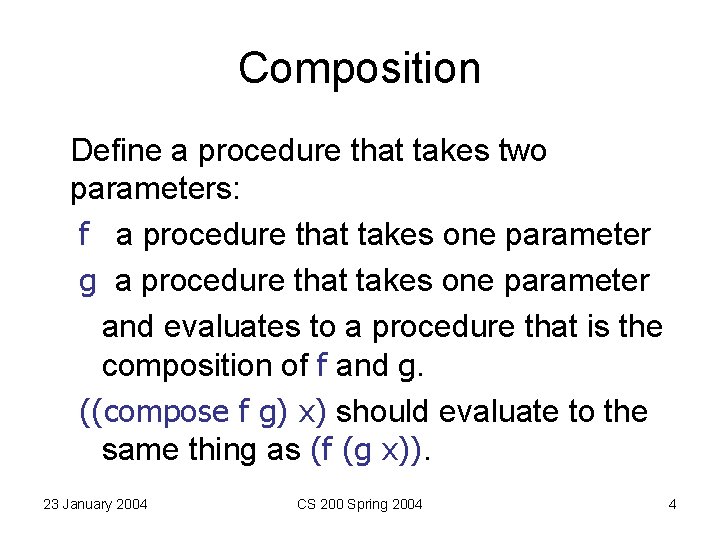
Composition Define a procedure that takes two parameters: f a procedure that takes one parameter g a procedure that takes one parameter and evaluates to a procedure that is the composition of f and g. ((compose f g) x) should evaluate to the same thing as (f (g x)). 23 January 2004 CS 200 Spring 2004 4
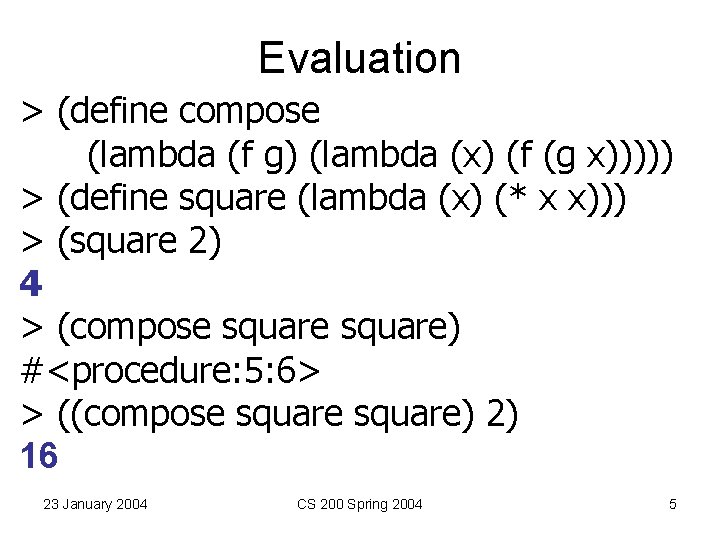
Evaluation > (define compose (lambda (f g) (lambda (x) (f (g x))))) > (define square (lambda (x) (* x x))) > (square 2) 4 > (compose square) #<procedure: 5: 6> > ((compose square) 2) 16 23 January 2004 CS 200 Spring 2004 5
Question 2 • Without Evaluation Rules, Question 2 was “guesswork” • Now you know the Evaluation Rules, you can answer Question 2 without any guessing! 23 January 2004 CS 200 Spring 2004 6
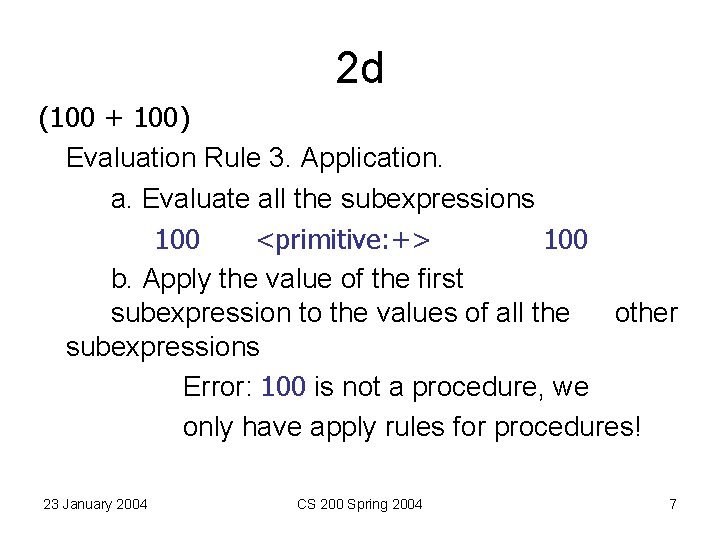
2 d (100 + 100) Evaluation Rule 3. Application. a. Evaluate all the subexpressions 100 <primitive: +> 100 b. Apply the value of the first subexpression to the values of all the other subexpressions Error: 100 is not a procedure, we only have apply rules for procedures! 23 January 2004 CS 200 Spring 2004 7
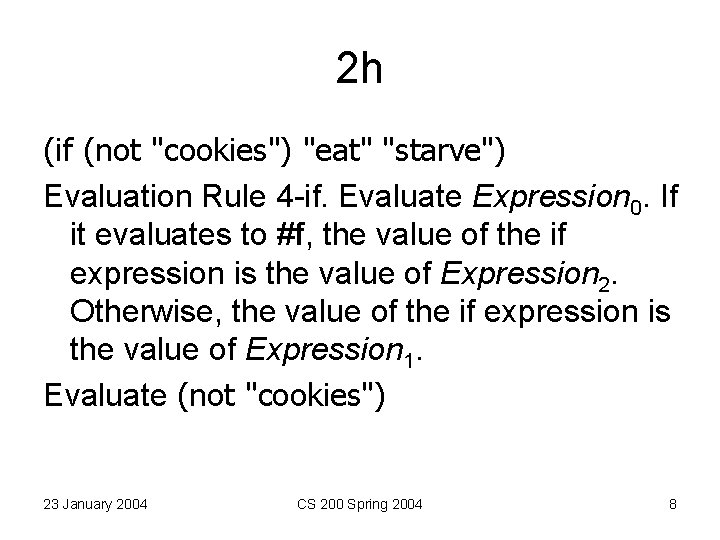
2 h (if (not "cookies") "eat" "starve") Evaluation Rule 4 -if. Evaluate Expression 0. If it evaluates to #f, the value of the if expression is the value of Expression 2. Otherwise, the value of the if expression is the value of Expression 1. Evaluate (not "cookies") 23 January 2004 CS 200 Spring 2004 8
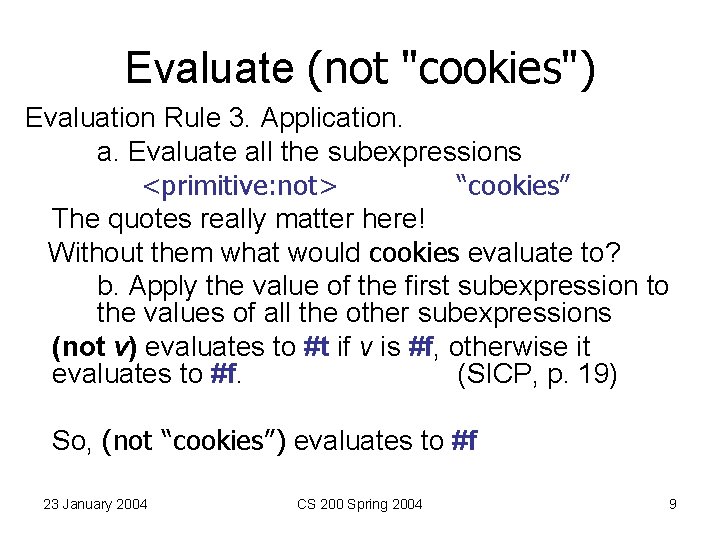
Evaluate (not "cookies") Evaluation Rule 3. Application. a. Evaluate all the subexpressions <primitive: not> “cookies” The quotes really matter here! Without them what would cookies evaluate to? b. Apply the value of the first subexpression to the values of all the other subexpressions (not v) evaluates to #t if v is #f, otherwise it evaluates to #f. (SICP, p. 19) So, (not “cookies”) evaluates to #f 23 January 2004 CS 200 Spring 2004 9
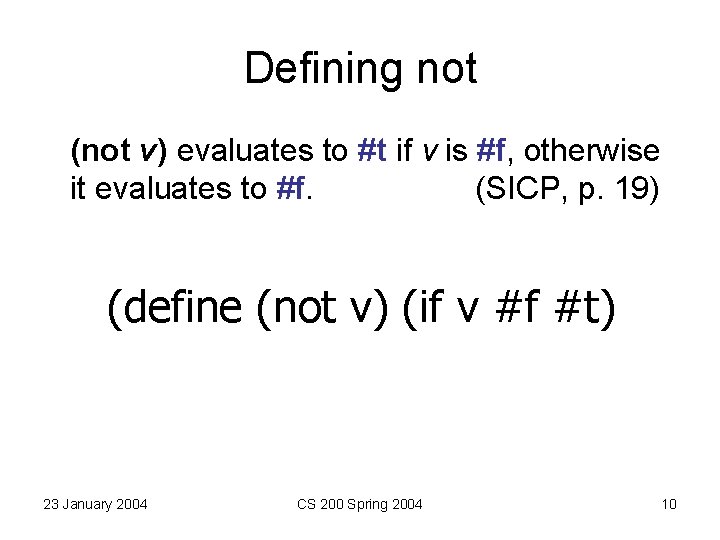
Defining not (not v) evaluates to #t if v is #f, otherwise it evaluates to #f. (SICP, p. 19) (define (not v) (if v #f #t) 23 January 2004 CS 200 Spring 2004 10
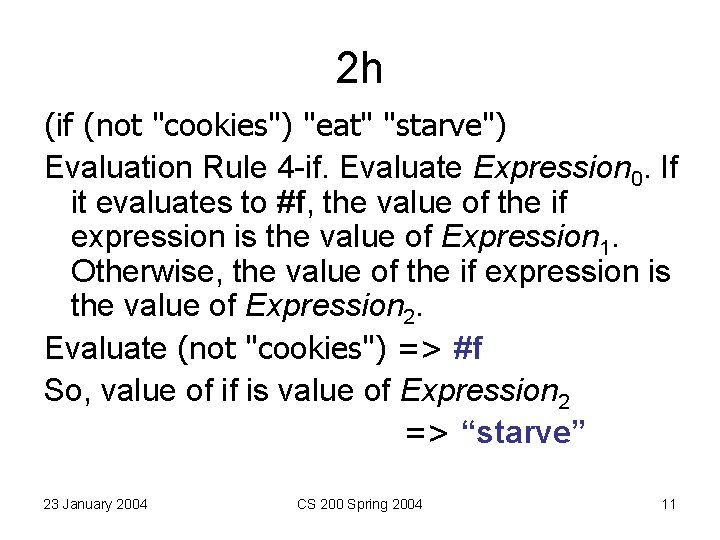
2 h (if (not "cookies") "eat" "starve") Evaluation Rule 4 -if. Evaluate Expression 0. If it evaluates to #f, the value of the if expression is the value of Expression 1. Otherwise, the value of the if expression is the value of Expression 2. Evaluate (not "cookies") => #f So, value of if is value of Expression 2 => “starve” 23 January 2004 CS 200 Spring 2004 11
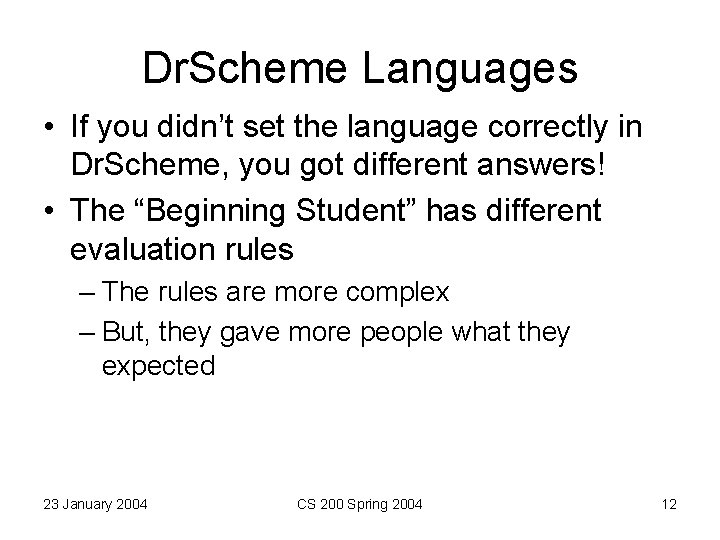
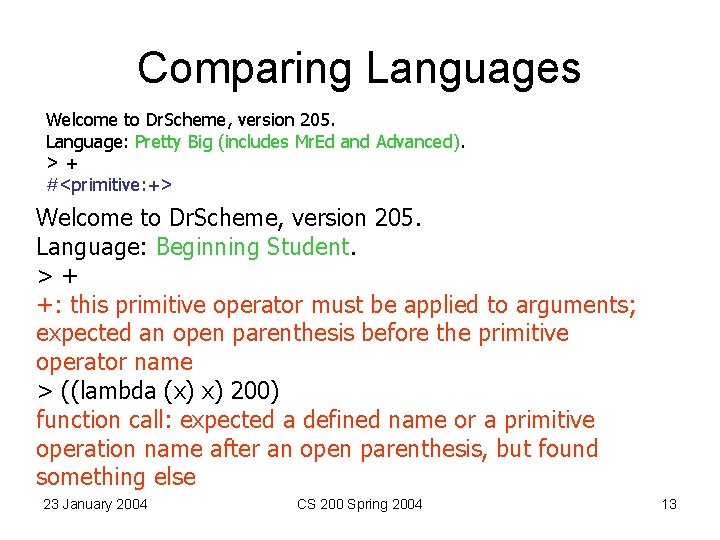
Dr. Scheme Languages • If you didn’t set the language correctly in Dr. Scheme, you got different answers! • The “Beginning Student” has different evaluation rules – The rules are more complex – But, they gave more people what they expected 23 January 2004 CS 200 Spring 2004 12
Comparing Languages Welcome to Dr. Scheme, version 205. Language: Pretty Big (includes Mr. Ed and Advanced). >+ #<primitive: +> Welcome to Dr. Scheme, version 205. Language: Beginning Student. >+ +: this primitive operator must be applied to arguments; expected an open parenthesis before the primitive operator name > ((lambda (x) x) 200) function call: expected a defined name or a primitive operation name after an open parenthesis, but found something else 23 January 2004 CS 200 Spring 2004 13
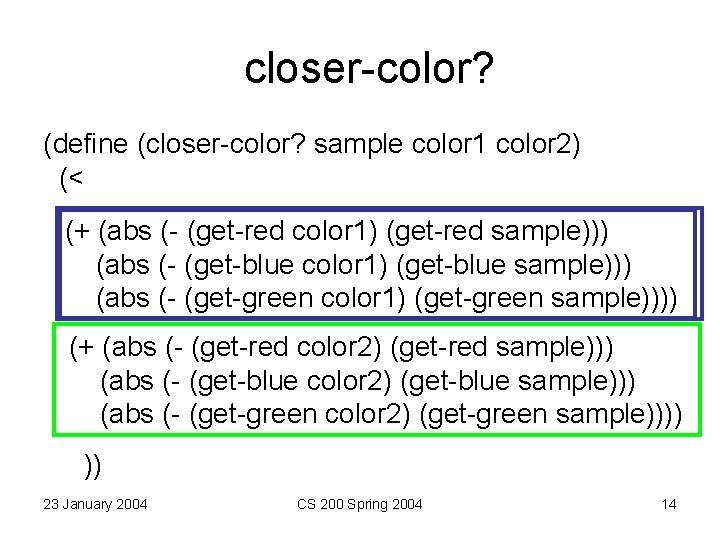
closer-color? (define (closer-color? sample color 1 color 2) (< (+ (abs (- (get-red color 1) (get-red sample))) (abs (- (get-blue color 1) (get-blue sample))) (abs (- (get-green color 1) (get-green sample)))) (+ (abs (- (get-red color 2) (get-red sample))) (abs (- (get-blue color 2) (get-blue sample))) (abs (- (get-green color 2) (get-green sample)))) )) 23 January 2004 CS 200 Spring 2004 14
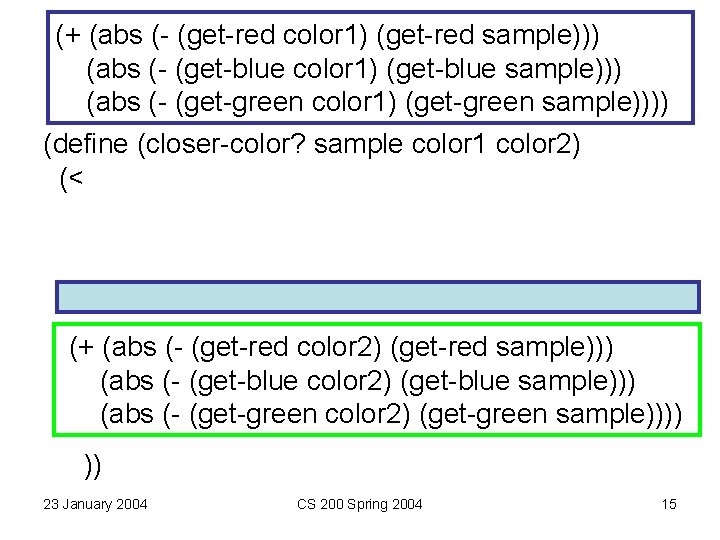
(+ (abs (- (get-red color 1) (get-red sample))) (abs (- (get-blue color 1) (get-blue sample))) (abs (- (get-green color 1) (get-green sample)))) (define (closer-color? sample color 1 color 2) (< (+ (abs (- (get-red color 2) (get-red sample))) (abs (- (get-blue color 2) (get-blue sample))) (abs (- (get-green color 2) (get-green sample)))) )) 23 January 2004 CS 200 Spring 2004 15
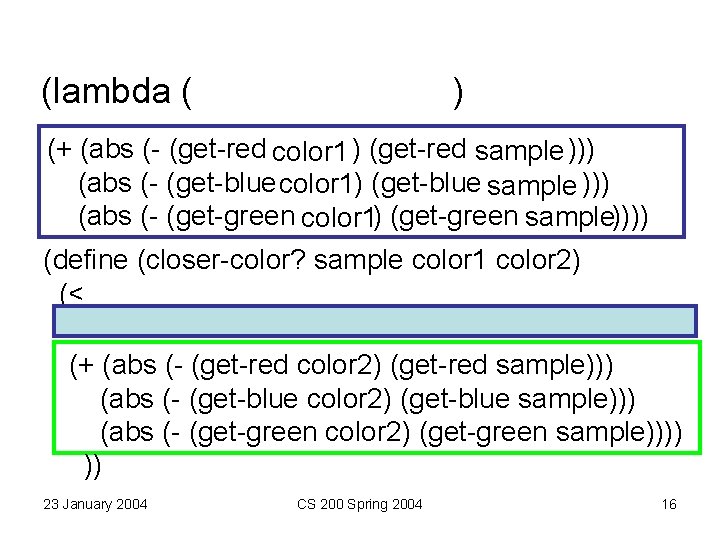
(lambda ( ) (+ (abs (- (get-red color 1 ) (get-red sample ))) (abs (- (get-blue color 1) (get-blue sample ))) (abs (- (get-green color 1) (get-green sample)))) (define (closer-color? sample color 1 color 2) (< (+ (abs (- (get-red color 2) (get-red sample))) (abs (- (get-blue color 2) (get-blue sample))) (abs (- (get-green color 2) (get-green sample)))) )) 23 January 2004 CS 200 Spring 2004 16
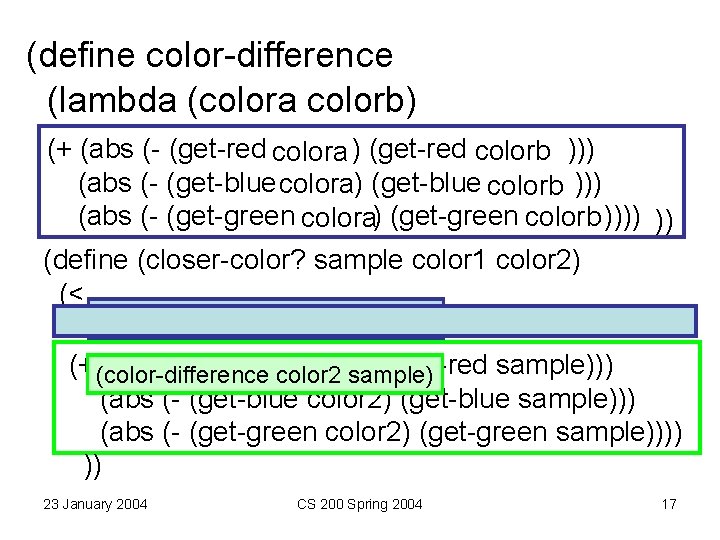
(define color-difference (lambda (colora colorb) (+ (abs (- (get-red colora ) (get-red colorb ))) (abs (- (get-blue colora) (get-blue colorb ))) (abs (- (get-green colora) (get-green colorb )))) )) (define (closer-color? sample color 1 color 2) (< (color-difference color 1 sample) (+ (color-difference (abs (- (get-redcolor 2) (get-red sample))) sample) (abs (- (get-blue color 2) (get-blue sample))) (abs (- (get-green color 2) (get-green sample)))) )) 23 January 2004 CS 200 Spring 2004 17
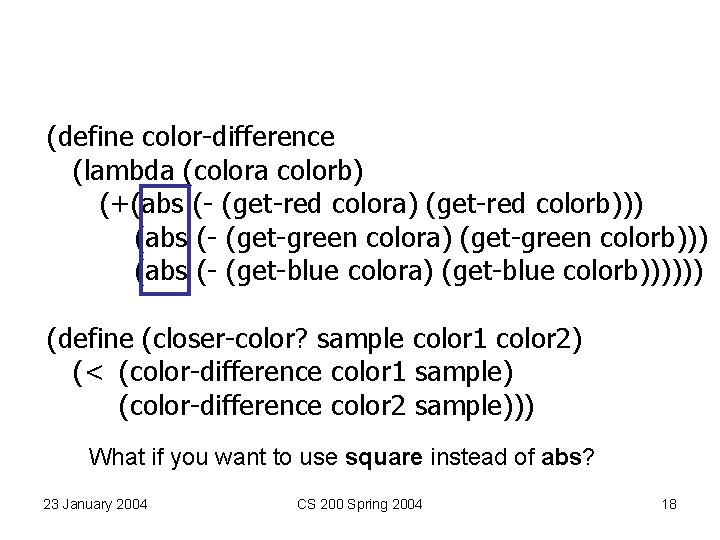
(define color-difference (lambda (colora colorb) (+(abs (- (get-red colora) (get-red colorb))) (abs (- (get-green colora) (get-green colorb))) (abs (- (get-blue colora) (get-blue colorb)))))) (define (closer-color? sample color 1 color 2) (< (color-difference color 1 sample) (color-difference color 2 sample))) What if you want to use square instead of abs? 23 January 2004 CS 200 Spring 2004 18
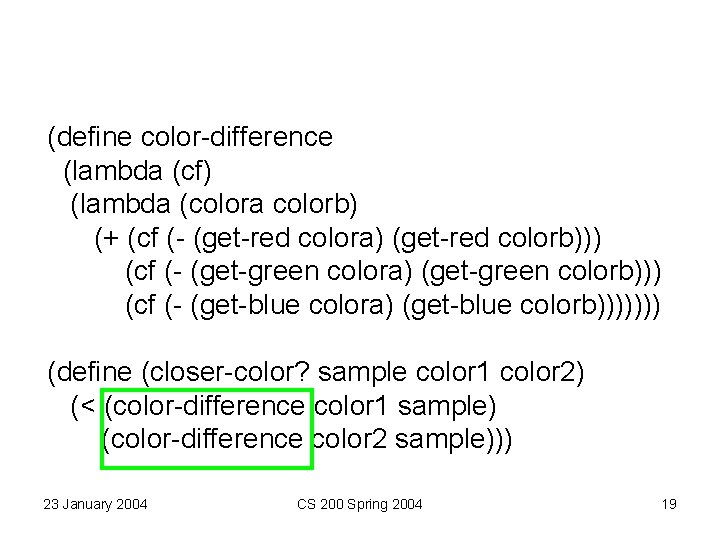
(define color-difference (lambda (cf) (lambda (colora colorb) (+ (cf (- (get-red colora) (get-red colorb))) (cf (- (get-green colora) (get-green colorb))) (cf (- (get-blue colora) (get-blue colorb))))))) (define (closer-color? sample color 1 color 2) (< (color-difference color 1 sample) (color-difference color 2 sample))) 23 January 2004 CS 200 Spring 2004 19
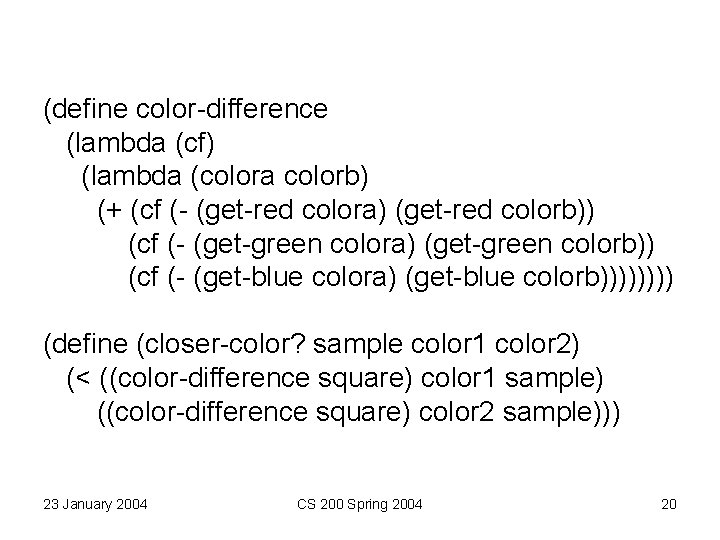
(define color-difference (lambda (cf) (lambda (colora colorb) (+ (cf (- (get-red colora) (get-red colorb)) (cf (- (get-green colora) (get-green colorb)) (cf (- (get-blue colora) (get-blue colorb)))) (define (closer-color? sample color 1 color 2) (< ((color-difference square) color 1 sample) ((color-difference square) color 2 sample))) 23 January 2004 CS 200 Spring 2004 20
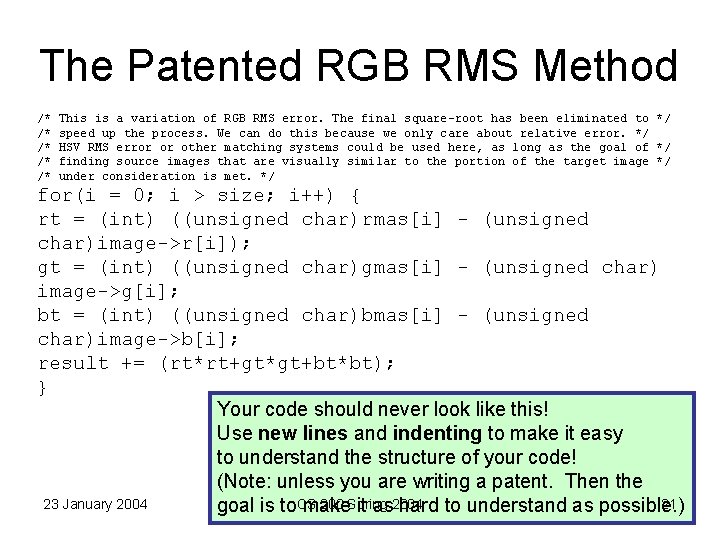
The Patented RGB RMS Method /* /* /* This is a variation of RGB RMS error. The final square-root has been eliminated to */ speed up the process. We can do this because we only care about relative error. */ HSV RMS error or other matching systems could be used here, as long as the goal of */ finding source images that are visually similar to the portion of the target image */ under consideration is met. */ for(i = 0; i > size; i++) { rt = (int) ((unsigned char)rmas[i] - (unsigned char)image->r[i]); gt = (int) ((unsigned char)gmas[i] - (unsigned char) image->g[i]; bt = (int) ((unsigned char)bmas[i] - (unsigned char)image->b[i]; result += (rt*rt+gt*gt+bt*bt); } Your code should never look like this! Use new lines and indenting to make it easy to understand the structure of your code! (Note: unless you are writing a patent. Then the 23 January 2004 200 Spring 21 goal is to. CS make it as 2004 hard to understand as possible. )
The Patented RGB RMS Method rt = rmas[i] - image->r[i]; gt = gmas[i] - image->g[i]; bt = bmas[i] - image->b[i]; result += (rt*rt + gt*gt + bt*bt); Patent requirements: 1. new – must not be previously available (ancient Babylonians made mosaics) 2. useful 3. nonobvious about ¼ of the class came up with this method! (most of rest used abs instead, which works as well) 23 January 2004 CS 200 Spring 2004 22
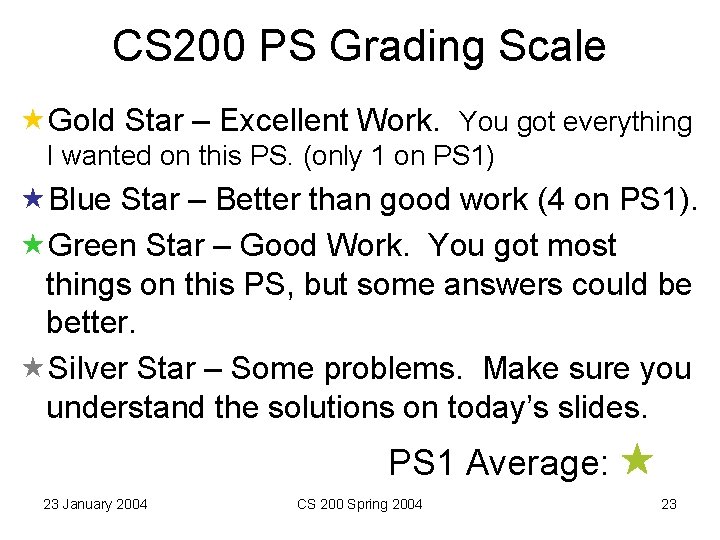
CS 200 PS Grading Scale Gold Star – Excellent Work. You got everything I wanted on this PS. (only 1 on PS 1) Blue Star – Better than good work (4 on PS 1). Green Star – Good Work. You got most things on this PS, but some answers could be better. Silver Star – Some problems. Make sure you understand the solutions on today’s slides. PS 1 Average: 23 January 2004 CS 200 Spring 2004 23
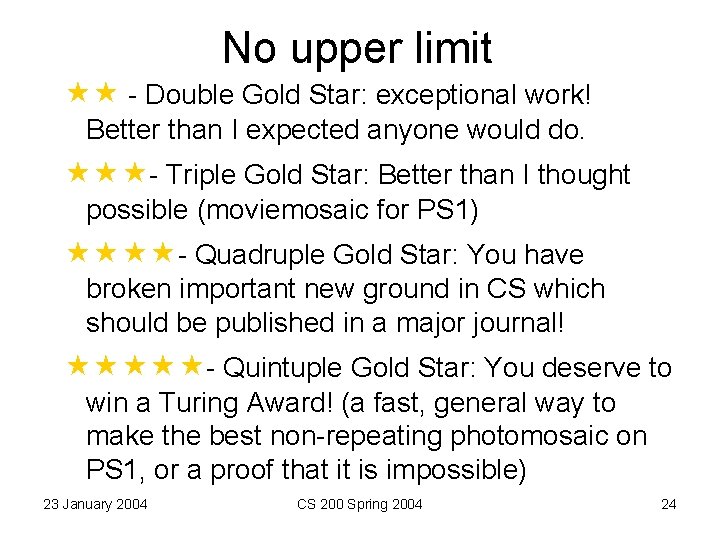
No upper limit - Double Gold Star: exceptional work! Better than I expected anyone would do. - Triple Gold Star: Better than I thought possible (moviemosaic for PS 1) - Quadruple Gold Star: You have broken important new ground in CS which should be published in a major journal! - Quintuple Gold Star: You deserve to win a Turing Award! (a fast, general way to make the best non-repeating photomosaic on PS 1, or a proof that it is impossible) 23 January 2004 CS 200 Spring 2004 24
Problem Set 2 • Main ideas: recursion, procedures – We have covered everything you need after today • Lots more code for you to write • As we progress, problem sets will expect you to write more code on your own • PS 8 is “Do something worthwhile using things you have learned from this class. ” (But will be a little bit more specific about what is expected. ) 23 January 2004 CS 200 Spring 2004 25
Charge • Many, many important problems can be solved by recursive definitions • Read GEB Chapter 5 before Monday’s class: lots of great stuff in there! 23 January 2004 CS 200 Spring 2004 26