
Lecture 4 Functional properties of proteins The properties



- Slides: 41
Lecture 4 Functional properties of proteins.
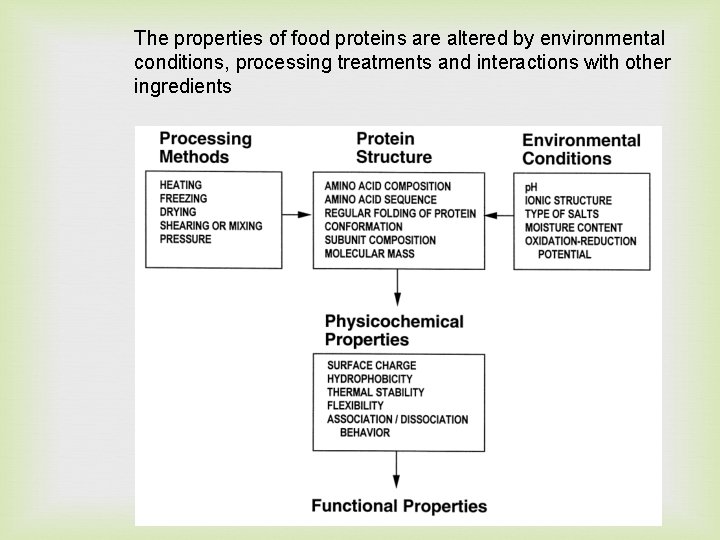
The properties of food proteins are altered by environmental conditions, processing treatments and interactions with other ingredients
Proteins – functional properties Functional properties defined as: “those physical and chemical properties of proteins that influence their behavior in food systems during preparation, processing, storage and consumption, and contribute to the quality and organoleptic attributes of food systems” Many food products owe their function to food proteins. It is important to understand protein functionality to develop and improve existing products and to find new protein ingredients. http: //cdn. intechopen. com/pdfs-wm/15717. pdf
Examples of protein functional properties in different food systems Functional Property Food System Solubility Beverages, Protein concentrates/isolates Water-binding and holding ability Muscle foods, cheese, yogurt Gelation Muscle foods, eggs, yogurt, gelatin, tofu, baked goods Emulsification Salad dressing, mayonnaise, ice cream, gravy Foaming Meringues, whipped toppings, angel cake, marshmallows
Functional properties: Water binding- and holding ability Water binding The ability of foods to take up and/or hold water is of paramount importance to the food industry. More H 2 O = Higher product yield = Higher financial benefit. Product quality may also be better, more juiciness.
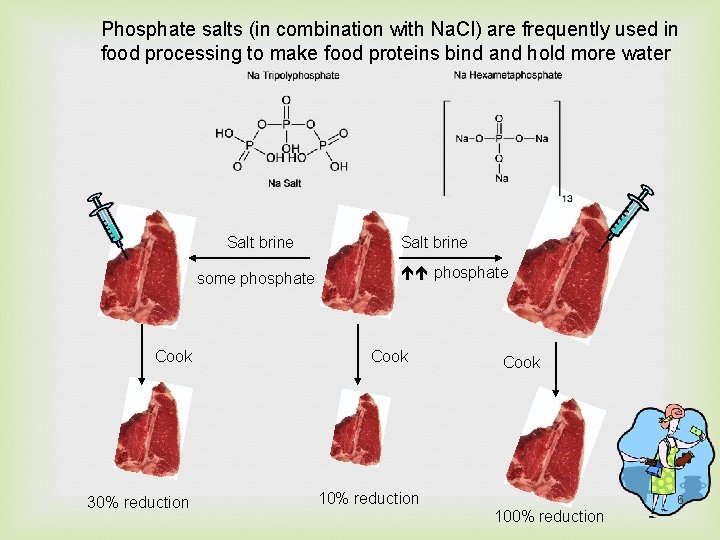
Phosphate salts (in combination with Na. Cl) are frequently used in food processing to make food proteins bind and hold more water Salt brine some phosphate Cook 30% reduction Salt brine phosphate Cook 10% reduction 6 100% reduction
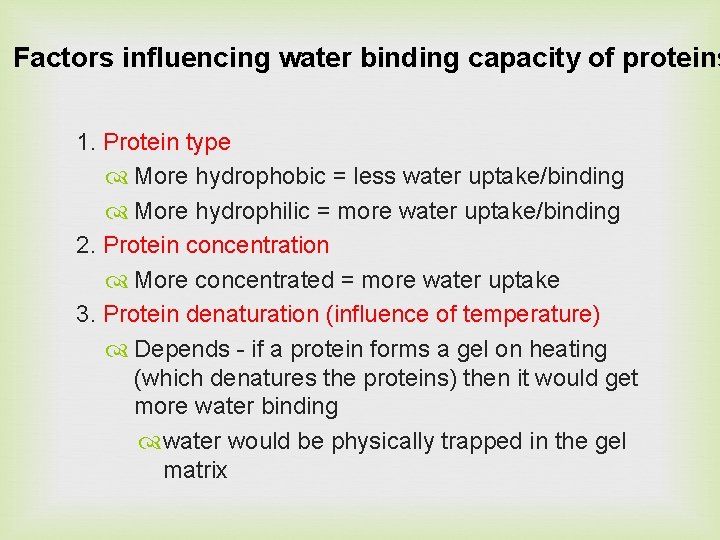
Factors influencing water binding capacity of proteins 1. Protein type More hydrophobic = less water uptake/binding More hydrophilic = more water uptake/binding 2. Protein concentration More concentrated = more water uptake 3. Protein denaturation (influence of temperature) Depends - if a protein forms a gel on heating (which denatures the proteins) then it would get more water binding water would be physically trapped in the gel matrix
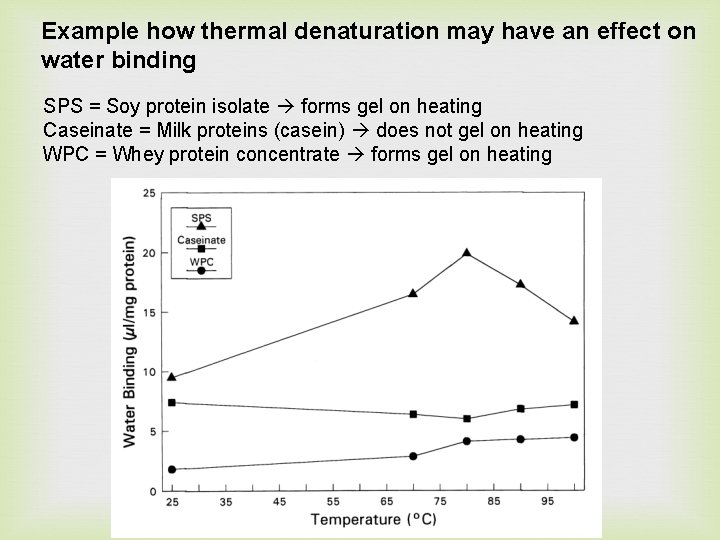
Example how thermal denaturation may have an effect on water binding SPS = Soy protein isolate forms gel on heating Caseinate = Milk proteins (casein) does not gel on heating WPC = Whey protein concentrate forms gel on heating
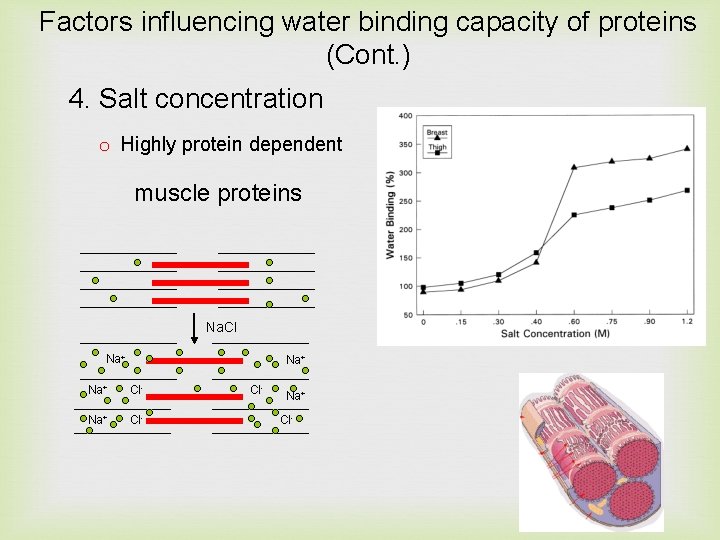
Factors influencing water binding capacity of proteins (Cont. ) 4. Salt concentration o Highly protein dependent muscle proteins Na. Cl Na+ Na+ Cl- Cl- Na+ Cl-
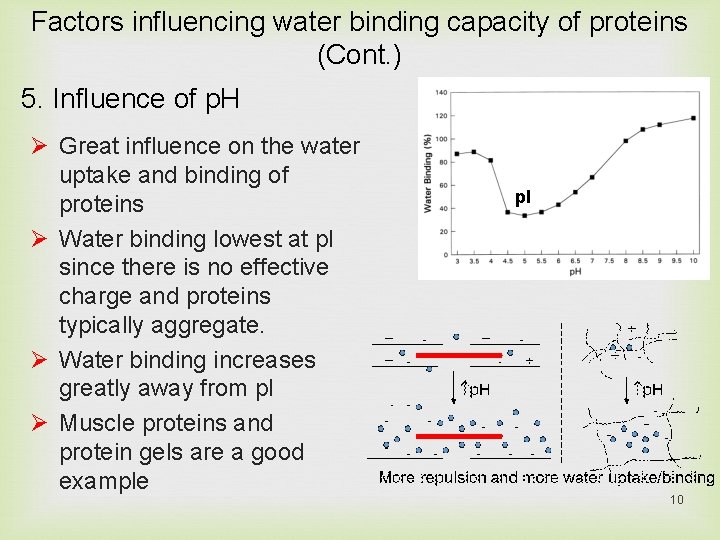
Factors influencing water binding capacity of proteins (Cont. ) 5. Influence of p. H Ø Great influence on the water uptake and binding of proteins Ø Water binding lowest at p. I since there is no effective charge and proteins typically aggregate. Ø Water binding increases greatly away from p. I Ø Muscle proteins and protein gels are a good example p. I 10
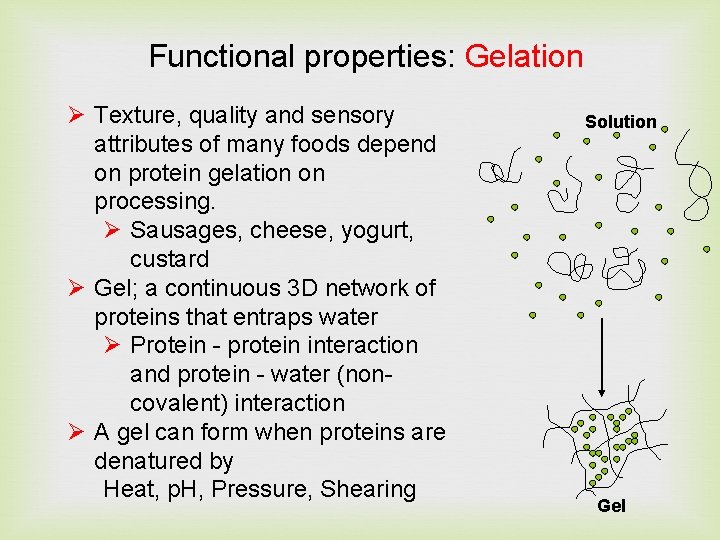
Functional properties: Gelation Ø Texture, quality and sensory attributes of many foods depend on protein gelation on processing. Ø Sausages, cheese, yogurt, custard Ø Gel; a continuous 3 D network of proteins that entraps water Ø Protein - protein interaction and protein - water (noncovalent) interaction Ø A gel can form when proteins are denatured by Heat, p. H, Pressure, Shearing Solution Gel
Factors influencing gel properties 1. 2. 3. 4. Temperature heating/cooling scheme p. H Salts
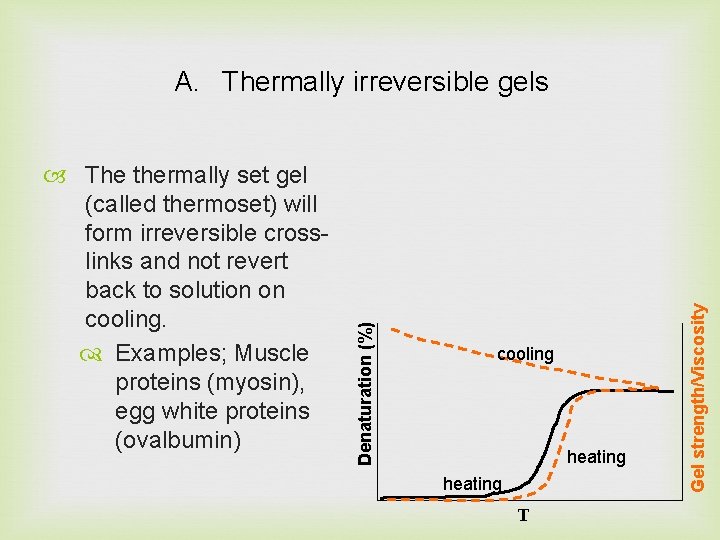
Thermally induced food gels (the most common) Involves unfolding of the protein structure by heat which exposes its hydrophobic regions which leads to protein aggregation to form a continuous 3 D network This aggregation can be irreversible or reversible
cooling heating T Gel strength/Viscosity The thermally set gel (called thermoset) will form irreversible crosslinks and not revert back to solution on cooling. Examples; Muscle proteins (myosin), egg white proteins (ovalbumin) Denaturation (%) A. Thermally irreversible gels
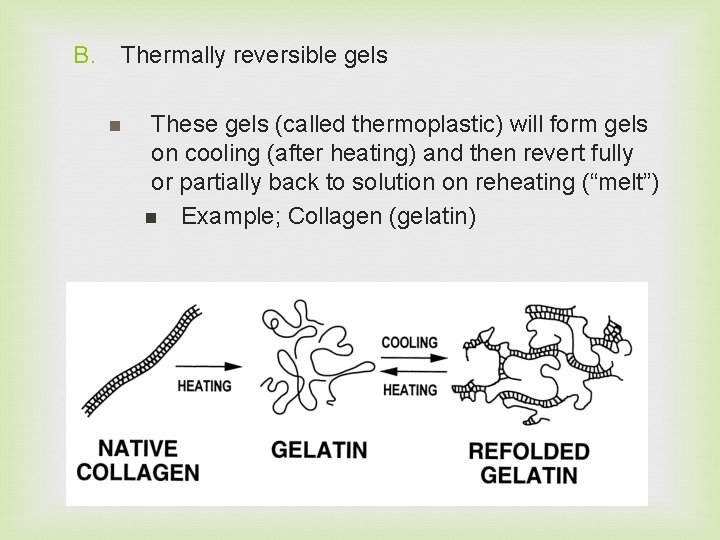
B. Thermally reversible gels n These gels (called thermoplastic) will form gels on cooling (after heating) and then revert fully or partially back to solution on reheating (“melt”) n Example; Collagen (gelatin)
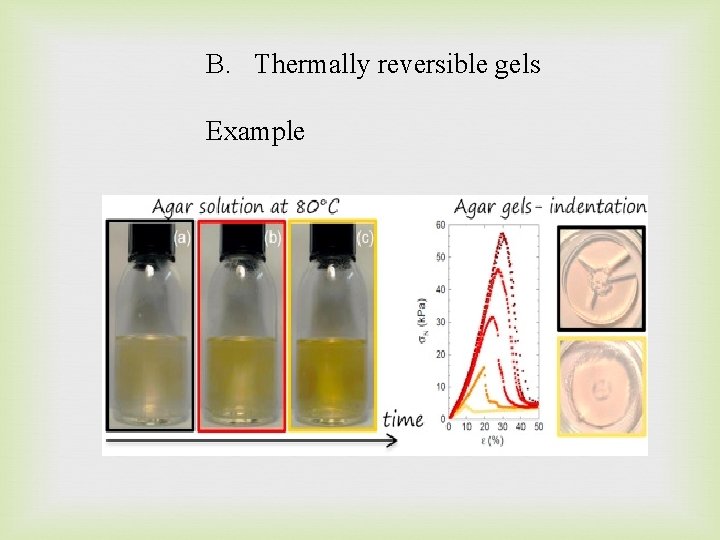
B. Thermally reversible gels Example
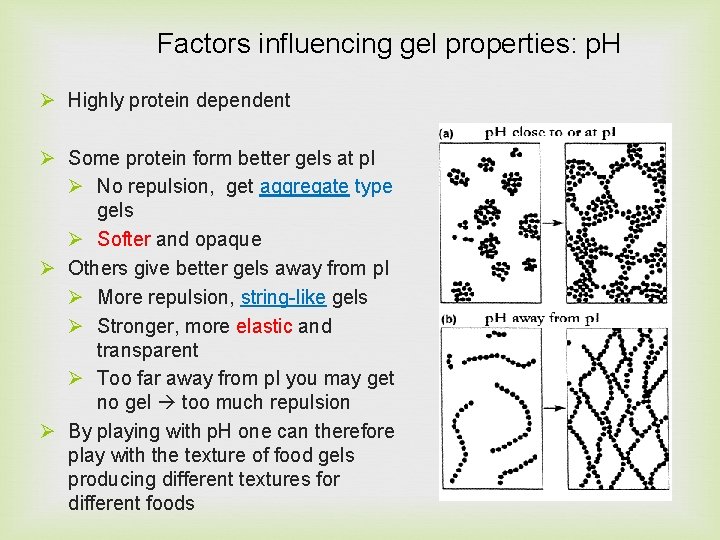
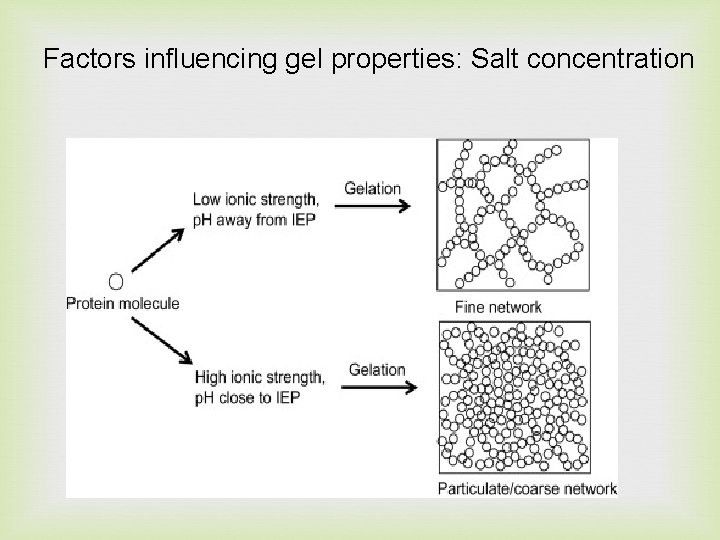
Factors influencing gel properties: p. H Ø Highly protein dependent Ø Some protein form better gels at p. I Ø No repulsion, get aggregate type gels Ø Softer and opaque Ø Others give better gels away from p. I Ø More repulsion, string-like gels Ø Stronger, more elastic and transparent Ø Too far away from p. I you may get no gel too much repulsion Ø By playing with p. H one can therefore play with the texture of food gels producing different textures for different foods
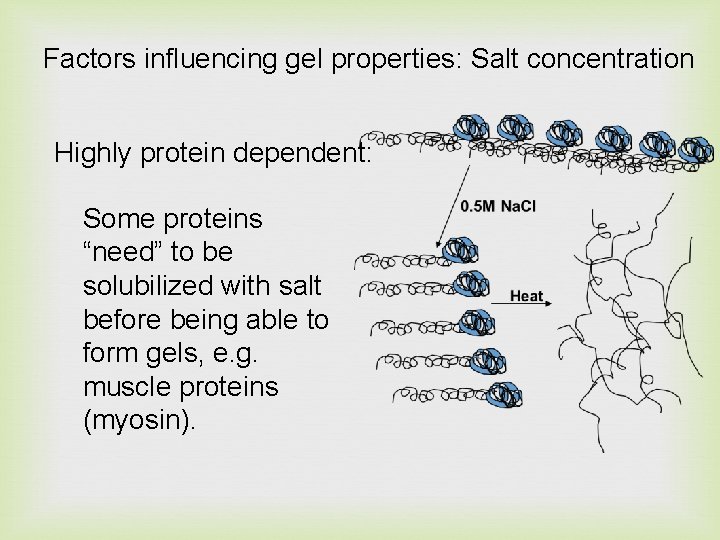
Factors influencing gel properties: Salt concentration Highly protein dependent: Some proteins “need” to be solubilized with salt before being able to form gels, e. g. muscle proteins (myosin).
Factors influencing gel properties: Salt concentration
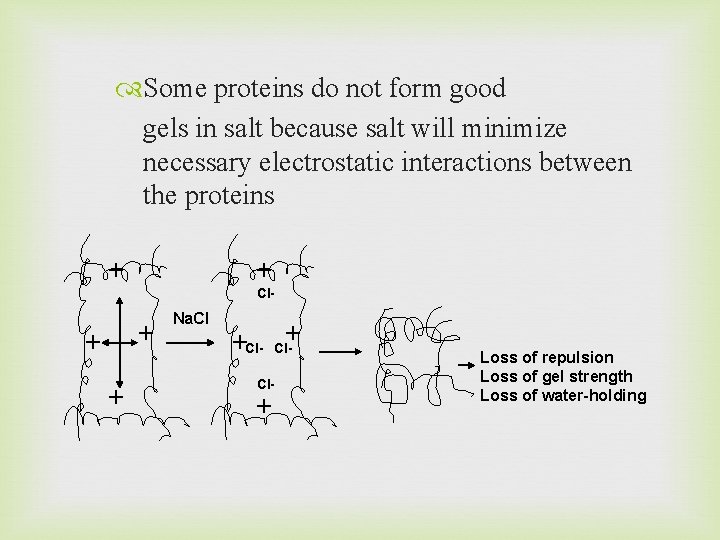
Some proteins do not form good gels in salt because salt will minimize necessary electrostatic interactions between the proteins + + Cl- + + + Na. Cl +Cl- Cl-+ Cl- + Loss of repulsion Loss of gel strength Loss of water-holding
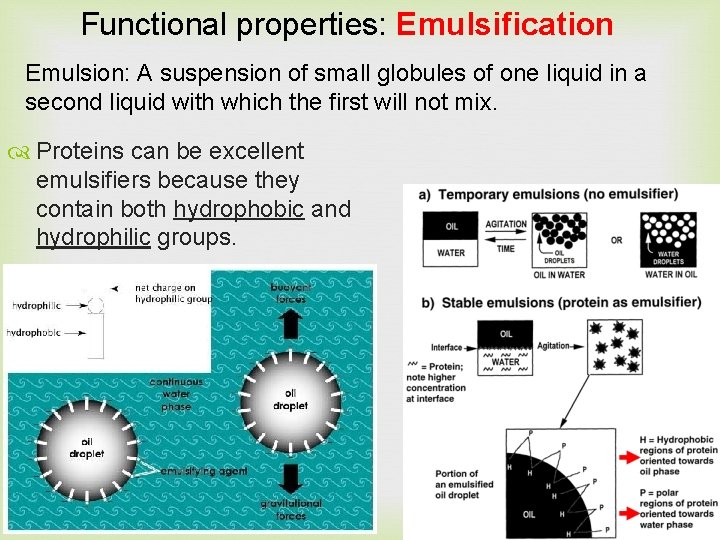
Functional properties: Emulsification Emulsion: A suspension of small globules of one liquid in a second liquid with which the first will not mix. Proteins can be excellent emulsifiers because they contain both hydrophobic and hydrophilic groups.
To form a good emulsion the protein has to be able to: Ø Rapidly adsorb to the oil-water interface Ø Rapidly and readily open up and orient its hydrophobic groups towards the oil phase and its hydrophilic groups to the water phase Ø Form a stable film around the oil droplet
Important protein features: Ø Distribution of hydrophobic vs. hydrophilic amino acids Need a proper balance Increased surface hydrophobicity will increase emulsifying properties Ø Structure of protein Globular is better than fibrous Ø Flexibility of protein More flexible it is, easier it opens up Ø Solubility of protein Insoluble will not form a good emulsion (can’t migrate well; p. I is not good) Increasing solubility increase emulsification ability (up to a point)
Emulsifiers are characterized by: Ø Emulsification capacity - Oil titrated into a protein solution with mixing and the max amount of oil that can be added to the protein solution measured Ø Emulsification stability - Emulsion formed and its breakdown (separation of water and oil phase) monitored with time
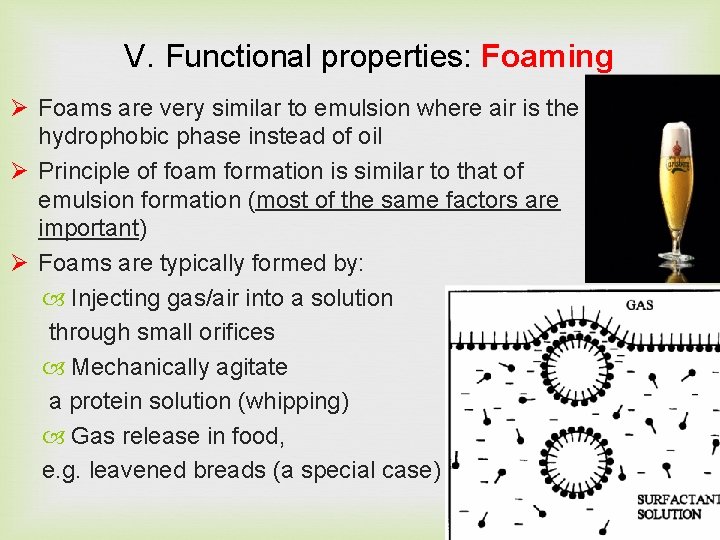
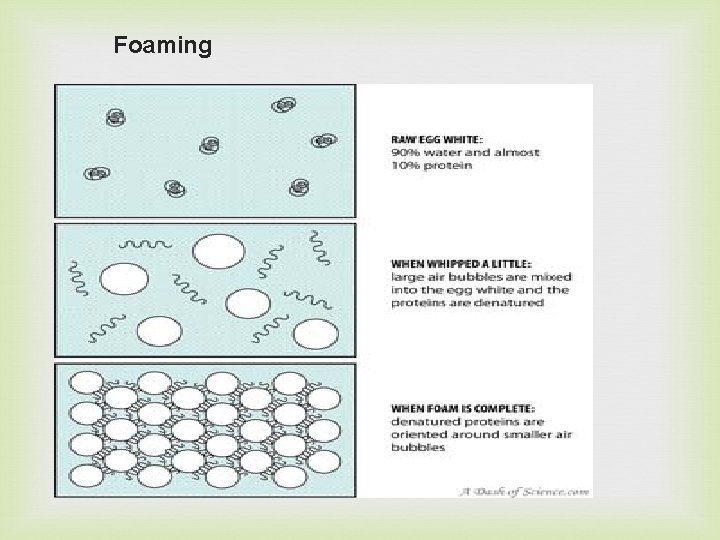
V. Functional properties: Foaming Ø Foams are very similar to emulsion where air is the hydrophobic phase instead of oil Ø Principle of foam formation is similar to that of emulsion formation (most of the same factors are important) Ø Foams are typically formed by: Injecting gas/air into a solution through small orifices Mechanically agitate a protein solution (whipping) Gas release in food, e. g. leavened breads (a special case) 25
Foaming
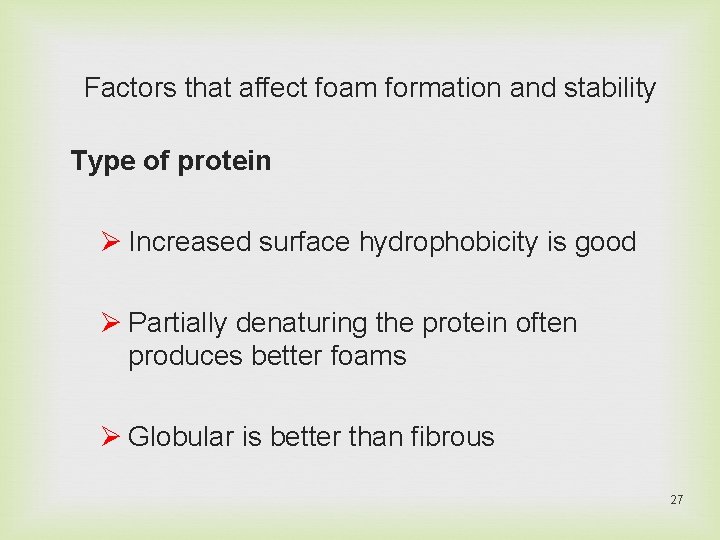
Factors that affect foam formation and stability Type of protein Ø Increased surface hydrophobicity is good Ø Partially denaturing the protein often produces better foams Ø Globular is better than fibrous 27
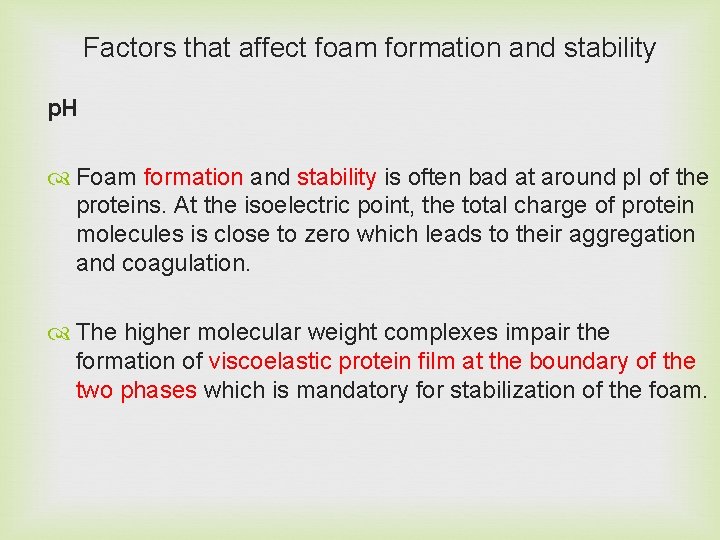
Factors that affect foam formation and stability p. H Foam formation and stability is often bad at around p. I of the proteins. At the isoelectric point, the total charge of protein molecules is close to zero which leads to their aggregation and coagulation. The higher molecular weight complexes impair the formation of viscoelastic protein film at the boundary of the two phases which is mandatory for stabilization of the foam.
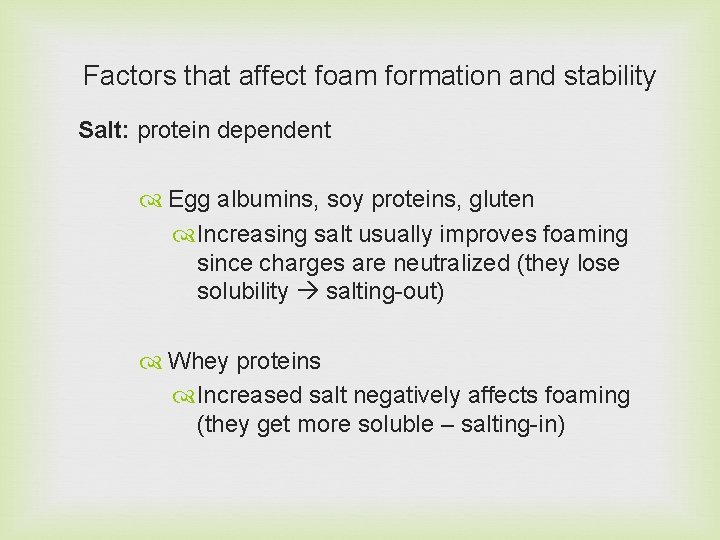
Factors that affect foam formation and stability Salt: protein dependent Egg albumins, soy proteins, gluten Increasing salt usually improves foaming since charges are neutralized (they lose solubility salting-out) Whey proteins Increased salt negatively affects foaming (they get more soluble – salting-in)
Factors that affect foam formation and stability Lipids in food foams usually inhibit foaming by adsorbing to the air-water interface and thinning it. Only 0. 03% egg yolk (which has about 33% lipids) completely inhibits foaming of egg white! Cream is an exception where very high level of fat stabilizes foam
Factors that affect foam formation and stability Stabilizing ingredients Ingredients that increase viscosity of the liquid phase stabilize the foam (sucrose, gums, polyols, etc. ) We add sugar to egg white foams at the later stages of foam formation to stabilize Addition of flour (protein, starch and fiber) to foamed egg white to produce angel cake (a very stable cooked foam) 31
Factors that affect foam formation and stability Energy input Ø The amount of energy (e. g. speed of whipping) and the time used to foam a protein is very important Ø To much energy or too long whipping time can produce a poor foam The foam structure breaks down Proteins become too denatured
Foams are characterized by: Ø Foam capacity –determined by volume increase immediately after whipping. Ø Foam stability - the volume of the foam that remain after time. Can be expressed as a percentage of the initial foam volume.
Protein modification to improve their functional properties. Some proteins don’t exhibit good functional properties and must be modified. Other proteins are excellent in one functional aspect but poor in another but can be modified to have a broader range of function.
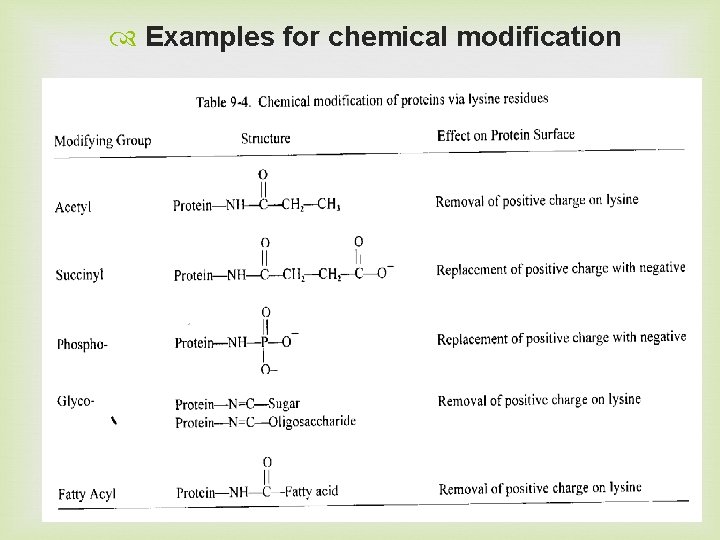
1. Chemical modification Reactive amino acids are chemically modified by adding a group to them. Lysine, tyrosine and cysteine Increases solubility and gel-forming abilities. Modified protein has to be non-toxic and digestible Retain 50 -100% of original biological value Often used in very small amounts due to possible toxicity
Examples for chemical modification
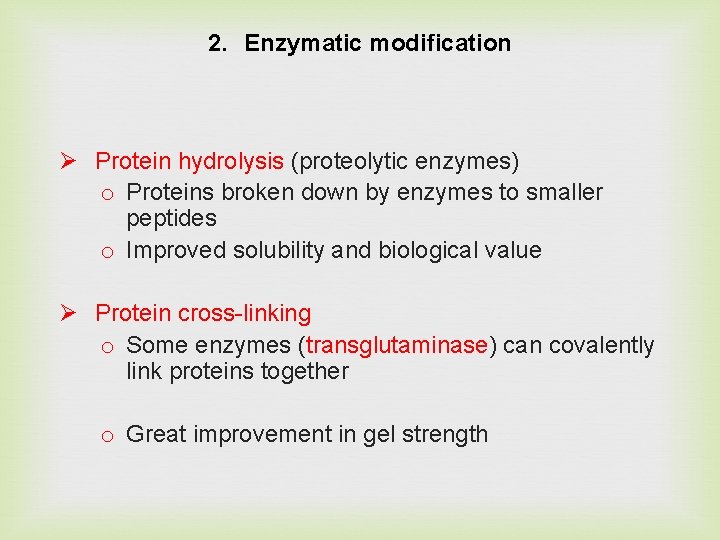
2. Enzymatic modification Ø Protein hydrolysis (proteolytic enzymes) o Proteins broken down by enzymes to smaller peptides o Improved solubility and biological value Ø Protein cross-linking o Some enzymes (transglutaminase) can covalently link proteins together o Great improvement in gel strength
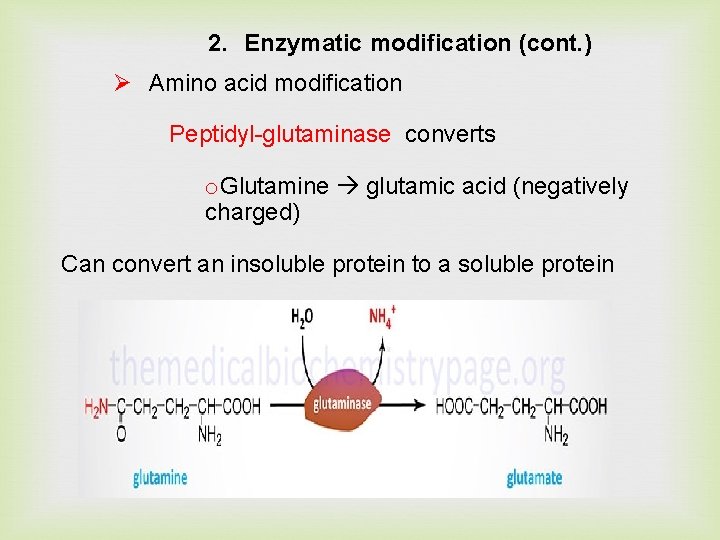
2. Enzymatic modification (cont. ) Ø Amino acid modification Peptidyl-glutaminase converts o. Glutamine glutamic acid (negatively charged) Can convert an insoluble protein to a soluble protein
3. Physical modification Most of the methods involve heat to partly denature the proteins; alkaline treatment Texturized vegetable proteins – TVP (e. g. soy meat) A combination of heat (above 60 C), pressure, high p. H (11) and ionic strength used to solubilize and denature the proteins which rearrange into 3 D gel structures with meat like texture Good water and fat holding capacity Cheaper than muscle proteins - often used in meat products
3. Physical modification (cont. ) Protein based fat substitutes (e. g. Simplesse. TM ) Milk or egg proteins heat denatured and mechanically sheared: On cooling they form small globular particles that have the same mouthfeel and juiciness as fat. Simplesse. TM is very sensitive to high heat – limits use in processing