
Lecture 4 Developing your own energy system scenarios

- Slides: 18
Lecture 4: Developing your own energy system scenarios Open-Source Energy System Modeling TU Wien, VU 370. 062 Dipl. -Ing. Dr. Daniel Huppmann Please consider the environment before printing this slide deck Icon from all-free-download. com, Environmental icons 310835 by BSGstudio, under CC-BY
Part 1 A high-level overview of the open-source energy system model MESSAGEix Open-Source Energy System Modeling, Lecture 4 Daniel Huppmann 3
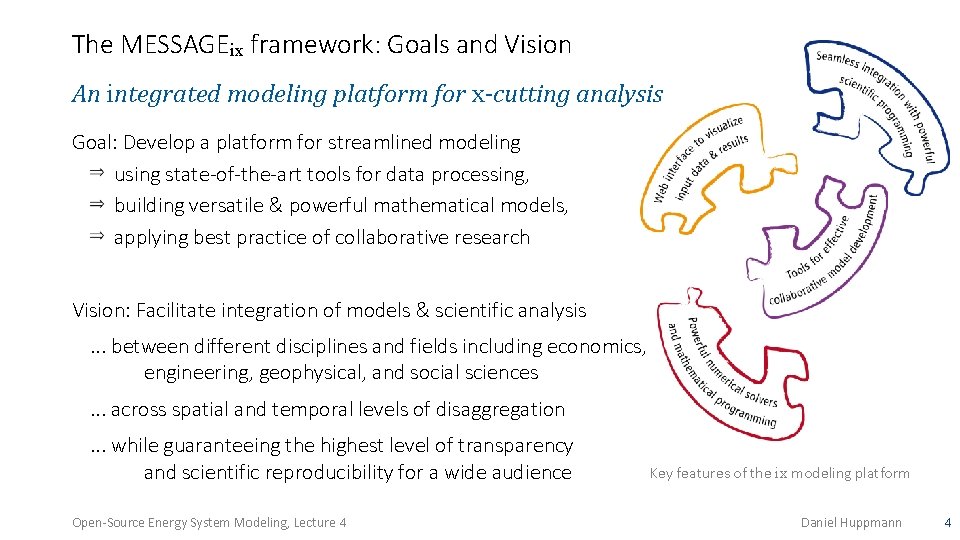
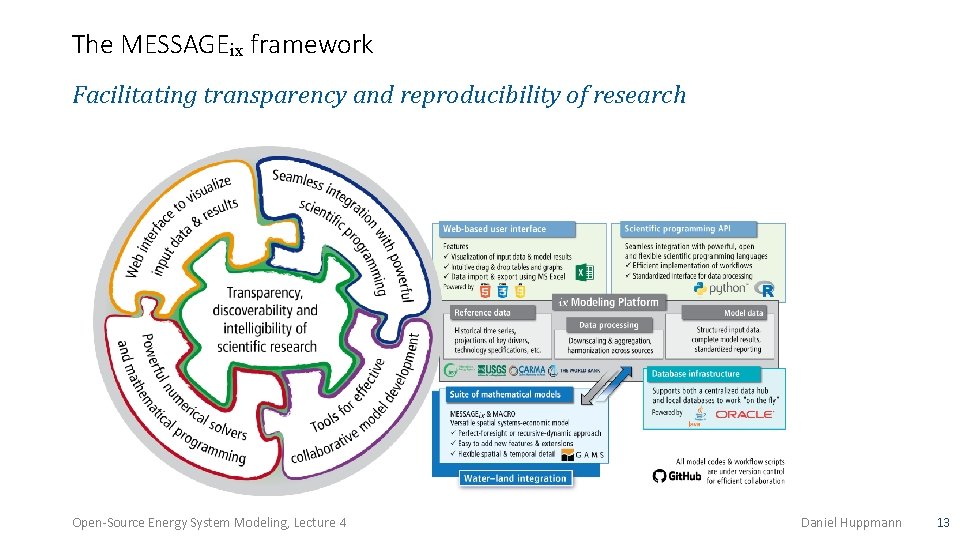
The MESSAGEix framework: Goals and Vision An integrated modeling platform for x-cutting analysis Goal: Develop a platform for streamlined modeling using state-of-the-art tools for data processing, building versatile & powerful mathematical models, applying best practice of collaborative research Vision: Facilitate integration of models & scientific analysis. . . between different disciplines and fields including economics, engineering, geophysical, and social sciences. . . across spatial and temporal levels of disaggregation. . . while guaranteeing the highest level of transparency and scientific reproducibility for a wide audience Open-Source Energy System Modeling, Lecture 4 Key features of the ix modeling platform Daniel Huppmann 4
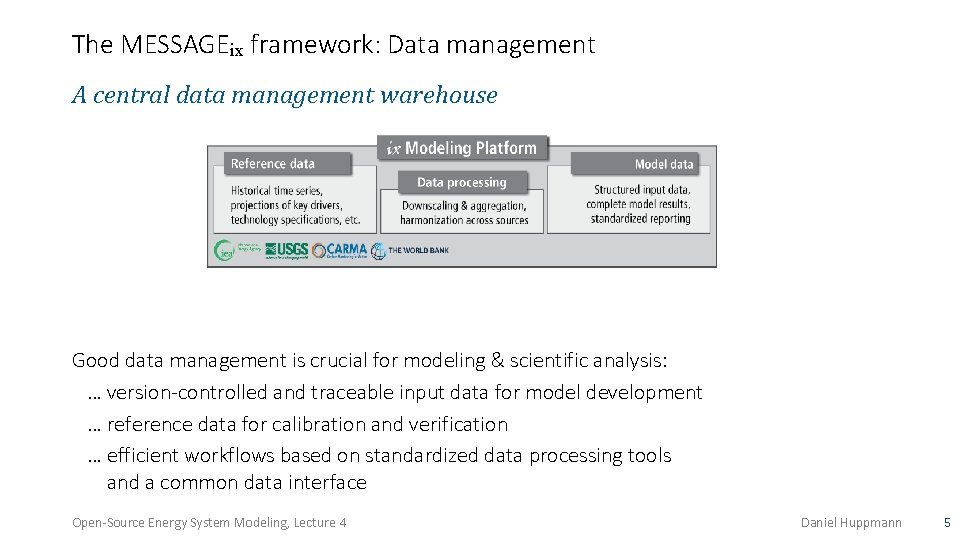
The MESSAGEix framework: Data management A central data management warehouse Good data management is crucial for modeling & scientific analysis: … version-controlled and traceable input data for model development … reference data for calibration and verification … efficient workflows based on standardized data processing tools and a common data interface Open-Source Energy System Modeling, Lecture 4 Daniel Huppmann 5
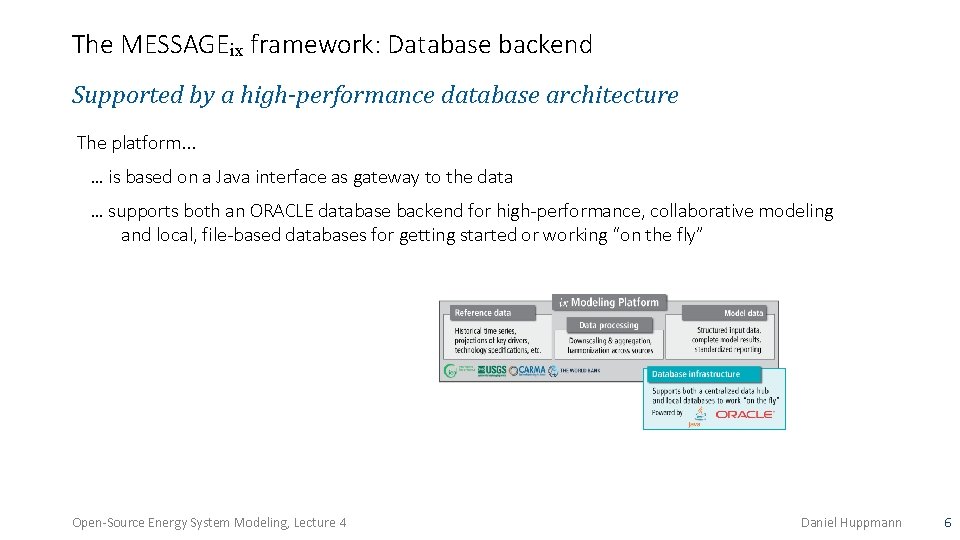
The MESSAGEix framework: Database backend Supported by a high-performance database architecture The platform. . . … is based on a Java interface as gateway to the data … supports both an ORACLE database backend for high-performance, collaborative modeling and local, file-based databases for getting started or working “on the fly” Open-Source Energy System Modeling, Lecture 4 Daniel Huppmann 6
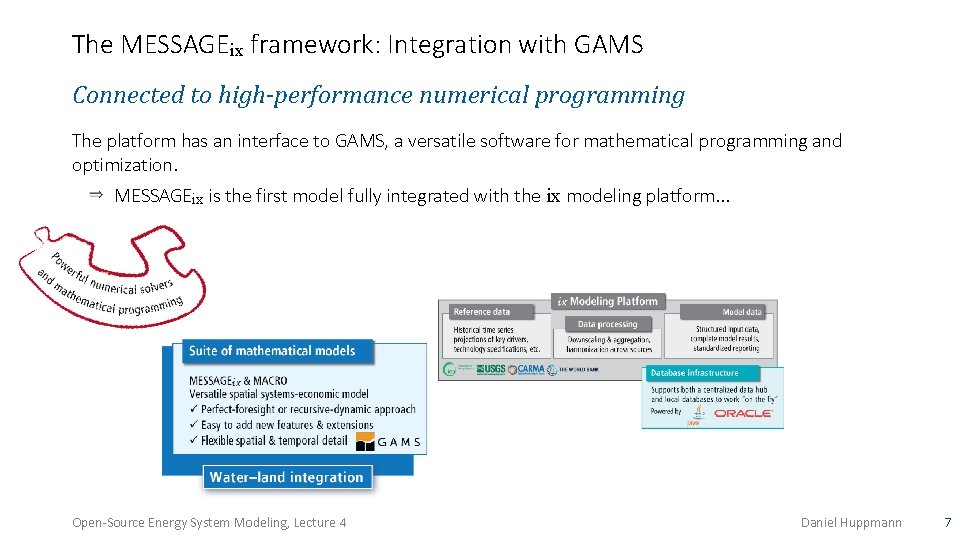
The MESSAGEix framework: Integration with GAMS Connected to high-performance numerical programming The platform has an interface to GAMS, a versatile software for mathematical programming and optimization. MESSAGEix is the first model fully integrated with the ix modeling platform. . . Open-Source Energy System Modeling, Lecture 4 Daniel Huppmann 7
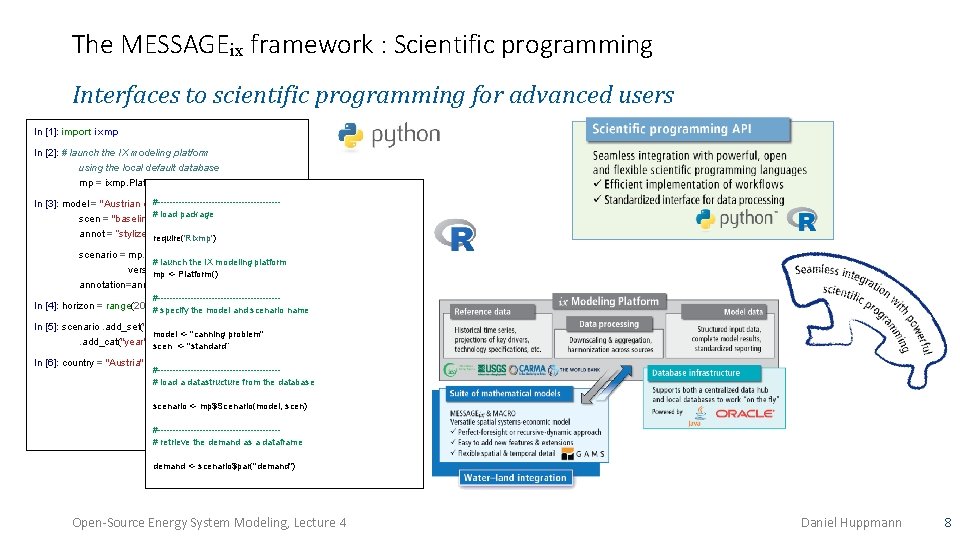
The MESSAGEix framework : Scientific programming Interfaces to scientific programming for advanced users In [1]: import ixmp In [2]: # launch the IX modeling platform using the local default database mp = ixmp. Platform(dbtype='HSQLDB') #--------------------In [3]: model = "Austrian energy model" # load package scen = "baseline" annot = “stylized require('Rixmp') test scenario" scenario = mp. Scenario(model, scen, # launch the IX modeling platform version='new', mp <- Platform() annotation=annot, scheme=‘MESSAGE‘) #--------------------- In [4]: horizon = range(2010, 2070, 10) firstyear horizon[0] # specify the model and=scenario name In [5]: scenario. add_set("year", horizon) scenario model <- "canning problem". add_cat("year", scen "firstmodelyear", <- "standard“firstyear) In [6]: country = "Austria" ds. add_set("node", country) #--------------------# load a datastructure from the database scenario <- mp$Scenario(model, scen) #--------------------# retrieve the demand as a dataframe demand <- scenario$par("demand") Open-Source Energy System Modeling, Lecture 4 Daniel Huppmann 8
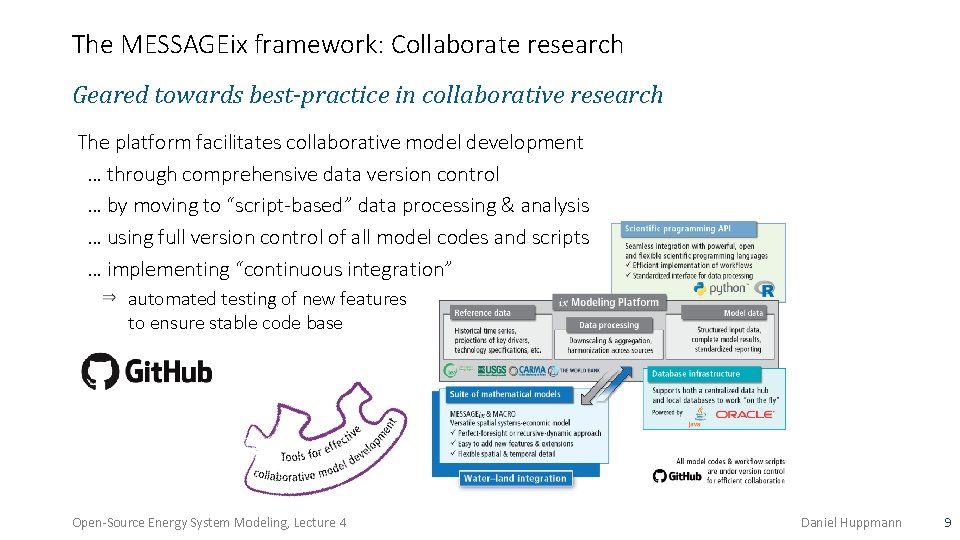
The MESSAGEix framework: Collaborate research Geared towards best-practice in collaborative research The platform facilitates collaborative model development … through comprehensive data version control … by moving to “script-based” data processing & analysis … using full version control of all model codes and scripts … implementing “continuous integration” automated testing of new features to ensure stable code base Open-Source Energy System Modeling, Lecture 4 Daniel Huppmann 9
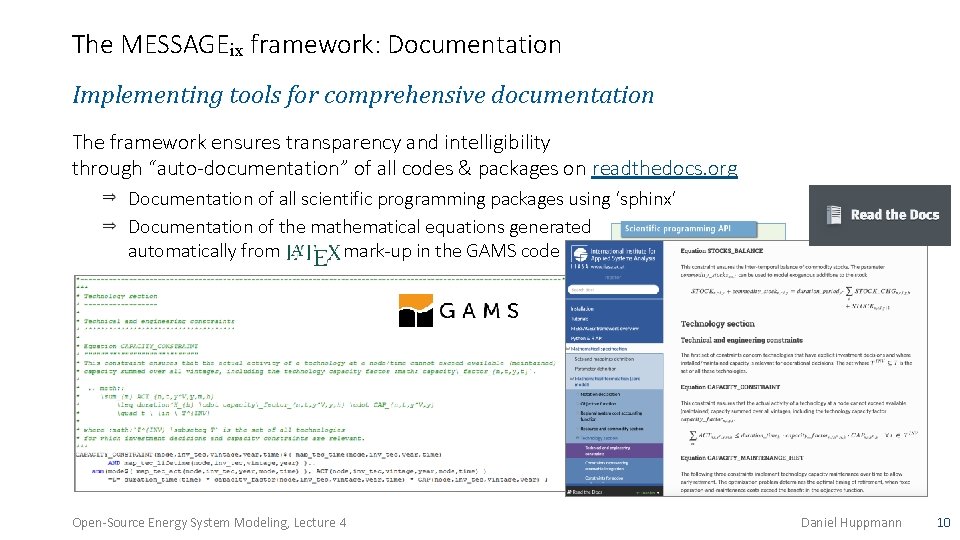
The MESSAGEix framework: Documentation Implementing tools for comprehensive documentation The framework ensures transparency and intelligibility through “auto-documentation” of all codes & packages on readthedocs. org Documentation of all scientific programming packages using ‘sphinx‘ Documentation of the mathematical equations generated automatically from mark-up in the GAMS code Open-Source Energy System Modeling, Lecture 4 Daniel Huppmann 10
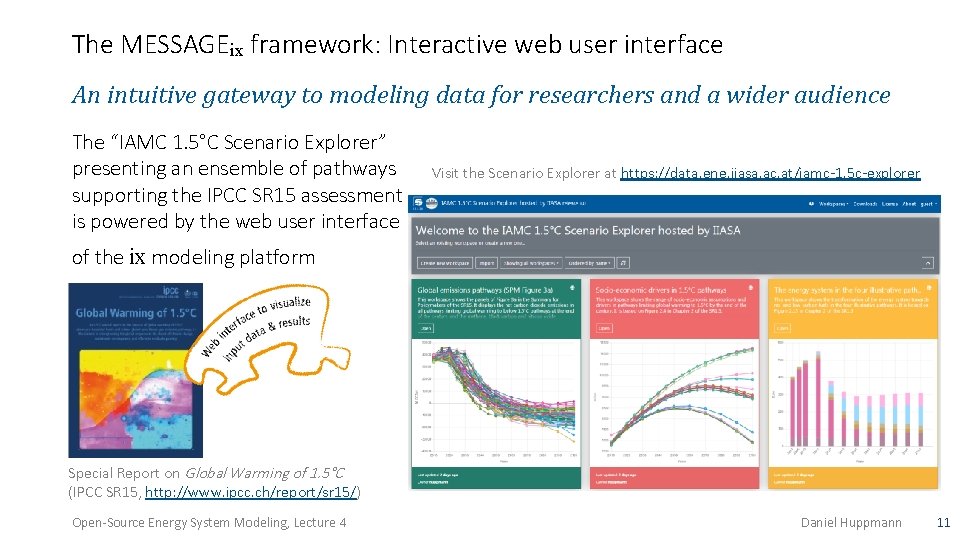
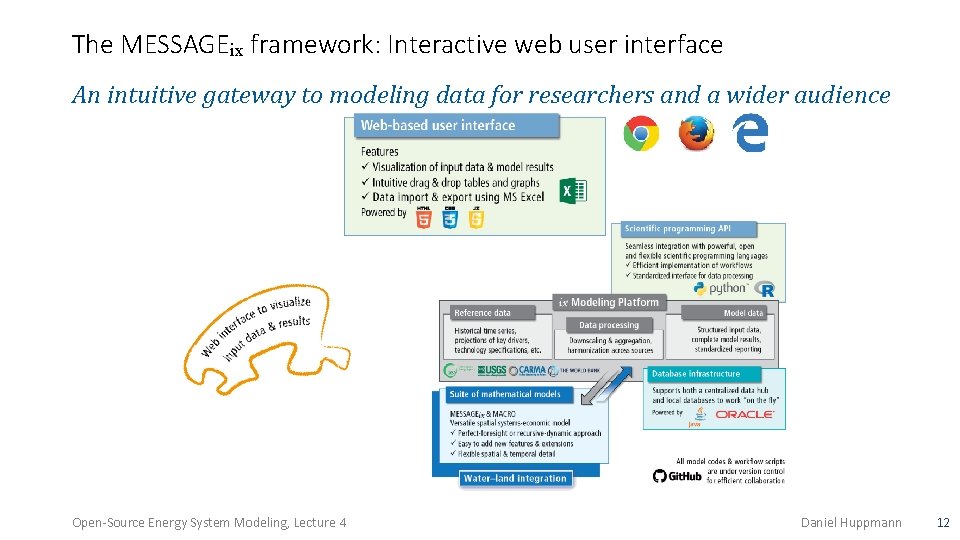
The MESSAGEix framework: Interactive web user interface An intuitive gateway to modeling data for researchers and a wider audience The “IAMC 1. 5°C Scenario Explorer” presenting an ensemble of pathways supporting the IPCC SR 15 assessment is powered by the web user interface Visit the Scenario Explorer at https: //data. ene. iiasa. ac. at/iamc-1. 5 c-explorer of the ix modeling platform Special Report on Global Warming of 1. 5°C (IPCC SR 15, http: //www. ipcc. ch/report/sr 15/) Open-Source Energy System Modeling, Lecture 4 Daniel Huppmann 11
The MESSAGEix framework: Interactive web user interface An intuitive gateway to modeling data for researchers and a wider audience Open-Source Energy System Modeling, Lecture 4 Daniel Huppmann 12
The MESSAGEix framework Facilitating transparency and reproducibility of research Open-Source Energy System Modeling, Lecture 4 Daniel Huppmann 13
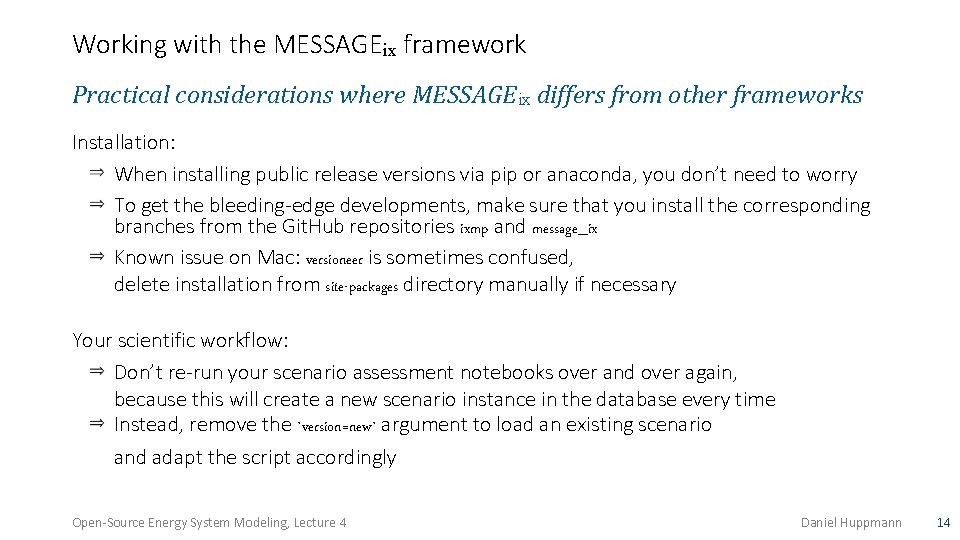
Working with the MESSAGEix framework Practical considerations where MESSAGEix differs from other frameworks Installation: When installing public release versions via pip or anaconda, you don’t need to worry To get the bleeding-edge developments, make sure that you install the corresponding branches from the Git. Hub repositories ixmp and message_ix Known issue on Mac: versioneer is sometimes confused, delete installation from site-packages directory manually if necessary Your scientific workflow: Don’t re-run your scenario assessment notebooks over and over again, because this will create a new scenario instance in the database every time Instead, remove the `version=new` argument to load an existing scenario and adapt the script accordingly Open-Source Energy System Modeling, Lecture 4 Daniel Huppmann 14
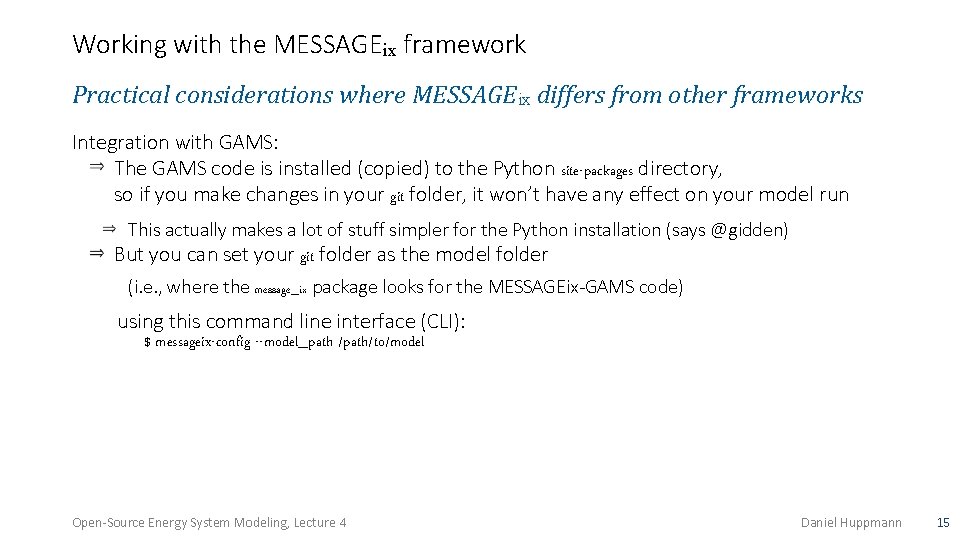
Working with the MESSAGEix framework Practical considerations where MESSAGEix differs from other frameworks Integration with GAMS: The GAMS code is installed (copied) to the Python site-packages directory, so if you make changes in your git folder, it won’t have any effect on your model run This actually makes a lot of stuff simpler for the Python installation (says @gidden) But you can set your git folder as the model folder (i. e. , where the message_ix package looks for the MESSAGEix-GAMS code) using this command line interface (CLI): $ messageix-config --model_path /path/to/model Open-Source Energy System Modeling, Lecture 4 Daniel Huppmann 15
Part 2 How to start developing your own energy system scenarios? Open-Source Energy System Modeling, Lecture 4 Daniel Huppmann 16
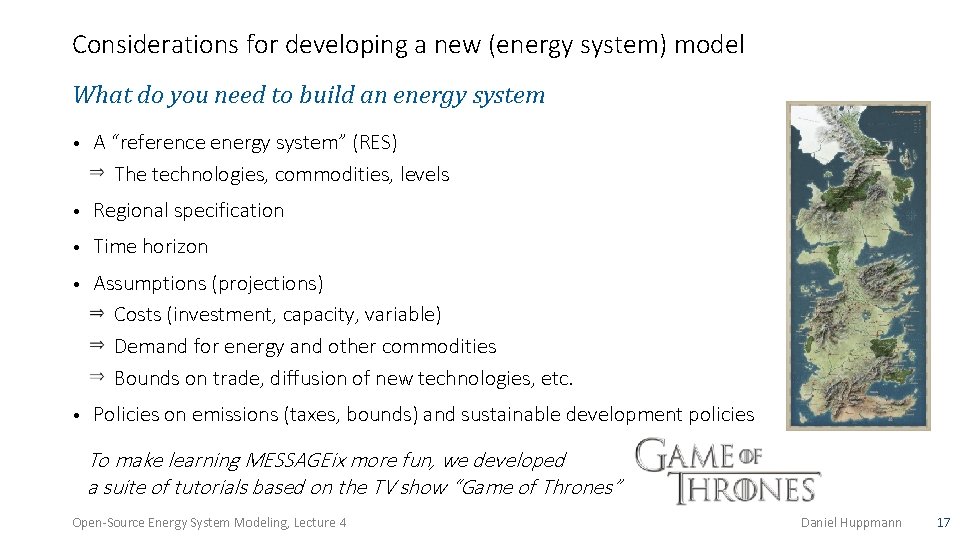
Considerations for developing a new (energy system) model What do you need to build an energy system • A “reference energy system” (RES) The technologies, commodities, levels • Regional specification • Time horizon • Assumptions (projections) Costs (investment, capacity, variable) Demand for energy and other commodities Bounds on trade, diffusion of new technologies, etc. • Policies on emissions (taxes, bounds) and sustainable development policies To make learning MESSAGEix more fun, we developed a suite of tutorials based on the TV show “Game of Thrones” Open-Source Energy System Modeling, Lecture 4 Daniel Huppmann 17
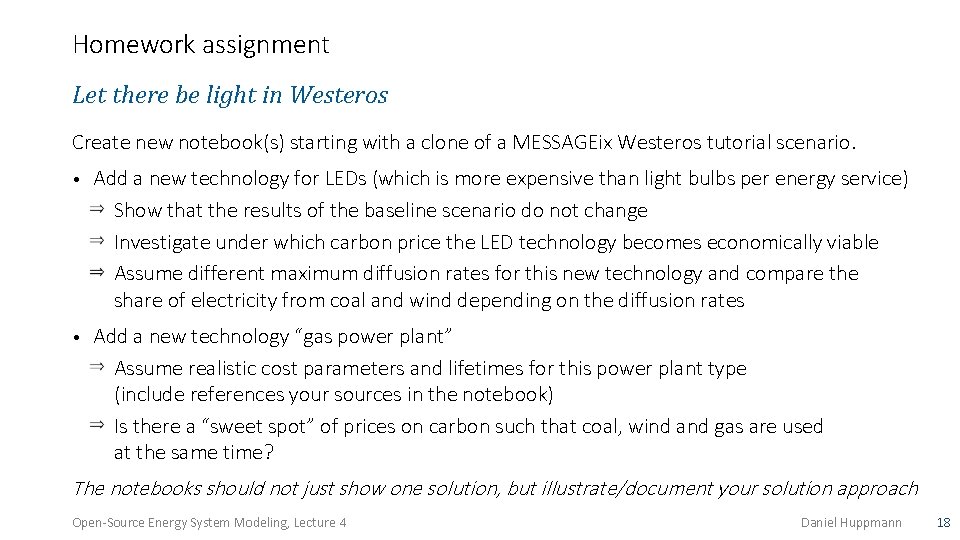
Homework assignment Let there be light in Westeros Create new notebook(s) starting with a clone of a MESSAGEix Westeros tutorial scenario. • Add a new technology for LEDs (which is more expensive than light bulbs per energy service) Show that the results of the baseline scenario do not change Investigate under which carbon price the LED technology becomes economically viable Assume different maximum diffusion rates for this new technology and compare the share of electricity from coal and wind depending on the diffusion rates • Add a new technology “gas power plant” Assume realistic cost parameters and lifetimes for this power plant type (include references your sources in the notebook) Is there a “sweet spot” of prices on carbon such that coal, wind and gas are used at the same time? The notebooks should not just show one solution, but illustrate/document your solution approach Open-Source Energy System Modeling, Lecture 4 Daniel Huppmann 18
Thank you very much for your attention! Dr. Daniel Huppmann Research Scholar – Energy Program International Institute for Applied Systems Analysis (IIASA) Schlossplatz 1, A-2361 Laxenburg, Austria huppmann@iiasa. ac. at http: //www. iiasa. ac. at/staff/huppmann This presentation is licensed under a Creative Commons Attribution 4. 0 International License