
Lecture 4 Cost Behaviour Chapter 10 Prepared by
Lecture #4 Cost Behaviour Chapter 10 Prepared by Simon Lenthen University of Western Sydney Presented by Dr Greg Laing http: //www. youtube. com/watch? v=Daav. R AV 8 a 0 A
Introduction • CVP analysis is concerned with the change in profits in response to changes in sales volumes, costs and prices • Helps answer the following questions: – How many units need to be sold, or services performed, to break even (for example, earn zero profit)? – What is the impact on profit of a change in the mix between fixed and variable costs? – How many units need to be sold, or services performed, to achieve a particular level of profit? – What is the impact on profit of a 15 per cent increase in costs? 2
Cost behaviour • Examining cost behaviour enables us to consider – the way in which costs change, and – the main factors that influence those changes • Costs can be classified as fixed, variable or mixed • The nature of fixed and variable costs relates to whether such costs are likely to alter in total with changes in activity 3
Fixed, variable and mixed costs • Fixed costs are those costs which remain the same in total (within a given range of activity and timeframe) irrespective of the level of activity – e. g. lease costs, depreciation charges • When we consider levels of activity in terms of units of output: – total fixed costs remain the same, but – fixed costs per unit will decrease as the number of units produced increases 4

Fixed, variable and mixed costs continued 5

Fixed, variable and mixed costs continued • Variable costs change in total as the level of activity changes e. g. - costs of bricks to build a house - aviation fuel for Qantas • Variable costs can be considered on either a total or unit basis 6
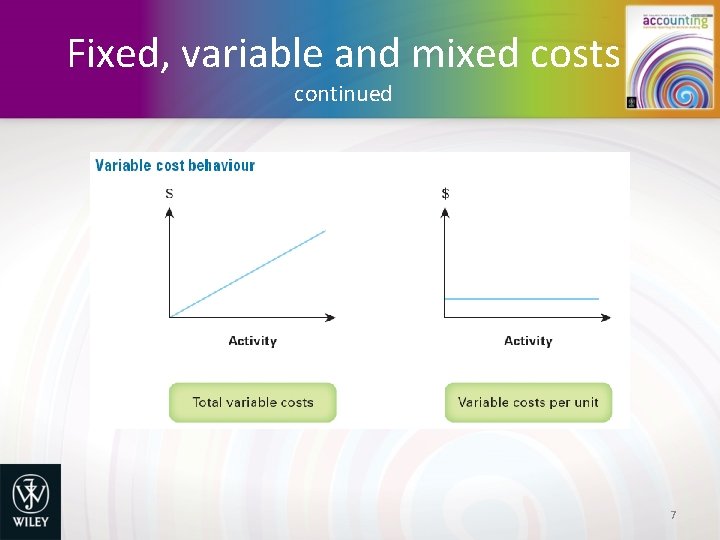
Fixed, variable and mixed costs continued 7
Fixed, variable and mixed costs continued • The relevant range is the range of activity over which the cost behaviour is assumed to be valid • If the activity level goes outside the relevant range, then the expected behaviour of costs changes can no longer be assumed to be fixed 8
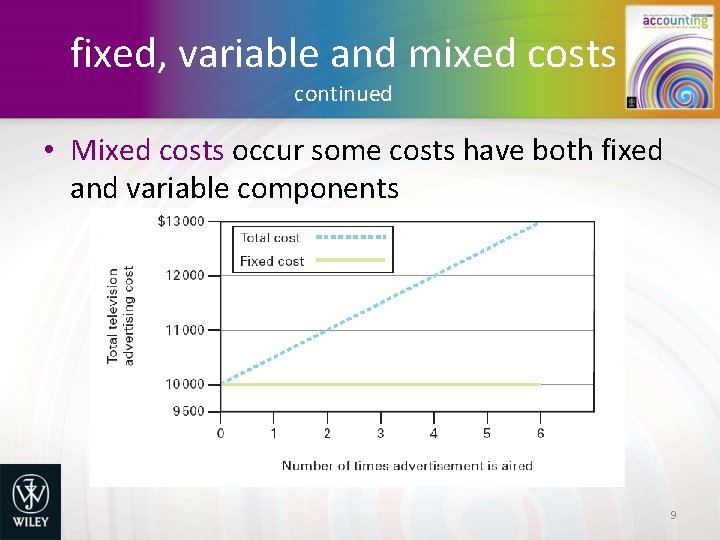
fixed, variable and mixed costs continued • Mixed costs occur some costs have both fixed and variable components 9
Break-even analysis • Break-even analysis relates to the calculation of the necessary levels of activity required in order to break even in a given period • Break-even occurs when total revenue and total costs are equal resulting in zero profit – i. e. when Revenue = FC + VC 10
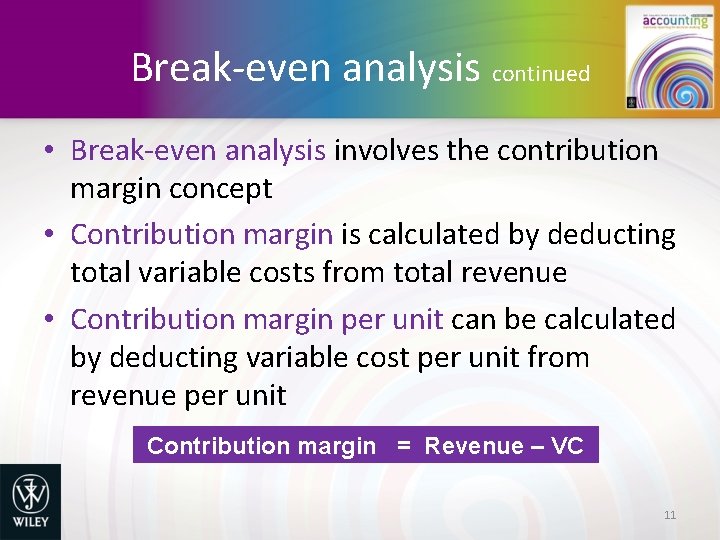
Break-even analysis continued • Break-even analysis involves the contribution margin concept • Contribution margin is calculated by deducting total variable costs from total revenue • Contribution margin per unit can be calculated by deducting variable cost per unit from revenue per unit Contribution margin = Revenue – VC 11
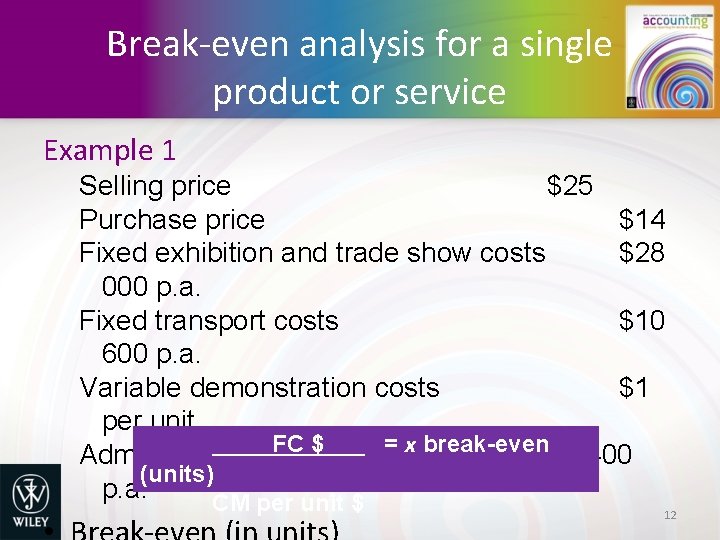
Break-even analysis for a single product or service Example 1 Selling price $25 Purchase price $14 Fixed exhibition and trade show costs $28 000 p. a. Fixed transport costs $10 600 p. a. Variable demonstration costs $1 per unit FC $ costs = x break-even$6 400 Administration fixed (units) p. a. CM per unit $ 12
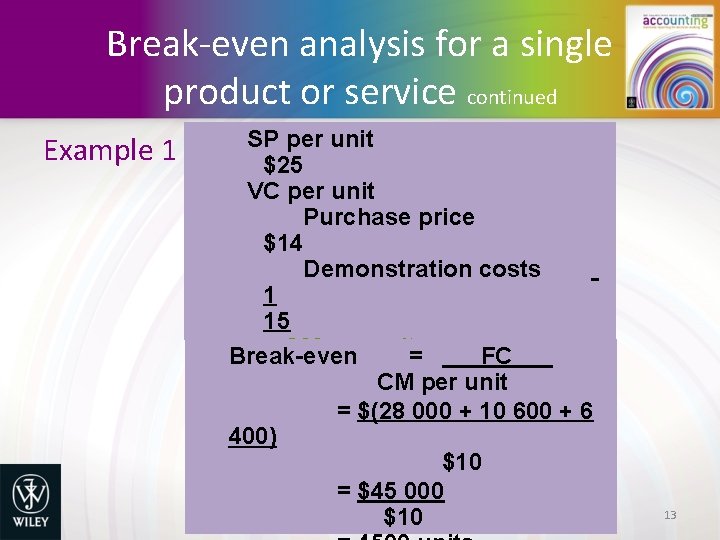
Break-even analysis for a single product or service continued Example 1 SP per unit $25 VC per unit Purchase price $14 Demonstration costs 1 15 CM per unit= Break-even FC CM$10 per unit = $(28 000 + 10 600 + 6 400) $10 = $45 000 $10 13
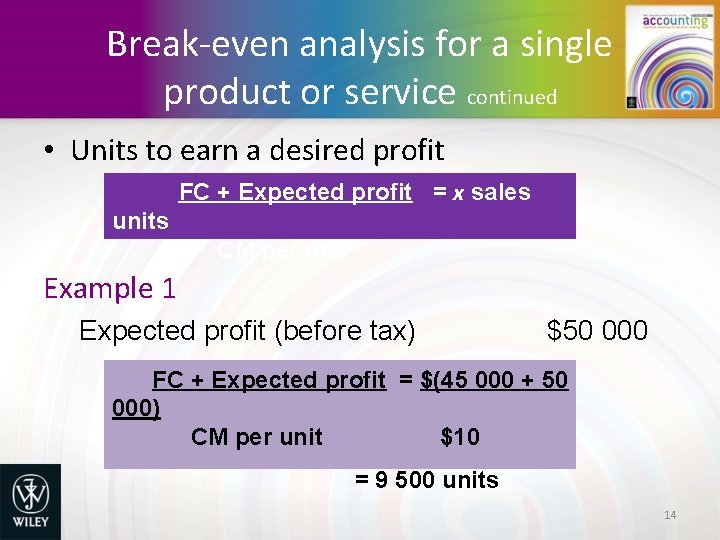
Break-even analysis for a single product or service continued • Units to earn a desired profit FC + Expected profit = x sales units CM per unit Example 1 Expected profit (before tax) $50 000 FC + Expected profit = $(45 000 + 50 000) CM per unit $10 = 9 500 units 14
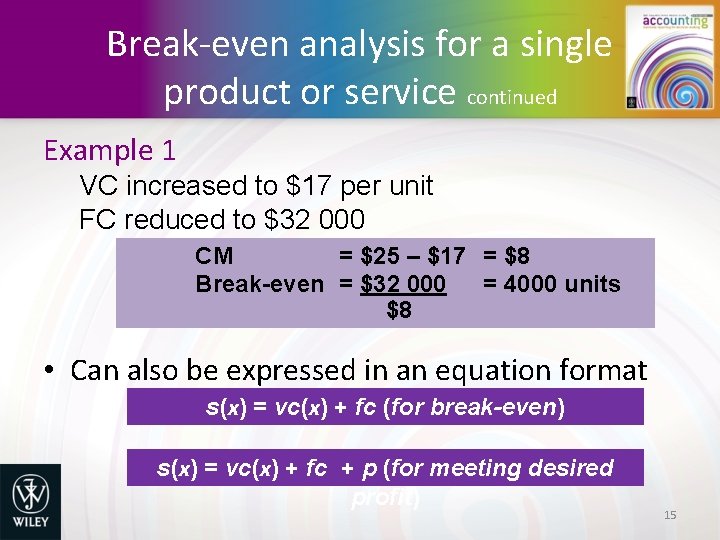
Break-even analysis for a single product or service continued Example 1 VC increased to $17 per unit FC reduced to $32 000 CM = $25 – $17 = $8 Break-even = $32 000 = 4000 units $8 • Can also be expressed in an equation format s(x) = vc(x) + fc (for break-even) s(x) = vc(x) + fc + p (for meeting desired profit) 15
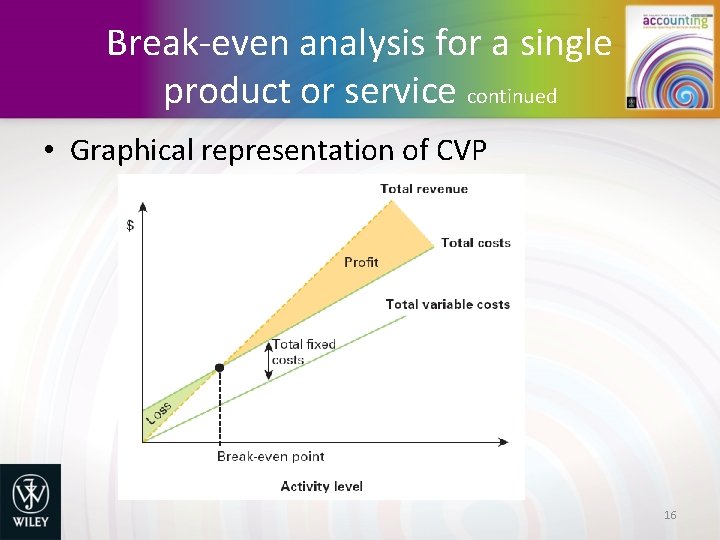
Break-even analysis for a single product or service continued • Graphical representation of CVP 16
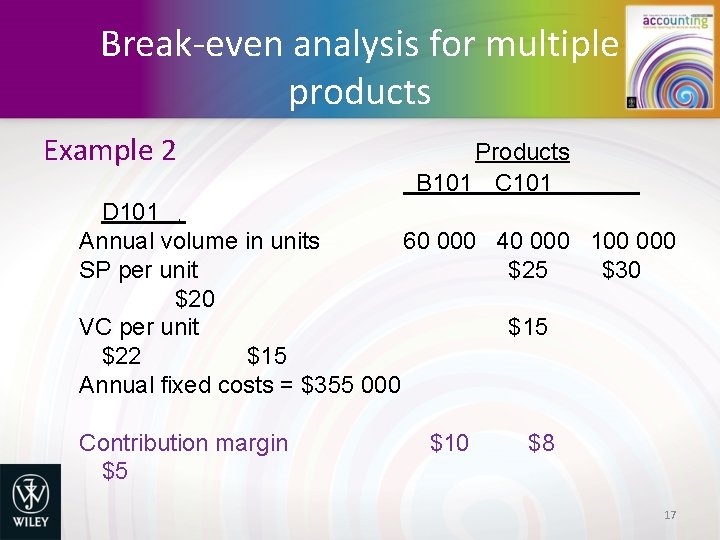
Break-even analysis for multiple products Example 2 Products B 101 C 101 D 101 Annual volume in units 60 000 40 000 100 000 SP per unit $25 $30 $20 VC per unit $15 $22 $15 Annual fixed costs = $355 000. Contribution margin $5 $10 $8 17
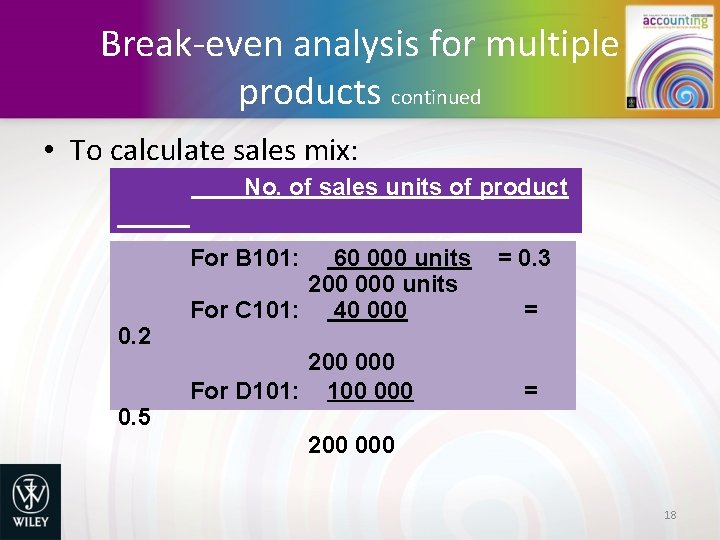
Break-even analysis for multiple products continued • To calculate sales mix: No. of sales units of product Total no. of sales units of all For B 101: 60 000 units = 0. 3 products 200 000 units 0. 2 0. 5 For C 101: 40 000 = 200 000 For D 101: 100 000 = 200 000 18
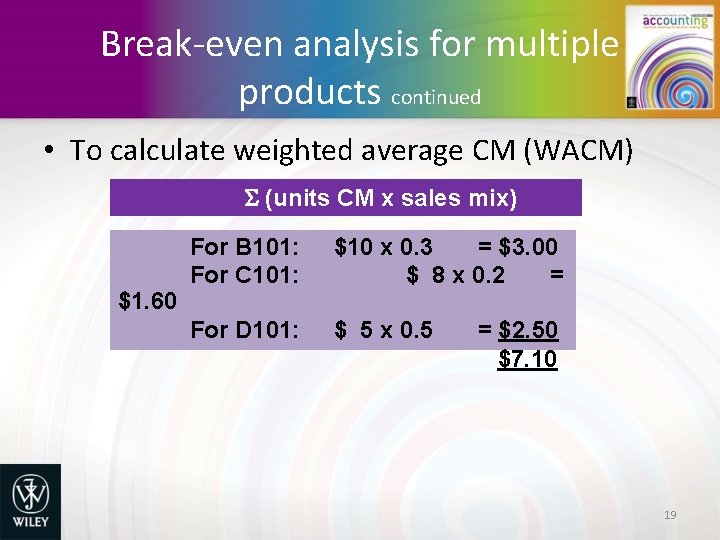
Break-even analysis for multiple products continued • To calculate weighted average CM (WACM) (units CM x sales mix) $1. 60 For B 101: For C 101: $10 x 0. 3 = $3. 00 $ 8 x 0. 2 = For D 101: $ 5 x 0. 5 = $2. 50 $7. 10 19
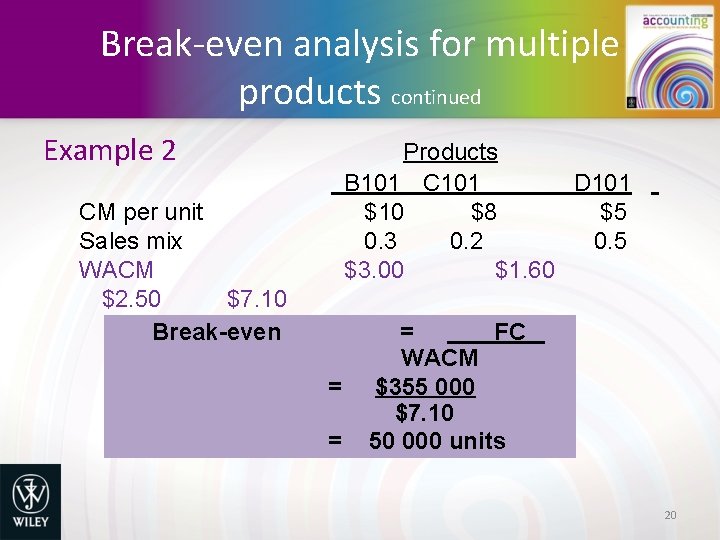
Break-even analysis for multiple products continued Example 2 Products B 101 C 101 D 101 $10 $8 $5 0. 3 0. 2 0. 5 $3. 00 $1. 60 CM per unit Sales mix WACM $2. 50 $7. 10 Break-even = = . = FC WACM $355 000 $7. 10 50 000 units 20
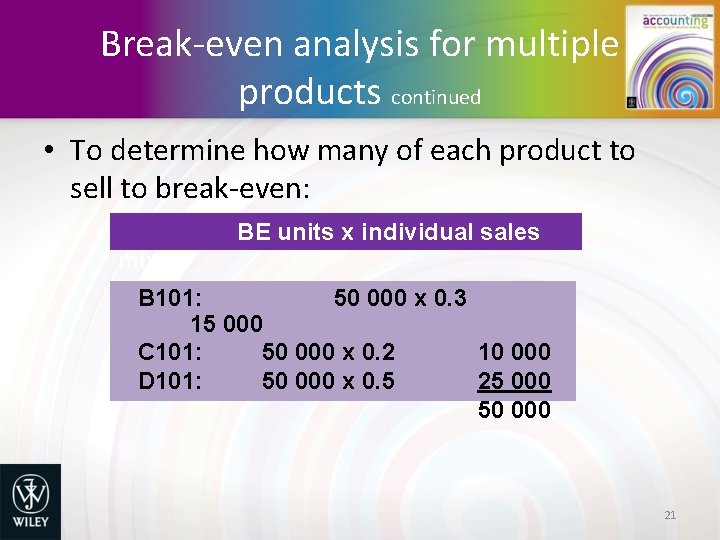
Break-even analysis for multiple products continued • To determine how many of each product to sell to break-even: BE units x individual sales mix B 101: 50 000 x 0. 3 15 000 C 101: 50 000 x 0. 2 10 000 D 101: 50 000 x 0. 5 25 000 50 000 21
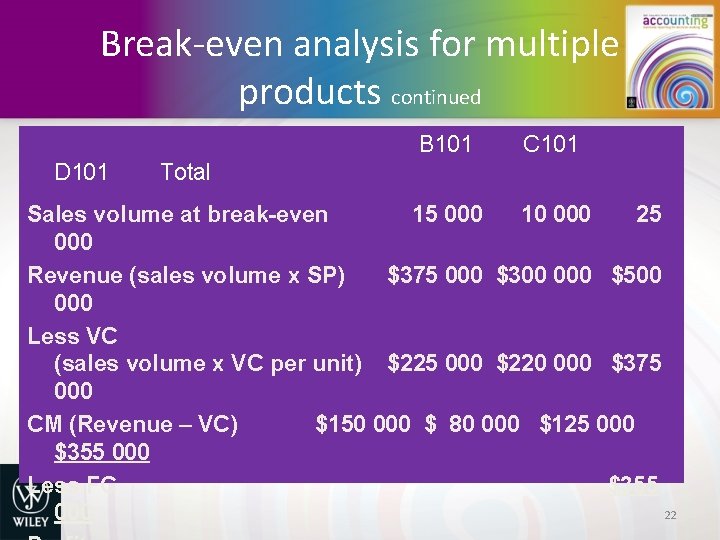
Break-even analysis for multiple products continued B 101 D 101 C 101 Total Sales volume at break-even 15 000 10 000 25 000 Revenue (sales volume x SP) $375 000 $300 000 $500 000 Less VC (sales volume x VC per unit) $225 000 $220 000 $375 000 CM (Revenue – VC) $150 000 $ 80 000 $125 000 $355 000 Less FC $355 22 000
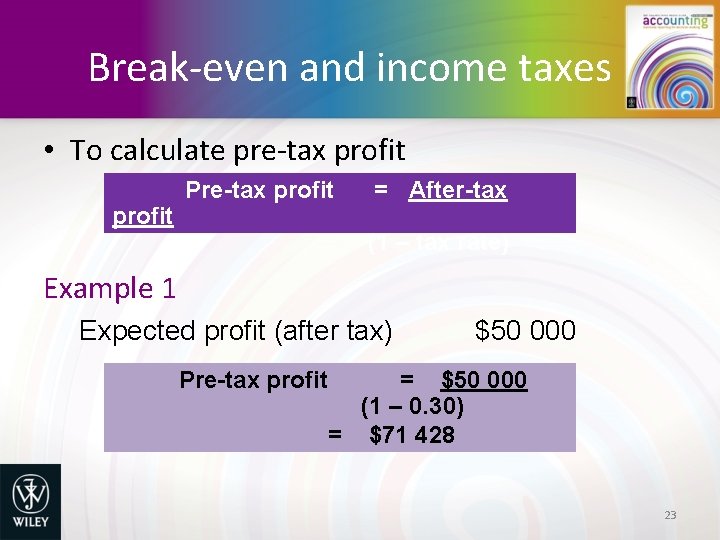
Break-even and income taxes • To calculate pre-tax profit Pre-tax profit = After-tax (1 – tax rate) Example 1 Expected profit (after tax) Pre-tax profit $50 000 = $50 000 (1 – 0. 30) = $71 428 23
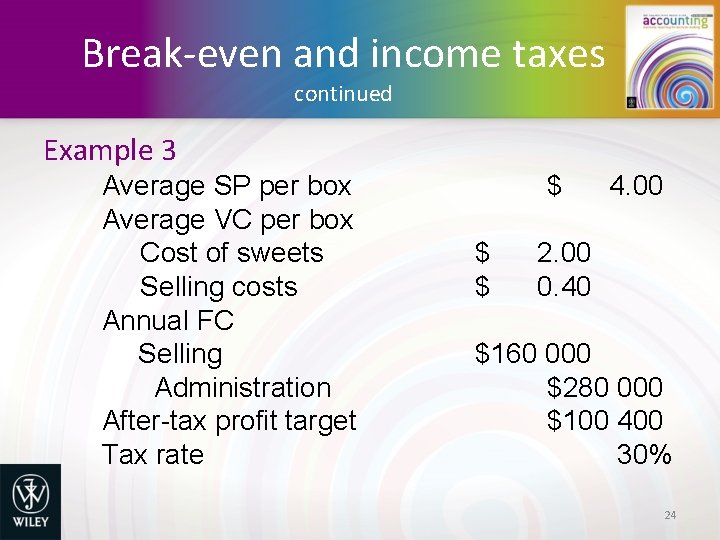
Break-even and income taxes continued Example 3 Average SP per box Average VC per box Cost of sweets Selling costs Annual FC Selling Administration After-tax profit target Tax rate $ $ $ 4. 00 2. 00 0. 40 $160 000 $280 000 $100 400 30% 24
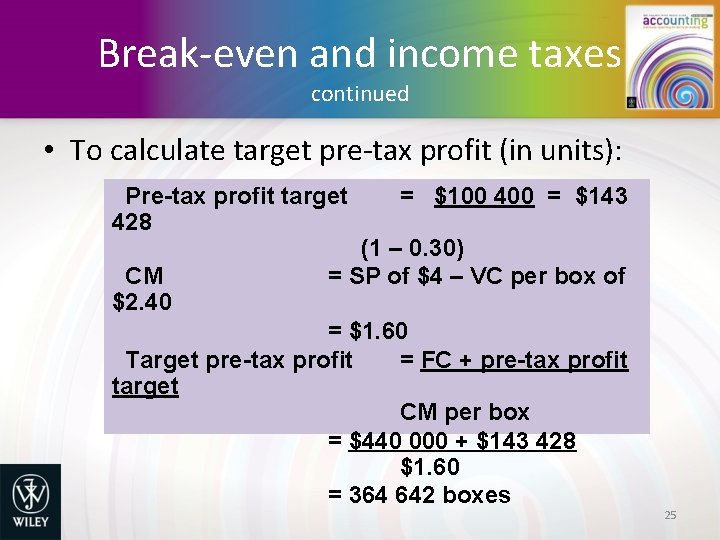
Break-even and income taxes continued • To calculate target pre-tax profit (in units): Pre-tax profit target 428 CM $2. 40 = $100 400 = $143 (1 – 0. 30) = SP of $4 – VC per box of = $1. 60 Target pre-tax profit = FC + pre-tax profit target CM per box = $440 000 + $143 428 $1. 60 = 364 642 boxes 25
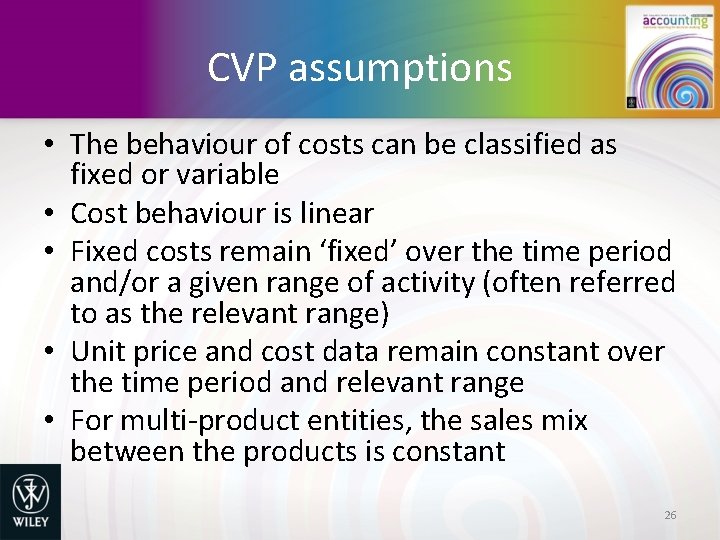
CVP assumptions • The behaviour of costs can be classified as fixed or variable • Cost behaviour is linear • Fixed costs remain ‘fixed’ over the time period and/or a given range of activity (often referred to as the relevant range) • Unit price and cost data remain constant over the time period and relevant range • For multi-product entities, the sales mix between the products is constant 26
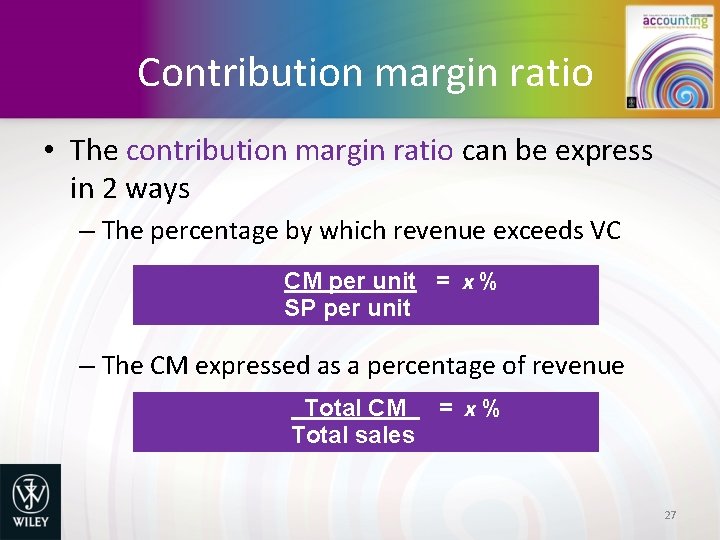
Contribution margin ratio • The contribution margin ratio can be express in 2 ways – The percentage by which revenue exceeds VC CM per unit = x % SP per unit – The CM expressed as a percentage of revenue Total CM Total sales = x% 27
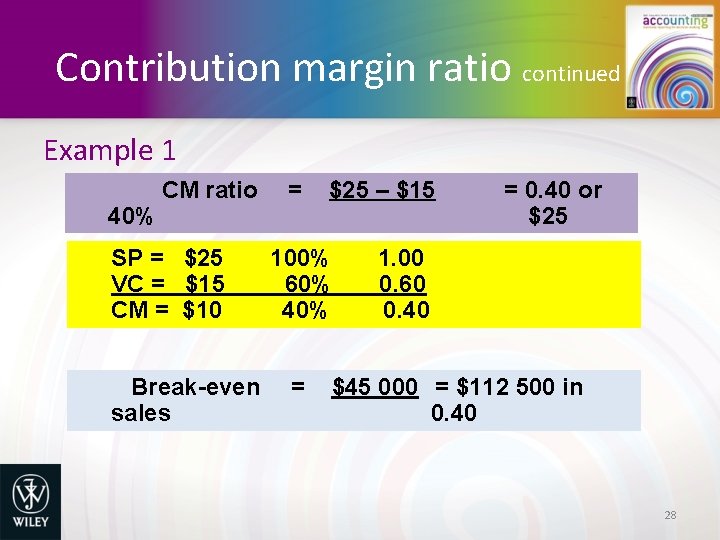
Contribution margin ratio continued Example 1 40% CM ratio SP = $25 VC = $15 CM = $10 Break-even sales = $25 – $15 100% 60% 40% = = 0. 40 or $25 1. 00 0. 60 0. 40 $45 000 = $112 500 in 0. 40 28
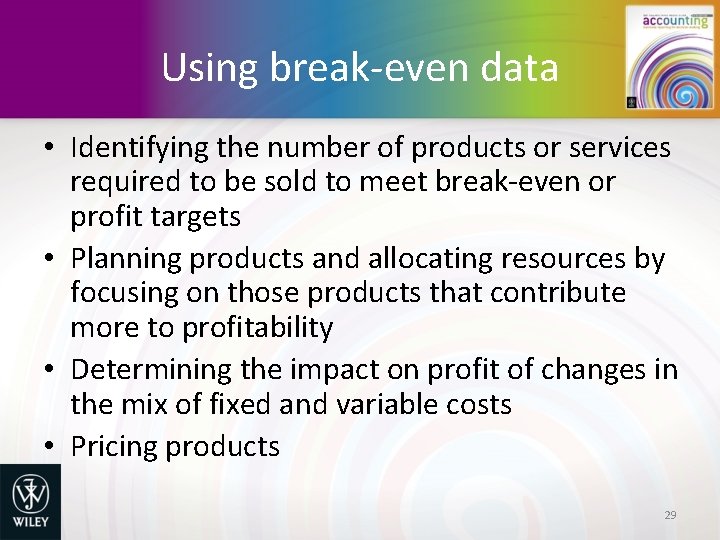
Using break-even data • Identifying the number of products or services required to be sold to meet break-even or profit targets • Planning products and allocating resources by focusing on those products that contribute more to profitability • Determining the impact on profit of changes in the mix of fixed and variable costs • Pricing products 29
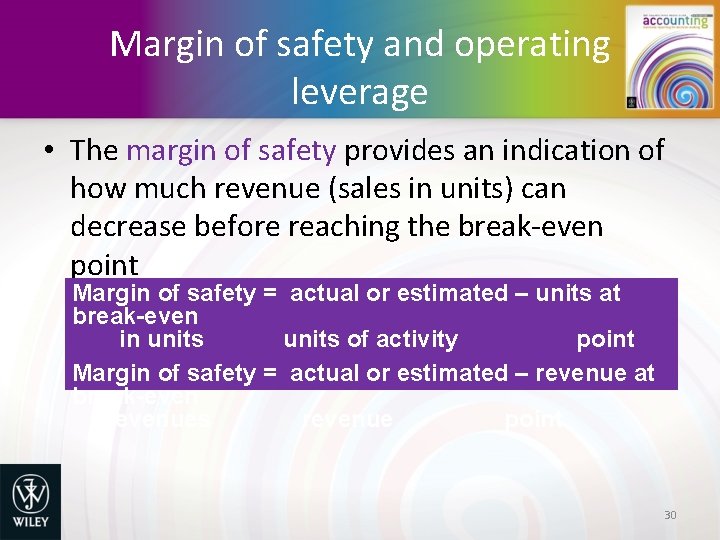
Margin of safety and operating leverage • The margin of safety provides an indication of how much revenue (sales in units) can decrease before reaching the break-even point Margin of safety = actual or estimated – units at break-even in units of activity point Margin of safety = actual or estimated – revenue at break-even revenues revenue point 30
Margin of safety and operating leverage continued • Operating leverage is the mix between FC and VC in the cost structure of an entity • It provides an understanding of the impact of changes in revenue on profit • Greater proportion of FC in a firm more highly leveraged more risky because fluctuations in sales higher fluctuations in profit 31
Margin of safety (example) • Modclean uses casual labour to demonstrate their product. – Variable cost $1 per unit • Human resource manager proposes to hire a part-time permanent employee – Fixed cost $10, 000 • If this proposal goes ahead – Variable costs drop by $1. 00 – Fixed Costs increase by $10, 000 32
Margin of safety (example, cont) • Is it worthwhile? – Determine level of sales at which profit would be the same. . . Fixed Costs/Variable costs – $10, 000/$1 = 10, 000 units – At this point we are indifferent because profit is same. 33
Margin of safety (example, cont) • Contribution margin under part time employee $25 – 14 = $11 • Contribution Margin under casual employee $25 – 15 = $10 • Therefore if sales fall below 10, 000 units they should use casual labour because profit reduces at a slower rate • and if sales rise above 10, 000 units they should use part-time labour because profit increases at a faster rate 34
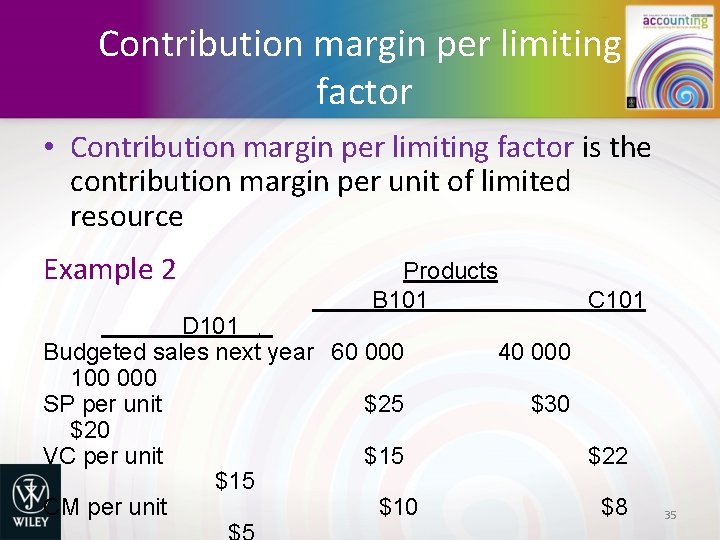
Contribution margin per limiting factor • Contribution margin per limiting factor is the contribution margin per unit of limited resource Example 2 Products B 101 D 101 Budgeted sales next year 60 000 100 000 SP per unit $25 $20 VC per unit $15 CM per unit $10 C 101 . 40 000 $30 $22 $8 35
Contribution margin per limiting factor continued • By summing the required hours, we find that the firm needs a total of 370 000 hours • BUT only 250 000 hours are available for production • Firm wants to know which product it should promote • This means we need to determine the most profitable product • To do this need to find CM per hour because time is the limiting factor 36
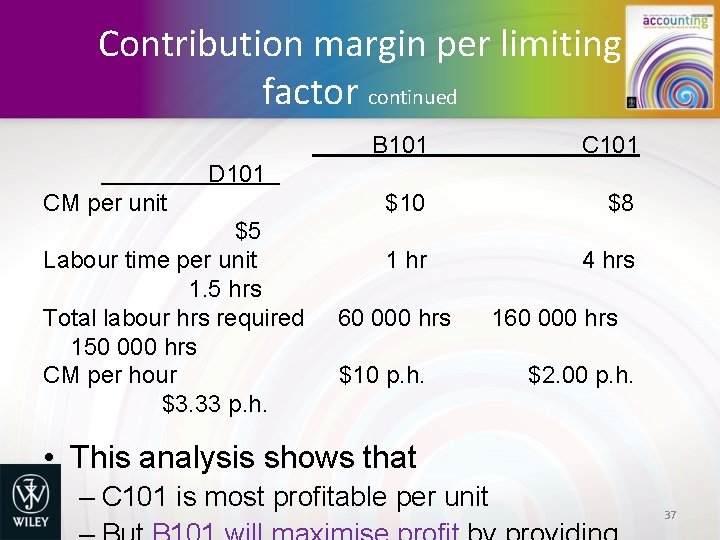
Contribution margin per limiting factor continued B 101 C 101 $10 $8 1 hr 4 hrs D 101 CM per unit $5 Labour time per unit 1. 5 hrs Total labour hrs required 150 000 hrs CM per hour $3. 33 p. h. 60 000 hrs $10 p. h. 160 000 hrs $2. 00 p. h. • This analysis shows that – C 101 is most profitable per unit 37
May and buy (outsourcing) and special order decision • To make sure decisions are based on the right information, the following must be identified where relevant: – Relevant costs and relevant income – Incremental costs and incremental income – Opportunity cost – Avoidable costs and unavoidable costs 38
May and buy (outsourcing) and special order decision continued • A make or buy decision requires an entity to choose whether – To make or buy a product or service OR – To outsource the production of that product or service • Such a decision will involve both quantitative and qualitative factors 39
May and buy (outsourcing) and special order decision continued • A special order is a one-off request from a customer that is different from the orders usually received by the entity • The incremental FC must be considered • These will be dependant on whether the entity is operating at full capacity, or has idle capacity (or available capacity) 40
Summary • CVP analysis is an important part of the planning process and serves as a useful decision-making tool • An understanding of fixed, variable and mixed costs is necessary to execute break-even analysis • Break-even analysis can be conducted for single-product/service entities and multiproduct/service entities 41
Summary continued • The concepts of margin of safety and operating leverage provide businesses with useful extensions to the basic CVP analysis and break-even calculations • Special attention needs to be given to limited resources • Entities use relevant income/costs to analyse make or buy and special order decisions 42

Homework Ch 10: CQ 10. 11, 10. 12 EX 10. 19, 10. 24, 10. 32 Due in Tutorial Next Week. 43
- Slides: 43