
Lecture 4 Consumer Choice Indifference Curve Theory Outline

- Slides: 28
Lecture 4 Consumer Choice Indifference Curve Theory
Outline • Indifference Curve Theory – Deriving an indifference curve – The Marginal rate of substitution – The Indifference Map – What happens when things change • Changes in Income • Changes in price – Derivation of the consumer’s demand curve
Preferences (Review) • An individual – can compare any two options and decide which is best, or if equally attractive – Makes choices that are logically consistent – Prefers more of a good to less
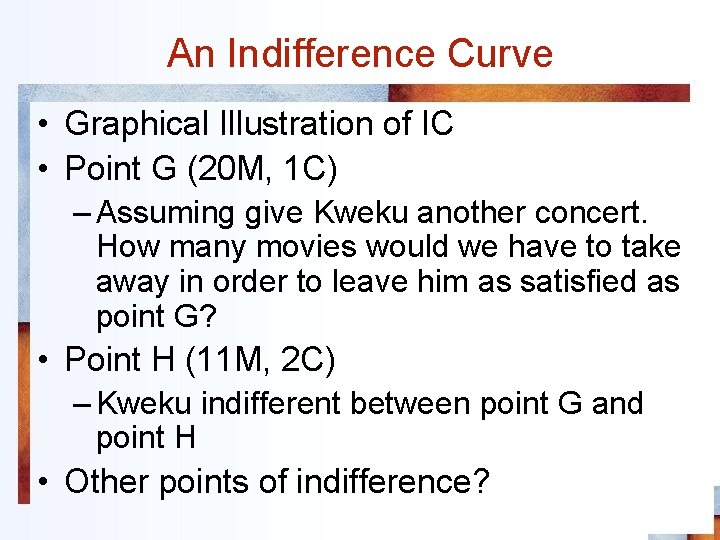
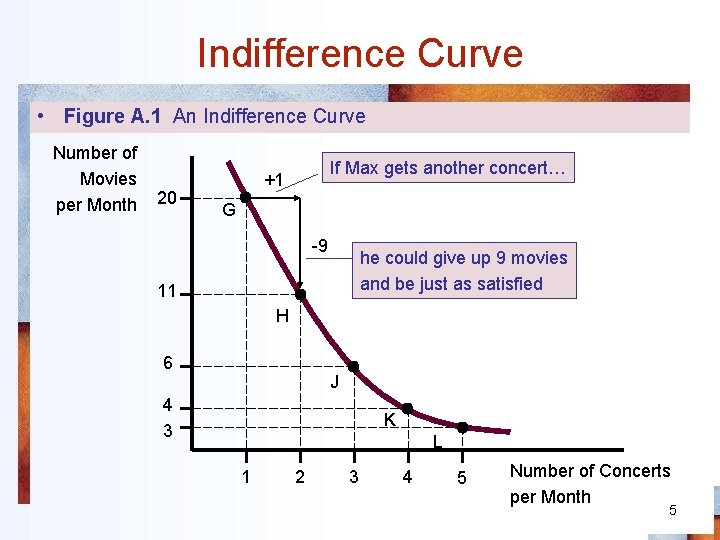
An Indifference Curve • Graphical Illustration of IC • Point G (20 M, 1 C) – Assuming give Kweku another concert. How many movies would we have to take away in order to leave him as satisfied as point G? • Point H (11 M, 2 C) – Kweku indifferent between point G and point H • Other points of indifference?
Indifference Curve • Figure A. 1 An Indifference Curve Number of Movies per Month 20 If Max gets another concert… +1 G -9 he could give up 9 movies and be just as satisfied 11 H 6 J 4 3 K L 1 2 3 4 5 Number of Concerts per Month 5
Indifference Curve • An IC represents all combinations of two goods that make a consumer equally well off. • Characteristics – An IC slopes downwards • Implication? – IC is convex-shaped i. e. As we move downwards and rightwards, curve becomes flatter • Why?
The Marginal Rate of Substitution • Absolute value of IC Slope – Maximum number of movies that Kweku willing to trade for one additional concert – E. g. At G, greatest number of movies Kweku would sacrifice for an extra concert is 9 • The MRS tells us the maximum amount of good y (movies) that a consumer would willingly trade for one more unit of good x (concerts) – When the quantity of good y is measured on the vertical axis and the quantity of good x is measured on the horizontal axis
The Marginal Rate of Substitution • As we move down the IC, the MRS gets smaller – The number of movies Kweku is willing to give away for an additional concert gets smaller and smaller – Why?
Diminishing Marginal Rate of Substitution • MRSm, c (slope of IC) relatively large at G – At G, Kweku has many movies and value them lowly – Willing to give movies away for additional concerts • MRSm, c (slope of IC) relatively small at L – At this point, Kweku has fewer movies and values them more highly. – Therefore, less willing to give movies away for additional concerts
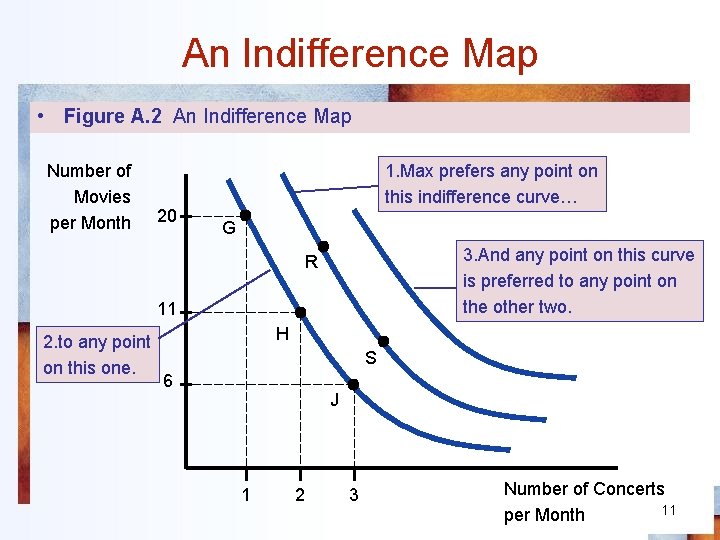
The Indifference Map • Consider point R with more movies and more concerts – Develop second indifference curve – Repeat process to trace out indifference map • An Indifference Map is a set of Indifference Curves that describe Kweku’s preferences – Complete characterization of one’s preferences
An Indifference Map • Figure A. 2 An Indifference Map Number of Movies per Month 20 1. Max prefers any point on this indifference curve… G 3. And any point on this curve is preferred to any point on the other two. R 11 2. to any point on this one. H S 6 J 1 2 3 Number of Concerts 11 per Month
The Indifference Map • Any point on a higher IC is preferred to any point below it- How do we know? – Consider points H and S – H has more movies but fewer concerts • S has more concerts but fewer movies – Why, then, is S preferred to H?
The Indifference Map • S on IC 2 is preferred to H on IC 1 • Examine indifference curves IC 1 and IC 2 – R is preferred to H • Since R has more of both goods – Kweku indifferent between R and S – Since indifferent between R and S, but prefers R to H, Kweku MUST prefer S to H! • Any point on a higher IC is preferred to any point below it
Violations of ICs • ICs should not ‘curl up’ – Implications? • ICs do not cross – Implications?
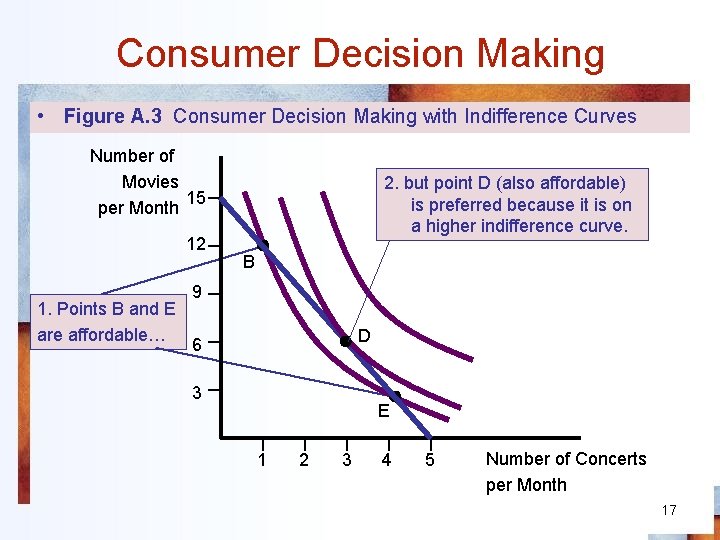
Consumer Decision-Making • Combine information on budget lines and indifference curves – Determine optimal combination of movies and concerts that Kweku should choose • In order to maximise his satisfaction – Kweku will consume at a point on his BL – It will lie on the highest possible IC – Combination on the budget line for which MRSy/x= Px /Py.
Consumer Decision-Making • At optimal point, slope of IC= slope of budget line • Slope of IC – Rate at which Kweku would willingly trade movies for concerts • Slope of BL – Rate at which Kweku is actually able to trade movies for concerts – Graphical Illustration
Consumer Decision Making • Figure A. 3 Consumer Decision Making with Indifference Curves Number of Movies 15 per Month 12 1. Points B and E are affordable… 2. but point D (also affordable) is preferred because it is on a higher indifference curve. B 9 D 6 3 E 1 2 3 4 5 Number of Concerts per Month 17
Consumer Decision-Making • At D, – Slope of IC = slope of BL = 3 – Rate at which Kweku is willing to trade movies for an additional concert is equal to rate at which he is able to trade movies for an additional concert
Changes in Income • Income rises – Normal good - quantity demanded increases – Inferior good - quantity demanded decreases – Depends on the individual’s preferences, as represented by his indifference map. 19
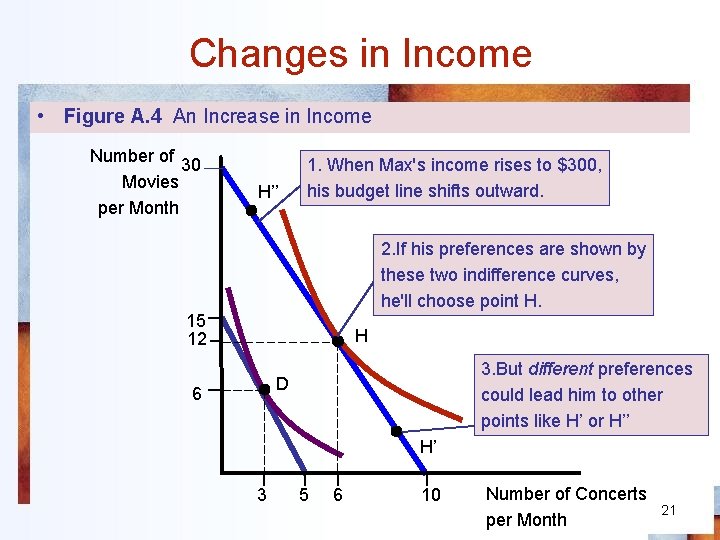
What happens when things change? Changes in Income • If Kweku income increases to Ghc 300 – BL shifts outwards • Kweku will shift downwards along his BL until he is tangent with highest IC
Changes in Income • Figure A. 4 An Increase in Income Number of 30 Movies per Month H’’ 1. When Max's income rises to $300, his budget line shifts outward. 2. If his preferences are shown by these two indifference curves, he'll choose point H. 15 12 H 3. But different preferences could lead him to other points like H’ or H’’ D 6 H’ 3 5 6 10 Number of Concerts per Month 21
Income-Consumption Line • For each level of income, there is an equilibrium position where IC is tangent to BL • Joining up these points of equilibrium, we derive an individual’s incomeconsumption line – Shows how consumption bundle changes as income changes, holding prices constant – Graphical illustration
What happens when things change? Changes in Price • If Price of concerts decreases from Ghc 30 to Ghc 10 – BL rotates
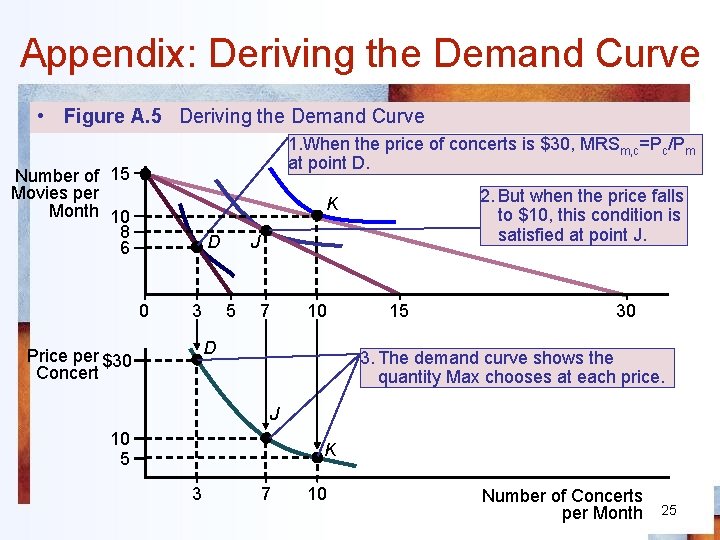
Derive the demand curve • Additional decreases in the price of concerts leads to continuous rotation of the budget line – (Graphical Illustration)
Appendix: Deriving the Demand Curve • Figure A. 5 Deriving the Demand Curve 1. When the price of concerts is $30, MRSm, c=Pc/Pm at point D. Number of 15 Movies per Month 10 8 6 2. But when the price falls to $10, this condition is satisfied at point J. K J D 0 3 5 7 10 D Price per $30 Concert 15 30 3. The demand curve shows the quantity Max chooses at each price. J 10 5 K 3 7 10 Number of Concerts per Month 25
Price-Consumption line • Change in price of a good changes the slope of the budget line, holding price of other good constant • There is an equilibrium consumption bundle for each price of the goods • Joining up these equilibriums gives the priceconsumption line – Line showing how a consumer’s purchases reacts to changes in price of one good, holding other price and income constant
Take-home Exercise 1 • Using the indifference curve approach – Draw a budget line for Akwesi, who has a monthly income of Ghc 100. Assume that he buys chicken and potatoes, and that chicken costs Ghc 10 per pound and potatoes cost Ghc 2 per pound. Add an indifference curve for Akwesi that is tangent to his budget line at the combination of 5 pounds of chicken and 25 pounds of potatoes. – Draw a new budget line for Akwesi, if his monthly income falls to Ghc 80. Assume that potatoes are an inferior good to Akwesi. Draw a new indifference curve tangent to his new budget constraint that reflects this inferiority. What will happen to Akwesi’s potato consumption? What will happen to his chicken consumption? 27
Next Class • Income and substitution effects • Individual and market demand • Wrap up 28