
Lecture 4 Complex numbers matrix algebra and partial
Lecture 4 Complex numbers, matrix algebra, and partial derivatives
Basic mathematics for QM l l l Complex numbers Matrix algebra Partial derivatives l l Derivative operators in the Schrödinger equations Kinetic-energy operators in the Cartesian and spherical coordinates.
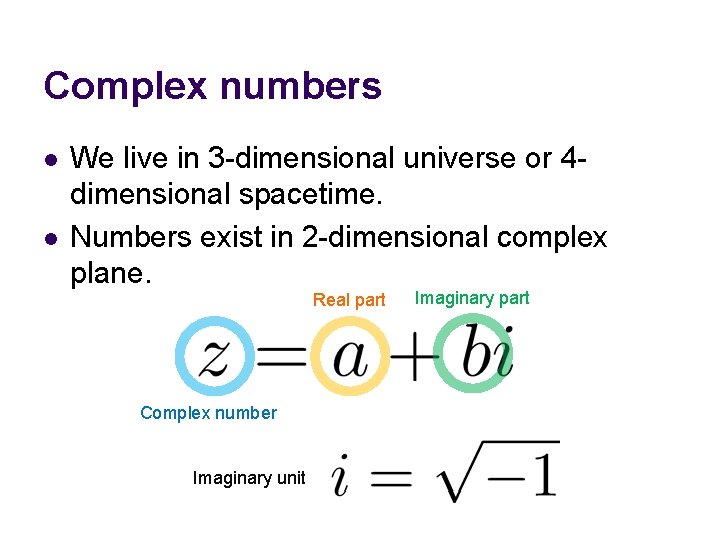
Complex numbers l l We live in 3 -dimensional universe or 4 dimensional spacetime. Numbers exist in 2 -dimensional complex plane. Real part Complex number Imaginary unit Imaginary part
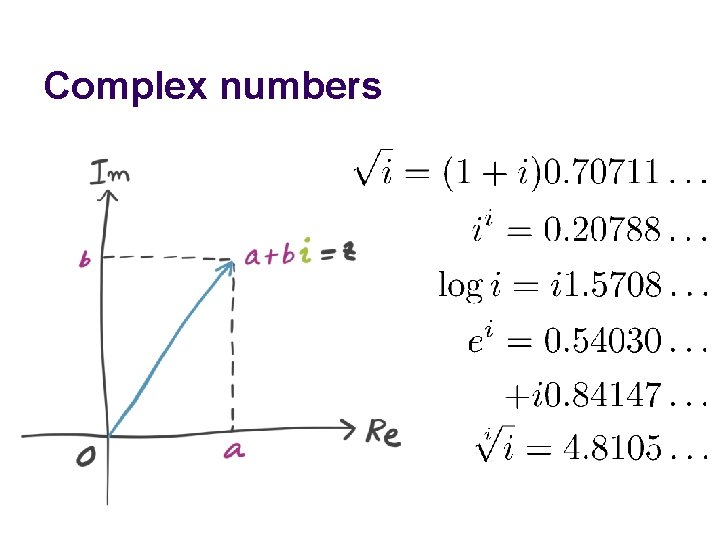
Complex numbers
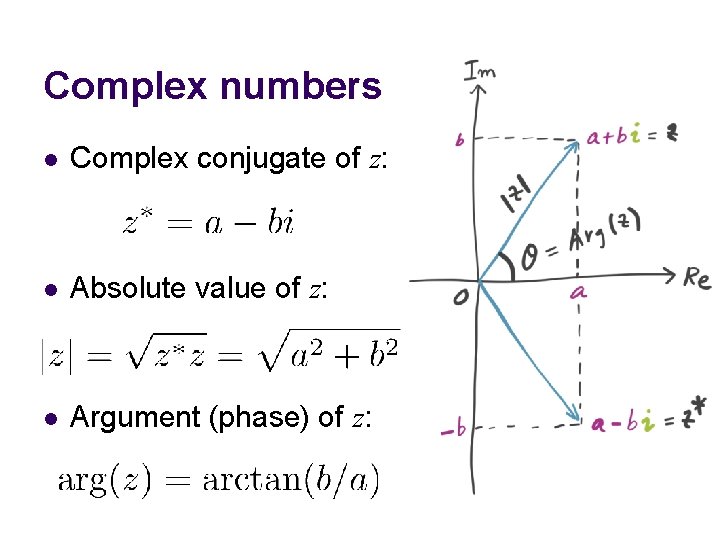
Complex numbers l Complex conjugate of z: l Absolute value of z: l Argument (phase) of z:
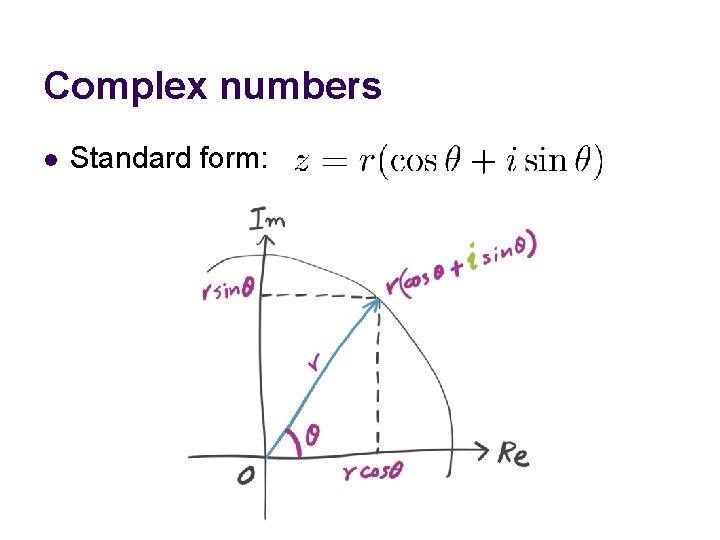
Complex numbers l Standard form:
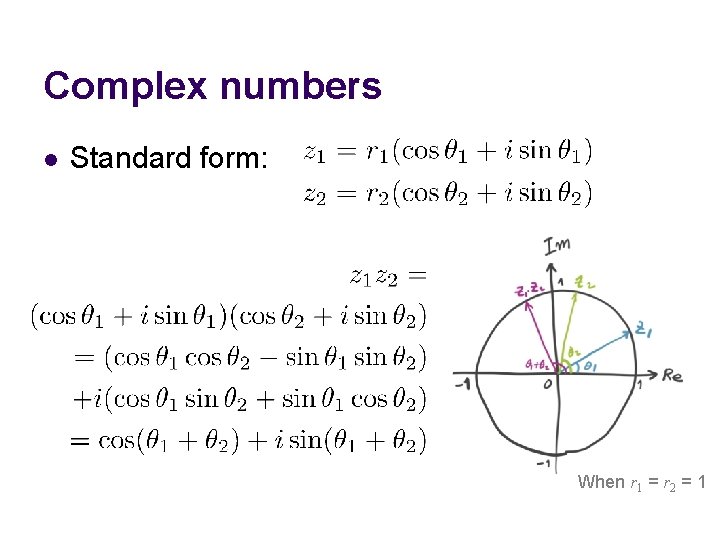
Complex numbers l Standard form: When r 1 = r 2 = 1
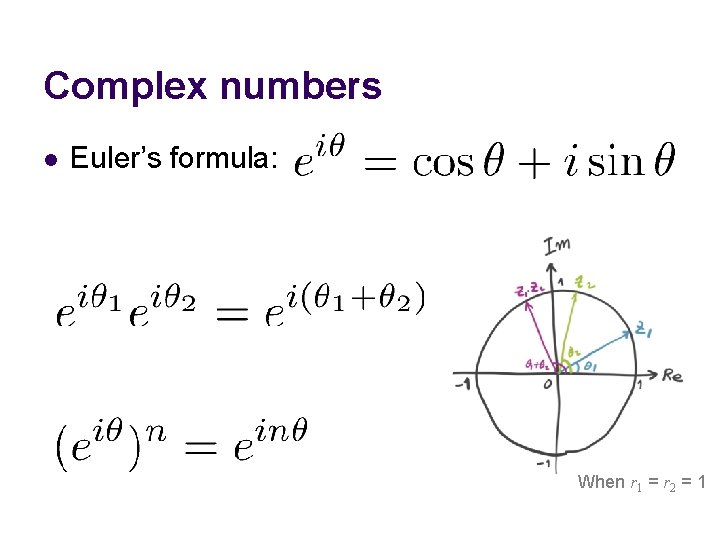
Complex numbers l Euler’s formula: When r 1 = r 2 = 1
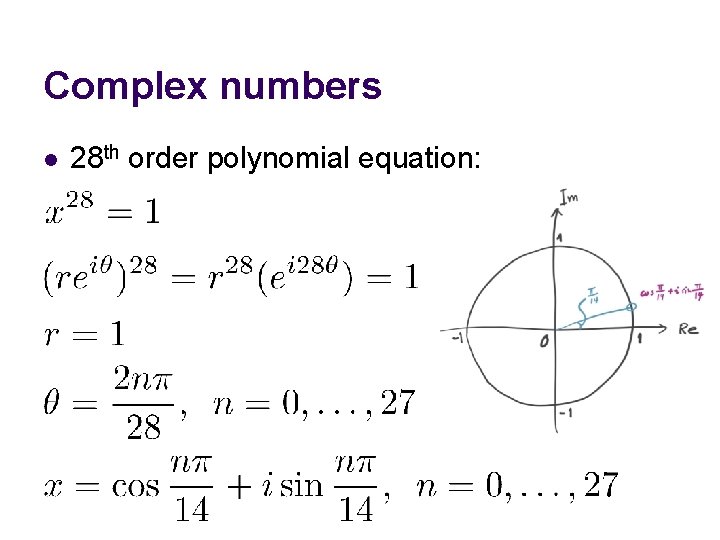
Complex numbers l 28 th order polynomial equation:
Matrix algebra l l l Matrices are everywhere in computational sciences and engineering. This is because a computer is extremely good at performing simple arithmetic operations on a huge array of numbers, rather than performing symbolic or analytic operations on higher constructs. QM has even stronger ties with matrix algebra.
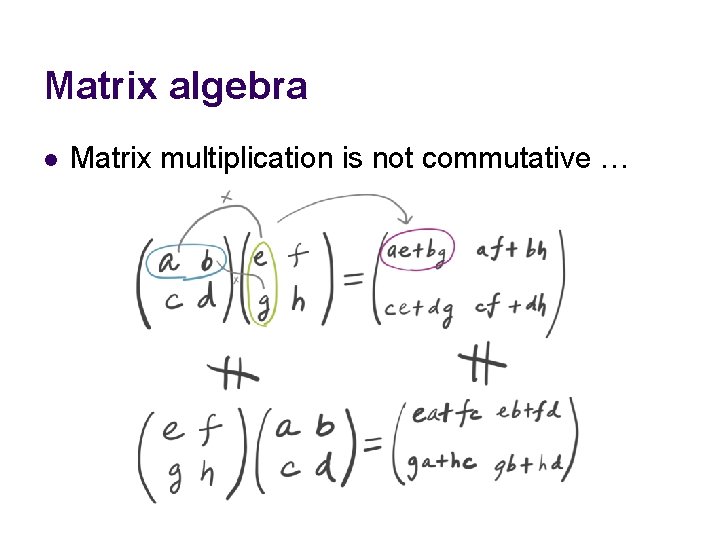
Matrix algebra l Matrix multiplication is not commutative …
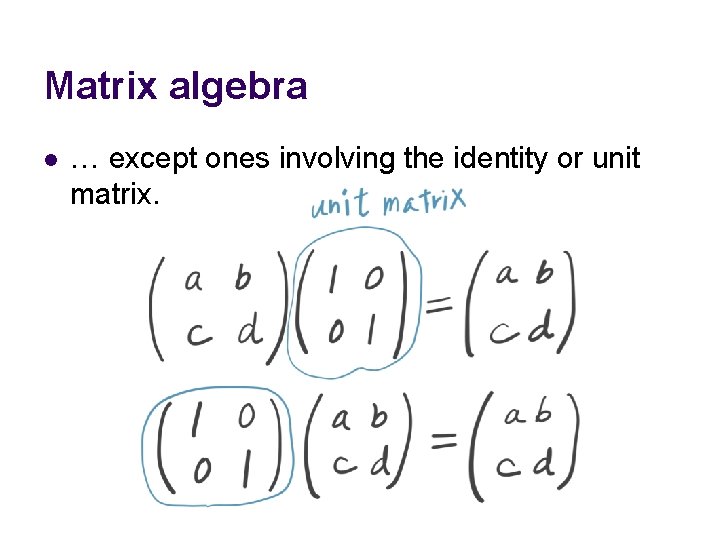
Matrix algebra l … except ones involving the identity or unit matrix.
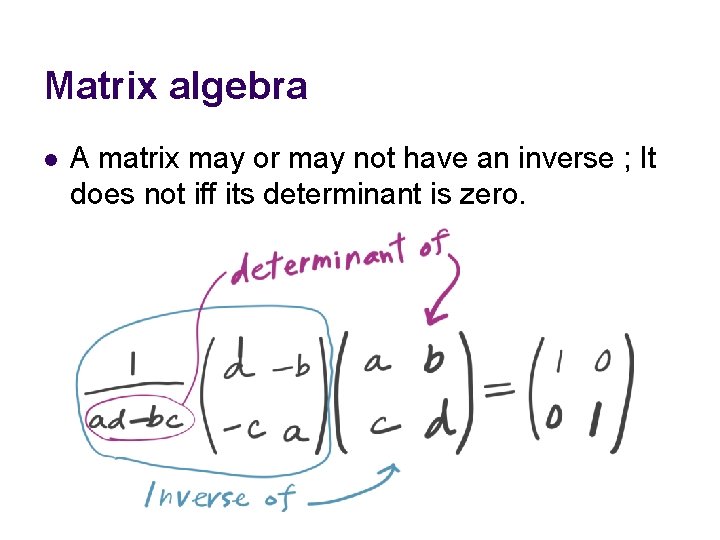
Matrix algebra l A matrix may or may not have an inverse ; It does not iff its determinant is zero.
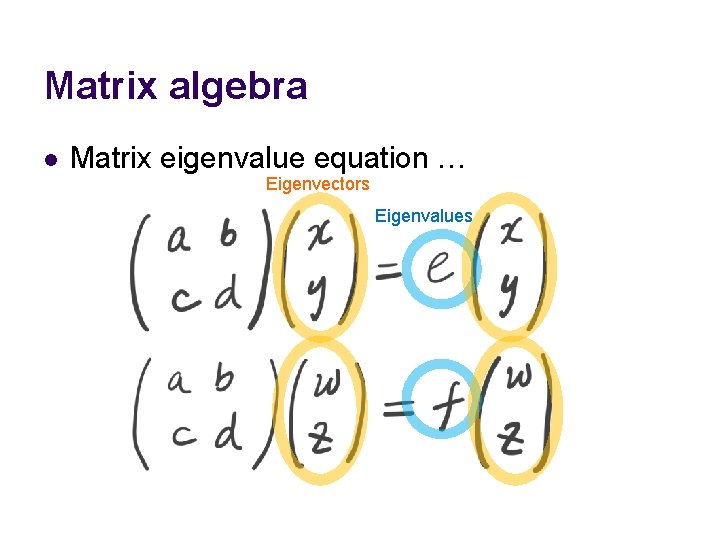
Matrix algebra l Matrix eigenvalue equation … Eigenvectors Eigenvalues
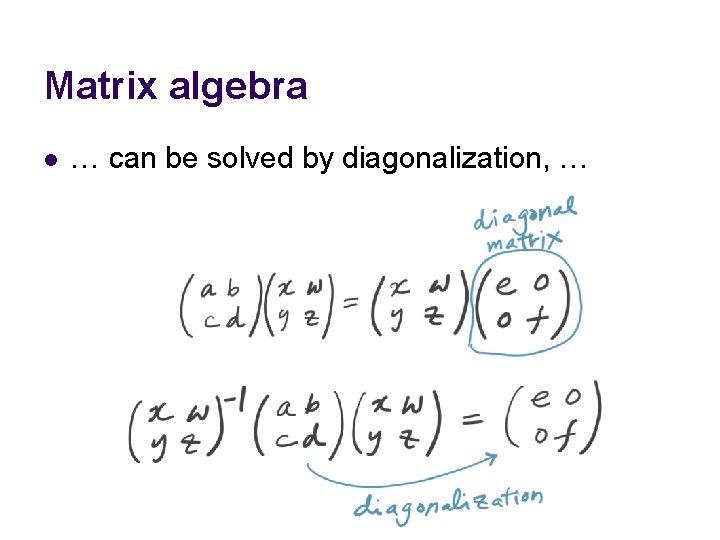
Matrix algebra l … can be solved by diagonalization, …
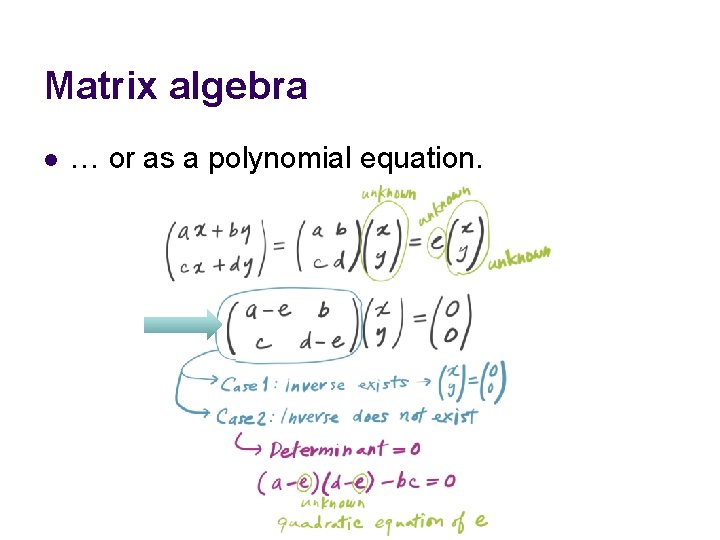
Matrix algebra l … or as a polynomial equation.
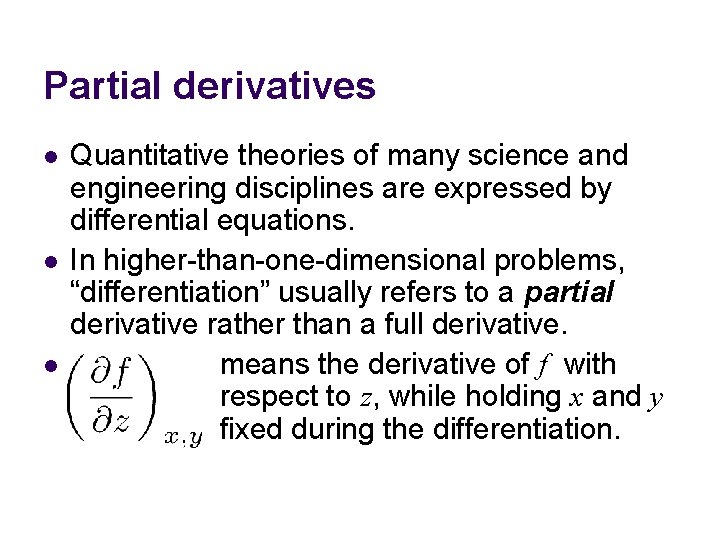
Partial derivatives l l l Quantitative theories of many science and engineering disciplines are expressed by differential equations. In higher-than-one-dimensional problems, “differentiation” usually refers to a partial derivative rather than a full derivative. means the derivative of f with respect to z, while holding x and y fixed during the differentiation.
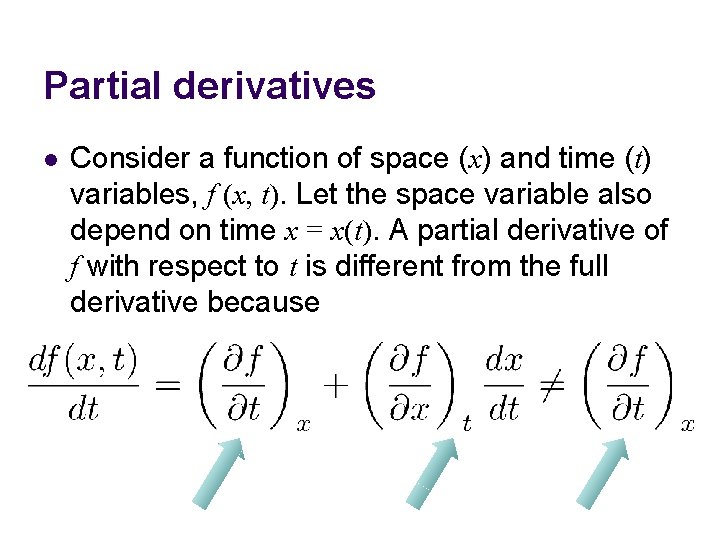
Partial derivatives l Consider a function of space (x) and time (t) variables, f (x, t). Let the space variable also depend on time x = x(t). A partial derivative of f with respect to t is different from the full derivative because
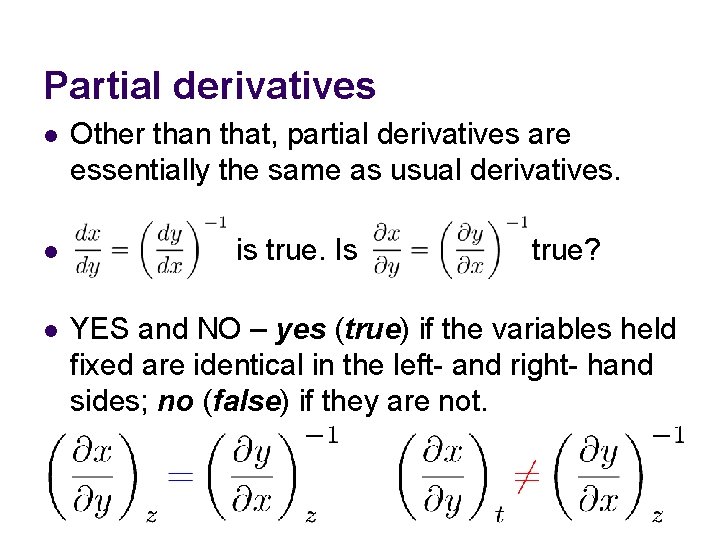
Partial derivatives l l l Other than that, partial derivatives are essentially the same as usual derivatives. is true. Is true? YES and NO – yes (true) if the variables held fixed are identical in the left- and right- hand sides; no (false) if they are not.
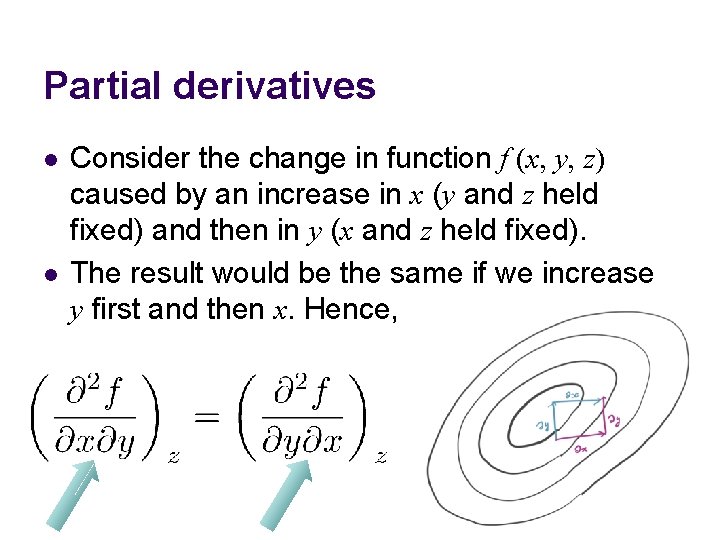
Partial derivatives l l Consider the change in function f (x, y, z) caused by an increase in x (y and z held fixed) and then in y (x and z held fixed). The result would be the same if we increase y first and then x. Hence,
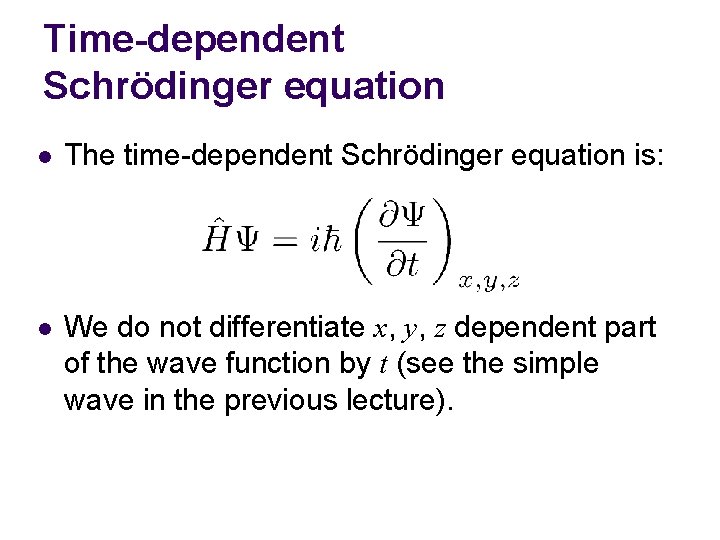
Time-dependent Schrödinger equation l The time-dependent Schrödinger equation is: l We do not differentiate x, y, z dependent part of the wave function by t (see the simple wave in the previous lecture).
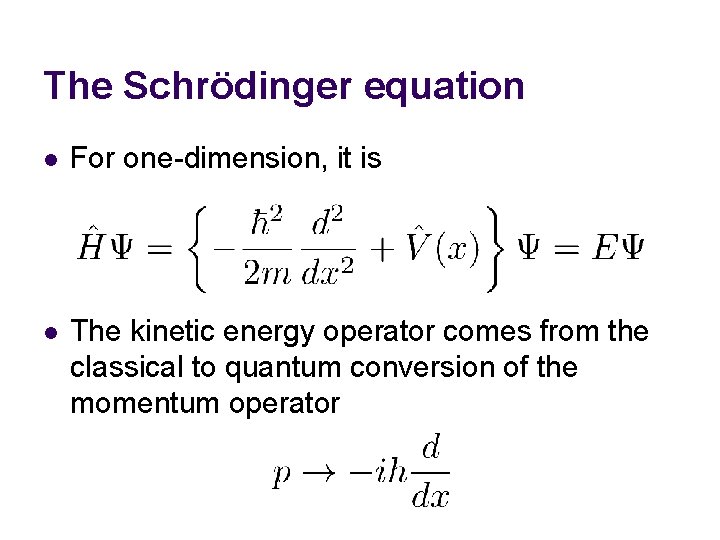
The Schrödinger equation l For one-dimension, it is l The kinetic energy operator comes from the classical to quantum conversion of the momentum operator
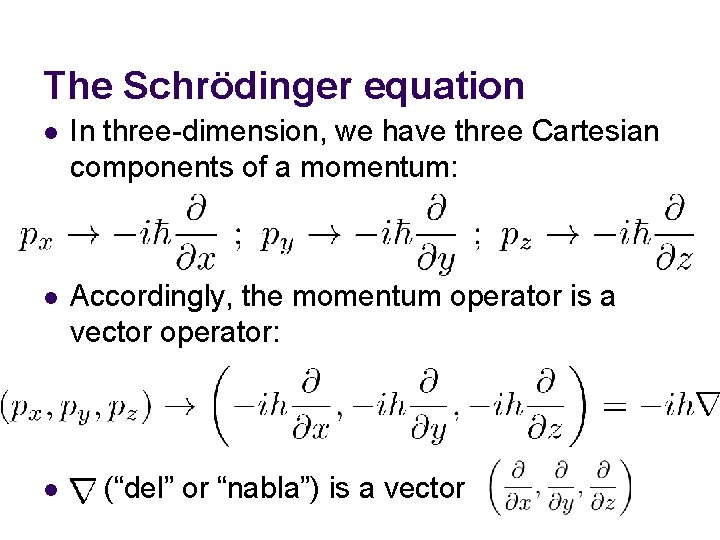
The Schrödinger equation l In three-dimension, we have three Cartesian components of a momentum: l Accordingly, the momentum operator is a vector operator: l (“del” or “nabla”) is a vector
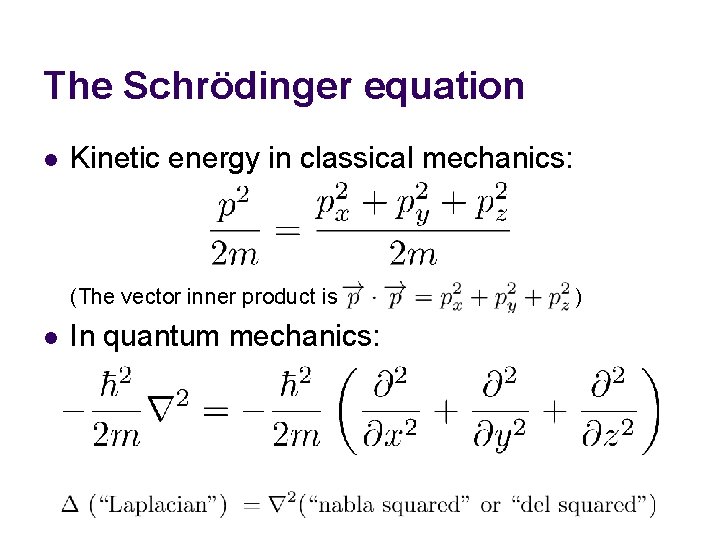
The Schrödinger equation l Kinetic energy in classical mechanics: (The vector inner product is l In quantum mechanics: )
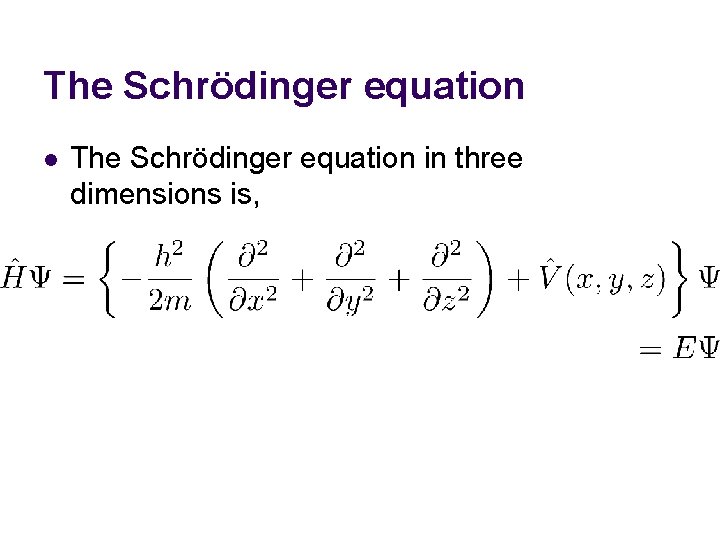
The Schrödinger equation l The Schrödinger equation in three dimensions is,
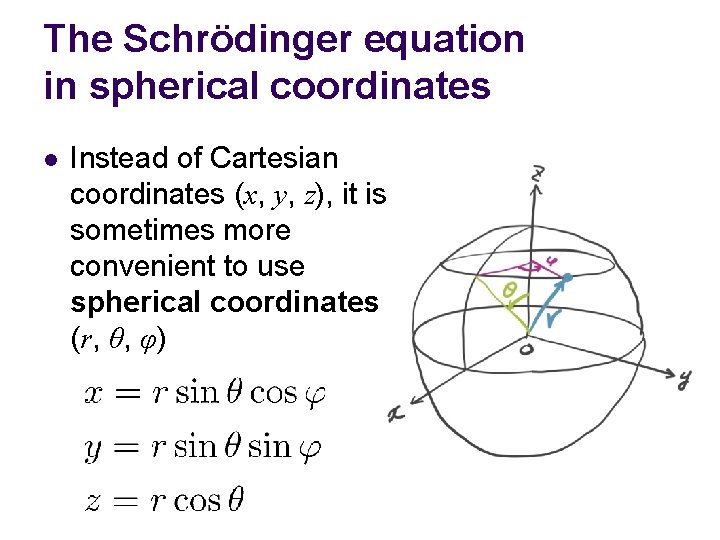
The Schrödinger equation in spherical coordinates l Instead of Cartesian coordinates (x, y, z), it is sometimes more convenient to use spherical coordinates (r, θ, φ)
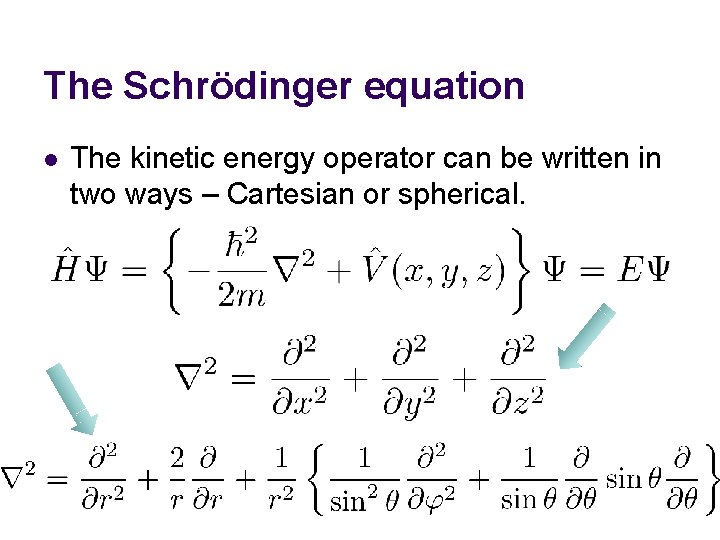
The Schrödinger equation l The kinetic energy operator can be written in two ways – Cartesian or spherical.
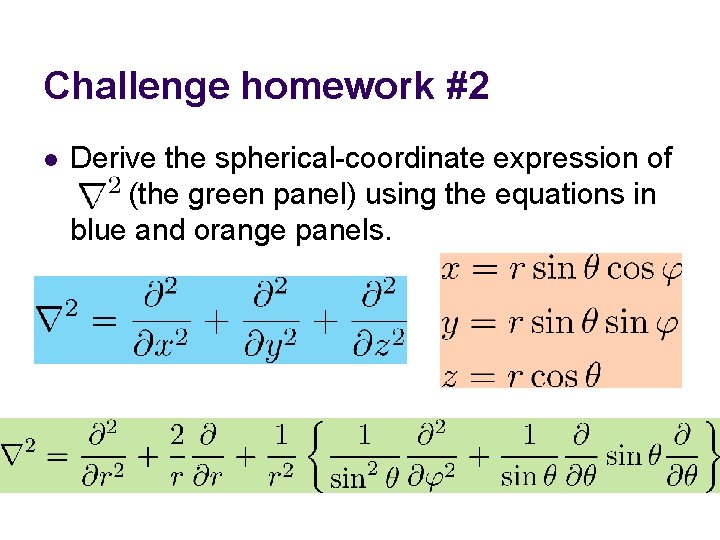
Challenge homework #2 l Derive the spherical-coordinate expression of (the green panel) using the equations in blue and orange panels.
Summary l l l We have reviewed some basic, but essential concepts of mathematics for quantum mechanics. The derivative operators in the Schrödinger equations are partial derivatives. The kinetic-energy operators in the Cartesian and spherical coordinates are presented.
- Slides: 29