
Lecture 4 Chapter 11 Security Protocols Network Security
- Slides: 33
Lecture 4 (Chapter 11) Security Protocols Network Security Threats Security and Cryptography Network Security Protocols Cryptographic Algorithms
Chapter 11 Security Protocols Network Security Threats
Network Security l The combination of low-cost powerful computing and high-performance networks is a two-edged sword: l l l Many powerful new services and applications are enabled But computer systems and networks become highly susceptible to a wide variety of security threats Network security involves countermeasures to protect computer systems from intruders l l Firewalls, security protocols, security practices We will focus on security protocols
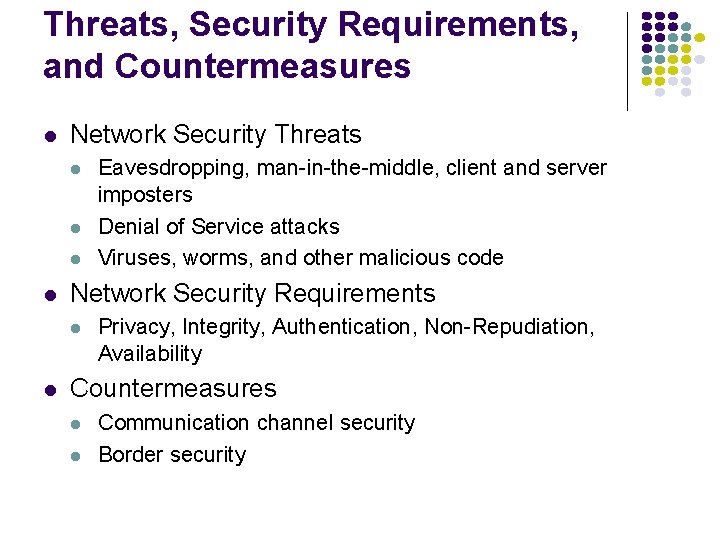
Threats, Security Requirements, and Countermeasures l Network Security Threats l l Network Security Requirements l l Eavesdropping, man-in-the-middle, client and server imposters Denial of Service attacks Viruses, worms, and other malicious code Privacy, Integrity, Authentication, Non-Repudiation, Availability Countermeasures l l Communication channel security Border security
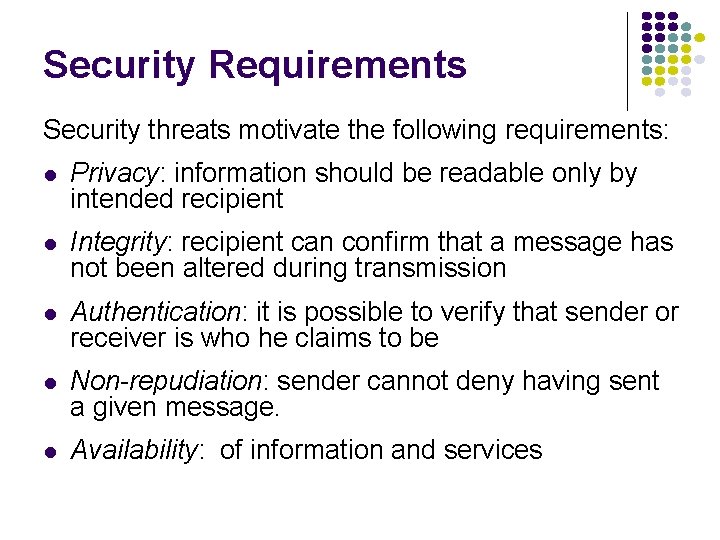
Security Requirements Security threats motivate the following requirements: l Privacy: information should be readable only by intended recipient l Integrity: recipient can confirm that a message has not been altered during transmission l Authentication: it is possible to verify that sender or receiver is who he claims to be l Non-repudiation: sender cannot deny having sent a given message. l Availability: of information and services
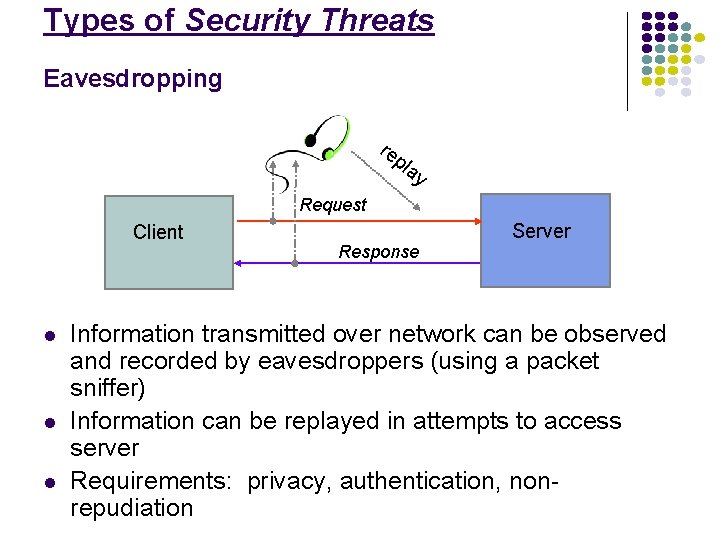
Types of Security Threats Eavesdropping re pl ay Request Client l l l Response Server Information transmitted over network can be observed and recorded by eavesdroppers (using a packet sniffer) Information can be replayed in attempts to access server Requirements: privacy, authentication, nonrepudiation
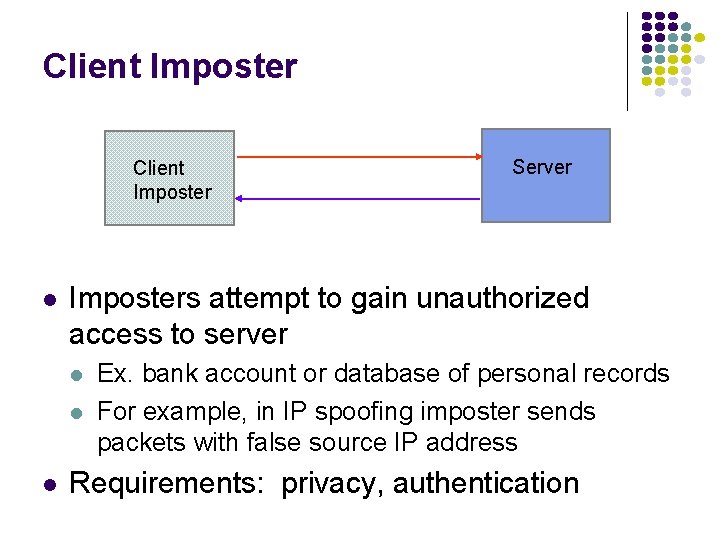
Client Imposter l Imposters attempt to gain unauthorized access to server l l l Server Ex. bank account or database of personal records For example, in IP spoofing imposter sends packets with false source IP address Requirements: privacy, authentication
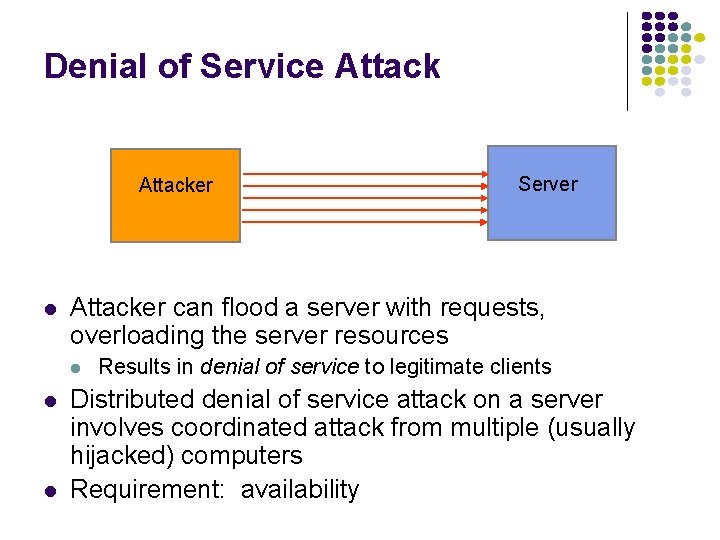
Denial of Service Attacker l Attacker can flood a server with requests, overloading the server resources l l l Server Results in denial of service to legitimate clients Distributed denial of service attack on a server involves coordinated attack from multiple (usually hijacked) computers Requirement: availability
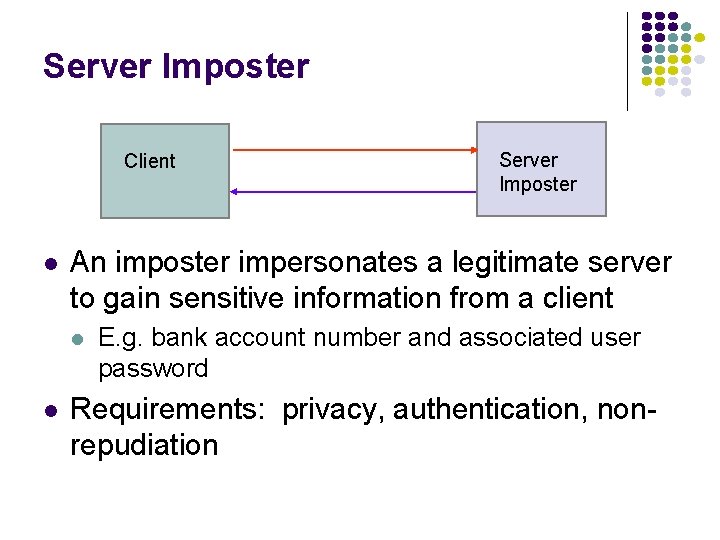
Server Imposter Client l An imposter impersonates a legitimate server to gain sensitive information from a client l l Server Imposter E. g. bank account number and associated user password Requirements: privacy, authentication, nonrepudiation
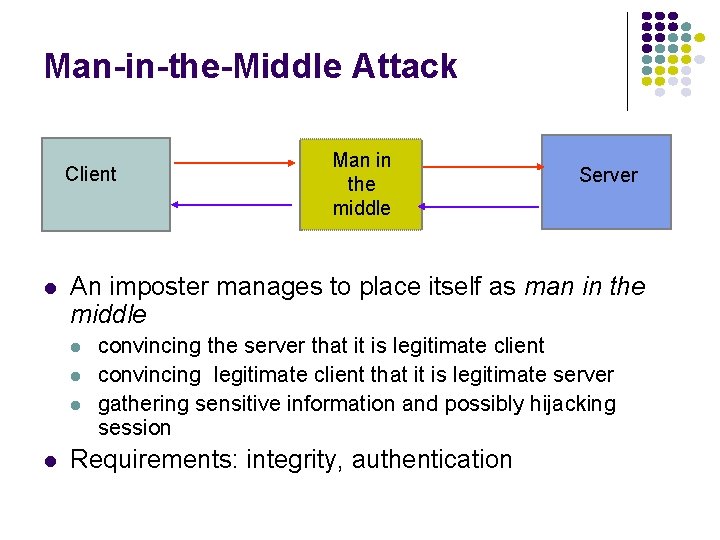
Man-in-the-Middle Attack Client l Server An imposter manages to place itself as man in the middle l l Man in the middle convincing the server that it is legitimate client convincing legitimate client that it is legitimate server gathering sensitive information and possibly hijacking session Requirements: integrity, authentication
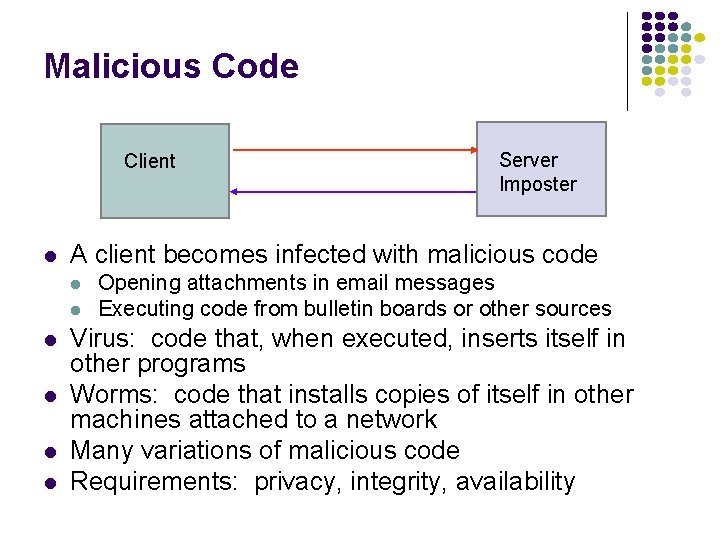
Malicious Code Client l A client becomes infected with malicious code l l l Server Imposter Opening attachments in email messages Executing code from bulletin boards or other sources Virus: code that, when executed, inserts itself in other programs Worms: code that installs copies of itself in other machines attached to a network Many variations of malicious code Requirements: privacy, integrity, availability
Countermeasures Secure communication channels l Encryption l Cryptographic checksums and hashes l Authentication l Digital Signatures
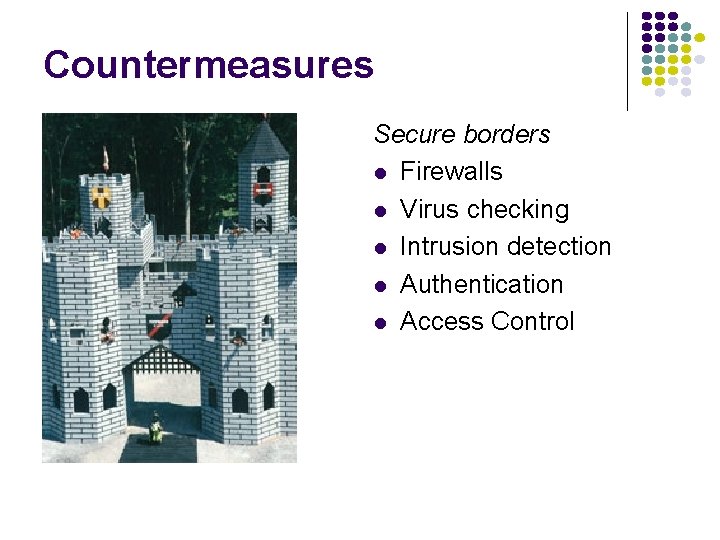
Countermeasures Secure borders l Firewalls l Virus checking l Intrusion detection l Authentication l Access Control
Chapter 11 Security Protocols Security and Cryptography
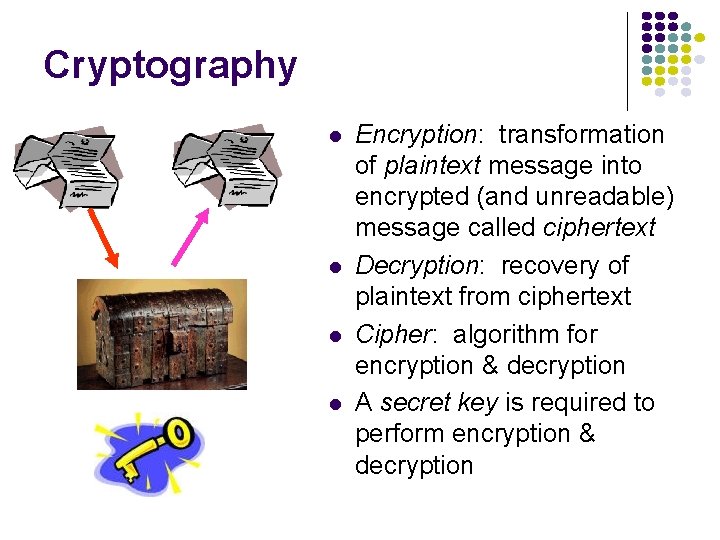
Cryptography l l Encryption: transformation of plaintext message into encrypted (and unreadable) message called ciphertext Decryption: recovery of plaintext from ciphertext Cipher: algorithm for encryption & decryption A secret key is required to perform encryption & decryption
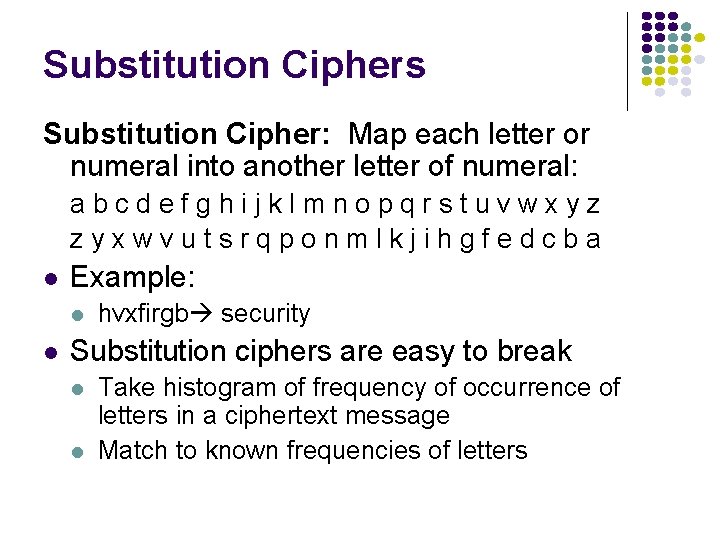
Substitution Ciphers Substitution Cipher: Map each letter or numeral into another letter of numeral: abcdefghijklmnopqrstuvwxyz zyxwvutsrqponmlkjihgfedcba l Example: l l hvxfirgb security Substitution ciphers are easy to break l l Take histogram of frequency of occurrence of letters in a ciphertext message Match to known frequencies of letters
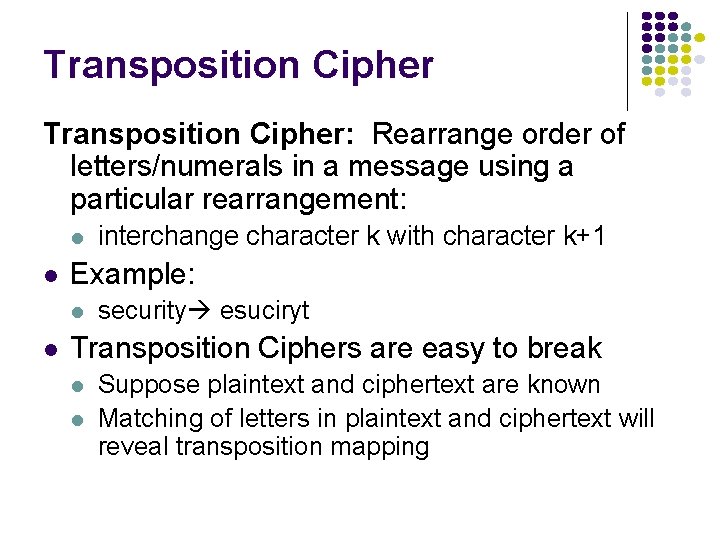
Transposition Cipher: Rearrange order of letters/numerals in a message using a particular rearrangement: l l Example: l l interchange character k with character k+1 security esuciryt Transposition Ciphers are easy to break l l Suppose plaintext and ciphertext are known Matching of letters in plaintext and ciphertext will reveal transposition mapping
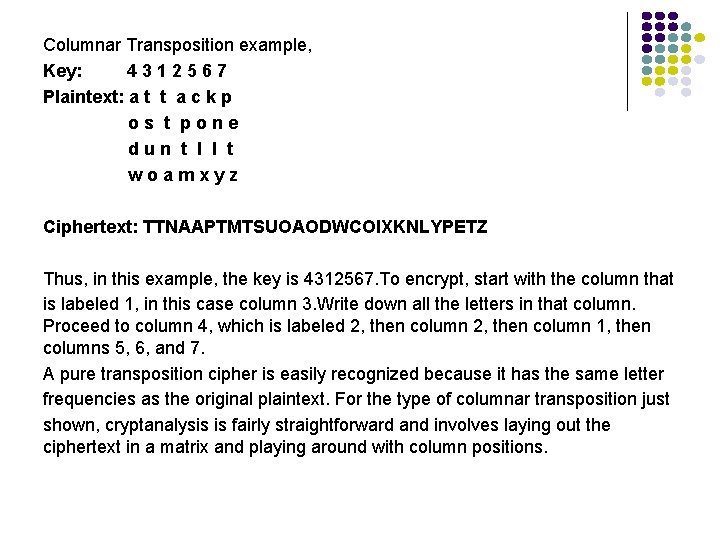
Columnar Transposition example, Key: 4312567 Plaintext: a t t a c k p os t pone dun t I l t woamxyz Ciphertext: TTNAAPTMTSUOAODWCOIXKNLYPETZ Thus, in this example, the key is 4312567. To encrypt, start with the column that is labeled 1, in this case column 3. Write down all the letters in that column. Proceed to column 4, which is labeled 2, then column 1, then columns 5, 6, and 7. A pure transposition cipher is easily recognized because it has the same letter frequencies as the original plaintext. For the type of columnar transposition just shown, cryptanalysis is fairly straightforward and involves laying out the ciphertext in a matrix and playing around with column positions.
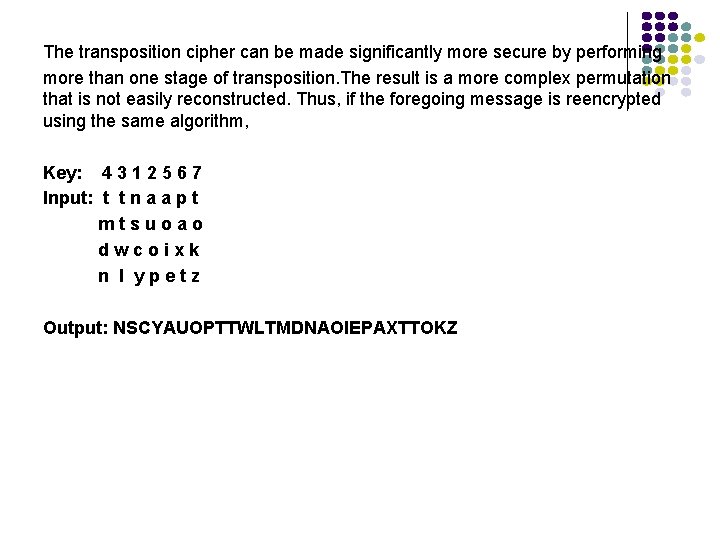
The transposition cipher can be made significantly more secure by performing more than one stage of transposition. The result is a more complex permutation that is not easily reconstructed. Thus, if the foregoing message is reencrypted using the same algorithm, Key: 4 3 1 2 5 6 7 Input: t t n a a p t mtsuoao dwcoixk n l ypetz Output: NSCYAUOPTTWLTMDNAOIEPAXTTOKZ
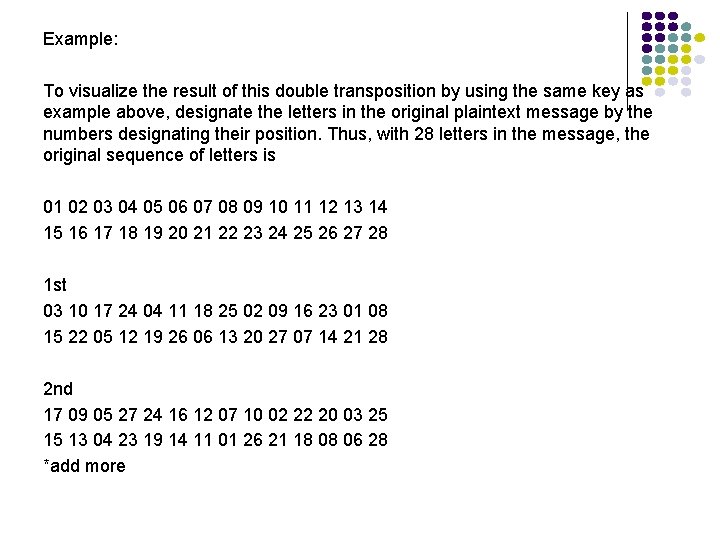
Example: To visualize the result of this double transposition by using the same key as example above, designate the letters in the original plaintext message by the numbers designating their position. Thus, with 28 letters in the message, the original sequence of letters is 01 02 03 04 05 06 07 08 09 10 11 12 13 14 15 16 17 18 19 20 21 22 23 24 25 26 27 28 1 st 03 10 17 24 04 11 18 25 02 09 16 23 01 08 15 22 05 12 19 26 06 13 20 27 07 14 21 28 2 nd 17 09 05 27 24 16 12 07 10 02 22 20 03 25 15 13 04 23 19 14 11 01 26 21 18 08 06 28 *add more
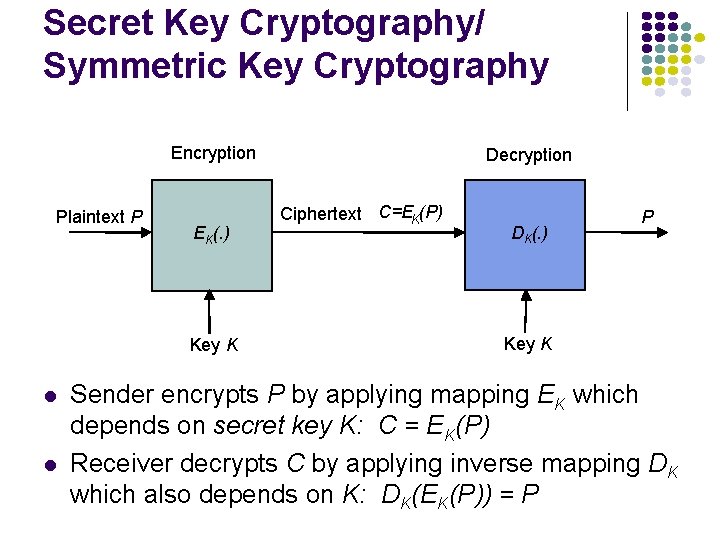
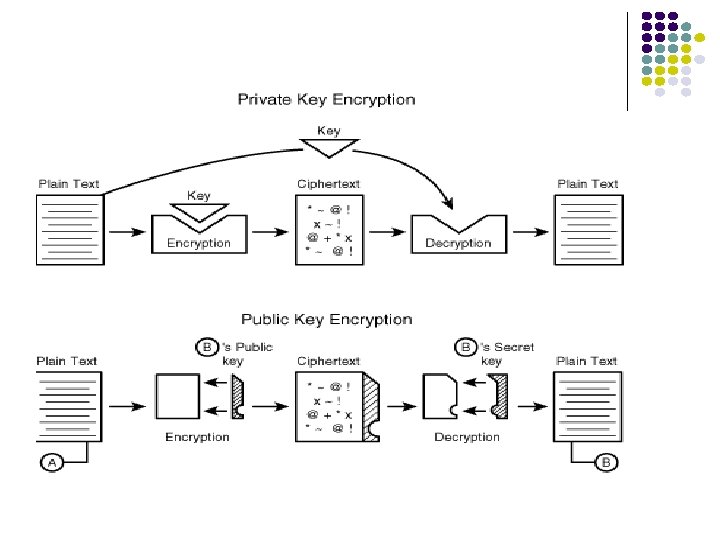
Secret Key Cryptography/ Symmetric Key Cryptography Encryption Plaintext P EK(. ) Key K l l Decryption Ciphertext C=EK(P) DK(. ) P Key K Sender encrypts P by applying mapping EK which depends on secret key K: C = EK(P) Receiver decrypts C by applying inverse mapping DK which also depends on K: DK(EK(P)) = P
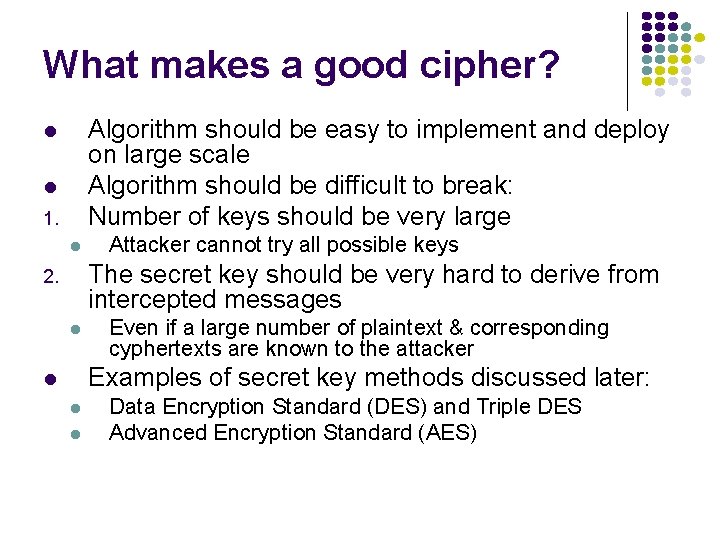
What makes a good cipher? Algorithm should be easy to implement and deploy on large scale Algorithm should be difficult to break: Number of keys should be very large l l 1. l Attacker cannot try all possible keys The secret key should be very hard to derive from intercepted messages 2. l Even if a large number of plaintext & corresponding cyphertexts are known to the attacker Examples of secret key methods discussed later: l l l Data Encryption Standard (DES) and Triple DES Advanced Encryption Standard (AES)
Security using Secret Key Cryptography l l Privacy: secret key provides messages confidential Integrity: alteration of the cyphertext will be detected, because the decrypted message will be gibberish l l When privacy is not required, encryption of the entire message is overkill because much processing involved We will see that cryptographic checksums provide integrity and require less processing
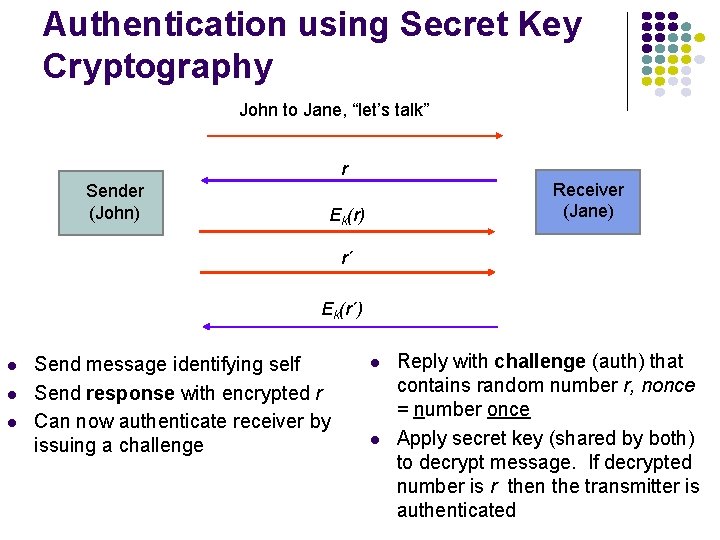
Authentication using Secret Key Cryptography John to Jane, “let’s talk” r Sender (John) Receiver (Jane) Ek(r) r´ Ek(r´) l l l Send message identifying self Send response with encrypted r Can now authenticate receiver by issuing a challenge l l Reply with challenge (auth) that contains random number r, nonce = number once Apply secret key (shared by both) to decrypt message. If decrypted number is r then the transmitter is authenticated
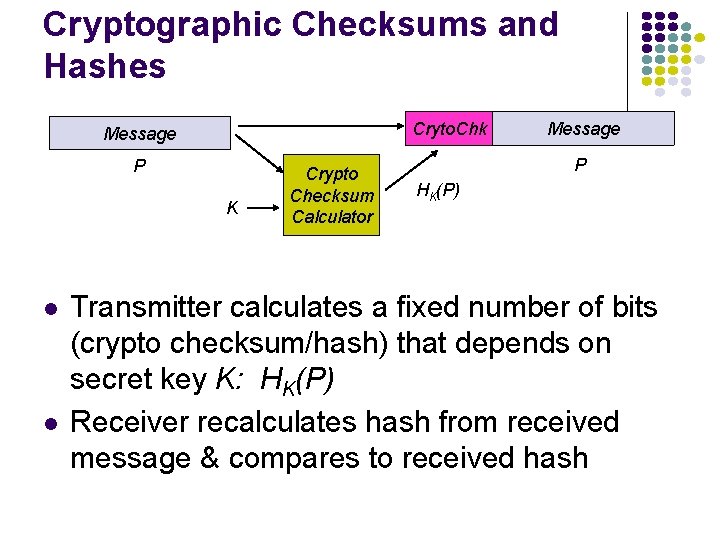
Cryptographic Checksums and Hashes Cryto. Chk Message P K l l Crypto Checksum Calculator Message P HK(P) Transmitter calculates a fixed number of bits (crypto checksum/hash) that depends on secret key K: HK(P) Receiver recalculates hash from received message & compares to received hash
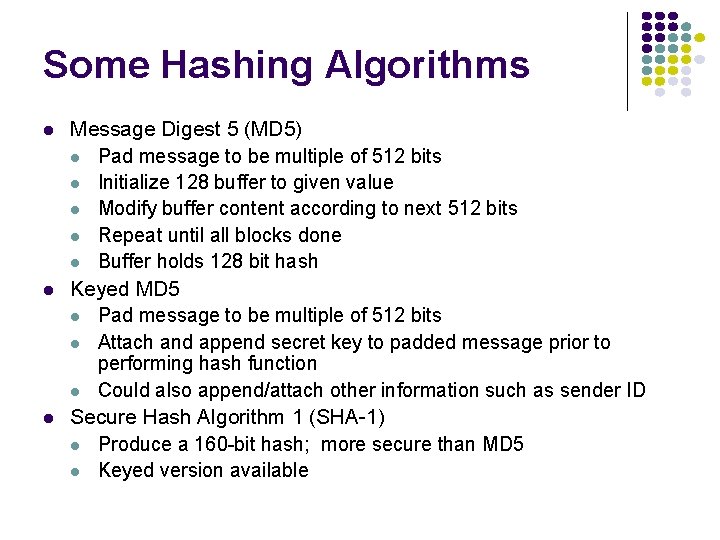
Some Hashing Algorithms l l l Message Digest 5 (MD 5) l Pad message to be multiple of 512 bits l Initialize 128 buffer to given value l Modify buffer content according to next 512 bits l Repeat until all blocks done l Buffer holds 128 bit hash Keyed MD 5 l Pad message to be multiple of 512 bits l Attach and append secret key to padded message prior to performing hash function l Could also append/attach other information such as sender ID Secure Hash Algorithm 1 (SHA-1) l Produce a 160 -bit hash; more secure than MD 5 l Keyed version available
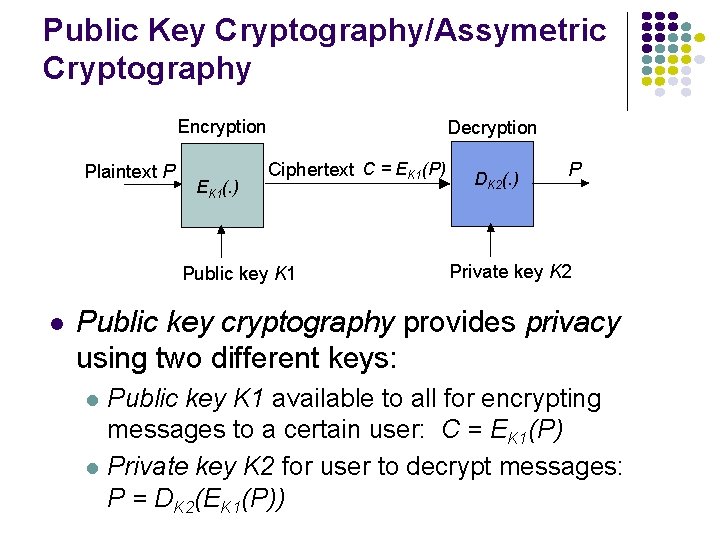
Public Key Cryptography/Assymetric Cryptography Encryption Plaintext P EK 1(. ) Decryption Ciphertext C = EK 1(P) Public key K 1 l DK 2(. ) P Private key K 2 Public key cryptography provides privacy using two different keys: l l Public key K 1 available to all for encrypting messages to a certain user: C = EK 1(P) Private key K 2 for user to decrypt messages: P = DK 2(EK 1(P))
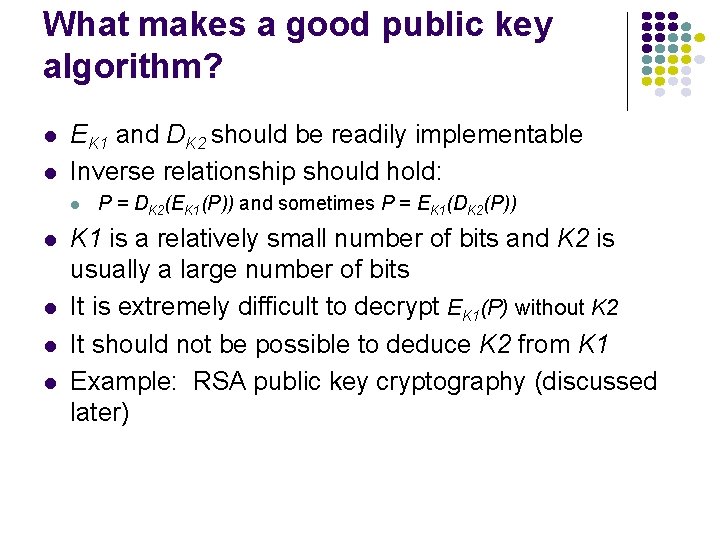
What makes a good public key algorithm? l l EK 1 and DK 2 should be readily implementable Inverse relationship should hold: l l l P = DK 2(EK 1(P)) and sometimes P = EK 1(DK 2(P)) K 1 is a relatively small number of bits and K 2 is usually a large number of bits It is extremely difficult to decrypt EK 1(P) without K 2 It should not be possible to deduce K 2 from K 1 Example: RSA public key cryptography (discussed later)
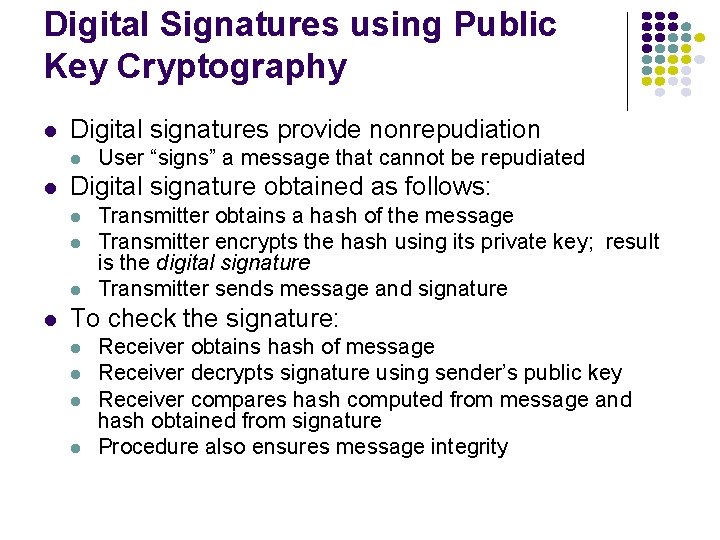
Digital Signatures using Public Key Cryptography l Digital signatures provide nonrepudiation l l Digital signature obtained as follows: l l User “signs” a message that cannot be repudiated Transmitter obtains a hash of the message Transmitter encrypts the hash using its private key; result is the digital signature Transmitter sends message and signature To check the signature: l l Receiver obtains hash of message Receiver decrypts signature using sender’s public key Receiver compares hash computed from message and hash obtained from signature Procedure also ensures message integrity
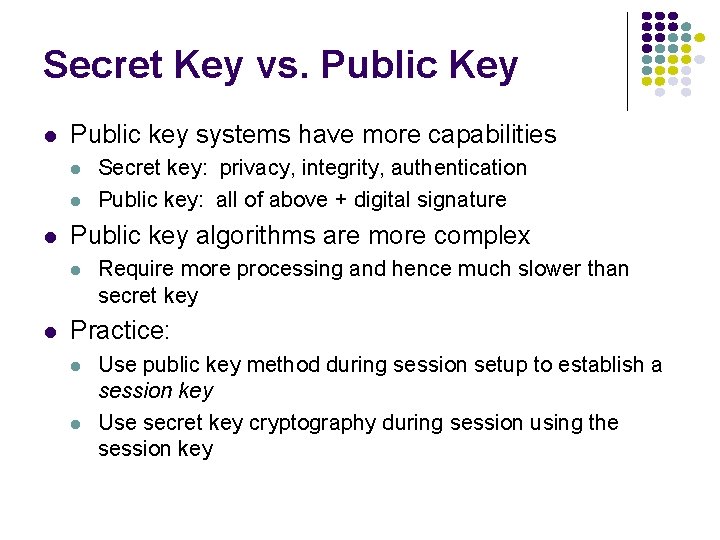
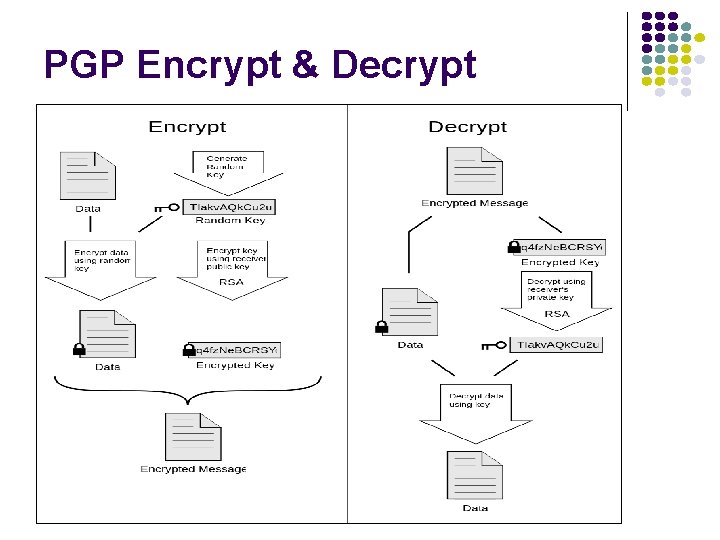
Secret Key vs. Public Key l Public key systems have more capabilities l l l Public key algorithms are more complex l l Secret key: privacy, integrity, authentication Public key: all of above + digital signature Require more processing and hence much slower than secret key Practice: l l Use public key method during session setup to establish a session key Use secret key cryptography during session using the session key
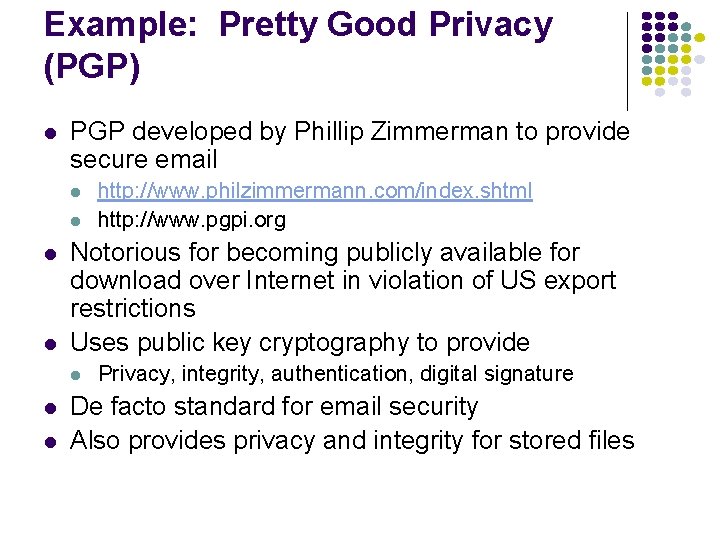
Example: Pretty Good Privacy (PGP) l PGP developed by Phillip Zimmerman to provide secure email l l Notorious for becoming publicly available for download over Internet in violation of US export restrictions Uses public key cryptography to provide l l l http: //www. philzimmermann. com/index. shtml http: //www. pgpi. org Privacy, integrity, authentication, digital signature De facto standard for email security Also provides privacy and integrity for stored files
PGP Encrypt & Decrypt