
Lecture 4 Ch 2 Determinant Delivered by Iksan

Lecture 4 Ch 2. Determinant Delivered by: Iksan Bukhori iksan. bukhori@president. ac. id Original Presentation by Filson Maratur Sidjabat Matrices & Vector Spaces 2018
Chapter Content 2 �Determinants by Cofactor Expansion �Evaluating Determinants by Row Reduction �Properties of the Determinant Function �A Combinatorial Approach to Determinants Elementary Linear Algebra 2020/11/29
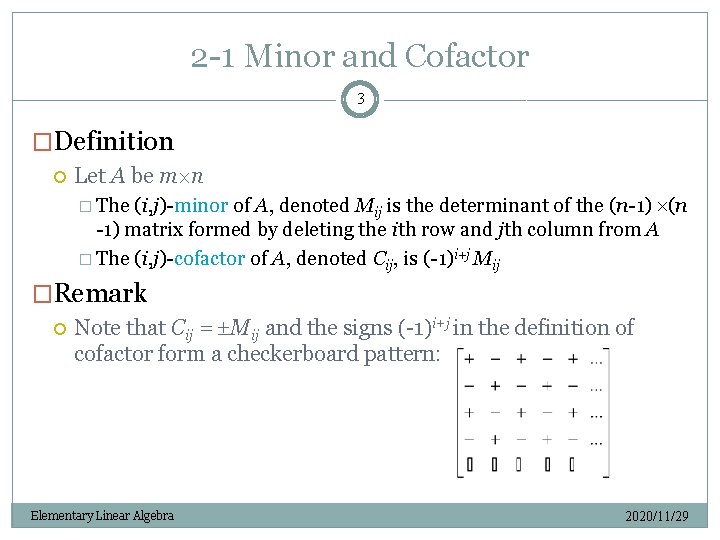
2 -1 Minor and Cofactor 3 �Definition Let A be m n (i, j)-minor of A, denoted Mij is the determinant of the (n-1) (n -1) matrix formed by deleting the ith row and jth column from A � The (i, j)-cofactor of A, denoted Cij, is (-1)i+j Mij � The �Remark Note that Cij = Mij and the signs (-1)i+j in the definition of cofactor form a checkerboard pattern: Elementary Linear Algebra 2020/11/29
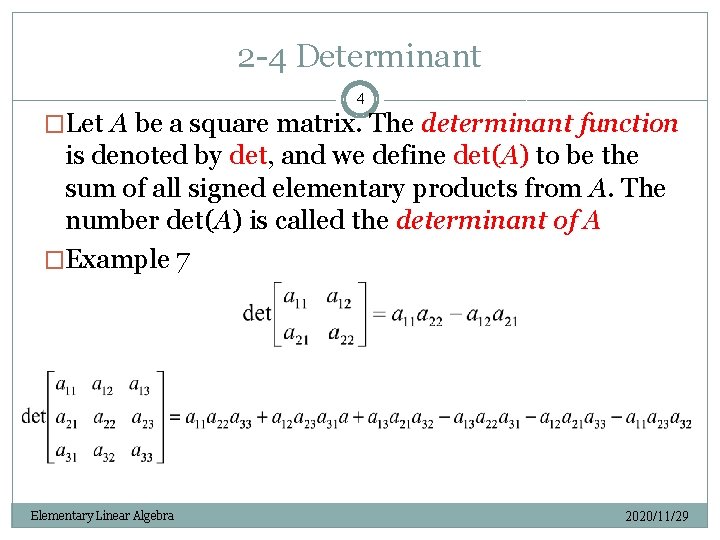
2 -4 Determinant 4 �Let A be a square matrix. The determinant function is denoted by det, and we define det(A) to be the sum of all signed elementary products from A. The number det(A) is called the determinant of A �Example 7 Elementary Linear Algebra 2020/11/29
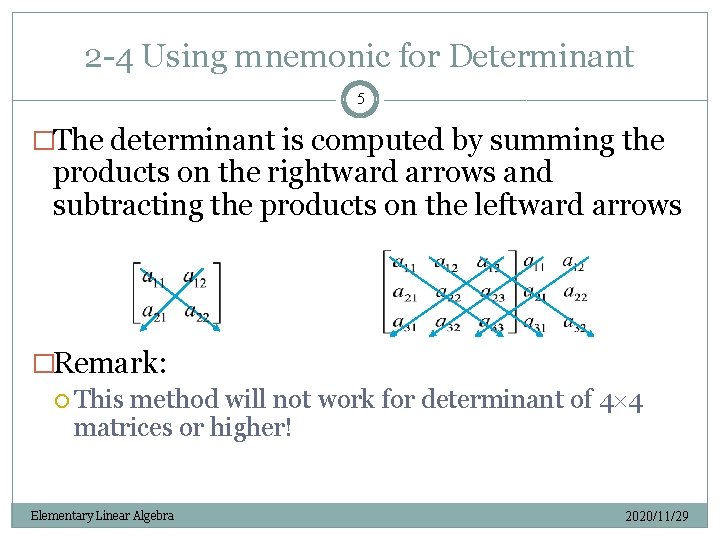
2 -4 Using mnemonic for Determinant 5 �The determinant is computed by summing the products on the rightward arrows and subtracting the products on the leftward arrows �Remark: This method will not work for determinant of 4 4 matrices or higher! Elementary Linear Algebra 2020/11/29
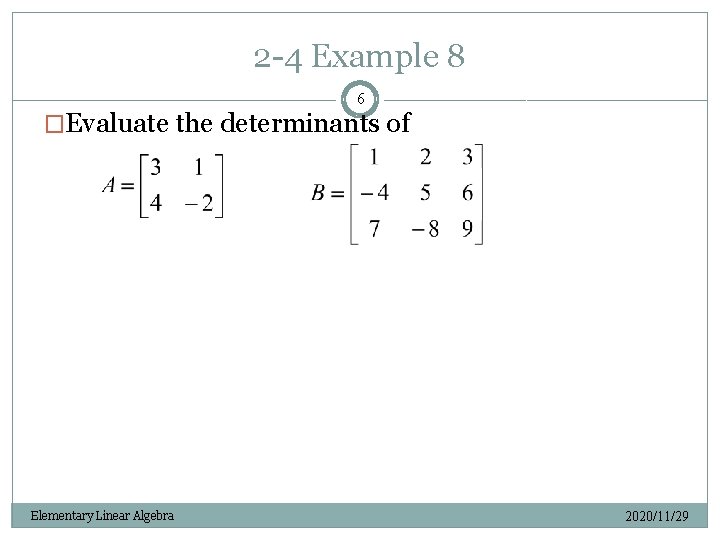
2 -4 Example 8 6 �Evaluate the determinants of Elementary Linear Algebra 2020/11/29
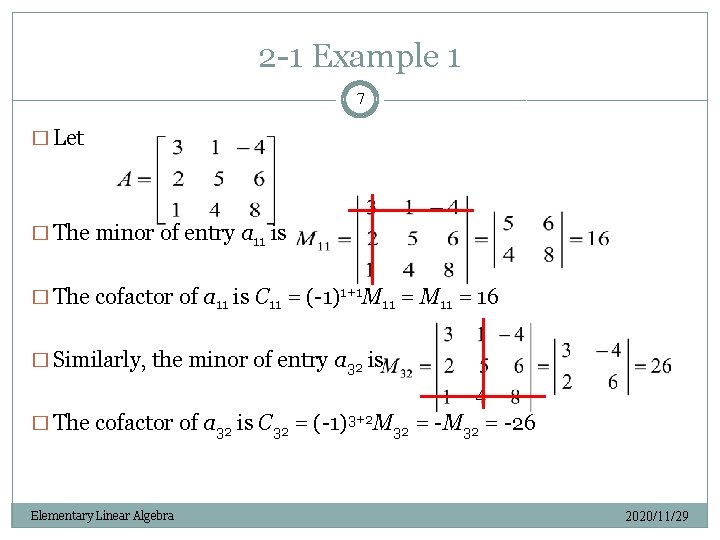
2 -1 Example 1 7 � Let � The minor of entry a 11 is � The cofactor of a 11 is C 11 = (-1)1+1 M 11 = 16 � Similarly, the minor of entry a 32 is � The cofactor of a 32 is C 32 = (-1)3+2 M 32 = -26 Elementary Linear Algebra 2020/11/29
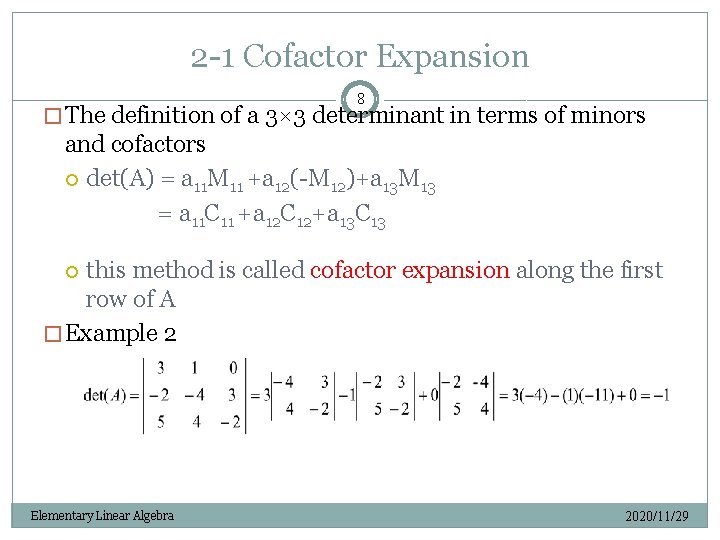
2 -1 Cofactor Expansion 8 � The definition of a 3× 3 determinant in terms of minors and cofactors det(A) = a 11 M 11 +a 12(-M 12)+a 13 M 13 = a 11 C 11 +a 12 C 12+a 13 C 13 this method is called cofactor expansion along the first row of A � Example 2 Elementary Linear Algebra 2020/11/29
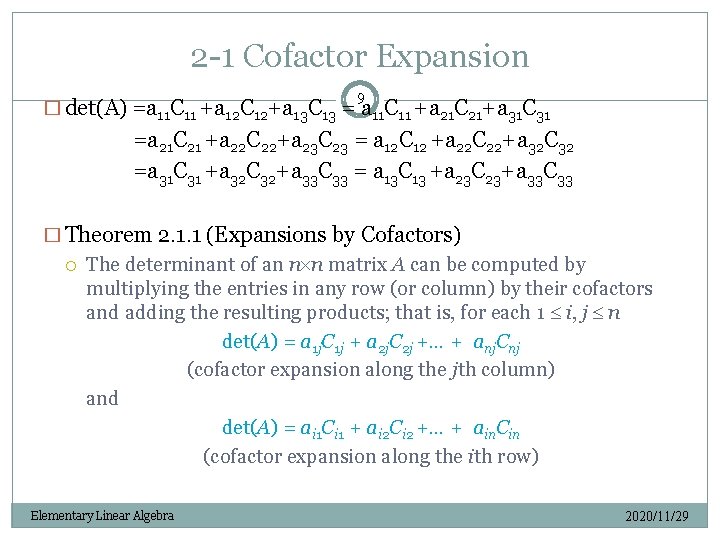
2 -1 Cofactor Expansion 9 � det(A) =a 11 C 11 +a 12 C 12+a 13 C 13 = a 11 C 11 +a 21 C 21+a 31 C 31 =a 21 C 21 +a 22 C 22+a 23 C 23 = a 12 C 12 +a 22 C 22+a 32 C 32 =a 31 C 31 +a 32 C 32+a 33 C 33 = a 13 C 13 +a 23 C 23+a 33 C 33 � Theorem 2. 1. 1 (Expansions by Cofactors) The determinant of an n n matrix A can be computed by multiplying the entries in any row (or column) by their cofactors and adding the resulting products; that is, for each 1 i, j n det(A) = a 1 j. C 1 j + a 2 j. C 2 j +… + anj. Cnj (cofactor expansion along the jth column) and det(A) = ai 1 Ci 1 + ai 2 Ci 2 +… + ain. Cin (cofactor expansion along the ith row) Elementary Linear Algebra 2020/11/29
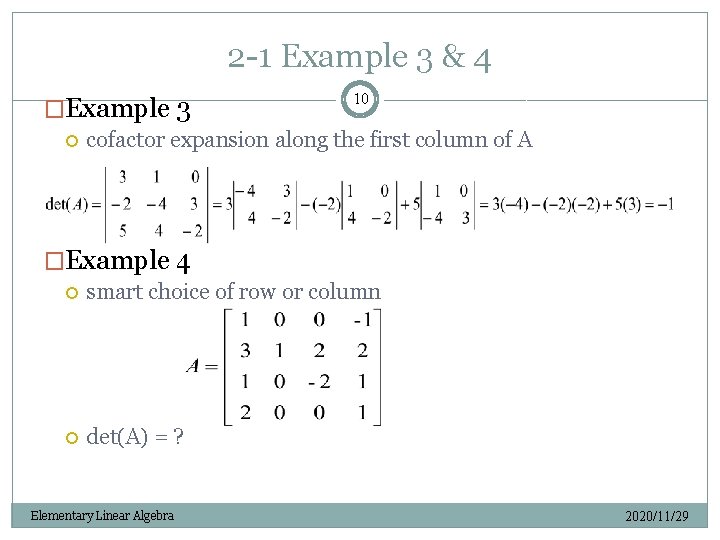
2 -1 Example 3 & 4 �Example 3 10 cofactor expansion along the first column of A �Example 4 smart choice of row or column det(A) = ? Elementary Linear Algebra 2020/11/29
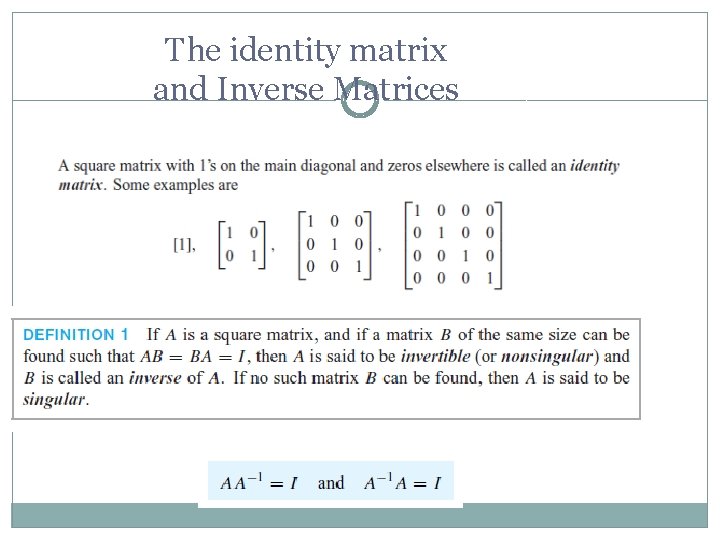
The identity matrix and Inverse Matrices
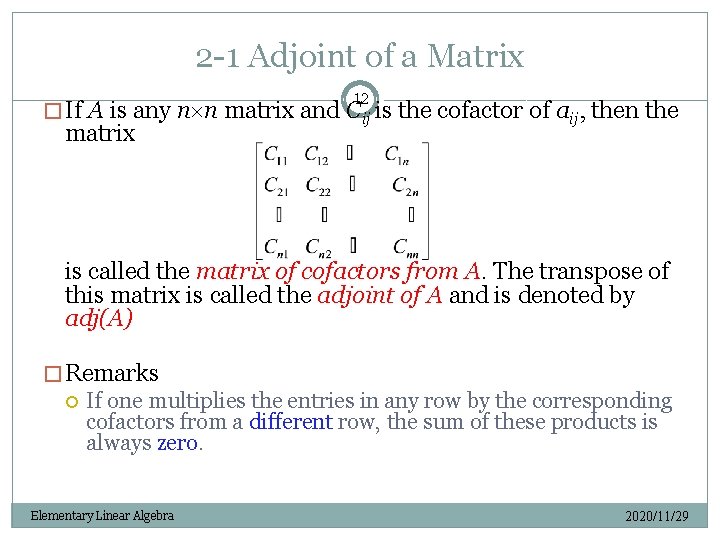
2 -1 Adjoint of a Matrix 12 � If A is any n n matrix and Cij is the cofactor of aij, then the matrix is called the matrix of cofactors from A. The transpose of this matrix is called the adjoint of A and is denoted by adj(A) � Remarks If one multiplies the entries in any row by the corresponding cofactors from a different row, the sum of these products is always zero. Elementary Linear Algebra 2020/11/29
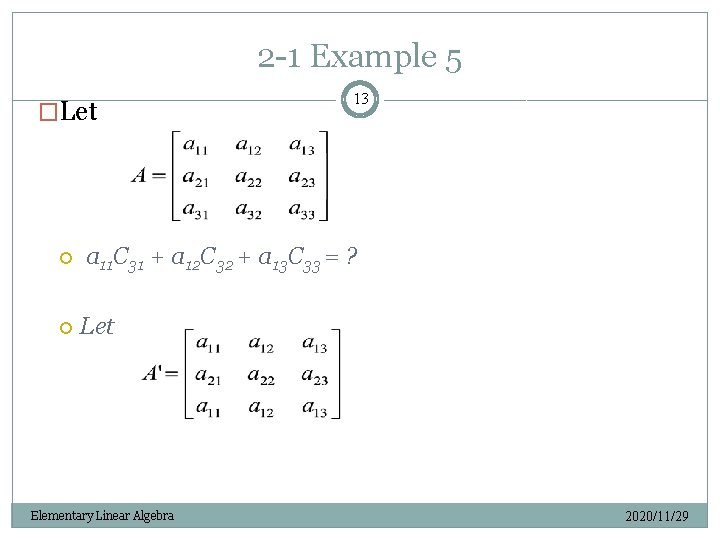
2 -1 Example 5 �Let 13 a 11 C 31 + a 12 C 32 + a 13 C 33 = ? Let Elementary Linear Algebra 2020/11/29
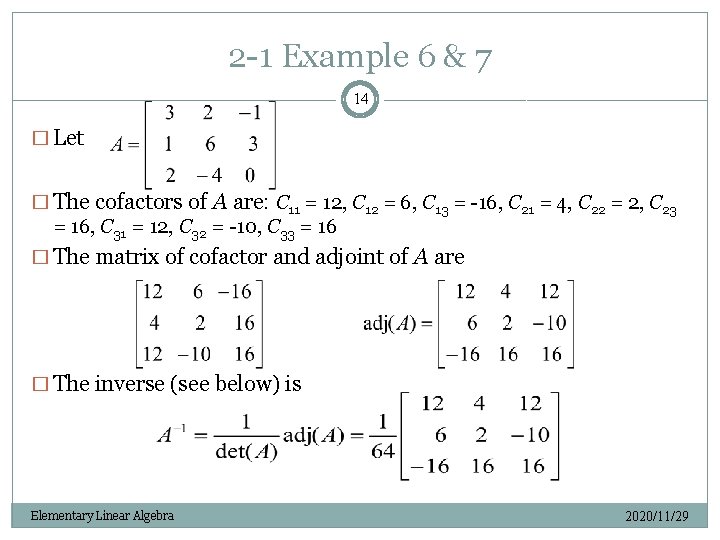
2 -1 Example 6 & 7 14 � Let � The cofactors of A are: C 11 = 12, C 12 = 6, C 13 = -16, C 21 = 4, C 22 = 2, C 23 = 16, C 31 = 12, C 32 = -10, C 33 = 16 � The matrix of cofactor and adjoint of A are � The inverse (see below) is Elementary Linear Algebra 2020/11/29
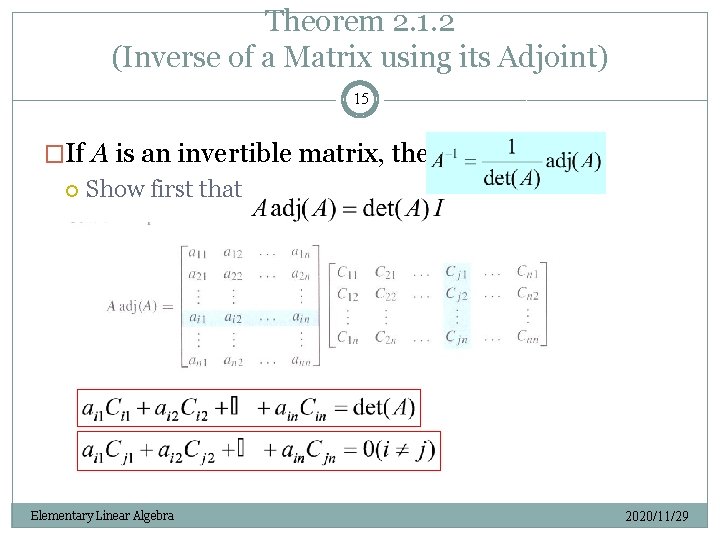
Theorem 2. 1. 2 (Inverse of a Matrix using its Adjoint) 15 �If A is an invertible matrix, then Show first that Elementary Linear Algebra 2020/11/29
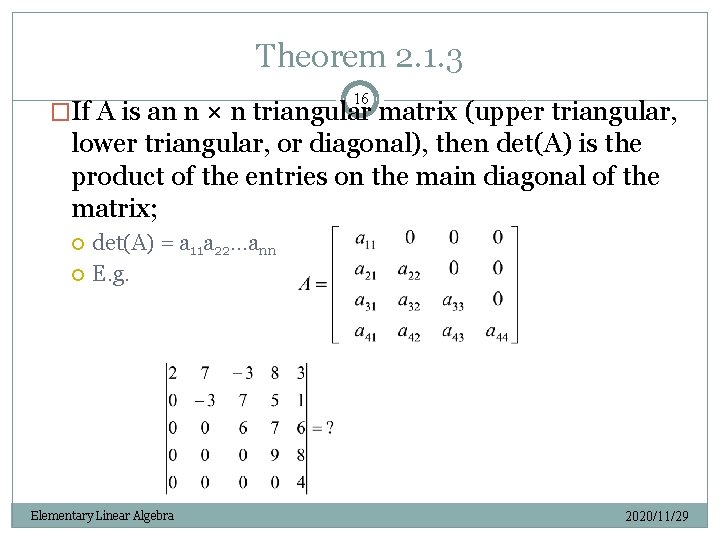
Theorem 2. 1. 3 16 �If A is an n × n triangular matrix (upper triangular, lower triangular, or diagonal), then det(A) is the product of the entries on the main diagonal of the matrix; det(A) = a 11 a 22…ann E. g. Elementary Linear Algebra 2020/11/29
2 -1 Prove Theorem 1. 7. 1 c 17 �A triangular matrix is invertible if and only if its diagonal entries are all nonzero Elementary Linear Algebra 2020/11/29
2 -1 Prove Theorem 1. 7. 1 d 18 �The inverse of an invertible lower triangular matrix is lower triangular, and the inverse of an invertible upper triangular matrix is upper triangular Elementary Linear Algebra 2020/11/29
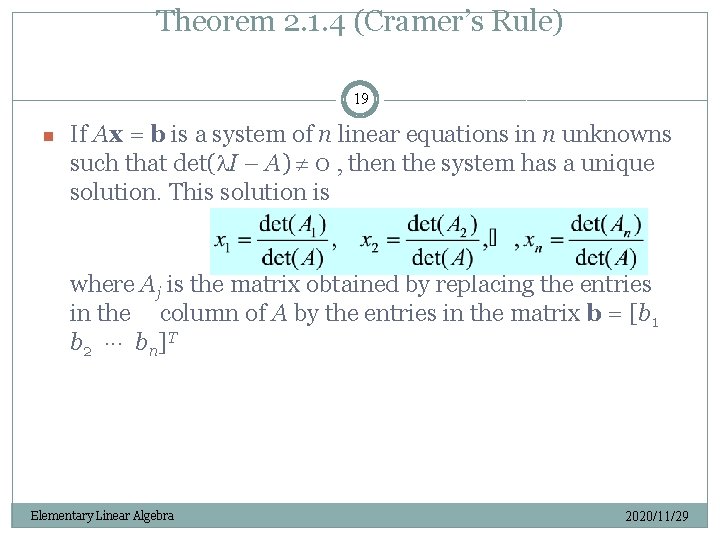
Theorem 2. 1. 4 (Cramer’s Rule) 19 n If Ax = b is a system of n linear equations in n unknowns such that det( I – A) 0 , then the system has a unique solution. This solution is where Aj is the matrix obtained by replacing the entries in the column of A by the entries in the matrix b = [b 1 b 2 ··· bn]T Elementary Linear Algebra 2020/11/29
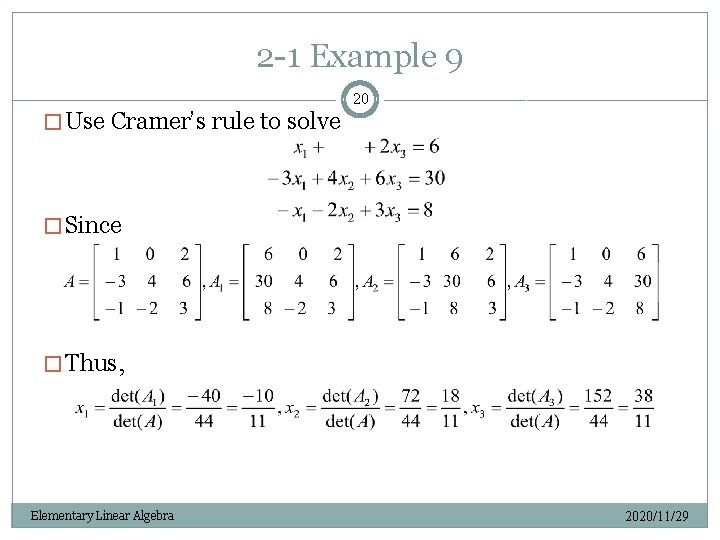
2 -1 Example 9 � Use Cramer’s rule to solve 20 � Since � Thus, Elementary Linear Algebra 2020/11/29
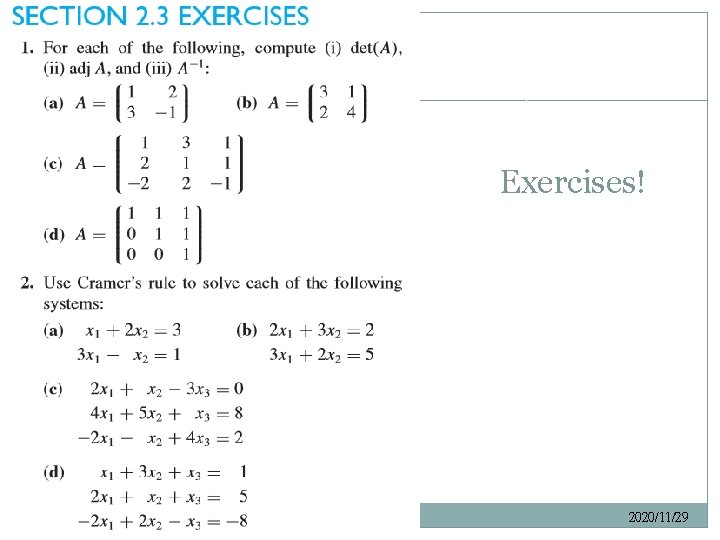
21 Exercises! Elementary Linear Algebra 2020/11/29
- Slides: 21