
Lecture 4 c Geometric Isomers of MoCO 4
- Slides: 14
Lecture 4 c Geometric Isomers of Mo(CO) 4 (PPh 3 ) 2
Introduction I � As discussed previously, metal carbonyl compounds are good starting materials for many low oxidation state compounds � They are reactive and lose one or several CO ligand upon heating, photolysis, exposure towards other radiation, partial oxidation, etc. � The resulting species are very reactive because they usually exhibit an open valence shell � They react with Lewis bases (i. e. , acetonitrile, THF, phosphines, amines, etc. ) to form closed shell compounds i. e. , Cr(CO)5 THF, Mo(CO)4(bipy), fac-Cr(CO)3(CH 3 CN)3, etc. � The also react with each other to form clusters i. e. , Fe 2(CO)9, Co 4(CO)12, etc. � Oxidation with iodine i. e. , Fe(CO)4 I 2, Mn(CO)5 I, etc.
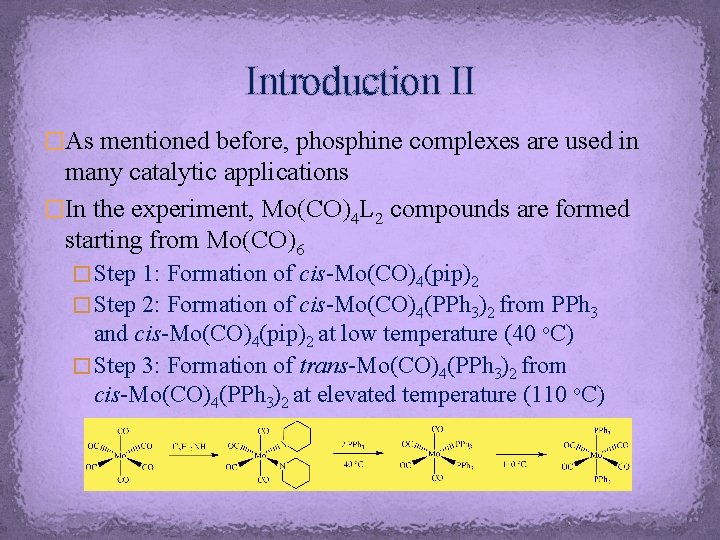
Introduction II �As mentioned before, phosphine complexes are used in many catalytic applications �In the experiment, Mo(CO)4 L 2 compounds are formed starting from Mo(CO)6 � Step 1: Formation of cis-Mo(CO)4(pip)2 � Step 2: Formation of cis-Mo(CO)4(PPh 3)2 from PPh 3 and cis-Mo(CO)4(pip)2 at low temperature (40 o. C) � Step 3: Formation of trans-Mo(CO)4(PPh 3)2 from cis-Mo(CO)4(PPh 3)2 at elevated temperature (110 o. C)
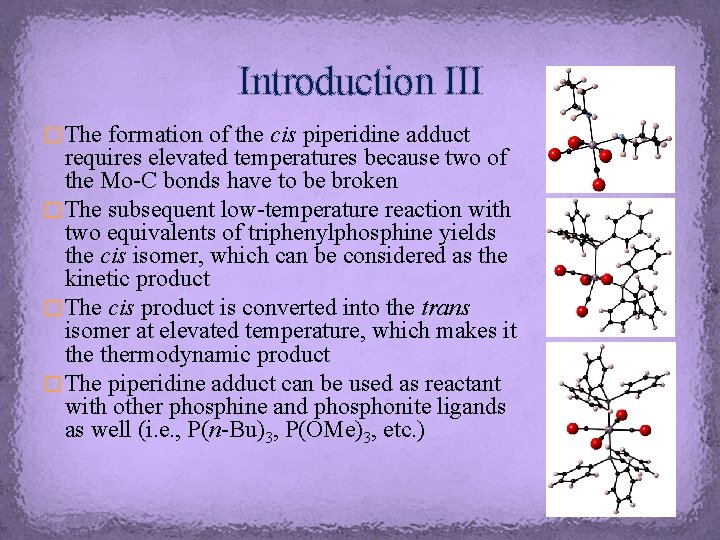
Introduction III � The formation of the cis piperidine adduct requires elevated temperatures because two of the Mo-C bonds have to be broken � The subsequent low-temperature reaction with two equivalents of triphenylphosphine yields the cis isomer, which can be considered as the kinetic product � The cis product is converted into the trans isomer at elevated temperature, which makes it thermodynamic product � The piperidine adduct can be used as reactant with other phosphine and phosphonite ligands as well (i. e. , P(n-Bu)3, P(OMe)3, etc. )
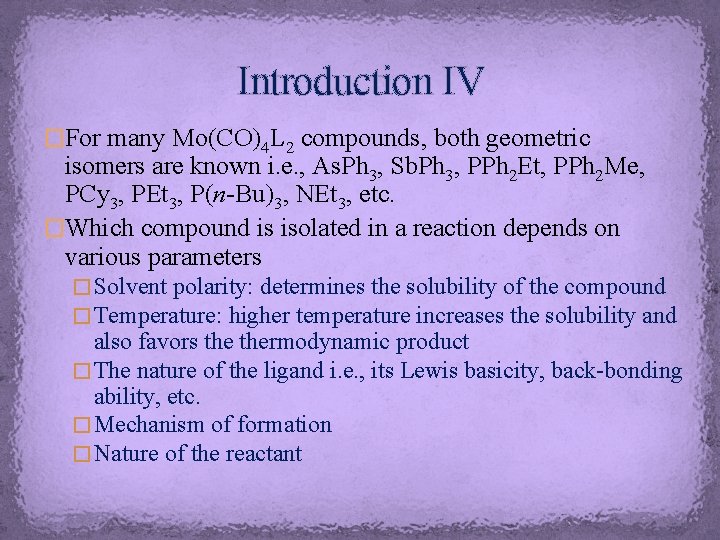
Introduction IV �For many Mo(CO)4 L 2 compounds, both geometric isomers are known i. e. , As. Ph 3, Sb. Ph 3, PPh 2 Et, PPh 2 Me, PCy 3, PEt 3, P(n-Bu)3, NEt 3, etc. �Which compound is isolated in a reaction depends on various parameters � Solvent polarity: determines the solubility of the compound � Temperature: higher temperature increases the solubility and also favors thermodynamic product � The nature of the ligand i. e. , its Lewis basicity, back-bonding ability, etc. � Mechanism of formation � Nature of the reactant
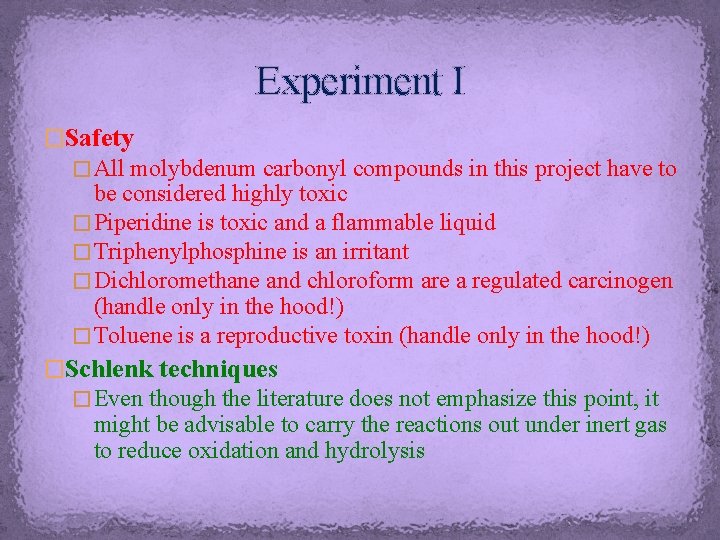
Experiment I �Safety � All molybdenum carbonyl compounds in this project have to be considered highly toxic � Piperidine is toxic and a flammable liquid � Triphenylphosphine is an irritant � Dichloromethane and chloroform are a regulated carcinogen (handle only in the hood!) � Toluene is a reproductive toxin (handle only in the hood!) �Schlenk techniques � Even though the literature does not emphasize this point, it might be advisable to carry the reactions out under inert gas to reduce oxidation and hydrolysis
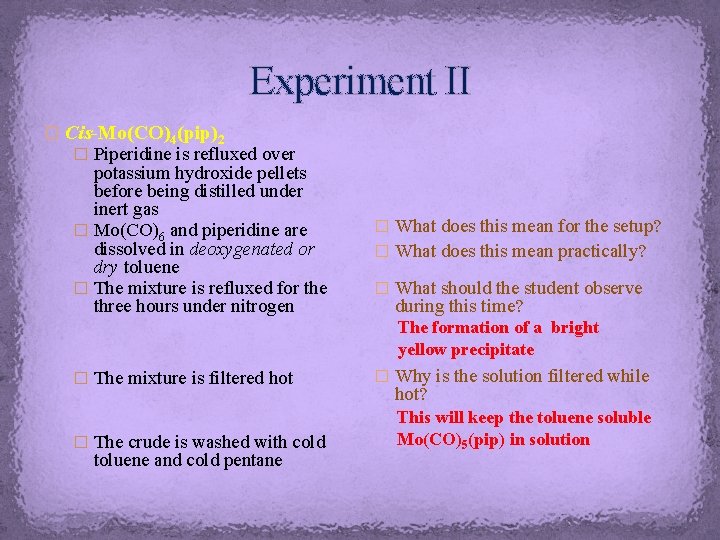
Experiment II � Cis-Mo(CO)4(pip)2 � Piperidine is refluxed over potassium hydroxide pellets before being distilled under inert gas � Mo(CO)6 and piperidine are dissolved in deoxygenated or dry toluene � The mixture is refluxed for the three hours under nitrogen � What does this mean for the setup? � What does this mean practically? � What should the student observe during this time? The formation of a bright yellow precipitate � The mixture is filtered hot � The crude is washed with cold toluene and cold pentane � Why is the solution filtered while hot? This will keep the toluene soluble Mo(CO)5(pip) in solution
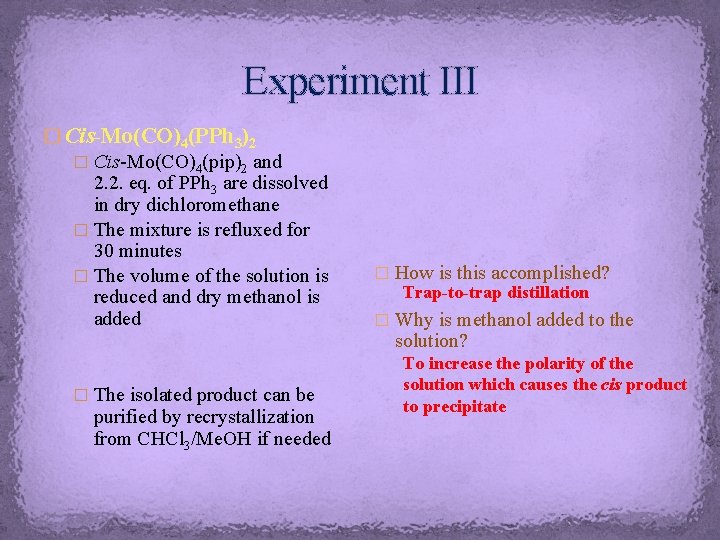
Experiment III � Cis-Mo(CO)4(PPh 3)2 � Cis-Mo(CO)4(pip)2 and 2. 2. eq. of PPh 3 are dissolved in dry dichloromethane � The mixture is refluxed for 30 minutes � The volume of the solution is reduced and dry methanol is added � How is this accomplished? Trap-to-trap distillation � Why is methanol added to the solution? � The isolated product can be purified by recrystallization from CHCl 3/Me. OH if needed To increase the polarity of the solution which causes the cis product to precipitate
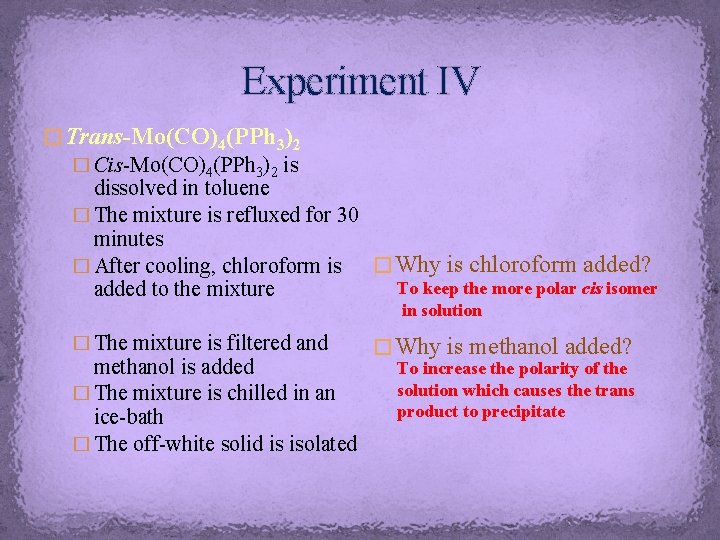
Experiment IV � Trans-Mo(CO)4(PPh 3)2 � Cis-Mo(CO)4(PPh 3)2 is dissolved in toluene � The mixture is refluxed for 30 minutes � Why is chloroform added? � After cooling, chloroform is To keep the more polar cis isomer added to the mixture in solution � The mixture is filtered and methanol is added � The mixture is chilled in an ice-bath � The off-white solid is isolated � Why is methanol added? To increase the polarity of the solution which causes the trans product to precipitate
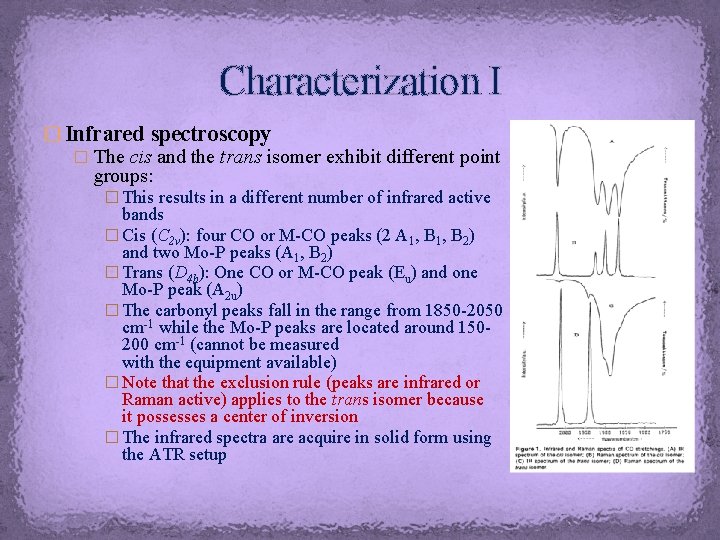
Characterization I � Infrared spectroscopy � The cis and the trans isomer exhibit different point groups: � This results in a different number of infrared active bands � Cis (C 2 v): four CO or M-CO peaks (2 A 1, B 2) and two Mo-P peaks (A 1, B 2) � Trans (D 4 h): One CO or M-CO peak (Eu) and one Mo-P peak (A 2 u) � The carbonyl peaks fall in the range from 1850 -2050 cm-1 while the Mo-P peaks are located around 150200 cm-1 (cannot be measured with the equipment available) � Note that the exclusion rule (peaks are infrared or Raman active) applies to the trans isomer because it possesses a center of inversion � The infrared spectra are acquire in solid form using the ATR setup
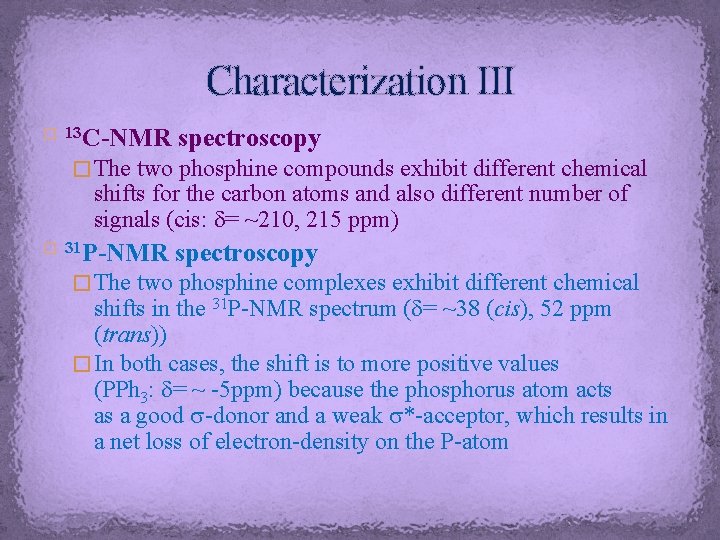
Characterization III � 13 C-NMR spectroscopy � The two phosphine compounds exhibit different chemical shifts for the carbon atoms and also different number of signals (cis: d= ~210, 215 ppm) � 31 P-NMR spectroscopy � The two phosphine complexes exhibit different chemical shifts in the 31 P-NMR spectrum (d= ~38 (cis), 52 ppm (trans)) � In both cases, the shift is to more positive values (PPh 3: d= ~ -5 ppm) because the phosphorus atom acts as a good s-donor and a weak s*-acceptor, which results in a net loss of electron-density on the P-atom
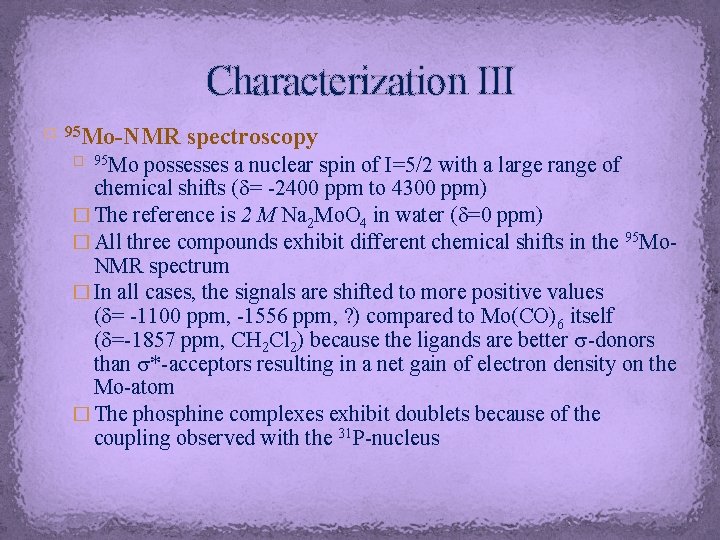
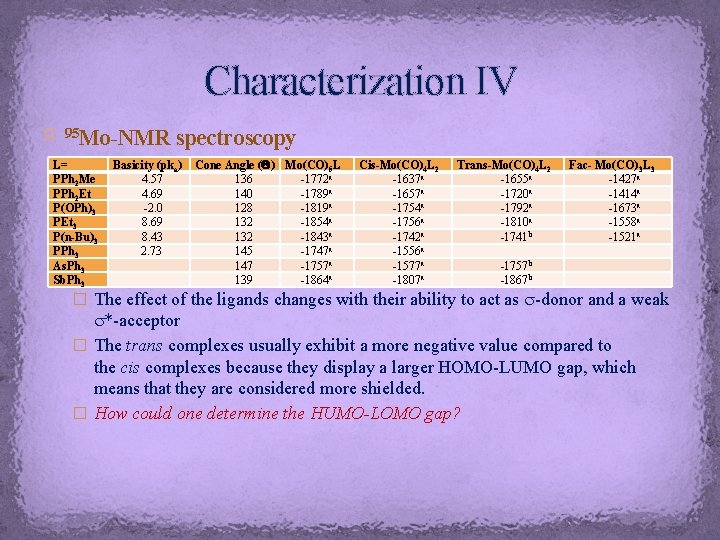
Characterization III Mo-NMR spectroscopy � 95 Mo possesses a nuclear spin of I=5/2 with a large range of chemical shifts (d= -2400 ppm to 4300 ppm) � The reference is 2 M Na 2 Mo. O 4 in water (d=0 ppm) � All three compounds exhibit different chemical shifts in the 95 Mo. NMR spectrum � In all cases, the signals are shifted to more positive values (d= -1100 ppm, -1556 ppm, ? ) compared to Mo(CO)6 itself (d=-1857 ppm, CH 2 Cl 2) because the ligands are better s-donors than s*-acceptors resulting in a net gain of electron density on the Mo-atom � The phosphine complexes exhibit doublets because of the coupling observed with the 31 P-nucleus � 95
Characterization IV Mo-NMR spectroscopy � 95 L= PPh 2 Me PPh 2 Et P(OPh)3 PEt 3 P(n-Bu)3 PPh 3 As. Ph 3 Sb. Ph 3 Basicity (pka) 4. 57 4. 69 -2. 0 8. 69 8. 43 2. 73 Cone Angle ( ) Mo(CO)5 L 136 -1772 a 140 -1789 a 128 -1819 a 132 -1854 a 132 -1843 a 145 -1747 a 147 -1757 a 139 -1864 a Cis-Mo(CO)4 L 2 -1637 a -1657 a -1754 a -1756 a -1742 a -1556 a -1577 a -1807 a Trans-Mo(CO)4 L 2 -1655 a -1720 a -1792 a -1810 a -1741 b Fac- Mo(CO)3 L 3 -1427 a -1414 a -1673 a -1558 a -1521 a -1757 b -1867 b � The effect of the ligands changes with their ability to act as s-donor and a weak s*-acceptor � The trans complexes usually exhibit a more negative value compared to the cis complexes because they display a larger HOMO-LUMO gap, which means that they are considered more shielded. � How could one determine the HUMO-LOMO gap?
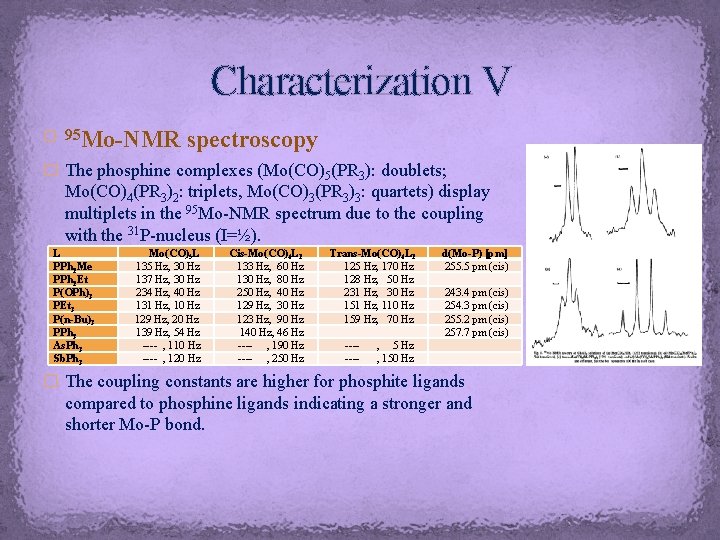
Characterization V Mo-NMR spectroscopy � 95 � The phosphine complexes (Mo(CO)5(PR 3): doublets; Mo(CO)4(PR 3)2: triplets, Mo(CO)3(PR 3)3: quartets) display multiplets in the 95 Mo-NMR spectrum due to the coupling with the 31 P-nucleus (I=½). L PPh 2 Me PPh 2 Et P(OPh)3 PEt 3 P(n-Bu)3 PPh 3 As. Ph 3 Sb. Ph 3 Mo(CO)5 L 135 Hz, 30 Hz 137 Hz, 30 Hz 234 Hz, 40 Hz 131 Hz, 10 Hz 129 Hz, 20 Hz 139 Hz, 54 Hz ---- , 110 Hz ---- , 120 Hz Cis-Mo(CO)4 L 2 133 Hz, 60 Hz 130 Hz, 80 Hz 250 Hz, 40 Hz 129 Hz, 30 Hz 123 Hz, 90 Hz 140 Hz, 46 Hz ---- , 190 Hz ---- , 250 Hz Trans-Mo(CO)4 L 2 125 Hz, 170 Hz 128 Hz, 50 Hz 231 Hz, 30 Hz 151 Hz, 110 Hz 159 Hz, 70 Hz ------- d(Mo-P) [pm] 255. 5 pm (cis) 243. 4 pm (cis) 254. 3 pm (cis) 255. 2 pm (cis) 257. 7 pm (cis) , 5 Hz , 150 Hz � The coupling constants are higher for phosphite ligands compared to phosphine ligands indicating a stronger and shorter Mo-P bond.