
Lecture 4 BIOACOUSTICS Plan of the lecture 1
Lecture #4 BIOACOUSTICS
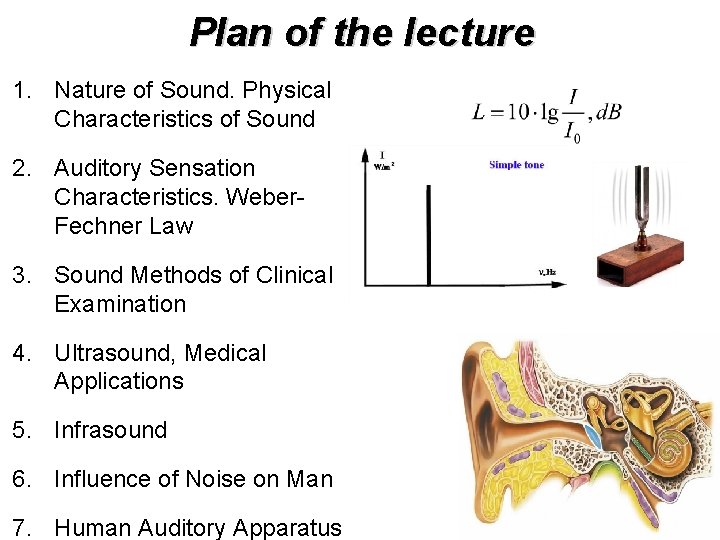
Plan of the lecture 1. Nature of Sound. Physical Characteristics of Sound 2. Auditory Sensation Characteristics. Weber. Fechner Law 3. Sound Methods of Clinical Examination 4. Ultrasound, Medical Applications 5. Infrasound 6. Influence of Noise on Man 7. Human Auditory Apparatus
Key Concepts of bioacoustics Acoustics is the field of physics, which investigates acoustic oscillations and waves, and processes of their excitation, propagation and interaction with substance.
Types of waves: 1. Electromagnetic waves: • gamma radiation • X-radiation • optical radiation • radio waves 2. Mechanical waves: a) Liquid surface waves b) Elastic waves: - Acoustic waves - Seismic waves

Acoustic waves are mechanical waves propagating in elastic mediums. Elastic mediums: • Gas • Liquid • Solid Acoustic waves are alternation of the regions of rarefaction and compression of the medium where these waves propagate.
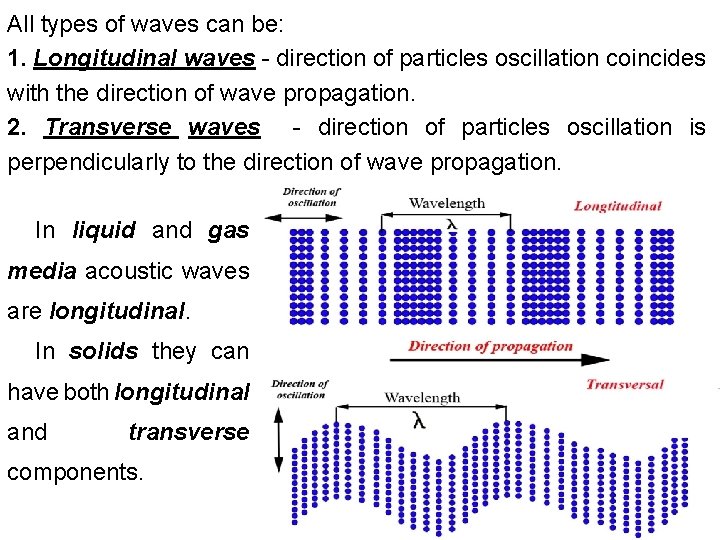
All types of waves can be: 1. Longitudinal waves - direction of particles oscillation coincides with the direction of wave propagation. 2. Transverse waves - direction of particles oscillation is perpendicularly to the direction of wave propagation. In liquid and gas media acoustic waves are longitudinal. In solids they can have both longitudinal and transverse components.
• Acoustic waves propagate with frequencies from 0 Hz up to 1012– 1013 Hz. • According to the frequency acoustic waves are devided on 4 ranges: - infrasound (0 - 16 Hz) - sound (16 – 20 000 Hz) - ultrasound (20 000 - 109 Hz) - hypersound ( 109 – 1013 Hz)
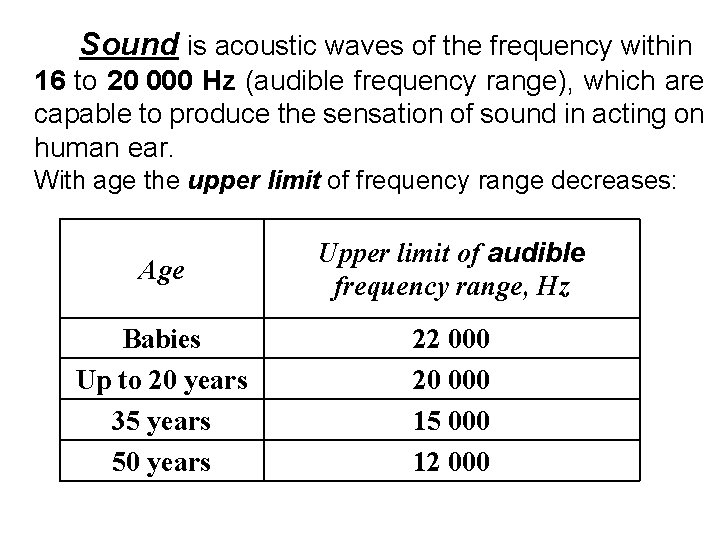
Sound is acoustic waves of the frequency within 16 to 20 000 Hz (audible frequency range), which are capable to produce the sensation of sound in acting on human ear. With age the upper limit of frequency range decreases: Age Upper limit of audible frequency range, Hz Babies Up to 20 years 35 years 50 years 22 000 20 000 15 000 12 000
Sound characteristics : • Objective (physical) characteristics – measured by the instruments, regardless of the feelings of the person • Subjective (physiological) characteristics evaluated by the person, regardless of instrument readings
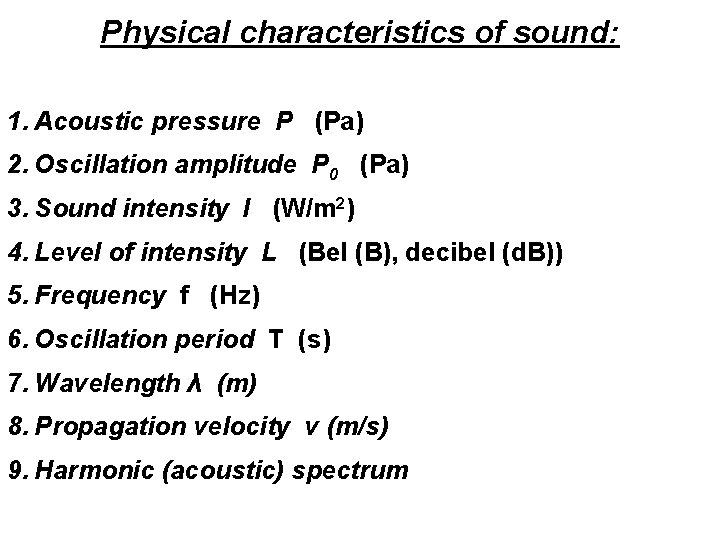
Physical characteristics of sound: 1. Acoustic pressure P (Pa) 2. Oscillation amplitude P 0 (Pa) 3. Sound intensity I (W/m 2) 4. Level of intensity L (Bel (B), decibel (d. B)) 5. Frequency f (Hz) 6. Oscillation period T (s) 7. Wavelength λ (m) 8. Propagation velocity v (m/s) 9. Harmonic (acoustic) spectrum
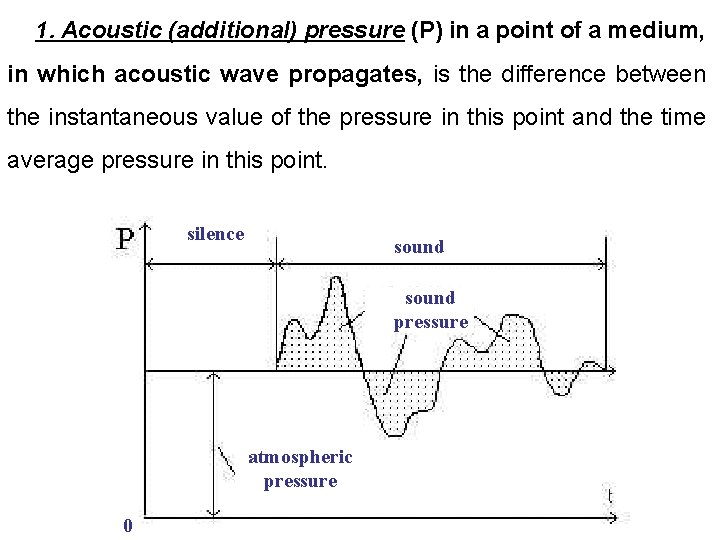
1. Acoustic (additional) pressure (Р) in a point of a medium, in which acoustic wave propagates, is the difference between the instantaneous value of the pressure in this point and the time average pressure in this point. silence sound pressure atmospheric pressure 0
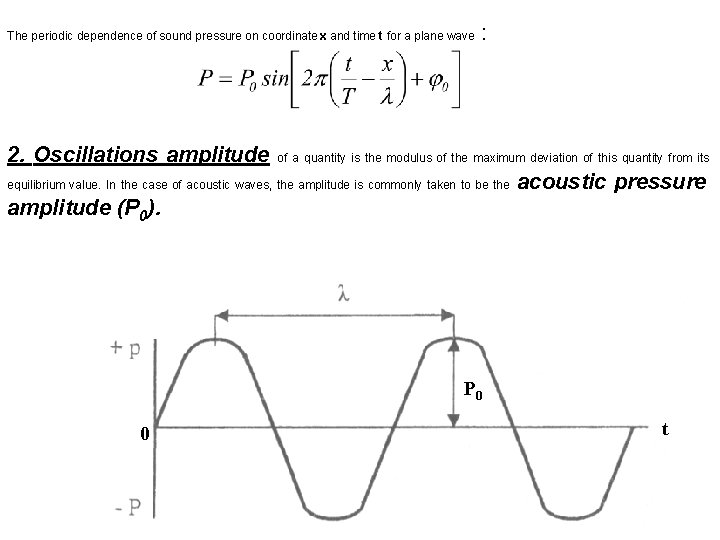
The periodic dependence of sound pressure on coordinate х and time t for a plane wave 2. Oscillations amplitude : of a quantity is the modulus of the maximum deviation of this quantity from its equilibrium value. In the case of acoustic waves, the amplitude is commonly taken to be the acoustic pressure amplitude (Р 0). P 0 0 t
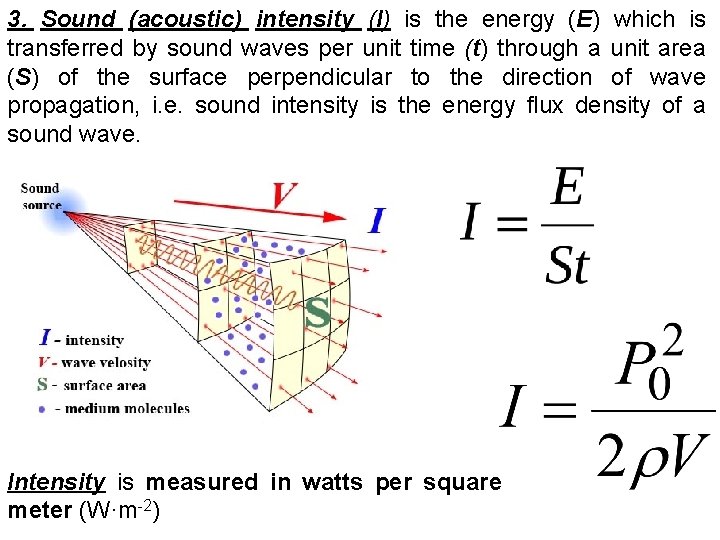
3. Sound (acoustic) intensity (I) is the energy (E) which is transferred by sound waves per unit time (t) through a unit area (S) of the surface perpendicular to the direction of wave propagation, i. e. sound intensity is the energy flux density of a sound wave. Intensity is measured in watts per square meter (W·m-2)
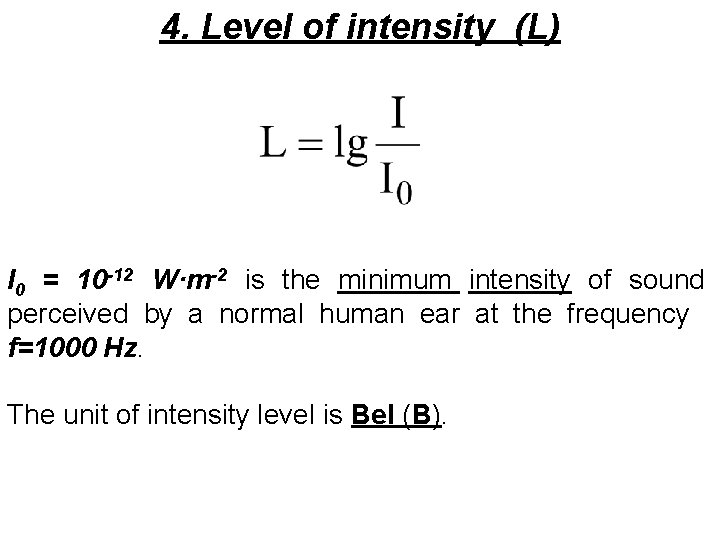
4. Level of intensity (L) I 0 = 10 -12 W·m-2 is the minimum intensity of sound perceived by a normal human ear at the frequency f=1000 Hz. The unit of intensity level is Bel (B).
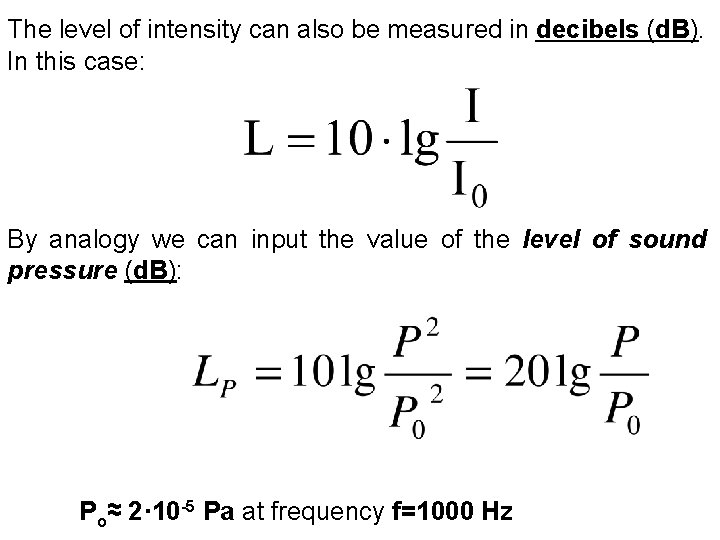
The level of intensity can also be measured in decibels (d. B). In this case: By analogy we can input the value of the level of sound pressure (d. B): Po≈ 2· 10 -5 Pа at frequency f=1000 Hz
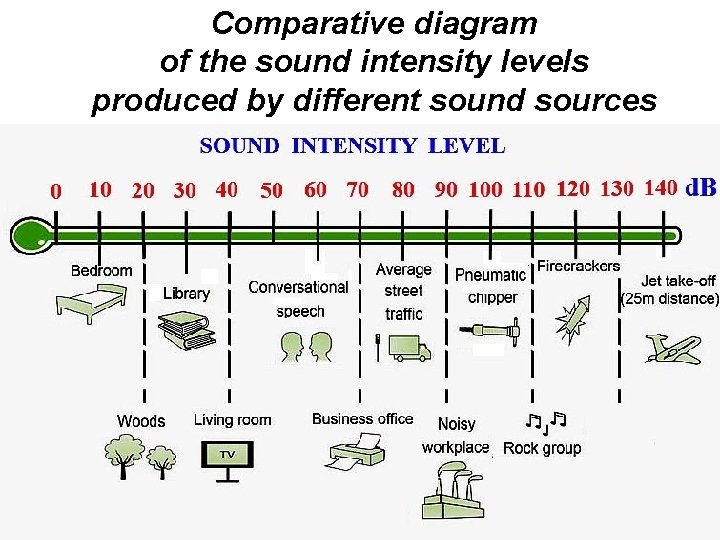
Comparative diagram of the sound intensity levels produced by different sound sources
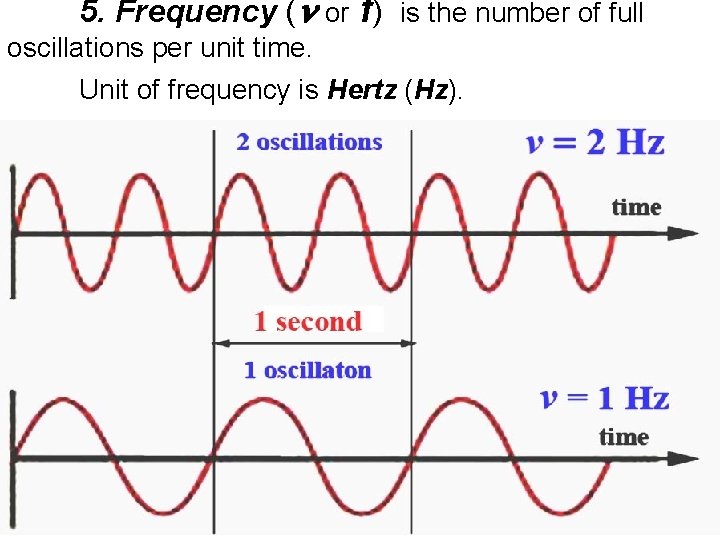
5. Frequency ( or f) is the number of full oscillations per unit time. Unit of frequency is Hertz (Hz). .
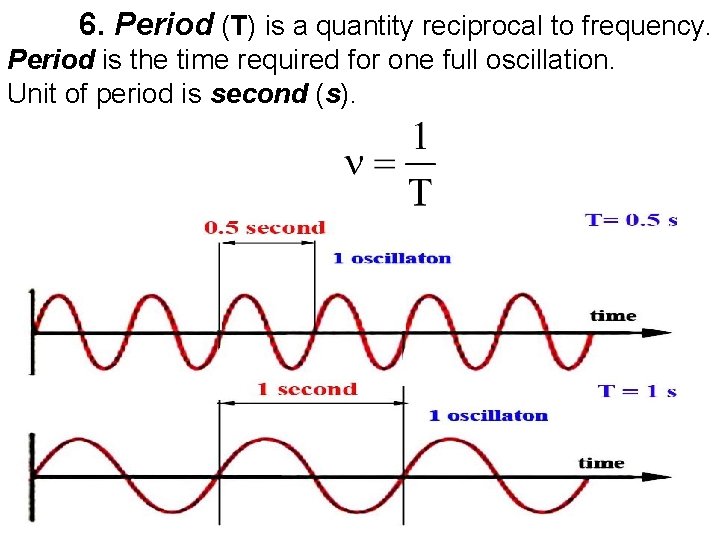
6. Period (T) is a quantity reciprocal to frequency. Period is the time required for one full oscillation. Unit of period is second (s).
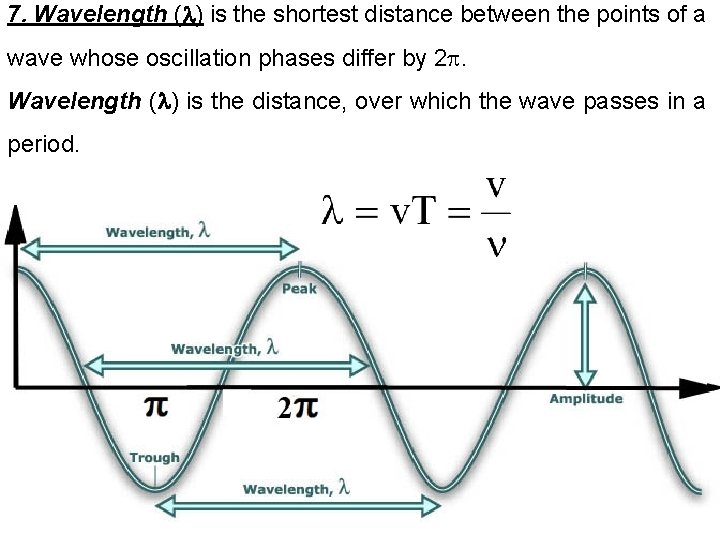
7. Wavelength ( ) is the shortest distance between the points of a wave whose oscillation phases differ by 2. Wavelength ( ) is the distance, over which the wave passes in a period.
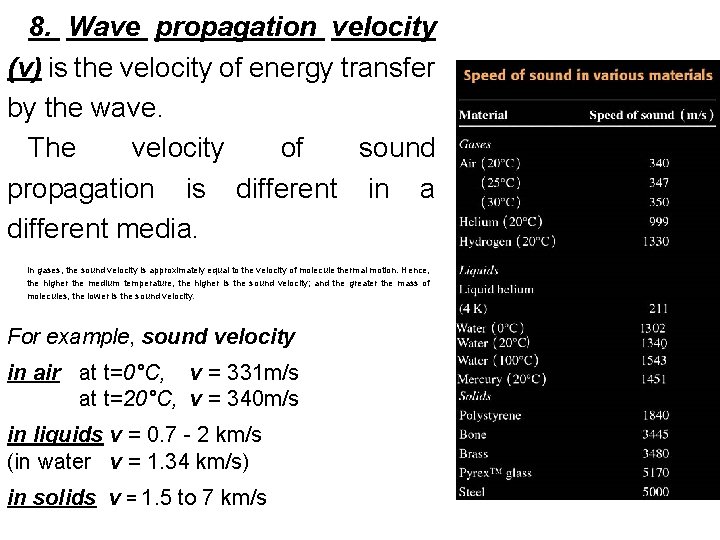
8. Wave propagation velocity (v) is the velocity of energy transfer by the wave. The velocity of sound propagation is different in a different media. In gases, the sound velocity is approximately equal to the velocity of molecule thermal motion. Hence, the higher the medium temperature, the higher is the sound velocity; and the greater the mass of molecules, the lower is the sound velocity. For example, sound velocity in air at t=0°C, v = 331 m/s at t=20°C, v = 340 m/s in liquids v = 0. 7 - 2 km/s (in water v = 1. 34 km/s) in solids v = 1. 5 to 7 km/s
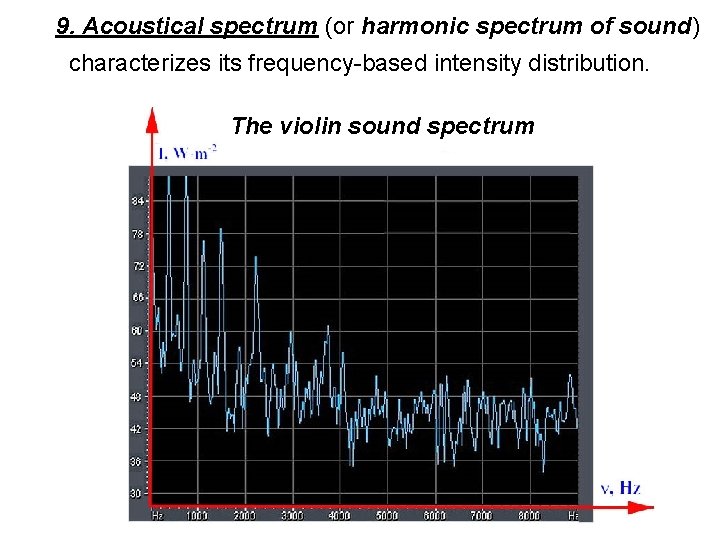
9. Acoustical spectrum (or harmonic spectrum of sound) characterizes its frequency-based intensity distribution. The violin sound spectrum
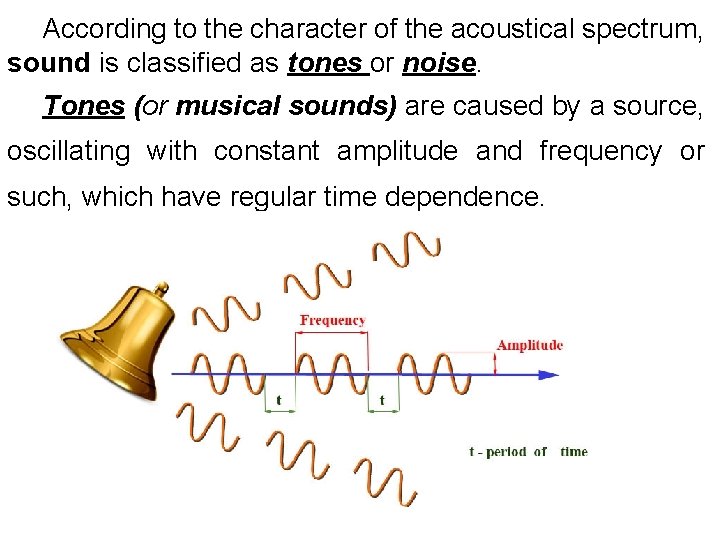
According to the character of the acoustical spectrum, sound is classified as tones or noise. Tones (or musical sounds) are caused by a source, oscillating with constant amplitude and frequency or such, which have regular time dependence.
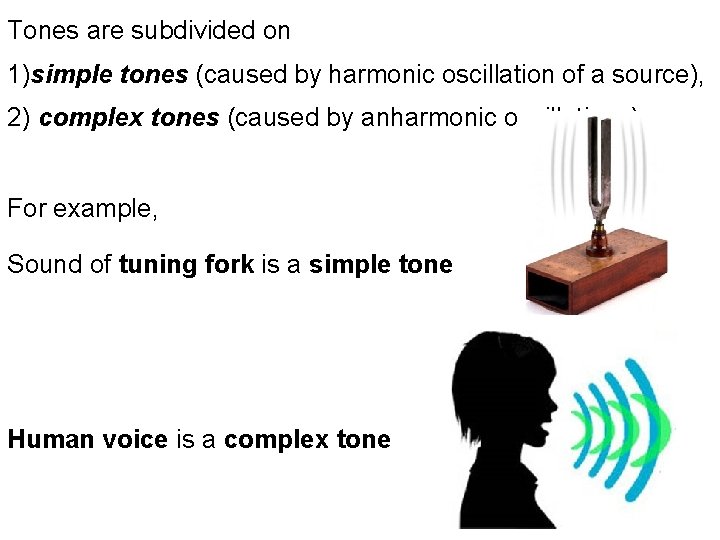
Tones are subdivided on 1)simple tones (caused by harmonic oscillation of a source), 2) complex tones (caused by anharmonic oscillations) For example, Sound of tuning fork is a simple tone Human voice is a complex tone
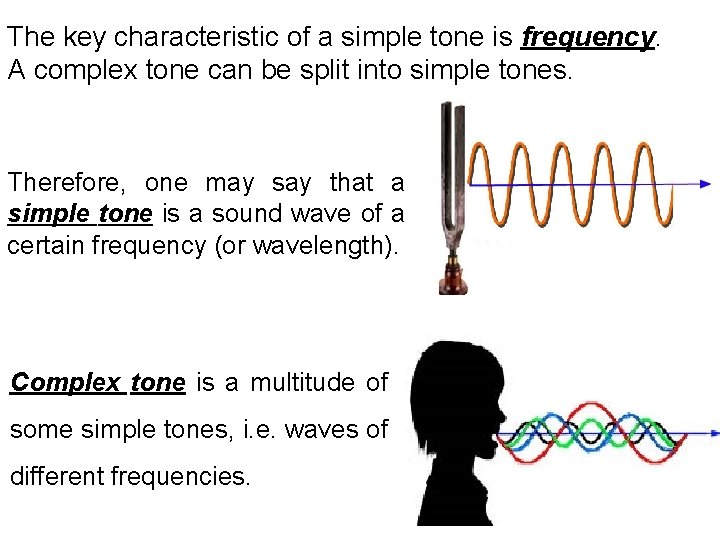
The key characteristic of a simple tone is frequency. A complex tone can be split into simple tones. Therefore, one may say that a simple tone is a sound wave of a certain frequency (or wavelength). Complex tone is a multitude of some simple tones, i. e. waves of different frequencies.
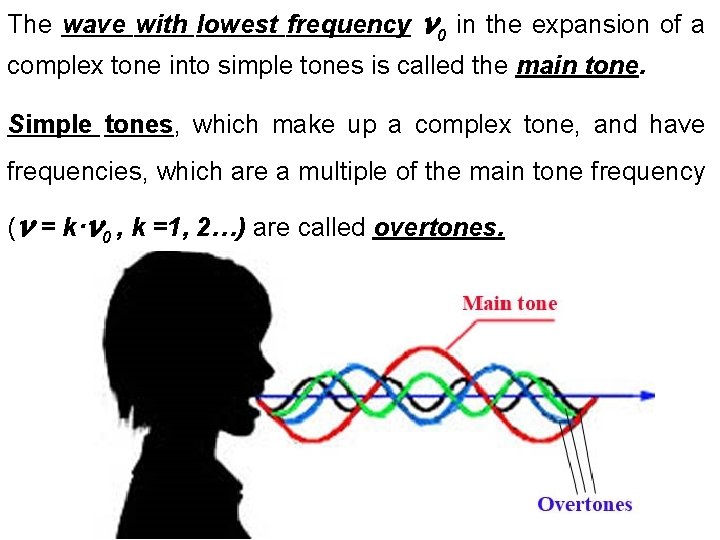
The wave with lowest frequency 0 in the expansion of a complex tone into simple tones is called the main tone. Simple tones, which make up a complex tone, and have frequencies, which are a multiple of the main tone frequency ( = k· 0 , k =1, 2…) are called overtones.
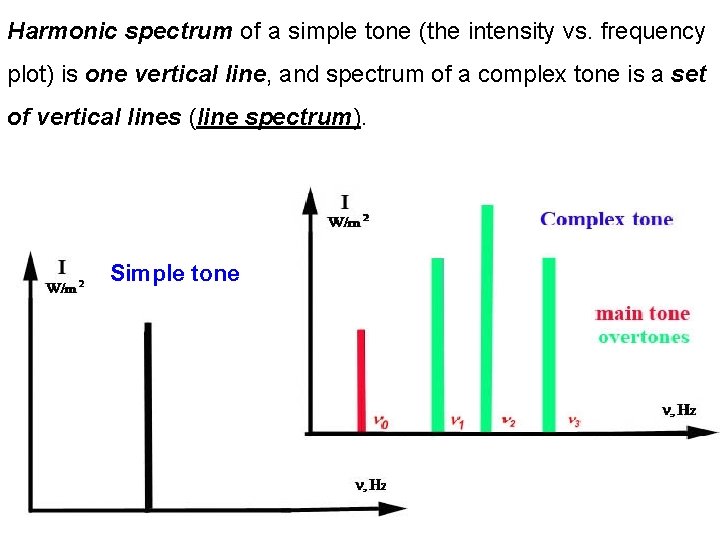
Harmonic spectrum of a simple tone (the intensity vs. frequency plot) is one vertical line, and spectrum of a complex tone is a set of vertical lines (line spectrum). Simple tone
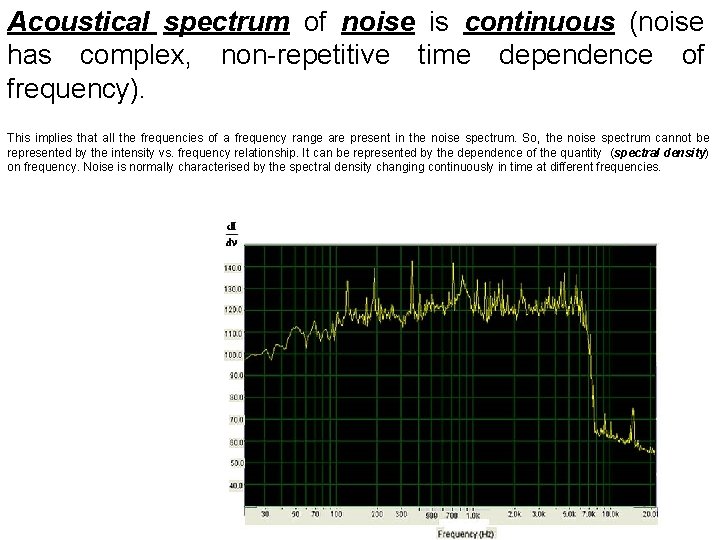
Acoustical spectrum of noise is continuous (noise has complex, non-repetitive time dependence of frequency). This implies that all the frequencies of a frequency range are present in the noise spectrum. So, the noise spectrum cannot be represented by the intensity vs. frequency relationship. It can be represented by the dependence of the quantity (spectral density) on frequency. Noise is normally characterised by the spectral density changing continuously in time at different frequencies.
Subjective (Physiological, or Auditory Sensation) Characteristics So far, we considered the objective (physical) characteristics of sound, which are evaluated with relevant instruments independently of person sensations. However, sound is an object of auditory sensations, so man evaluates sound subjectively as well. Physiological (subjective) characteristics are used for describing the auditory sensation of sound. 1. Loudness (or loudness level) of sound 2. Pitch of sound 3. Sound Timbre
1. The value of loudness level (E) depends on intensity (I) and frequency (f) of sound. At a fixed sound frequency, the auditory sensations obey the Weber-Fechner law: with increase of irritation in geometric progression (i. e. in an equal number of times), the sensation of this irritation increases in arithmetical progression (i. e. in equal value). As applied to sound, this means that if sound intensity takes a number of successive values, e. g. a. I 0, a 2 I 0, a 3 I 0 (a is a coefficient greater than 1), the respective loudness of sound sensations will be Е 0, 2 Е 0, 3 Е 0.
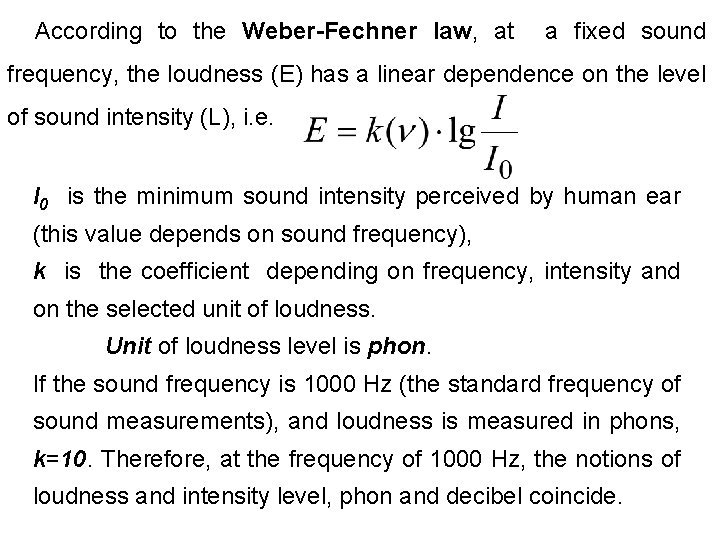
According to the Weber-Fechner law, at a fixed sound frequency, the loudness (Е) has a linear dependence on the level of sound intensity (L), i. e. I 0 is the minimum sound intensity perceived by human ear (this value depends on sound frequency), k is the coefficient depending on frequency, intensity and on the selected unit of loudness. Unit of loudness level is phon. If the sound frequency is 1000 Hz (the standard frequency of sound measurements), and loudness is measured in phons, k=10. Therefore, at the frequency of 1000 Hz, the notions of loudness and intensity level, phon and decibel coincide.
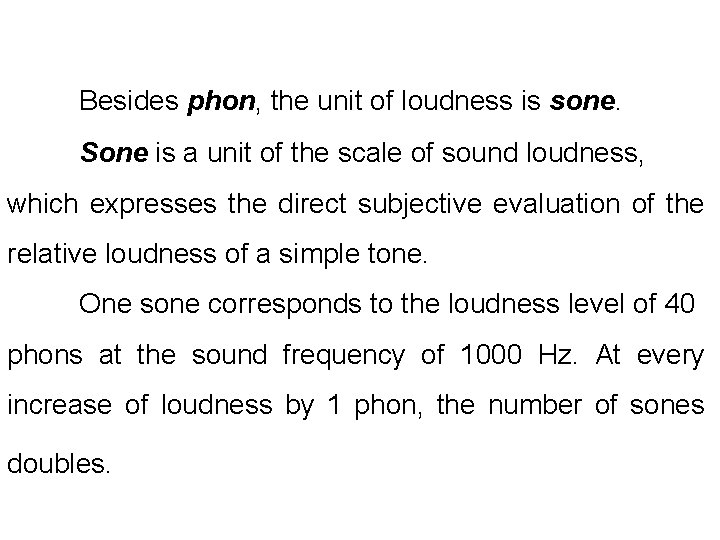
Besides phon, the unit of loudness is sone. Sone is a unit of the scale of sound loudness, which expresses the direct subjective evaluation of the relative loudness of a simple tone. One sone corresponds to the loudness level of 40. phons at the sound frequency of 1000 Hz. At every increase of loudness by 1 phon, the number of sones doubles.
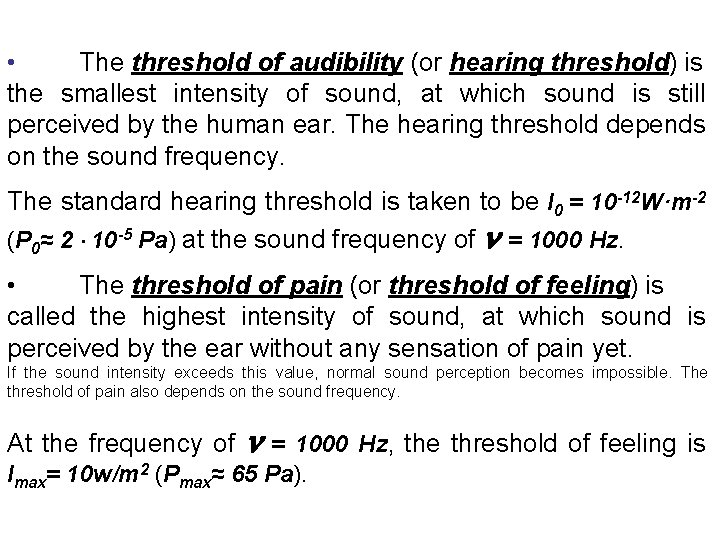
• The threshold of audibility (or hearing threshold) is the smallest intensity of sound, at which sound is still perceived by the human ear. The hearing threshold depends on the sound frequency. The standard hearing threshold is taken to be I 0 = 10 -12 W·m-2 (P 0≈ 2 · 10 -5 Pa) at the sound frequency of = 1000 Hz. • The threshold of pain (or threshold of feeling) is. called the highest intensity of sound, at which sound is perceived by the ear without any sensation of pain yet. If the sound intensity exceeds this value, normal sound perception becomes impossible. The threshold of pain also depends on the sound frequency. At the frequency of = 1000 Hz, the Imax= 10 w/m 2 (Pmax≈ 65 Pa). threshold of feeling is
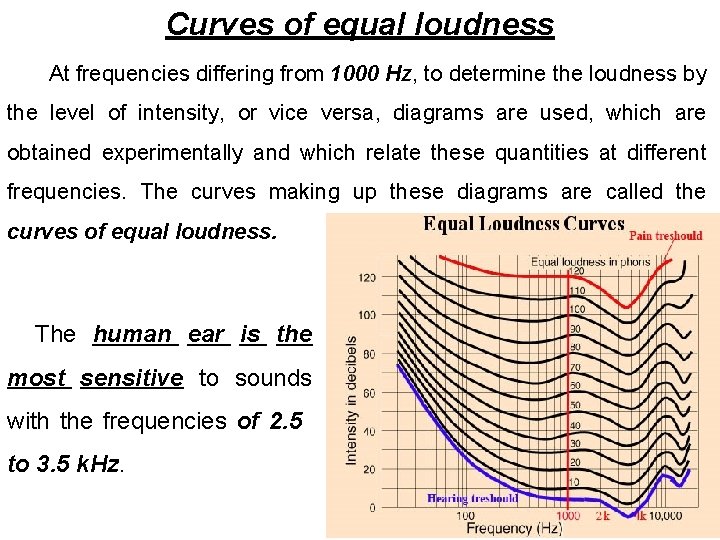
Curves of equal loudness At frequencies differing from 1000 Hz, to determine the loudness by the level of intensity, or vice versa, diagrams are used, which are obtained experimentally and which relate these quantities at different frequencies. The curves making up these diagrams are called the curves of equal loudness. The human ear is the most sensitive to sounds with the frequencies of 2. 5 to 3. 5 k. Hz.
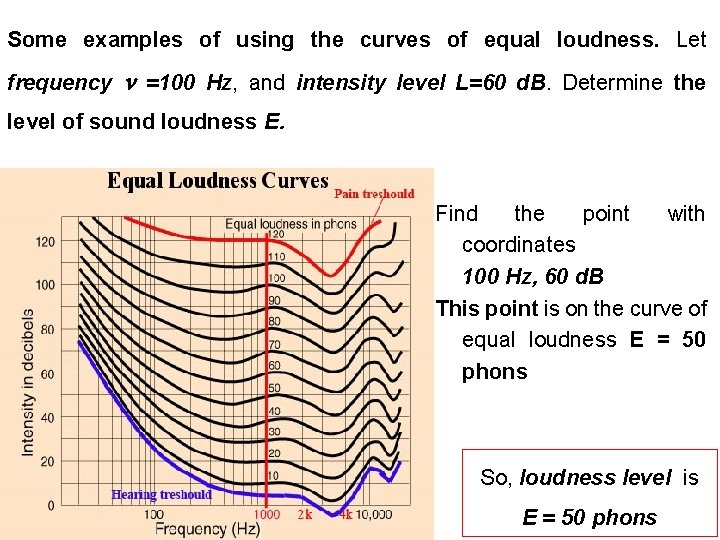
Some examples of using the curves of equal loudness. Let frequency =100 Hz, and intensity level L=60 d. B. Determine the level of sound loudness E. Find the point with coordinates 100 Hz, 60 d. B This point is on the curve of equal loudness Е = 50 phons So, loudness level is Е = 50 phons
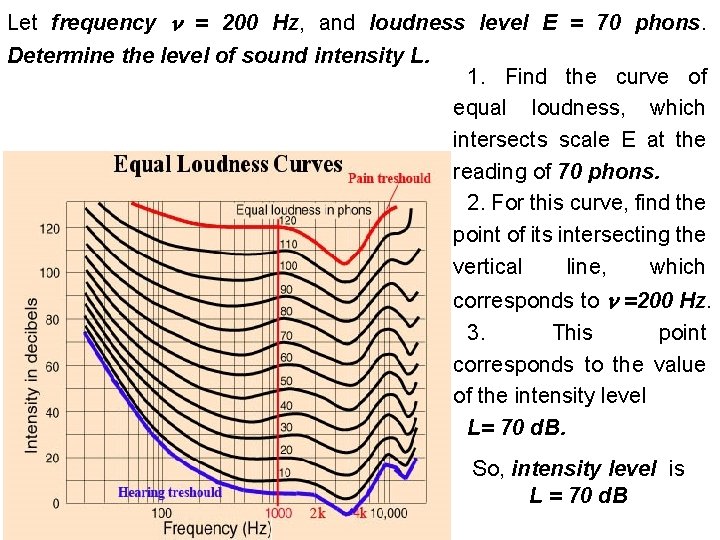
Let frequency = 200 Hz, and loudness level Е = 70 phons. Determine the level of sound intensity L. 1. Find the curve of equal loudness, which intersects scale E at the reading of 70 phons. 2. For this curve, find the point of its intersecting the vertical line, which corresponds to =200 Hz. 3. This point corresponds to the value of the intensity level L= 70 d. B. So, intensity level is L = 70 d. B
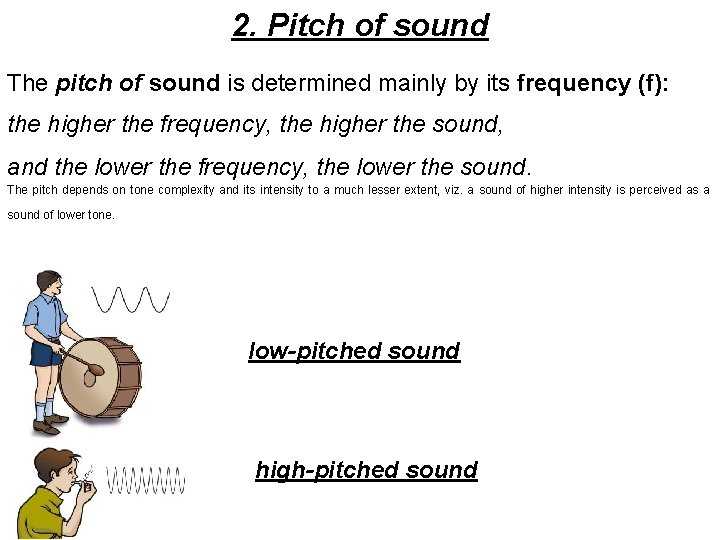
2. Pitch of sound The pitch of sound is determined mainly by its frequency (f): the higher the frequency, the higher the sound, and the lower the frequency, the lower the sound. The pitch depends on tone complexity and its intensity to a much lesser extent, viz. a sound of higher intensity is perceived as a sound of lower tone. low-pitched sound high-pitched sound
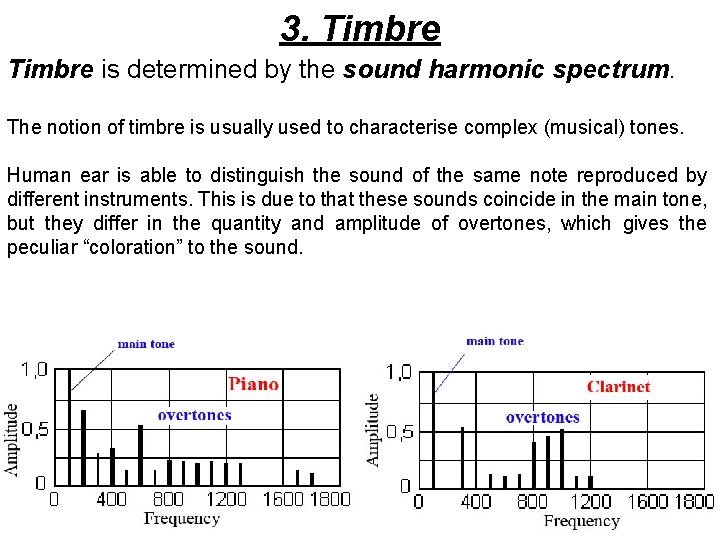
3. Timbre is determined by the sound harmonic spectrum. The notion of timbre is usually used to characterise complex (musical) tones. Human ear is able to distinguish the sound of the same note reproduced by different instruments. This is due to that these sounds coincide in the main tone, but they differ in the quantity and amplitude of overtones, which gives the peculiar “coloration” to the sound.
Sound Methods of Clinical Examination: 1. Audiometry 2. Auscultation 3. Percussion 4. Phonocardiography
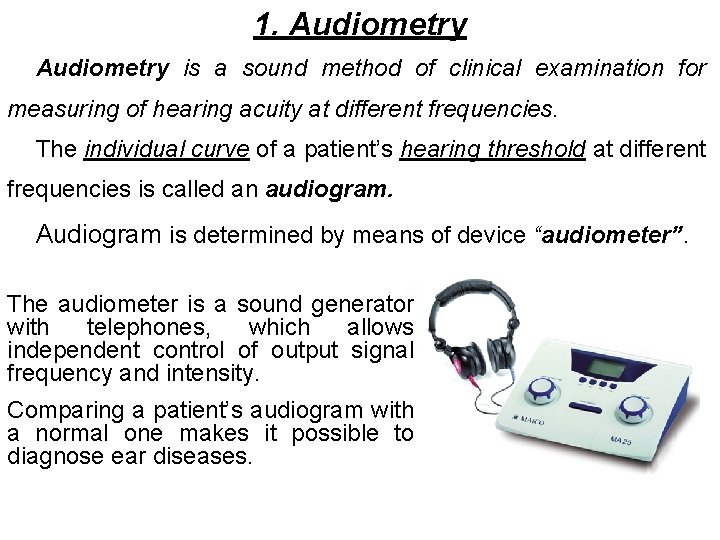
1. Audiometry is a sound method of clinical examination for measuring of hearing acuity at different frequencies. The individual curve of a patient’s hearing threshold at different frequencies is called an audiogram. Audiogram is determined by means of device “audiometer”. The audiometer is a sound generator with telephones, which allows independent control of output signal frequency and intensity. Comparing a patient’s audiogram with a normal one makes it possible to diagnose ear diseases.
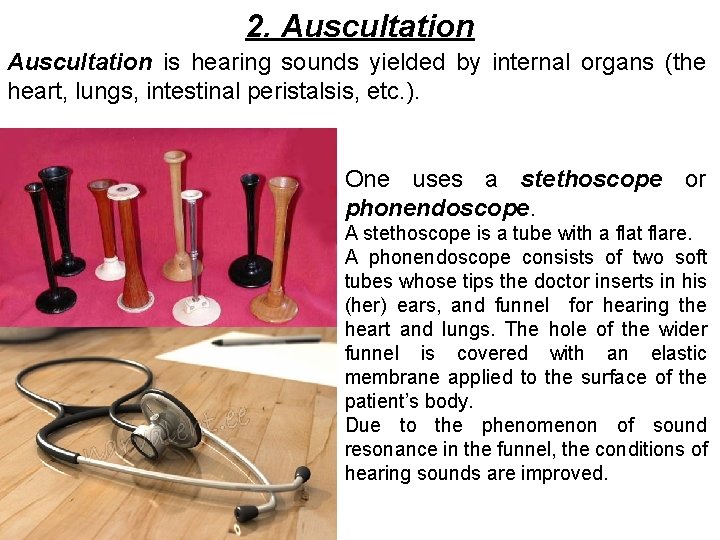
2. Auscultation is hearing sounds yielded by internal organs (the heart, lungs, intestinal peristalsis, etc. ). One uses a stethoscope or phonendoscope. A stethoscope is a tube with a flat flare. A phonendoscope consists of two soft tubes whose tips the doctor inserts in his (her) ears, and funnel for hearing the heart and lungs. The hole of the wider funnel is covered with an elastic membrane applied to the surface of the patient’s body. Due to the phenomenon of sound resonance in the funnel, the conditions of hearing sounds are improved.
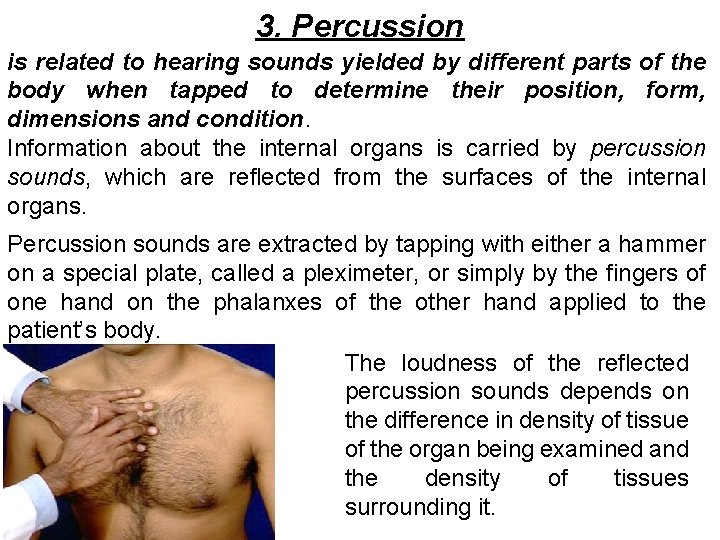
3. Percussion is related to hearing sounds yielded by different parts of the body when tapped to determine their position, form, dimensions and condition. Information about the internal organs is carried by percussion sounds, which are reflected from the surfaces of the internal organs. Percussion sounds are extracted by tapping with either a hammer on a special plate, called a pleximeter, or simply by the fingers of one hand on the phalanxes of the other hand applied to the patient’s body. The loudness of the reflected percussion sounds depends on the difference in density of tissue of the organ being examined and the density of tissues surrounding it.
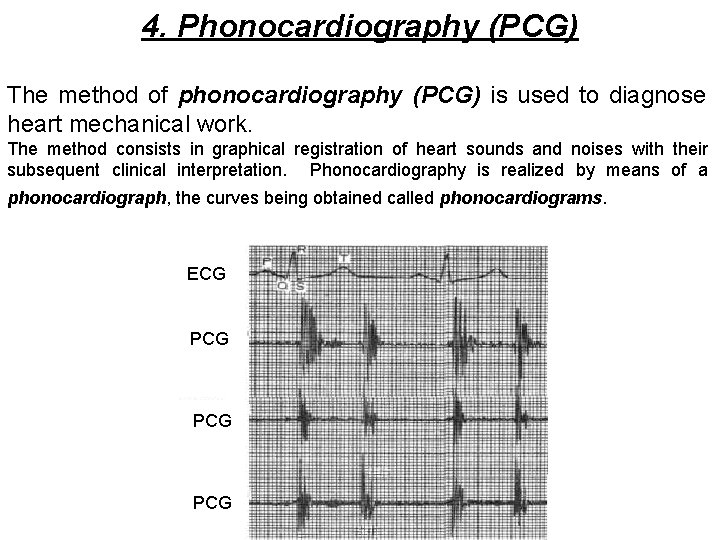
4. Phonocardiography (PCG) The method of phonocardiography (PCG) is used to diagnose heart mechanical work. The method consists in graphical registration of heart sounds and noises with their subsequent clinical interpretation. Phonocardiography is realized by means of a phonocardiograph, the curves being obtained called phonocardiograms. ECG PCG PCG
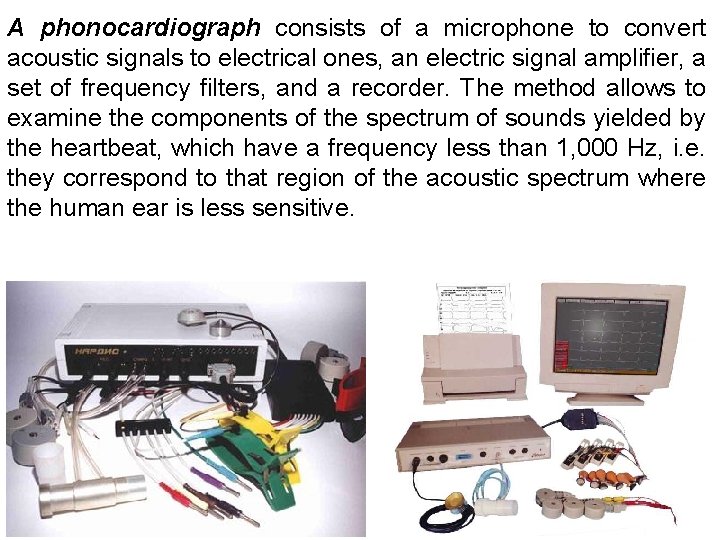
A phonocardiograph consists of a microphone to convert acoustic signals to electrical ones, an electric signal amplifier, a set of frequency filters, and a recorder. The method allows to examine the components of the spectrum of sounds yielded by the heartbeat, which have a frequency less than 1, 000 Hz, i. e. they correspond to that region of the acoustic spectrum where the human ear is less sensitive.
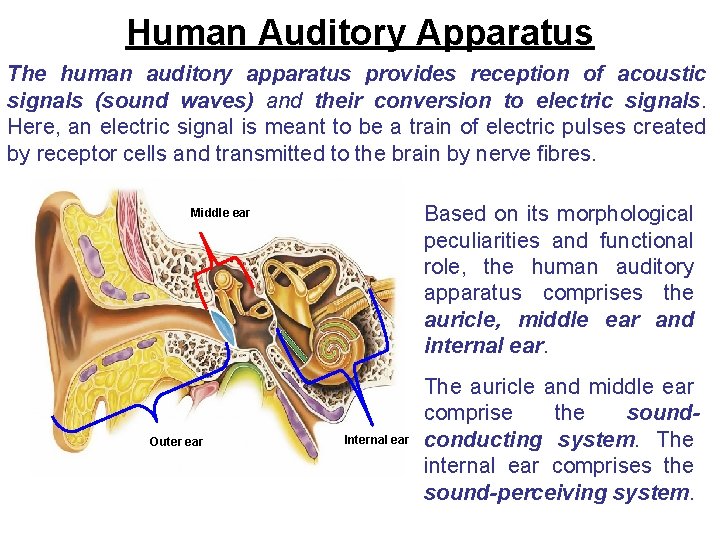
Human Auditory Apparatus The human auditory apparatus provides reception of acoustic signals (sound waves) and their conversion to electric signals. Here, an electric signal is meant to be a train of electric pulses created by receptor cells and transmitted to the brain by nerve fibres. Based on its morphological peculiarities and functional role, the human auditory apparatus comprises the auricle, middle ear and internal ear. Middle ear Outer ear Internal ear The auricle and middle ear comprise the soundconducting system. The internal ear comprises the sound-perceiving system.
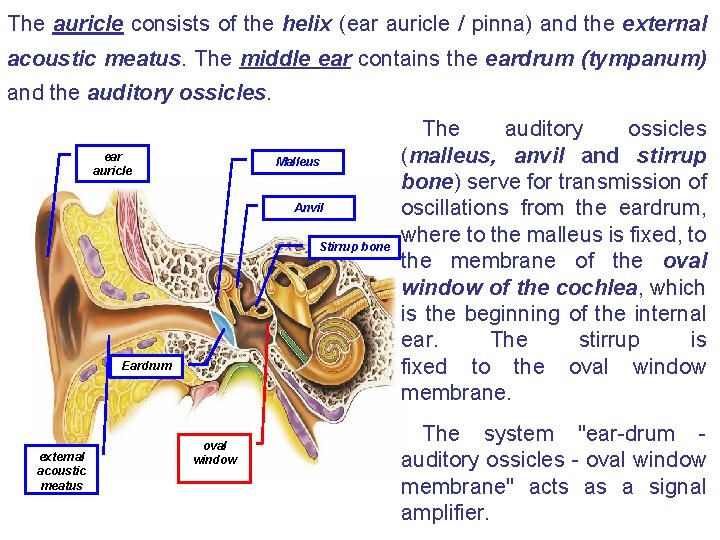
The auricle consists of the helix (ear auricle / pinna) and the external acoustic meatus. The middle ear contains the eardrum (tympanum) and the auditory ossicles. ear auricle Malleus Anvil Stirrup bone Eardrum external acoustic meatus oval window The auditory ossicles (malleus, anvil and stirrup bone) serve for transmission of oscillations from the eardrum, where to the malleus is fixed, to the membrane of the oval window of the cochlea, which is the beginning of the internal ear. The stirrup is fixed to the oval window membrane. The system "ear-drum auditory ossicles - oval window membrane" acts as a signal amplifier.
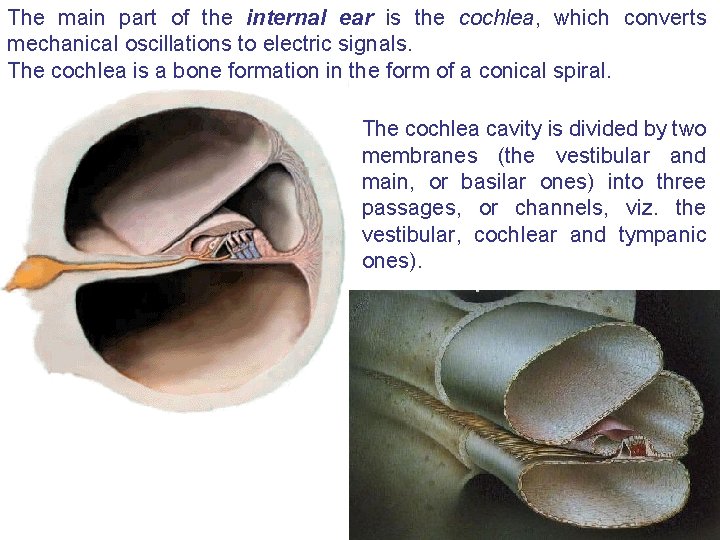
The main part of the internal ear is the cochlea, which converts mechanical oscillations to electric signals. The cochlea is a bone formation in the form of a conical spiral. The cochlea cavity is divided by two membranes (the vestibular and main, or basilar ones) into three passages, or channels, viz. the vestibular, cochlear and tympanic ones).
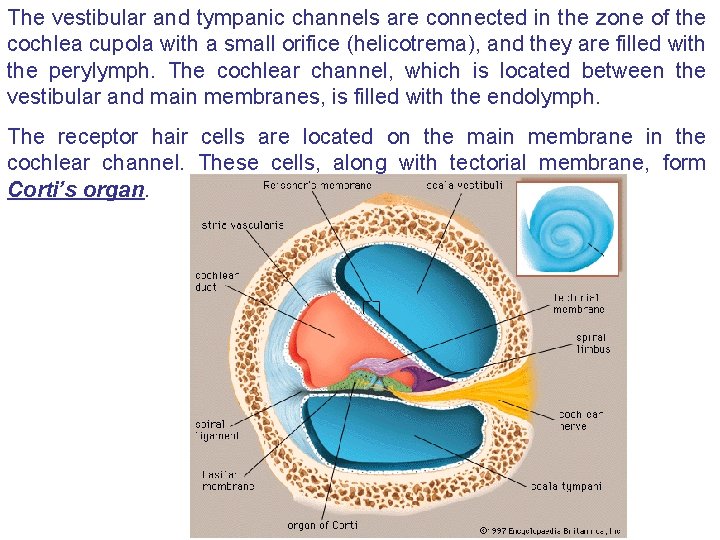
The vestibular and tympanic channels are connected in the zone of the cochlea cupola with a small orifice (helicotrema), and they are filled with the perylymph. The cochlear channel, which is located between the vestibular and main membranes, is filled with the endolymph. The receptor hair cells are located on the main membrane in the cochlear channel. These cells, along with tectorial membrane, form Corti’s organ.
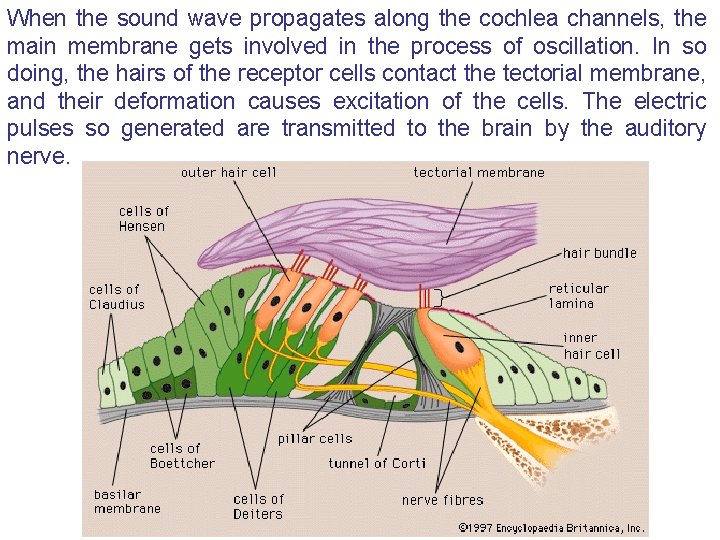
When the sound wave propagates along the cochlea channels, the main membrane gets involved in the process of oscillation. In so doing, the hairs of the receptor cells contact the tectorial membrane, and their deformation causes excitation of the cells. The electric pulses so generated are transmitted to the brain by the auditory nerve.
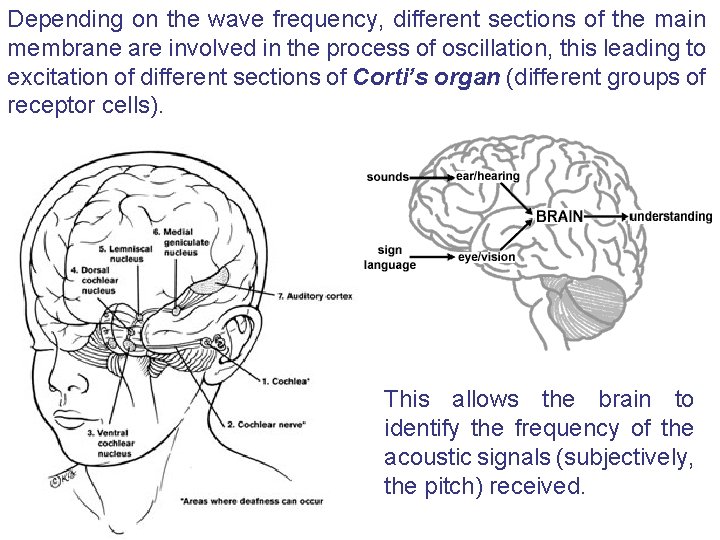
Depending on the wave frequency, different sections of the main membrane are involved in the process of oscillation, this leading to excitation of different sections of Corti’s organ (different groups of receptor cells). This allows the brain to identify the frequency of the acoustic signals (subjectively, the pitch) received.
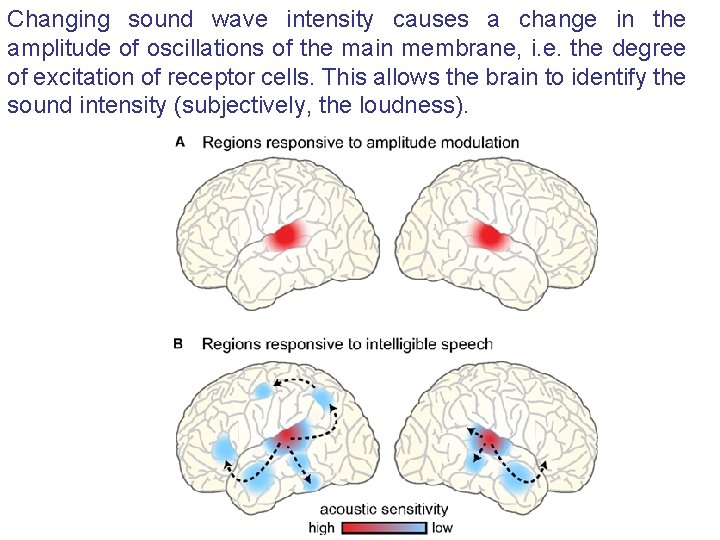
Changing sound wave intensity causes a change in the amplitude of oscillations of the main membrane, i. e. the degree of excitation of receptor cells. This allows the brain to identify the sound intensity (subjectively, the loudness).
Ultrasound for Medical Applications Acoustic waves with frequencies from 20 k. Hz to 109 Hz are called ultrasound (US) waves or ultrasound. Acoustic waves with frequencies more than 109 Hz are called hypersound. Ultrasound is generated by using such physical phenomena as the inverse piezoelectric effect (piezoeffect) and magnetostriction. The essence of the inverse piezoeffect is that piezoelectrics (for example, quartz) are subject to strain (expand or compress) when placed in an electric field. Therefore, placing a piezoelectric crystal in an alternating electric field of ultrasound frequency makes the crystal surface oscillate with this frequency and excite ultrasound waves in the environment. Magnetostriction is changing of dimensions (expansion or compression) of ferrites in an alternating magnetic field. Placing ferrites into an alternating magnetic field of ultrasound frequency causes oscillation of the ferrite surface with this frequency, i. e. excitation of ultrasound waves in the environment.
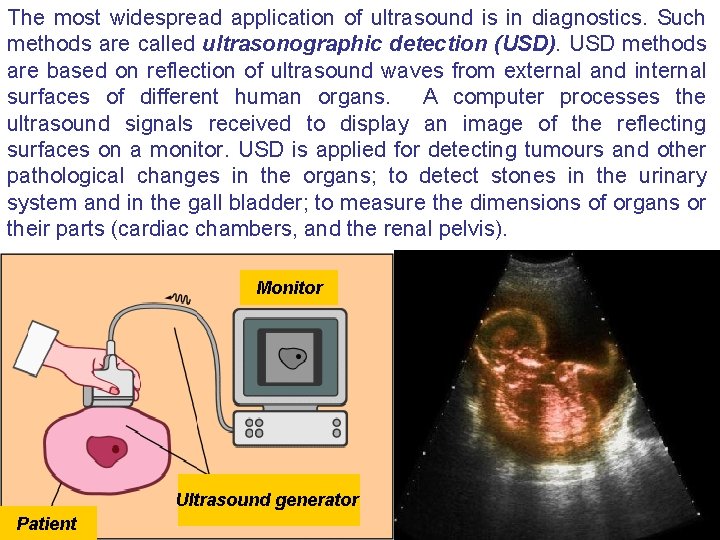
The most widespread application of ultrasound is in diagnostics. Such methods are called ultrasonographic detection (USD). USD methods are based on reflection of ultrasound waves from external and internal surfaces of different human organs. A computer processes the ultrasound signals received to display an image of the reflecting surfaces on a monitor. USD is applied for detecting tumours and other pathological changes in the organs; to detect stones in the urinary system and in the gall bladder; to measure the dimensions of organs or their parts (cardiac chambers, and the renal pelvis). Monitor Ultrasound generator Patient
Before considering therapeutic application of ultrasound, we will indicate the effects that appear when ultrasound waves pass through biological tissues: 1)micro vibrations at cellular and subcellular levels; 2)destruction of macromolecules; 3)reconstruction and damage of membranes, leading to changes in their permeability; 4)heat release; 5)destruction of cells; 6)formation of chemically highly active ions and free radicals. The primary mechanisms of ultrasound therapy are mechanical and heat action on the tissue.
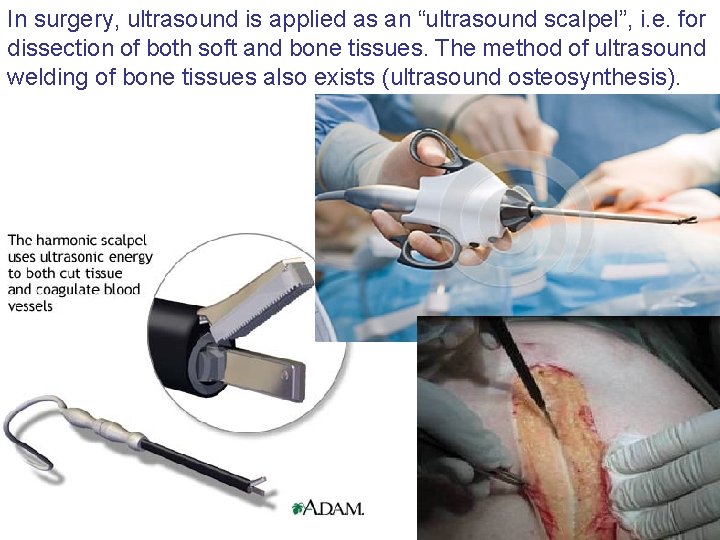
In surgery, ultrasound is applied as an “ultrasound scalpel”, i. e. for dissection of both soft and bone tissues. The method of ultrasound welding of bone tissues also exists (ultrasound osteosynthesis).
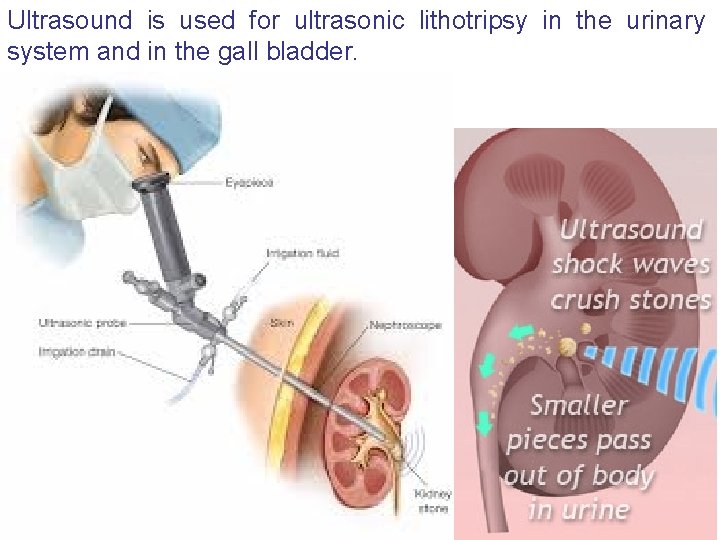
Ultrasound is used for ultrasonic lithotripsy in the urinary system and in the gall bladder.
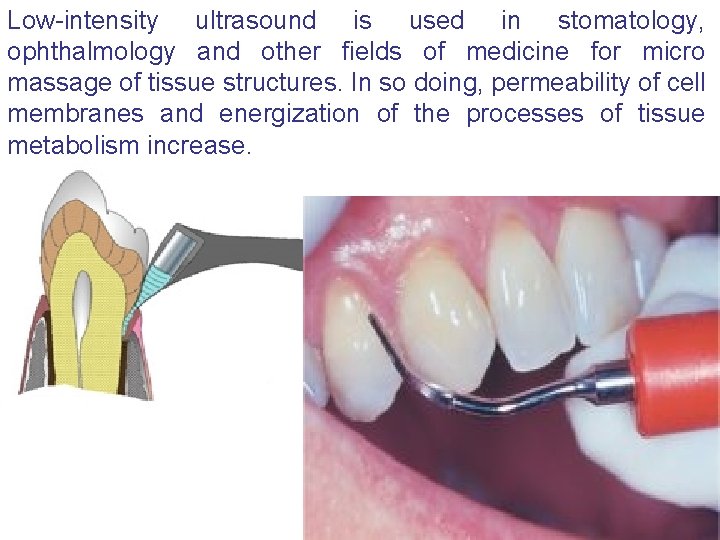
Low-intensity ultrasound is used in stomatology, ophthalmology and other fields of medicine for micro massage of tissue structures. In so doing, permeability of cell membranes and energization of the processes of tissue metabolism increase.
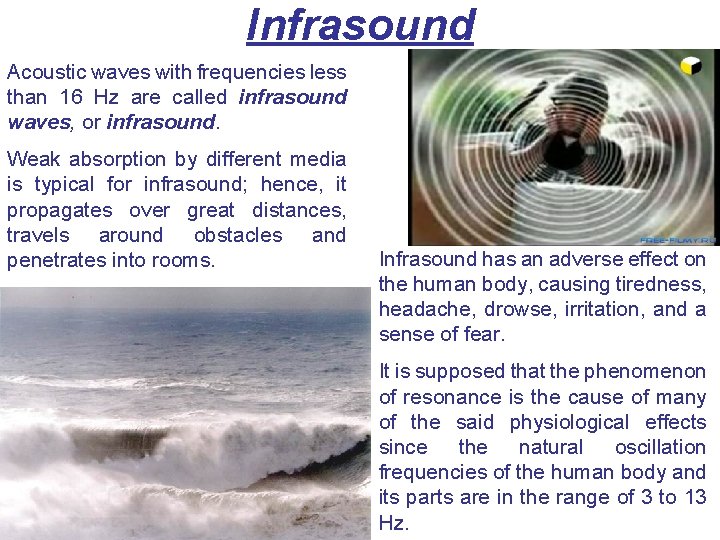
Infrasound Acoustic waves with frequencies less than 16 Hz are called infrasound waves, or infrasound. Weak absorption by different media is typical for infrasound; hence, it propagates over great distances, travels around obstacles and penetrates into rooms. Infrasound has an adverse effect on the human body, causing tiredness, headache, drowse, irritation, and a sense of fear. It is supposed that the phenomenon of resonance is the cause of many of the said physiological effects since the natural oscillation frequencies of the human body and its parts are in the range of 3 to 13 Hz.
- Slides: 57