
Lecture 4 Basic Computer Graphics For User Interfaces
Lecture 4: Basic Computer Graphics For User Interfaces Brad Myers 05 -830 Advanced User Interface Software 1
Why? l l To draw application-specific graphical objects Lines, rectangles, text Mac, Windows, X have approximately the same model There are some complexities that are worth looking at 2
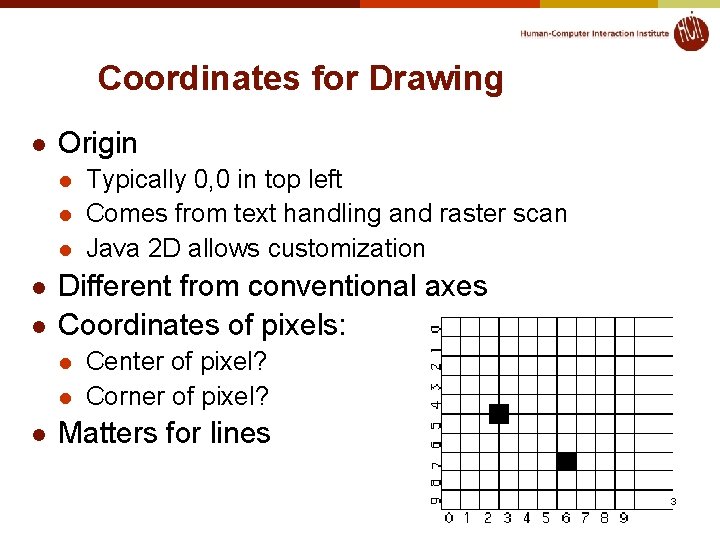
Coordinates for Drawing l Origin l l l Different from conventional axes Coordinates of pixels: l l l Typically 0, 0 in top left Comes from text handling and raster scan Java 2 D allows customization Center of pixel? Corner of pixel? Matters for lines 3
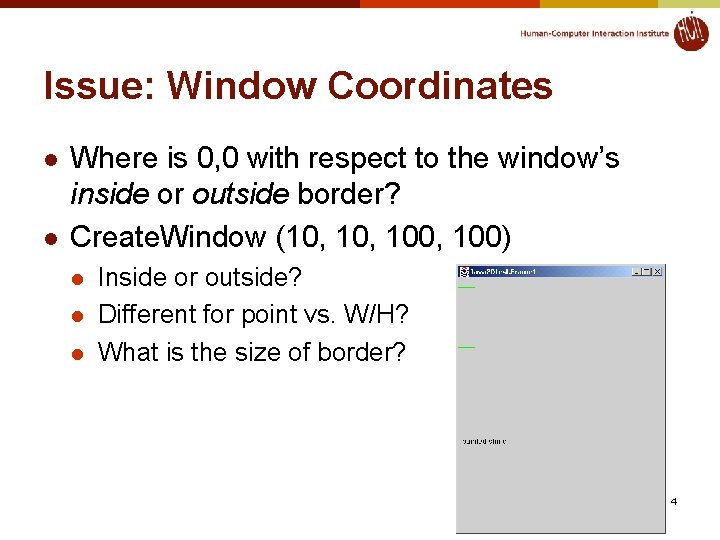
Issue: Window Coordinates l l Where is 0, 0 with respect to the window’s inside or outside border? Create. Window (10, 100, 100) l l l Inside or outside? Different for point vs. W/H? What is the size of border? 4
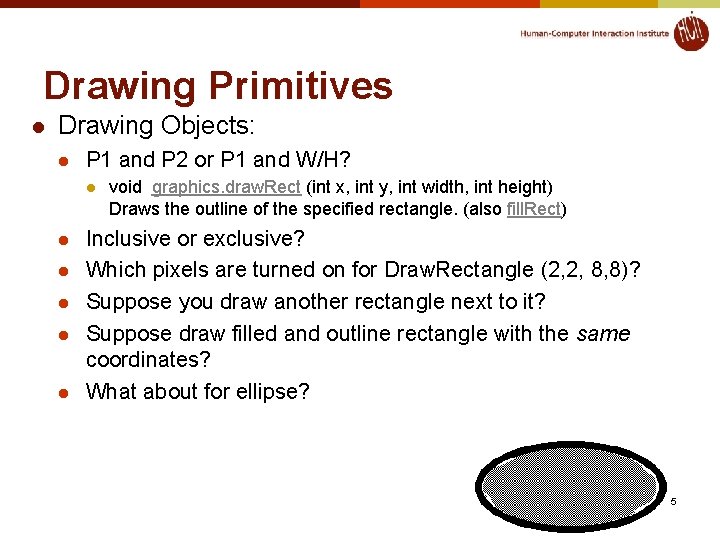
Drawing Primitives l Drawing Objects: l P 1 and P 2 or P 1 and W/H? l l l void graphics. draw. Rect (int x, int y, int width, int height) Draws the outline of the specified rectangle. (also fill. Rect) Inclusive or exclusive? Which pixels are turned on for Draw. Rectangle (2, 2, 8, 8)? Suppose you draw another rectangle next to it? Suppose draw filled and outline rectangle with the same coordinates? What about for ellipse? 5
Primitives, 2 l Draw. Line has similar concerns l l Thick lines often go to both sides of the coordinates draw. Polyline takes a sequence of points l l l Endpoints of each segment drawn? Last end-point drawn? Closed vs. open; may draw first point twice 6
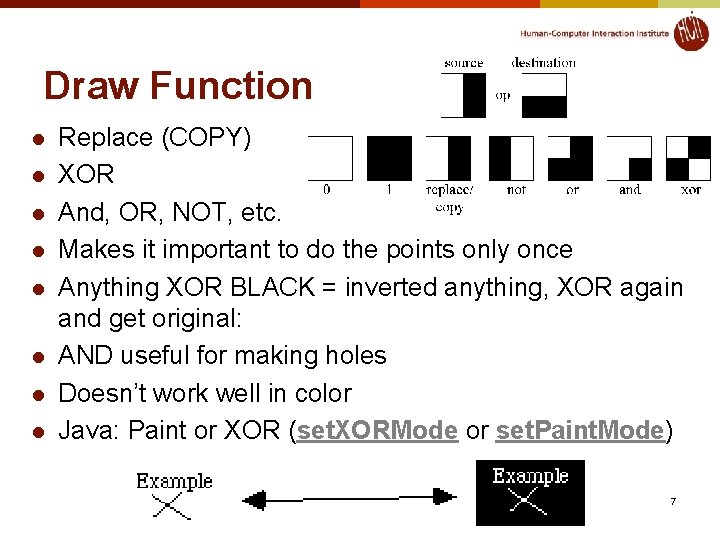
Draw Function l l l l Replace (COPY) XOR And, OR, NOT, etc. Makes it important to do the points only once Anything XOR BLACK = inverted anything, XOR again and get original: AND useful for making holes Doesn’t work well in color Java: Paint or XOR (set. XORMode or set. Paint. Mode) 7
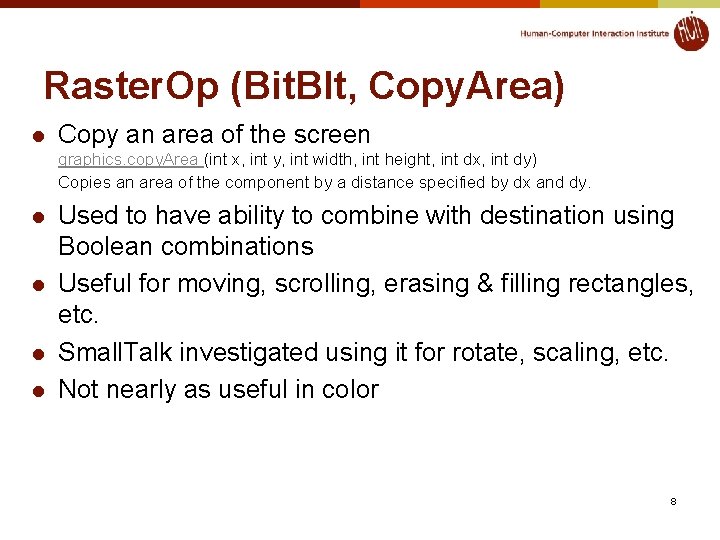
Raster. Op (Bit. Blt, Copy. Area) l Copy an area of the screen graphics. copy. Area (int x, int y, int width, int height, int dx, int dy) Copies an area of the component by a distance specified by dx and dy. l l Used to have ability to combine with destination using Boolean combinations Useful for moving, scrolling, erasing & filling rectangles, etc. Small. Talk investigated using it for rotate, scaling, etc. Not nearly as useful in color 8
Double Buffering l Save an extra picture offscreen l l l Smoother animations Save hidden parts of windows = “Backing store” Use two buffers for special effects, faster refresh “Save-under” for pop-ups 9
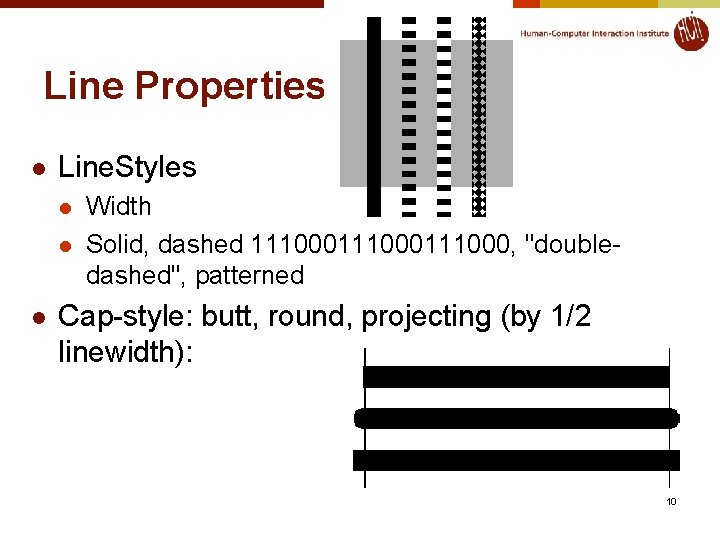
Line Properties l Line. Styles l l l Width Solid, dashed 111000111000, "doubledashed", patterned Cap-style: butt, round, projecting (by 1/2 linewidth): 10
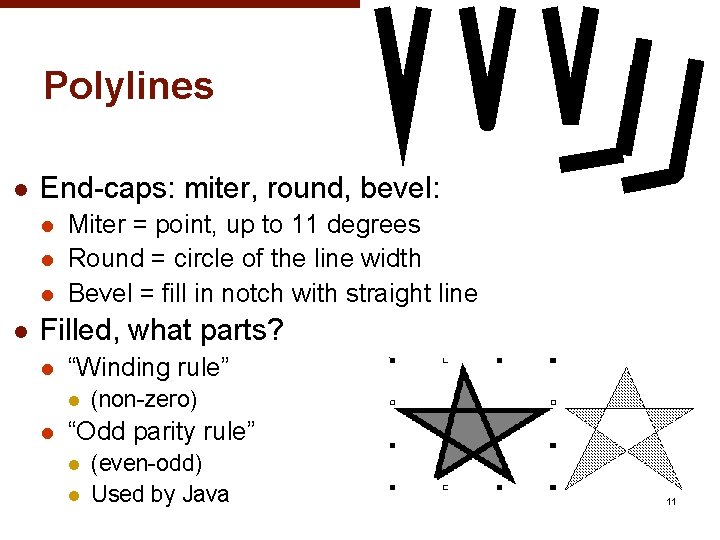
Polylines l End-caps: miter, round, bevel: l l Miter = point, up to 11 degrees Round = circle of the line width Bevel = fill in notch with straight line Filled, what parts? l “Winding rule” l l (non-zero) “Odd parity rule” l l (even-odd) Used by Java 11
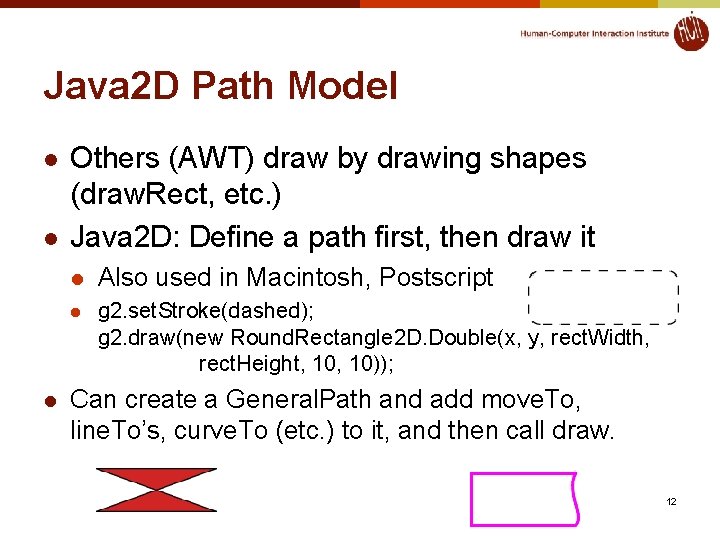
Java 2 D Path Model l Others (AWT) draw by drawing shapes (draw. Rect, etc. ) Java 2 D: Define a path first, then draw it l Also used in Macintosh, Postscript l g 2. set. Stroke(dashed); g 2. draw(new Round. Rectangle 2 D. Double(x, y, rect. Width, rect. Height, 10)); Can create a General. Path and add move. To, line. To’s, curve. To (etc. ) to it, and then call draw. 12
Splines l Curves defined by “cubic” equation l l l x(t) = axt 3 + bxt 2 + cxt + dx y(t) = ayt 3 + byt 2 + cyt + dy Well-defined techniques from graphics (not covered here – see Foley&van. Dam) Defined to go through the “control” points curve. To(float x 1, float y 1, float x 2, float y 2, float x 3, float y 3) Adds a curved segment, defined by three new points, to the path by drawing a Bézier curve that intersects both the current coordinates and the coordinates (x 3, y 3), using the specified points (x 1, y 1) and (x 2, y 2) as Bézier control points. 13
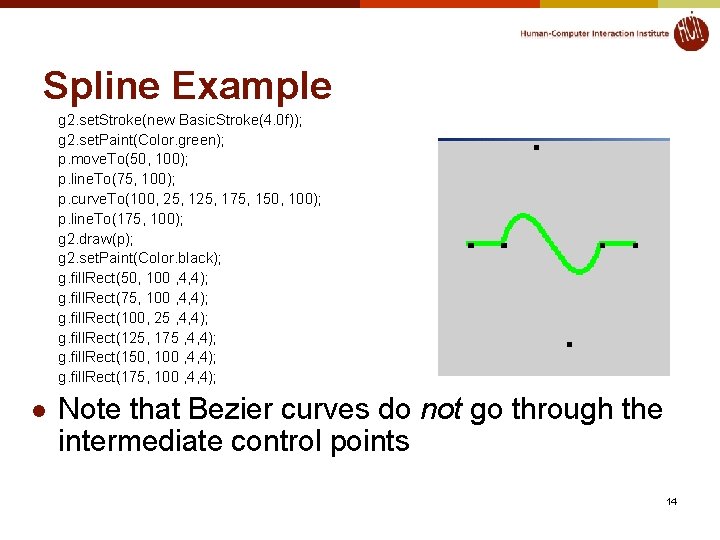
Spline Example g 2. set. Stroke(new Basic. Stroke(4. 0 f)); g 2. set. Paint(Color. green); p. move. To(50, 100); p. line. To(75, 100); p. curve. To(100, 25, 175, 150, 100); p. line. To(175, 100); g 2. draw(p); g 2. set. Paint(Color. black); g. fill. Rect(50, 100 , 4, 4); g. fill. Rect(75, 100 , 4, 4); g. fill. Rect(100, 25 , 4, 4); g. fill. Rect(125, 175 , 4, 4); g. fill. Rect(150, 100 , 4, 4); g. fill. Rect(175, 100 , 4, 4); l Note that Bezier curves do not go through the intermediate control points 14
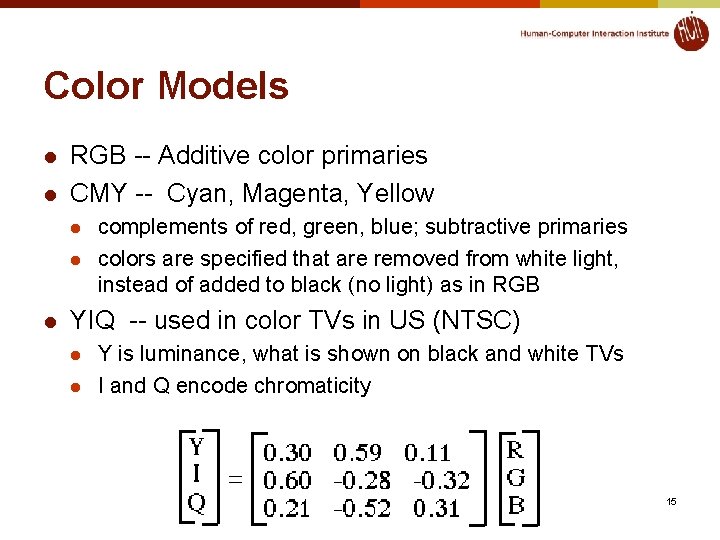
Color Models l l RGB -- Additive color primaries CMY -- Cyan, Magenta, Yellow l l l complements of red, green, blue; subtractive primaries colors are specified that are removed from white light, instead of added to black (no light) as in RGB YIQ -- used in color TVs in US (NTSC) l l Y is luminance, what is shown on black and white TVs I and Q encode chromaticity 15
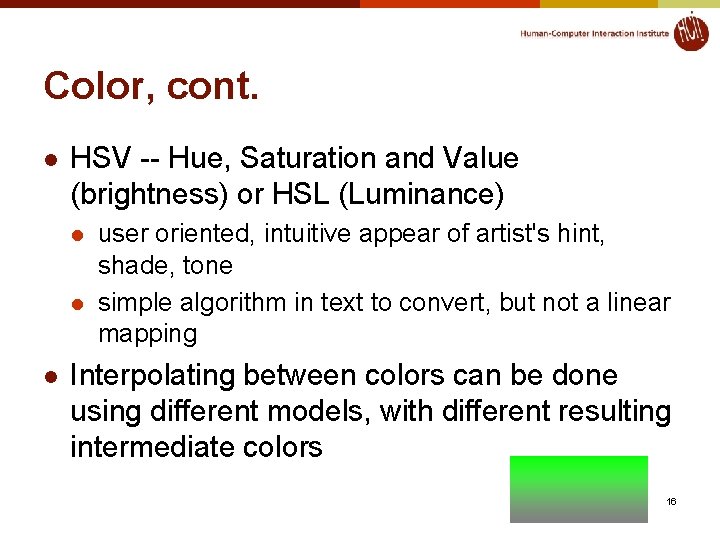
Color, cont. l HSV -- Hue, Saturation and Value (brightness) or HSL (Luminance) l l l user oriented, intuitive appear of artist's hint, shade, tone simple algorithm in text to convert, but not a linear mapping Interpolating between colors can be done using different models, with different resulting intermediate colors 16
Transparency of Color l Original model used only opaque paint l l Current systems now support “paint” that combines with “paint” already under it l l Modeled hardcopy devices this was developed for (at Xerox PARC) e. g. , translucent paint (“alpha” values) Intermediate l Icons and images can select one “transparent” color l E. g, “transparent gifs” 17
Paint with transparency l Postscript model is based on “alpha blending” approach l l Dominant model for hardcopy Java 2 D drawing model also takes this approach 18
Paint with transparency, 2 l Advantages l l Flexible display Disadvantages l Slower l l l Less and less of an issue But interactive response tends to be dominated by redraw time Much harder to implement 19
Alpha Blending l Alpha is percent of this picture used l Color(float r, float g, float b, float a) Creates an s. RGB color with the specified red, green, blue, and alpha values in the range (0. 0 - 1. 0). 20
Fonts and drawing strings l Font provides description of the shape of a collection of chars l l l Shapes are called “glyphs” Plus information e. g. about how to advance after drawing a glyph And aggregate info for the whole collection 21
Fonts l Typically specified by: l A family or typeface l l l e. g. , courier, helvetica, times roman A size (normally in “points”) A style l l e. g. , plain, italic, bold & italic other possibles (from mac): underline, outline, shadow 22
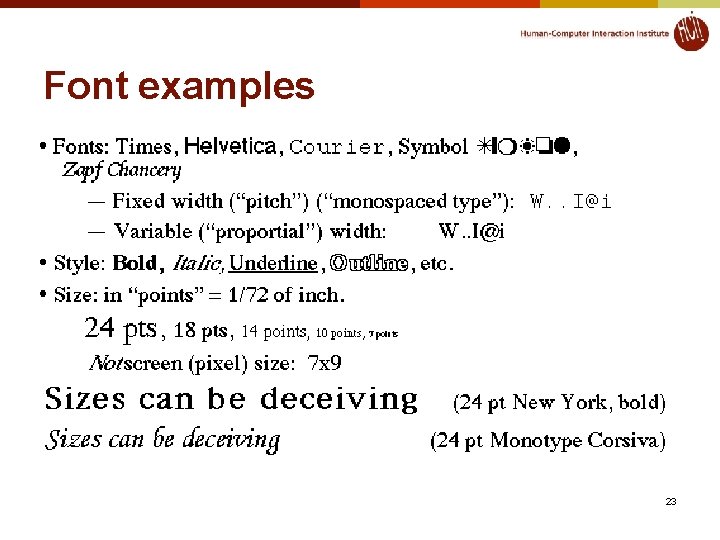
Font examples 23
Points l An odd and archaic unit of measurement l 72. 27 points per inch l l Postscript rounded to 72/inch l l Origin: 72 per French inch (!) Most have followed Early Macintosh: point==pixel (1/75 th) 24
Font. Metrics l Objects that allow you to measure characters, strings, and properties of whole fonts 25
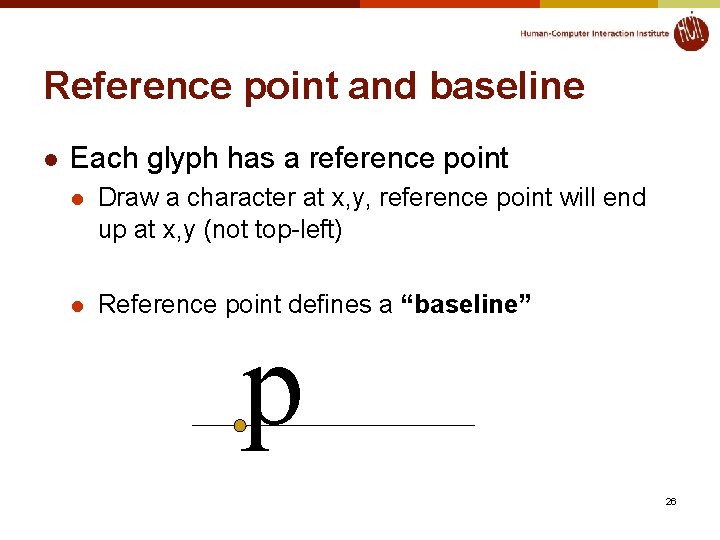
Reference point and baseline l Each glyph has a reference point l Draw a character at x, y, reference point will end up at x, y (not top-left) l Reference point defines a “baseline” p 26
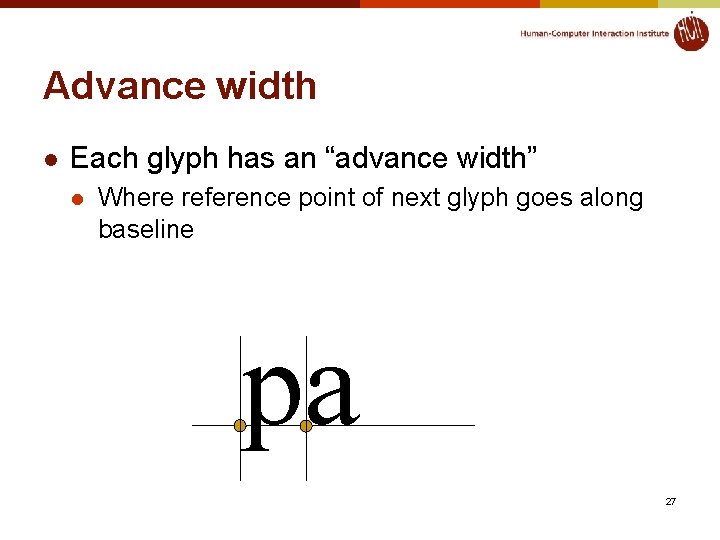
Advance width l Each glyph has an “advance width” l Where reference point of next glyph goes along baseline pa 27
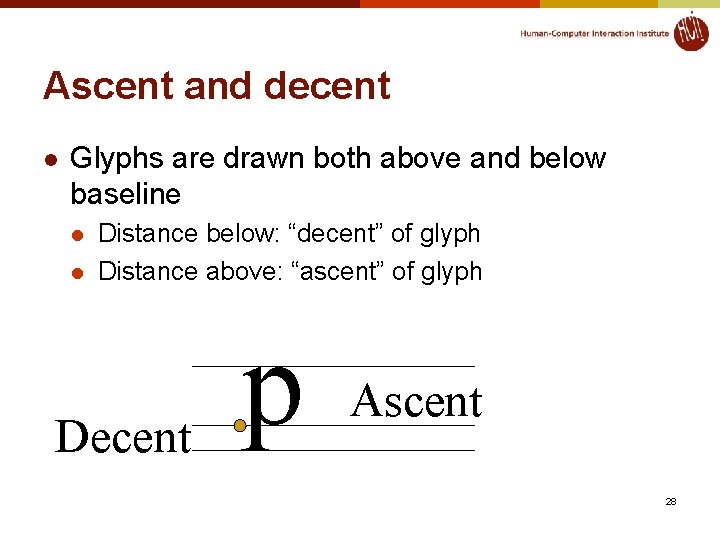
Ascent and decent l Glyphs are drawn both above and below baseline l l Distance below: “decent” of glyph Distance above: “ascent” of glyph Decent p Ascent 28
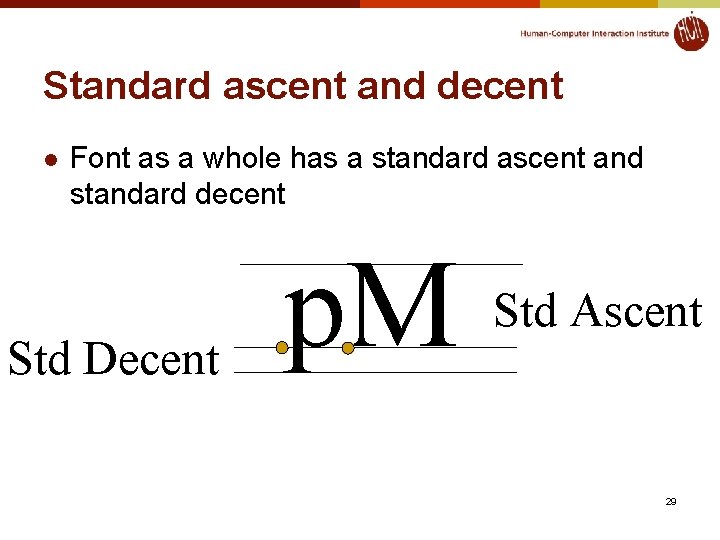
Standard ascent and decent l Font as a whole has a standard ascent and standard decent Std Decent p. M Std Ascent 29
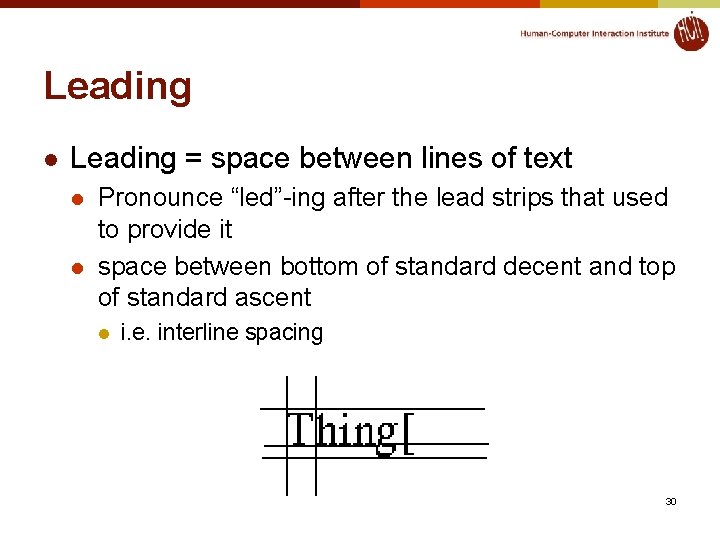
Leading l Leading = space between lines of text l l Pronounce “led”-ing after the lead strips that used to provide it space between bottom of standard decent and top of standard ascent l i. e. interline spacing 30
Height l Height of character or font l ascent + decent + leading l not standard across systems: on some systems doesn’t include leading (but does in Java) l New question: is the leading above or below the text in Java? 31
Other Parameters l l Kerning: overlapping of characters: VA, ff, V. Stroke: Element of a character that would have originally been created with a single pen stroke Em: Equal to the font's point size. So an "Em-dash" in a 18 point font is 18 points wide: (option-shift-underline on Mac) En: Half font's point size. "En-dash" is 9 points wide in 18 point font: (Mac: option-underline) l DASHES – DASHES—DASHES 32
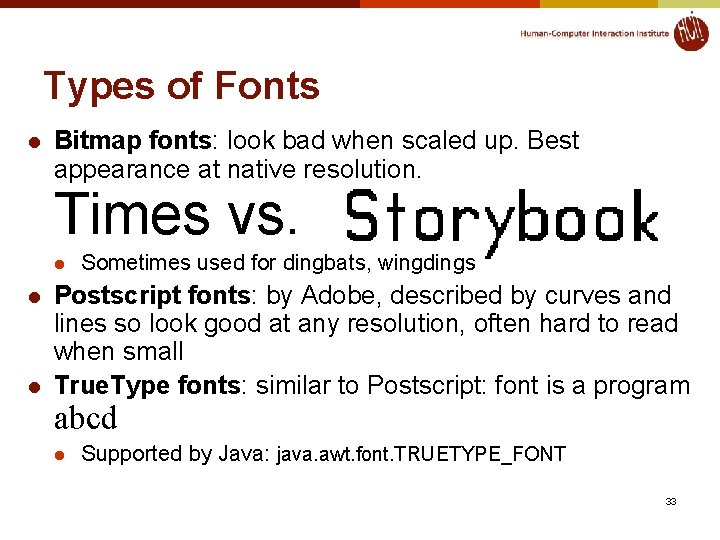
Types of Fonts l Bitmap fonts: look bad when scaled up. Best appearance at native resolution. Times vs. l l l Sometimes used for dingbats, wingdings Postscript fonts: by Adobe, described by curves and lines so look good at any resolution, often hard to read when small True. Type fonts: similar to Postscript: font is a program abcd l Supported by Java: java. awt. font. TRUETYPE_FONT 33
Encoding of Characters l Conventional ASCII l l One byte per character Various special characters in lower and upper part of fonts l l Depends on OS, font, etc. Unicode: http: //www. unicode. org l l l 16 bits per character All the world’s languages Java uses Unicode 34
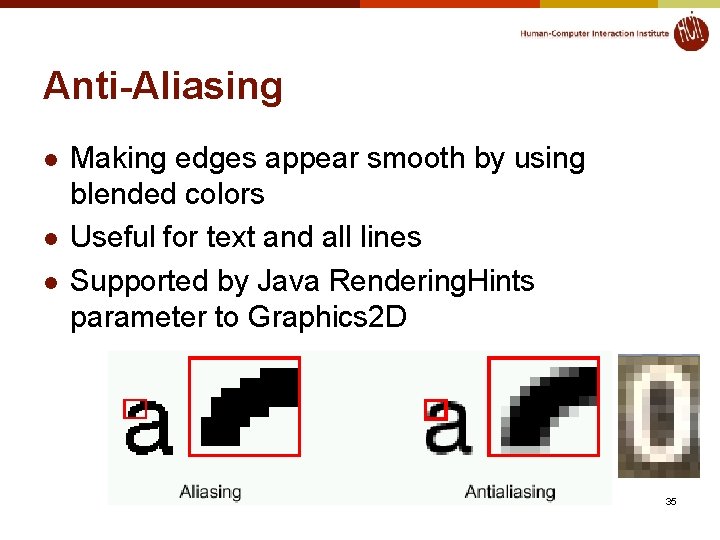
Anti-Aliasing l l l Making edges appear smooth by using blended colors Useful for text and all lines Supported by Java Rendering. Hints parameter to Graphics 2 D 35
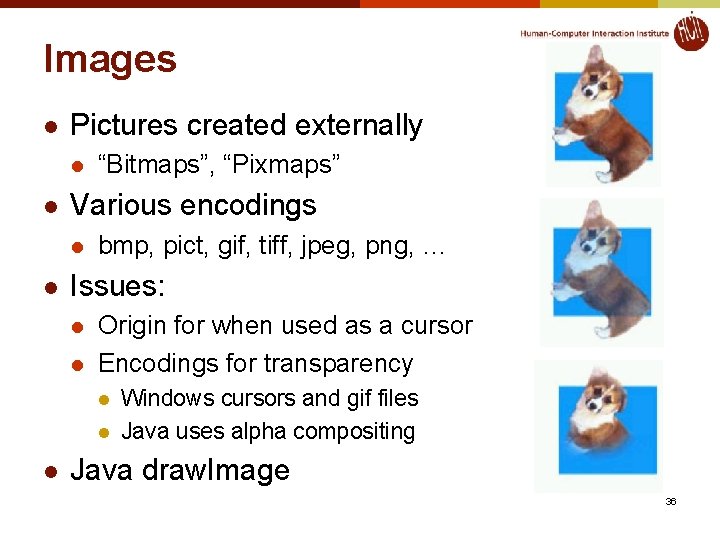
Images l Pictures created externally l l Various encodings l l “Bitmaps”, “Pixmaps” bmp, pict, gif, tiff, jpeg, png, … Issues: l l Origin for when used as a cursor Encodings for transparency l l l Windows cursors and gif files Java uses alpha compositing Java draw. Image 36
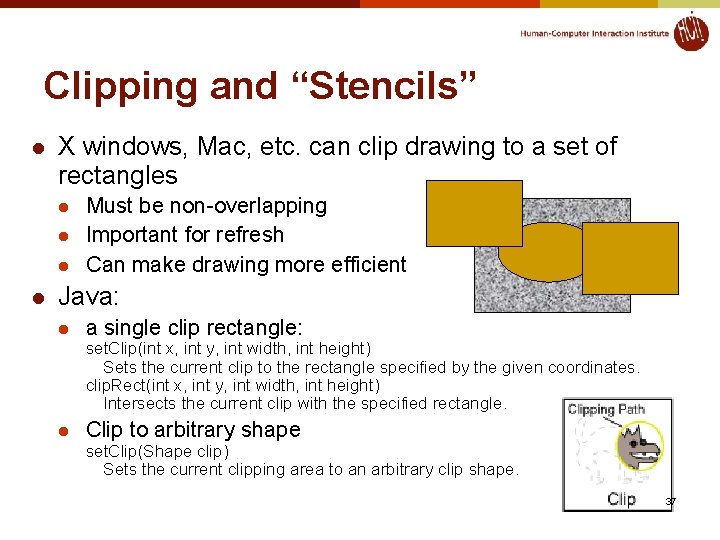
Clipping and “Stencils” l X windows, Mac, etc. can clip drawing to a set of rectangles l l Must be non-overlapping Important for refresh Can make drawing more efficient Java: l a single clip rectangle: set. Clip(int x, int y, int width, int height) Sets the current clip to the rectangle specified by the given coordinates. clip. Rect(int x, int y, int width, int height) Intersects the current clip with the specified rectangle. l Clip to arbitrary shape set. Clip(Shape clip) Sets the current clipping area to an arbitrary clip shape. 37
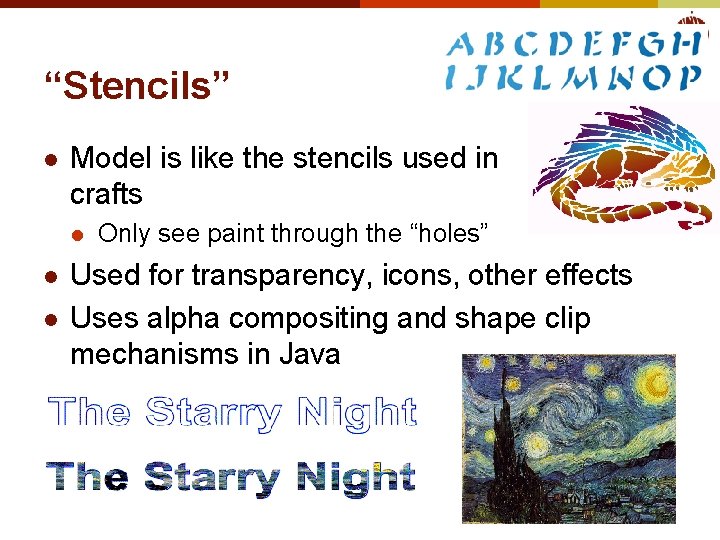
“Stencils” l Model is like the stencils used in crafts l l l Only see paint through the “holes” Used for transparency, icons, other effects Uses alpha compositing and shape clip mechanisms in Java 38
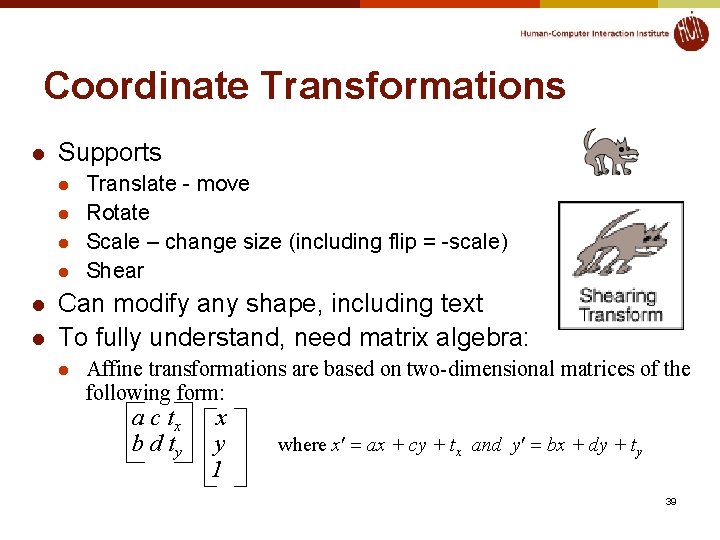
Coordinate Transformations l Supports l l l Translate - move Rotate Scale – change size (including flip = -scale) Shear Can modify any shape, including text To fully understand, need matrix algebra: l Affine transformations are based on two-dimensional matrices of the following form: a c tx b d ty x y 1 where x¢ = ax + cy + tx and y¢ = bx + dy + ty 39
Units for locations, sizes l Screen (pixels) versus “real” measures (inches) l Depends on screen resolution l Not necessarily known to system l l Java provides inches, millimeters, etc. as a transform l l l Easier for Postscript Default is pixels Visual Basic uses “twip” = 1/20 of a point = 1/1440 inch l Conventional screen = 1280 / 15” = 90 pixels/inch l Laser printers are 600 dots/inch Windows = “dialog box units” – DBU l based on the default system font: one vertical dbu is 1/8 of the font height, and one horizontal dbu is 1/4 of the font's average width 40
How Parameters are Passed l l How pass parameters for drawing operations? Issue: Lots of parameters control the drawing of objects. l l X drawline has at least 19 How many for Java swing? l Adds (at least): transformation matrix, antialiasing and other renderinghints, what else? 41
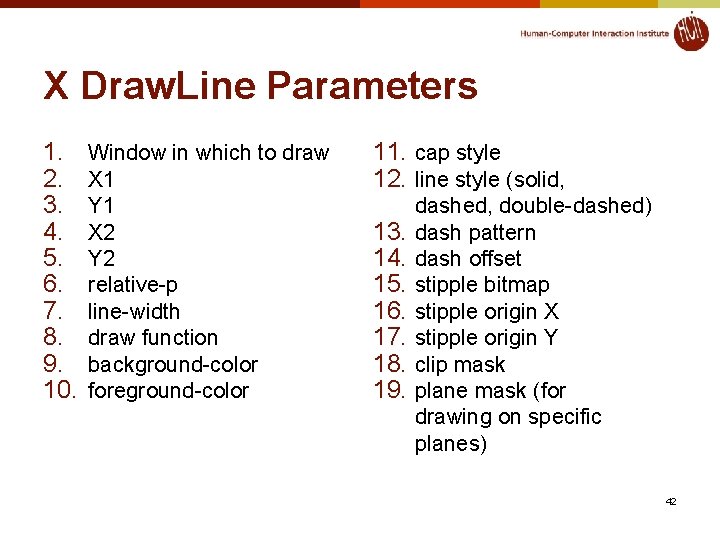
X Draw. Line Parameters 1. 2. 3. 4. 5. 6. 7. 8. 9. 10. Window in which to draw X 1 Y 1 X 2 Y 2 relative-p line-width draw function background-color foreground-color 11. cap style 12. line style (solid, 13. 14. 15. 16. 17. 18. 19. dashed, double-dashed) dash pattern dash offset stipple bitmap stipple origin X stipple origin Y clip mask plane mask (for drawing on specific planes) 42
How Pass Parameters? l Three basic possibilities l Pass all parameters with each operation l l l Draw. Line(70, 30, 70, 200, Red, . . . ) - too many parameters Not really used by any modern system 43
Passing Parameters, 2 l All parameters stored in the system l l l Used by Macintosh, Display Postscript, etc. Sometimes called the “pen” Example (pseudo code): § l l l Set. Color(Red) Move. To(70, 30) Draw. To(70, 200) + Fewer parameters to calls + Don't have to set properties don't care about - Interrupts, multi-processing, may result in unexpected settings 44
Passing Parameters, 3 l Store parameters in an object l X = “graphics context” § l Windows = “device context” § l Can have more than one corresponds to surface, but can push and pop Java § “Graphics”, Graphics 2 D, Graphics 3 D objects § Lots of settings 45
- Slides: 45