
Lecture 4 b Verb Processes Relationship between sentence
Lecture 4 b: Verb Processes
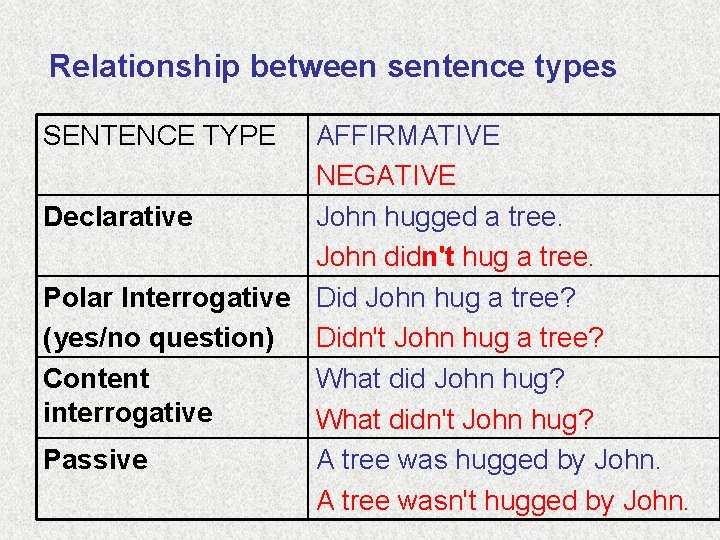
Relationship between sentence types SENTENCE TYPE AFFIRMATIVE NEGATIVE Declarative John hugged a tree. John didn't hug a tree. Polar Interrogative Did John hug a tree? (yes/no question) Didn't John hug a tree? Content What did John hug? interrogative What didn't John hug? Passive A tree was hugged by John. A tree wasn't hugged by John.

The relationship between one sentence type and another can be represented as a series of processes: • add something • change the form of something • change the position of something It can also be represented in terms of contrasting features or properties. We will present a 'derivational' model.

Many of these processes involve verbs. These processes distinguish Auxiliary Verbs from Lexical Verbs. • AUXILIARY VERB RAISING • AUXILIARY do INSERTION/SUPPORT
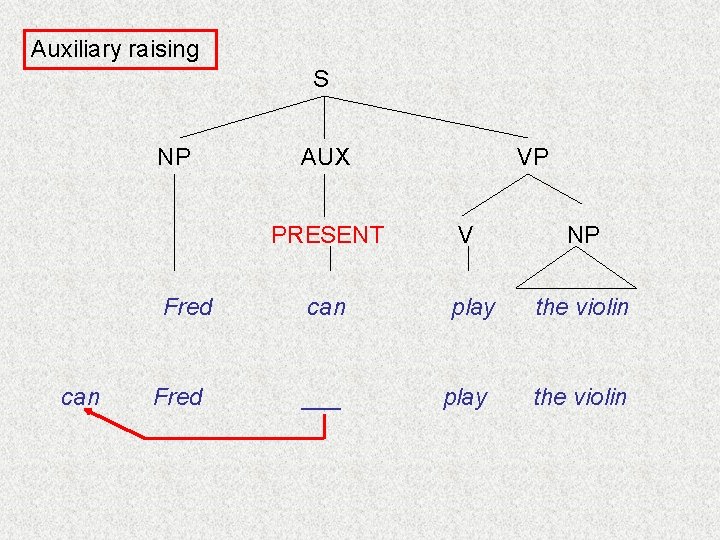
Auxiliary raising S NP AUX PRESENT Fred can ___ VP V play NP the violin
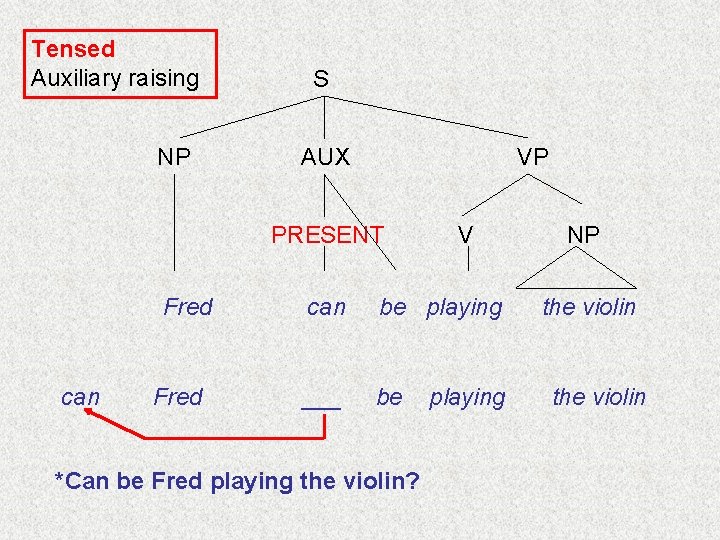
Tensed Auxiliary raising NP S AUX VP PRESENT Fred can Fred V can be playing ___ be *Can be Fred playing the violin? playing NP the violin
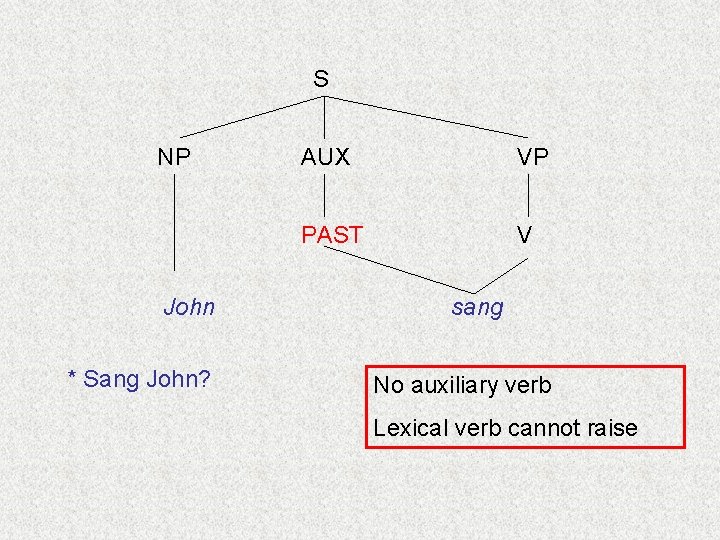
S NP John * Sang John? AUX VP PAST V sang No auxiliary verb Lexical verb cannot raise
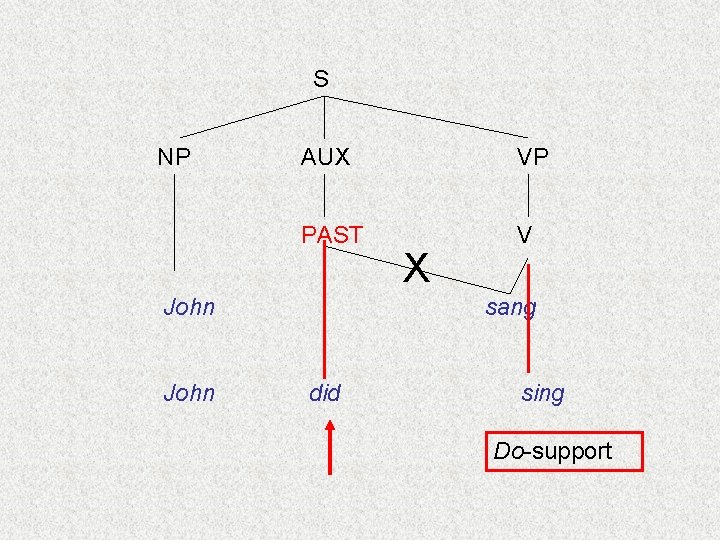
S NP AUX VP PAST V John X sang did sing Do-support
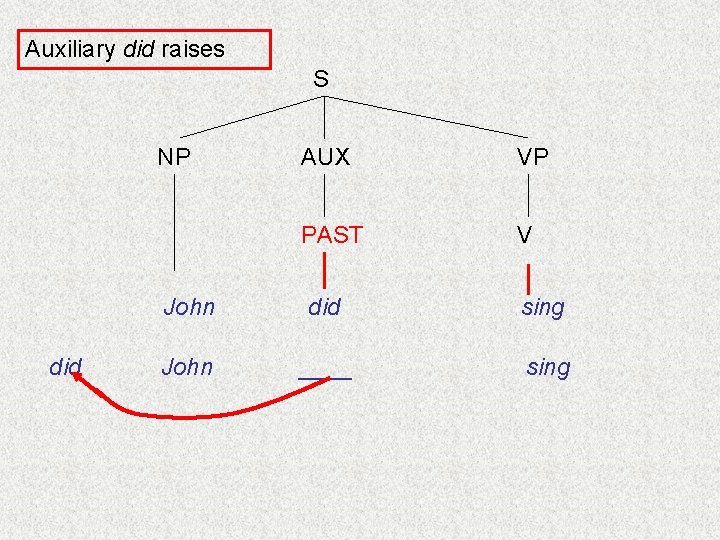
Auxiliary did raises S NP did AUX VP PAST V John did sing John ____ sing
What position does tense-marking auxiliary raise into?
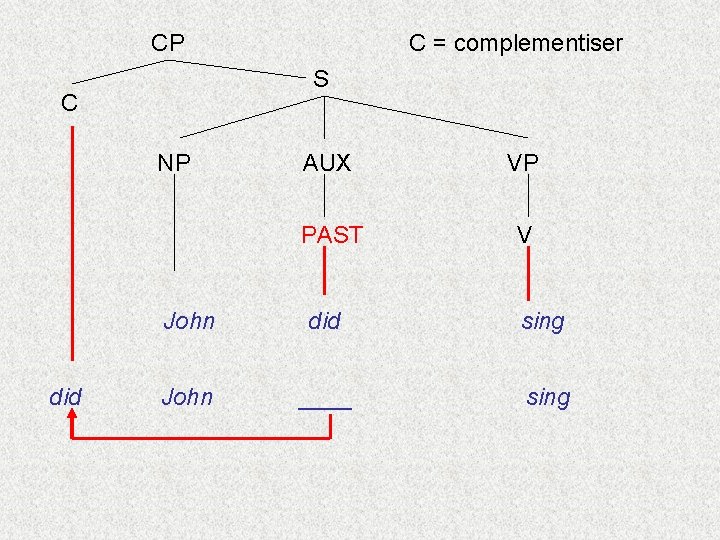
CP S C NP did C = complementiser AUX VP PAST V John did sing John ____ sing
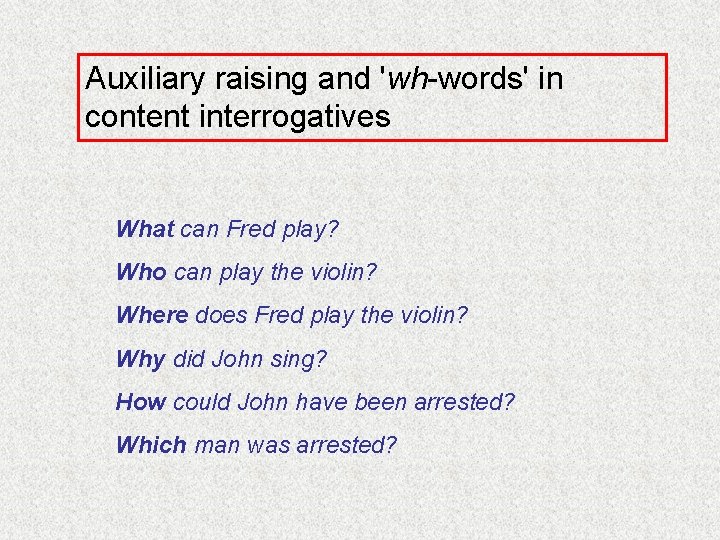
Auxiliary raising and 'wh-words' in content interrogatives What can Fred play? Who can play the violin? Where does Fred play the violin? Why did John sing? How could John have been arrested? Which man was arrested?
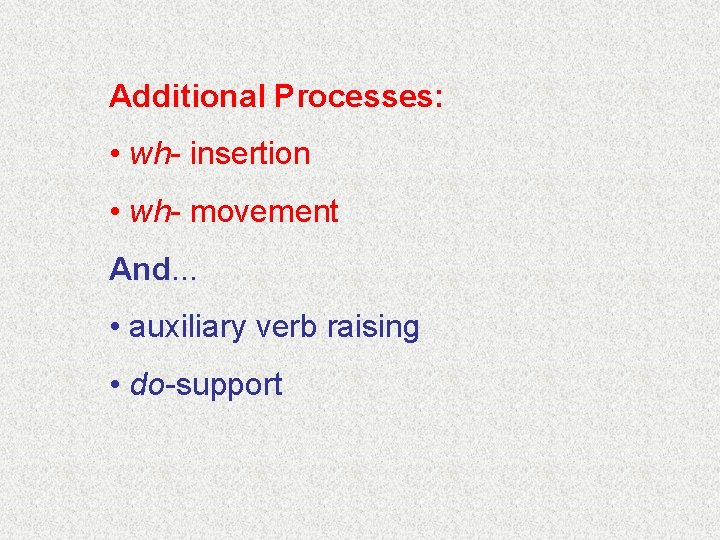
Additional Processes: • wh- insertion • wh- movement And. . . • auxiliary verb raising • do-support
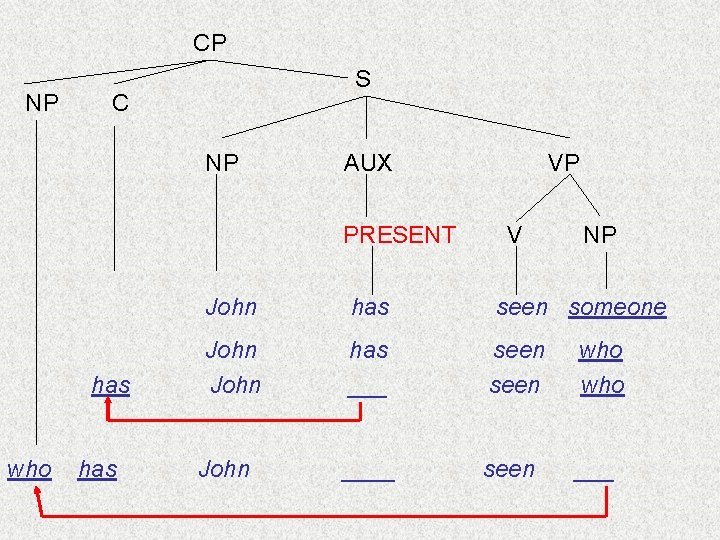
CP NP S C NP AUX PRESENT has who has VP V NP John has ___ seen who ____ seen ___ John seen someone
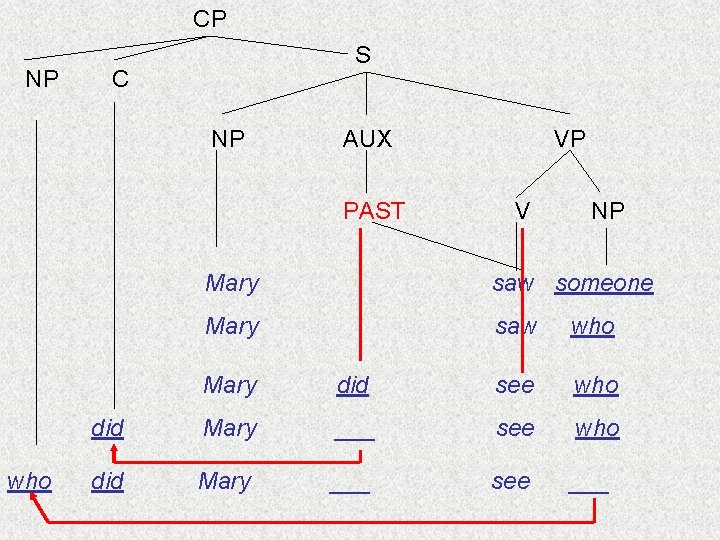
CP NP S C NP AUX PAST who VP V NP Mary saw someone Mary saw who Mary did see who did Mary ___ see ___
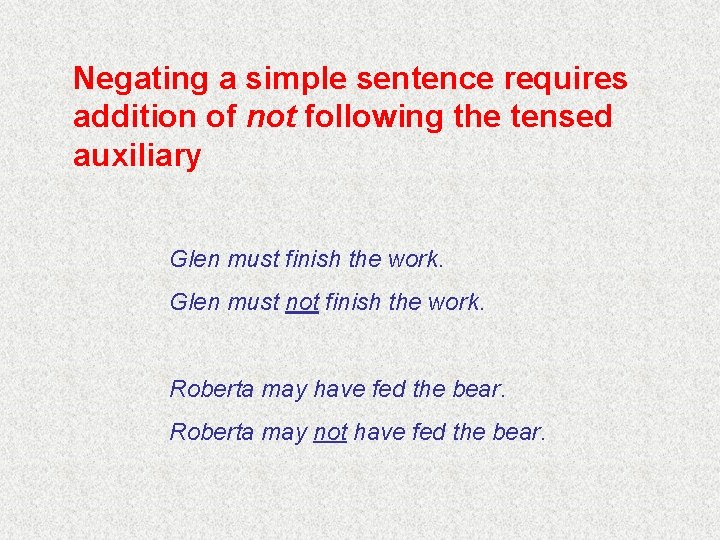
Negating a simple sentence requires addition of not following the tensed auxiliary Glen must finish the work. Glen must not finish the work. Roberta may have fed the bear. Roberta may not have fed the bear.
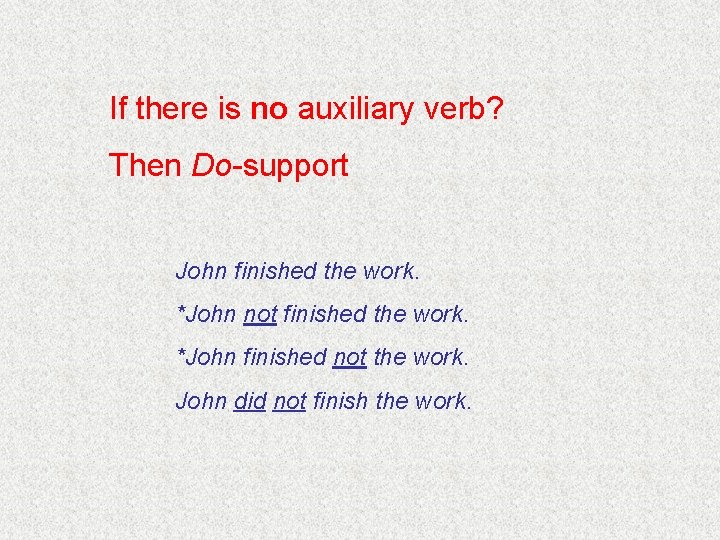
If there is no auxiliary verb? Then Do-support John finished the work. *John not finished the work. *John finished not the work. John did not finish the work.
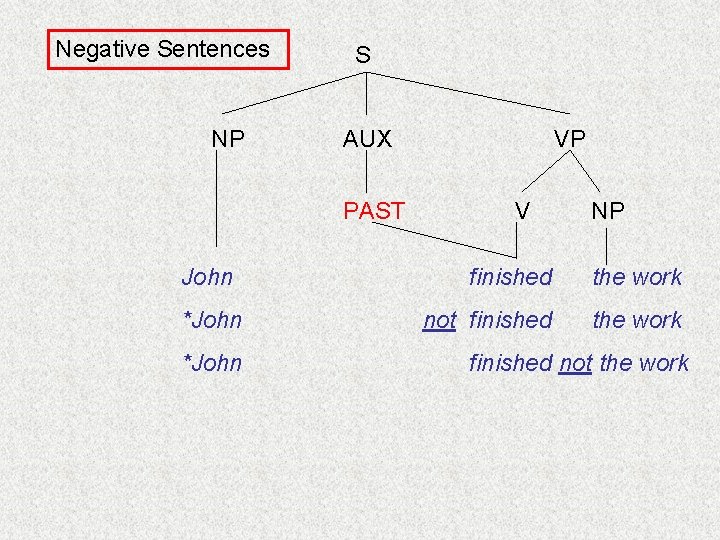
Negative Sentences NP S AUX PAST John *John VP V NP finished the work not finished the work finished not the work
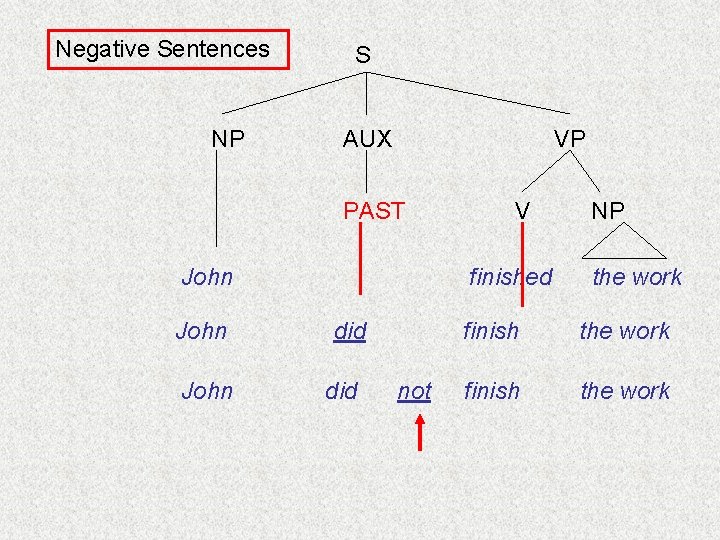
Negative Sentences NP S AUX VP PAST John V finished did not NP the work finish the work
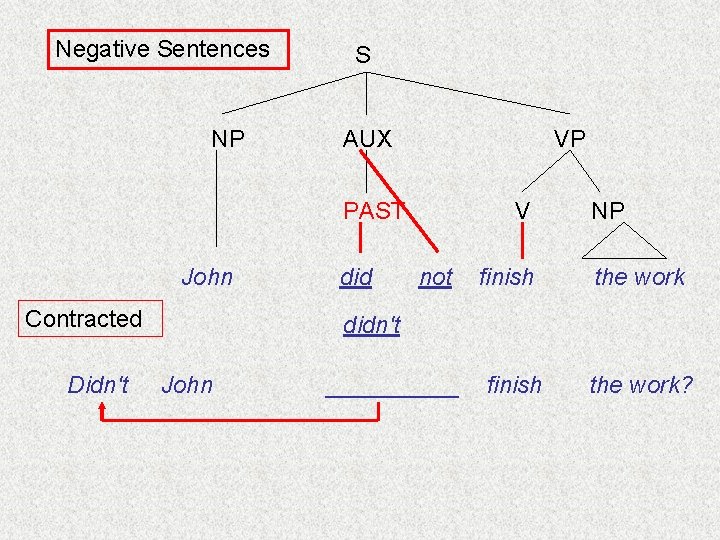
Negative Sentences NP S AUX VP PAST John Contracted Didn't did V not finish NP the work didn't John _____ finish the work?
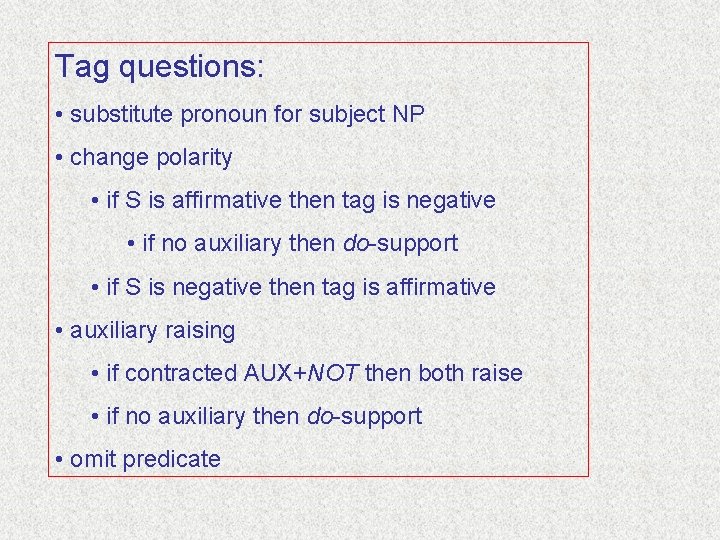
Tag questions: • substitute pronoun for subject NP • change polarity • if S is affirmative then tag is negative • if no auxiliary then do-support • if S is negative then tag is affirmative • auxiliary raising • if contracted AUX+NOT then both raise • if no auxiliary then do-support • omit predicate
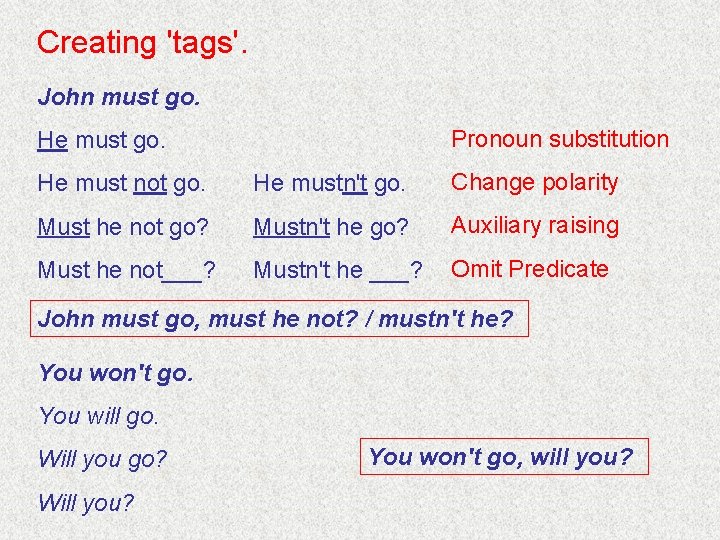
Creating 'tags'. John must go. Pronoun substitution He must go. He must not go. He mustn't go. Change polarity Must he not go? Mustn't he go? Auxiliary raising Must he not___? Mustn't he ___? Omit Predicate John must go, must he not? / mustn't he? You won't go. You will go. Will you go? Will you? You won't go, will you?
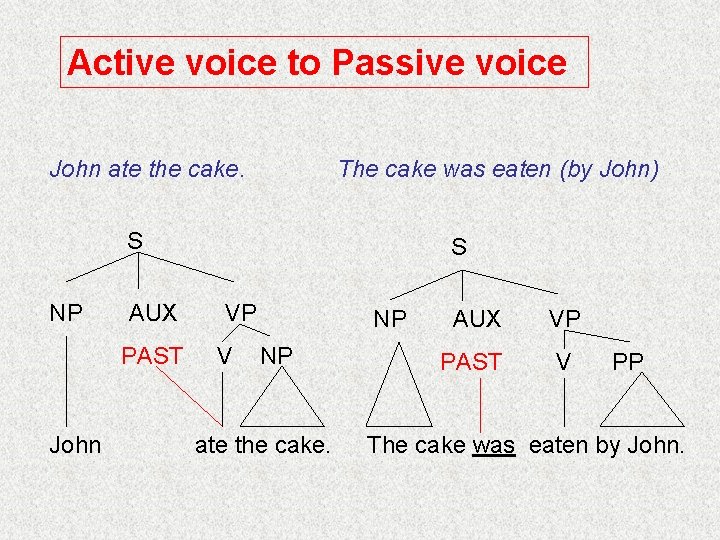
Active voice to Passive voice John ate the cake. The cake was eaten (by John) S NP AUX PAST John S VP V NP NP ate the cake. AUX VP PAST V PP The cake was eaten by John.
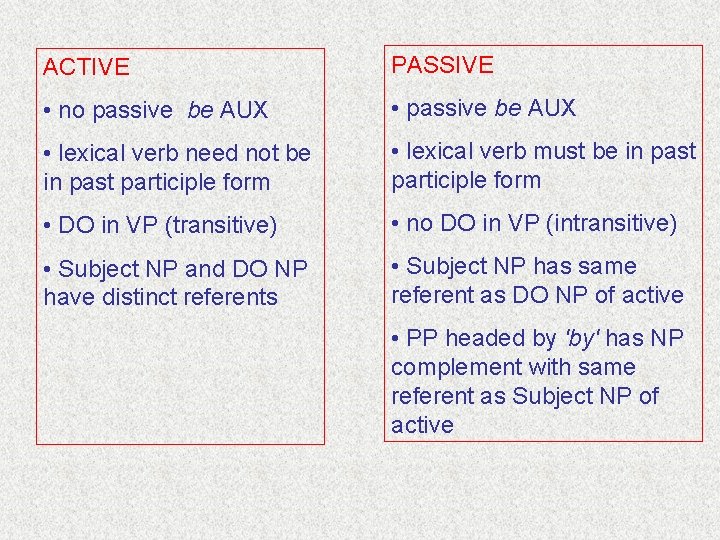
ACTIVE PASSIVE • no passive be AUX • lexical verb need not be in past participle form • lexical verb must be in past participle form • DO in VP (transitive) • no DO in VP (intransitive) • Subject NP and DO NP have distinct referents • Subject NP has same referent as DO NP of active • PP headed by 'by' has NP complement with same referent as Subject NP of active
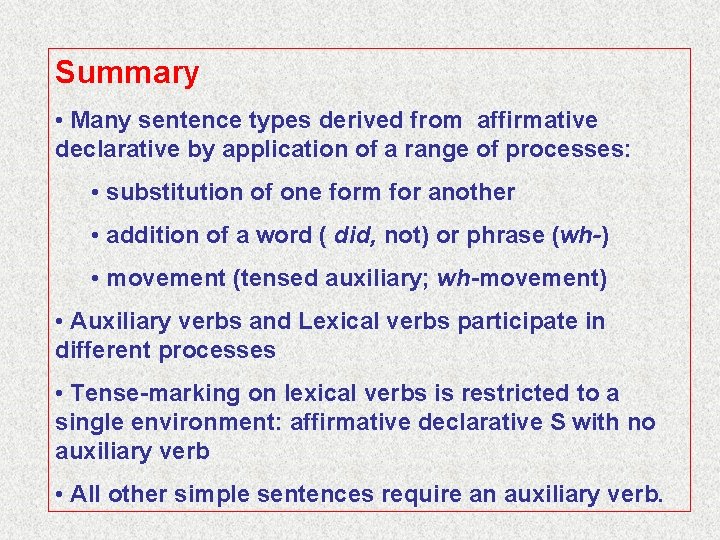
Summary • Many sentence types derived from affirmative declarative by application of a range of processes: • substitution of one form for another • addition of a word ( did, not) or phrase (wh-) • movement (tensed auxiliary; wh-movement) • Auxiliary verbs and Lexical verbs participate in different processes • Tense-marking on lexical verbs is restricted to a single environment: affirmative declarative S with no auxiliary verb • All other simple sentences require an auxiliary verb.
- Slides: 25