
Lecture 4 b Catalytic Air Oxidation with Mo
Lecture 4 b Catalytic Air Oxidation with Mo. O x dtc 2
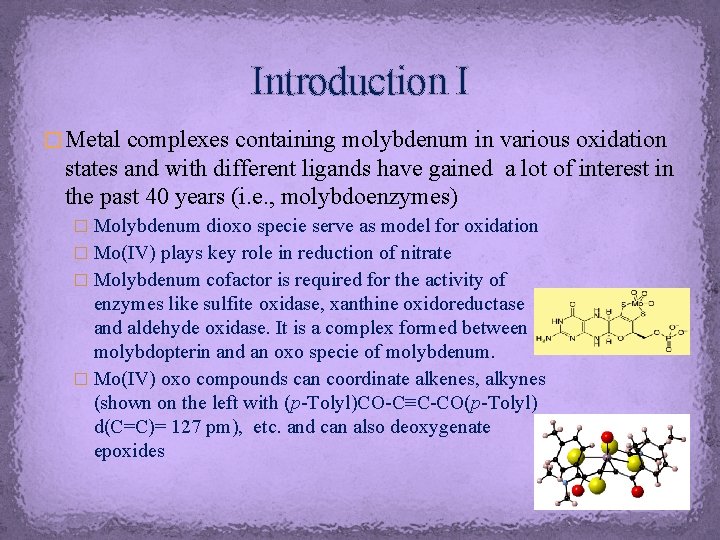
Introduction I � Metal complexes containing molybdenum in various oxidation states and with different ligands have gained a lot of interest in the past 40 years (i. e. , molybdoenzymes) � Molybdenum dioxo specie serve as model for oxidation � Mo(IV) plays key role in reduction of nitrate � Molybdenum cofactor is required for the activity of enzymes like sulfite oxidase, xanthine oxidoreductase and aldehyde oxidase. It is a complex formed between molybdopterin and an oxo specie of molybdenum. � Mo(IV) oxo compounds can coordinate alkenes, alkynes (shown on the left with (p-Tolyl)CO-C≡C-CO(p-Tolyl) d(C=C)= 127 pm), etc. and can also deoxygenate epoxides
Introduction II �In the lab, two molybdenum oxo dithiocarbamates (Mo. Oxdtc 2, x=1, 2) are synthesized and tested as catalysts for the oxidation of benzoin �Mo. O 2 dtc 2 is obtained by the reaction of Na 2 Mo. O 4 with Nadtc in weakly acidic medium (Na. OAc-HOAc buffer, p. H= ~5. 5) �Mo. Odtc 2 is obtained by the reaction of Na 2 Mo. O 4 with Nadtc and Na 2 S 2 O 4 (serves as reducing agent) via Mo 2 O 3 dtc 4.
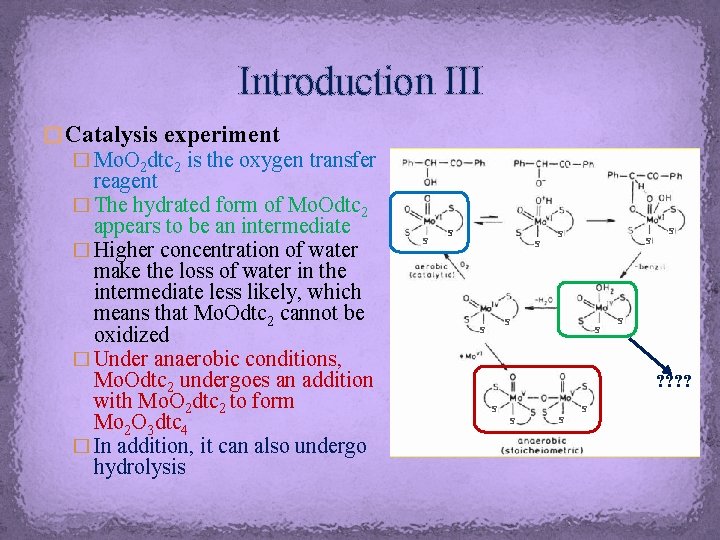
Introduction III � Catalysis experiment � Mo. O 2 dtc 2 is the oxygen transfer reagent � The hydrated form of Mo. Odtc 2 appears to be an intermediate � Higher concentration of water make the loss of water in the intermediate less likely, which means that Mo. Odtc 2 cannot be oxidized � Under anaerobic conditions, Mo. Odtc 2 undergoes an addition with Mo. O 2 dtc 2 to form Mo 2 O 3 dtc 4 � In addition, it can also undergo hydrolysis S S S S S ? ? S S
Experiment I �Cis-Mo. O 2 dtc 2 � Sodium molybdate and sodium acetate are dissolved in water and diluted hydrochloric acid is added until a p. H-value of 5. 5 is reached (needs to be measured with a p. H-meter!) � The p. H-value cannot be lower because the compound decomposes then (Mo 2 O 3 dtc 4 (dark purple), etc. ) � The orange-brown crude isolated by filtration, washed and dried before being extracted several times with warm (50 -60 o. C) toluene � The volume of the combined extracts is reduced and petroleum ether (or hexane) is added to precipitate the product
Experiment II �Mo. Odtc 2 � Note that this reaction has to be carried under strict Schlenk techniques � Sodium molybdate and sodium dithionite are dissolved in deaerated water (freeze-pump-thaw) � A dark purple precipitate is formed almost immediately (Mo 2 O 3 dtc 4) � Upon stirring, the color of the precipitate changes to pink within 2 -3 hours � The precipitate is isolated by filtration under inert gas, washed with deaerated water, deaerated ethanol and dry diethyl ether
Experiment III � Catalytic experiments � The Mo-compounds are tested as catalysts in the air oxidation of benzoin � Ph. CH(OH)COPh + ½ O 2 Ph. COCOPh + H 2 O � Each experiment uses 5 mol% of the catalyst (cis-Mo. O 2 dtc 2, Mo. Odtc 2, cis-Mo. O 2 dtc 2 with molecular sieve (3 Å), no catalyst (as control)) � Solvent: dry DMF (has to be prepared by the student, dried over anhydrous magnesium sulfate) � In order to assess the kinetics, one sample is removed after 2 hours. The reaction is stopped after ~24 hours by adding water! � Quantitation is performed with GC (~5 mg/m. L)
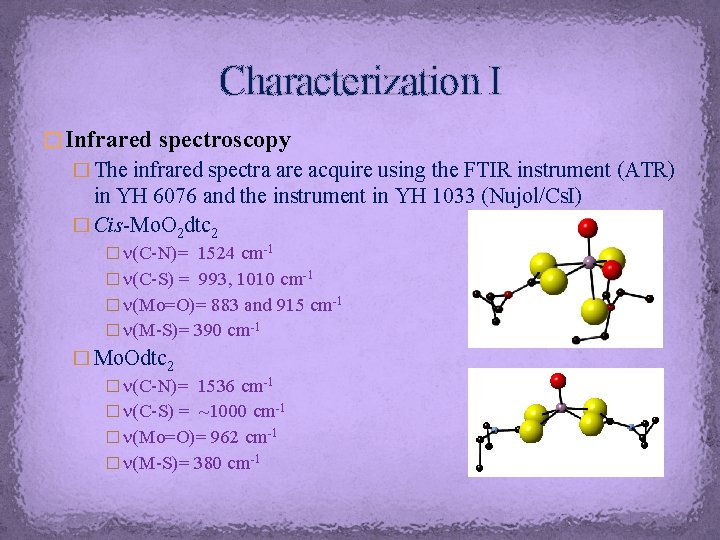
Characterization I � Infrared spectroscopy � The infrared spectra are acquire using the FTIR instrument (ATR) in YH 6076 and the instrument in YH 1033 (Nujol/Cs. I) � Cis-Mo. O 2 dtc 2 � n(C-N)= 1524 cm-1 � n(C-S) = 993, 1010 cm-1 � n(Mo=O)= 883 and 915 cm-1 � n(M-S)= 390 cm-1 � Mo. Odtc 2 � n(C-N)= 1536 cm-1 � n(C-S) = ~1000 cm-1 � n(Mo=O)= 962 cm-1 � n(M-S)= 380 cm-1
Characterization II � EPR � Measured in dry dichloromethane in EPR tube (which is made from quartz and 4 mm in diameter and longer than a NMR tube) � Mo. Odtc 2 contains Mo(IV), which possesses a d 2 -configuration � Two different ground states possible resulting in no unpaired electron or two unpaired electron � All electrons paired: no EPR signal � Two unpaired electrons: EPR signal observed � If the compound is partially oxidized with air, Mo 2 O 3 dtc 4 is formed, which contains paramagnetic Mo(V), which possesses a d 1 -configuration � The complete oxidation leads to the formation of Mo. O 2 dtc 2, which contains Mo(VI), a d 0 -configuration which is diamagnetic
- Slides: 9