
Lecture 4 Atmospheric Radiative Transfer Role of clouds

- Slides: 34
Lecture 4 Atmospheric Radiative Transfer; Role of clouds on climate GEU 0136 Climatology
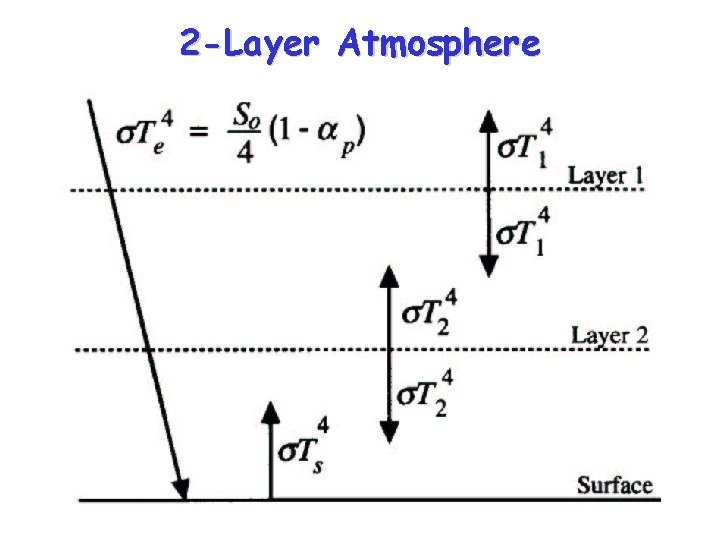
2 -Layer Atmosphere
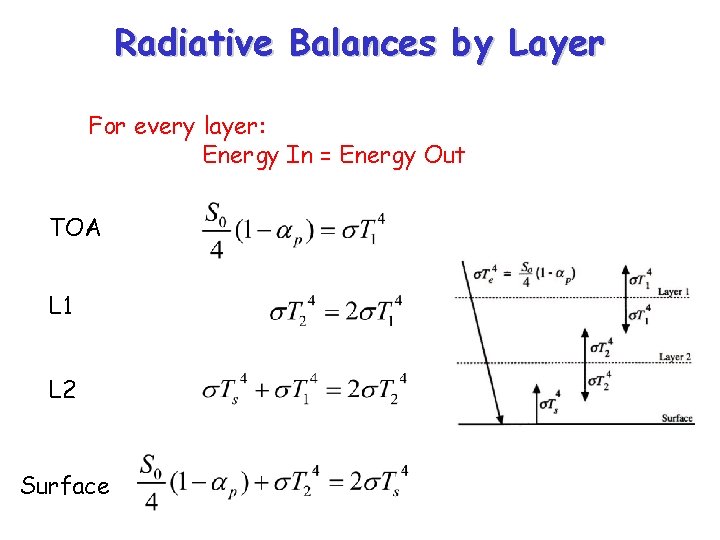
Radiative Balances by Layer For every layer: Energy In = Energy Out TOA L 1 L 2 Surface
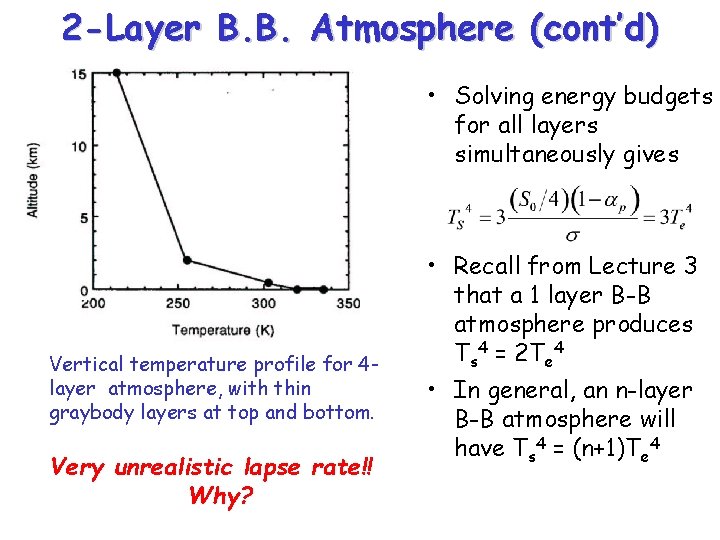
2 -Layer B. B. Atmosphere (cont’d) • Solving energy budgets for all layers simultaneously gives Vertical temperature profile for 4 layer atmosphere, with thin graybody layers at top and bottom. Very unrealistic lapse rate!! Why? • Recall from Lecture 3 that a 1 layer B-B atmosphere produces Ts 4 = 2 Te 4 • In general, an n-layer B-B atmosphere will have Ts 4 = (n+1)Te 4
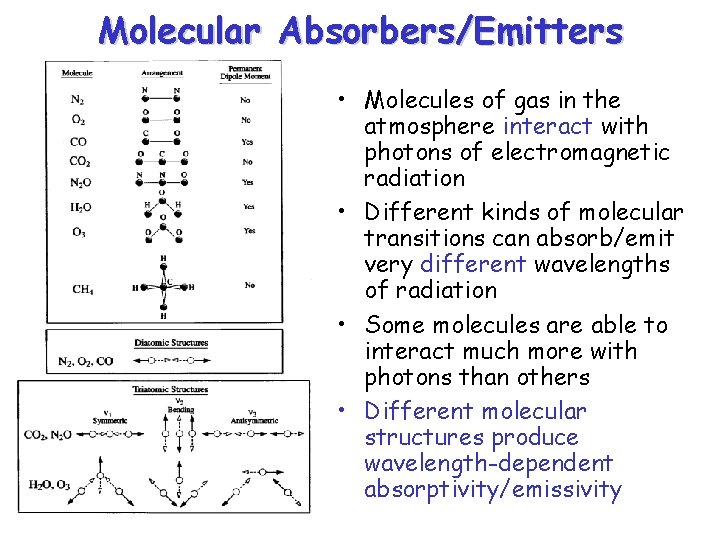
Molecular Absorbers/Emitters • Molecules of gas in the atmosphere interact with photons of electromagnetic radiation • Different kinds of molecular transitions can absorb/emit very different wavelengths of radiation • Some molecules are able to interact much more with photons than others • Different molecular structures produce wavelength-dependent absorptivity/emissivity
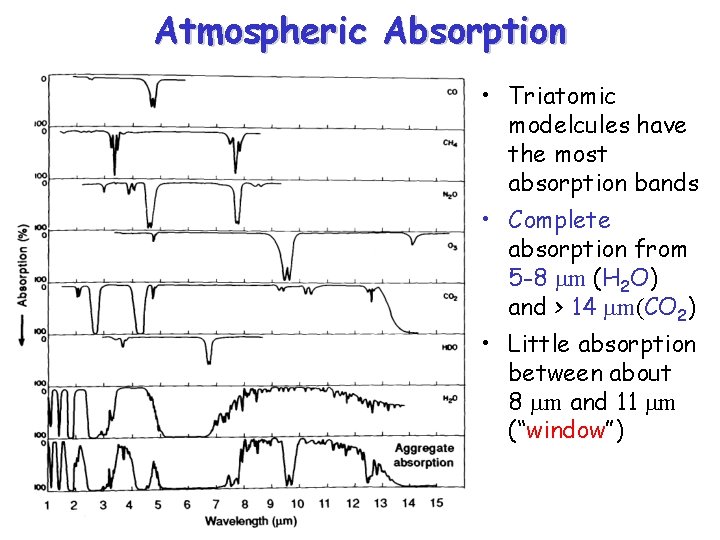
Atmospheric Absorption • Triatomic modelcules have the most absorption bands • Complete absorption from 5 -8 mm (H 2 O) and > 14 mm(CO 2) • Little absorption between about 8 mm and 11 mm (“window”)
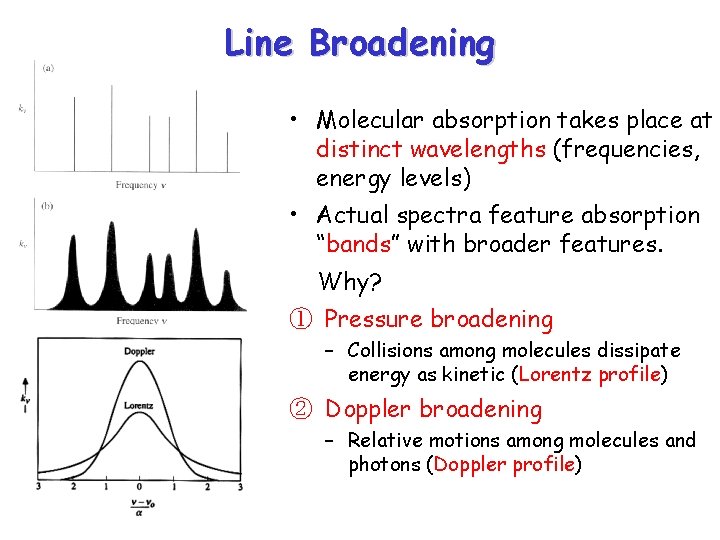
Line Broadening • Molecular absorption takes place at distinct wavelengths (frequencies, energy levels) • Actual spectra feature absorption “bands” with broader features. Why? ① Pressure broadening – Collisions among molecules dissipate energy as kinetic (Lorentz profile) ② Doppler broadening – Relative motions among molecules and photons (Doppler profile)
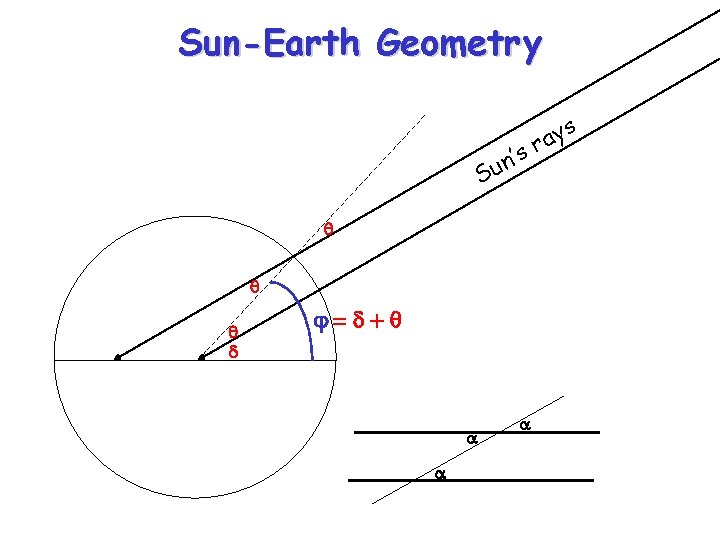
Sun-Earth Geometry ’s n u S q q q d j=d+q a a a s y a r
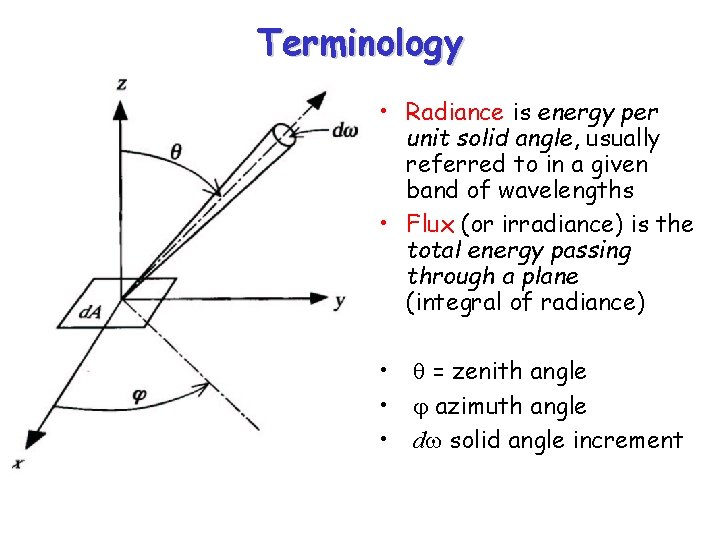
Terminology • Radiance is energy per unit solid angle, usually referred to in a given band of wavelengths • Flux (or irradiance) is the total energy passing through a plane (integral of radiance) • • • q = zenith angle j azimuth angle dw solid angle increment
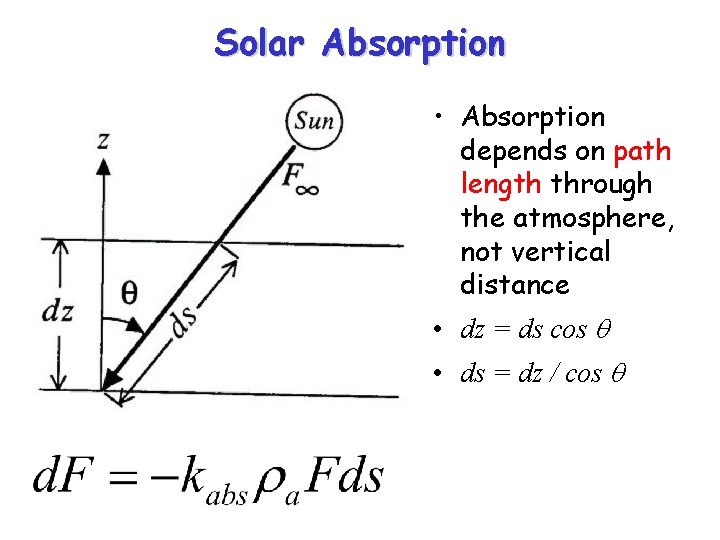
Solar Absorption • Absorption depends on path length through the atmosphere, not vertical distance • dz = ds cos q • ds = dz / cos q
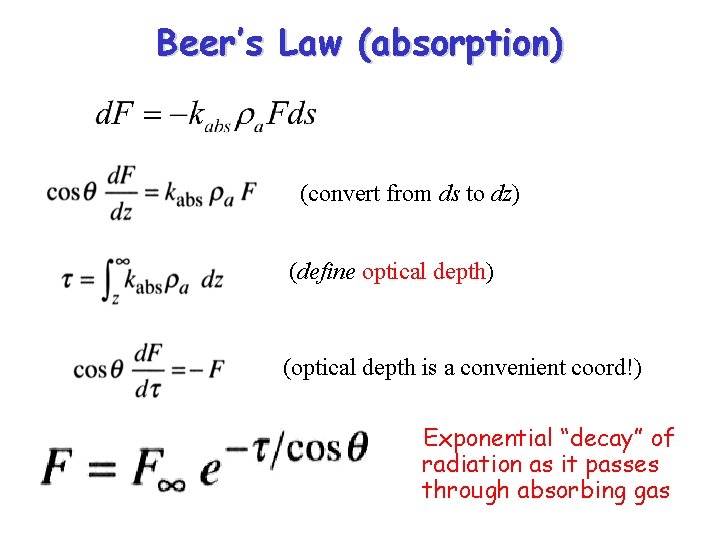
Beer’s Law (absorption) (convert from ds to dz) (define optical depth) (optical depth is a convenient coord!) Exponential “decay” of radiation as it passes through absorbing gas
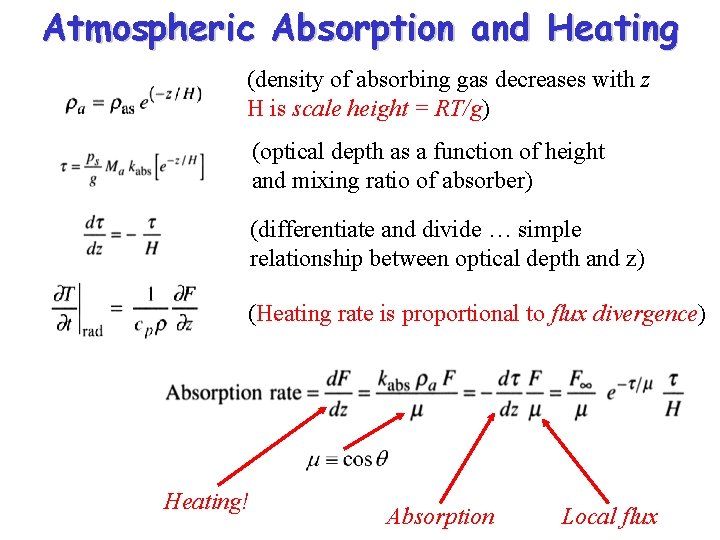
Atmospheric Absorption and Heating (density of absorbing gas decreases with z H is scale height = RT/g) (optical depth as a function of height and mixing ratio of absorber) (differentiate and divide … simple relationship between optical depth and z) (Heating rate is proportional to flux divergence) Heating! Absorption Local flux
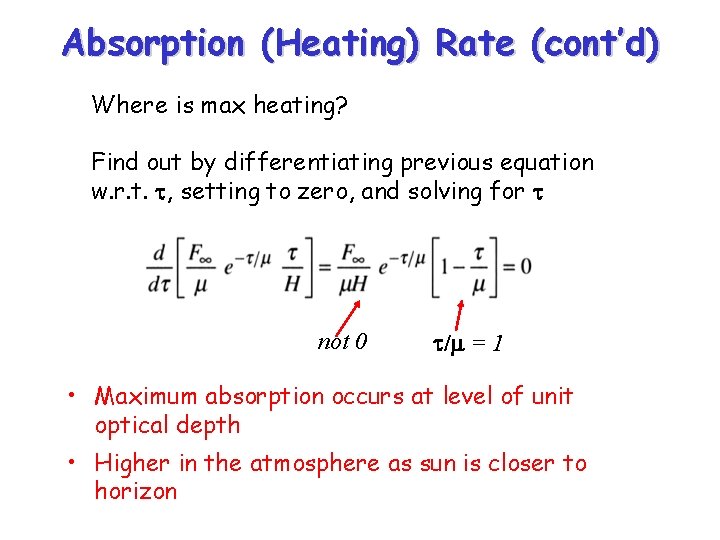
Absorption (Heating) Rate (cont’d) Where is max heating? Find out by differentiating previous equation w. r. t. t, setting to zero, and solving for t not 0 t/m = 1 • Maximum absorption occurs at level of unit optical depth • Higher in the atmosphere as sun is closer to horizon
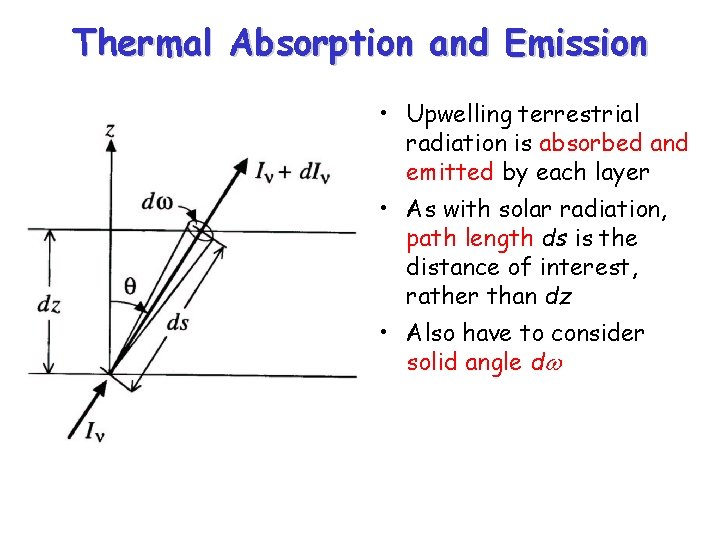
Thermal Absorption and Emission • Upwelling terrestrial radiation is absorbed and emitted by each layer • As with solar radiation, path length ds is the distance of interest, rather than dz • Also have to consider solid angle dw
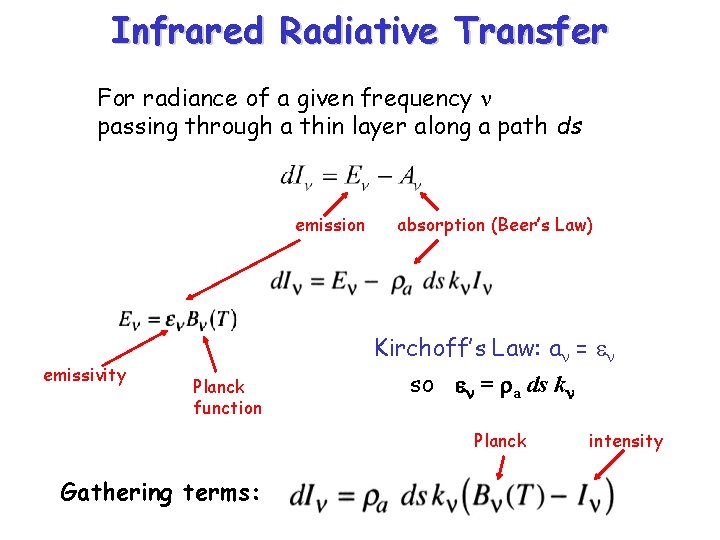
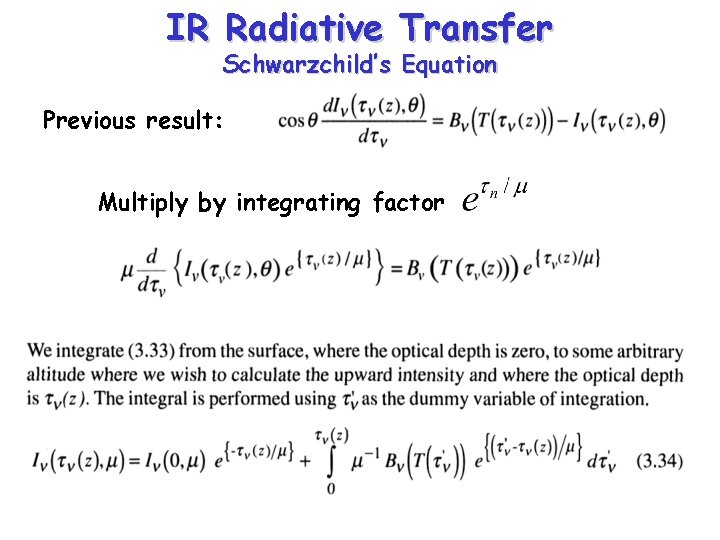
Infrared Radiative Transfer For radiance of a given frequency n passing through a thin layer along a path ds emission emissivity Planck function absorption (Beer’s Law) Kirchoff’s Law: an = en so en = ra ds kn Planck Gathering terms: intensity
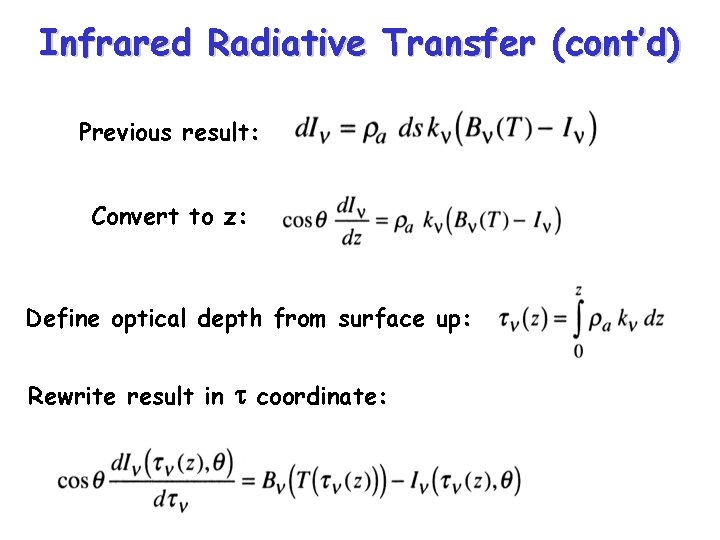
Infrared Radiative Transfer (cont’d) Previous result: Convert to z: Define optical depth from surface up: Rewrite result in t coordinate:
IR Radiative Transfer Schwarzchild’s Equation Previous result: Multiply by integrating factor
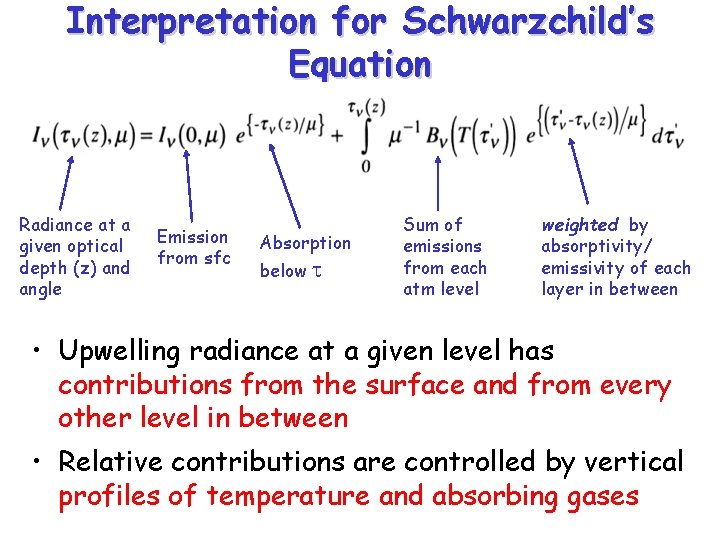
Interpretation for Schwarzchild’s Equation Radiance at a given optical depth (z) and angle Emission from sfc Absorption below t Sum of emissions from each atm level weighted by absorptivity/ emissivity of each layer in between • Upwelling radiance at a given level has contributions from the surface and from every other level in between • Relative contributions are controlled by vertical profiles of temperature and absorbing gases
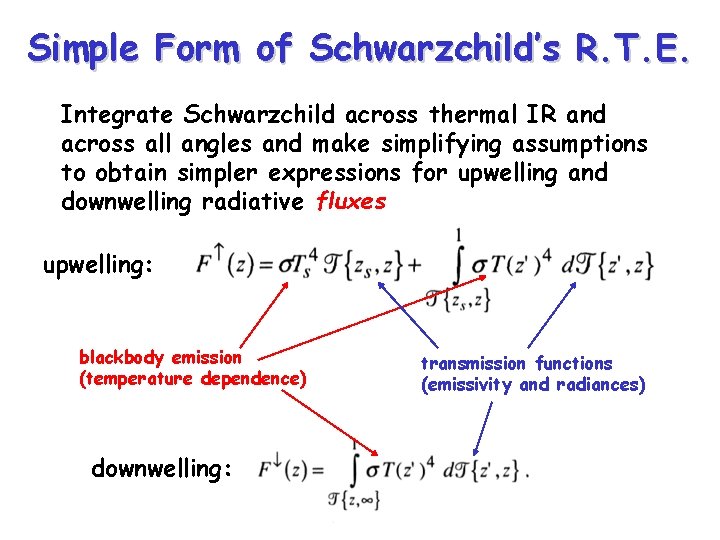
Simple Form of Schwarzchild’s R. T. E. Integrate Schwarzchild across thermal IR and across all angles and make simplifying assumptions to obtain simpler expressions for upwelling and downwelling radiative fluxes upwelling: blackbody emission (temperature dependence) downwelling: transmission functions (emissivity and radiances)
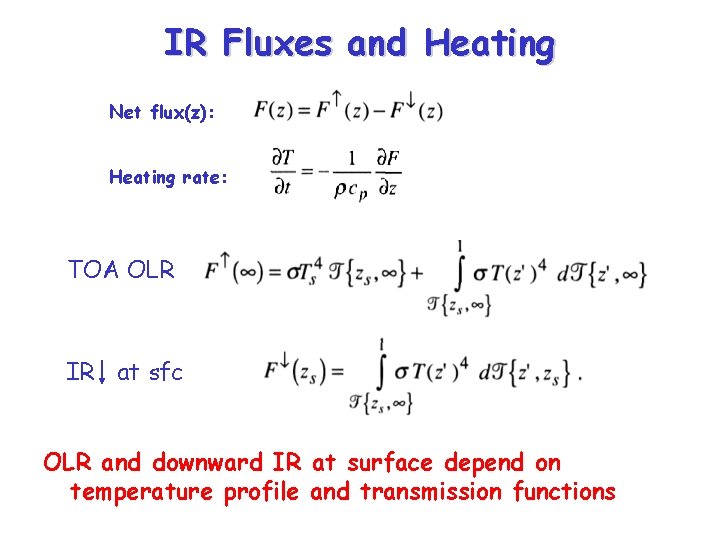
IR Fluxes and Heating Net flux(z): Heating rate: TOA OLR IR at sfc OLR and downward IR at surface depend on temperature profile and transmission functions
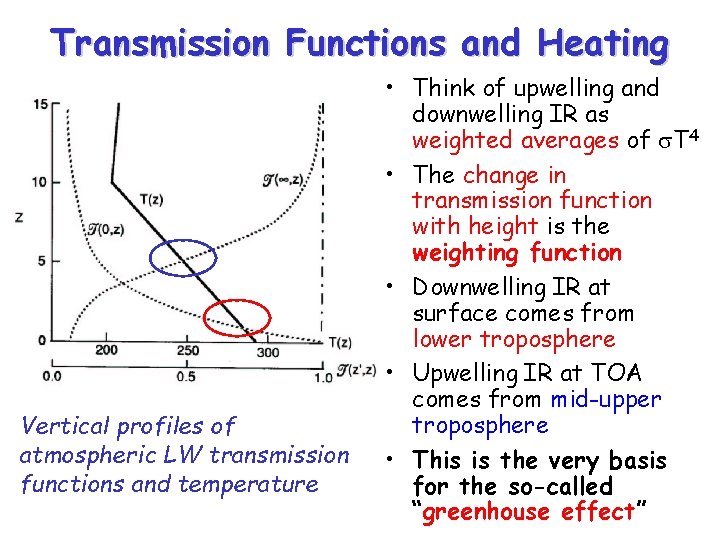
Transmission Functions and Heating Vertical profiles of atmospheric LW transmission functions and temperature • Think of upwelling and downwelling IR as weighted averages of s. T 4 • The change in transmission function with height is the weighting function • Downwelling IR at surface comes from lower troposphere • Upwelling IR at TOA comes from mid-upper troposphere • This is the very basis for the so-called “greenhouse effect”
Cloud Radiative Properties
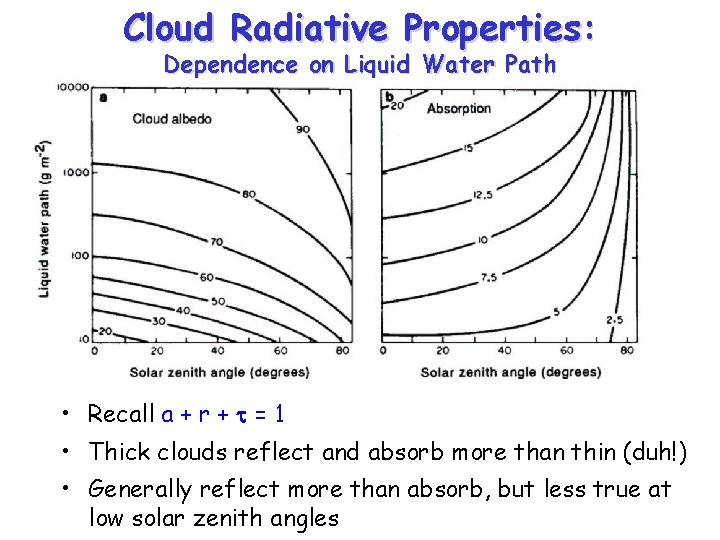
Cloud Radiative Properties: Dependence on Liquid Water Path • Recall a + r + t = 1 • Thick clouds reflect and absorb more than thin (duh!) • Generally reflect more than absorb, but less true at low solar zenith angles
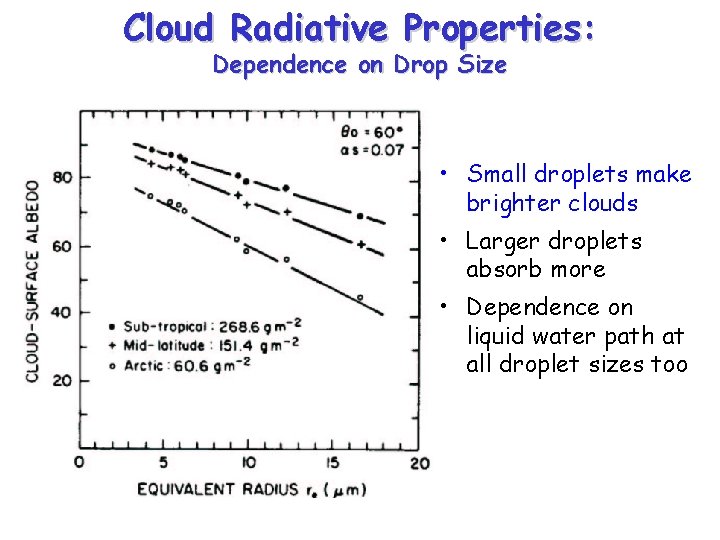
Cloud Radiative Properties: Dependence on Drop Size • Small droplets make brighter clouds • Larger droplets absorb more • Dependence on liquid water path at all droplet sizes too
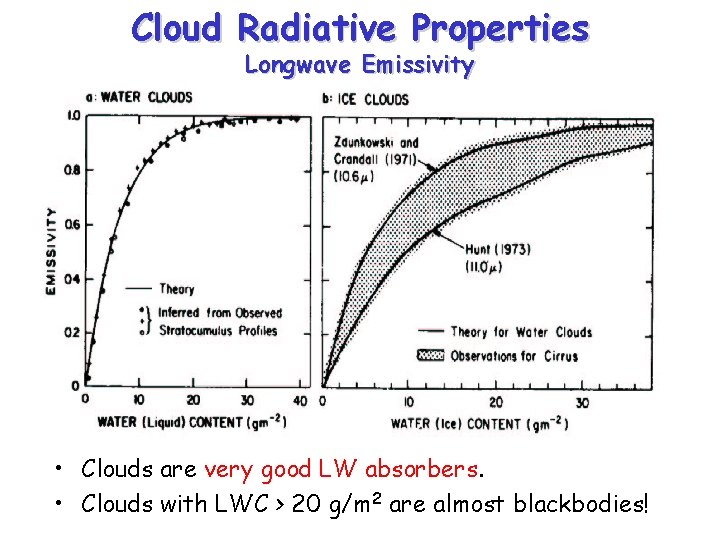
Cloud Radiative Properties Longwave Emissivity • Clouds are very good LW absorbers. • Clouds with LWC > 20 g/m 2 are almost blackbodies!
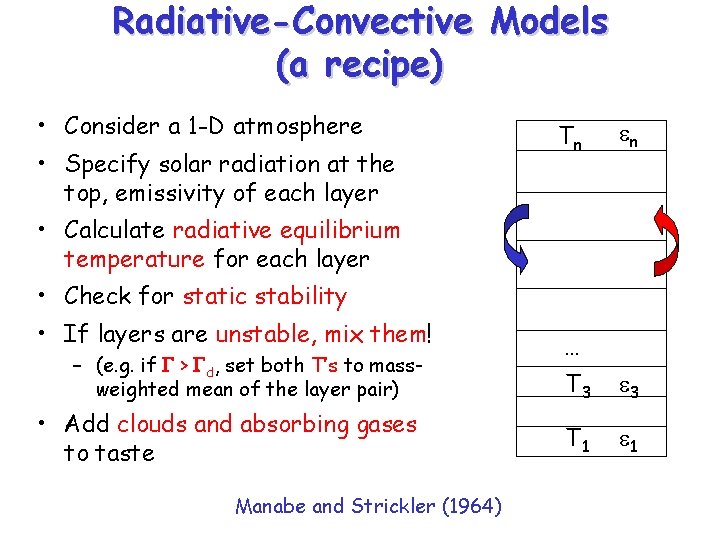
Radiative-Convective Models (a recipe) • Consider a 1 -D atmosphere • Specify solar radiation at the top, emissivity of each layer Tn en • Calculate radiative equilibrium temperature for each layer • Check for static stability • If layers are unstable, mix them! – (e. g. if G > Gd, set both T’s to massweighted mean of the layer pair) • Add clouds and absorbing gases to taste Manabe and Strickler (1964) … T 3 e 3 T 1 e 1
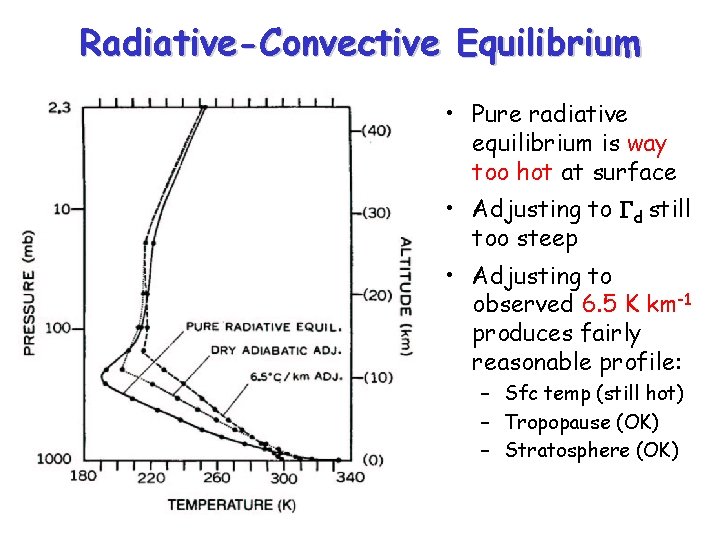
Radiative-Convective Equilibrium • Pure radiative equilibrium is way too hot at surface • Adjusting to Gd still too steep • Adjusting to observed 6. 5 K km-1 produces fairly reasonable profile: – Sfc temp (still hot) – Tropopause (OK) – Stratosphere (OK)
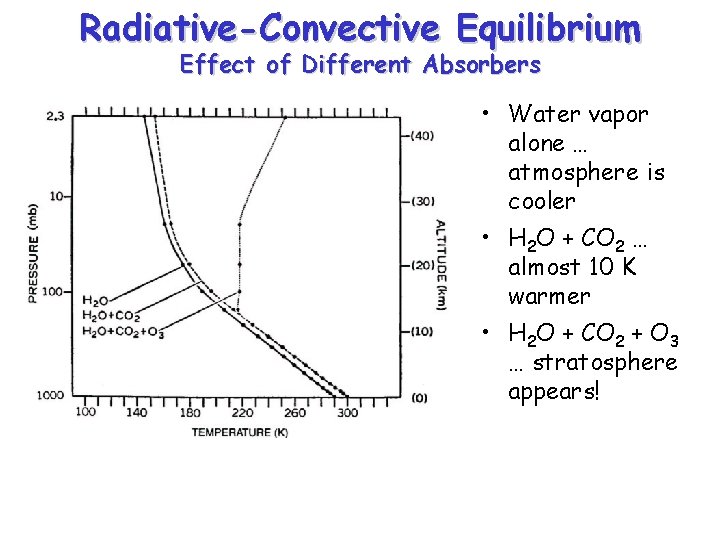
Radiative-Convective Equilibrium Effect of Different Absorbers • Water vapor alone … atmosphere is cooler • H 2 O + CO 2 … almost 10 K warmer • H 2 O + CO 2 + O 3 … stratosphere appears!
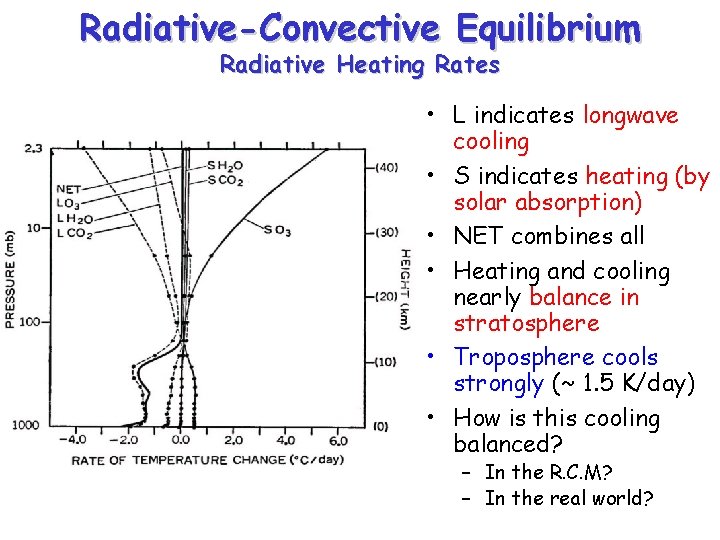
Radiative-Convective Equilibrium Radiative Heating Rates • L indicates longwave cooling • S indicates heating (by solar absorption) • NET combines all • Heating and cooling nearly balance in stratosphere • Troposphere cools strongly (~ 1. 5 K/day) • How is this cooling balanced? – In the R. C. M? – In the real world?
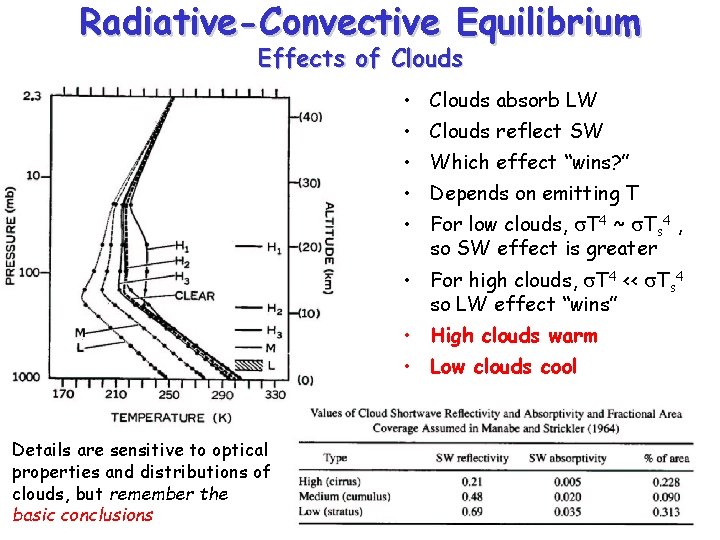
Radiative-Convective Equilibrium Effects of Clouds • Clouds absorb LW • Clouds reflect SW • Which effect “wins? ” • Depends on emitting T • For low clouds, s. T 4 ~ s. Ts 4 , so SW effect is greater • For high clouds, s. T 4 << s. Ts 4 so LW effect “wins” • High clouds warm • Low clouds cool Details are sensitive to optical properties and distributions of clouds, but remember the basic conclusions
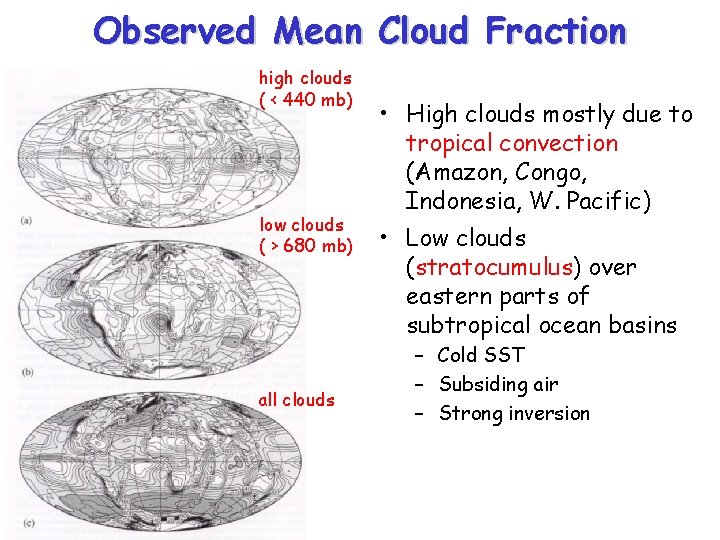
Observed Mean Cloud Fraction high clouds ( < 440 mb) low clouds ( > 680 mb) all clouds • High clouds mostly due to tropical convection (Amazon, Congo, Indonesia, W. Pacific) • Low clouds (stratocumulus) over eastern parts of subtropical ocean basins – Cold SST – Subsiding air – Strong inversion
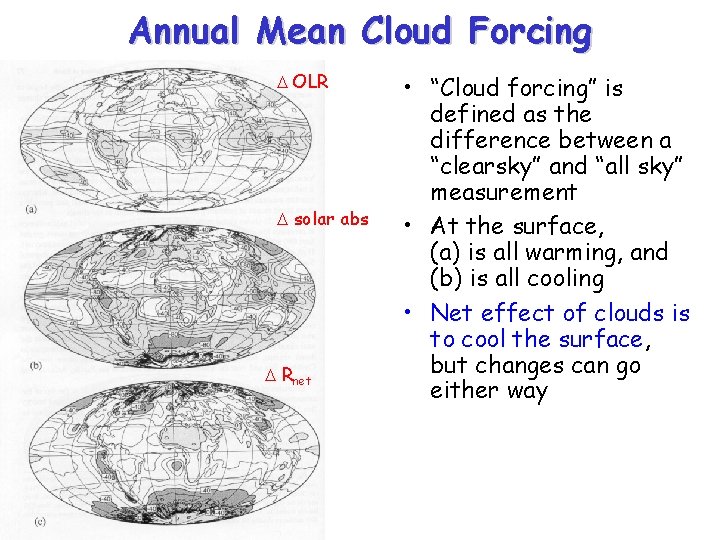
Annual Mean Cloud Forcing D OLR D solar abs D Rnet • “Cloud forcing” is defined as the difference between a “clearsky” and “all sky” measurement • At the surface, (a) is all warming, and (b) is all cooling • Net effect of clouds is to cool the surface, but changes can go either way
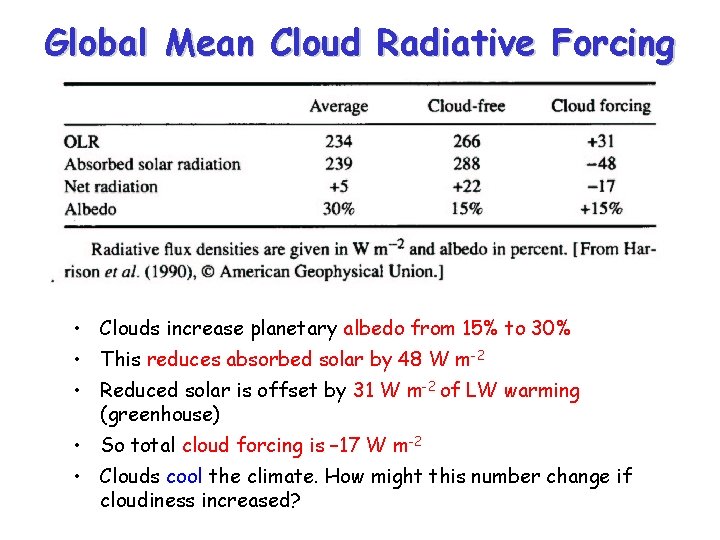
Global Mean Cloud Radiative Forcing • Clouds increase planetary albedo from 15% to 30% • This reduces absorbed solar by 48 W m-2 • Reduced solar is offset by 31 W m-2 of LW warming (greenhouse) • So total cloud forcing is – 17 W m-2 • Clouds cool the climate. How might this number change if cloudiness increased?