
Lecture 4 Anxiety 1 Statement on normal anxiety






- Slides: 19
Lecture 4: Anxiety 1. Statement on normal anxiety = mini thesis on emotion 2. Normal anxiety a. Response to expected harm b. Intensity = nature of threat + ability to handle threat. c. Functions: 1. Draw attention to threat 2. Readies body for action 3. Where do all emotions come from? a. Memories of past events
Neurotic Anxiety Free-floating anxiety: a. Appears to have no cause, but must have a cause b. Cause is hidden 1. Freud: hidden cause is forbidden, e. g. , sex. urges 2. Modern POV: Cause is any dangerous meaning c. Anxiety arises when encountering cue related to forbidden /threatening meaning or inclination.
Anxiety Aroused by Threatening Cues You would be surprised if you listen to the number of times a day people tell you something will last a lifetime or tell you something killed them, or tell you they are dead. “I was simply dead” they say, “He killed me, ” “I am dying, ” which I never noticed before but now begun to notice more and more. Mark Harris, Bang the Drum Slowly, 1953
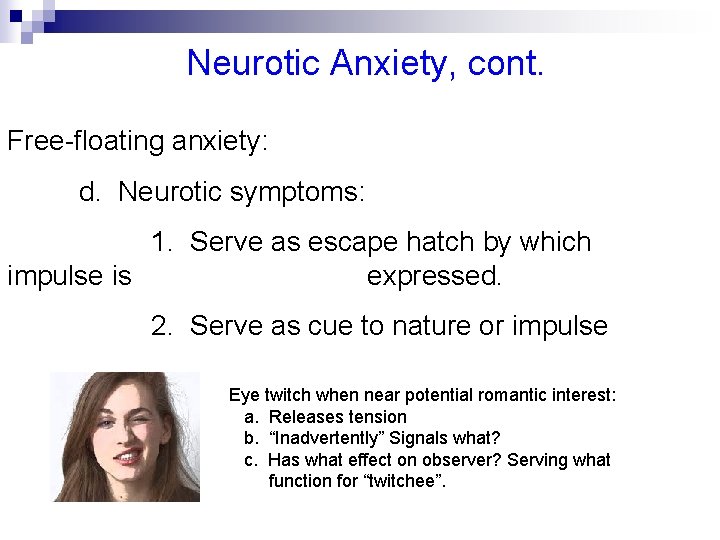
Neurotic Anxiety, cont. Free-floating anxiety: d. Neurotic symptoms: 1. Serve as escape hatch by which impulse is expressed. 2. Serve as cue to nature or impulse Eye twitch when near potential romantic interest: a. Releases tension b. “Inadvertently” Signals what? c. Has what effect on observer? Serving what function for “twitchee”.
Sublimation: The Motor of Civilization
Class 4 Relational Matrix / Ego Psychology
Mind Arise From Culture Brain selected by culture 1. Adaptive value of sharing, empathy, cooperation 2. Language produces meaning, rather than is the "ink" through which meaning is conveyed. 3. Brain requires cultural context to function. Freud was focused too much on individual, neglected "social field"
Relational By Design Humans genetically wired to be relational Bowlby--attachment a biological imperative. a. Need for mom eclipses all other needs b. Mom only needs to be there. c. Attachment doesn't come from other needs, it is itself a primary need. Attachment evidenced behaviorally: sucking, smiling, clinging, crying, following.
Evidence that Attachment is Hard-Wired 1. Infants seek out social relations from Day 1 Prefer human face over other forms AT BIRTH 2. Infants show selective preferences for: * Human voice * Human form * Eyes focus first at 8" away, not 1" away. Indicates? Focuses on face (relational) not breast (sustenance) * Can distinguish scent of mom's milk from other moms' * Mom's face becomes familiar "gestalt" w/n week. * Within weeks shows repertoire of social behaviors
Matrix POV Suggests All Mental Content Comes from Social Field Freud: People born with certain "meanings" that shape identity, personality Neo-Freudians: Social field, culture, provides meanings. BUT…. : Moana and Tikiti Up and down arrows Bomb whistle Entering and Leaving arrows Ant emotional signals: http: //home. olemiss. edu/~hickling/
Relational by Intent (Fairbairn) Humans crave relatedness Seek social contact at any price. Abused children, abused spouses loyal to abusers Please principal (Freud, Skinner) can't explain this. Social contact therefore an "Unconditioned Stim" At core of repressed is not trauma, but a relationship Prospect of "getting better" (rejecting bad rels) terrifying. Why? Therapist as a "good bike"
Relational By Implication (Winnicott, Kohut) The self as developmental goal Sense of self a complex achievement, requires others’ help Psych problem: Self, world always changes, BUT need steady orientation point. A "core" self = compass Core self occurs thru primary relationships with parents * Parents reflect self back to infant * Partents should be idealiaziable Mother (parent) needs to be "good enough mom"
D. W. Winnicott 1896 -1971 Career first as pediatrician. Keen observer. Paradoxes of development: Separation necessary for union Communicate w/o depletion Be touched w/o being exploited Be total self w/o being isolated
Development of the Person Freud assumes personhood. Winnicott does not. Development of "person", aka of "self" is central developmental goal. Notes that some people are not persons. What does this mean? * Too compliant to others; live with "as if" self--adapted to others' wishes, needs. * Not connected to others: Unable to extend self to others, isolated.
"Good Enough" Mother brings the world to infant. What does this mean? Important tasks of mother: a. Experience of omnipotence b. Reflect baby's experience back to baby--serves as a mirror c. Allows the baby to be alone. Does not intrude. d. Holding --> "containing" --> integrity. Why? Failure in these tasks lead to "impingement" by mother --> fragmentation a. Split btwn true self (based on real needs), and false self (based on external compliance). Infant becomes mother's image of him/her, not who he/she truly is.
Transitional Objects Serve to move infant from "hallucinatory omnipotence" to objective reality. From subjective inner life (solipsism) to recognition of outside world independent of self. Must “destroy” object to regard it as real. Parent must be complicit in "magical realism" of objects. * Doesn't question origin of object. * Does not question baby's special rights to object. * Does not push "reality" of object. Question: Are there "adult" versions of transitional objects?
Mother as Object Mom's resilience to child's anger, usage: * "non-retaliatory durability" * Should provide opportunity for reparation Why is this important to child? * * Others "not destroyed" by him Others have own reality, outside of him Can learn how and when to experiment, to test Self lovable (understandable) across different moods, actions.
Object Relations, Emotional Illness, and Treatment Health: Spontaneous and integrated self Psychopathology: Corruption of, constriction of, self. Psychopathology = "Environmental Deficiency Disease" Regression = point where environment failed child Healthy self can create illusion, can plan, be spontaneous. Unmet needs dominate current motives, personality Psychotherapy is NOT based on insights, but instead by addressing unmet needs. Therapist must become "good enough mother. " Winnicott's radical notion: Neurosis sign of healthy personality!!! Why?
Relevance to Social Psychology 1. Role of "healthy self" and conformity. 2. How do infancy/early childhood relations affect how we behave to others? How and what we see in others? 3. Relation between Winnicott's "unmet needs" and Zeigarnik effect? 4. How does "relational matrix" relate to loyalty to: clan, nation, fraternity, football team, etc?