
Lecture 4 Absorption Emission Equilibrium SEASONS Learning Goals
Lecture 4 Absorption Emission Equilibrium & SEASONS
Learning Goals for Part 2 of Chapter 2 1. Know the difference between ABSORPTION, EMISSION, and REFLECTION (ALBEDO) and what they have to do with the atmosphere and weather (e. g. clouds). 2. Be able to describe what is meant by EQUILIBRIUM with regard to the Earth and why we care. 3. Have an understanding of why the Earth has SEASONS. 2
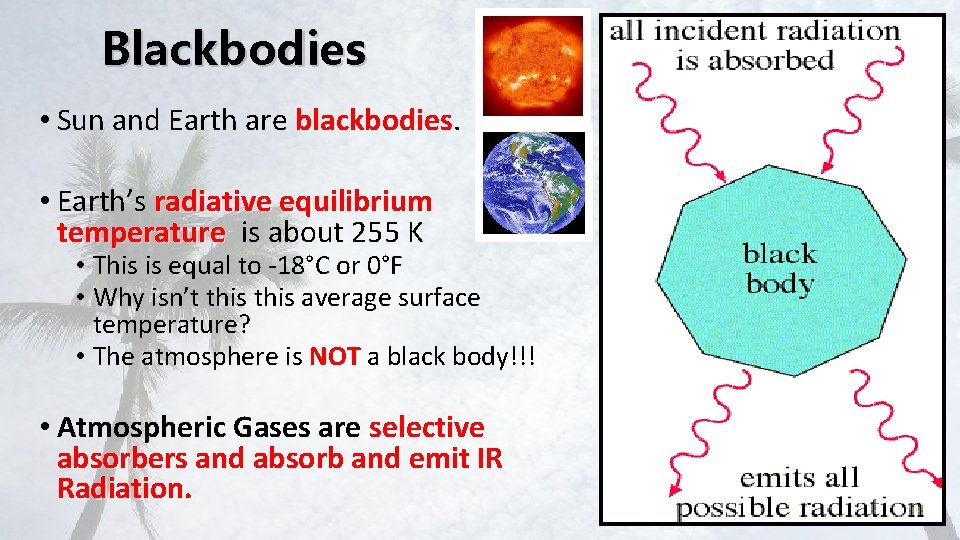
Blackbodies • Sun and Earth are blackbodies • Earth’s radiative equilibrium temperature is about 255 K • This is equal to -18°C or 0°F • Why isn’t this average surface temperature? • The atmosphere is NOT a black body!!! • Atmospheric Gases are selective absorbers and absorb and emit IR Radiation.
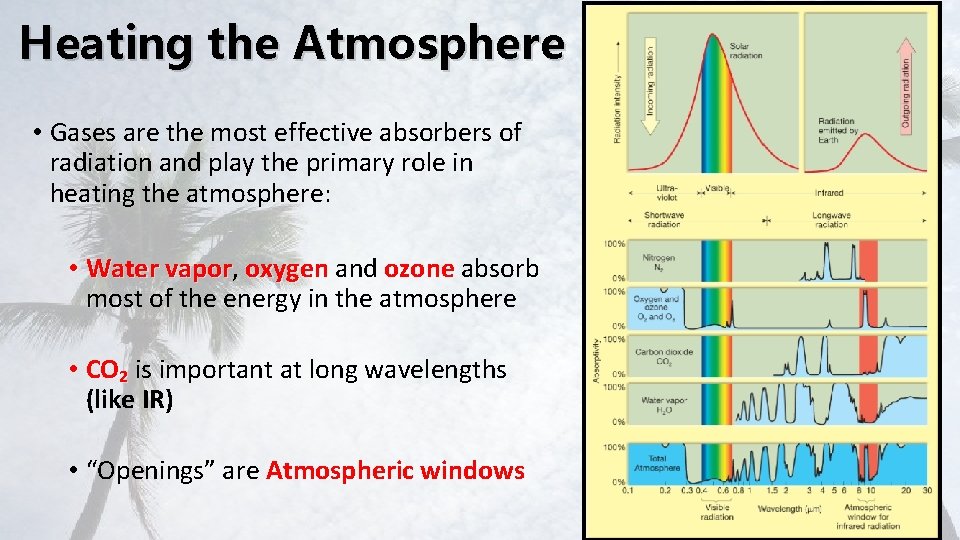
Heating the Atmosphere • Gases are the most effective absorbers of radiation and play the primary role in heating the atmosphere: • Water vapor, vapor oxygen and ozone absorb most of the energy in the atmosphere • CO 2 is important at long wavelengths (like IR) • “Openings” are Atmospheric windows
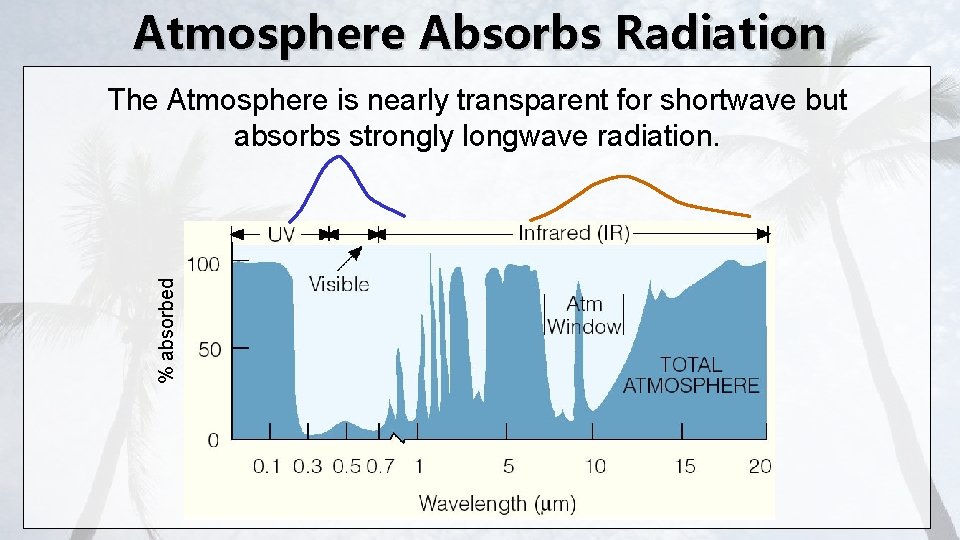
Atmosphere Absorbs Radiation % absorbed The Atmosphere is nearly transparent for shortwave but absorbs strongly longwave radiation.
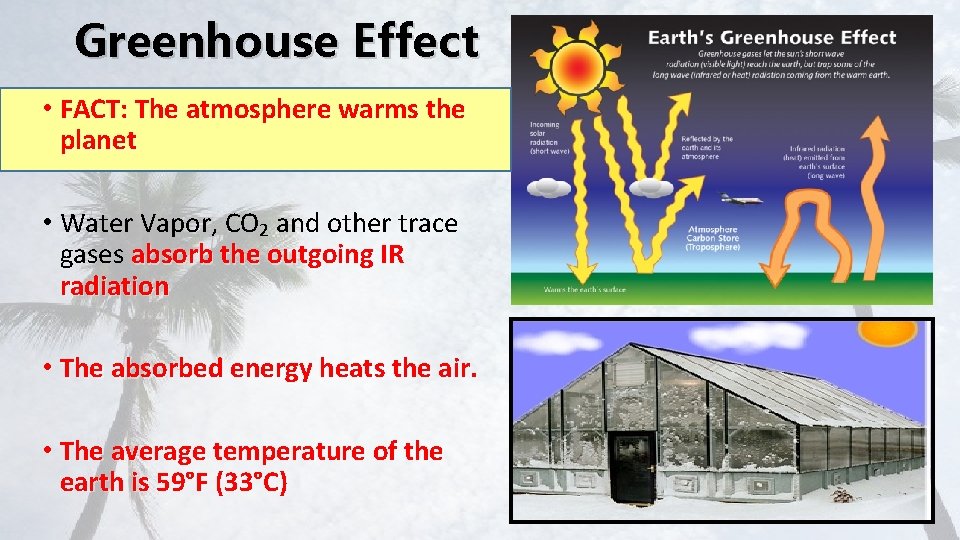
Greenhouse Effect • FACT: The atmosphere warms the planet • Water Vapor, CO 2 and other trace gases absorb the outgoing IR radiation • The absorbed energy heats the air. • The average temperature of the earth is 59°F (33°C)
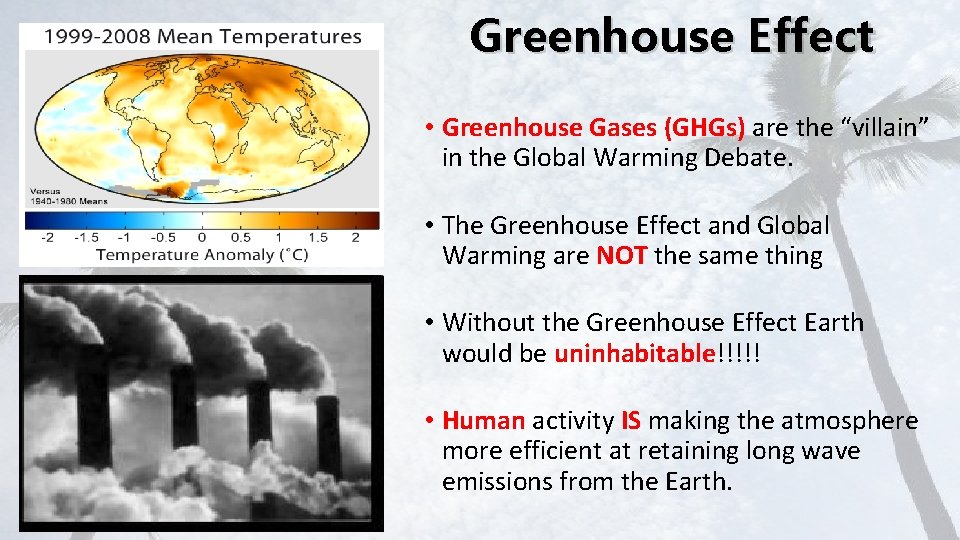
Greenhouse Effect • Greenhouse Gases (GHGs) are the “villain” in the Global Warming Debate. • The Greenhouse Effect and Global Warming are NOT the same thing • Without the Greenhouse Effect Earth would be uninhabitable!!!!! • Human activity IS making the atmosphere more efficient at retaining long wave emissions from the Earth.
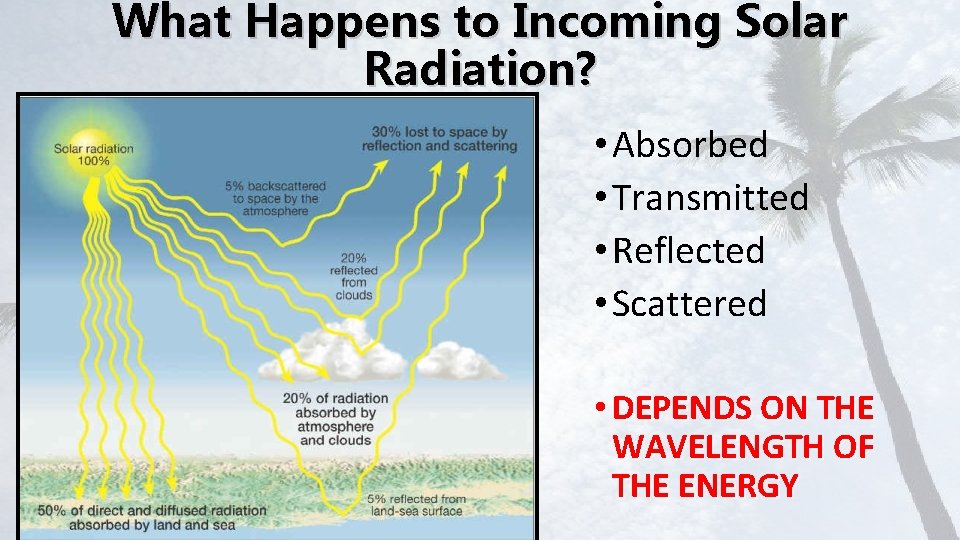
What Happens to Incoming Solar Radiation? • Absorbed • Transmitted • Reflected • Scattered • DEPENDS ON THE WAVELENGTH OF THE ENERGY
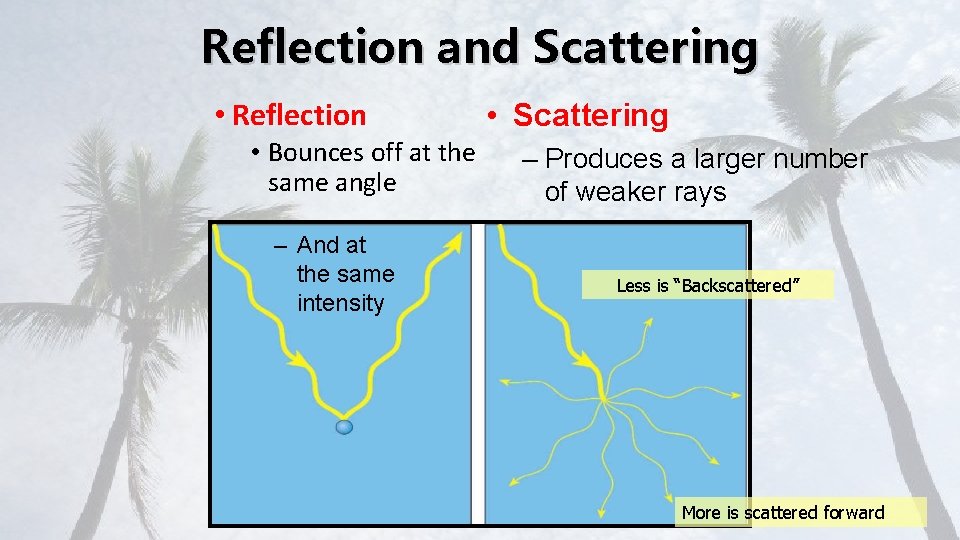
Reflection and Scattering • Reflection • Bounces off at the same angle – And at the same intensity • Scattering – Produces a larger number of weaker rays Less is “Backscattered” More is scattered forward
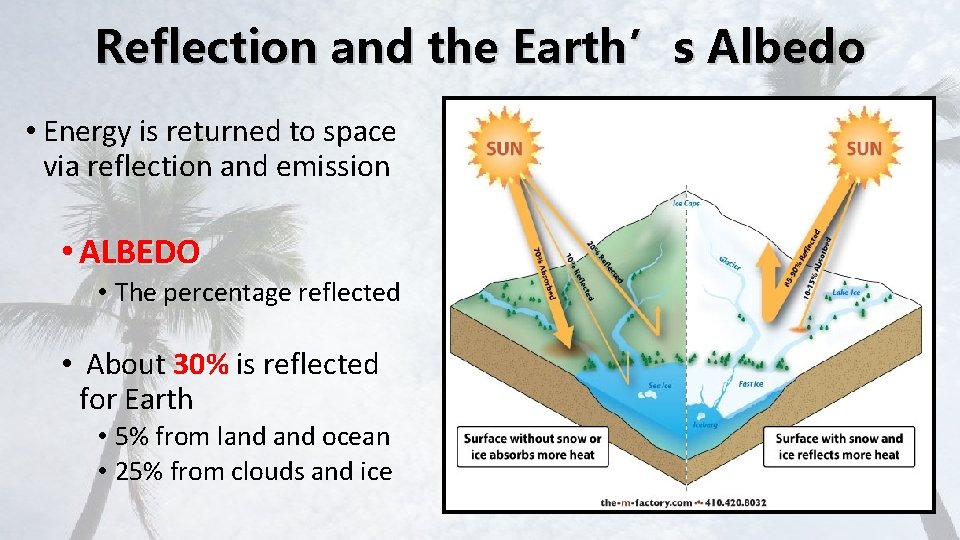
Reflection and the Earth’s Albedo • Energy is returned to space via reflection and emission • ALBEDO • The percentage reflected • About 30% is reflected for Earth • 5% from land ocean • 25% from clouds and ice
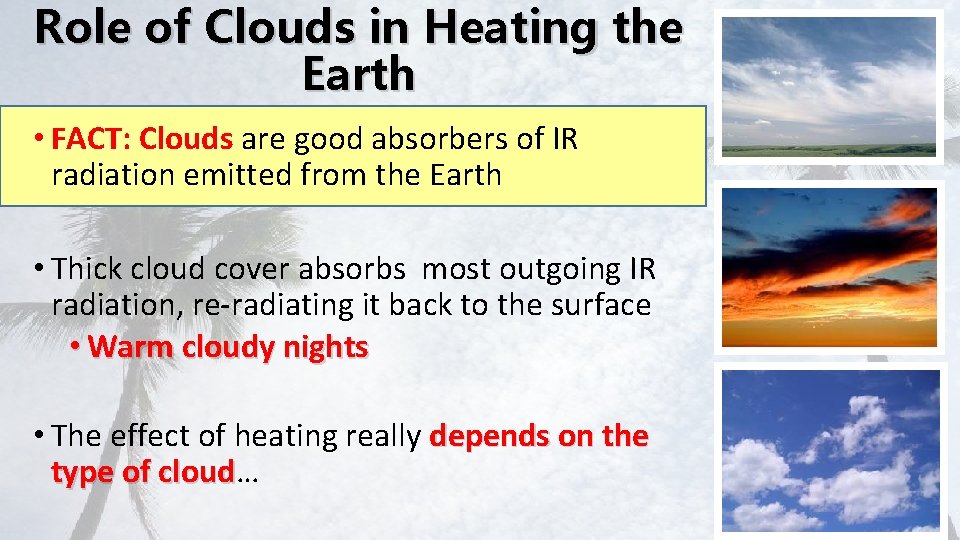
Role of Clouds in Heating the Earth • FACT: Clouds are good absorbers of IR radiation emitted from the Earth • Thick cloud cover absorbs most outgoing IR radiation, re-radiating it back to the surface • Warm cloudy nights • The effect of heating really depends on the type of cloud… cloud
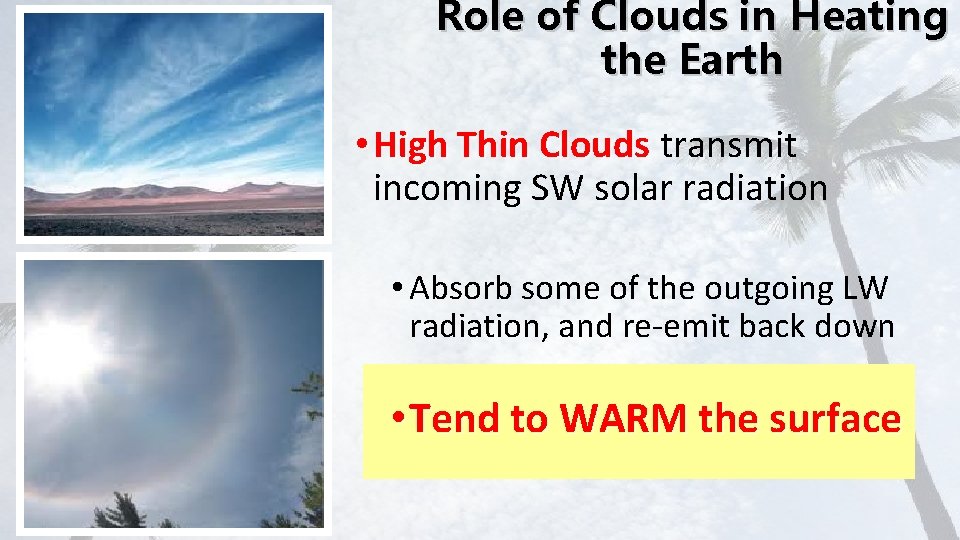
Role of Clouds in Heating the Earth • High Thin Clouds transmit incoming SW solar radiation • Absorb some of the outgoing LW radiation, and re-emit back down • Tend to WARM the surface
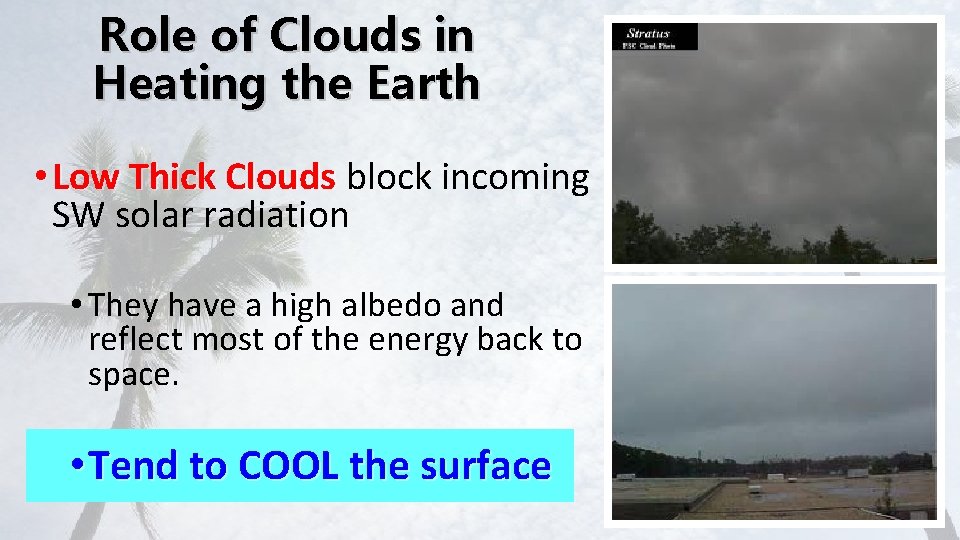
Role of Clouds in Heating the Earth • Low Thick Clouds block incoming SW solar radiation • They have a high albedo and reflect most of the energy back to space. • Tend to COOL the surface
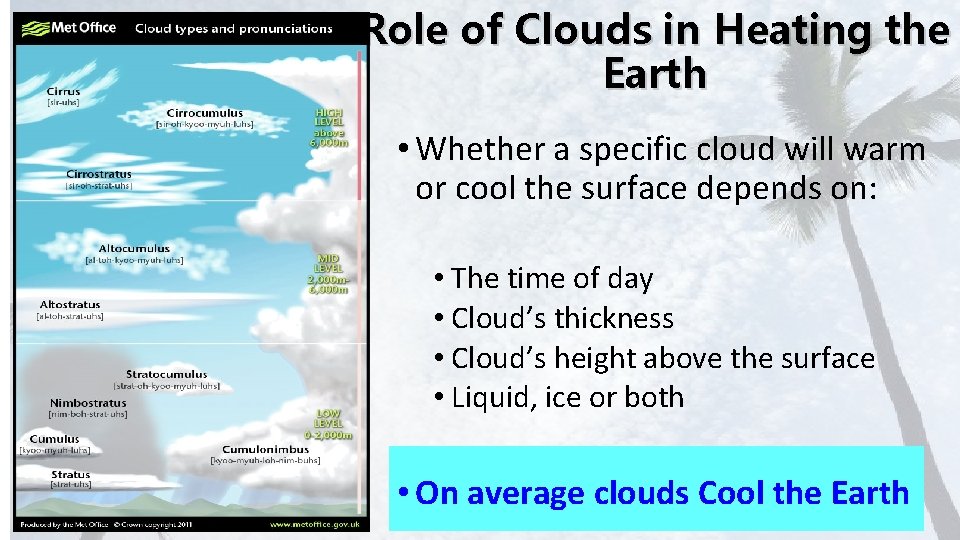
Role of Clouds in Heating the Earth • Whether a specific cloud will warm or cool the surface depends on: • The time of day • Cloud’s thickness • Cloud’s height above the surface • Liquid, ice or both • On average clouds Cool the Earth
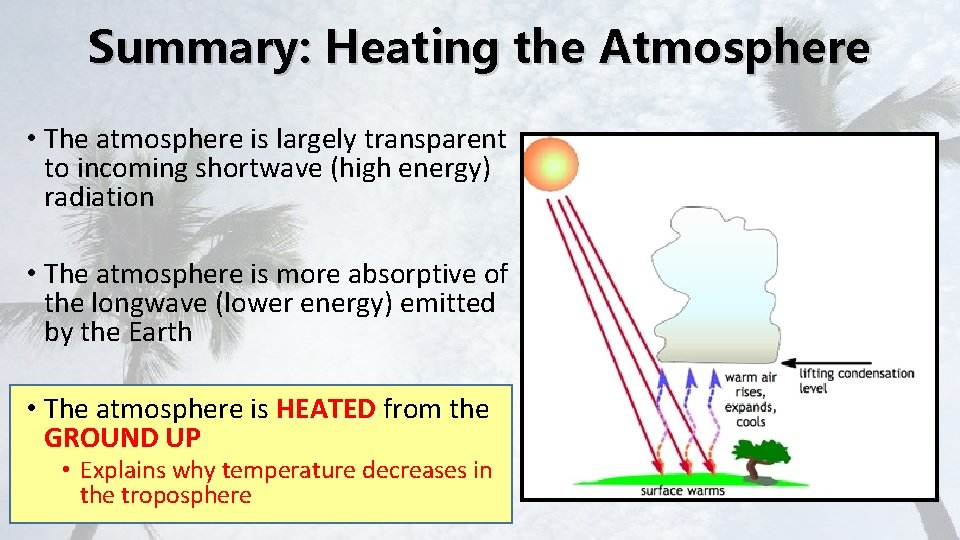
Summary: Heating the Atmosphere • The atmosphere is largely transparent to incoming shortwave (high energy) radiation • The atmosphere is more absorptive of the longwave (lower energy) emitted by the Earth • The atmosphere is HEATED from the GROUND UP • Explains why temperature decreases in the troposphere
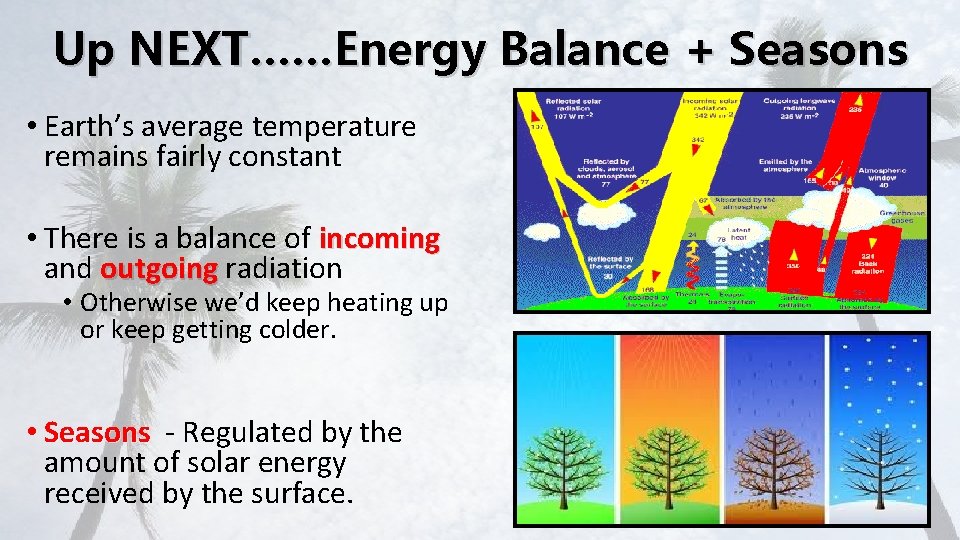
Up NEXT……Energy Balance + Seasons • Earth’s average temperature remains fairly constant • There is a balance of incoming and outgoing radiation • Otherwise we’d keep heating up or keep getting colder. • Seasons - Regulated by the amount of solar energy received by the surface.
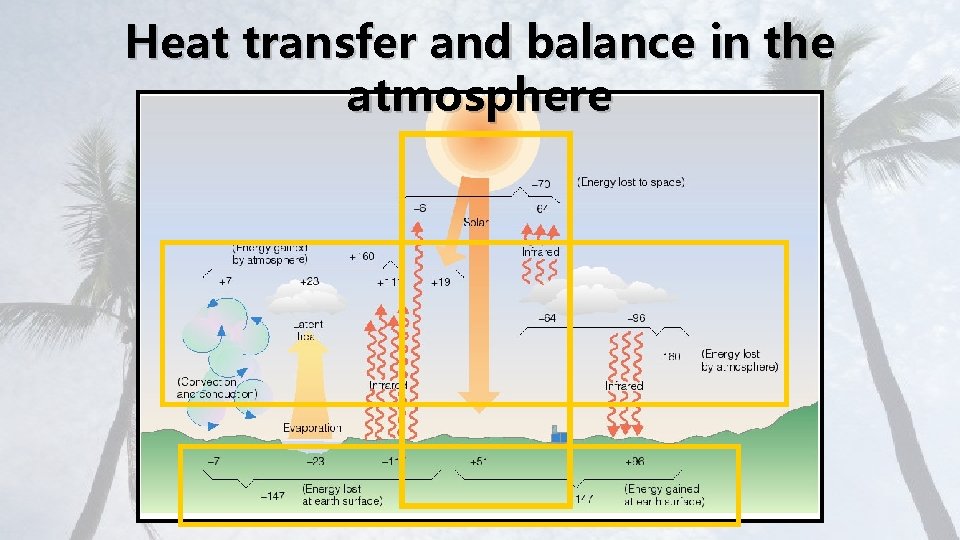
Heat transfer and balance in the atmosphere
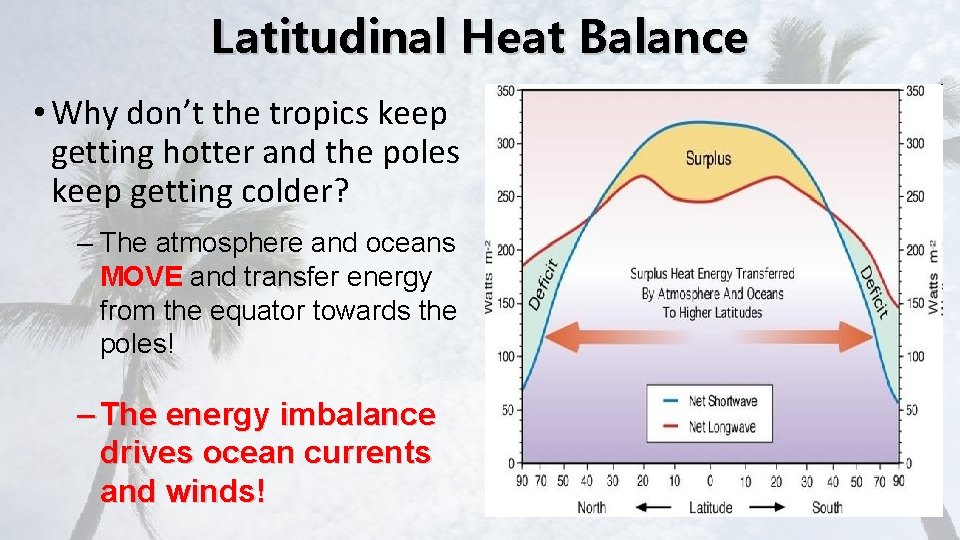
Latitudinal Heat Balance • Why don’t the tropics keep getting hotter and the poles keep getting colder? – The atmosphere and oceans MOVE and transfer energy from the equator towards the poles! – The energy imbalance drives ocean currents and winds!
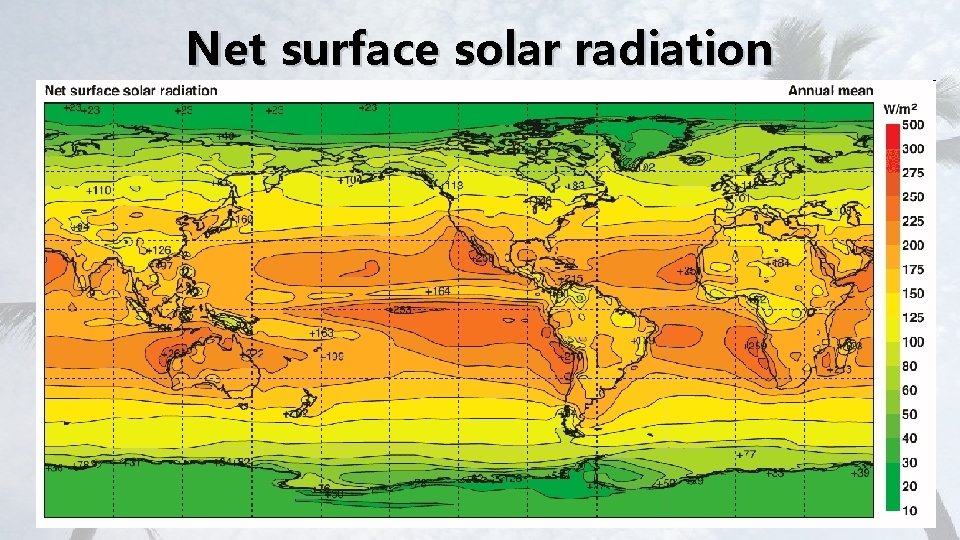
Net surface solar radiation
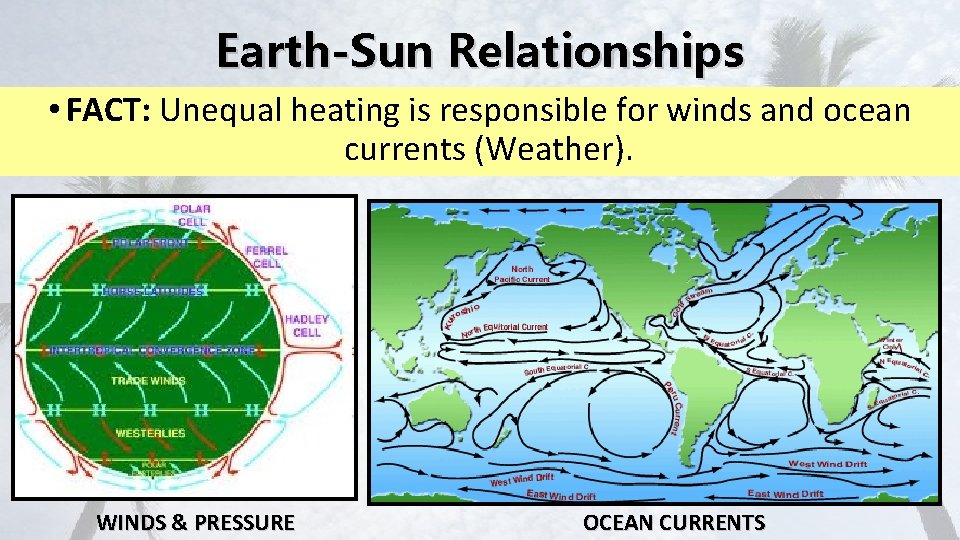
Earth-Sun Relationships • FACT: Unequal heating is responsible for winds and ocean currents (Weather). WINDS & PRESSURE OCEAN CURRENTS
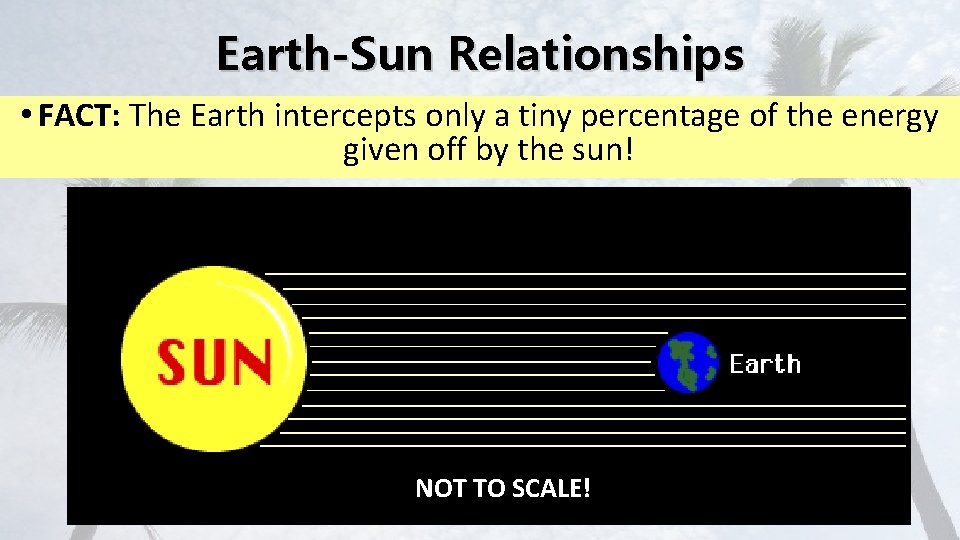
Earth-Sun Relationships • FACT: The Earth intercepts only a tiny percentage of the energy given off by the sun! NOT TO SCALE!
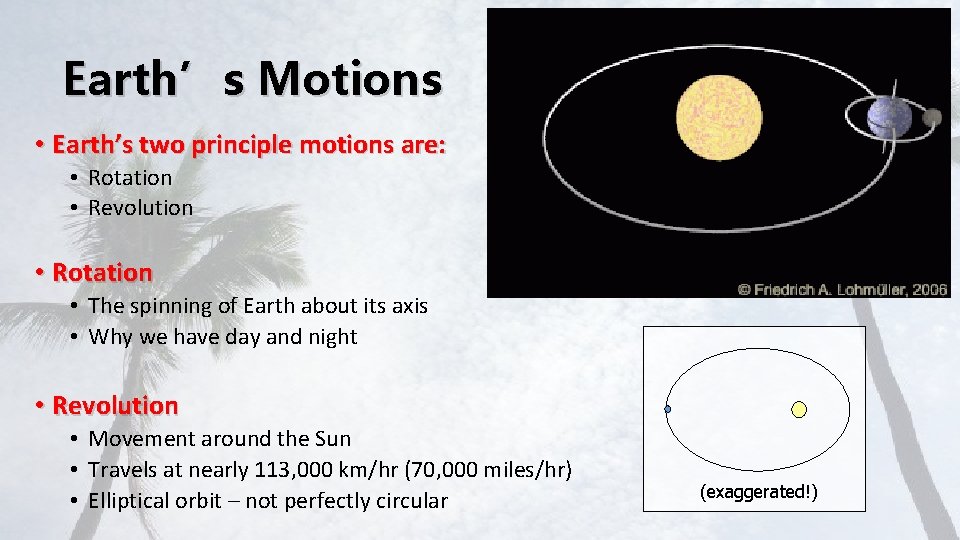
Earth’s Motions • Earth’s two principle motions are: • Rotation • Revolution • Rotation • The spinning of Earth about its axis • Why we have day and night • Revolution • Movement around the Sun • Travels at nearly 113, 000 km/hr (70, 000 miles/hr) • Elliptical orbit – not perfectly circular (exaggerated!)
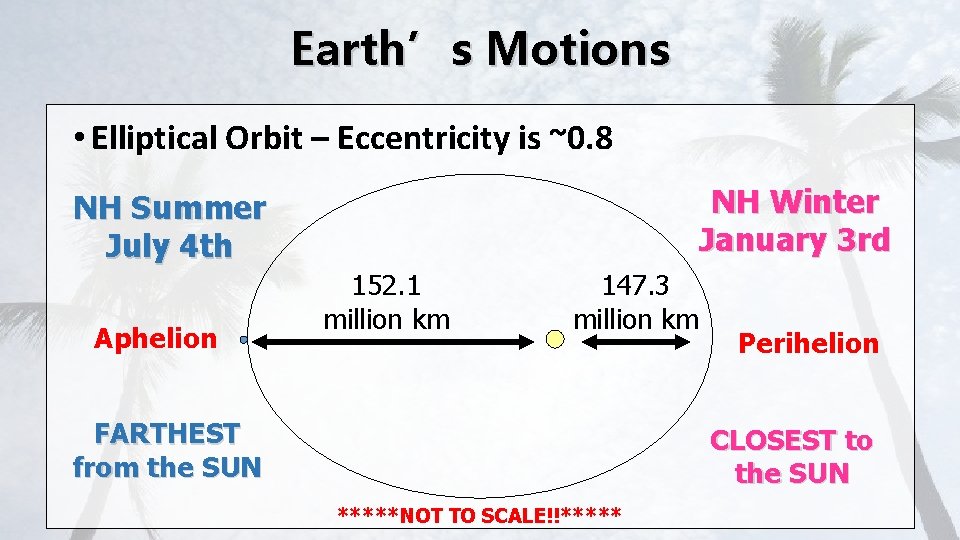
Earth’s Motions • Elliptical Orbit – Eccentricity is ~0. 8 NH Winter January 3 rd NH Summer July 4 th Aphelion 152. 1 million km 147. 3 million km FARTHEST from the SUN Perihelion CLOSEST to the SUN *****NOT TO SCALE!!*****
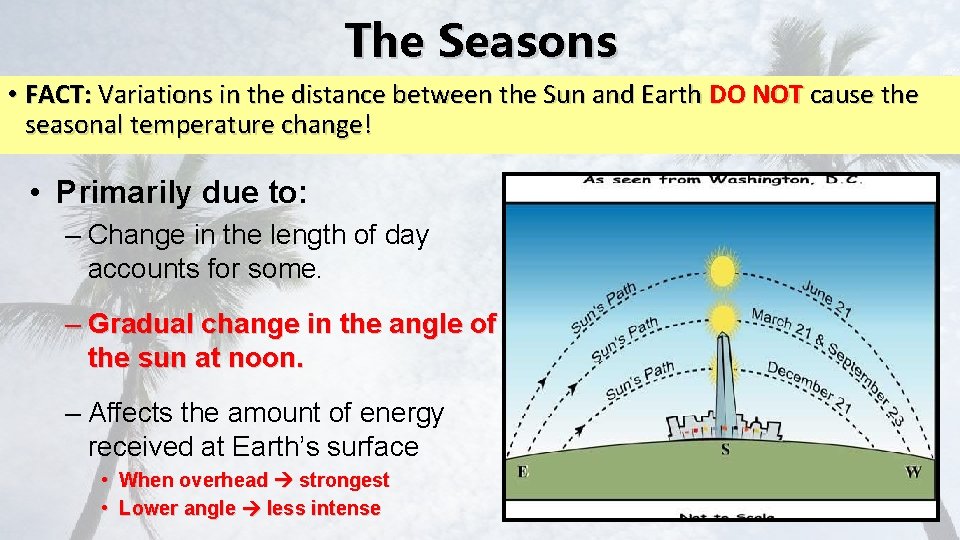
The Seasons • FACT: Variations in the distance between the Sun and Earth DO NOT cause the seasonal temperature change! • Primarily due to: – Change in the length of day accounts for some. – Gradual change in the angle of the sun at noon. – Affects the amount of energy received at Earth’s surface • When overhead strongest • Lower angle less intense
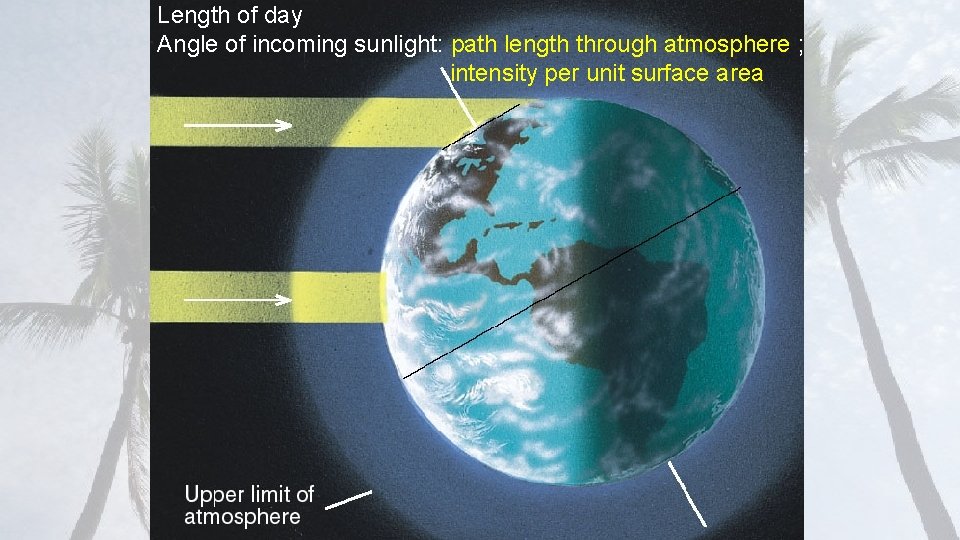
Length of day Angle of incoming sunlight: path length through atmosphere ; intensity per unit surface area
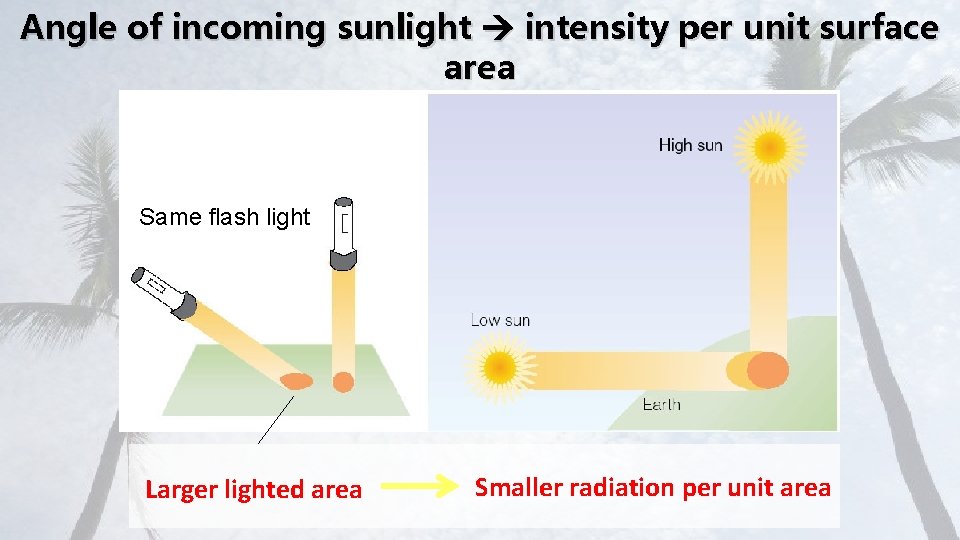
Angle of incoming sunlight intensity per unit surface area Same flash light Larger lighted area Smaller radiation per unit area
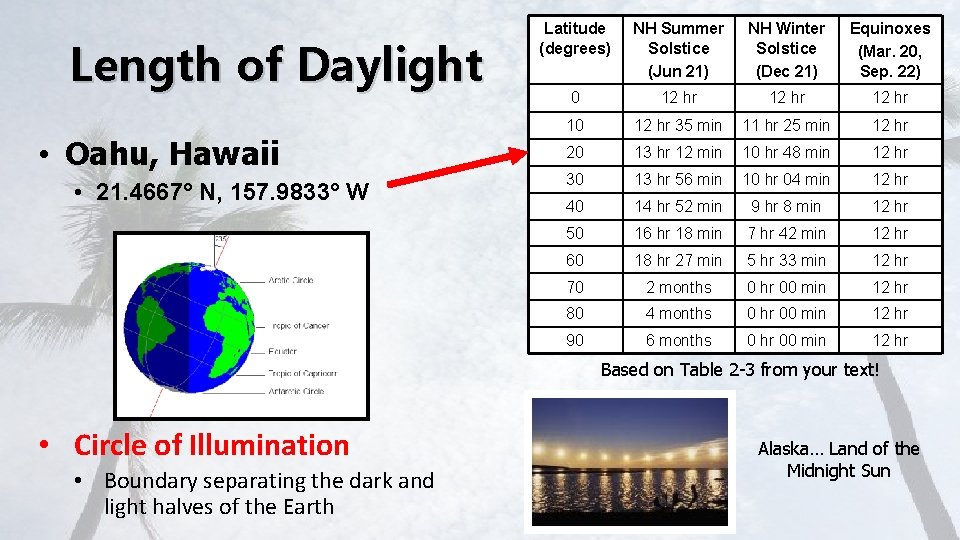
Length of Daylight • Oahu, Hawaii • 21. 4667° N, 157. 9833° W Latitude (degrees) NH Summer Solstice (Jun 21) NH Winter Solstice (Dec 21) Equinoxes (Mar. 20, Sep. 22) 0 12 hr 10 12 hr 35 min 11 hr 25 min 12 hr 20 13 hr 12 min 10 hr 48 min 12 hr 30 13 hr 56 min 10 hr 04 min 12 hr 40 14 hr 52 min 9 hr 8 min 12 hr 50 16 hr 18 min 7 hr 42 min 12 hr 60 18 hr 27 min 5 hr 33 min 12 hr 70 2 months 0 hr 00 min 12 hr 80 4 months 0 hr 00 min 12 hr 90 6 months 0 hr 00 min 12 hr Based on Table 2 -3 from your text! • Circle of Illumination • Boundary separating the dark and light halves of the Earth Alaska… Land of the Midnight Sun
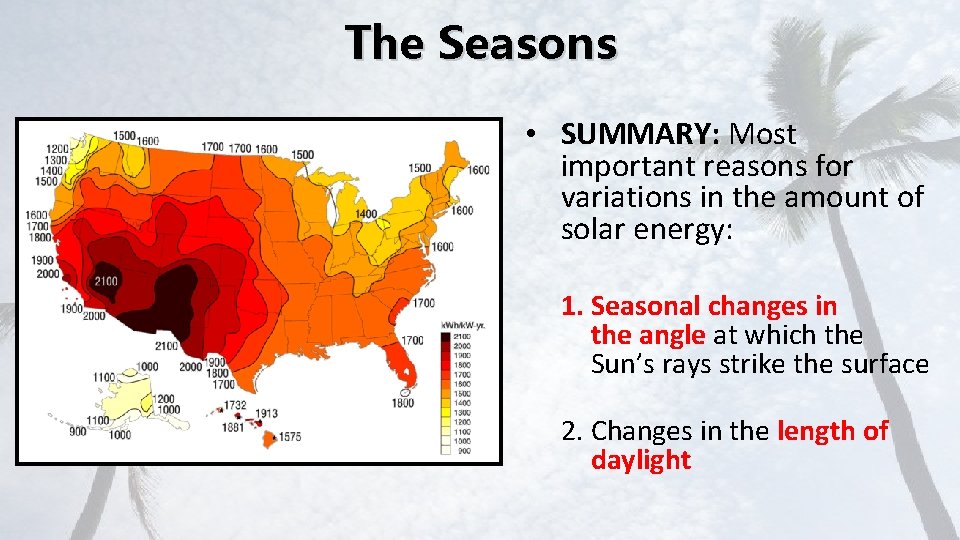
The Seasons • SUMMARY: Most important reasons for variations in the amount of solar energy: 1. Seasonal changes in the angle at which the Sun’s rays strike the surface 2. Changes in the length of daylight
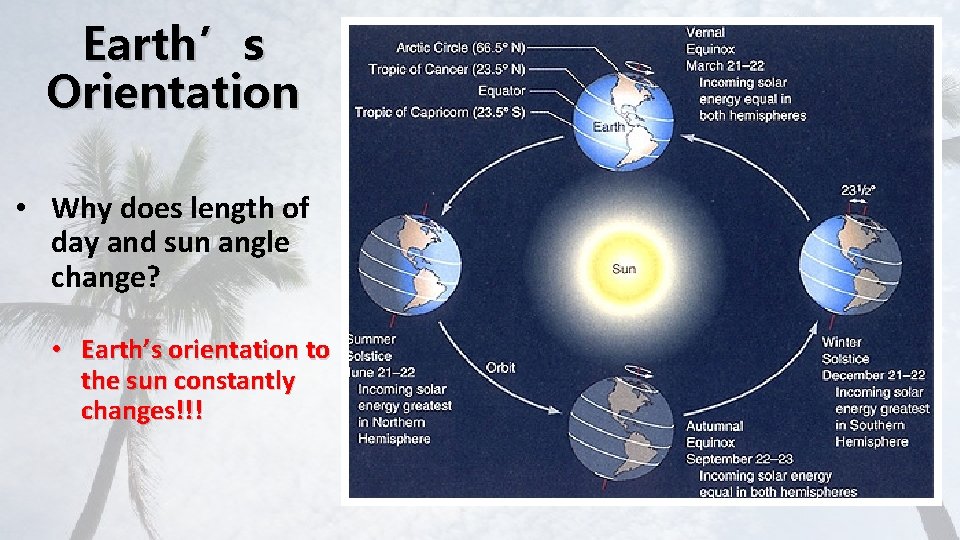
Earth’s Orientation • Why does length of day and sun angle change? • Earth’s orientation to the sun constantly changes!!!
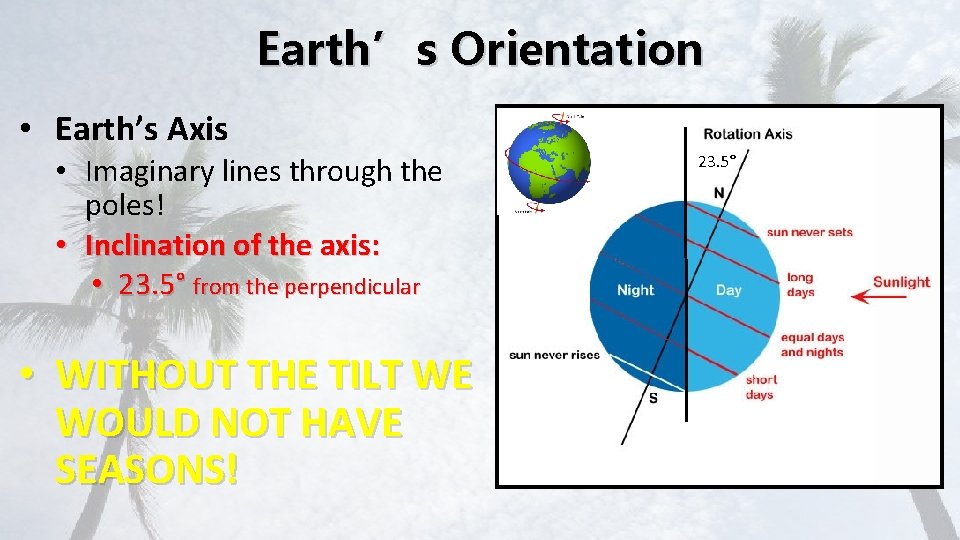
Earth’s Orientation • Earth’s Axis • Imaginary lines through the poles! • Inclination of the axis: • 23. 5° from the perpendicular • WITHOUT THE TILT WE WOULD NOT HAVE SEASONS! 23. 5°
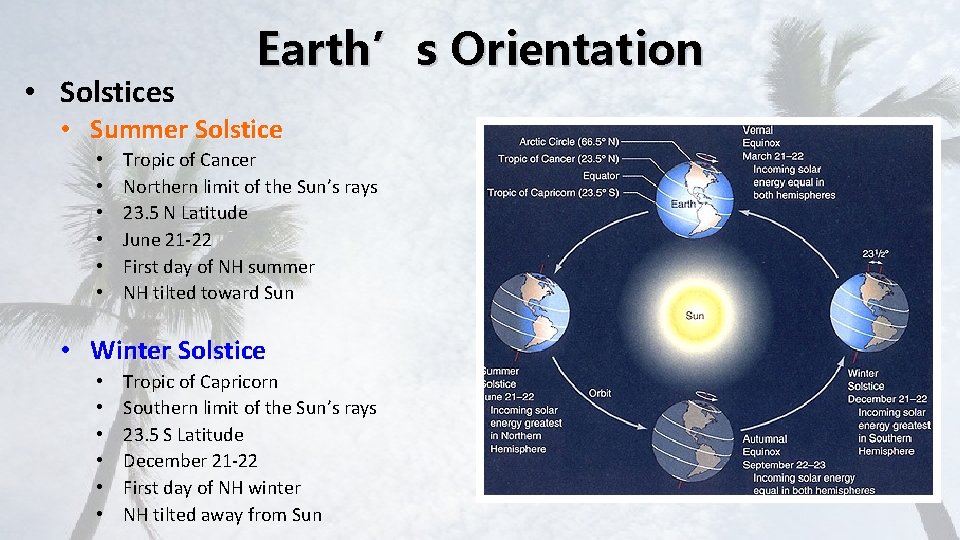
• Solstices Earth’s Orientation • Summer Solstice • • • Tropic of Cancer Northern limit of the Sun’s rays 23. 5 N Latitude June 21 -22 First day of NH summer NH tilted toward Sun • Winter Solstice • • • Tropic of Capricorn Southern limit of the Sun’s rays 23. 5 S Latitude December 21 -22 First day of NH winter NH tilted away from Sun
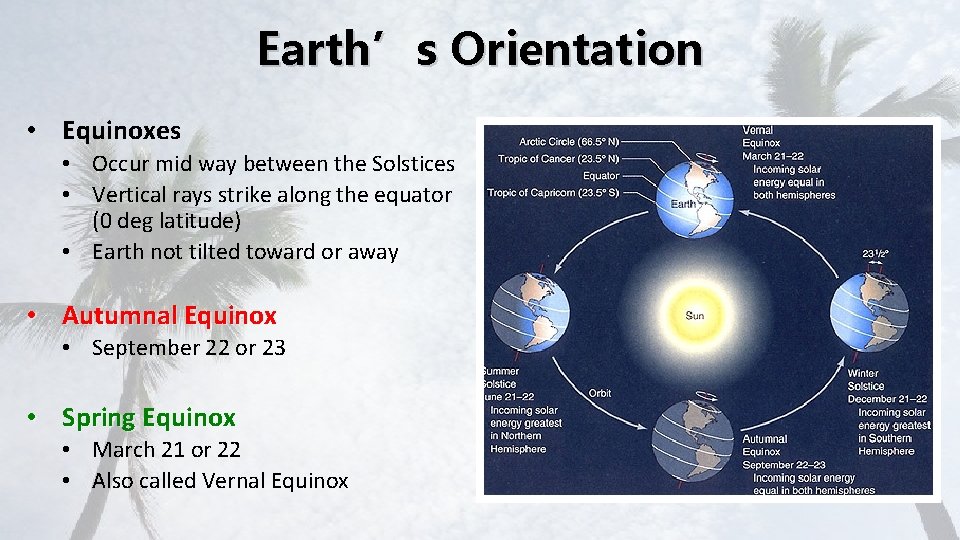
Earth’s Orientation • Equinoxes • Occur mid way between the Solstices • Vertical rays strike along the equator (0 deg latitude) • Earth not tilted toward or away • Autumnal Equinox • September 22 or 23 • Spring Equinox • March 21 or 22 • Also called Vernal Equinox
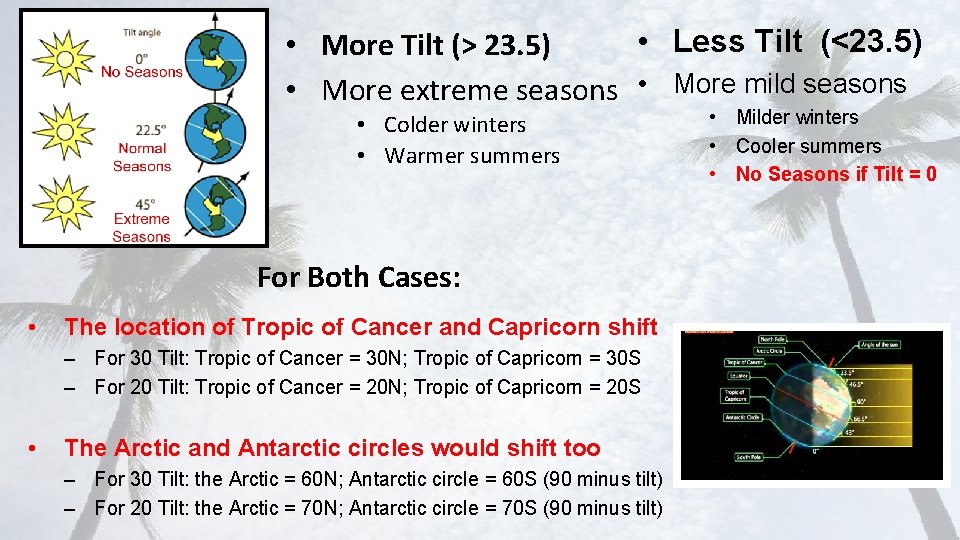
• Less Tilt (<23. 5) • More Tilt (> 23. 5) • More extreme seasons • More mild seasons • Colder winters • Warmer summers For Both Cases: • The location of Tropic of Cancer and Capricorn shift – For 30 Tilt: Tropic of Cancer = 30 N; Tropic of Capricorn = 30 S – For 20 Tilt: Tropic of Cancer = 20 N; Tropic of Capricorn = 20 S • The Arctic and Antarctic circles would shift too – For 30 Tilt: the Arctic = 60 N; Antarctic circle = 60 S (90 minus tilt) – For 20 Tilt: the Arctic = 70 N; Antarctic circle = 70 S (90 minus tilt) • Milder winters • Cooler summers • No Seasons if Tilt = 0
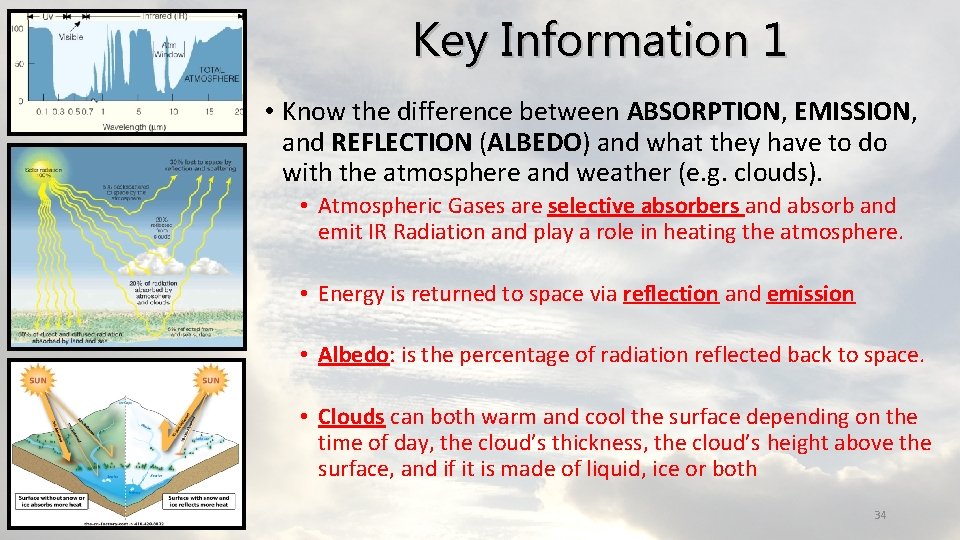
Key Information 1 • Know the difference between ABSORPTION, EMISSION, and REFLECTION (ALBEDO) and what they have to do with the atmosphere and weather (e. g. clouds). • Atmospheric Gases are selective absorbers and absorb and emit IR Radiation and play a role in heating the atmosphere. • Energy is returned to space via reflection and emission • Albedo: is the percentage of radiation reflected back to space. • Clouds can both warm and cool the surface depending on the time of day, the cloud’s thickness, the cloud’s height above the surface, and if it is made of liquid, ice or both 34
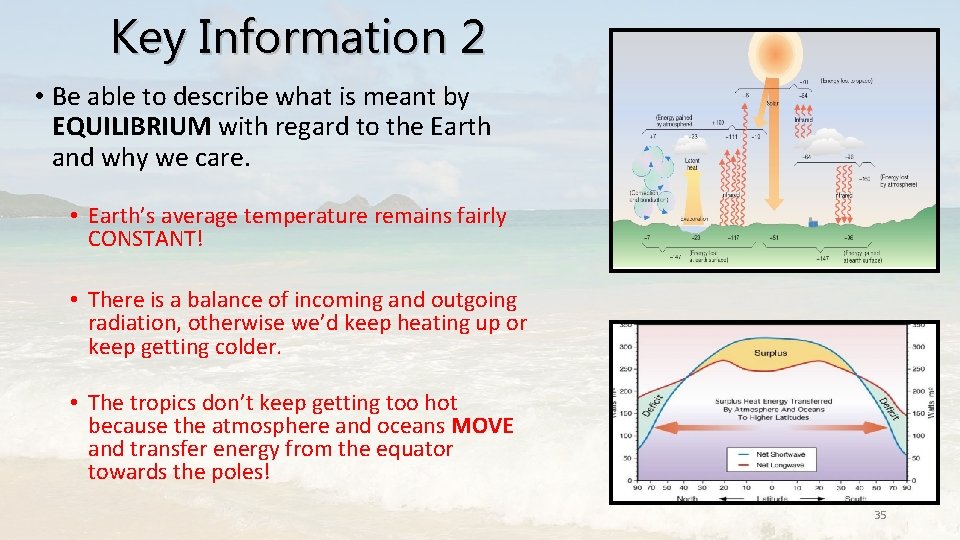
Key Information 2 • Be able to describe what is meant by EQUILIBRIUM with regard to the Earth and why we care. • Earth’s average temperature remains fairly CONSTANT! • There is a balance of incoming and outgoing radiation, otherwise we’d keep heating up or keep getting colder. • The tropics don’t keep getting too hot because the atmosphere and oceans MOVE and transfer energy from the equator towards the poles! 35
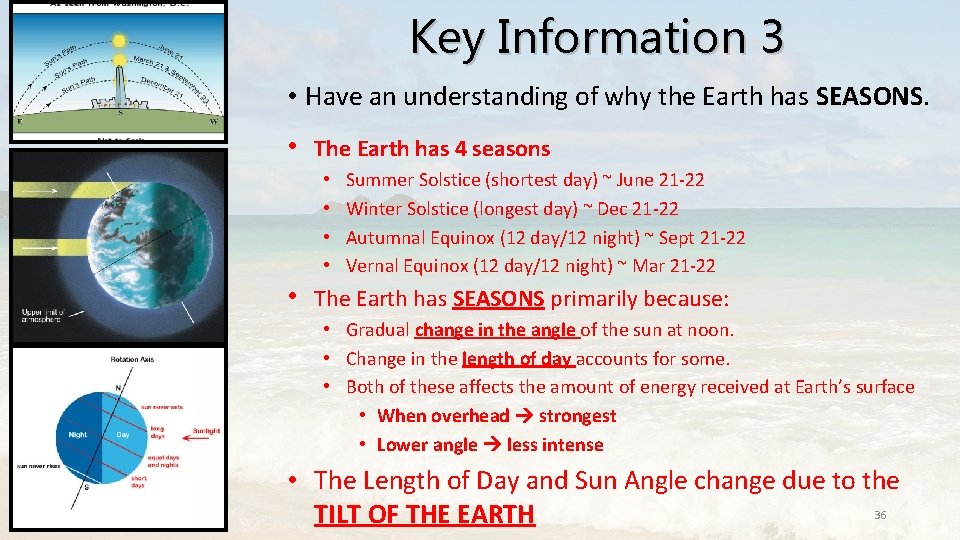
Key Information 3 • Have an understanding of why the Earth has SEASONS. • The Earth has 4 seasons • • Summer Solstice (shortest day) ~ June 21 -22 Winter Solstice (longest day) ~ Dec 21 -22 Autumnal Equinox (12 day/12 night) ~ Sept 21 -22 Vernal Equinox (12 day/12 night) ~ Mar 21 -22 • The Earth has SEASONS primarily because: • Gradual change in the angle of the sun at noon. • Change in the length of day accounts for some. • Both of these affects the amount of energy received at Earth’s surface • When overhead strongest • Lower angle less intense • The Length of Day and Sun Angle change due to the 36 TILT OF THE EARTH
- Slides: 36