
Lecture 34 Gas Exchange Respiratory Regulation Respiratory Diseases

- Slides: 14
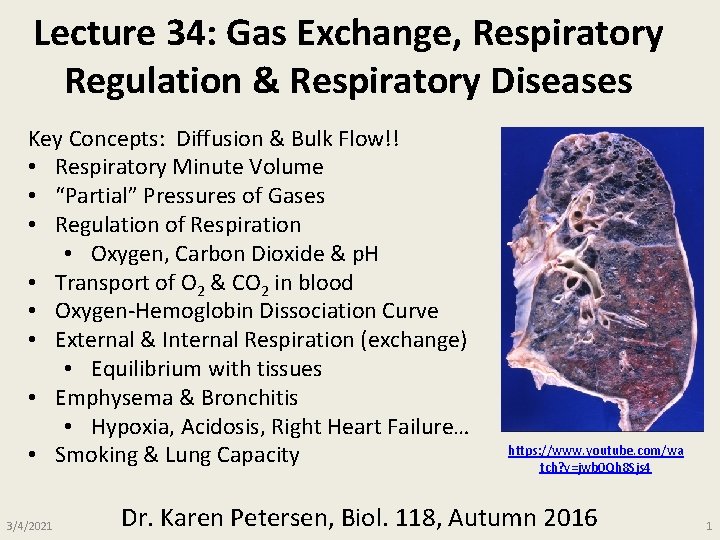
Lecture 34: Gas Exchange, Respiratory Regulation & Respiratory Diseases Key Concepts: Diffusion & Bulk Flow!! • Respiratory Minute Volume • “Partial” Pressures of Gases • Regulation of Respiration • Oxygen, Carbon Dioxide & p. H • Transport of O 2 & CO 2 in blood • Oxygen-Hemoglobin Dissociation Curve • External & Internal Respiration (exchange) • Equilibrium with tissues • Emphysema & Bronchitis • Hypoxia, Acidosis, Right Heart Failure… • Smoking & Lung Capacity 3/4/2021 https: //www. youtube. com/wa tch? v=jwb 0 Qh 8 Sjs 4 Dr. Karen Petersen, Biol. 118, Autumn 2016 1
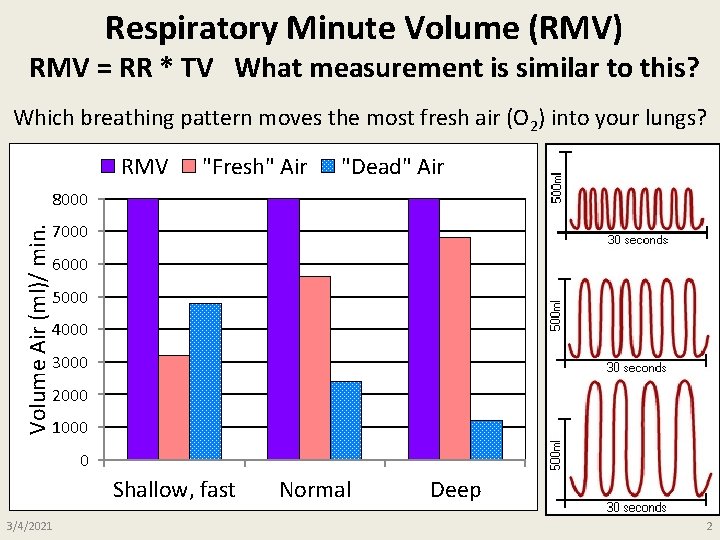
Respiratory Minute Volume (RMV) RMV = RR * TV What measurement is similar to this? Which breathing pattern moves the most fresh air (O 2) into your lungs? RMV "Fresh" Air "Dead" Air Volume Air (ml)/ min. 8000 7000 6000 5000 4000 3000 2000 1000 0 Shallow, fast 3/4/2021 Normal Deep 2
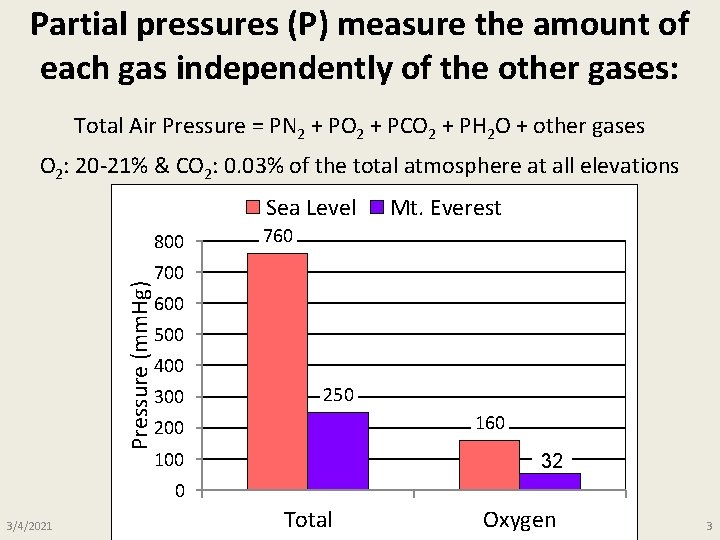
Partial pressures (P) measure the amount of each gas independently of the other gases: Total Air Pressure = PN 2 + PO 2 + PCO 2 + PH 2 O + other gases O 2: 20 -21% & CO 2: 0. 03% of the total atmosphere at all elevations Sea Level Pressure (mm. Hg) 800 Mt. Everest 760 700 600 500 400 300 250 160 200 100 32 0 3/4/2021 Total Oxygen 3
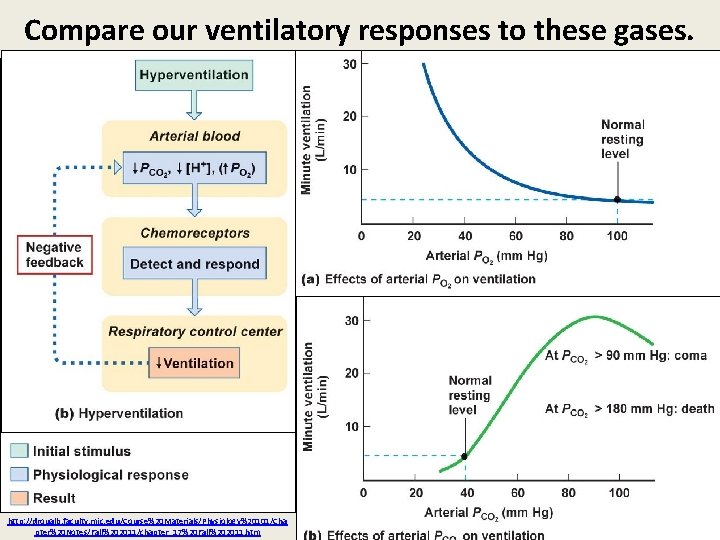
Compare our ventilatory responses to these gases. http: //droualb. faculty. mjc. edu/Course%20 Materials/Physiology%20101/Cha pter%20 Notes/Fall%202011/chapter_17%20 Fall%202011. htm
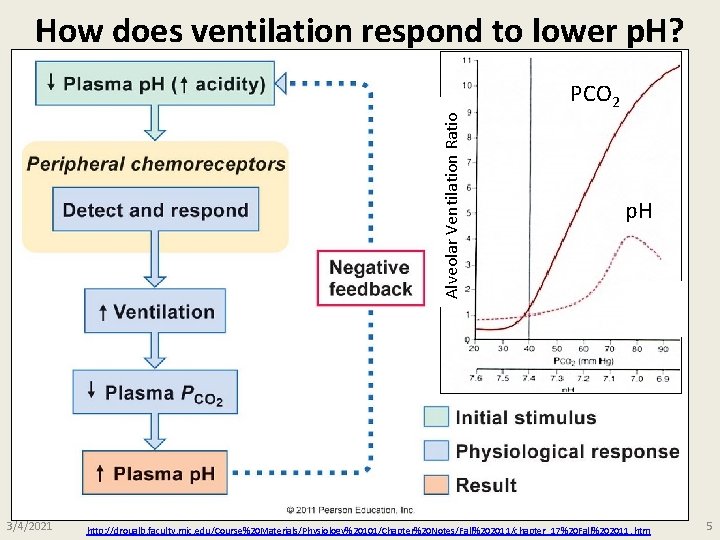
How does ventilation respond to lower p. H? Alveolar Ventilation Ratio PCO 2 3/4/2021 p. H http: //droualb. faculty. mjc. edu/Course%20 Materials/Physiology%20101/Chapter%20 Notes/Fall%202011/chapter_17%20 Fall%202011. htm 5
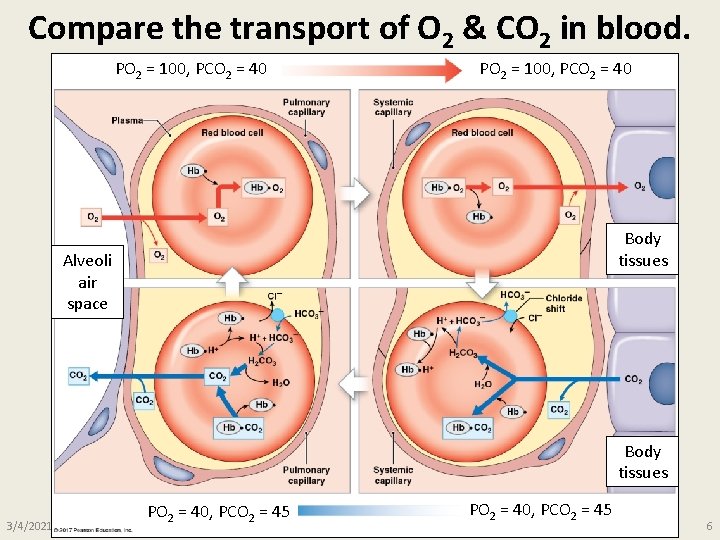
Compare the transport of O 2 & CO 2 in blood. PO 2 = 100, PCO 2 = 40 Body tissues Alveoli air space Body tissues 3/4/2021 PO 2 = 40, PCO 2 = 45 6
Explain the hemoglobin-oxygen saturation curve. 1 hemoglobin with 4 O 2 molecules 3/4/2021 RBC with ~ 75% O 2 saturation of hemoglobin Animation of hemoglobin: http: //classes. midlandstech. edu/carterp/Courses/bio 211/chap 22. htm 7
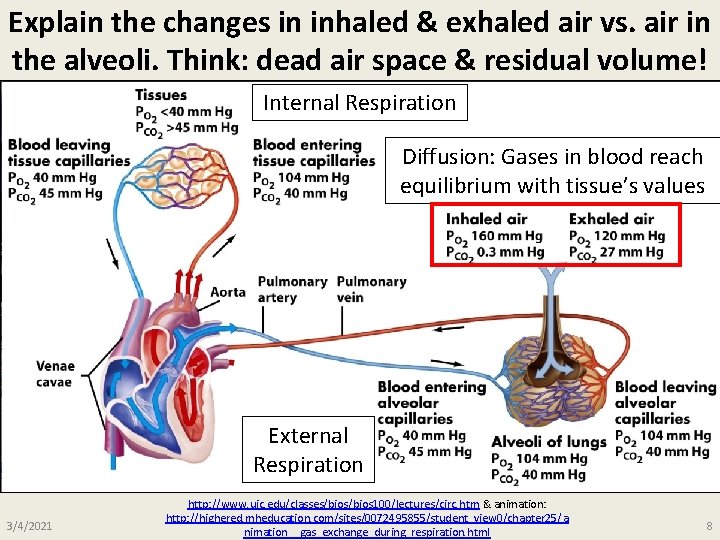
Explain the changes in inhaled & exhaled air vs. air in the alveoli. Think: dead air space & residual volume! Internal Respiration Diffusion: Gases in blood reach equilibrium with tissue’s values External Respiration 3/4/2021 http: //www. uic. edu/classes/bios 100/lectures/circ. htm & animation: http: //highered. mheducation. com/sites/0072495855/student_view 0/chapter 25/a nimation__gas_exchange_during_respiration. html 8
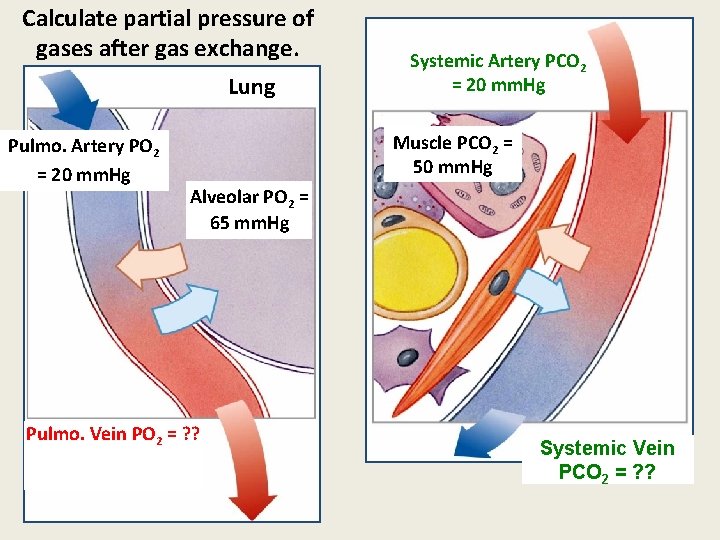
Calculate partial pressure of gases after gas exchange. Lung Pulmo. Artery PO 2 = 20 mm. Hg Systemic Artery PCO 2 = 20 mm. Hg Muscle PCO 2 = 50 mm. Hg Alveolar PO 2 = 65 mm. Hg Pulmo. Vein PO 2 = ? ? Systemic Vein PCO 2 = ? ?
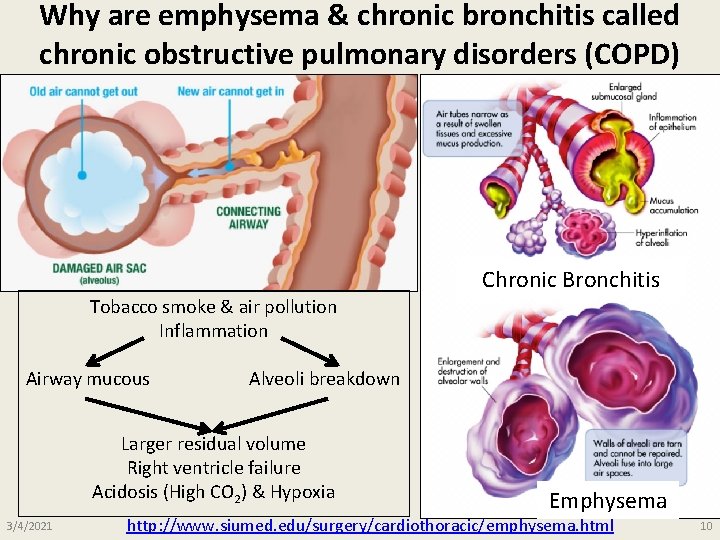
Why are emphysema & chronic bronchitis called chronic obstructive pulmonary disorders (COPD) Chronic Bronchitis Tobacco smoke & air pollution Inflammation Airway mucous Alveoli breakdown Larger residual volume Right ventricle failure Acidosis (High CO 2) & Hypoxia 3/4/2021 Emphysema http: //www. siumed. edu/surgery/cardiothoracic/emphysema. html 10
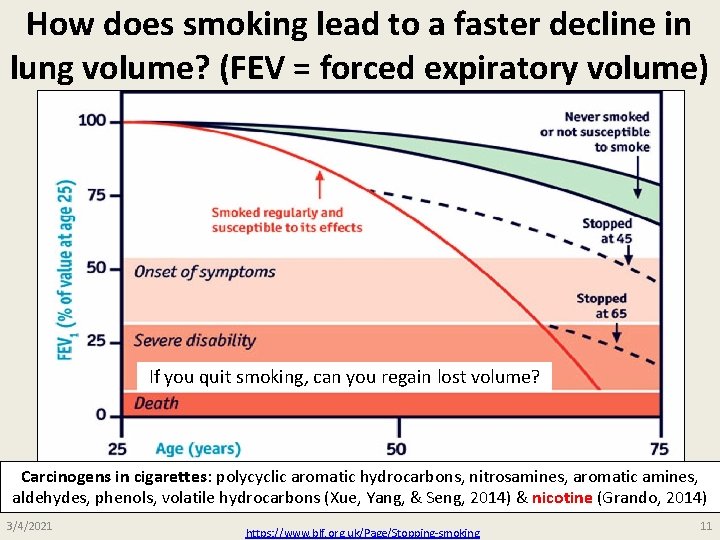
How does smoking lead to a faster decline in lung volume? (FEV = forced expiratory volume) If you quit smoking, can you regain lost volume? Carcinogens in cigarettes: polycyclic aromatic hydrocarbons, nitrosamines, aromatic amines, aldehydes, phenols, volatile hydrocarbons (Xue, Yang, & Seng, 2014) & nicotine (Grando, 2014) 3/4/2021 https: //www. blf. org. uk/Page/Stopping-smoking 11
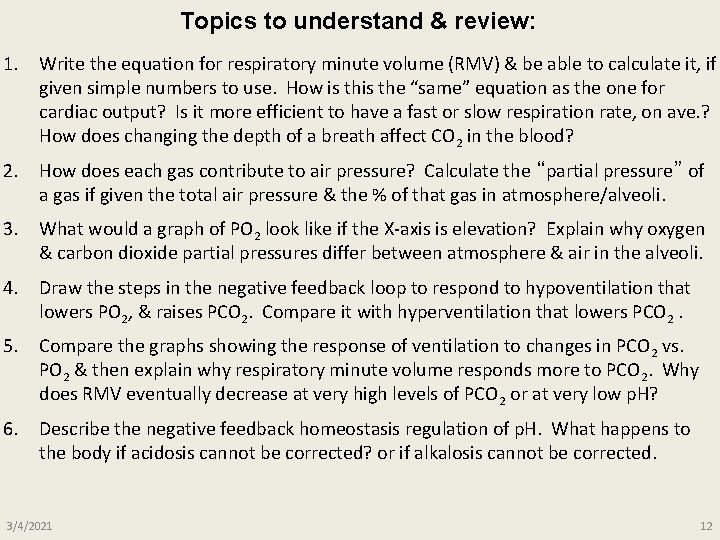
Topics to understand & review: 1. Write the equation for respiratory minute volume (RMV) & be able to calculate it, if given simple numbers to use. How is the “same” equation as the one for cardiac output? Is it more efficient to have a fast or slow respiration rate, on ave. ? How does changing the depth of a breath affect CO 2 in the blood? 2. How does each gas contribute to air pressure? Calculate the “partial pressure” of a gas if given the total air pressure & the % of that gas in atmosphere/alveoli. 3. What would a graph of PO 2 look like if the X-axis is elevation? Explain why oxygen & carbon dioxide partial pressures differ between atmosphere & air in the alveoli. 4. Draw the steps in the negative feedback loop to respond to hypoventilation that lowers PO 2, & raises PCO 2. Compare it with hyperventilation that lowers PCO 2. 5. Compare the graphs showing the response of ventilation to changes in PCO 2 vs. PO 2 & then explain why respiratory minute volume responds more to PCO 2. Why does RMV eventually decrease at very high levels of PCO 2 or at very low p. H? 6. Describe the negative feedback homeostasis regulation of p. H. What happens to the body if acidosis cannot be corrected? or if alkalosis cannot be corrected. 3/4/2021 12
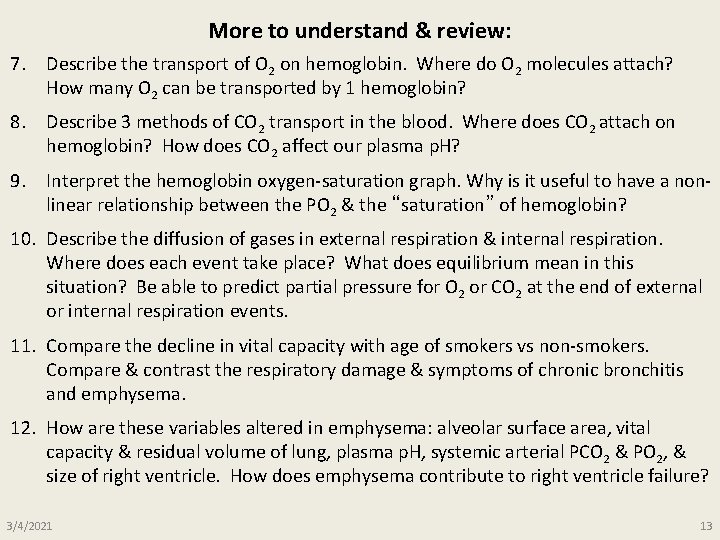
More to understand & review: 7. Describe the transport of O 2 on hemoglobin. Where do O 2 molecules attach? How many O 2 can be transported by 1 hemoglobin? 8. Describe 3 methods of CO 2 transport in the blood. Where does CO 2 attach on hemoglobin? How does CO 2 affect our plasma p. H? 9. Interpret the hemoglobin oxygen-saturation graph. Why is it useful to have a nonlinear relationship between the PO 2 & the “saturation” of hemoglobin? 10. Describe the diffusion of gases in external respiration & internal respiration. Where does each event take place? What does equilibrium mean in this situation? Be able to predict partial pressure for O 2 or CO 2 at the end of external or internal respiration events. 11. Compare the decline in vital capacity with age of smokers vs non-smokers. Compare & contrast the respiratory damage & symptoms of chronic bronchitis and emphysema. 12. How are these variables altered in emphysema: alveolar surface area, vital capacity & residual volume of lung, plasma p. H, systemic arterial PCO 2 & PO 2, & size of right ventricle. How does emphysema contribute to right ventricle failure? 3/4/2021 13
Additional Resources 1. Burns DM, Lee L, Shen LZ, et al. (2012) Chapter 2: Cigarette smoking behavior in the United States. Smoking and Tobacco Control Monograph 8. http: //cancercontrol. cancer. gov/brp/tcrb/monographs/8/ 2. Grando SA. (2014) Connections of nicotine to cancer. Nature Reviews: Cancer 14 : 419 - 429. 3. Herbst RS, Hobin JA, & Gritz ER. (2014) AACR celebrates 50 years of tobacco research and policy. Clin Cancer Res; 20(7): 1709 -1718. 4. Jemal A, Bray F, Center MM, et al. (2011) Global cancer statistics. CA Cancer J Clin 61: 69– 90. 5. Jha P, Ramasundarahettige C, Landsman V, et al. (2013) 21 st-century hazards of smoking and benefits of cessation in the United States. N Engl J Med 368: 341 -350. 6. Lim SS, Vos T, Flaxman AD, et al. (2012) A comparative risk assessment of burden of disease and injury attributable to 67 risk factors and risk factor clusters in 21 regions, 1990– 2010: a systematic analysis for the Global Burden of Disease Study 2010. Lancet 380: 2224– 2260. 7. Oza S, Thun MJ, Henley SJ, et al. (2011) How many deaths are attributable to smoking in the United States? Comparison of methods for estimating smoking-attributable mortality when smoking prevalence changes. Preventive Medicine 52(6): 428– 433. 8. Soriano JB, Zielinski J, & Price D. (2009) Screening for and early detection of chronic obstructive pulmonary disease. The Lancet 374(9691): 721– 732. 9. Xue J, Yang S, & Seng S. (2014) Mechanisms of cancer induction by tobacco-specific NNK and NNN. Cancers 6: 11381156. 3/4/2021 14