
Lecture 30 Review First order highpass and lowpass

- Slides: 25
Lecture 30 • Review: • First order highpass and lowpass filters • Cutoff frequency • Checking frequency response results • Time-to-frequency domain relations for first order filters • Bode plots • Related educational modules: –Section 2. 8. 2, 2. 8. 3
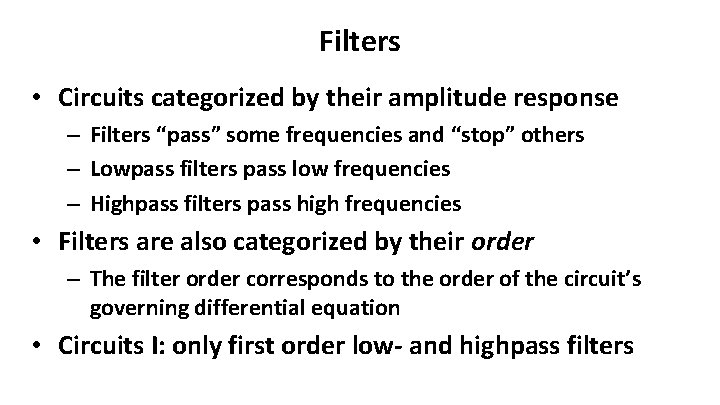
Filters • Circuits categorized by their amplitude response – Filters “pass” some frequencies and “stop” others – Lowpass filters pass low frequencies – Highpass filters pass high frequencies • Filters are also categorized by their order – The filter order corresponds to the order of the circuit’s governing differential equation • Circuits I: only first order low- and highpass filters
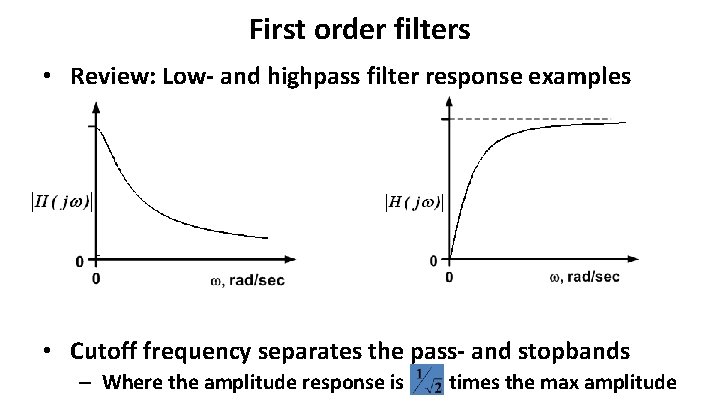
First order filters • Review: Low- and highpass filter response examples • Cutoff frequency separates the pass- and stopbands – Where the amplitude response is times the max amplitude
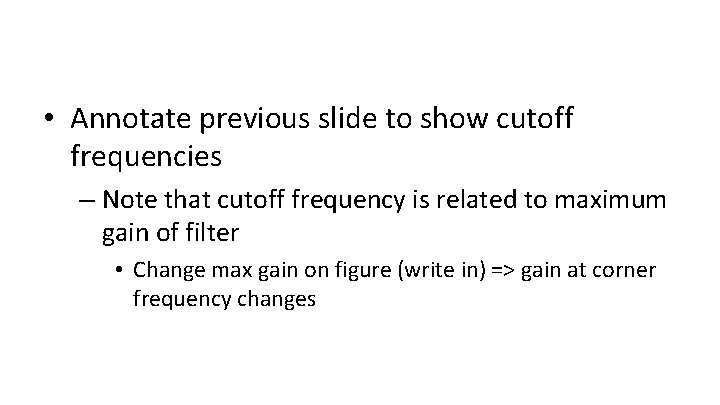
• Annotate previous slide to show cutoff frequencies – Note that cutoff frequency is related to maximum gain of filter • Change max gain on figure (write in) => gain at corner frequency changes
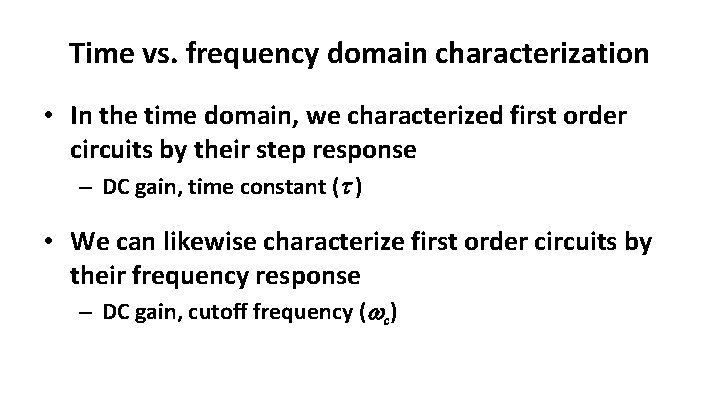
Time vs. frequency domain characterization • In the time domain, we characterized first order circuits by their step response – DC gain, time constant ( ) • We can likewise characterize first order circuits by their frequency response – DC gain, cutoff frequency ( c)
• On previous slide, sketch step response, show DC gain • Then show that cosine input becomes a step input as frequency -> zero
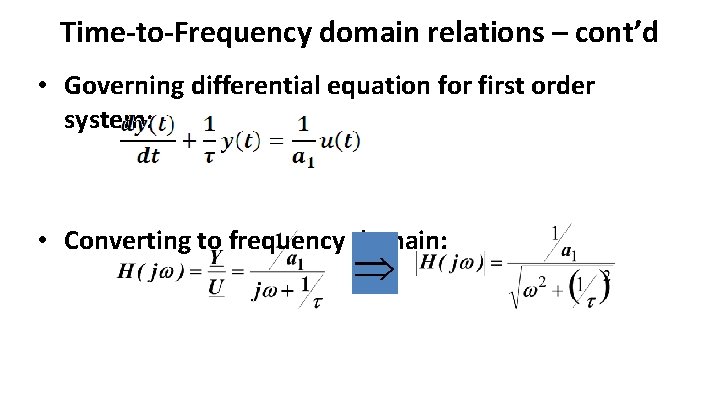
Time-to-Frequency domain relations – cont’d • Governing differential equation for first order system: • Converting to frequency domain:
• On previous slide, show: – (1) time domain DC gain, tau – (2) conversion to frequency response => u(t)=Ue^(jwt), etc. – (3) freqency response -> magnitude response – (4) DC gain and cutoff frequency from mag. Resp.
Checking amplitude responses • We can (fairly) easily check our amplitude responses at very low and very high frequencies • Capacitors, inductors replaced by open, short circuits – Results in purely resistive network – Analyze resistive network, and compare result to amplitude response – Provides “physical insight” into low, high frequency operation
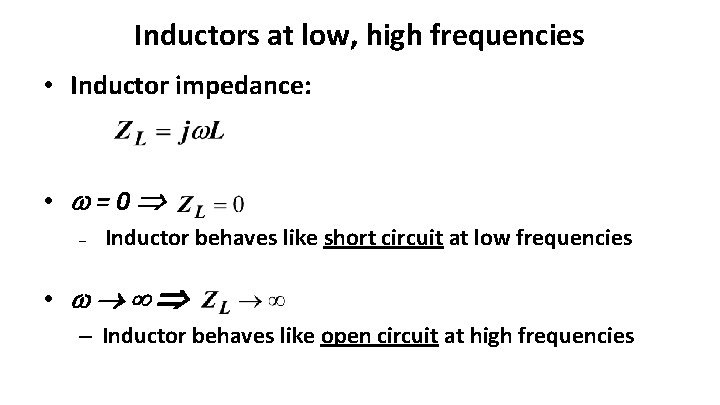
Inductors at low, high frequencies • Inductor impedance: • =0 – Inductor behaves like short circuit at low frequencies • – Inductor behaves like open circuit at high frequencies
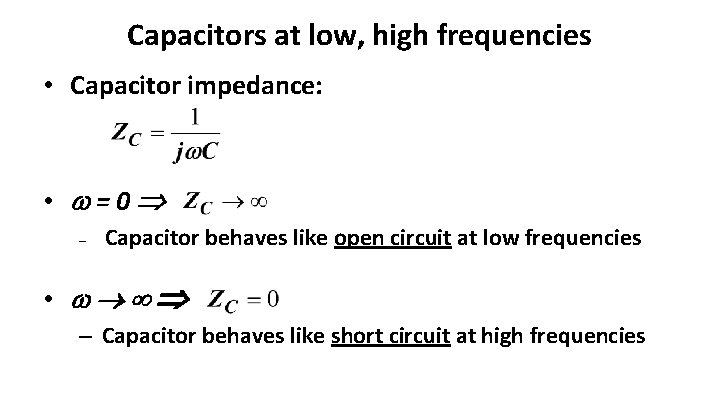
Capacitors at low, high frequencies • Capacitor impedance: • =0 – Capacitor behaves like open circuit at low frequencies • – Capacitor behaves like short circuit at high frequencies
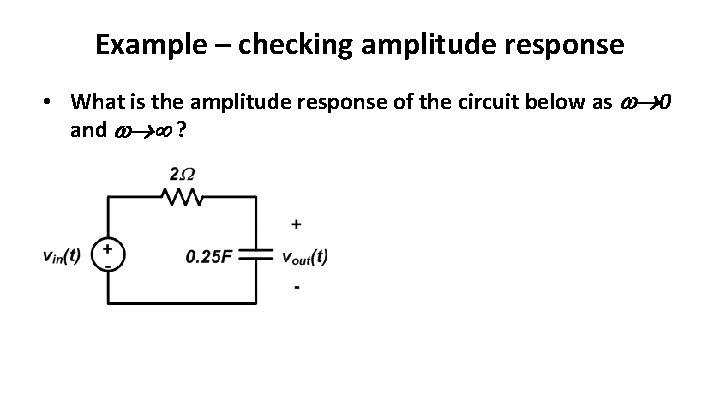
Example – checking amplitude response • What is the amplitude response of the circuit below as 0 and ?
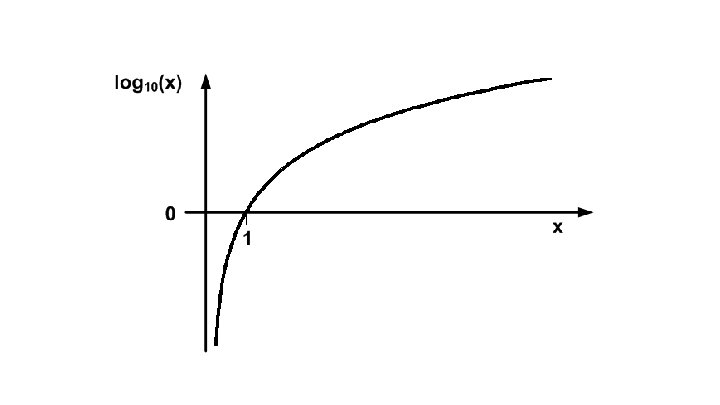
Bode plots – introduction • We have used linear scales to plot frequency responses • Selective use of logarithmic scales has a number of advantages: – Amplitudes and frequencies tend to span large ranges – Logarithms convert multiplication and division to addition and subtraction – Human senses work logarithmically • Bode plots use logarithmic scales to simplify plotting of frequency responses and interpretation of plots
• Do demos on previous slide – Note large ranges of frequencies; sensitivity to frequency ranges – Note human senses work logarithmically
Nomenclature relative to log scales • Logarithmic scales convert multiplicative factors to linear differences • Some of these multiplicative factors have special names – A factor of 10 change in frequency is a decade difference on a log scale – A factor of 2 change in frequency is an octave difference on a log scale
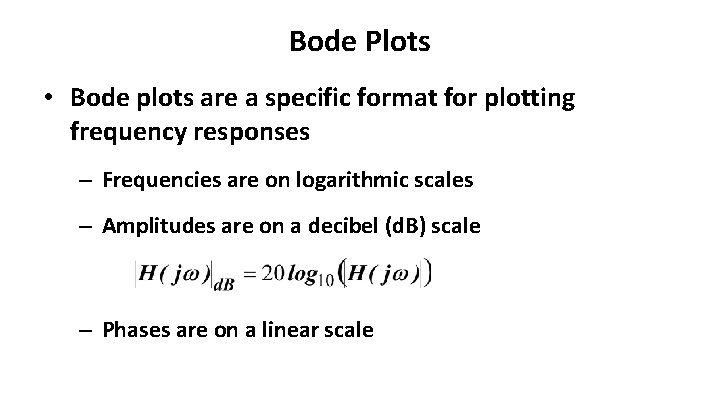
Bode Plots • Bode plots are a specific format for plotting frequency responses – Frequencies are on logarithmic scales – Amplitudes are on a decibel (d. B) scale – Phases are on a linear scale
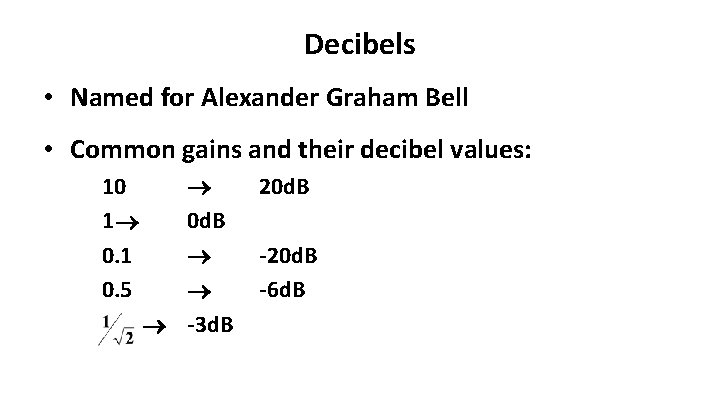
Decibels • Named for Alexander Graham Bell • Common gains and their decibel values: 10 1 0. 5 0 d. B -3 d. B 20 d. B -6 d. B
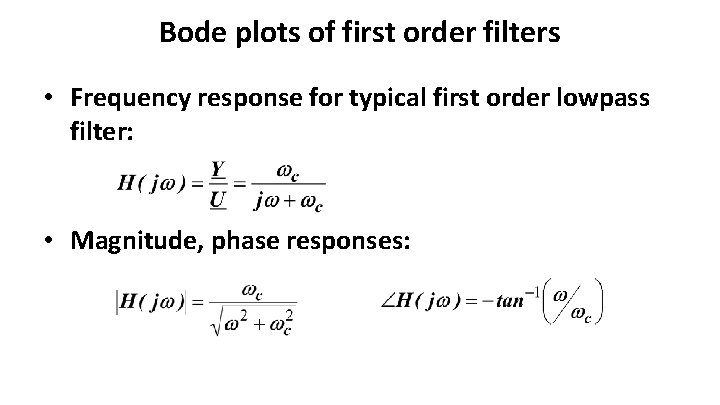
Bode plots of first order filters • Frequency response for typical first order lowpass filter: • Magnitude, phase responses:
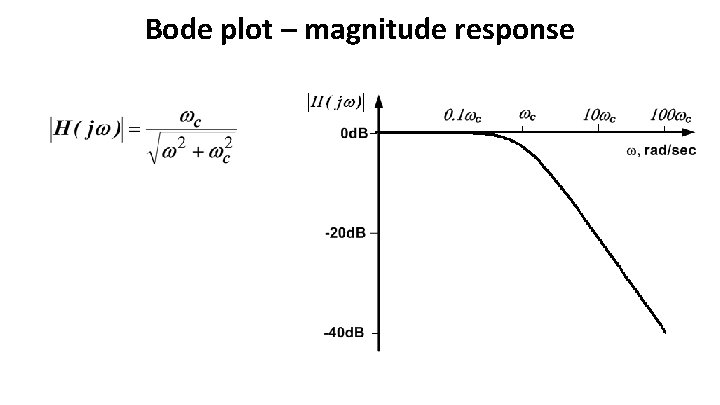
Bode plot – magnitude response
• Annotate previous slide to show asymptotic behavior, -3 d. B point at wc, intersection of asymptotes is at wc • Note that I can muliply this by a gain, without affecting the shape of the curve – it simply moves up and down
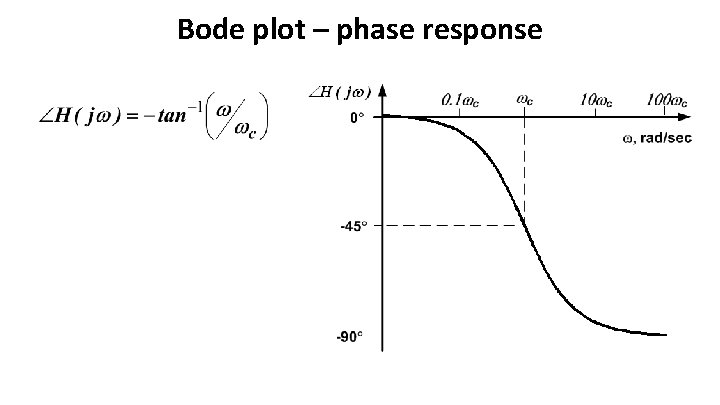
Bode plot – phase response
• Annotate previous slide to show asymptotic behavior, -45 degrees at wc
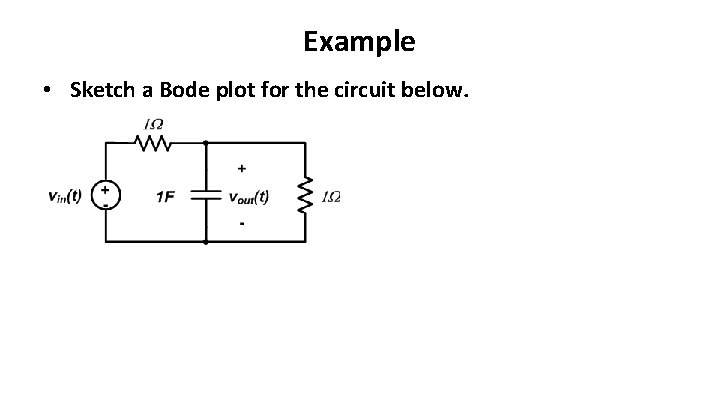
Example • Sketch a Bode plot for the circuit below.