
Lecture 30 Finite State Machines Last lecture CMOS

- Slides: 27
Lecture #30 Finite State Machines • Last lecture: – CMOS fabrication – Clocked and latched circuits • This lecture: – Finite State Machines 11/10/2004 EE 42 fall 2004 lecture 30 1
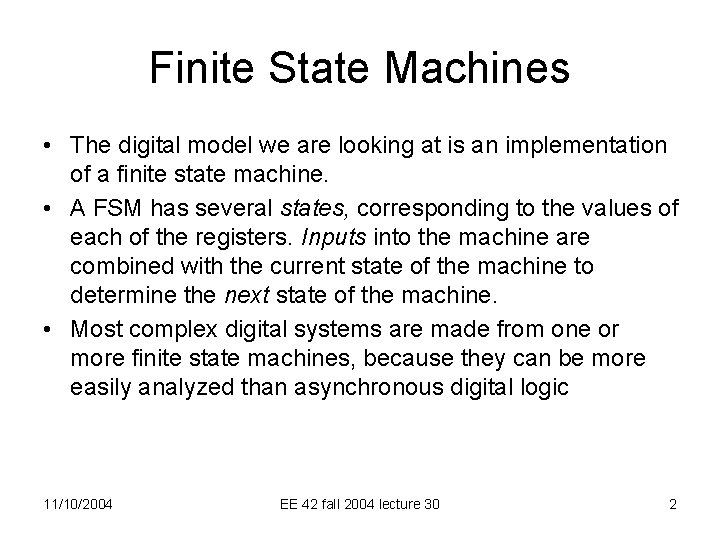
Finite State Machines • The digital model we are looking at is an implementation of a finite state machine. • A FSM has several states, corresponding to the values of each of the registers. Inputs into the machine are combined with the current state of the machine to determine the next state of the machine. • Most complex digital systems are made from one or more finite state machines, because they can be more easily analyzed than asynchronous digital logic 11/10/2004 EE 42 fall 2004 lecture 30 2
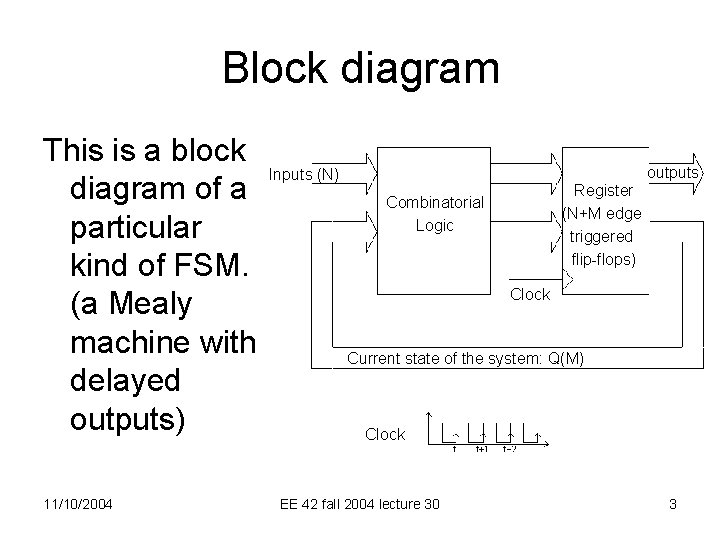
Block diagram This is a block diagram of a particular kind of FSM. (a Mealy machine with delayed outputs) 11/10/2004 outputs Inputs (N) Register (N+M edge triggered flip-flops) Combinatorial Logic Clock Current state of the system: Q(M) Clock EE 42 fall 2004 lecture 30 3
Timing diagram for synchronous FSM Clock Inputs Logic State Output 11/10/2004 EE 42 fall 2004 lecture 30 4
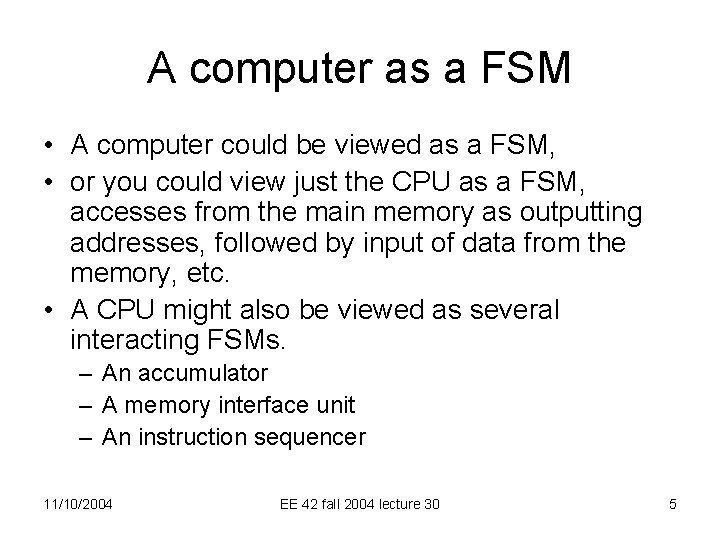
A computer as a FSM • A computer could be viewed as a FSM, • or you could view just the CPU as a FSM, accesses from the main memory as outputting addresses, followed by input of data from the memory, etc. • A CPU might also be viewed as several interacting FSMs. – An accumulator – A memory interface unit – An instruction sequencer 11/10/2004 EE 42 fall 2004 lecture 30 5
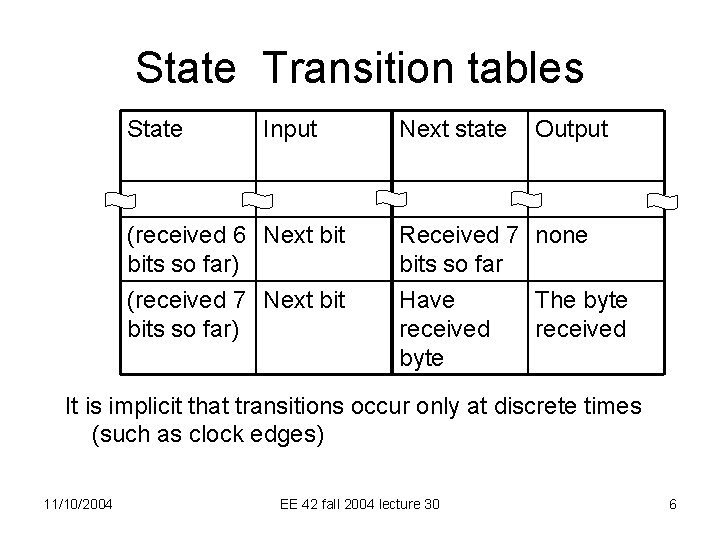
State Transition tables State Input Next state Output (received 6 Next bits so far) Received 7 none bits so far (received 7 Next bits so far) Have received byte The byte received It is implicit that transitions occur only at discrete times (such as clock edges) 11/10/2004 EE 42 fall 2004 lecture 30 6
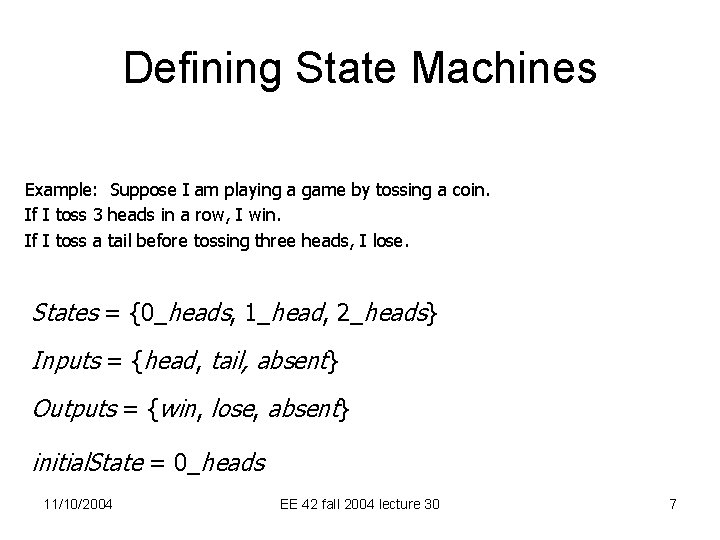
Defining State Machines Example: Suppose I am playing a game by tossing a coin. If I toss 3 heads in a row, I win. If I toss a tail before tossing three heads, I lose. States = {0_heads, 1_head, 2_heads} Inputs = {head, tail, absent} Outputs = {win, lose, absent} initial. State = 0_heads 11/10/2004 EE 42 fall 2004 lecture 30 7
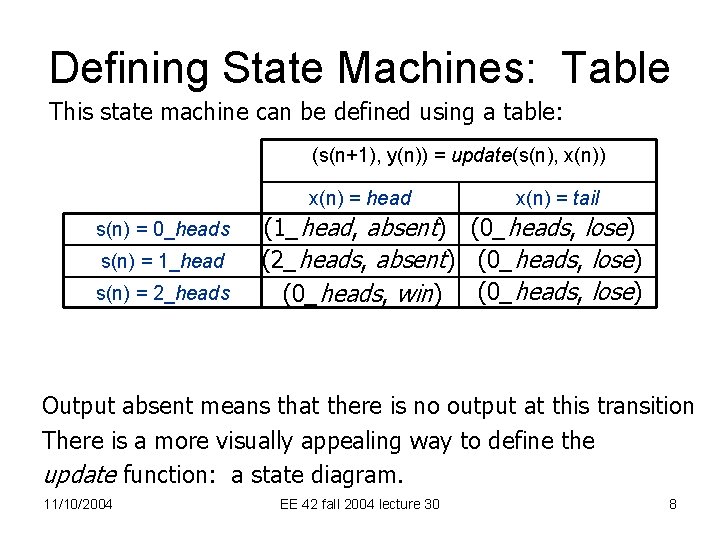
Defining State Machines: Table This state machine can be defined using a table: (s(n+1), y(n)) = update(s(n), x(n)) x(n) = head s(n) = 0_heads s(n) = 1_head s(n) = 2_heads x(n) = tail (1_head, absent) (0_heads, lose) (2_heads, absent) (0_heads, lose) (0_heads, win) Output absent means that there is no output at this transition There is a more visually appealing way to define the update function: a state diagram. 11/10/2004 EE 42 fall 2004 lecture 30 8
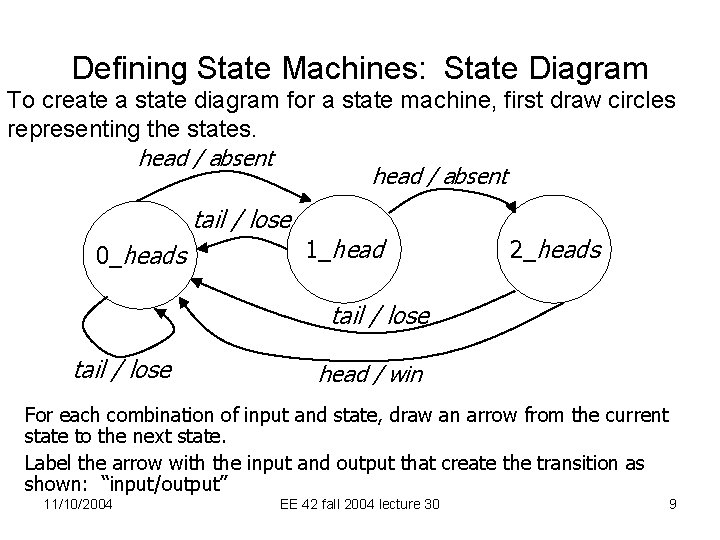
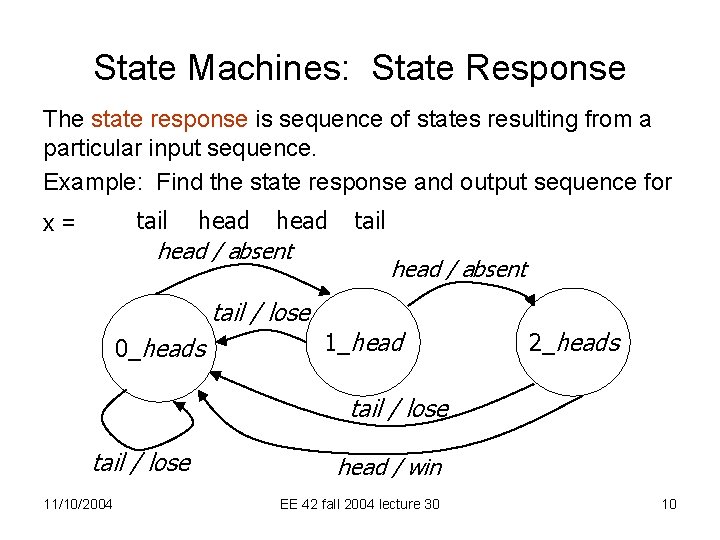
Defining State Machines: State Diagram To create a state diagram for a state machine, first draw circles representing the states. head / absent tail / lose 0_heads 1_head 2_heads tail / lose head / win For each combination of input and state, draw an arrow from the current state to the next state. Label the arrow with the input and output that create the transition as shown: “input/output” 11/10/2004 EE 42 fall 2004 lecture 30 9
State Machines: State Response The state response is sequence of states resulting from a particular input sequence. Example: Find the state response and output sequence for tail head / absent x= tail / lose 0_heads tail head / absent 1_head 2_heads tail / lose 11/10/2004 head / win EE 42 fall 2004 lecture 30 10
Facts About State Machines • The state machines addressed here are called Mealy machines generate outputs during state transitions. • Moore machines generate output while the system is in a particular state (output depends on state only). • Each transition and output depends only on the current state and current input. • Previous input elements only affect the transitions and output insofar as they determine the current state. • A transition will be defined for every possible combination of input and current state. 11/10/2004 EE 42 fall 2004 lecture 30 11
Deterministic vs Nondeterministic • For the state machines studied in this lecture, there is exactly one possible transition for each combination of current state and input. These state machines are called deterministic. • Sometimes it is useful to model a system using a state machine that has more than one possible transition for each combination of current state and input. These state machines are called nondeterministic. 11/10/2004 EE 42 fall 2004 lecture 30 12
FSMs in programs • The finite state machine model can be useful in the design of software as well as the design of hardware. • If a program is responding to external events, which are not happening in a controlled order, a FSM description of the program can describe its high level operation better than sequential descriptions. 11/10/2004 EE 42 fall 2004 lecture 30 13
Implementing Sequential Logic • Sequential Circuits – Simple circuits with feedback – Latches – Edge-triggered flip-flops • Timing Methodologies – Cascading flip-flops for properation – Clock skew • Asynchronous Inputs – Metastability and synchronization • Basic Registers – Shift registers 11/10/2004 EE 42 fall 2004 lecture 30 14
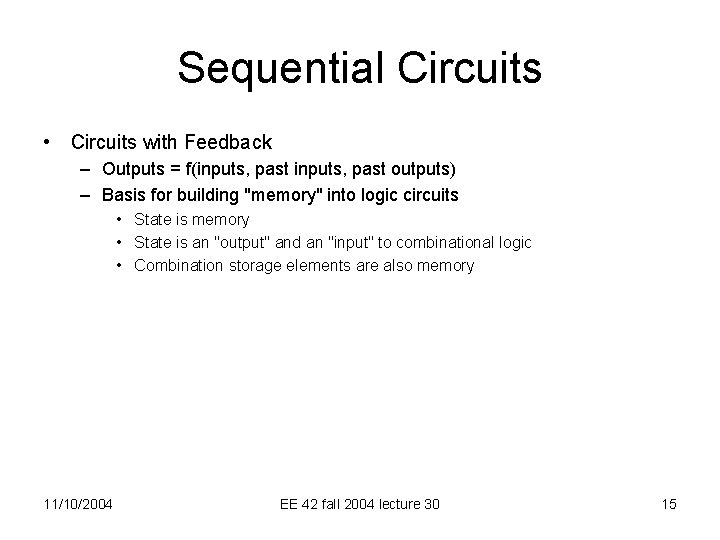
Sequential Circuits • Circuits with Feedback – Outputs = f(inputs, past outputs) – Basis for building "memory" into logic circuits • State is memory • State is an "output" and an "input" to combinational logic • Combination storage elements are also memory 11/10/2004 EE 42 fall 2004 lecture 30 15
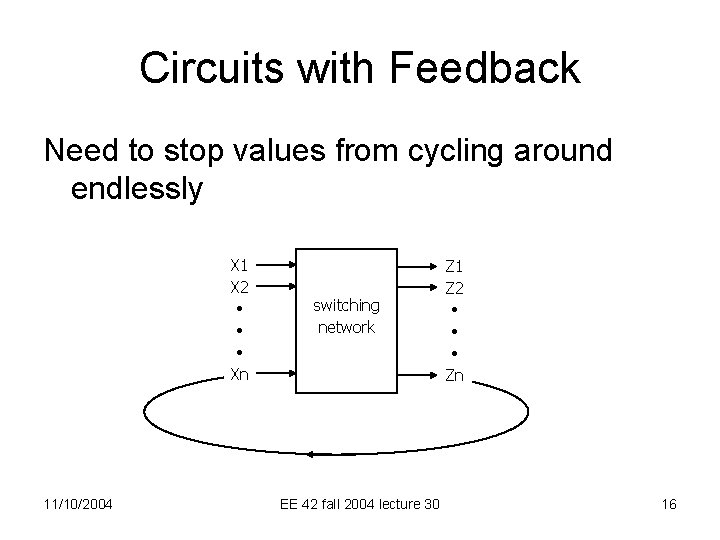
Circuits with Feedback Need to stop values from cycling around endlessly X 1 X 2 • • • Xn 11/10/2004 switching network EE 42 fall 2004 lecture 30 Z 1 Z 2 • • • Zn 16
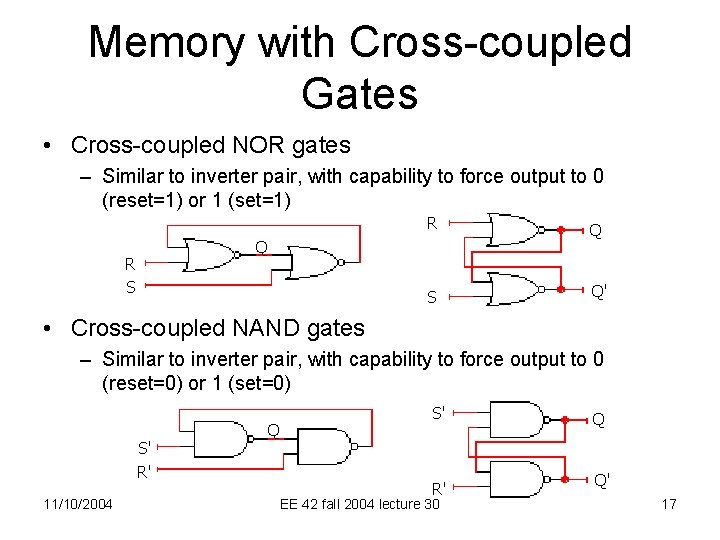
Memory with Cross-coupled Gates • Cross-coupled NOR gates – Similar to inverter pair, with capability to force output to 0 (reset=1) or 1 (set=1) R Q S Q' Q R S • Cross-coupled NAND gates – Similar to inverter pair, with capability to force output to 0 (reset=0) or 1 (set=0) S' R' 11/10/2004 Q S' R' EE 42 fall 2004 lecture 30 Q Q' 17
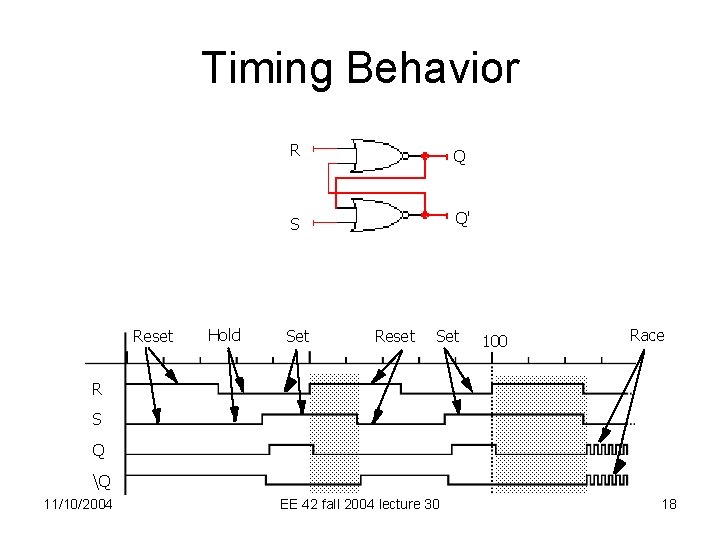
Timing Behavior Reset Hold R Q S Q' Set Reset Set 100 Race R S Q Q 11/10/2004 EE 42 fall 2004 lecture 30 18
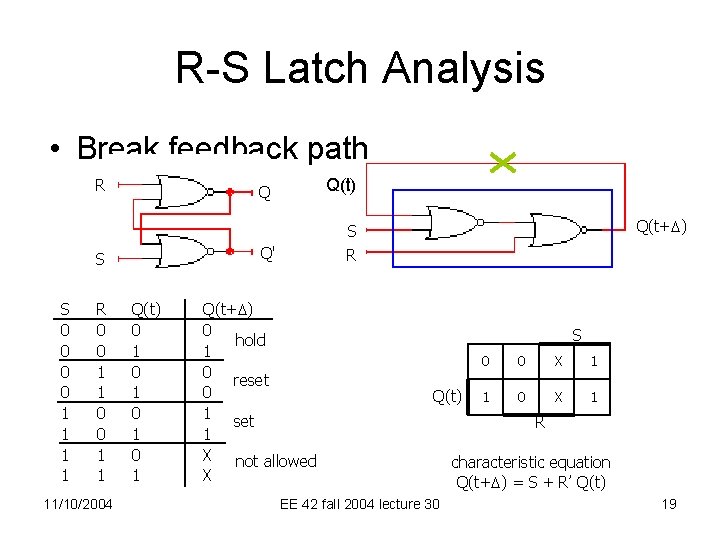
R-S Latch Analysis • Break feedback path R R 0 0 1 1 11/10/2004 Q(t) 0 1 0 1 Q(t+ ) S R Q' S S 0 0 1 1 Q(t) Q Q(t+ ) 0 hold 1 0 reset 0 1 set 1 X not allowed X S Q(t) EE 42 fall 2004 lecture 30 0 0 X 1 1 0 X 1 R characteristic equation Q(t+ ) = S + R’ Q(t) 19
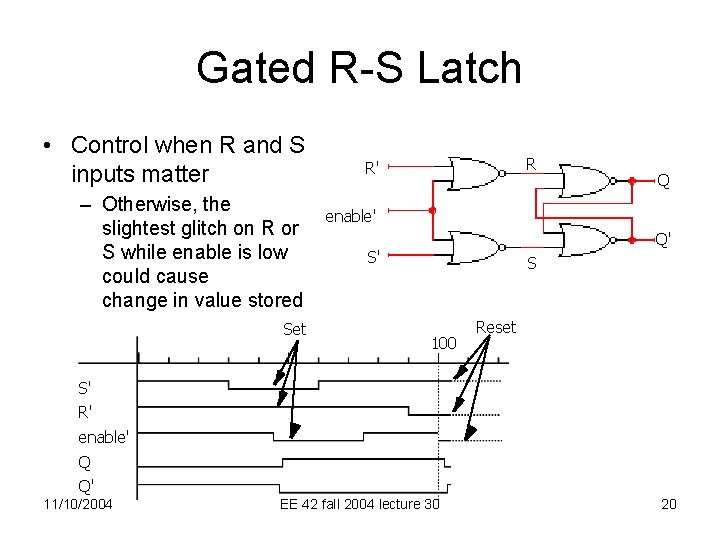
Gated R-S Latch • Control when R and S inputs matter – Otherwise, the slightest glitch on R or S while enable is low could cause change in value stored Set R R' Q enable' Q' S' S 100 Reset S' R' enable' Q Q' 11/10/2004 EE 42 fall 2004 lecture 30 20
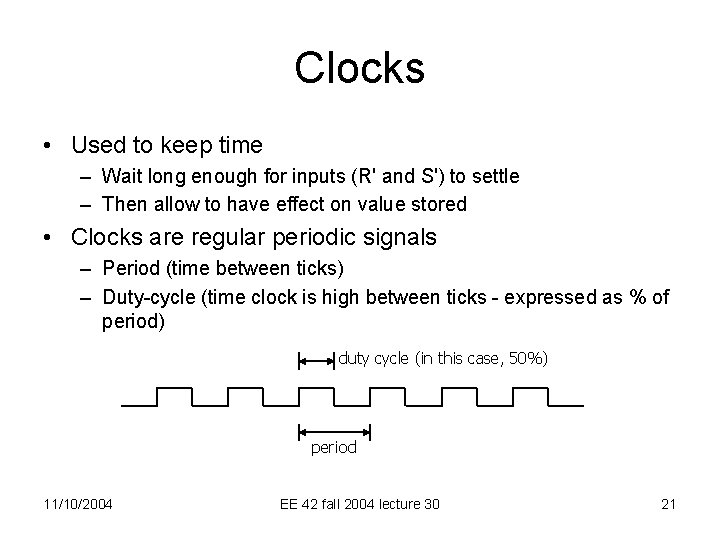
Clocks • Used to keep time – Wait long enough for inputs (R' and S') to settle – Then allow to have effect on value stored • Clocks are regular periodic signals – Period (time between ticks) – Duty-cycle (time clock is high between ticks - expressed as % of period) duty cycle (in this case, 50%) period 11/10/2004 EE 42 fall 2004 lecture 30 21
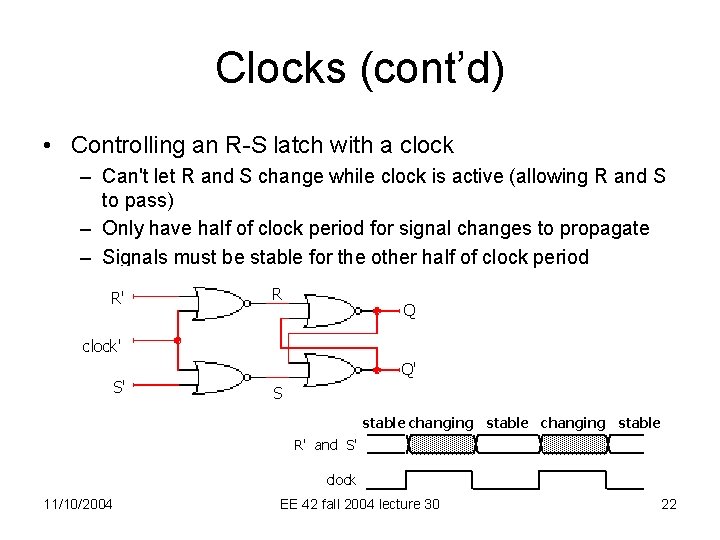
Clocks (cont’d) • Controlling an R-S latch with a clock – Can't let R and S change while clock is active (allowing R and S to pass) – Only have half of clock period for signal changes to propagate – Signals must be stable for the other half of clock period R' R Q clock' S' Q' S stable changing stable R' and S' clock 11/10/2004 EE 42 fall 2004 lecture 30 22
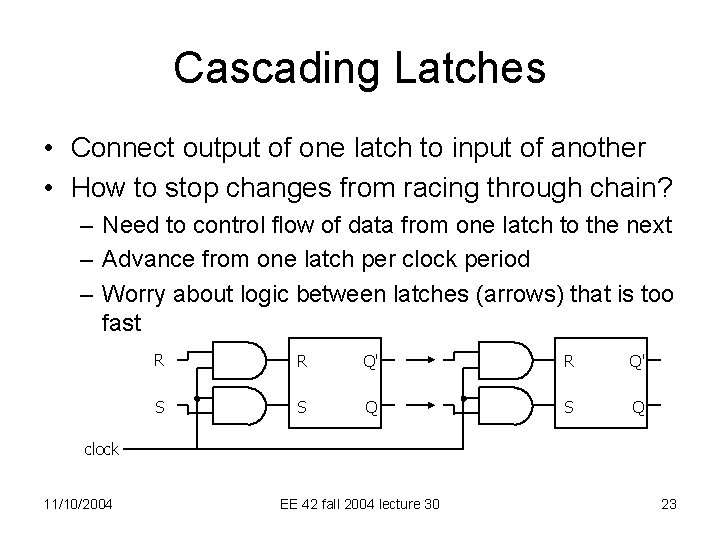
Cascading Latches • Connect output of one latch to input of another • How to stop changes from racing through chain? – Need to control flow of data from one latch to the next – Advance from one latch per clock period – Worry about logic between latches (arrows) that is too fast R R Q' S S Q clock 11/10/2004 EE 42 fall 2004 lecture 30 23
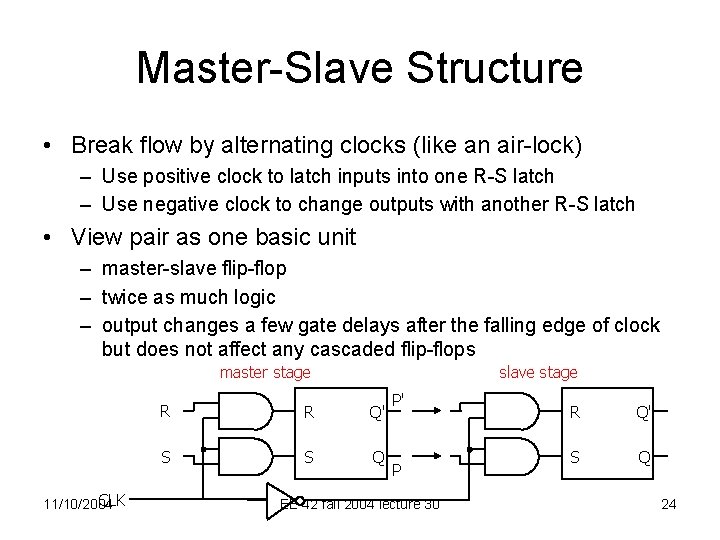
Master-Slave Structure • Break flow by alternating clocks (like an air-lock) – Use positive clock to latch inputs into one R-S latch – Use negative clock to change outputs with another R-S latch • View pair as one basic unit – master-slave flip-flop – twice as much logic – output changes a few gate delays after the falling edge of clock but does not affect any cascaded flip-flops slave stage master stage CLK 11/10/2004 R R Q' S S Q P' P EE 42 fall 2004 lecture 30 R Q' S Q 24
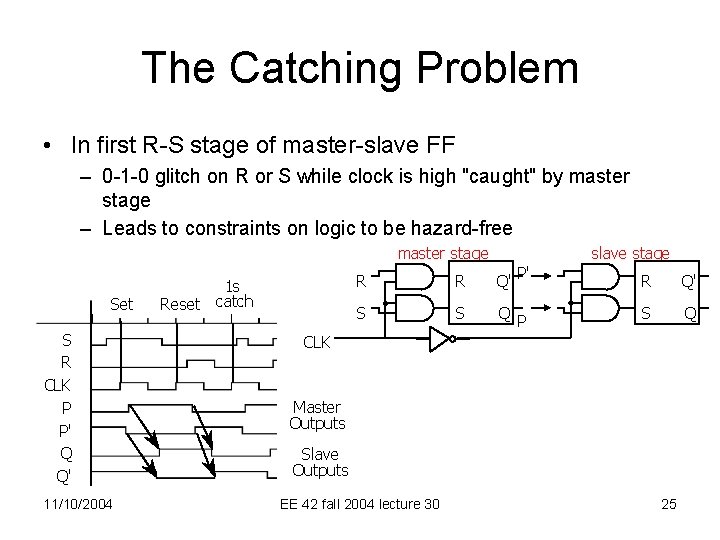
The Catching Problem • In first R-S stage of master-slave FF – 0 -1 -0 glitch on R or S while clock is high "caught" by master stage – Leads to constraints on logic to be hazard-free slave stage master stage Set S R CLK P P' Q Q' 11/10/2004 1 s Reset catch R R Q' S S Q P' P R Q' S Q CLK Master Outputs Slave Outputs EE 42 fall 2004 lecture 30 25
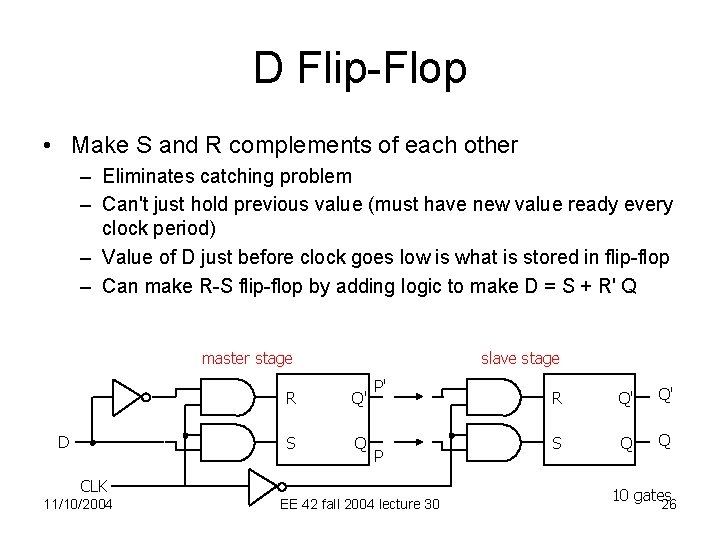
D Flip-Flop • Make S and R complements of each other – Eliminates catching problem – Can't just hold previous value (must have new value ready every clock period) – Value of D just before clock goes low is what is stored in flip-flop – Can make R-S flip-flop by adding logic to make D = S + R' Q slave stage master stage D R Q' S Q P' P CLK 11/10/2004 EE 42 fall 2004 lecture 30 R Q' Q' S Q Q 10 gates 26
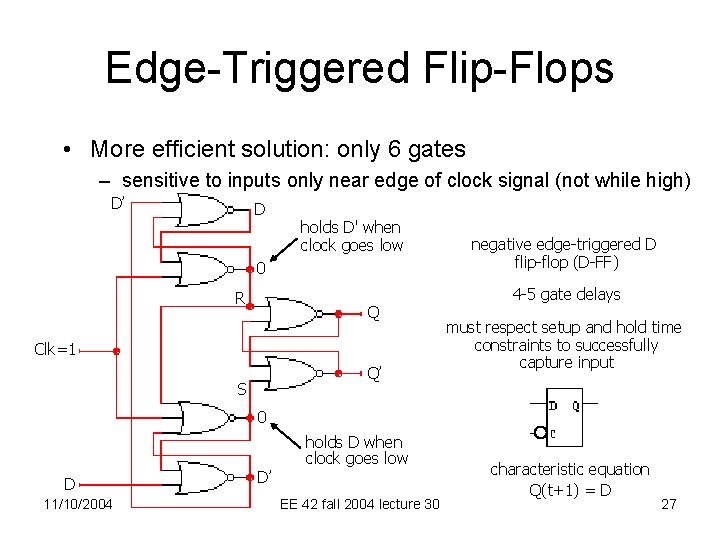
Edge-Triggered Flip-Flops • More efficient solution: only 6 gates – sensitive to inputs only near edge of clock signal (not while high) D’ D holds D' when clock goes low 0 R Q Clk=1 Q’ S negative edge-triggered D flip-flop (D-FF) 4 -5 gate delays must respect setup and hold time constraints to successfully capture input 0 D 11/10/2004 D’ holds D when clock goes low EE 42 fall 2004 lecture 30 characteristic equation Q(t+1) = D 27