
Lecture 3 WAN Data Communication Network L Rania
- Slides: 39
Lecture # 3: WAN Data Communication Network L. Rania Ahmed Tabeidi
Outline O Data Communication Network Taxonomy O Broadcast vs. Switched Networks O Circuit Switched vs. packet switched O Switched Network Performance O Delay, Lose, Throughtput L. Rania Ahmed Tabeidi 1 -2
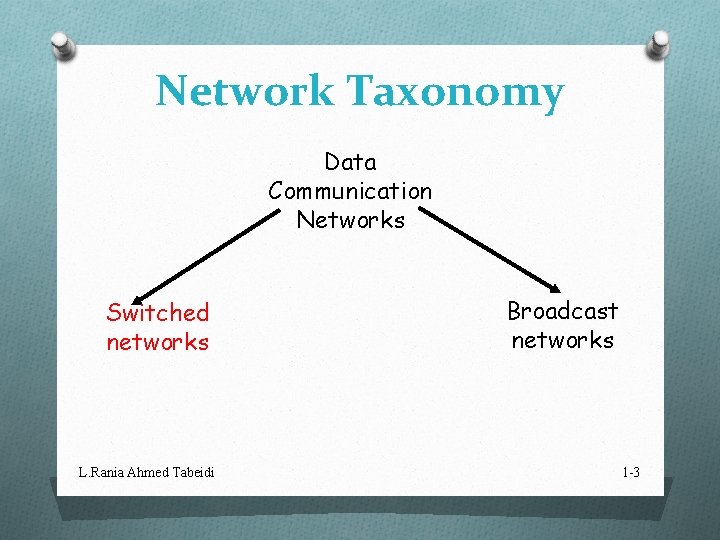
Network Taxonomy Data Communication Networks Switched networks L. Rania Ahmed Tabeidi Broadcast networks 1 -3
1. Broadcast networks O Nodes share a common channel; information transmitted by a node is received by all other nodes in the network. O Broadcast Network (used in LAN) O Examples: TV, radio L. Rania Ahmed Tabeidi 4
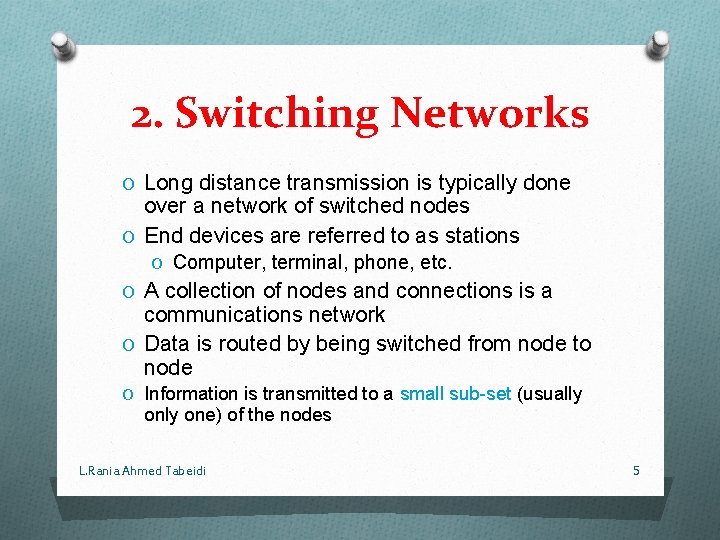
2. Switching Networks O Long distance transmission is typically done over a network of switched nodes O End devices are referred to as stations O Computer, terminal, phone, etc. O A collection of nodes and connections is a communications network O Data is routed by being switched from node to node O Information is transmitted to a small sub-set (usually one) of the nodes L. Rania Ahmed Tabeidi 5
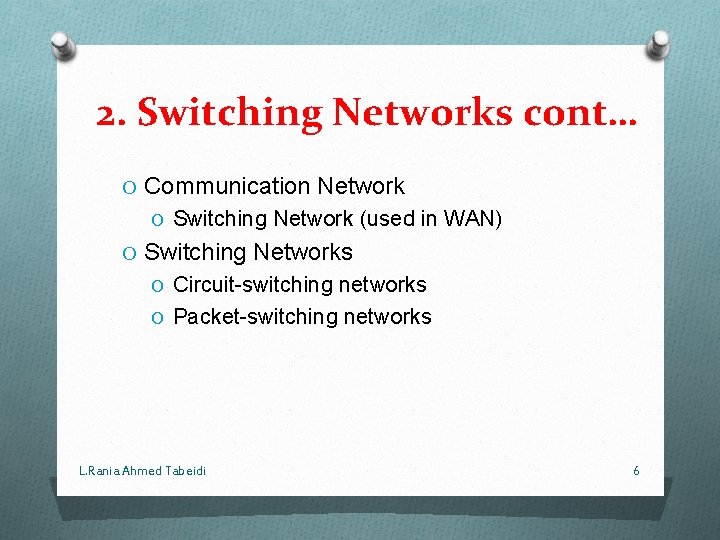
2. Switching Networks cont… O Communication Network O Switching Network (used in WAN) O Switching Networks O Circuit-switching networks O Packet-switching networks L. Rania Ahmed Tabeidi 6
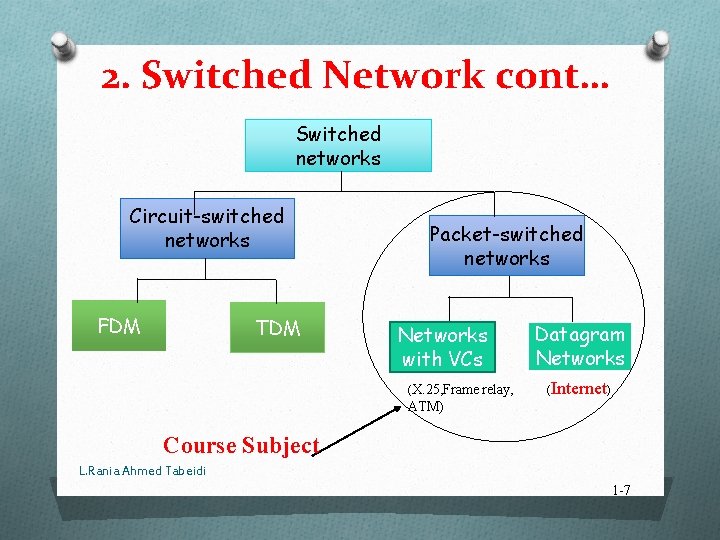
2. Switched Network cont… Switched networks Circuit-switched networks FDM TDM Packet-switched networks Networks with VCs (X. 25, Frame relay, Datagram Networks (Internet) ATM) Course Subject L. Rania Ahmed Tabeidi 1 -7
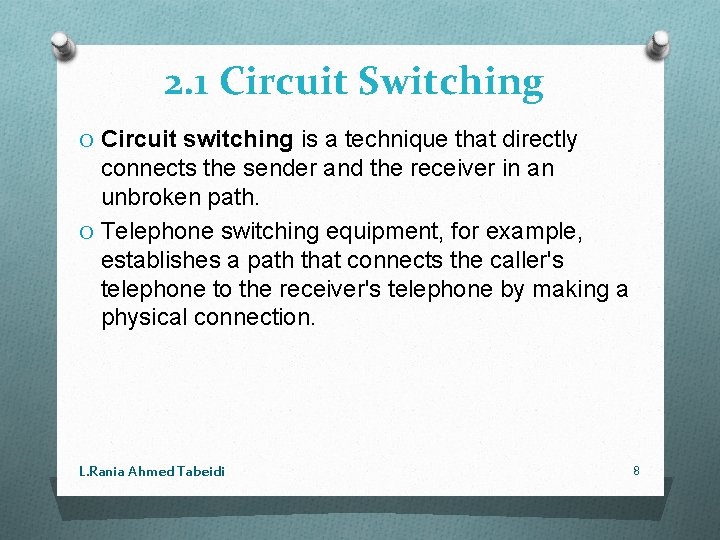
2. 1 Circuit Switching O Circuit switching is a technique that directly connects the sender and the receiver in an unbroken path. O Telephone switching equipment, for example, establishes a path that connects the caller's telephone to the receiver's telephone by making a physical connection. L. Rania Ahmed Tabeidi 8
2. 1 Circuit Switching cont… O With this type of switching technique, once a connection is established, a dedicated path exists between both ends until the connection is terminated. O Routing decisions must be made when the circuit is first established, but there are no decisions made after that time. L. Rania Ahmed Tabeidi 9
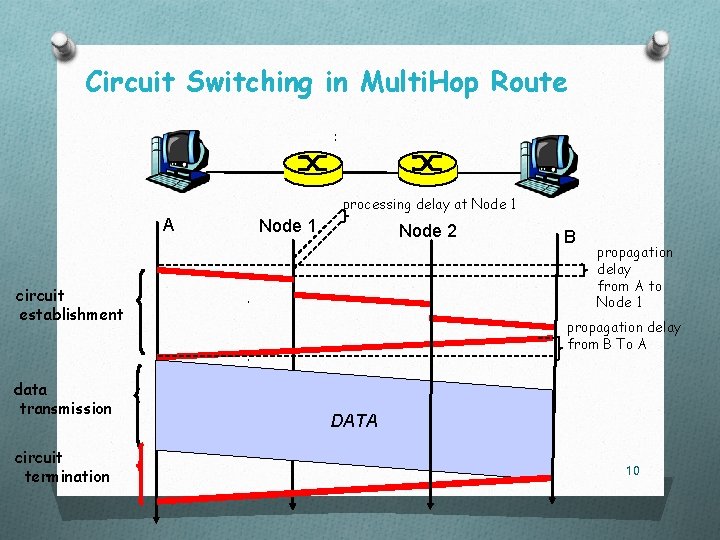
Circuit Switching in Multi. Hop Route processing delay at Node 1 A Node 1 Node 2 circuit establishment data transmission circuit termination B propagation delay from A to Node 1 propagation delay from B To A DATA 10
2. 1 Circuit switching cont… Advantages: • The communication channel (once established) is dedicated. Disadvantages: • Possible long wait to establish a connection, (10 seconds, more on long- distance or international calls. ) during which no data can be transmitted. • More expensive than any other switching techniques, because a dedicated path is required for each connection. • Inefficient use of the communication channel, because the channel is not used when the connected systems are not using it. L. Rania Ahmed Tabeidi 11
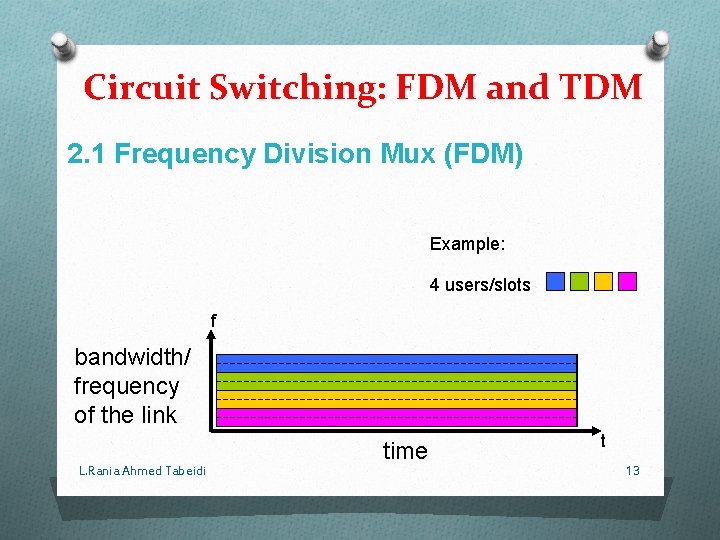
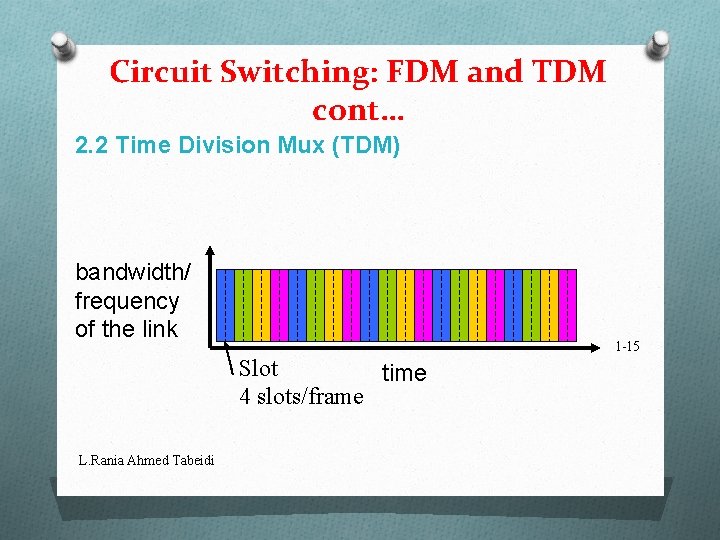
2. 1 Circuit Switching cont… q Dividing link bandwidth into “pieces”: 2. 1. 1 Frequency Division Multiplexing (FDM) 2. 1. 2 Time Division Multiplexing (TDM) L. Rania Ahmed Tabeidi 1 -12
Circuit Switching: FDM and TDM 2. 1 Frequency Division Mux (FDM) Example: 4 users/slots f bandwidth/ frequency of the link time L. Rania Ahmed Tabeidi t 13
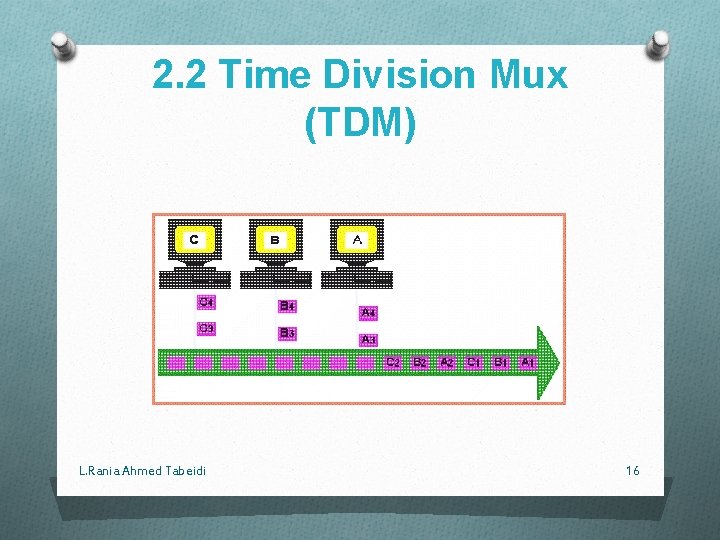
Time Division Multiplexing (TDM) O Two or more “channels” of information are transmitted over the same link by allocating a different time interval for the transmission of each channel, i. e. the channels take turns to use the link. O TDM becomes inefficient when traffic is intermittent because the time slot is still allocated even when the channel has no data to transmit
Circuit Switching: FDM and TDM cont… 2. 2 Time Division Mux (TDM) bandwidth/ frequency of the link 1 -15 Slot time 4 slots/frame L. Rania Ahmed Tabeidi
2. 2 Time Division Mux (TDM) L. Rania Ahmed Tabeidi 16
Packet Switching • packet switching methods, is broken into small parts, called packets. • With current technology, packets are generally accepted onto the network on a first-come, first-served basis. If the network becomes overloaded, packets are delayed or discarded (``dropped'').
2. 2 Packet-switched Networks: Features: • Data separated into packets Switching decision (output port) for each individual packet • Statistical multiplexing: Sum of peak rates may exceed. • L. Rania Ahmed Tabeidi 18
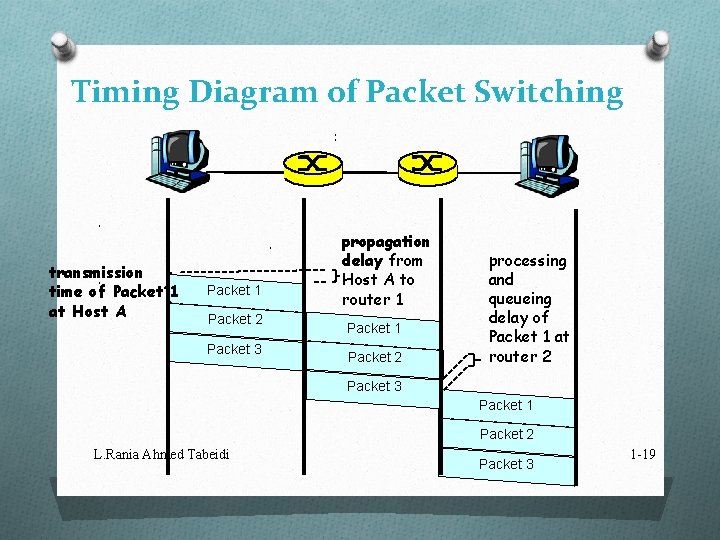
Timing Diagram of Packet Switching transmission time of Packet 1 at Host A Packet 1 Packet 2 Packet 3 propagation delay from Host A to router 1 Packet 2 processing and queueing delay of Packet 1 at router 2 Packet 3 Packet 1 Packet 2 L. Rania Ahmed Tabeidi Packet 3 1 -19
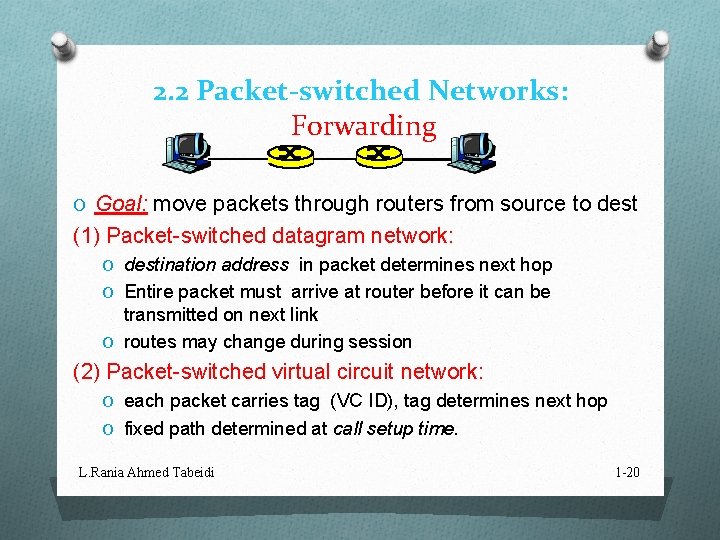
2. 2 Packet-switched Networks: Forwarding O Goal: move packets through routers from source to dest (1) Packet-switched datagram network: O destination address in packet determines next hop O Entire packet must arrive at router before it can be transmitted on next link O routes may change during session (2) Packet-switched virtual circuit network: O each packet carries tag (VC ID), tag determines next hop O fixed path determined at call setup time. L. Rania Ahmed Tabeidi 1 -20
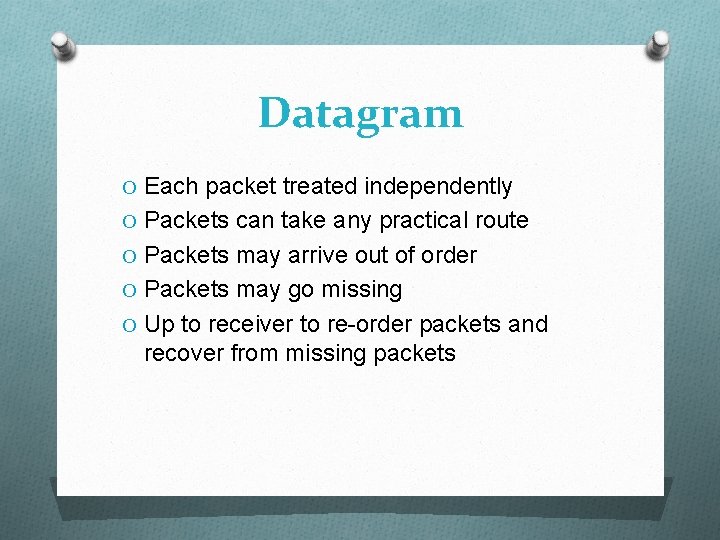
Datagram O Each packet treated independently O Packets can take any practical route O Packets may arrive out of order O Packets may go missing O Up to receiver to re-order packets and recover from missing packets
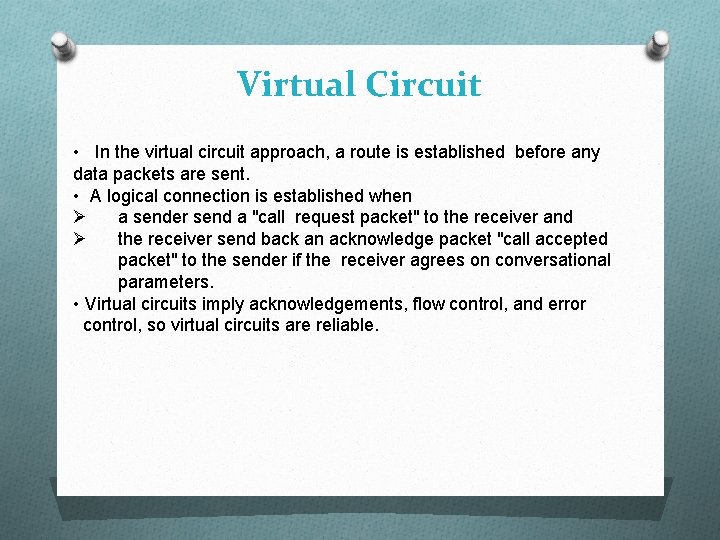
Virtual Circuit • In the virtual circuit approach, a route is established before any data packets are sent. • A logical connection is established when Ø a sender send a "call request packet" to the receiver and Ø the receiver send back an acknowledge packet "call accepted packet" to the sender if the receiver agrees on conversational parameters. • Virtual circuits imply acknowledgements, flow control, and error control, so virtual circuits are reliable.
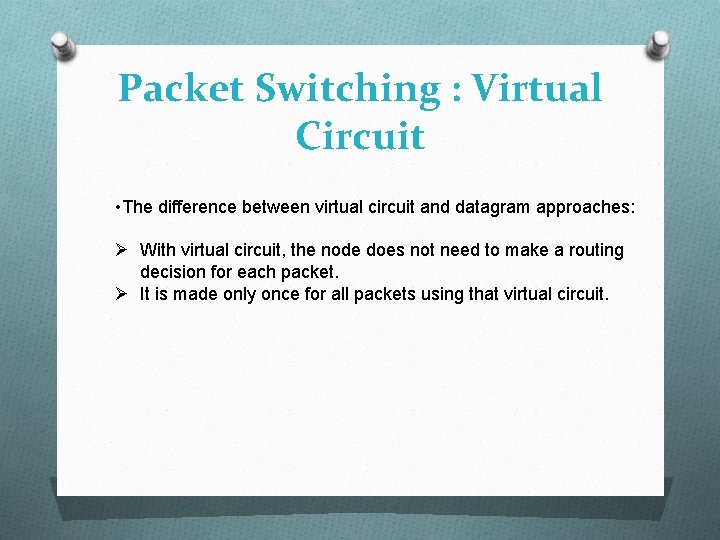
Packet Switching : Virtual Circuit • The difference between virtual circuit and datagram approaches: Ø With virtual circuit, the node does not need to make a routing decision for each packet. Ø It is made only once for all packets using that virtual circuit.
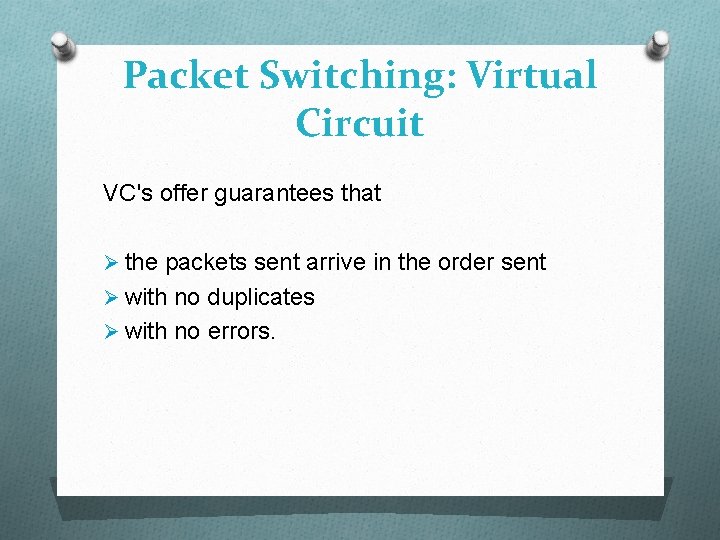
Packet Switching: Virtual Circuit VC's offer guarantees that Ø the packets sent arrive in the order sent Ø with no duplicates Ø with no errors.
Packet Switching vs Circuit Switching Is packet switching a “slam dunk winner? ” O Great for burst data O resource sharing O simpler, no call setup O Q: How to provide circuit-like behavior? O bandwidth guarantees needed for audio/video apps O still an unsolved problem L. Rania Ahmed Tabeidi 1 -25
Switching technology l Circuit switching n n l need a connection established between end nodes connection is maintained until one of end nodes terminates Connection is dedicated to the communication between two nodes Example : Public Switch Telephone Network (PSTN) Packet switching n n data are transmitted in short messages called packets a connection between the two end-nodes is not maintained a node-to-node link can be dynamically shared by many packets Example : Public Data Network (PDN) like X. 25, Frame Relay 26
Disadvantages of packet switching Disadvantages: • Protocols for packet switching are typically more complex. • It can add some initial costs in implementation. • If packet is lost, sender needs to retransmit the data. • Another disadvantage is that packet-switched systems still can’t deliver the same quality as dedicated circuits in applications requiring very little delay - like voice conversations or moving images.
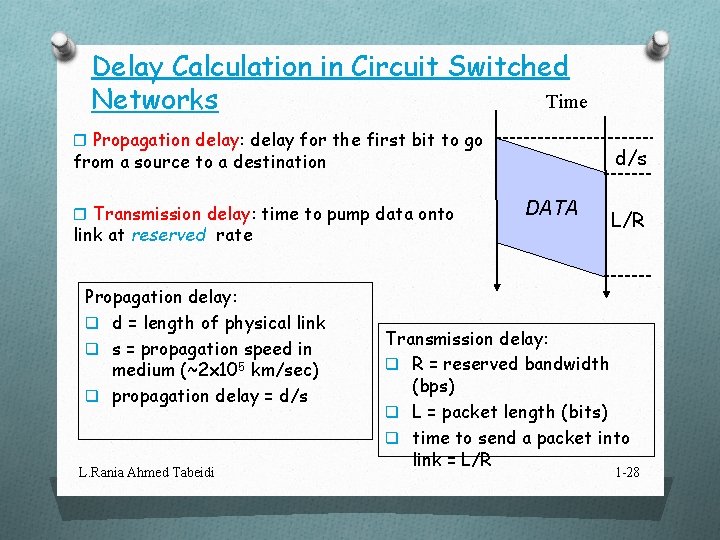
Delay Calculation in Circuit Switched Time Networks r Propagation delay: delay for the first bit to go d/s from a source to a destination r Transmission delay: time to pump data onto link at reserved rate Propagation delay: q d = length of physical link q s = propagation speed in medium (~2 x 10⁵ km/sec) q propagation delay = d/s L. Rania Ahmed Tabeidi DATA L/R Transmission delay: q R = reserved bandwidth (bps) q L = packet length (bits) q time to send a packet into link = L/R 1 -28
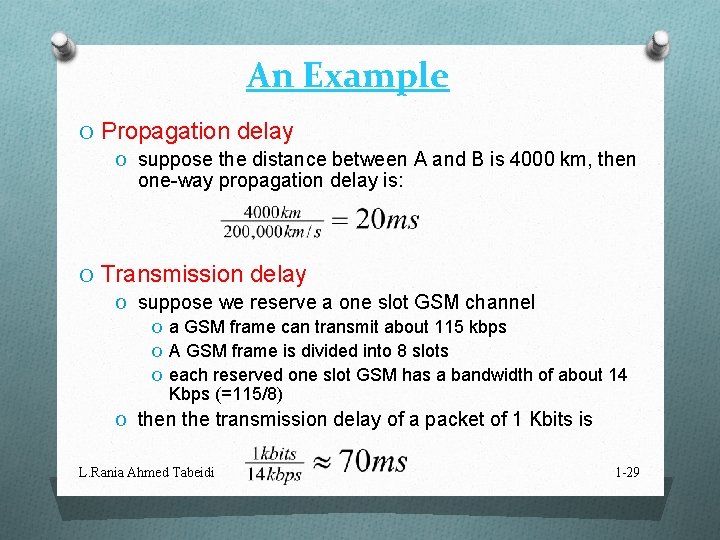
An Example O Propagation delay O suppose the distance between A and B is 4000 km, then one-way propagation delay is: O Transmission delay O suppose we reserve a one slot GSM channel O a GSM frame can transmit about 115 kbps O A GSM frame is divided into 8 slots O each reserved one slot GSM has a bandwidth of about 14 Kbps (=115/8) O then the transmission delay of a packet of 1 Kbits is L. Rania Ahmed Tabeidi 1 -29
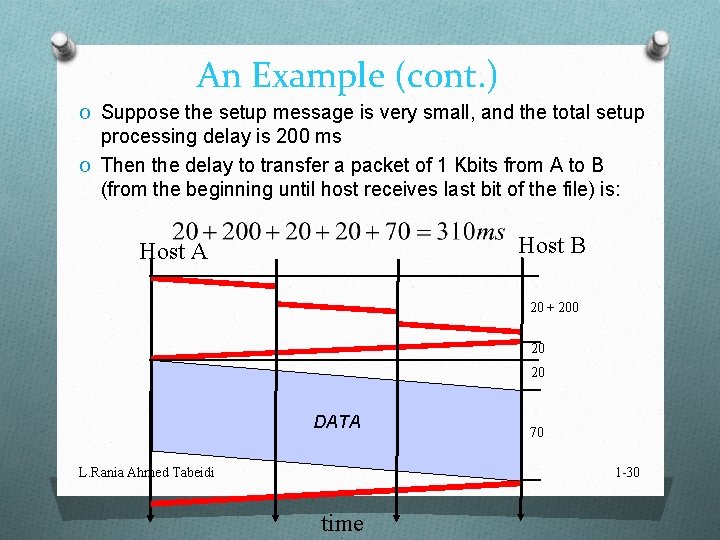
An Example (cont. ) O Suppose the setup message is very small, and the total setup processing delay is 200 ms O Then the delay to transfer a packet of 1 Kbits from A to B (from the beginning until host receives last bit of the file) is: Host B Host A 20 + 200 20 20 DATA L. Rania Ahmed Tabeidi 70 1 -30 time
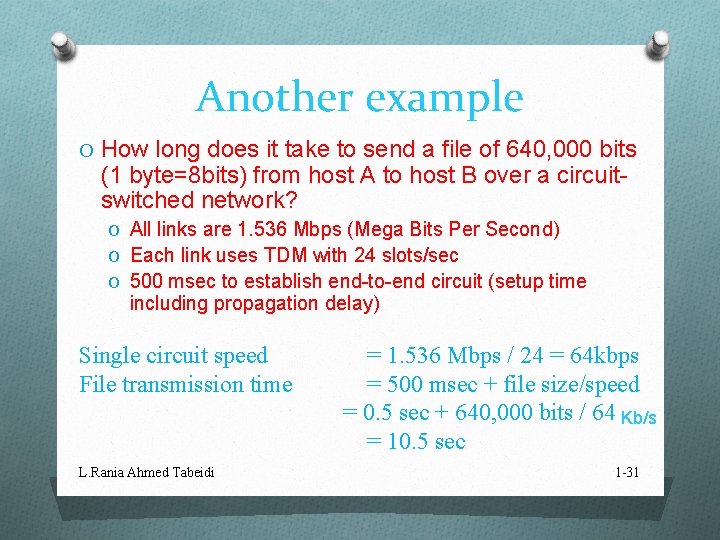
Another example O How long does it take to send a file of 640, 000 bits (1 byte=8 bits) from host A to host B over a circuitswitched network? O All links are 1. 536 Mbps (Mega Bits Per Second) O Each link uses TDM with 24 slots/sec O 500 msec to establish end-to-end circuit (setup time including propagation delay) Single circuit speed File transmission time L. Rania Ahmed Tabeidi = 1. 536 Mbps / 24 = 64 kbps = 500 msec + file size/speed = 0. 5 sec + 640, 000 bits / 64 Kb/s = 10. 5 sec 1 -31
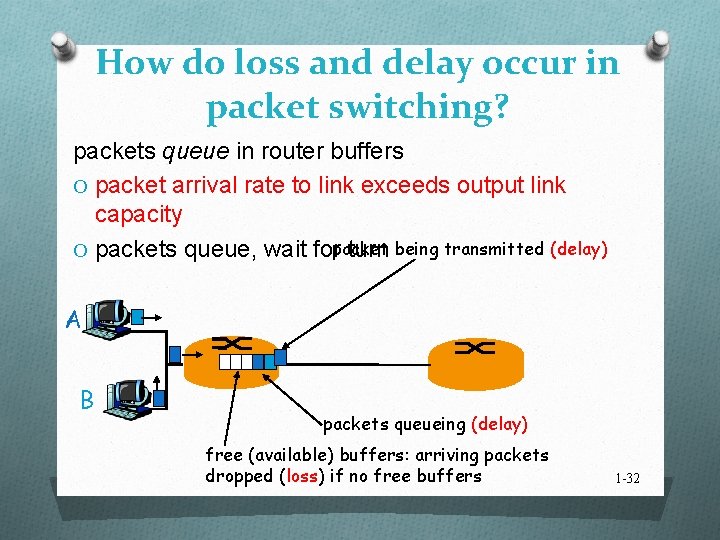
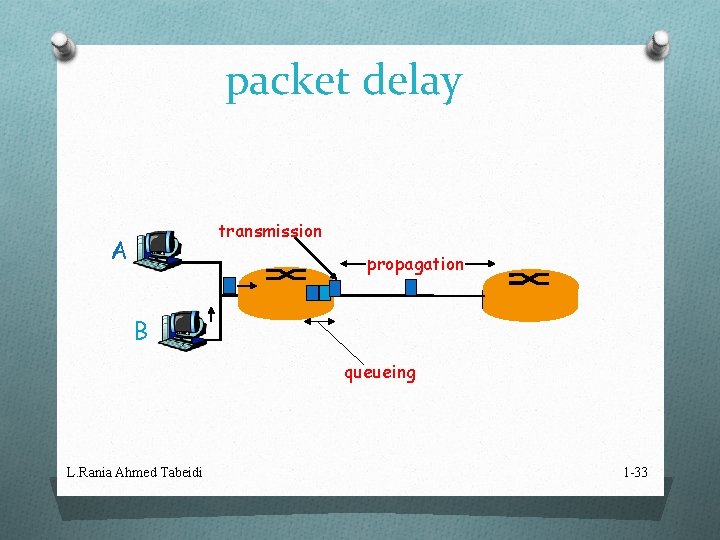
How do loss and delay occur in packet switching? packets queue in router buffers O packet arrival rate to link exceeds output link capacity O packets queue, wait forpacket turn being transmitted (delay) A B packets queueing (delay) free (available) buffers: arriving packets dropped (loss) if no free buffers 1 -32
packet delay transmission A propagation B queueing L. Rania Ahmed Tabeidi 1 -33
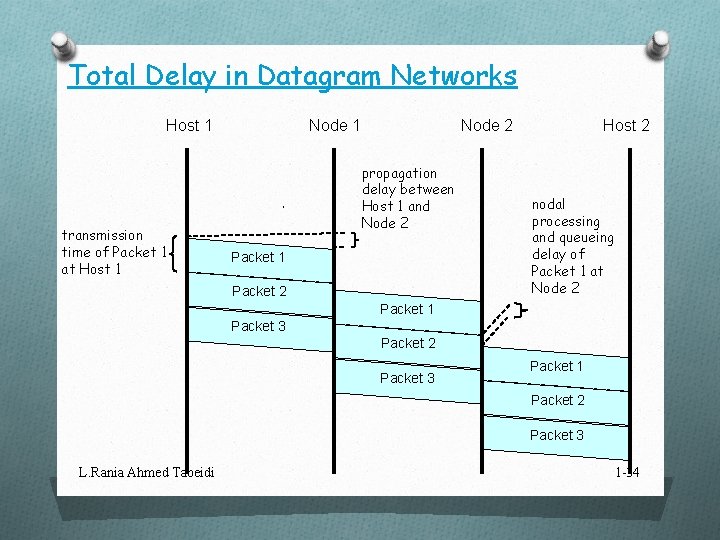
Total Delay in Datagram Networks Host 1 transmission time of Packet 1 at Host 1 Node 2 propagation delay between Host 1 and Node 2 Packet 1 Packet 2 Host 2 nodal processing and queueing delay of Packet 1 at Node 2 Packet 1 Packet 3 Packet 2 Packet 3 Packet 1 Packet 2 Packet 3 L. Rania Ahmed Tabeidi 1 -34
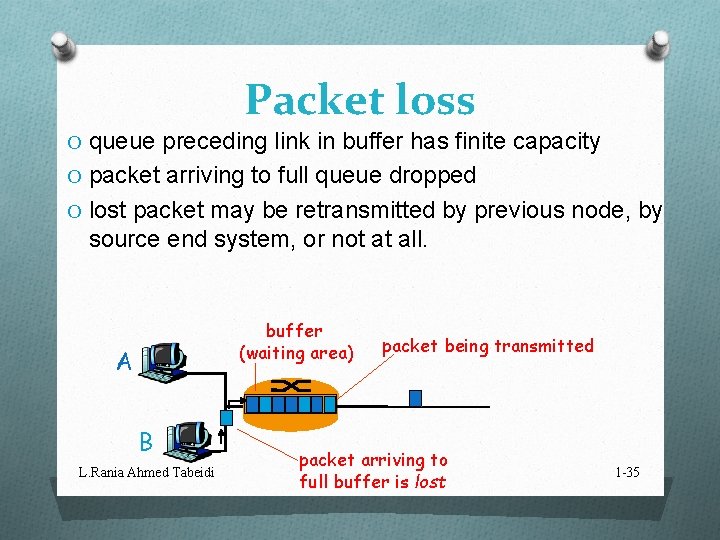
Packet loss O queue preceding link in buffer has finite capacity O packet arriving to full queue dropped O lost packet may be retransmitted by previous node, by source end system, or not at all. buffer (waiting area) A B L. Rania Ahmed Tabeidi packet being transmitted packet arriving to full buffer is lost 1 -35
Throughput O throughput: rate (bits/time unit) at which bits transferred between sender/receiver
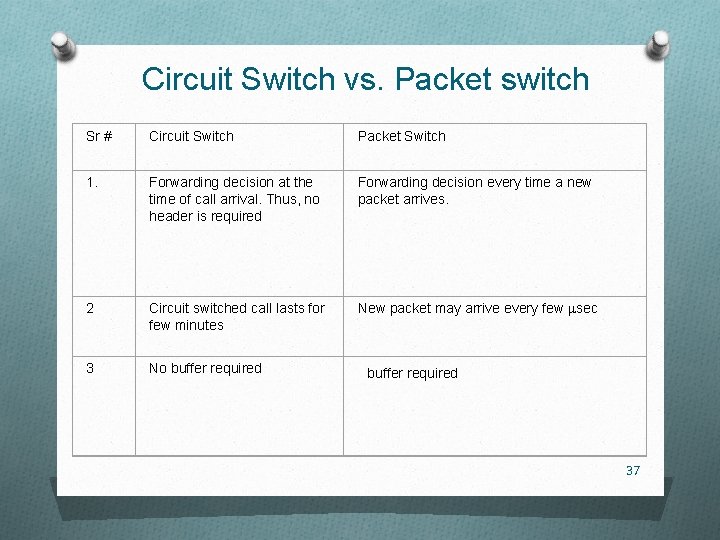
Circuit Switch vs. Packet switch Sr # Circuit Switch Packet Switch 1. Forwarding decision at the time of call arrival. Thus, no header is required Forwarding decision every time a new packet arrives. 2 Circuit switched call lasts for few minutes New packet may arrive every few sec 3 No buffer required 37
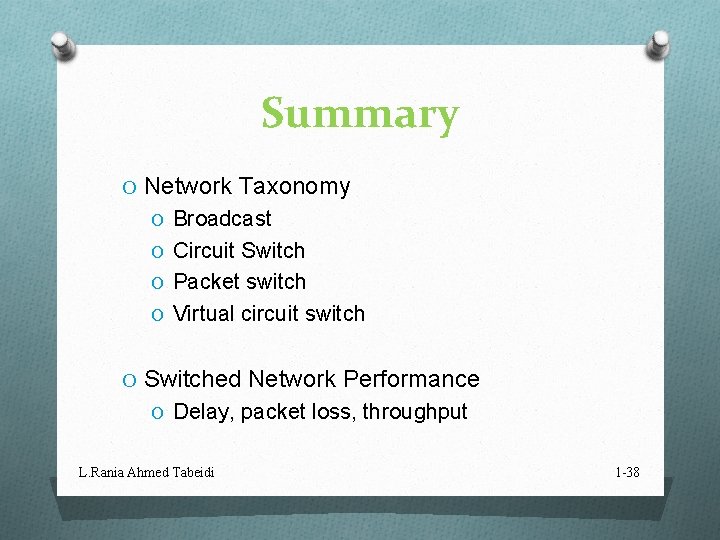
Summary O Network Taxonomy O Broadcast O Circuit Switch O Packet switch O Virtual circuit switch O Switched Network Performance O Delay, packet loss, throughput L. Rania Ahmed Tabeidi 1 -38
End Slide Show # 3 L. Rania Ahmed Tabeidi 39