
Lecture 3 Software Testing Fundamentals Prof Mostafa Abdel

Lecture 3 Software Testing Fundamentals Prof. Mostafa Abdel Aziem Mostafa
Contents 3. 1 General Testing Principles (The Seven Key Principles) 3. 2 Fundamental Test Process 3. 3 Psychology of Testing
3. 1 General Testing Principles (The Seven Key Principles) 1. Testing shows presence of Defects 2. Exhaustive Testing is Impossible! 3. Early Testing 4. Defect Clustering 5. The Pesticide Paradox 6. Testing is Context Dependent 7. Absence of Errors Fallacy
General Testing Principles The Seven Key Principles 1. Testing shows the presence of Defects ( it is not a ghost. It is a fact ) • We test to find Faults (as known as Defects) • As we find more defects, the probability of undiscovered defects remaining in a system reduces ( decreasing nature). • However Testing cannot prove that there are no defects present
Why Testing is necessary Testing Pearls of Wisdom • “The probability of the existence of more errors in a section of a program is proportional to the number of errors already found in that program” • “Do not plan a test effort under the tacit assumption that no errors will be found” • “A good test is one that has a high probability of detecting an as yet undiscovered error” • “A successful test is one that detects an as-yet undiscovered error” Myers 2004
General Testing Principles The Seven Key Principles 2. Exhaustive Testing is Impossible! • We have learned that we cannot test everything (i. e. all combinations of inputs and pre-conditions). • That is we must Prioritise our testing effort using a Risk Based Approach.
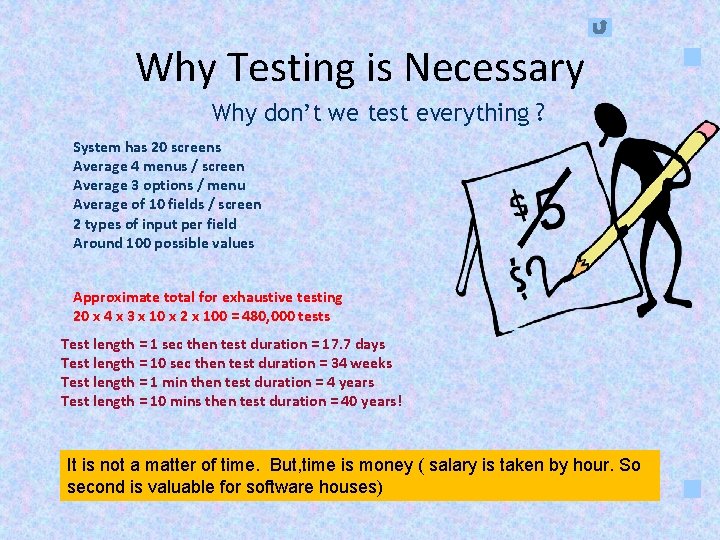
Why Testing is Necessary Why don’t we test everything ? System has 20 screens Average 4 menus / screen Average 3 options / menu Average of 10 fields / screen 2 types of input per field Around 100 possible values Approximate total for exhaustive testing 20 x 4 x 3 x 10 x 2 x 100 = 480, 000 tests Test length = 1 sec then test duration = 17. 7 days Test length = 10 sec then test duration = 34 weeks Test length = 1 min then test duration = 4 years Test length = 10 mins then test duration = 40 years! It is not a matter of time. But, time is money ( salary is taken by hour. So second is valuable for software houses)
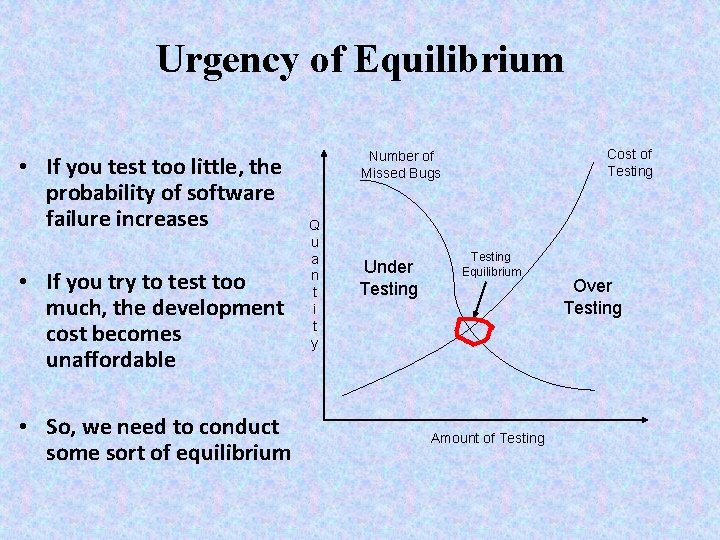
Urgency of Equilibrium • If you test too little, the probability of software failure increases • If you try to test too much, the development cost becomes unaffordable • So, we need to conduct some sort of equilibrium Cost of Testing Number of Missed Bugs Q u a n t i t y Under Testing Equilibrium Amount of Testing Over Testing
General Testing Principles The Seven Key Principles 3. Early testing • Testing activities should start as early as possible in the development life cycle • These activities should be focused on defined objectives – outlined in the Test Strategy • Remember from our Definition of Testing, that Testing doesn’t start once the code has been written!
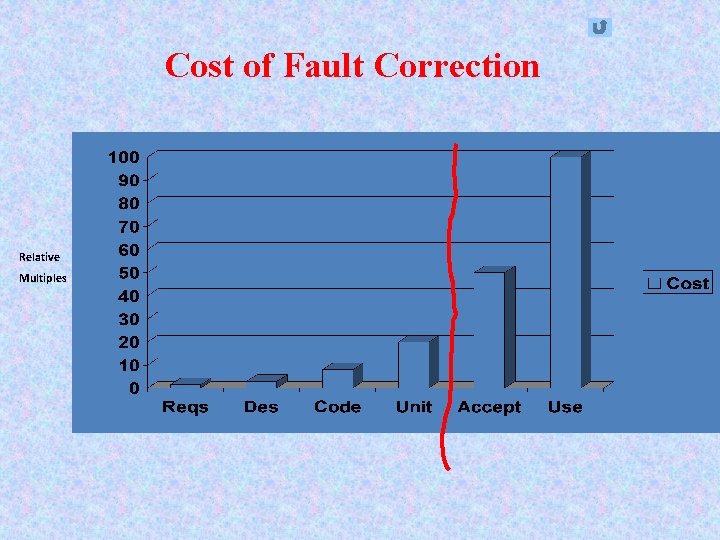
Cost of Fault Correction Relative Multiples
General Testing Principles The Seven Key Principles 4. Defect Clustering • Defects are not evenly distributed in a system • They are ‘clustered’ • In other words, most defects found during testing are usually confined to a small number of modules ( 80% of uncovered errors focused in 20% modules of the whole application) “Pareto law” • Similarly, most operational failures of a system are usually confined to a small number of modules • An important consideration in test prioritisation!
General Testing Principles The Seven Key Principles 5. The Pesticide Paradox ( )ﻣﻔﺎﺭﻗﺔ ﺍﻟﻤﺒﻴﺪﺍﺕ ﺍﻟﺤﺸﺮﻳﺔ • Testing identifies bugs, and programmers respond to fix them • As bugs are eliminated by the programmers, the software improves • As software improves the effectiveness of previous tests erodes ( ) ﺗآﻜﻞ • Therefore we must learn, create and use new tests based on new techniques to catch new bugs ( i. e. It is not a matter of repetition. It is a matter of learning and improving) • N. B It's called the "pesticide paradox" after the agricultural phenomenon, where bugs such as the boll weevil build up tolerance to pesticides, leaving you with the choice of ever-more powerful pesticides followed by ever-more powerful bugs or an altogether different approach. ’ – Beizer 1995
General Testing Principles The Seven Key Principles 6. Testing is Context (background)Dependent • Testing is done differently in different contexts • For example, safety-critical software is tested differently from an e-commerce site • Whilst, Testing can be 50% of development costs, in NASA's Apollo program (it was 80% testing) • 3 to 10 failures per thousand lines of code (KLOC) typical for commercial software • 1 to 3 failures per KLOC typical for industrial software • 0. 01 failures per KLOC for NASA Shuttle code! • Also different industries impose different testing standards

General Testing Principles The Seven Key Principles 7. Absence of Errors Fallacy ( ) ﻣﻐﺎﻟﻄﺔ • If we build a system and, in doing so, find and fix defects. . It doesn’t make it a good system • Even after defects have been resolved, it may still be unusable and/or does not fulfil the users’ needs and expectations • Visit the following site: http: //www. guru 99. com/software-testing-sevenprinciples. html
3. 2 Fundamental Test Process The five stages of the fundamental test process • Test Planning and Control • Test Analysis and Design • Test Implementation and Execution • Evaluating Exit Criteria and Reporting • Test Closure Activities
Fundamental Test Process • The process always starts with planning and ends with test closure activities • Each phase may have to be executed a number of times in order to fulfil exit or completion criteria • Although logically sequential, the activities in the process may overlap or take place concurrently
Fundamental Test Process 1. Test Planning and Control Test Planning • Specifies how the test strategy and project Test Plan A document describing the scope, approach, resources and schedule of intended test activities apply to the software under test • Principally: – verify the mission, – define the Test objectives – Specify the Test Activities required to meet the mission and objectives
Fundamental Test Process Test Planning and Control Test Planning (continued) • Major Tasks are : – – – – Identify the objectives of testing Determine Scope Determine the Test Approach Determine the required test resources Implement the test policy and/or the test strategy Schedule test analysis and design tasks Schedule test implementation, execution and evaluation Determine the Exit Criteria • More on Test Planning in Test Management section
Fundamental Test Process Test Planning and Control Test Control • The ongoing activity of comparing actual progress against the plan • Reporting status, including deviations from the plan • Taking actions necessary to meet the mission and objectives of the project • Test Planning takes into account the feedback from monitoring and control activities. • Major Tasks are : – measure and analyse results – Monitor and document progress, test coverage and exit criteria – initiate corrective actions – make decisions • More on Test Control in Test Management section
Fundamental Test Process 2. Test Analysis and Design • General testing objectives are transformed into tangible Test Conditions (An item or event of a component or system that could be verified by one or more test cases, e. g. a function, transaction, feature, quality attribute, or structural element) and Test Cases (A set of input values, execution preconditions, expected results and execution Post-conditions, developed for a particular objective or test condition, such as to exercise a particular program path or to verify compliance with a specific requirement). • Tests should be designed using the test design techniques selected in the test planning activity • Major tasks are: – Review the Test Basis - in doing so evaluate testability of Test Basis and Test Object(s) – From Analysis of Test Basis and Test Items, identify and prioritize Test Conditions and associated Test Data – Test Conditions and associated Test Data are documented in a Test Design Specification – Design and prioritize the Test Cases – Identify Test Data required to support Test Cases – Design the test environment set-up – Identify any required infrastructure and tools
Fundamental Test Process Test Analysis and Design • Each Test Case is specified in terms of : – its objective – the initial state of the system – the input – the expected result.
Fundamental Test Process Testing Pearl of Wisdom • “The act of designing tests is one of the most effective error prevention mechanisms known. . . The thought process that must take place to create useful tests can discover and eliminate problems at every stage of development. “ Beizer 1983
Fundamental Test Process 3. Test Implementation and Execution • Test Cases are combined in a particular order to form Test Procedures Specifications (a. k. a Test Scripts) A document specifying a sequence of actions for the execution of a test. Also known as test script or manual test script • • • Test Data is created The test environment is created Major tasks are: Create Test Scripts and Data – Develop, implement and prioritise Test Cases – Create the Test Scripts – Create test data – Preparing test harnesses ( dedicated resources) – Write automated test scripts – Create test suites from the test cases for efficient test execution Check the Environment – Verify that the test environment has been set up correctly
Fundamental Test Process Test Implementation and Execution • Major tasks (continued): Execute the Tests – Execute the Test Cases (manually or through tools) according to the planned sequence. – Log ( record ) the outcome of test execution – Test execution records should uniquely identify the versions of the software under test, test tools and Testware – It should be possible to establish that all testing has been carried out by reference to the test records.
Fundamental Test Process Test Implementation and Execution • Major tasks (continued): Check the Results – Compare actual results with expected results – Report discrepancies as Incidents – Analyse Incidents to establish Root cause – Repeat, as necessary, test activities as result of action taken for each discrepancy – The test coverage levels achieved for those measures specified as test completion criteria should be recorded.
Fundamental Test Process Testing Pearl of Wisdom • “carefully inspect the results of each test” Myers - 2004 Ref: Myers, The Art of Software Testing, J Wiley and Sons, 1979
Fundamental Test Process 4. Evaluating Exit Criteria and Reporting • Exit criteria ensures that the testing of the application is completed and ready. • Test execution is assessed against the objectives defined in Test Planning • This should be done for each Test Level (i. e. test stage) A group of test activities that are organized and managed together. • Major tasks are: – Check test logs against the exit criteria specified in Test Planning – If the exit criteria has not been met • Assess if more tests are needed • Assess which test activities may need to be repeated – Assess if the exit criteria specified should be changed – Produce a test summary report for stakeholders review
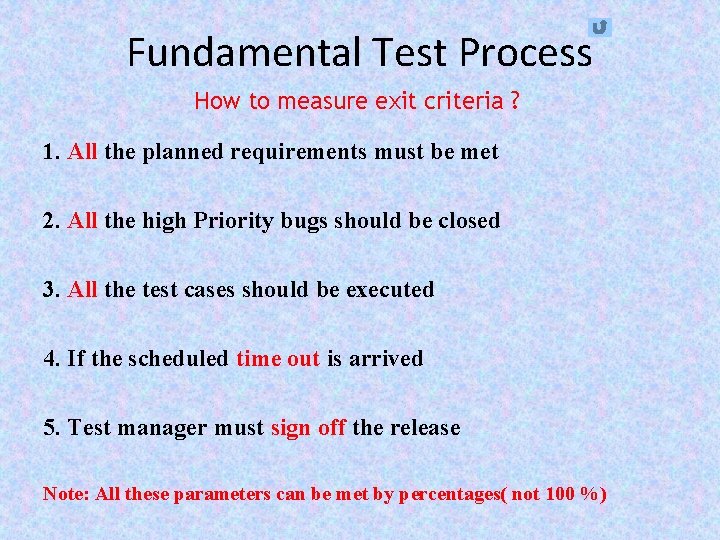
Fundamental Test Process How to measure exit criteria ? 1. All the planned requirements must be met 2. All the high Priority bugs should be closed 3. All the test cases should be executed 4. If the scheduled time out is arrived 5. Test manager must sign off the release Note: All these parameters can be met by percentages( not 100 %)
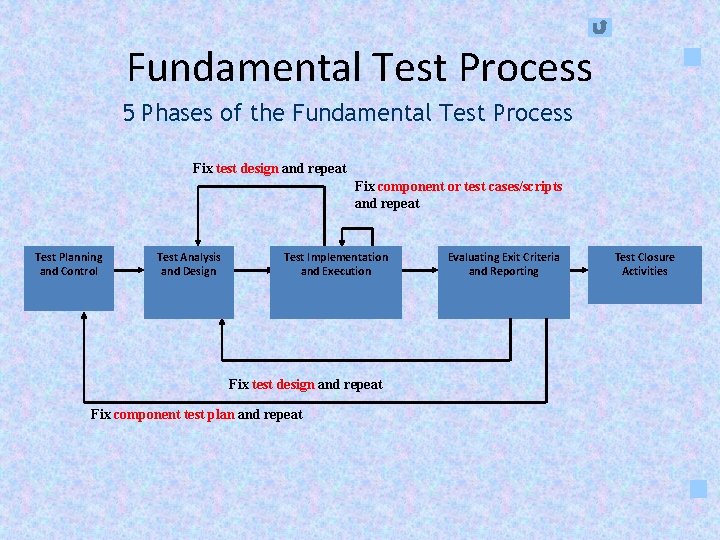
Fundamental Test Process 5 Phases of the Fundamental Test Process Fix test design and repeat Fix component or test cases/scripts and repeat Test Planning and Control Test Analysis and Design Test Implementation and Execution Fix test design and repeat Fix component test plan and repeat Evaluating Exit Criteria and Reporting Test Closure Activities
3. 3 Psychology of Testing The Testing approach • Historically testing was viewed as showing the system meets its requirements • This has evolved to a stage where testing is performed with the primary aim of finding faults rather than proving correctness. It is perceived as a destructive ( negative ) process • Seeking to find failures (the right approach) can be viewed as criticism of the product and/or its author • But looking for failures as constructive! ( useful) – – Time can be saved Risks reduced Costs reduced Skills improved
Psychology of Testing The Testing approach • It is important that the Objectives of testing are clearly understood as humans will moderate their behaviour accordingly (however sub-consciously )ﺑﻮﻋﻲ : – “If testing is showing the system meets its requirements then I will just produce tests that show this. ” – “If testing is aimed at finding faults then I will be measured on this so I will put effort into designing tests that are more likely to find faults. ” • The Testing approach is different from a Developer’s
Psychology of Testing Pearl of Wisdom • “Testing is an extremely creative and intellectually task” • ( )ﻓﻜﺮﻱ challenging “Tests must be written for invalid and unexpected, as well as valid and expected, input conditions” Myers - 1979
Psychology of Testing Traits of Good Testers • A Tester needs: – – – good communication skills good observation skills people handling skills Curiosity ( testing activities interest ) patience reliability Thoroughness ( carefulness) an inquisitive nature ( )ﻓﻀﻮﻟﻲ attention to detail creativity in terms of identifying likely faults Experience • However as with most other disciplines an effective test team will need a mix of skills so it is difficult to generalise
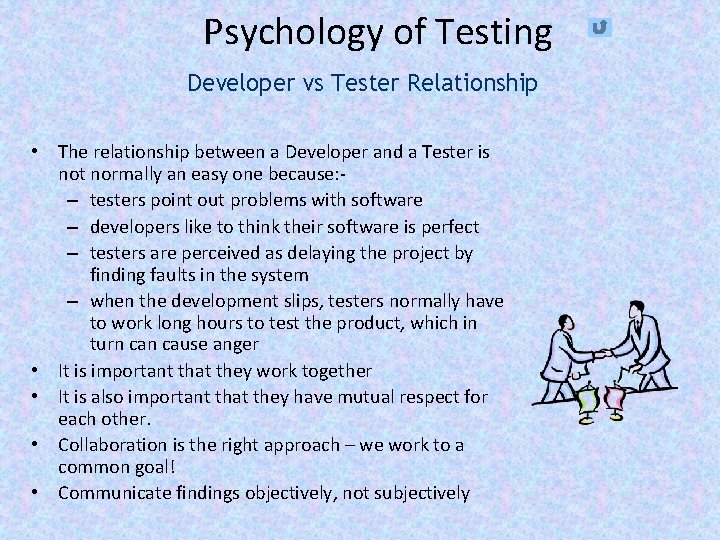
Psychology of Testing Developer vs Tester Relationship • The relationship between a Developer and a Tester is not normally an easy one because: – testers point out problems with software – developers like to think their software is perfect – testers are perceived as delaying the project by finding faults in the system – when the development slips, testers normally have to work long hours to test the product, which in turn cause anger • It is important that they work together • It is also important that they have mutual respect for each other. • Collaboration is the right approach – we work to a common goal! • Communicate findings objectively, not subjectively
Psychology of Testing Independent testing ( )ﺣﻴﺎﺩﻳﺔ ﺍﻻﺧﺘﺒﺎﺭ • The right approach could enable Developers to test the code • However, passing this responsibility to trained and professional testing resources has many benefits (such as higher defect find rates) • Authors tend to bring across assumptions they have made when developing the software. They are less likely to write tests to show faults in their own software (human nature) • With testing performed by independent testers, testing effort is focused and not compromised by development effort and bias • It is generally believed that objective independent testing is more effective
Psychology of Testing Independent testing • There are several levels of Independence (from Low to High): – Tests designed by the person(s) who wrote the software under test – Tests designed by another person(s) (e. g. from the development team). – Tests designed by a person(s) from a different organizational group (e. g. an independent test team). – Tests designed by a person(s) from a different organization or company (e. g. outsourcing to an in-house or external test specialist organisation)
- Slides: 36