
Lecture 3 Rules of Evaluation CS 200 Computer
- Slides: 40
Lecture 3: Rules of Evaluation CS 200: Computer Science David Evans University of Virginia 22 January 2003 CS 200 Spring 2003 http: //www. cs. virginia. edu/evans Computer Science
Menu • Language Elements • Why don’t we just program computers using English? • Evaluation • Procedures Scheduled Office Hours (Olsson 236 A): Wednesdays 3: 30 -4: 30 (after class) Thursdays 4: 00 -5: 00 22 January 2003 CS 200 Spring 2003 2
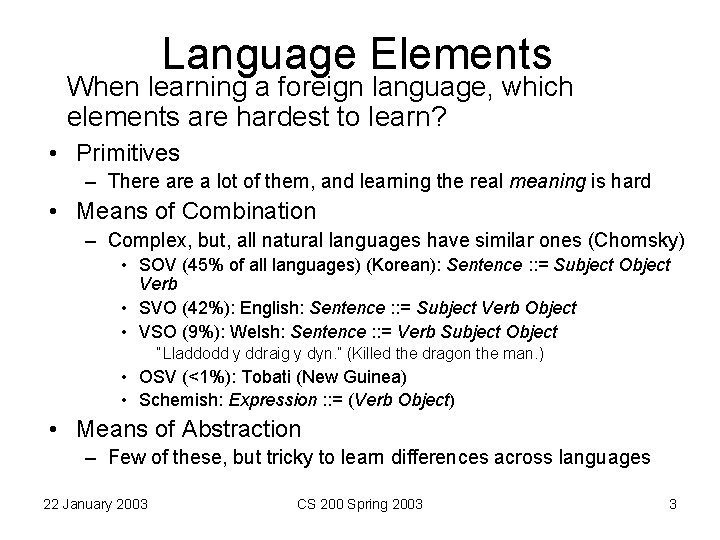
Language Elements When learning a foreign language, which elements are hardest to learn? • Primitives – There a lot of them, and learning the real meaning is hard • Means of Combination – Complex, but, all natural languages have similar ones (Chomsky) • SOV (45% of all languages) (Korean): Sentence : : = Subject Object Verb • SVO (42%): English: Sentence : : = Subject Verb Object • VSO (9%): Welsh: Sentence : : = Verb Subject Object “Lladdodd y ddraig y dyn. ” (Killed the dragon the man. ) • OSV (<1%): Tobati (New Guinea) • Schemish: Expression : : = (Verb Object) • Means of Abstraction – Few of these, but tricky to learn differences across languages 22 January 2003 CS 200 Spring 2003 3
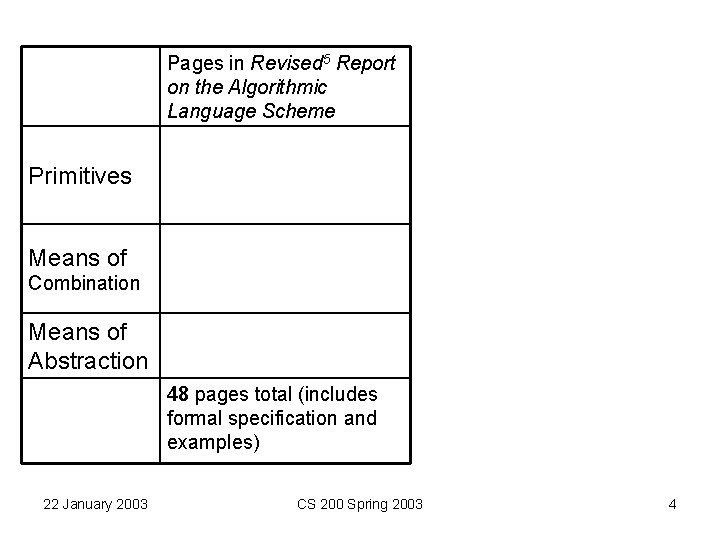
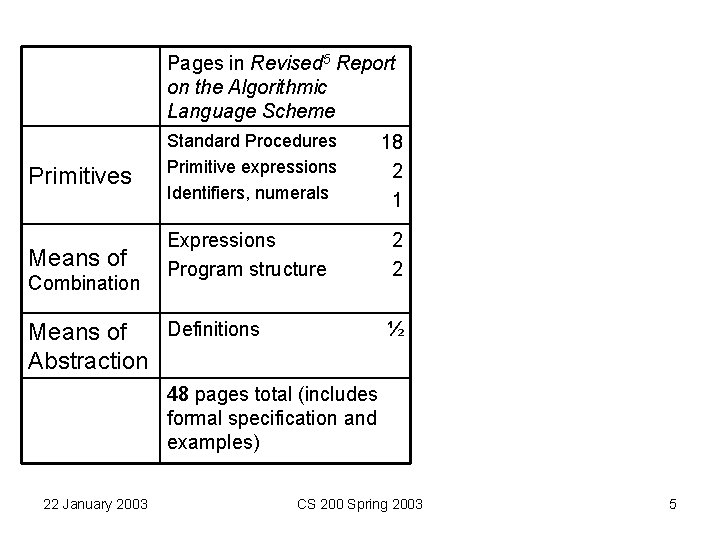
Pages in Revised 5 Report on the Algorithmic Language Scheme Primitives Means of Combination Means of Abstraction 48 pages total (includes formal specification and examples) 22 January 2003 CS 200 Spring 2003 4
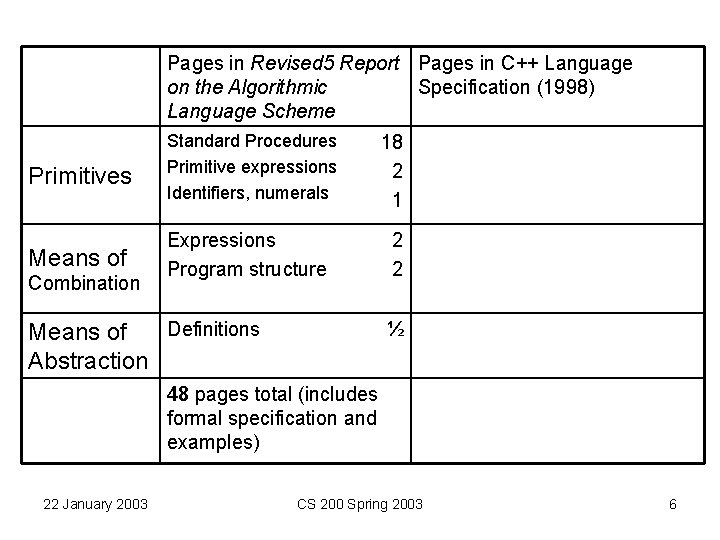
Pages in Revised 5 Report on the Algorithmic Language Scheme Primitives Standard Procedures Primitive expressions Identifiers, numerals 18 2 1 Means of Expressions Program structure 2 2 Combination Means of Definitions Abstraction ½ 48 pages total (includes formal specification and examples) 22 January 2003 CS 200 Spring 2003 5
Pages in Revised 5 Report Pages in C++ Language on the Algorithmic Specification (1998) Language Scheme Primitives Standard Procedures Primitive expressions Identifiers, numerals 18 2 1 Means of Expressions Program structure 2 2 Combination Means of Definitions Abstraction ½ 48 pages total (includes formal specification and examples) 22 January 2003 CS 200 Spring 2003 6
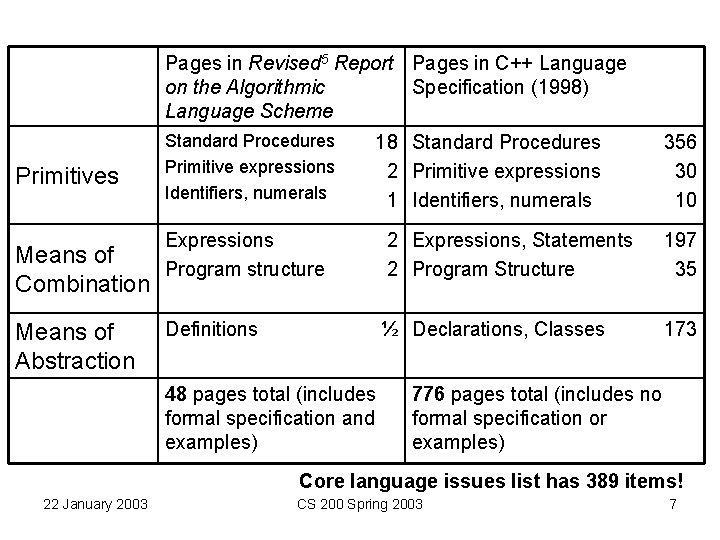
Pages in Revised 5 Report Pages in C++ Language on the Algorithmic Specification (1998) Language Scheme Primitives Means of Combination Means of Abstraction Standard Procedures Primitive expressions Identifiers, numerals 18 Standard Procedures 2 Primitive expressions 1 Identifiers, numerals 356 30 10 Expressions Program structure 2 Expressions, Statements 2 Program Structure 197 35 Definitions ½ Declarations, Classes 173 48 pages total (includes formal specification and examples) 776 pages total (includes no formal specification or examples) Core language issues list has 389 items! 22 January 2003 CS 200 Spring 2003 7
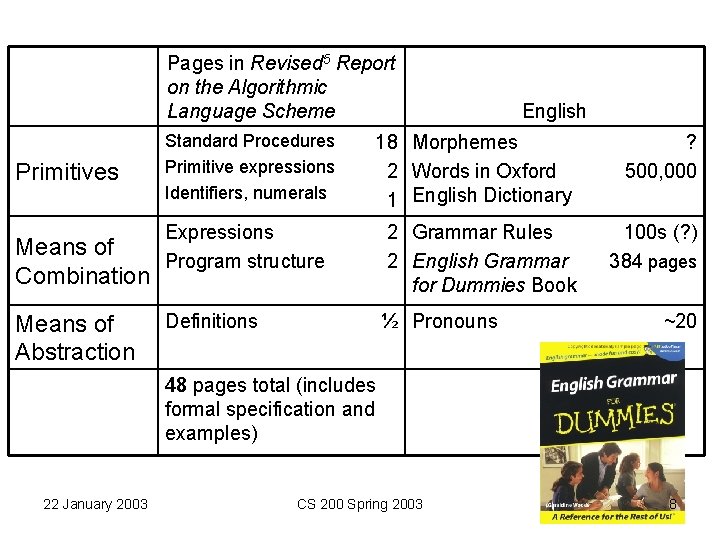
Pages in Revised 5 Report on the Algorithmic Language Scheme Primitives Means of Combination Means of Abstraction Standard Procedures Primitive expressions Identifiers, numerals English 18 Morphemes 2 Words in Oxford 1 English Dictionary ? 500, 000 Expressions Program structure 2 Grammar Rules 2 English Grammar for Dummies Book 100 s (? ) 384 pages Definitions ½ Pronouns ~20 48 pages total (includes formal specification and examples) 22 January 2003 CS 200 Spring 2003 8
Why don’t we just program computers using English? 22 January 2003 CS 200 Spring 2003 9
Why don’t we just program computers using English? • Too hard and complex Non-native English speakers don’t need convincing. The rest of you have spent your whole life learning English (and first 5 years of your life doing little else) and still don’t know useful words like floccipoccinihilipilification! There are thoughts that even native speakers find it hard to express. By the end of today you will know enough Scheme (nearly the entire language) to express and understand every computation. By the end of the class, you will know enough to completely describe Scheme in terms of itself (try doing that in English!) 22 January 2003 CS 200 Spring 2003 10
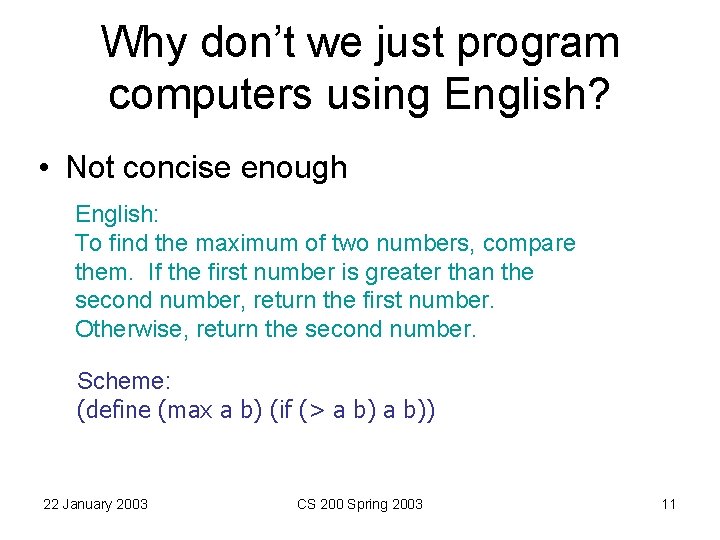
Why don’t we just program computers using English? • Not concise enough English: To find the maximum of two numbers, compare them. If the first number is greater than the second number, return the first number. Otherwise, return the second number. Scheme: (define (max a b) (if (> a b)) 22 January 2003 CS 200 Spring 2003 11
Why don’t we just program computers using English? • Limited means of abstraction There are only a few pronouns: he, she, it, they, these, … (English doesn’t even have a gender-neutral pronoun for a person!) Only Webster and Oxford can make up new ones. define allows any programmer to make up as many pronouns as that programmer wants, and use them to represent exactly what the programmer wants. 22 January 2003 CS 200 Spring 2003 12
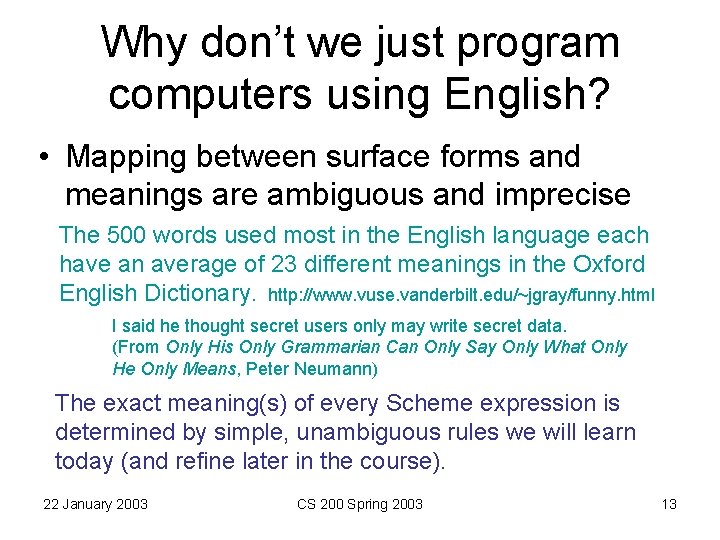
Why don’t we just program computers using English? • Mapping between surface forms and meanings are ambiguous and imprecise The 500 words used most in the English language each have an average of 23 different meanings in the Oxford English Dictionary. http: //www. vuse. vanderbilt. edu/~jgray/funny. html I said he thought secret users only may write secret data. (From Only His Only Grammarian Can Only Say Only What Only He Only Means, Peter Neumann) The exact meaning(s) of every Scheme expression is determined by simple, unambiguous rules we will learn today (and refine later in the course). 22 January 2003 CS 200 Spring 2003 13
Evaluation 22 January 2003 CS 200 Spring 2003
Expressions and Values • (Almost) every expression has a value – Have you seen any expressions that don’t have values? • When an expression with a value is evaluated, its value is produced 22 January 2003 CS 200 Spring 2003 15
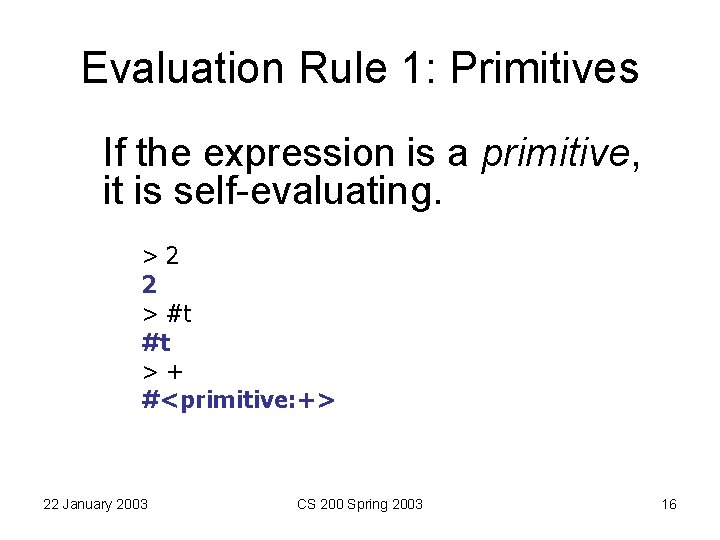
Evaluation Rule 1: Primitives If the expression is a primitive, it is self-evaluating. >2 2 > #t #t >+ #<primitive: +> 22 January 2003 CS 200 Spring 2003 16
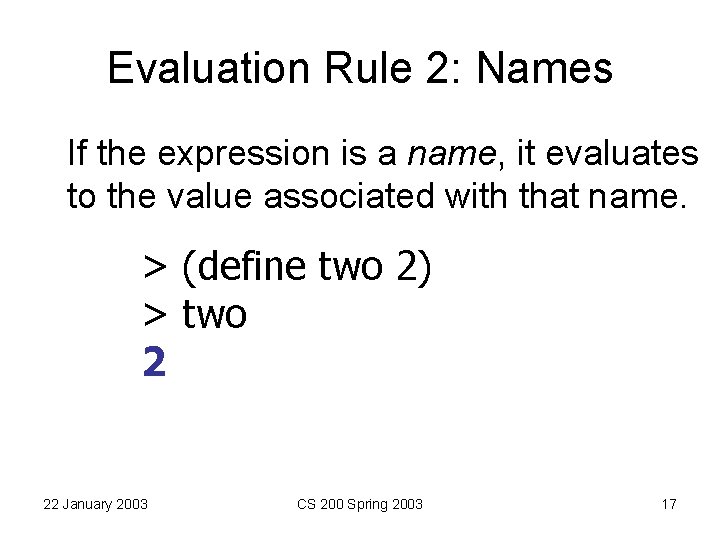
Evaluation Rule 2: Names If the expression is a name, it evaluates to the value associated with that name. > (define two 2) > two 2 22 January 2003 CS 200 Spring 2003 17
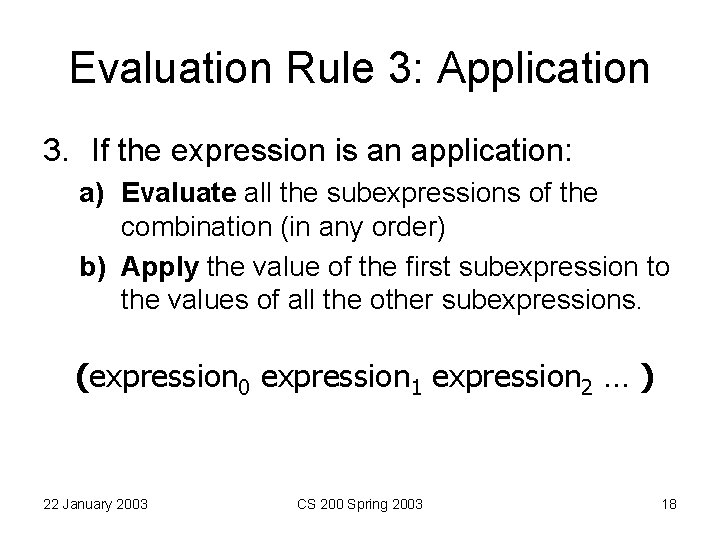
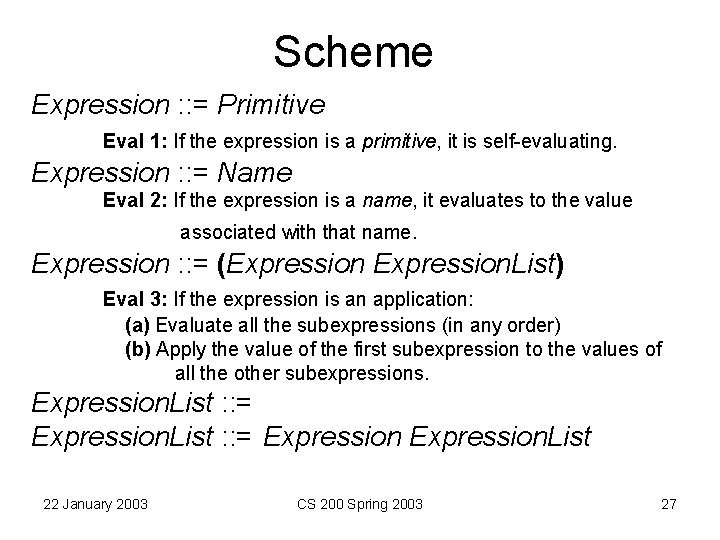
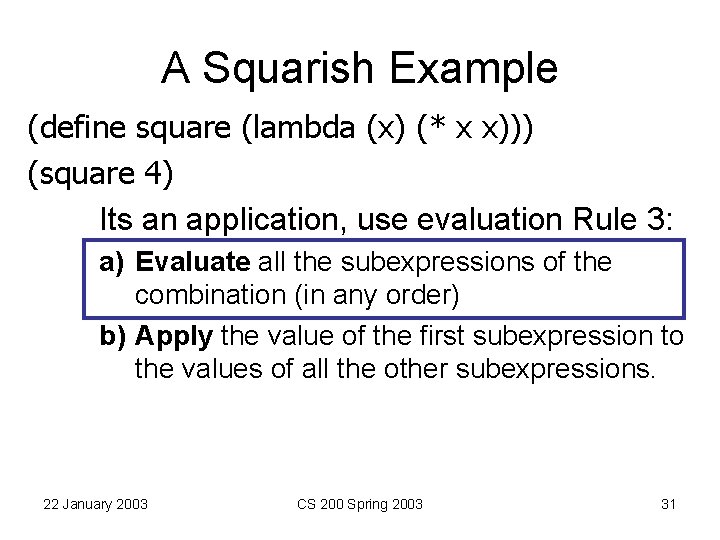
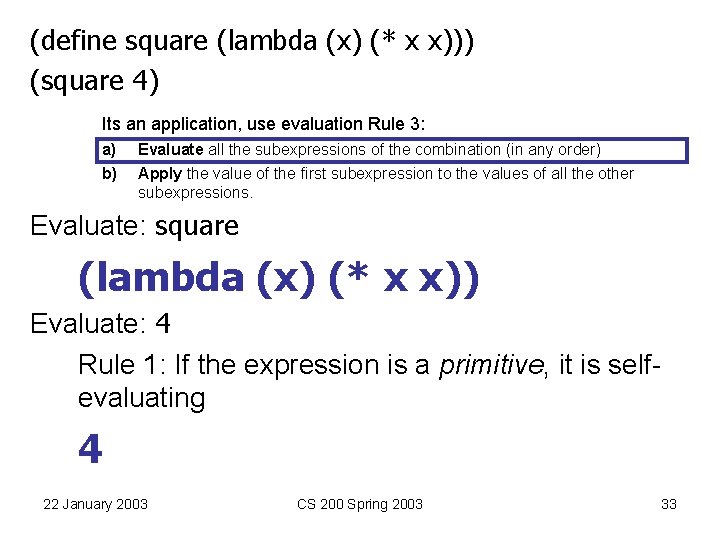
Evaluation Rule 3: Application 3. If the expression is an application: a) Evaluate all the subexpressions of the combination (in any order) b) Apply the value of the first subexpression to the values of all the other subexpressions. (expression 0 expression 1 expression 2 … ) 22 January 2003 CS 200 Spring 2003 18
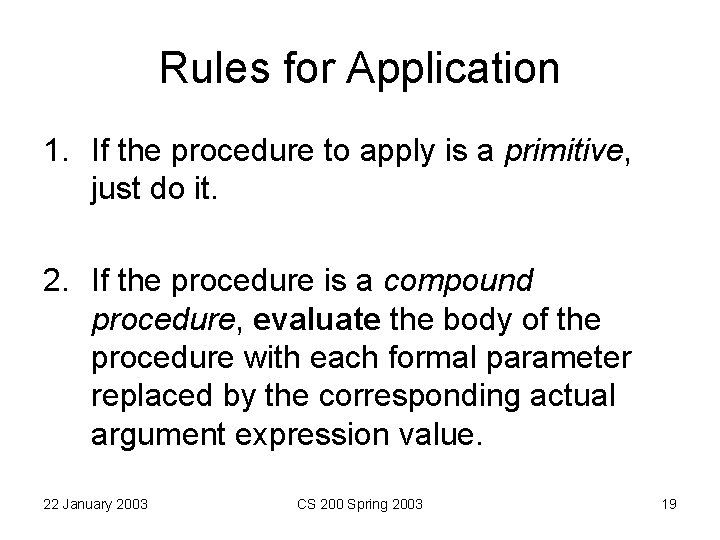
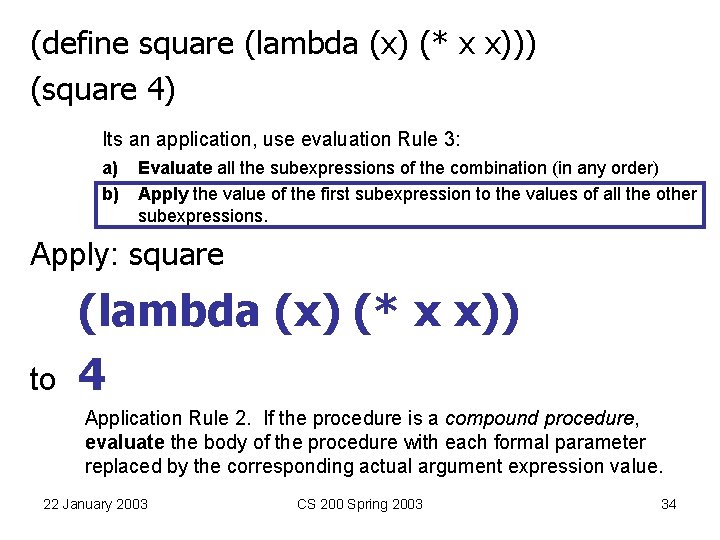
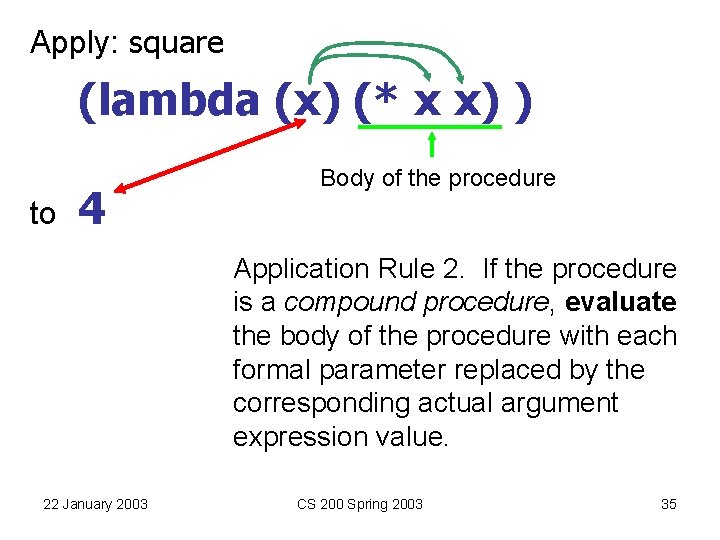
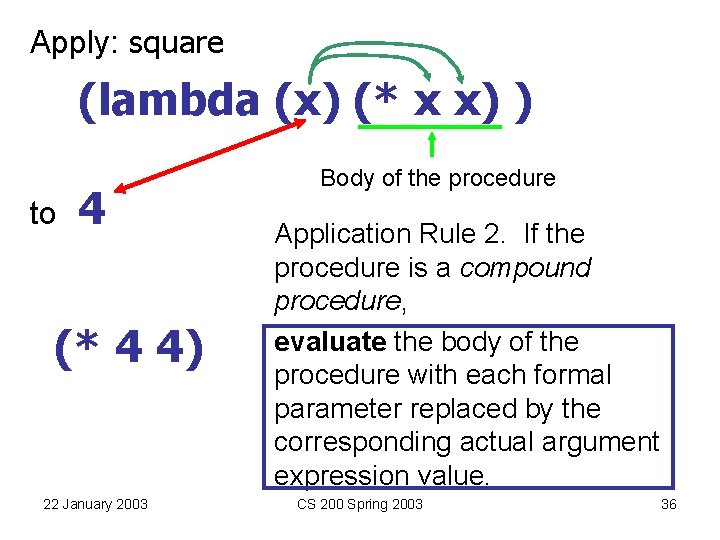
Rules for Application 1. If the procedure to apply is a primitive, just do it. 2. If the procedure is a compound procedure, evaluate the body of the procedure with each formal parameter replaced by the corresponding actual argument expression value. 22 January 2003 CS 200 Spring 2003 19
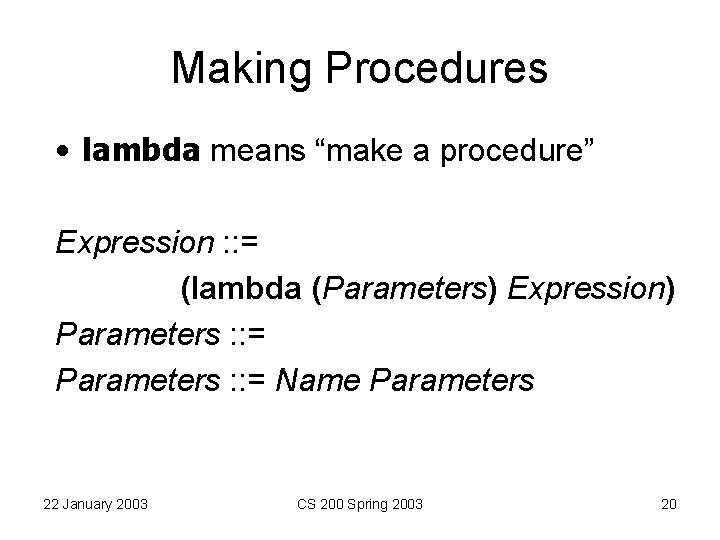
Making Procedures • lambda means “make a procedure” Expression : : = (lambda (Parameters) Expression) Parameters : : = Name Parameters 22 January 2003 CS 200 Spring 2003 20
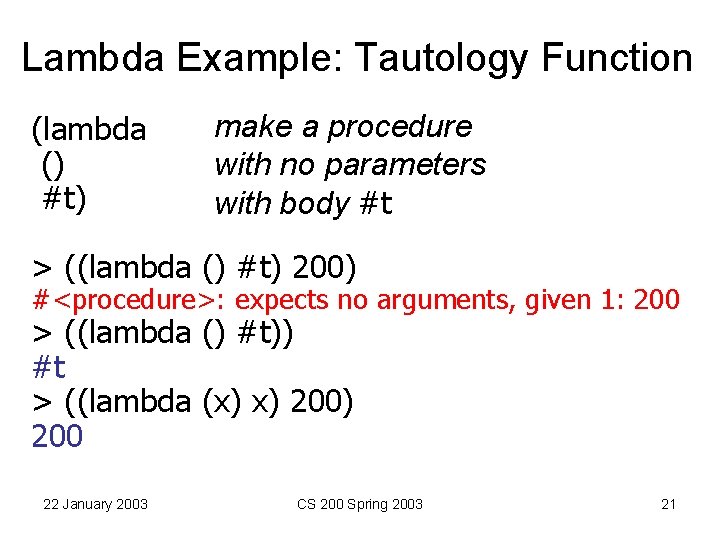
Lambda Example: Tautology Function (lambda () #t) make a procedure with no parameters with body #t > ((lambda () #t) 200) #<procedure>: expects no arguments, given 1: 200 > ((lambda () #t)) #t > ((lambda (x) x) 200 22 January 2003 CS 200 Spring 2003 21
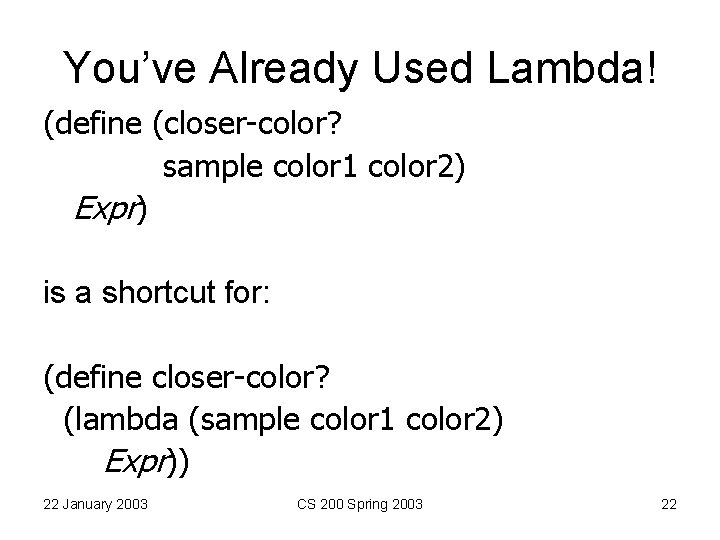
You’ve Already Used Lambda! (define (closer-color? sample color 1 color 2) Expr) is a shortcut for: (define closer-color? (lambda (sample color 1 color 2) Expr)) 22 January 2003 CS 200 Spring 2003 22
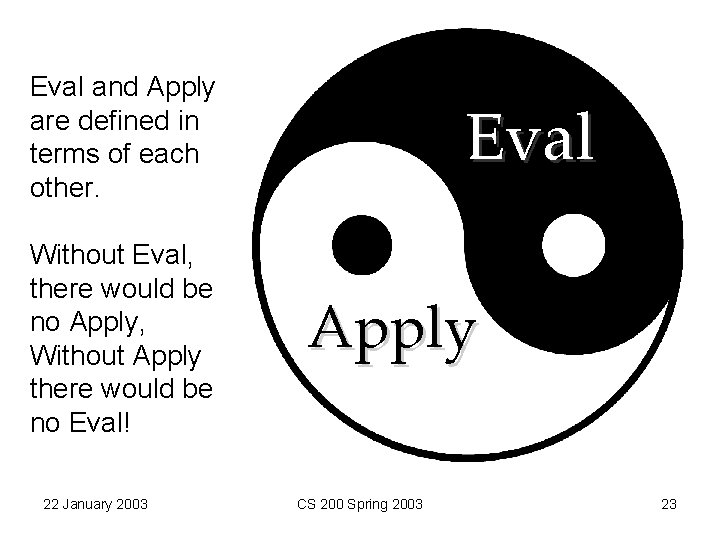
Eval and Apply are defined in terms of each other. Without Eval, there would be no Apply, Without Apply there would be no Eval! 22 January 2003 Eval Apply CS 200 Spring 2003 23
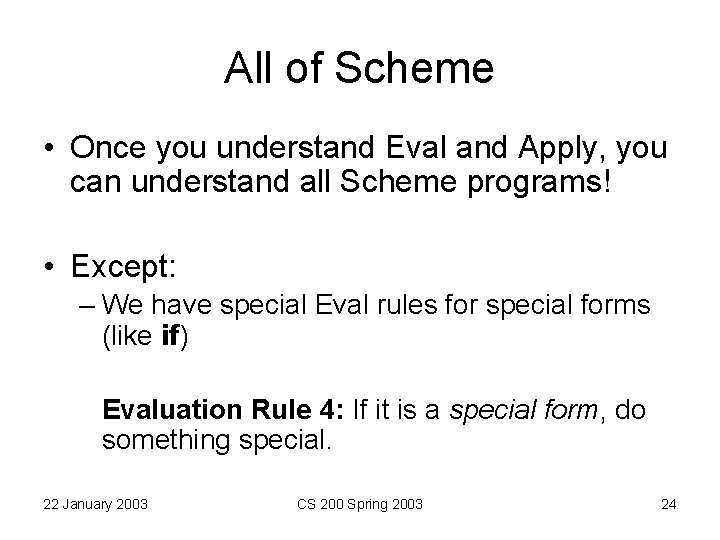
All of Scheme • Once you understand Eval and Apply, you can understand all Scheme programs! • Except: – We have special Eval rules for special forms (like if) Evaluation Rule 4: If it is a special form, do something special. 22 January 2003 CS 200 Spring 2003 24
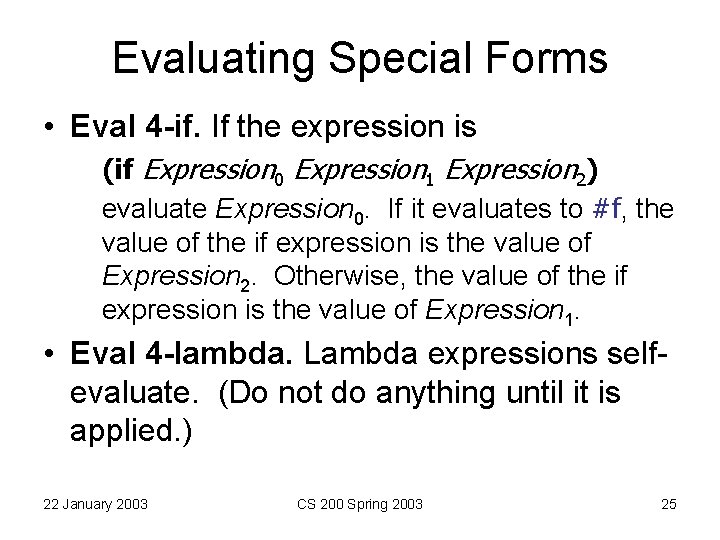
Evaluating Special Forms • Eval 4 -if. If the expression is (if Expression 0 Expression 1 Expression 2) evaluate Expression 0. If it evaluates to #f, the value of the if expression is the value of Expression 2. Otherwise, the value of the if expression is the value of Expression 1. • Eval 4 -lambda. Lambda expressions selfevaluate. (Do not do anything until it is applied. ) 22 January 2003 CS 200 Spring 2003 25
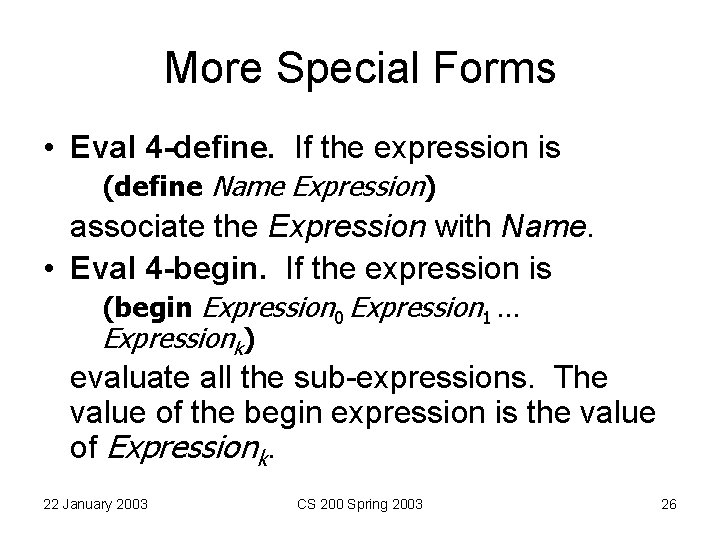
More Special Forms • Eval 4 -define. If the expression is (define Name Expression) associate the Expression with Name. • Eval 4 -begin. If the expression is (begin Expression 0 Expression 1 … Expressionk) evaluate all the sub-expressions. The value of the begin expression is the value of Expressionk. 22 January 2003 CS 200 Spring 2003 26
Scheme Expression : : = Primitive Eval 1: If the expression is a primitive, it is self-evaluating. Expression : : = Name Eval 2: If the expression is a name, it evaluates to the value associated with that name. Expression : : = (Expression. List) Eval 3: If the expression is an application: (a) Evaluate all the subexpressions (in any order) (b) Apply the value of the first subexpression to the values of all the other subexpressions. Expression. List : : = Expression. List 22 January 2003 CS 200 Spring 2003 27
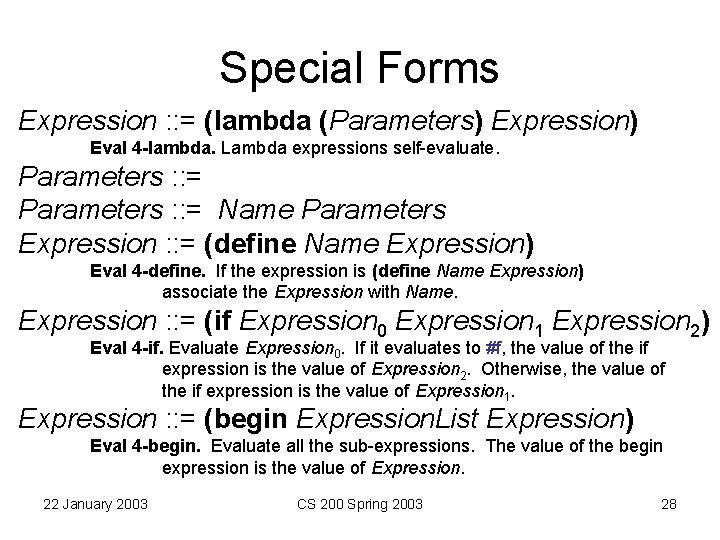
Special Forms Expression : : = (lambda (Parameters) Expression) Eval 4 -lambda. Lambda expressions self-evaluate. Parameters : : = Name Parameters Expression : : = (define Name Expression) Eval 4 -define. If the expression is (define Name Expression) associate the Expression with Name. Expression : : = (if Expression 0 Expression 1 Expression 2) Eval 4 -if. Evaluate Expression 0. If it evaluates to #f, the value of the if expression is the value of Expression 2. Otherwise, the value of the if expression is the value of Expression 1. Expression : : = (begin Expression. List Expression) Eval 4 -begin. Evaluate all the sub-expressions. The value of the begin expression is the value of Expression. 22 January 2003 CS 200 Spring 2003 28
Now, you really know all of Scheme! 22 January 2003 (Except for 3 more special forms you will learn for PS 5. ) CS 200 Spring 2003 29
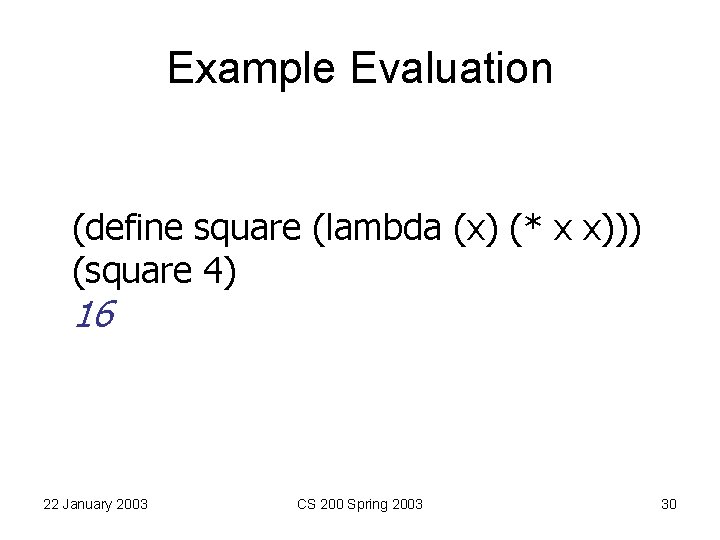
Example Evaluation (define square (lambda (x) (* x x))) (square 4) 16 22 January 2003 CS 200 Spring 2003 30
A Squarish Example (define square (lambda (x) (* x x))) (square 4) Its an application, use evaluation Rule 3: a) Evaluate all the subexpressions of the combination (in any order) b) Apply the value of the first subexpression to the values of all the other subexpressions. 22 January 2003 CS 200 Spring 2003 31
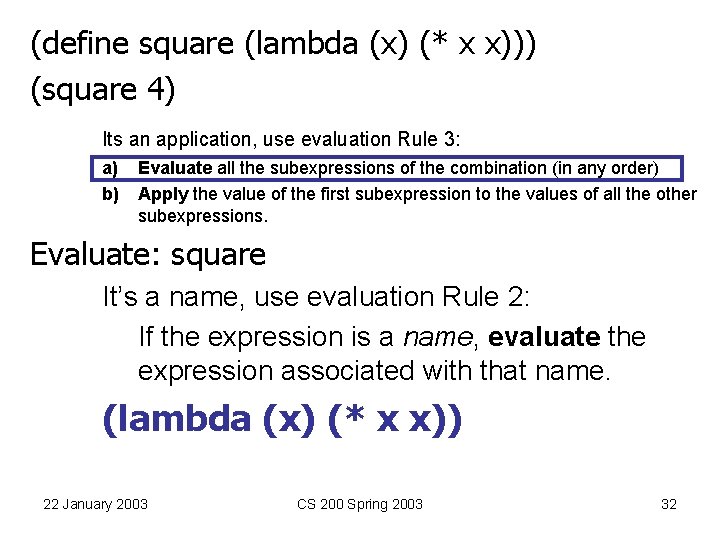
(define square (lambda (x) (* x x))) (square 4) Its an application, use evaluation Rule 3: a) b) Evaluate all the subexpressions of the combination (in any order) Apply the value of the first subexpression to the values of all the other subexpressions. Evaluate: square It’s a name, use evaluation Rule 2: If the expression is a name, evaluate the expression associated with that name. (lambda (x) (* x x)) 22 January 2003 CS 200 Spring 2003 32
(define square (lambda (x) (* x x))) (square 4) Its an application, use evaluation Rule 3: a) b) Evaluate all the subexpressions of the combination (in any order) Apply the value of the first subexpression to the values of all the other subexpressions. Evaluate: square (lambda (x) (* x x)) Evaluate: 4 Rule 1: If the expression is a primitive, it is selfevaluating 4 22 January 2003 CS 200 Spring 2003 33
(define square (lambda (x) (* x x))) (square 4) Its an application, use evaluation Rule 3: a) b) Evaluate all the subexpressions of the combination (in any order) Apply the value of the first subexpression to the values of all the other subexpressions. Apply: square (lambda (x) (* x x)) to 4 Application Rule 2. If the procedure is a compound procedure, evaluate the body of the procedure with each formal parameter replaced by the corresponding actual argument expression value. 22 January 2003 CS 200 Spring 2003 34
Apply: square (lambda (x) (* x x) ) to 4 Body of the procedure Application Rule 2. If the procedure is a compound procedure, evaluate the body of the procedure with each formal parameter replaced by the corresponding actual argument expression value. 22 January 2003 CS 200 Spring 2003 35
Apply: square (lambda (x) (* x x) ) to 4 (* 4 4) 22 January 2003 Body of the procedure Application Rule 2. If the procedure is a compound procedure, evaluate the body of the procedure with each formal parameter replaced by the corresponding actual argument expression value. CS 200 Spring 2003 36
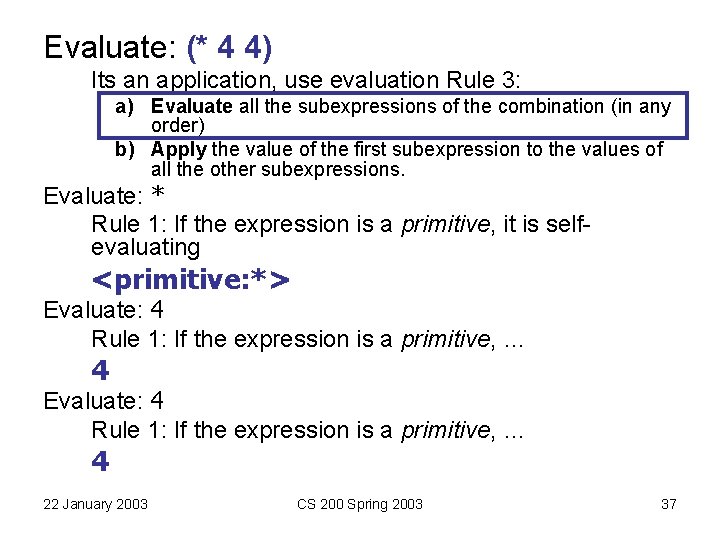
Evaluate: (* 4 4) Its an application, use evaluation Rule 3: a) Evaluate all the subexpressions of the combination (in any order) b) Apply the value of the first subexpression to the values of all the other subexpressions. Evaluate: * Rule 1: If the expression is a primitive, it is selfevaluating <primitive: *> Evaluate: 4 Rule 1: If the expression is a primitive, … 4 22 January 2003 CS 200 Spring 2003 37
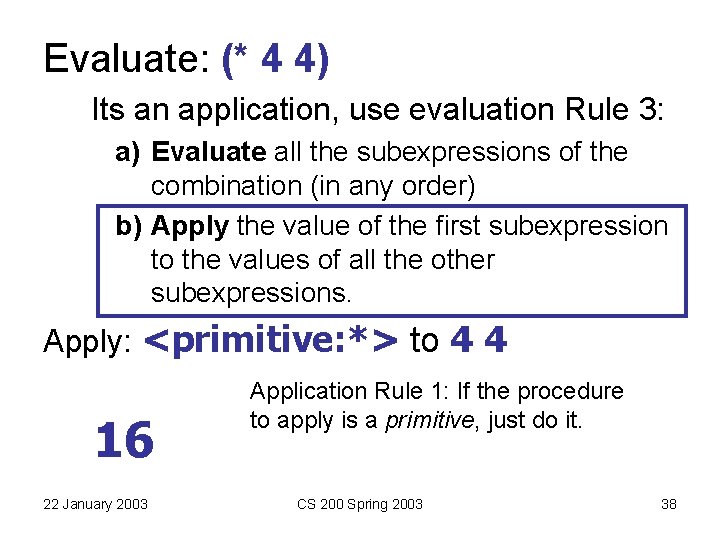
Evaluate: (* 4 4) Its an application, use evaluation Rule 3: a) Evaluate all the subexpressions of the combination (in any order) b) Apply the value of the first subexpression to the values of all the other subexpressions. Apply: <primitive: *> to 4 4 16 22 January 2003 Application Rule 1: If the procedure to apply is a primitive, just do it. CS 200 Spring 2003 38
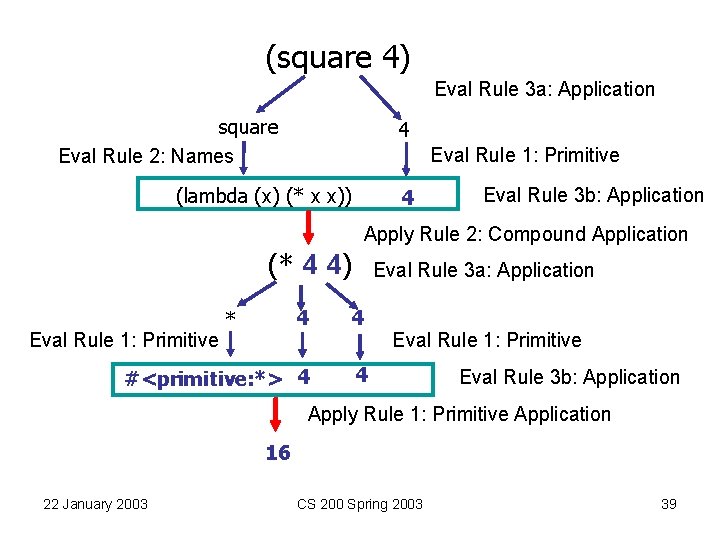
(square 4) Eval Rule 3 a: Application square Eval Rule 2: Names 4 Eval Rule 1: Primitive (lambda (x) (* x x)) 4 Eval Rule 3 b: Application Apply Rule 2: Compound Application (* 4 4) Eval Rule 3 a: Application 4 4 #<primitive: *> 4 4 Eval Rule 1: Primitive * Eval Rule 1: Primitive Eval Rule 3 b: Application Apply Rule 1: Primitive Application 16 22 January 2003 CS 200 Spring 2003 39
Charge • PS 2 Due Monday 3 Feb – Less code to read than PS 1, but now you should understand all of it! – Lots more code to write than PS 1 • Reading for Friday: SICP, 1. 2 • Reading for Monday: GEB, Ch 5 22 January 2003 CS 200 Spring 2003 40