
Lecture 3 Review Examples and Phasors A A
- Slides: 19
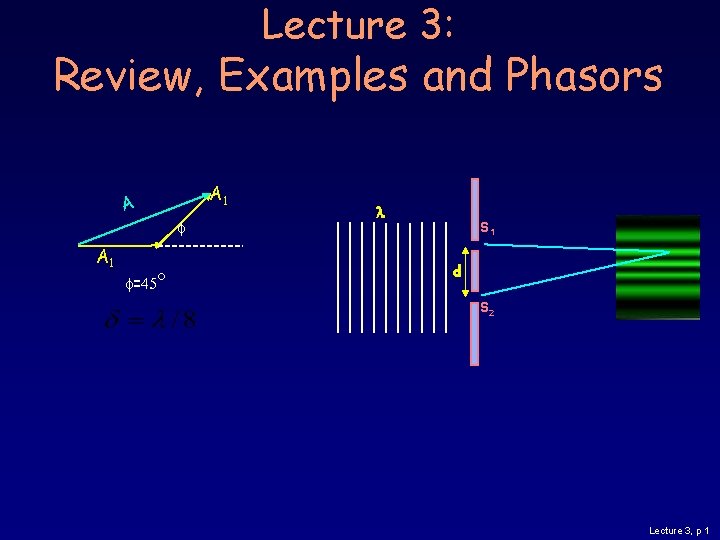
Lecture 3: Review, Examples and Phasors A A 1 =45° A 1 S 1 d S 2 Lecture 3, p 1
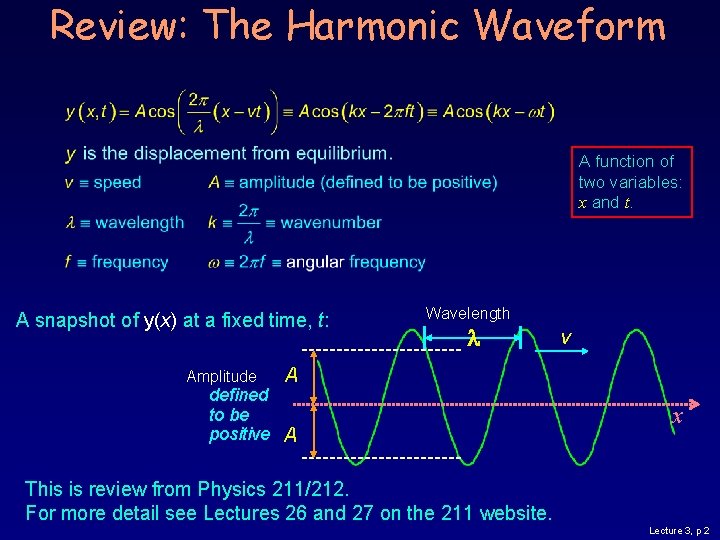
Review: The Harmonic Waveform A function of two variables: x and t. A snapshot of y(x) at a fixed time, t: Amplitude Wavelength v A defined to be positive A x This is review from Physics 211/212. For more detail see Lectures 26 and 27 on the 211 website. Lecture 3, p 2
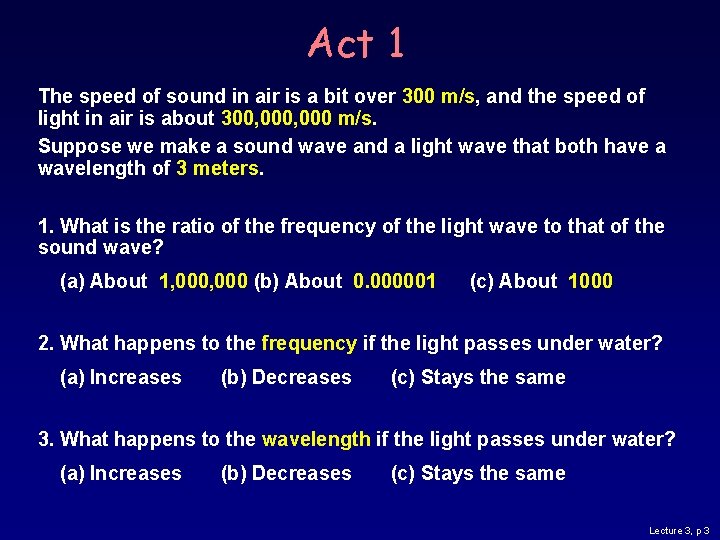
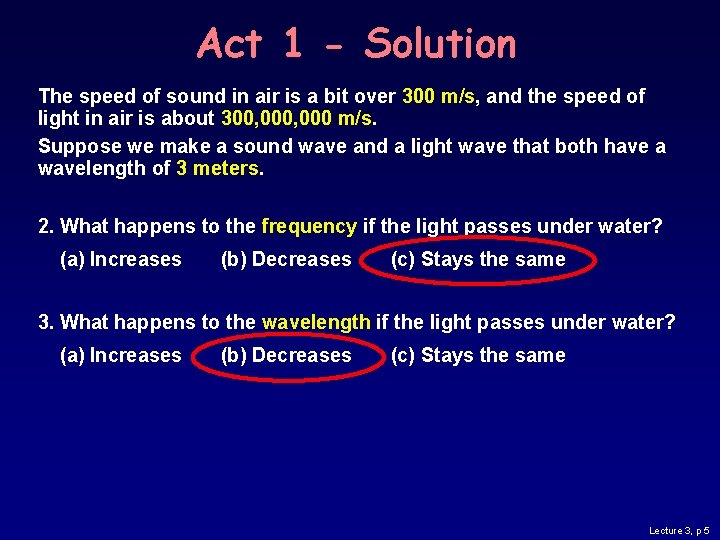
Act 1 The speed of sound in air is a bit over 300 m/s, and the speed of light in air is about 300, 000 m/s. Suppose we make a sound wave and a light wave that both have a wavelength of 3 meters. 1. What is the ratio of the frequency of the light wave to that of the sound wave? (a) About 1, 000 (b) About 0. 000001 (c) About 1000 2. What happens to the frequency if the light passes under water? (a) Increases (b) Decreases (c) Stays the same 3. What happens to the wavelength if the light passes under water? (a) Increases (b) Decreases (c) Stays the same Lecture 3, p 3
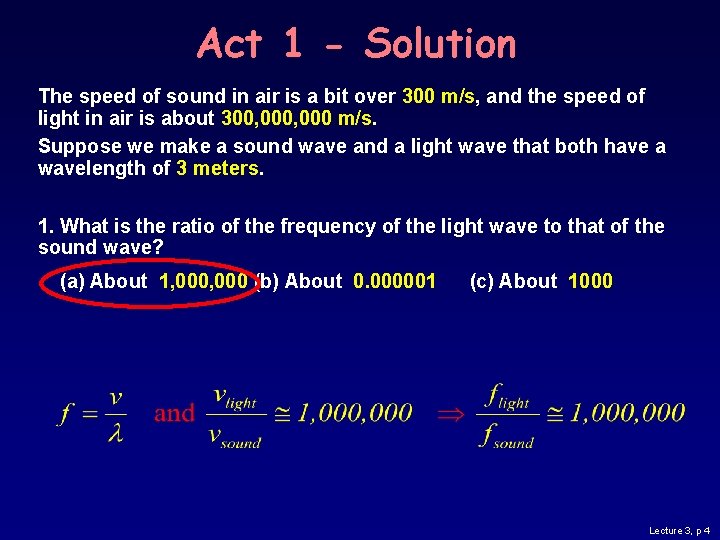
Act 1 - Solution The speed of sound in air is a bit over 300 m/s, and the speed of light in air is about 300, 000 m/s. Suppose we make a sound wave and a light wave that both have a wavelength of 3 meters. 1. What is the ratio of the frequency of the light wave to that of the sound wave? (a) About 1, 000 (b) About 0. 000001 (c) About 1000 Lecture 3, p 4
Act 1 - Solution The speed of sound in air is a bit over 300 m/s, and the speed of light in air is about 300, 000 m/s. Suppose we make a sound wave and a light wave that both have a wavelength of 3 meters. 2. What happens to the frequency if the light passes under water? (a) Increases (b) Decreases (c) Stays the same 3. What happens to the wavelength if the light passes under water? (a) Increases (b) Decreases (c) Stays the same Lecture 3, p 5
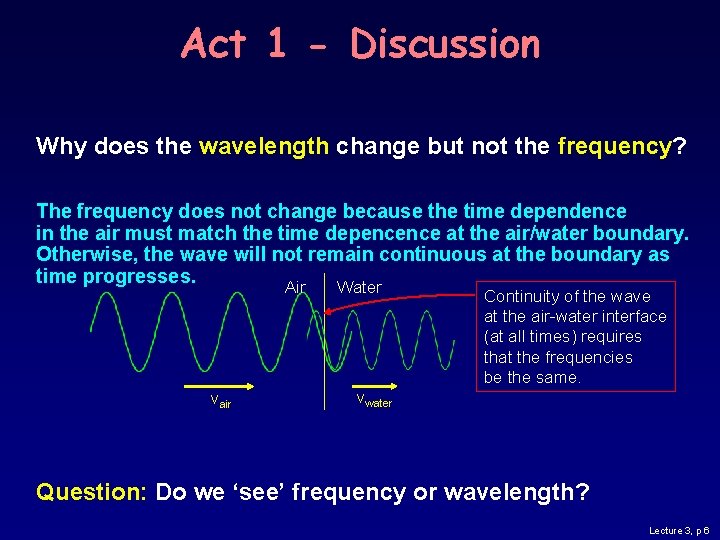
Act 1 - Discussion Why does the wavelength change but not the frequency? The frequency does not change because the time dependence in the air must match the time depencence at the air/water boundary. Otherwise, the wave will not remain continuous at the boundary as time progresses. Air Water Continuity of the wave at the air-water interface (at all times) requires that the frequencies be the same. vair vwater Question: Do we ‘see’ frequency or wavelength? Lecture 3, p 6
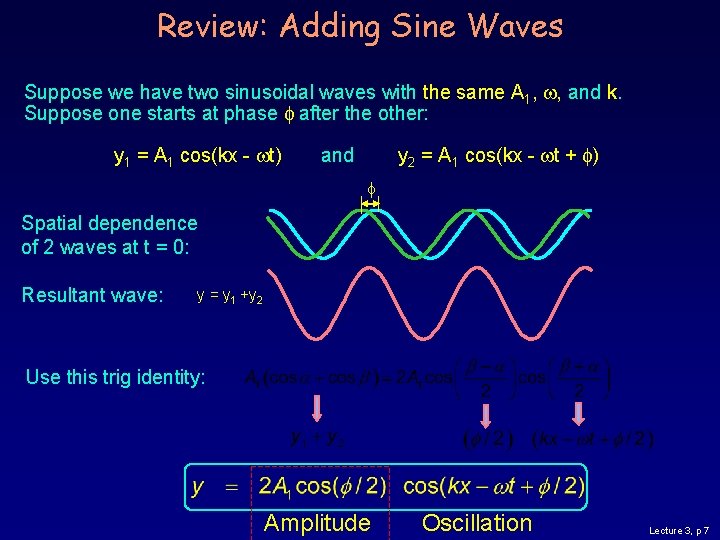
Review: Adding Sine Waves Suppose we have two sinusoidal waves with the same A 1, , and k. Suppose one starts at phase after the other: y 1 = A 1 cos(kx - t) y 2 = A 1 cos(kx - t + ) and Spatial dependence of 2 waves at t = 0: Resultant wave: y = y 1 +y 2 Use this trig identity: Amplitude Oscillation Lecture 3, p 7
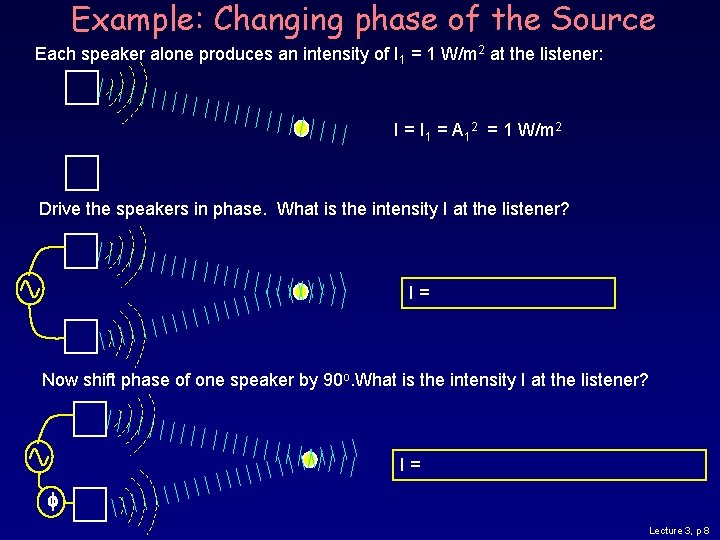
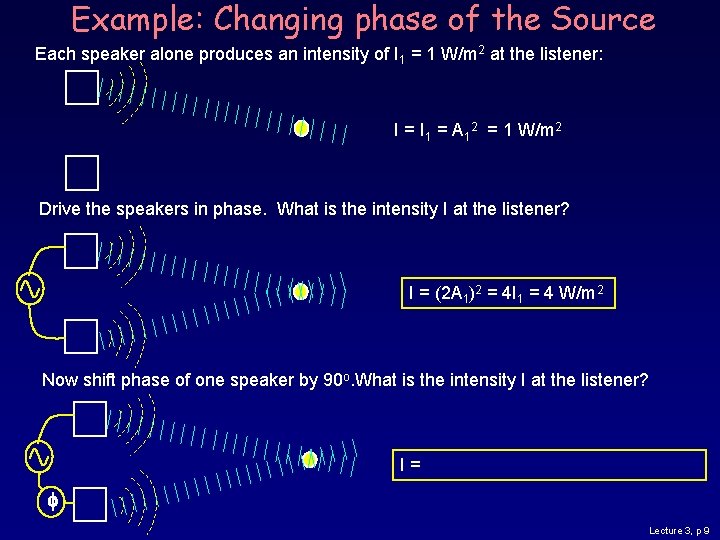
Example: Changing phase of the Source Each speaker alone produces an intensity of I 1 = 1 W/m 2 at the listener: I = I 1 = A 12 = 1 W/m 2 Drive the speakers in phase. What is the intensity I at the listener? I= Now shift phase of one speaker by 90 o. What is the intensity I at the listener? I= f Lecture 3, p 8
Example: Changing phase of the Source Each speaker alone produces an intensity of I 1 = 1 W/m 2 at the listener: I = I 1 = A 12 = 1 W/m 2 Drive the speakers in phase. What is the intensity I at the listener? I = (2 A 1)2 = 4 I 1 = 4 W/m 2 Now shift phase of one speaker by 90 o. What is the intensity I at the listener? I= f Lecture 3, p 9
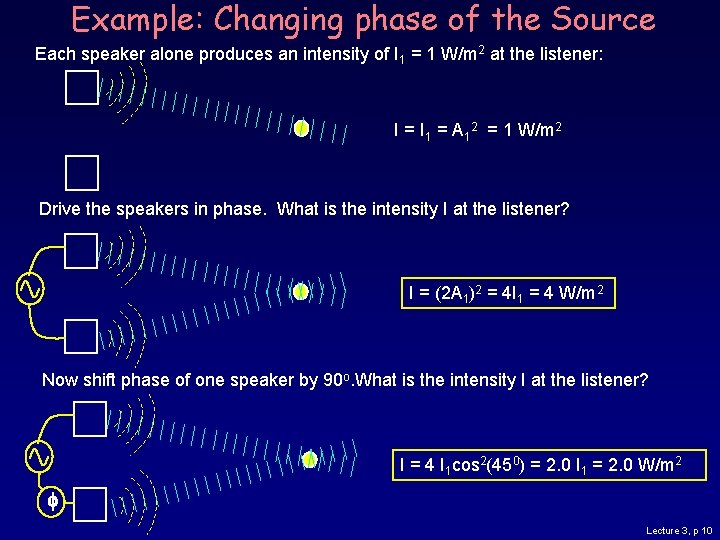
Example: Changing phase of the Source Each speaker alone produces an intensity of I 1 = 1 W/m 2 at the listener: I = I 1 = A 12 = 1 W/m 2 Drive the speakers in phase. What is the intensity I at the listener? I = (2 A 1)2 = 4 I 1 = 4 W/m 2 Now shift phase of one speaker by 90 o. What is the intensity I at the listener? I = 4 I 1 cos 2(450) = 2. 0 I 1 = 2. 0 W/m 2 f Lecture 3, p 10
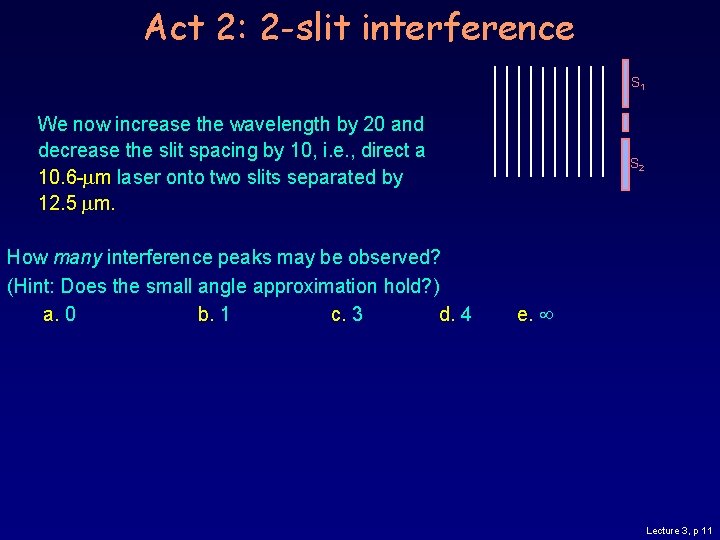
Act 2: 2 -slit interference S 1 We now increase the wavelength by 20 and decrease the slit spacing by 10, i. e. , direct a 10. 6 - m laser onto two slits separated by 12. 5 m. How many interference peaks may be observed? (Hint: Does the small angle approximation hold? ) a. 0 b. 1 c. 3 d. 4 S 2 e. Lecture 3, p 11
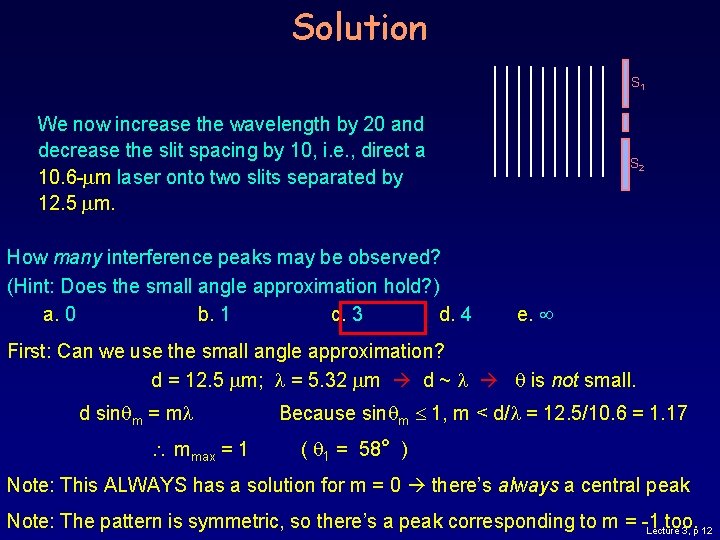
Solution S 1 We now increase the wavelength by 20 and decrease the slit spacing by 10, i. e. , direct a 10. 6 - m laser onto two slits separated by 12. 5 m. How many interference peaks may be observed? (Hint: Does the small angle approximation hold? ) a. 0 b. 1 c. 3 d. 4 S 2 e. First: Can we use the small angle approximation? d = 12. 5 m; l = 5. 32 m d ~ l q is not small. d sinqm = ml mmax = 1 Because sinqm 1, m < d/l = 12. 5/10. 6 = 1. 17 ( q 1 = 58° ) Note: This ALWAYS has a solution for m = 0 there’s always a central peak Note: The pattern is symmetric, so there’s a peak corresponding to m = -1 too. Lecture 3, p 12
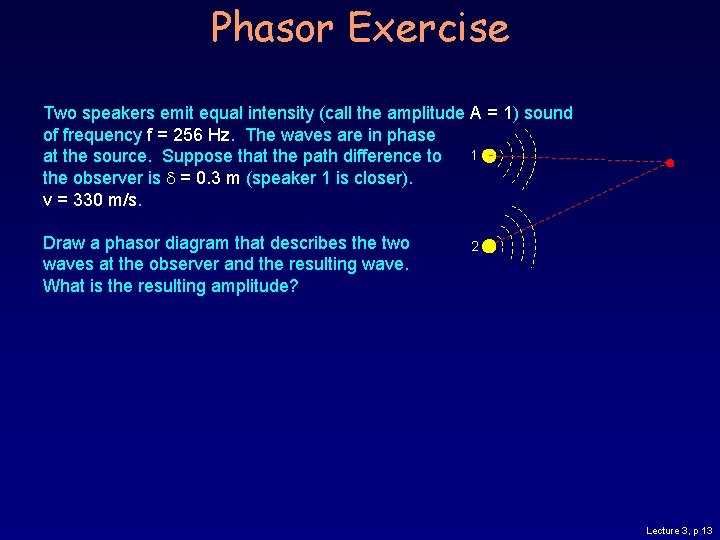
Phasor Exercise Two speakers emit equal intensity (call the amplitude A = 1) sound of frequency f = 256 Hz. The waves are in phase 1 at the source. Suppose that the path difference to the observer is d = 0. 3 m (speaker 1 is closer). v = 330 m/s. Draw a phasor diagram that describes the two waves at the observer and the resulting wave. What is the resulting amplitude? 2 Lecture 3, p 13
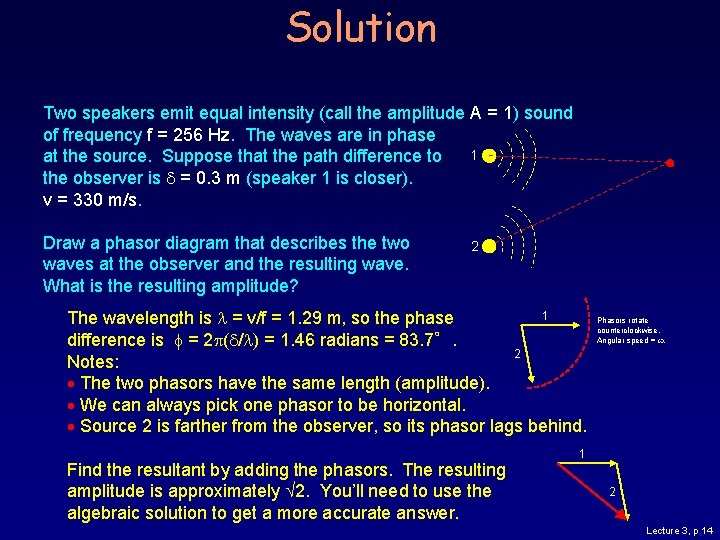
Solution Two speakers emit equal intensity (call the amplitude A = 1) sound of frequency f = 256 Hz. The waves are in phase 1 at the source. Suppose that the path difference to the observer is d = 0. 3 m (speaker 1 is closer). v = 330 m/s. Draw a phasor diagram that describes the two waves at the observer and the resulting wave. What is the resulting amplitude? 2 1 The wavelength is l = v/f = 1. 29 m, so the phase difference is = 2 p(d/l) = 1. 46 radians = 83. 7°. 2 Notes: The two phasors have the same length (amplitude). We can always pick one phasor to be horizontal. Source 2 is farther from the observer, so its phasor lags behind. Find the resultant by adding the phasors. The resulting amplitude is approximately 2. You’ll need to use the algebraic solution to get a more accurate answer. Phasors rotate counterclockwise. Angular speed = . 1 2 Lecture 3, p 14
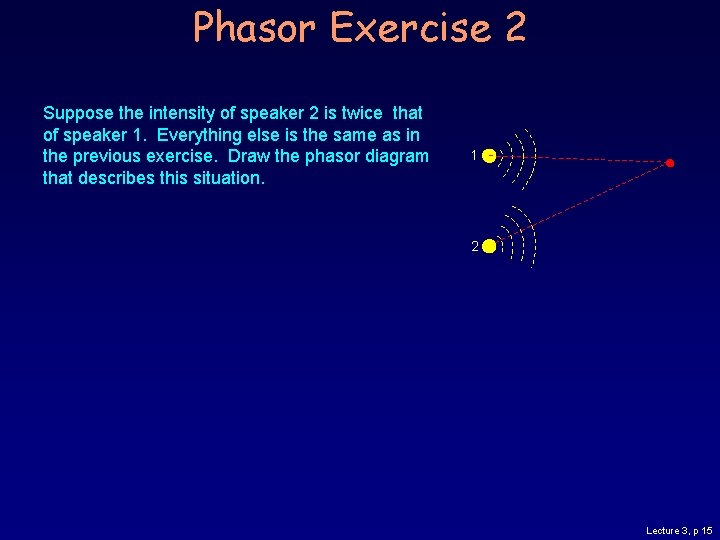
Phasor Exercise 2 Suppose the intensity of speaker 2 is twice that of speaker 1. Everything else is the same as in the previous exercise. Draw the phasor diagram that describes this situation. 1 2 Lecture 3, p 15
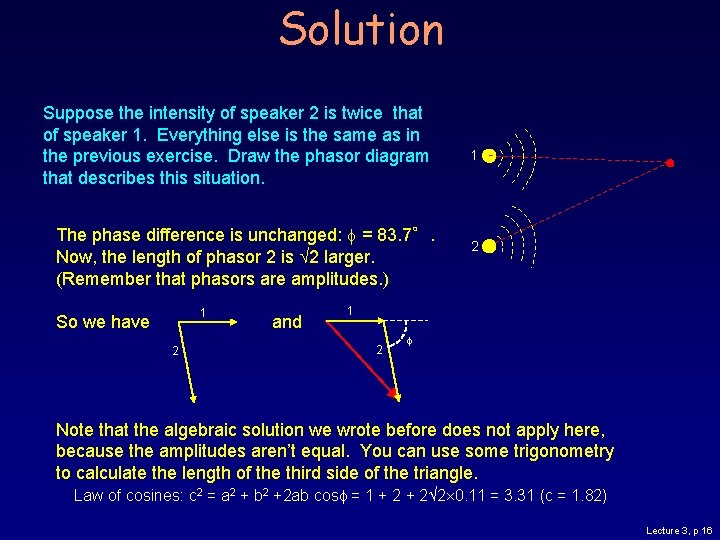
Solution Suppose the intensity of speaker 2 is twice that of speaker 1. Everything else is the same as in the previous exercise. Draw the phasor diagram that describes this situation. The phase difference is unchanged: = 83. 7°. Now, the length of phasor 2 is 2 larger. (Remember that phasors are amplitudes. ) 1 So we have 2 and 1 2 Note that the algebraic solution we wrote before does not apply here, because the amplitudes aren’t equal. You can use some trigonometry to calculate the length of the third side of the triangle. Law of cosines: c 2 = a 2 + b 2 +2 ab cos = 1 + 2 2 0. 11 = 3. 31 (c = 1. 82) Lecture 3, p 16
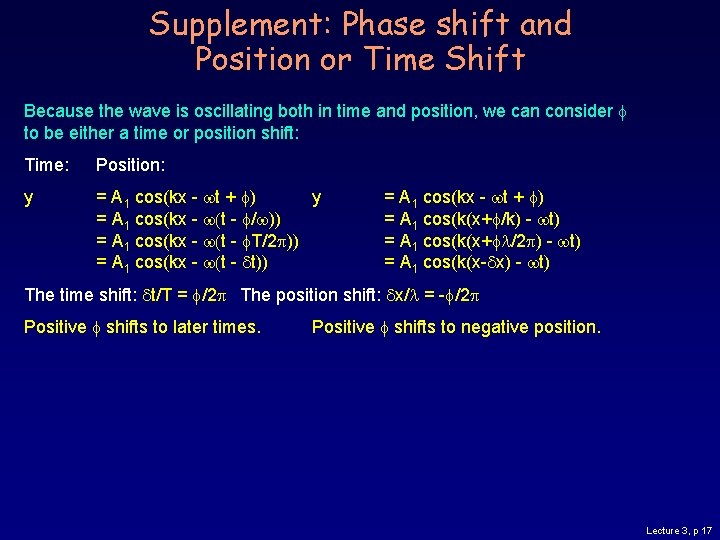
Supplement: Phase shift and Position or Time Shift Because the wave is oscillating both in time and position, we can consider to be either a time or position shift: Time: Position: y = A 1 cos(kx - t + ) y = A 1 cos(kx - (t - / )) = A 1 cos(kx - (t - T/2 p)) = A 1 cos(kx - (t - dt)) = A 1 cos(kx - t + ) = A 1 cos(k(x+ /k) - t) = A 1 cos(k(x+ l/2 p) - t) = A 1 cos(k(x-dx) - t) The time shift: dt/T = /2 p The position shift: dx/l = - /2 p Positive shifts to later times. Positive shifts to negative position. Lecture 3, p 17
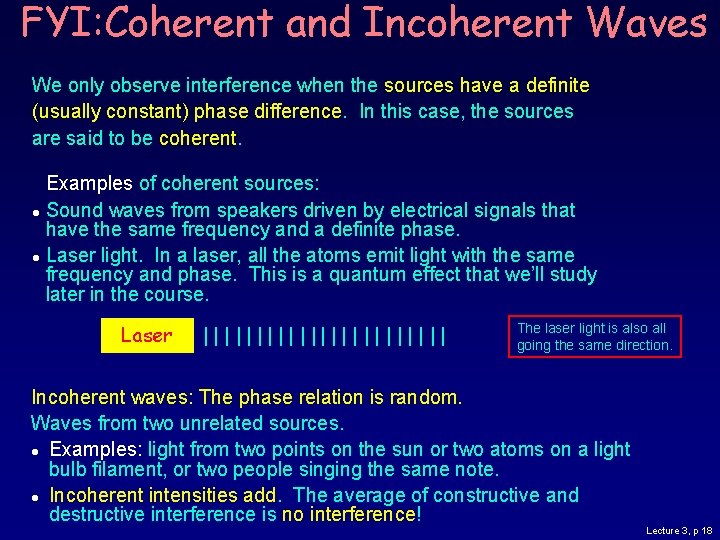
FYI: Coherent and Incoherent Waves We only observe interference when the sources have a definite (usually constant) phase difference. In this case, the sources are said to be coherent. Examples of coherent sources: l Sound waves from speakers driven by electrical signals that have the same frequency and a definite phase. l Laser light. In a laser, all the atoms emit light with the same frequency and phase. This is a quantum effect that we’ll study later in the course. Laser The laser light is also all going the same direction. Incoherent waves: The phase relation is random. Waves from two unrelated sources. l Examples: light from two points on the sun or two atoms on a light bulb filament, or two people singing the same note. l Incoherent intensities add. The average of constructive and destructive interference is no interference! Lecture 3, p 18
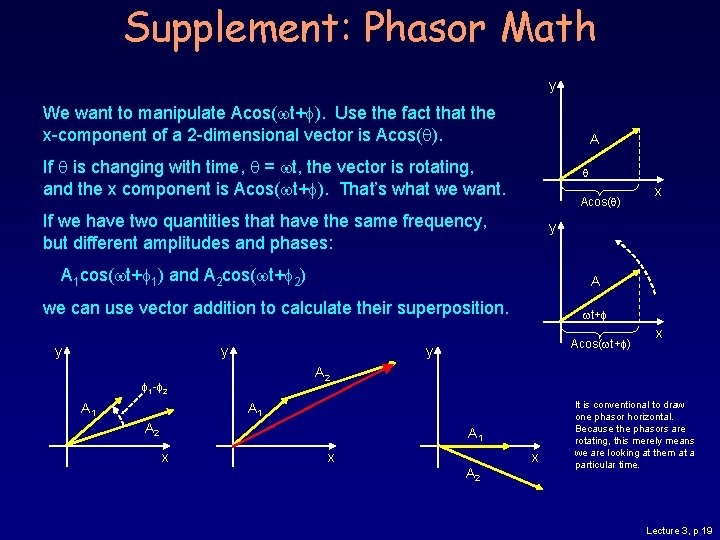
Supplement: Phasor Math y We want to manipulate Acos( t+ ). Use the fact that the x-component of a 2 -dimensional vector is Acos(q). A If q is changing with time, q = t, the vector is rotating, and the x component is Acos( t+ ). That’s what we want. q Acos(q) If we have two quantities that have the same frequency, but different amplitudes and phases: y A 1 cos( t+ 1) and A 2 cos( t+ 2) A we can use vector addition to calculate their superposition. y y t+ Acos( t+ ) y A 1 A 2 A 1 x x A 2 1 - 2 A 1 x x x A 2 It is conventional to draw one phasor horizontal. Because the phasors are rotating, this merely means we are looking at them at a particular time. Lecture 3, p 19