
Lecture 3 Resemblance Between Relatives Heritability Central concept
Lecture 3: Resemblance Between Relatives
Heritability • Central concept in quantitative genetics • Proportion of variation due to additive genetic values (Breeding values) – h 2 = VA/VP – Phenotypes (and hence VP) can be directly measured – Breeding values (and hence VA ) must be estimated • Estimates of VA require known collections of relatives

Ancestral. Collateral relatives, e. g. , parent offspring e. g. and sibs

Half-sibs Full-sibs
Key observations • The amount of phenotypic resemblance among relatives for the trait provides an indication of the amount of genetic variation for the trait. • If trait variation has a significant genetic basis, the closer the relatives, the more similar their appearance
Genetic Covariance between relatives Sharing meansarise having alleles two thatrelated are Genetic alleles covariances because identical by are descent both copies of than individuals more(IBD): likely to share alleles can two be traced backindividuals. to a single copy in a are unrelated recent common ancestor. One allele IBD No alleles Both IBD alleles IBD
Regressions and ANOVA • Parent-offspring regression – Single parent vs. midparent – Parent-offspring covariance is a intraclass (between class) covariance • Sibs – Covariances between sibs is an interclass (within class) covariance
ANOVA • Two key ANOVA identities – Total variance = between-group variance + within-group variance • Var(T) = Var(B) + Var(W) – Variance(between groups) = covariance (within groups) – Intraclass correlation, t = Var(B)/Var(T)
Situation 1 Var(B) = 2. 5 Var(W) = 0. 2 Var(T) = 2. 7 t = 2. 5/2. 7 = 0. 93 Situation 2 Var(B) = 0 Var(W) = 2. 7 Var(T) = 2. 7 t=0
Parent-offspring genetic covariance Cov(Gp, Go) --- Parents and offspring share EXACTLY one allele IBD Denote this common allele by A 1 IBD allele Non-IBD alleles
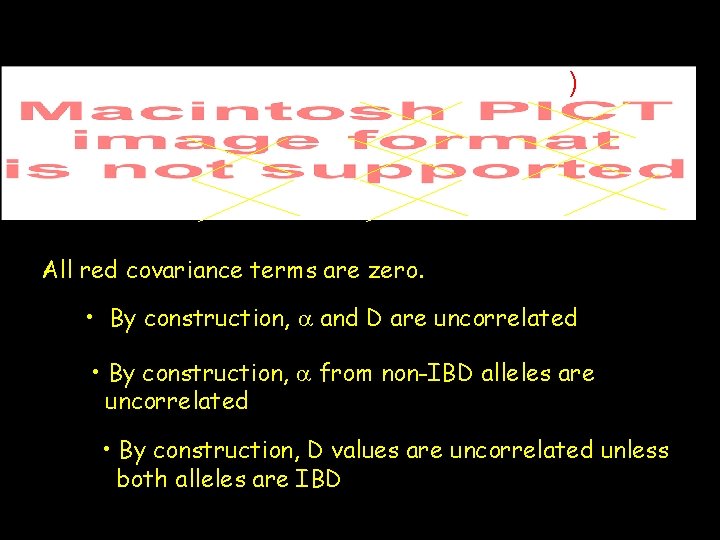
) All red covariance terms are zero. • By construction, a and D are uncorrelated • By construction, a from non-IBD alleles are uncorrelated • By construction, D values are uncorrelated unless both alleles are IBD
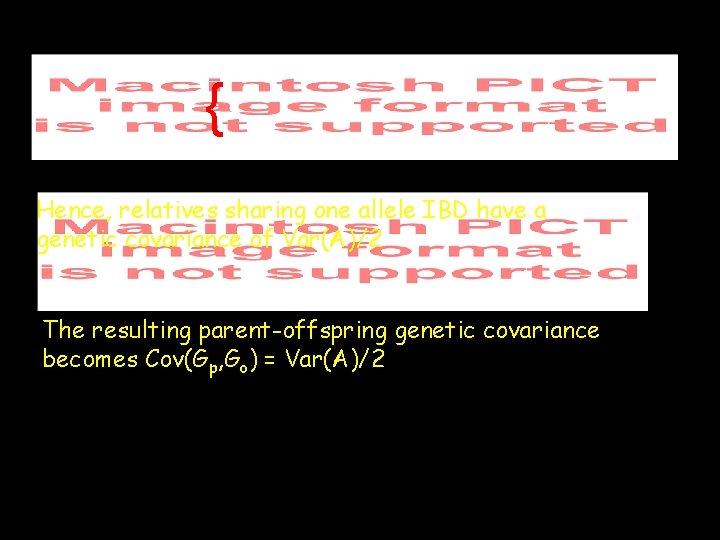
{ Hence, relatives sharing one allele IBD have a genetic covariance of Var(A)/2 The resulting parent-offspring genetic covariance becomes Cov(Gp, Go) = Var(A)/2
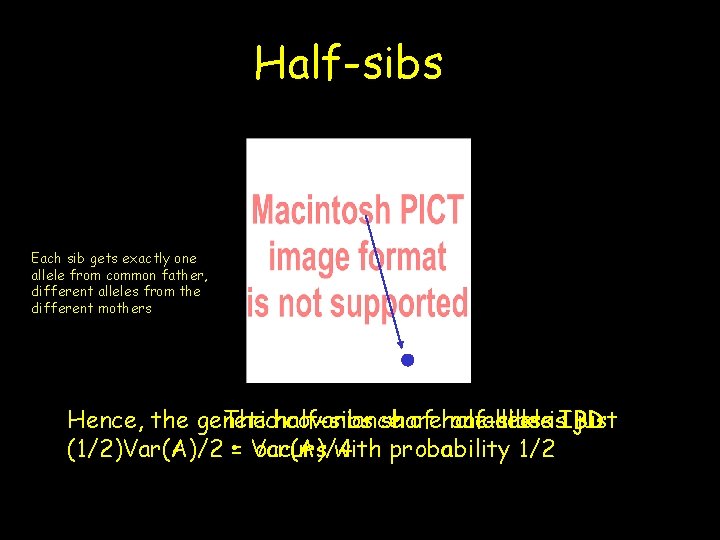
Half-sibs Each sib gets exactly one allele from common father, different alleles from the different mothers Hence, the genetic The half-sibs covariance share of half-sibs no onealleles alleleis. IBD just (1/2)Var(A)/2 • = Var(A)/4 occurs with probability 1/2
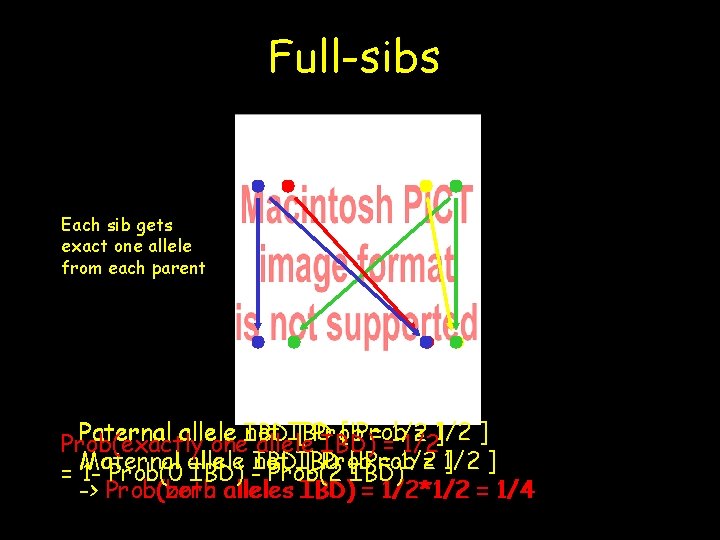
Full-sibs Each sib gets exact one allele from each parent not IBD [ Prob = 1/2 ] Paternal allele [ Prob(exactly one. IBD allele IBD)==1/2 1/2] not IBD [ Prob = 1/2 ] ] = Maternal 1 - Prob(0 allele IBD) -IBD Prob(2 IBD) Prob(zero alleles IBD) = 1/2*1/2 = 1/4 -> Prob(both
Resulting Genetic Covariance between full-sibs If both alleles Cov(Full-sibs) IBD, cov(Gsib 1, =GVar(A)/2 sib 2 )= + Var(D)/4 cov(ax+ay+dxy, ax+ay+dxy ) = cov(ax+ay, ax+ay) + cov(dxy, dxy) = Var(A) + Var(D)
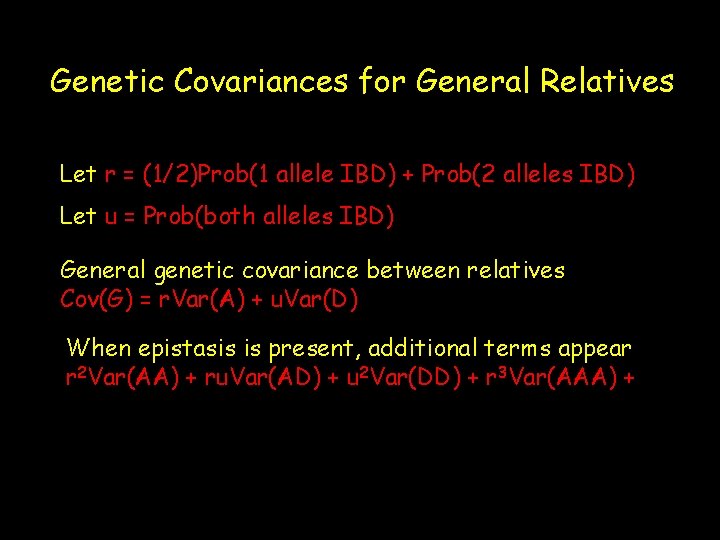
Genetic Covariances for General Relatives Let r = (1/2)Prob(1 allele IBD) + Prob(2 alleles IBD) Let u = Prob(both alleles IBD) General genetic covariance between relatives Cov(G) = r. Var(A) + u. Var(D) When epistasis is present, additional terms appear r 2 Var(AA) + ru. Var(AD) + u 2 Var(DD) + r 3 Var(AAA) +
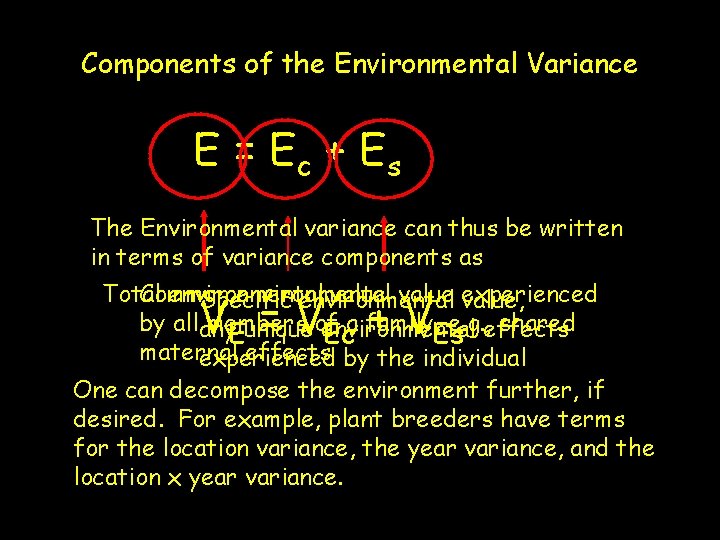
Components of the Environmental Variance E = Ec + Es The Environmental variance can thus be written in terms of variance components as Total environmental value experienced Common environmental Specific environmental value, by all any members of a family, e. g. , effects shared unique environmental E Ec Es maternal effects experienced by the individual One can decompose the environment further, if desired. For example, plant breeders have terms for the location variance, the year variance, and the location x year variance. V =V +V
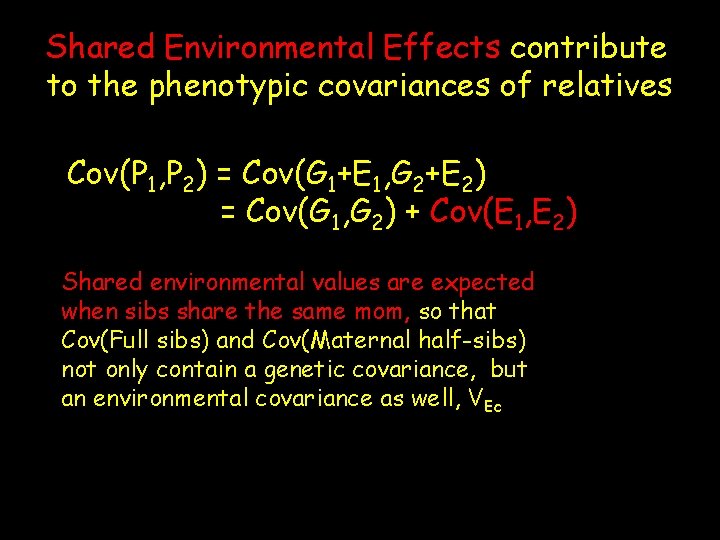
Shared Environmental Effects contribute to the phenotypic covariances of relatives Cov(P 1, P 2) = Cov(G 1+E 1, G 2+E 2) = Cov(G 1, G 2) + Cov(E 1, E 2) Shared environmental values are expected when sibs share the same mom, so that Cov(Full sibs) and Cov(Maternal half-sibs) not only contain a genetic covariance, but an environmental covariance as well, VEc
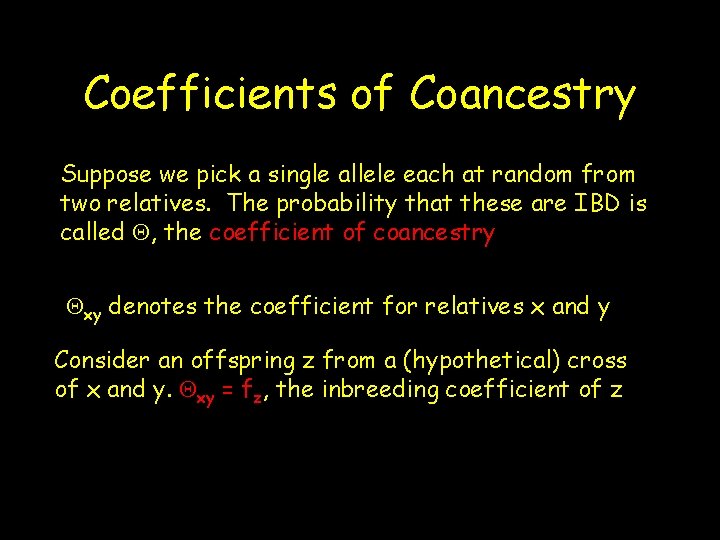
Coefficients of Coancestry Suppose we pick a single allele each at random from two relatives. The probability that these are IBD is called Q, the coefficient of coancestry Qxy denotes the coefficient for relatives x and y Consider an offspring z from a (hypothetical) cross of x and y. Qxy = fz, the inbreeding coefficient of z
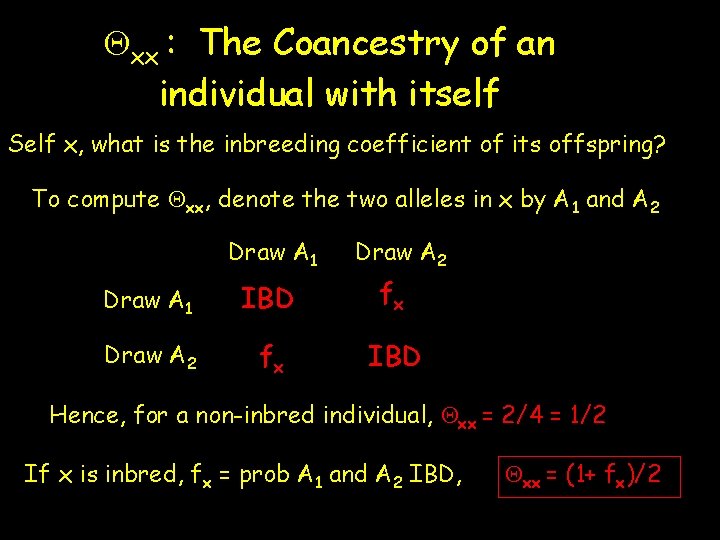
Qxx : The Coancestry of an individual with itself Self x, what is the inbreeding coefficient of its offspring? To compute Qxx, denote the two alleles in x by A 1 and A 2 Draw A 1 Draw A 2 Draw A 1 IBD fx Draw A 2 fx IBD Hence, for a non-inbred individual, Qxx = 2/4 = 1/2 If x is inbred, fx = prob A 1 and A 2 IBD, Qxx = (1+ fx)/2
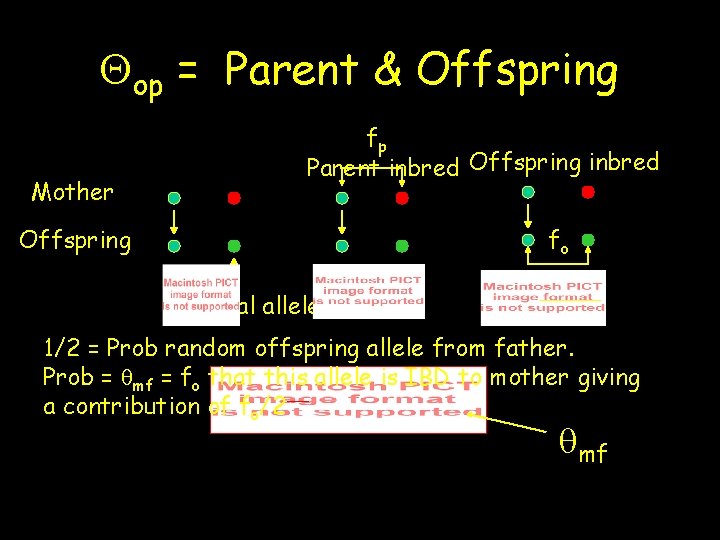
Qop = Parent & Offspring Mother fp Parent inbred Offspring fo Parental allele 1/2 = Prob random offspring allele from father. Prob = qmf = fo that this allele is IBD to mother giving a contribution of fo/2 qmf
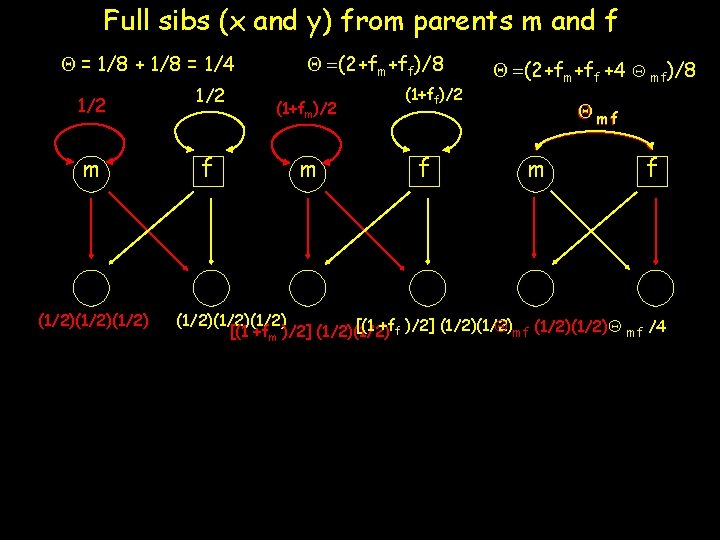
Full sibs (x and y) from parents m and f Q = 1/8 + 1/8 = 1/4 1/2 m (1/2)(1/2) 1/2 f Q =(2+fm+ff)/8 (1+fm)/2 m (1+ff)/2 f Q =(2+fm+ff +4 Q mf)/8 Q mf m f (1/2)(1/2) [(1 +ff )/2] (1/2)(1/2) Q mf /4 [(1 +fm )/2] (1/2)
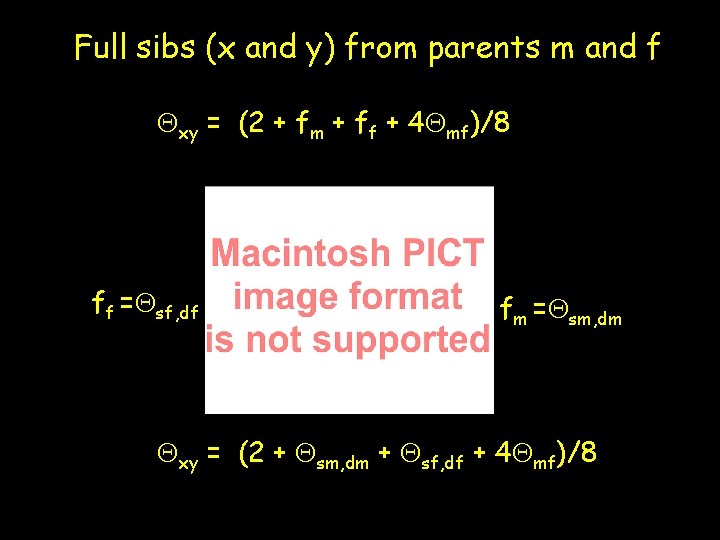
Full sibs (x and y) from parents m and f Qxy = (2 + fm + ff + 4 Qmf)/8 ff =Qsf, df fm =Qsm, dm Qxy = (2 + Qsm, dm + Qsf, df + 4 Qmf)/8
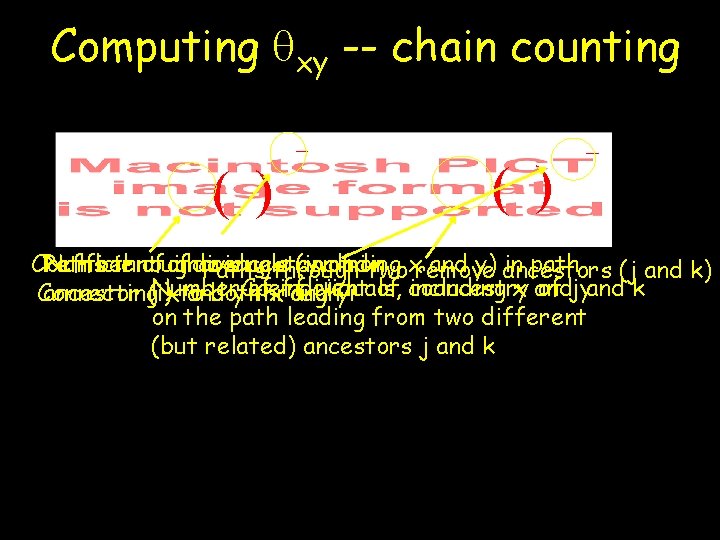
Computing qxy -- chain counting ( ) Coefficient Paths Number through ofof individuals coancestry a single (including common of i twoxremove and y) ancestors in path Paths through (j and k) Number of including x and of j yand k Connecting ancestor (i) xto and both y. Coefficient through xindividuals, and yi of coancestry on the path leading from two different (but related) ancestors j and k
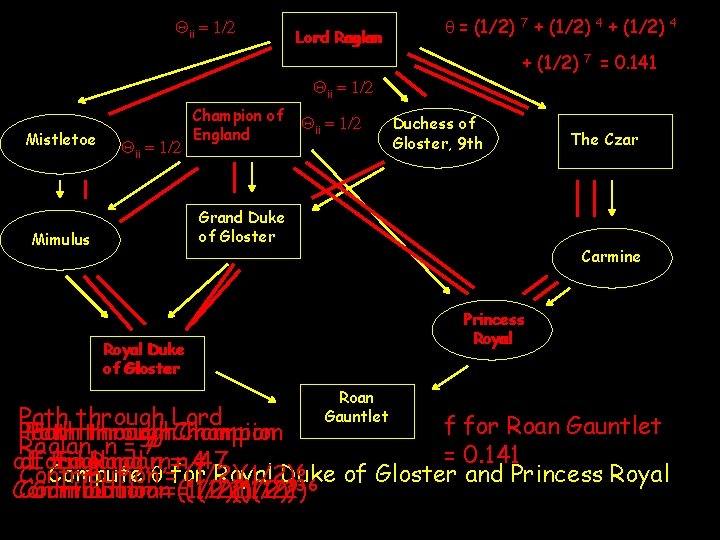
Qii = 1/2 Lord Raglan q = (1/2) 7 + (1/2) 7 4 + (1/2) = 0. 141 Qii = 1/2 Mistletoe Qii = 1/2 Champion of England Qii = 1/2 Duchess of Gloster, 9 th Grand Duke of Gloster Mimulus The Czar Carmine Princess Royal Duke of Gloster Roan Gauntlet Path through Lord f for Roan Gauntlet Path through Champion Paththrough. Champion Path Raglan, n = 7 = 0. 141 of England, nn=n=4=4 7 Lord Raglan, of England, 6 Compute q =for Royal Duke of Gloster and Princess Royal Contribution (1/2) 3 6 3 Contribution === (1/2)(1/2) Contribution (1/2) 4
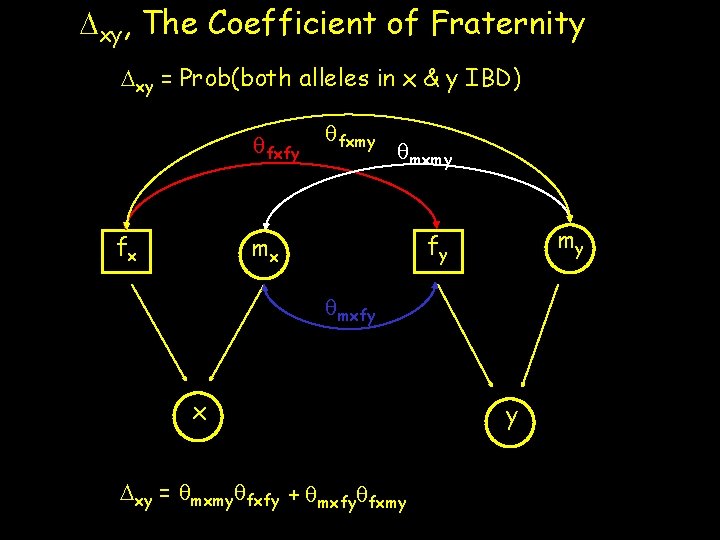
Dxy, The Coefficient of Fraternity Dxy = Prob(both alleles in x & y IBD) qfxfy fx qfxmy qmxmy my fy mx qmxfy x Dxy = qmxmyqfxfy + qmxfyqfxmy y
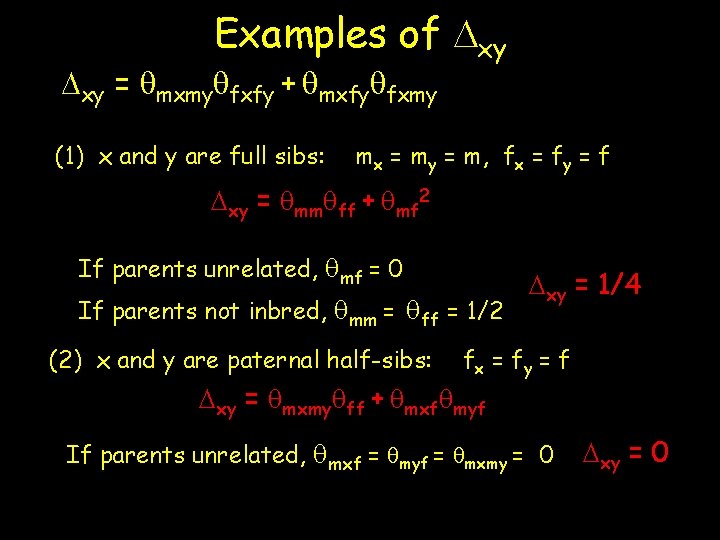
Examples of Dxy = qmxmyqfxfy + qmxfyqfxmy (1) x and y are full sibs: mx = my = m, fx = fy = f Dxy = qmmqff + qmf 2 If parents unrelated, qmf = 0 If parents not inbred, qmm = qff = 1/2 (2) x and y are paternal half-sibs: Dxy = 1/4 fx = f y = f Dxy = qmxmyqff + qmxfqmyf If parents unrelated, qmxf = qmyf = qmxmy = 0 Dxy = 0
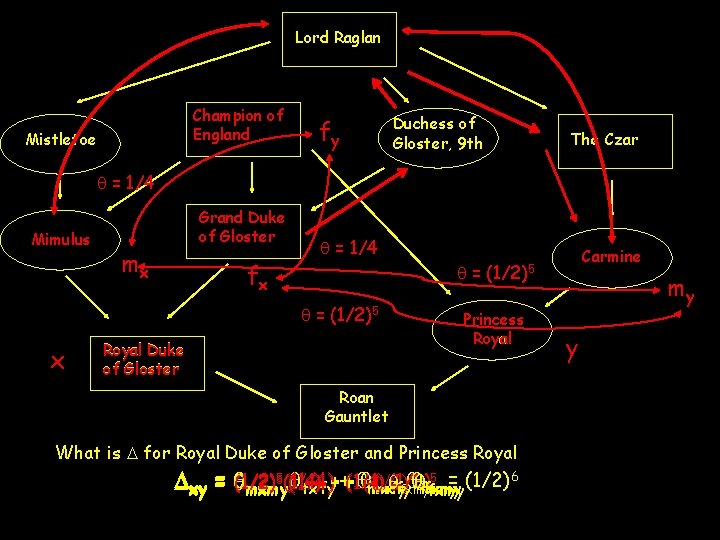
Lord Raglan Champion of England Mistletoe fy Duchess of Gloster, 9 th The Czar q = 1/4 Mimulus Grand Duke of Gloster mx fx q = 1/4 q = (1/2)5 x Royal Duke of Gloster q= Carmine (1/2)5 Princess Royal Roan Gauntlet What is D for Royal Duke of Gloster and Princess Royal 5 = (1/2)6 5 q Dxy = q(1/2) (1/4) qqqfxmy q(1/2) (1/4) fxmy mxmy(1/4) fxfy+++ mxfy fxmy my y
General Resemblance between relatives D D D
- Slides: 29