
Lecture 3 Quantization ESE 150 DIGITAL AUDIO BASICS
Lecture #3 – Quantization ESE 150 – DIGITAL AUDIO BASICS Based on slides © 2009 --2021 Koditschek & De. Hon Additional Material © 2014 --2017 Farmer 1
LECTURE TOPICS � � � � Reminder: Sampling and Quantization Expressing Mathematically <interlude: image resolution> Effects of Quantization System Capacity Summary References 2
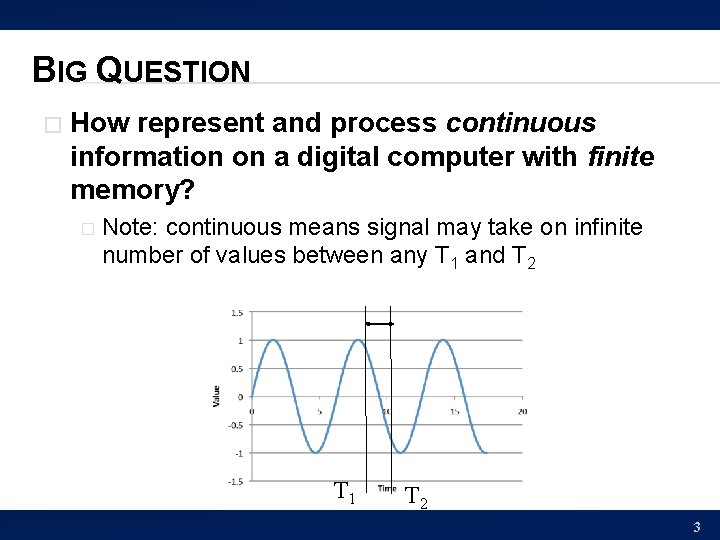
BIG QUESTION � How represent and process continuous information on a digital computer with finite memory? � Note: continuous means signal may take on infinite number of values between any T 1 and T 2 T 1 T 2 3
STRATEGY � Sample at periodic time intervals � � Discretize independent variable Quantize to discrete levels � Discretize the value of the dependent variable 4
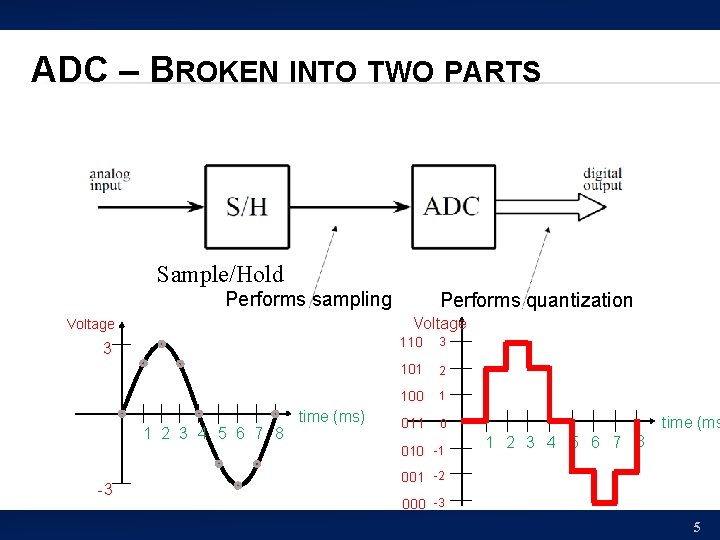
ADC – BROKEN INTO TWO PARTS Sample/Hold Performs sampling Performs quantization Voltage 3 1 2 3 4 5 6 7 8 time (ms) 110 3 101 2 100 1 011 0 010 -1 -3 time (ms 1 2 3 4 5 6 7 8 001 -2 000 -3 5
PROBLEM DECOMPOSITION � Powerful Engineering technique Formulate a parameterized solution strategy � Then identify the right parameters � Divides the problem � Here � Strategy of sampling and quantization � Then identify the right sampling rate, quantization level � Convergent: limit of infinite samples, levels � Once have strategy, reduces to a well-defined optimization problem � Parameterization admits to tuning for tradeoffs � 6
MATHEMATICAL EXPRESSION 7
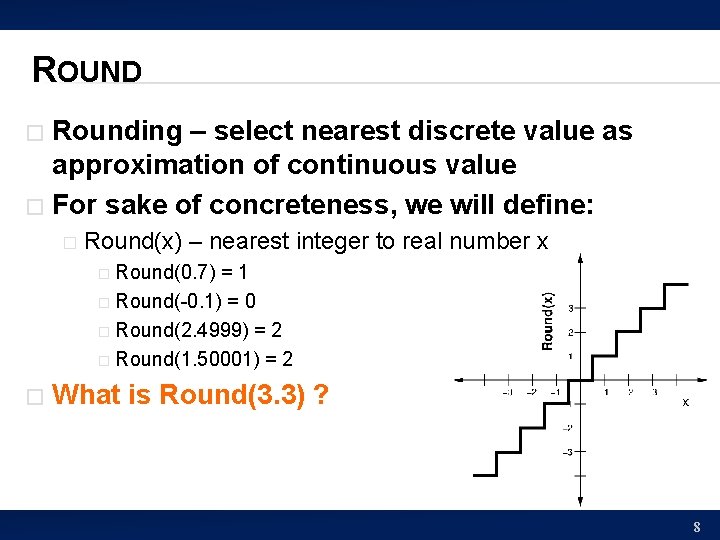
ROUND Rounding – select nearest discrete value as approximation of continuous value � For sake of concreteness, we will define: � � Round(x) – nearest integer to real number x � Round(0. 7) =1 � Round(-0. 1) = 0 � Round(2. 4999) = 2 � Round(1. 50001) = 2 � What is Round(3. 3) ? 8

QUANTIZE We will quantize to some level L � Define as number of values between integers � So, we have L steps of 1/L between integers � � � (or only represent every L’th integer if L<1) In terms of Round Quantize. L(x) = Round(L*x)/L � E. g. Quantize 8(0. 7)=Round(8*0. 7)/8=6/8=0. 75 � 9
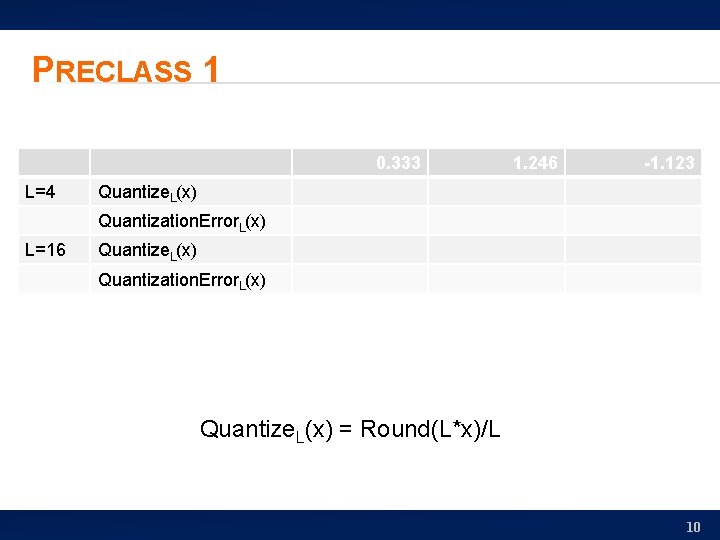
PRECLASS 1 0. 333 L=4 1. 246 -1. 123 Quantize. L(x) Quantization. Error. L(x) L=16 Quantize. L(x) Quantization. Error. L(x) Quantize. L(x) = Round(L*x)/L 10
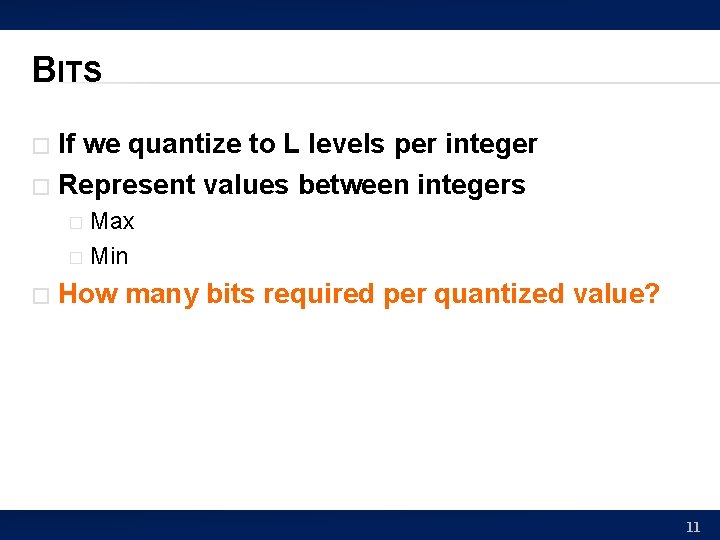
BITS If we quantize to L levels per integer � Represent values between integers � Max � Min � � How many bits required per quantized value? 11
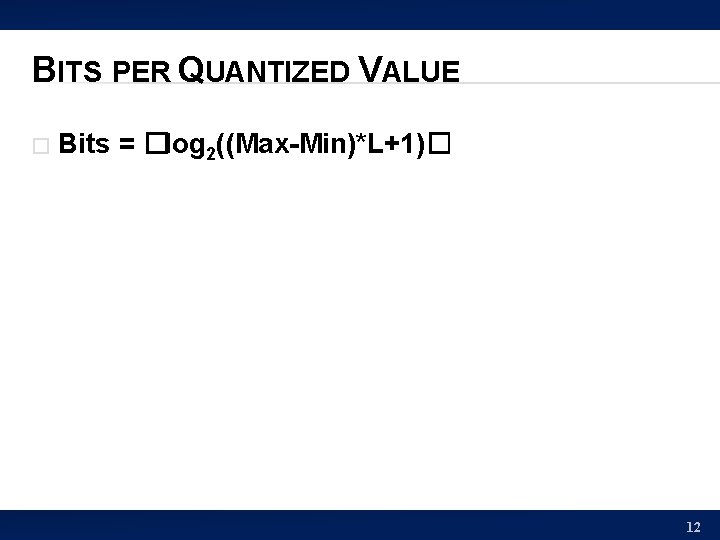
BITS PER QUANTIZED VALUE � Bits = �log 2((Max-Min)*L+1)� 12
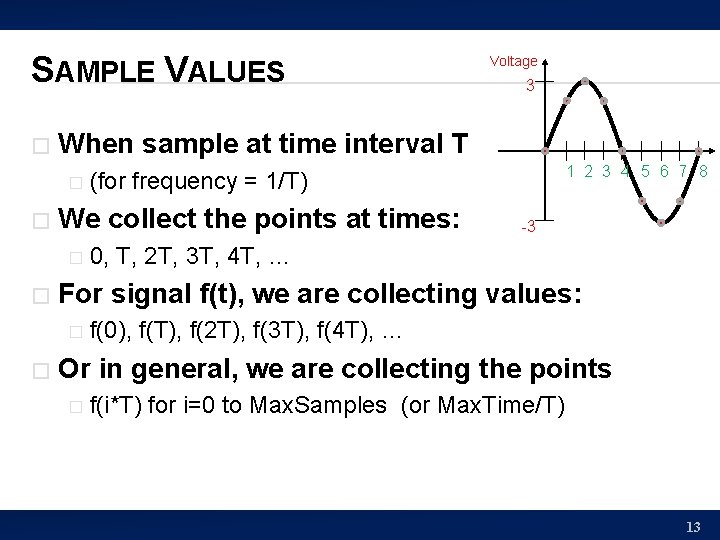
SAMPLE VALUES � -3 0, T, 2 T, 3 T, 4 T, … For signal f(t), we are collecting values: � � 1 2 3 4 5 6 7 8 (for frequency = 1/T) We collect the points at times: � � 3 When sample at time interval T � � Voltage f(0), f(T), f(2 T), f(3 T), f(4 T), … Or in general, we are collecting the points � f(i*T) for i=0 to Max. Samples (or Max. Time/T) 13
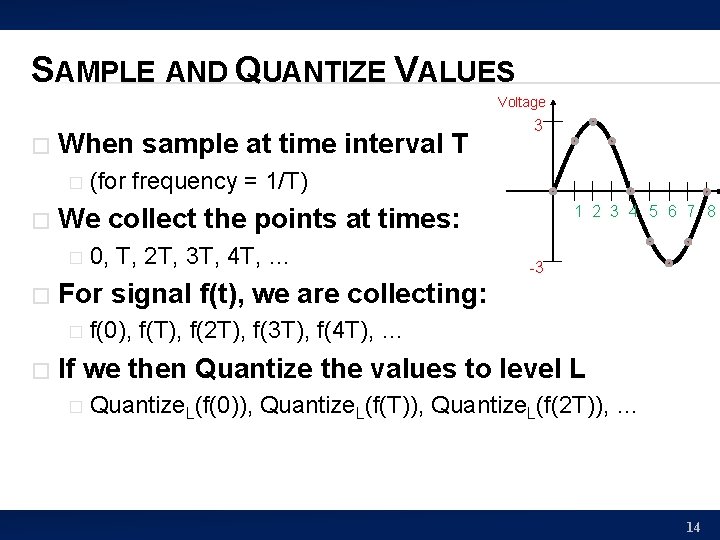
SAMPLE AND QUANTIZE VALUES Voltage � When sample at time interval T � � 1 2 3 4 5 6 7 8 0, T, 2 T, 3 T, 4 T, … -3 For signal f(t), we are collecting: � � (for frequency = 1/T) We collect the points at times: � � 3 f(0), f(T), f(2 T), f(3 T), f(4 T), … If we then Quantize the values to level L � Quantize. L(f(0)), Quantize. L(f(T)), Quantize. L(f(2 T)), … 14
SAMPLE AND QUANTIZE VALUES � If we then Quantize the values to level L � � Or in general, we are collecting the points � � Quantize. L(f(0)), Quantize. L(f(T)), Quantize. L(f(2 T)), … Quantize. L(f(i*T)) for i=0 to Max. Samples (or Max. Time/T) We store them in an array (or vector) F of Max. Samples+1 � For i from 0 to Max. Samples: F[i]= Quantize. L(f(i*T)) � This is what you collected on Monday! 15
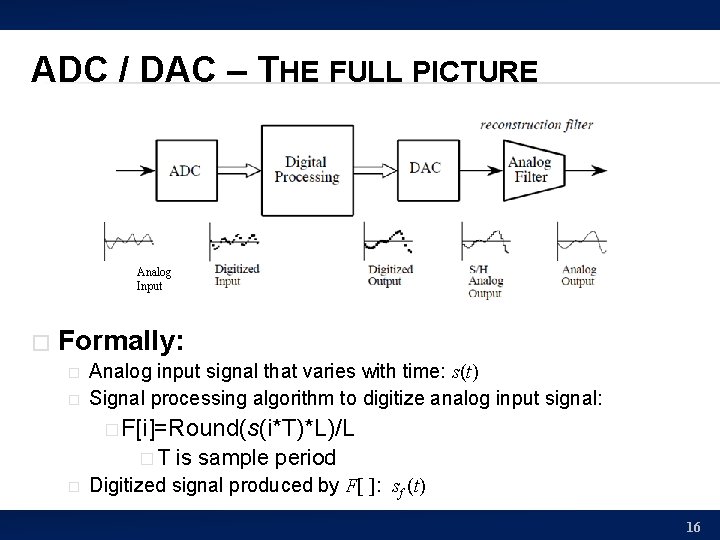
ADC / DAC – THE FULL PICTURE Analog Input � Formally: � � Analog input signal that varies with time: s(t) Signal processing algorithm to digitize analog input signal: � F[i]=Round(s(i*T)*L)/L �T � is sample period Digitized signal produced by F[ ]: sf (t) 16
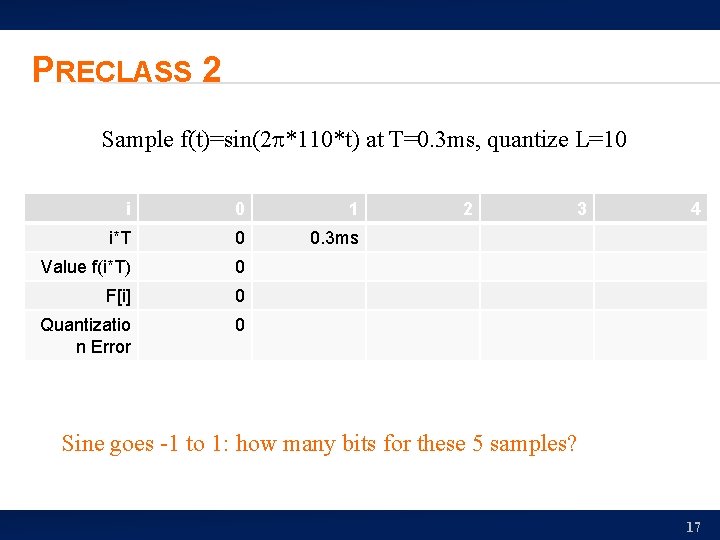
PRECLASS 2 Sample f(t)=sin(2 p*110*t) at T=0. 3 ms, quantize L=10 i 0 1 i*T 0 0. 3 ms Value f(i*T) 0 F[i] 0 Quantizatio n Error 0 2 3 4 Sine goes -1 to 1: how many bits for these 5 samples? 17
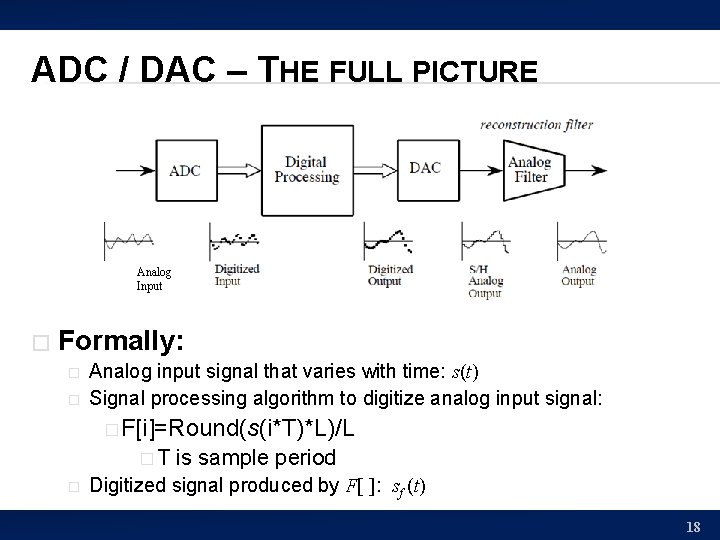
ADC / DAC – THE FULL PICTURE Analog Input � Formally: � � Analog input signal that varies with time: s(t) Signal processing algorithm to digitize analog input signal: � F[i]=Round(s(i*T)*L)/L �T � is sample period Digitized signal produced by F[ ]: sf (t) 18
INTERLUDE: 2 D IMAGES 19
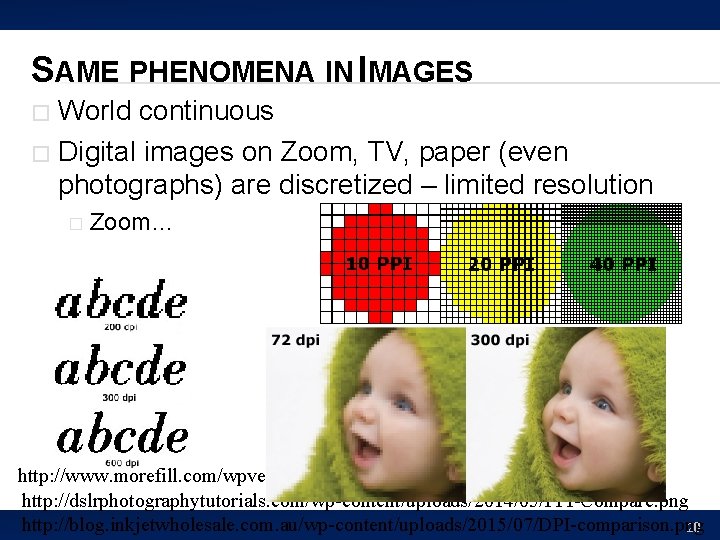
SAME PHENOMENA IN IMAGES World continuous � Digital images on Zoom, TV, paper (even photographs) are discretized – limited resolution � � Zoom… http: //www. morefill. com/wpver/wp-content/uploads/2015/08/DPI-abcde. jpg http: //dslrphotographytutorials. com/wp-content/uploads/2014/05/PPI-Compare. png http: //blog. inkjetwholesale. com. au/wp-content/uploads/2015/07/DPI-comparison. png 20
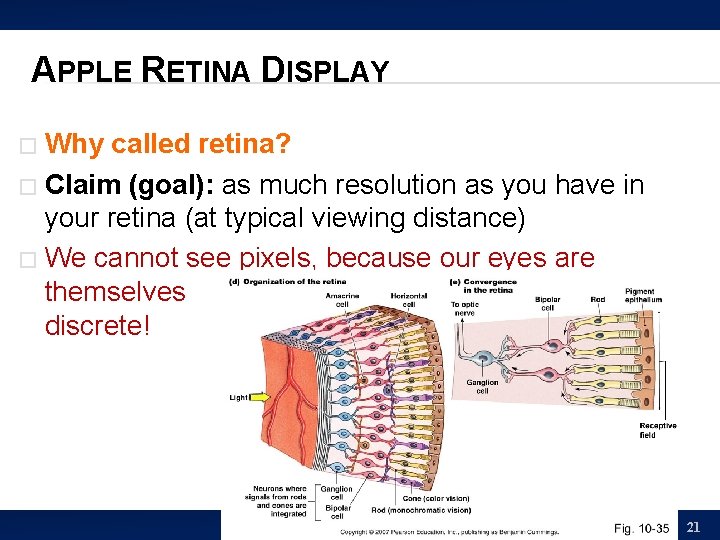
APPLE RETINA DISPLAY Why called retina? � Claim (goal): as much resolution as you have in your retina (at typical viewing distance) � We cannot see pixels, because our eyes are themselves discrete! � 21
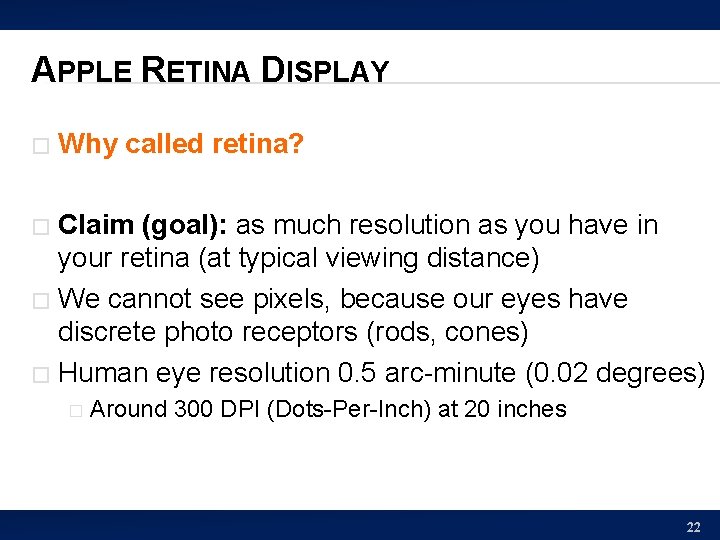
APPLE RETINA DISPLAY � Why called retina? Claim (goal): as much resolution as you have in your retina (at typical viewing distance) � We cannot see pixels, because our eyes have discrete photo receptors (rods, cones) � Human eye resolution 0. 5 arc-minute (0. 02 degrees) � � Around 300 DPI (Dots-Per-Inch) at 20 inches 22
EFFECTS OF QUANTIZATION 23
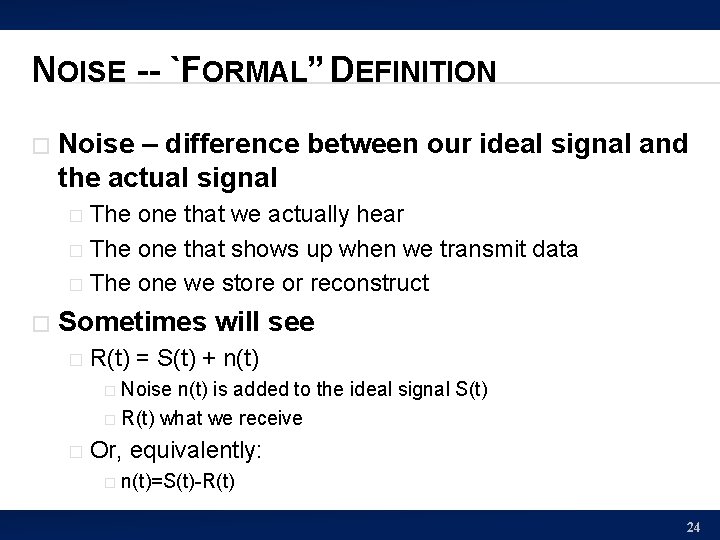
NOISE -- `F ORMAL” DEFINITION � Noise – difference between our ideal signal and the actual signal The one that we actually hear � The one that shows up when we transmit data � The one we store or reconstruct � � Sometimes will see � R(t) = S(t) + n(t) � Noise n(t) is added to the ideal signal S(t) � R(t) what we receive � Or, equivalently: � n(t)=S(t)-R(t) 24

QUANTIZATION ERROR � In example, quantization algorithm required us to round � � At sample time, t=1 ms, input signal was: 2. 2 V It was lower than 2. 5 V, we rounded down to quantized level of 2. 0 V � Side effect of quantization: the introduction of error in digital signal Voltage 110 3 101 2. 2 2. 0 100 1 011 0 010 -1 001 -2 time (ms) 1 2 3 4 5 6 7 Quantization Error 8 Difference between sampled value and quantized level 000 -3 25

QUANTIZATION ERROR � How much error? � In our case, we round up if equal to or above ½ a level… � � Generally, our input signal has 50/50 chance of being above/below Voltage 110 3 101 2. 2 2. 0 100 1 011 0 010 -1 001 -2 …round down if below ½ a level � Error becomes “uniformly distributed” Error L=2 Quantize 1=Round(1*x)/1 0. 5 Quantize. Error 1=x-Round(x) time (ms) 0. 2 0 1 2 3 4 5 6 7 8 -0. 2 1 2 3 4 5 6 7 8 -0. 5 000 -3 26
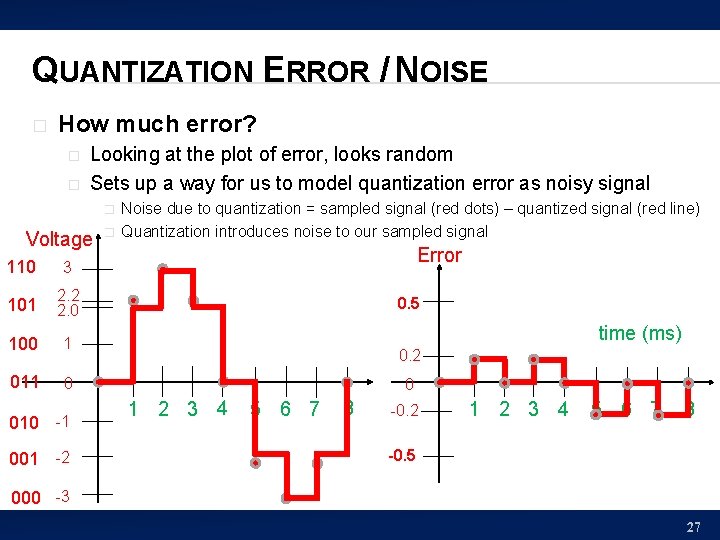
QUANTIZATION ERROR / NOISE � How much error? � � Looking at the plot of error, looks random Sets up a way for us to model quantization error as noisy signal � Voltage 110 3 101 2. 2 2. 0 100 1 011 0 010 -1 001 -2 � Noise due to quantization = sampled signal (red dots) – quantized signal (red line) Quantization introduces noise to our sampled signal Error 0. 5 time (ms) 0. 2 0 1 2 3 4 5 6 7 8 -0. 2 1 2 3 4 5 6 7 8 -0. 5 000 -3 27
CONTINUOUS ERROR So far, focus on error at sample points � Can also define error at any point � Depends on reconstruction model � � � How estimate/create continuous from samples Simple connect-the-dots model linear interpolation 28
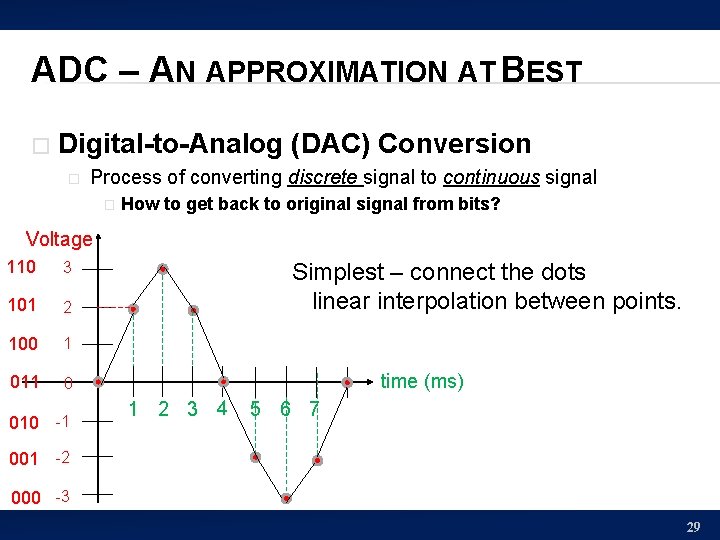
ADC – AN APPROXIMATION AT BEST � Digital-to-Analog (DAC) Conversion � Process of converting discrete signal to continuous signal � How to get back to original signal from bits? Voltage 110 3 101 2 100 1 011 0 010 -1 Simplest – connect the dots linear interpolation between points. time (ms) 1 2 3 4 5 6 7 001 -2 000 -3 29
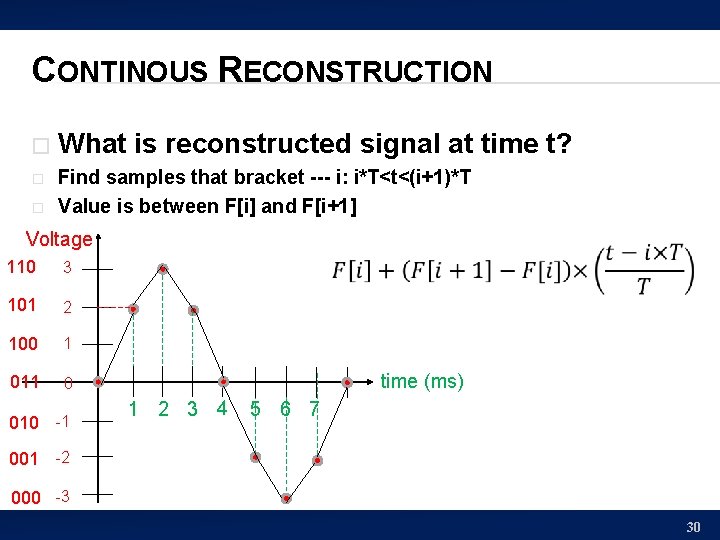
CONTINOUS RECONSTRUCTION � � � What is reconstructed signal at time t? Find samples that bracket --- i: i*T<t<(i+1)*T Value is between F[i] and F[i+1] Voltage 110 3 101 2 100 1 011 0 010 -1 time (ms) 1 2 3 4 5 6 7 001 -2 000 -3 30
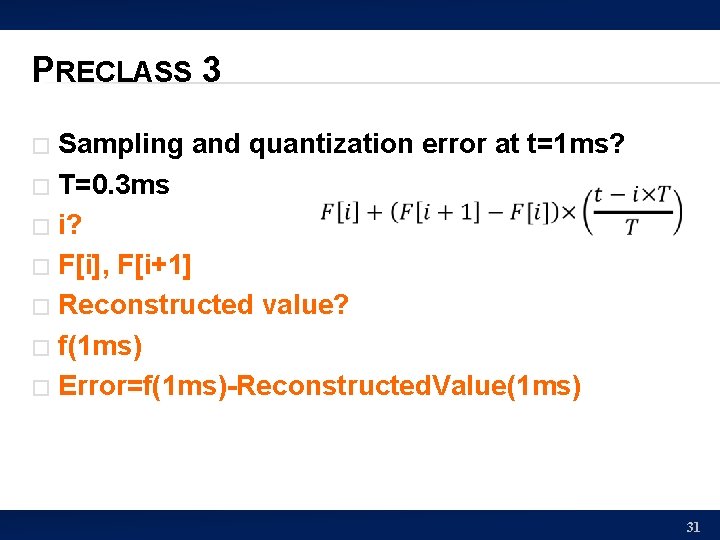
PRECLASS 3 Sampling and quantization error at t=1 ms? � T=0. 3 ms � i? � F[i], F[i+1] � Reconstructed value? � f(1 ms) � Error=f(1 ms)-Reconstructed. Value(1 ms) � 31
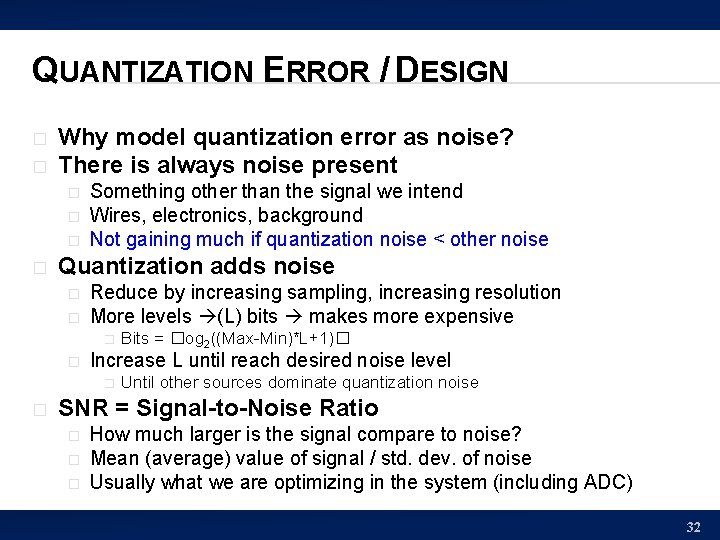
QUANTIZATION ERROR / DESIGN � � Why model quantization error as noise? There is always noise present � � Something other than the signal we intend Wires, electronics, background Not gaining much if quantization noise < other noise Quantization adds noise � � Reduce by increasing sampling, increasing resolution More levels (L) bits makes more expensive � � Increase L until reach desired noise level � � Bits = �log 2((Max-Min)*L+1)� Until other sources dominate quantization noise SNR = Signal-to-Noise Ratio � � � How much larger is the signal compare to noise? Mean (average) value of signal / std. dev. of noise Usually what we are optimizing in the system (including ADC) 32
ENGINEERING “An Engineer can do for a dime what anyone else can do for a dollar. ” � Engineering is about optimization and efficiency � Bits are costly � Anyone: Sample frequently with high resolution � Engineer ask: how few bits can I use without sacrificing quality? � Engineering is about tradeoffs � � Quality vs. Cost 33
PROBLEM DECOMPOSITION � Powerful Engineering technique Formulate a parameterized solution strategy � Then identify the right parameters � Divides the problem � Here � Strategy of sampling and quantization � Then identify the right sampling rate, quantization level � Once have strategy, reduces to a well-defined optimization problem � Parameterization admits to tuning for tradeoffs � 34
SYSTEM CAPACITY 35
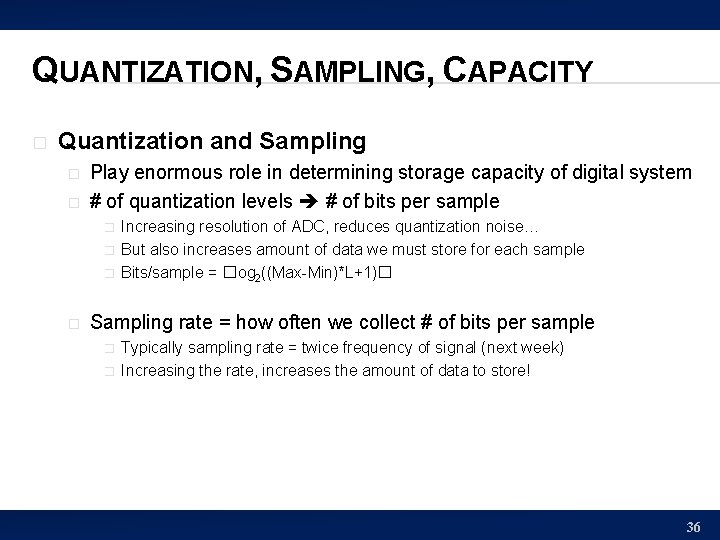
QUANTIZATION, SAMPLING, CAPACITY � Quantization and Sampling � � Play enormous role in determining storage capacity of digital system # of quantization levels # of bits per sample � � Increasing resolution of ADC, reduces quantization noise… But also increases amount of data we must store for each sample Bits/sample = �log 2((Max-Min)*L+1)� Sampling rate = how often we collect # of bits per sample � � Typically sampling rate = twice frequency of signal (next week) Increasing the rate, increases the amount of data to store! 36
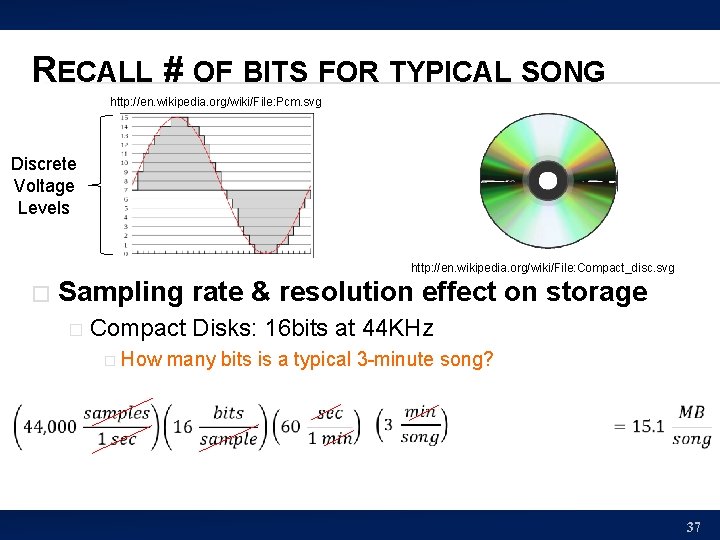
RECALL # OF BITS FOR TYPICAL SONG http: //en. wikipedia. org/wiki/File: Pcm. svg Discrete Voltage Levels http: //en. wikipedia. org/wiki/File: Compact_disc. svg � Sampling rate & resolution effect on storage � Compact Disks: 16 bits at 44 KHz � How many bits is a typical 3 -minute song? 37
LIMITS OF SAMPLING 38
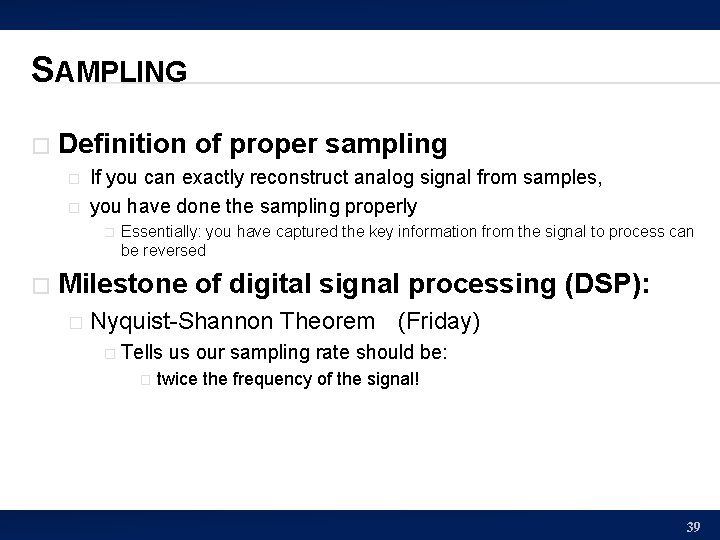
SAMPLING � Definition of proper sampling � � If you can exactly reconstruct analog signal from samples, you have done the sampling properly � � Essentially: you have captured the key information from the signal to process can be reversed Milestone of digital signal processing (DSP): � Nyquist-Shannon Theorem (Friday) � Tells � us our sampling rate should be: twice the frequency of the signal! 39
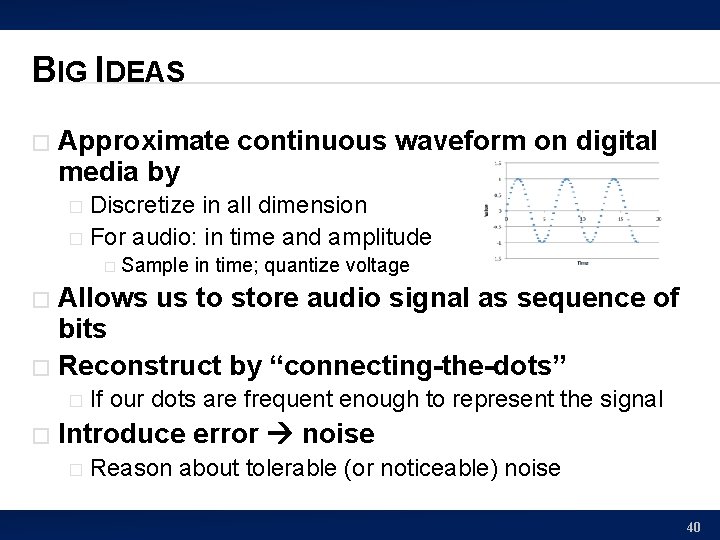
BIG IDEAS � Approximate continuous waveform on digital media by Discretize in all dimension � For audio: in time and amplitude � � Sample in time; quantize voltage Allows us to store audio signal as sequence of bits � Reconstruct by “connecting-the-dots” � � � If our dots are frequent enough to represent the signal Introduce error noise � Reason about tolerable (or noticeable) noise 40
ADMIN Reading for Friday on syllabus � Remember feedback � � � Includes Lab 1 Office Hours T 7, W 2, R 8 � Zoom links on Piazza (web, canvas) � � Lab 1 Reports due Friday 41
REFERENCES � � � S. Smith, “The Scientists and Engineer’s Guide to Digital Signal Processing, ” 1997. Wikipedia, http: //en. wikipedia. org/wiki/Analog-todigital_converter Wikipedia: http: //en. wikipedia. org/wiki/Pulsecode_modulation 42
- Slides: 42