
Lecture 3 Protocol Stacks and Layering Hui Zhang
- Slides: 30
Lecture 3 Protocol Stacks and Layering Hui Zhang School of Computer Science Carnegie Mellon University 15 -441 Networking, Fall 2007 http: //www. cs. cmu. edu/~srini/15 -441/F 07/ 1
What is a Communication Network? (from end-system point of view) l l l Network offers a service: move information » Bird, fire, messenger, truck, telegraph, telephone, Internet … » Another example, transportation service: move objects – Horse, train, truck, airplane. . . What distinguish different types of networks? » The services they provide What distinguish the services? » Rich of the services » Latency » Bandwidth » Loss rate » Number of end systems » Service interface » Other details – Reliability, unicast vs. multicast, real-time, message vs. byte. . . 2
What is a Communication Network? Infrastructure Centric View l l l Electrons and photons as communication medium Links: fiber, copper, satellite, … Switches: electronic/optic, crossbar/Banyan Protocols: TCP/IP, ATM, MPLS, SONET, Ethernet, X. 25, Frame. Relay, Apple. Talk, IPX, SNA Functionalities: routing, error control, flow control, congestion control, Quality of Service (Qo. S) Applications: telephony, FTP, WEB, X windows, . . . 3
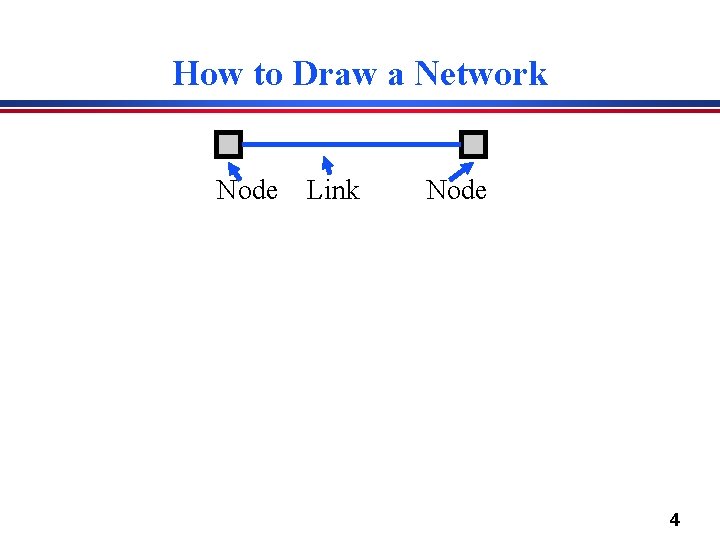
How to Draw a Network Node Link Node 4
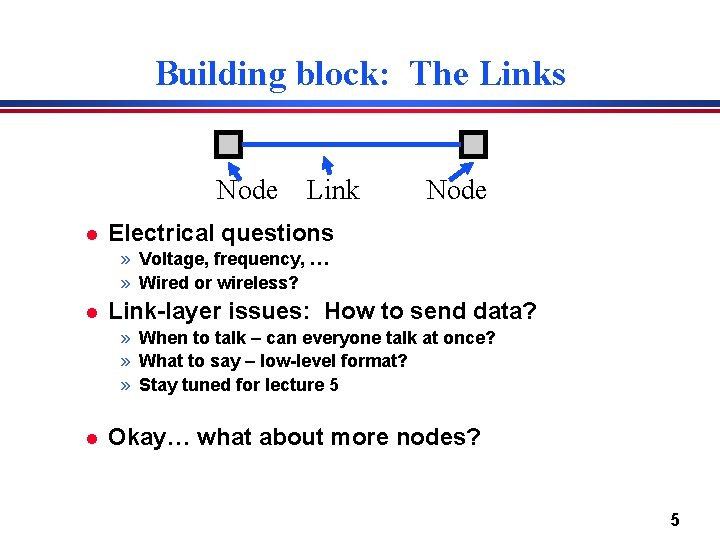
Building block: The Links Node l Link Node Electrical questions » Voltage, frequency, … » Wired or wireless? l Link-layer issues: How to send data? » When to talk – can everyone talk at once? » What to say – low-level format? » Stay tuned for lecture 5 l Okay… what about more nodes? 5
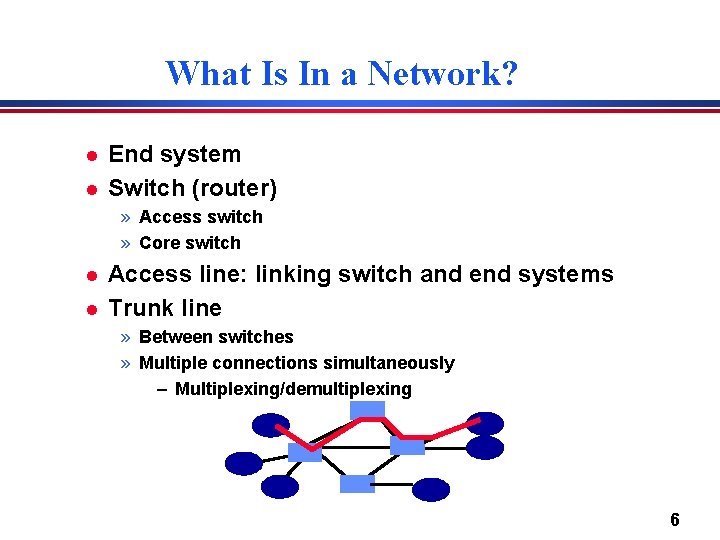
What Is In a Network? l l End system Switch (router) » Access switch » Core switch l l Access line: linking switch and end systems Trunk line » Between switches » Multiple connections simultaneously – Multiplexing/demultiplexing 6
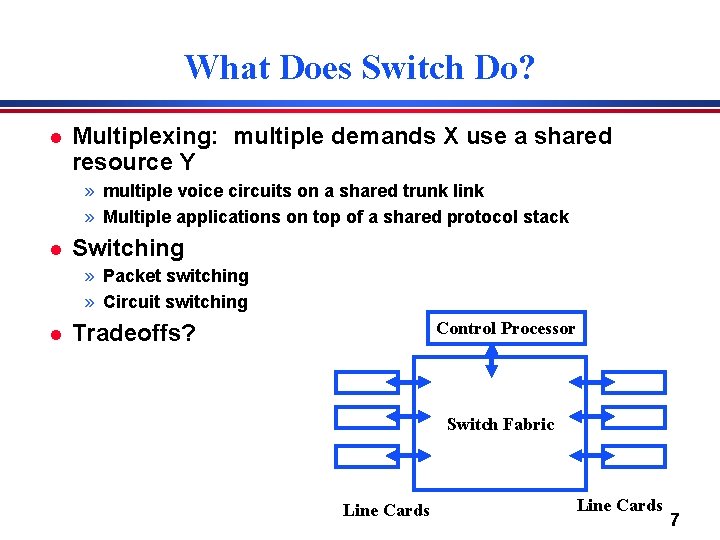
What Does Switch Do? l Multiplexing: multiple demands X use a shared resource Y » multiple voice circuits on a shared trunk link » Multiple applications on top of a shared protocol stack l Switching » Packet switching » Circuit switching l Control Processor Tradeoffs? Switch Fabric Line Cards 7
Packet vs. Circuit Switching l Packet-switching: Benefits » Ability to exploit statistical multiplexing » More efficient bandwidth usage l Packet switching: Concerns » Needs to buffer and deal with congestion: » More complex switches » Harder to provide good network services (e. g. , delay and bandwidth guarantees) 8
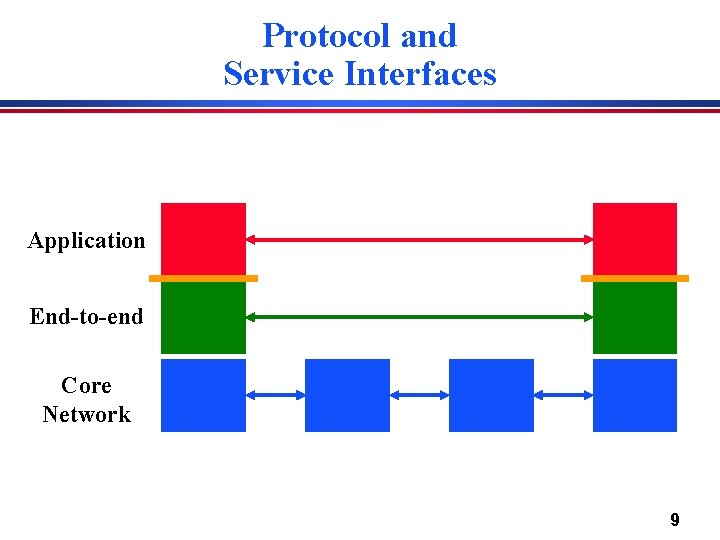
Protocol and Service Interfaces Application End-to-end Core Network 9
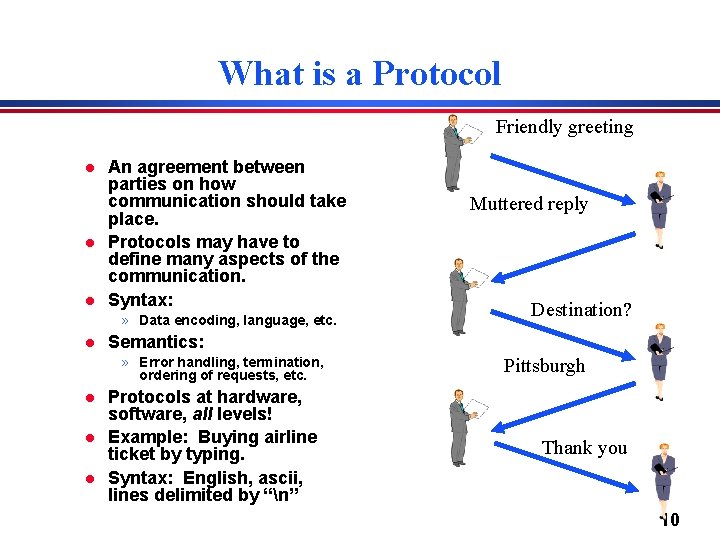
What is a Protocol Friendly greeting l l l An agreement between parties on how communication should take place. Protocols may have to define many aspects of the communication. Syntax: » Data encoding, language, etc. l l l Destination? Semantics: » Error handling, termination, ordering of requests, etc. l Muttered reply Protocols at hardware, software, all levels! Example: Buying airline ticket by typing. Syntax: English, ascii, lines delimited by “n” Pittsburgh Thank you 10
Interfaces l Each protocol offers an interface to its users, and expects one from the layers on which it builds » Syntax and semantics strike again – Data formats – Interface characteristics, e. g. IP service model l Protocols build upon each other » Add value – E. g. , a reliable protocol running on top of IP » Reuse – E. g. , OS provides TCP, so apps don’t have to rewrite 11
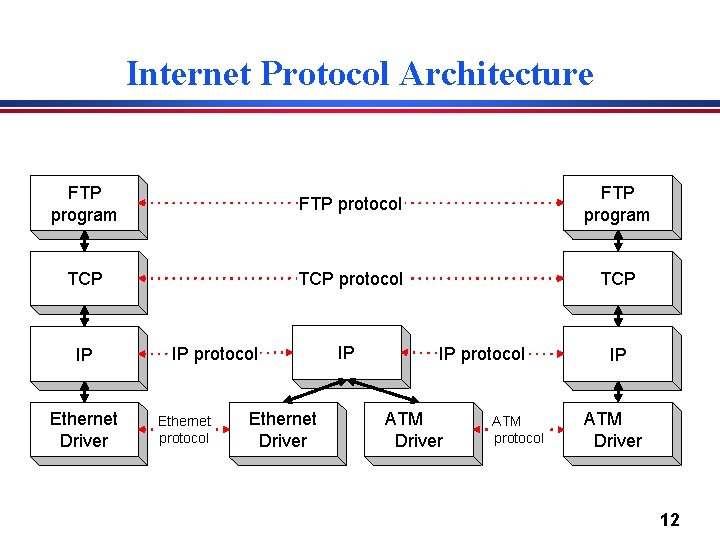
Internet Protocol Architecture FTP program FTP protocol FTP program TCP protocol TCP IP Ethernet Driver IP protocol Ethernet Driver IP IP protocol ATM Driver ATM protocol IP ATM Driver 12
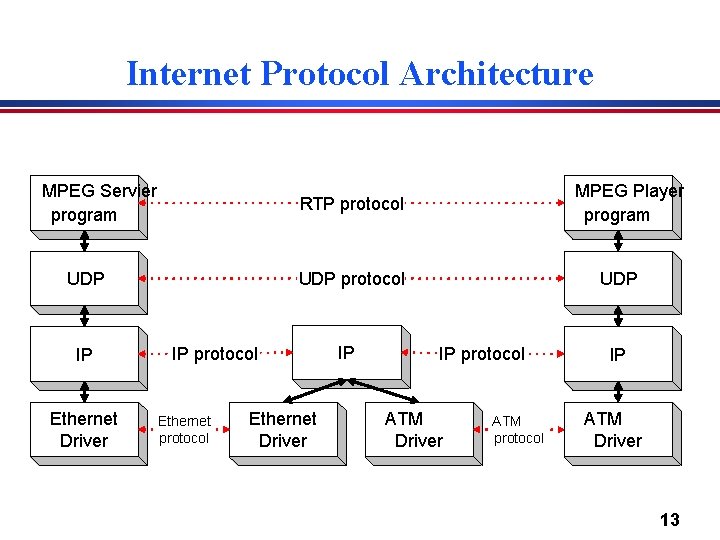
Internet Protocol Architecture MPEG Servier program UDP IP Ethernet Driver MPEG Player program RTP protocol UDP protocol IP protocol Ethernet Driver IP UDP IP protocol ATM Driver ATM protocol IP ATM Driver 13
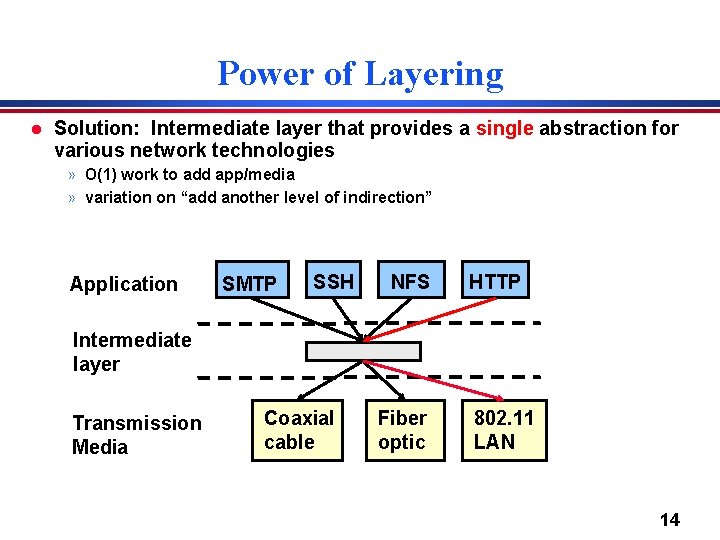
Power of Layering l Solution: Intermediate layer that provides a single abstraction for various network technologies » O(1) work to add app/media » variation on “add another level of indirection” Application SMTP SSH NFS HTTP Intermediate layer Transmission Media Coaxial cable Fiber optic 802. 11 LAN 14
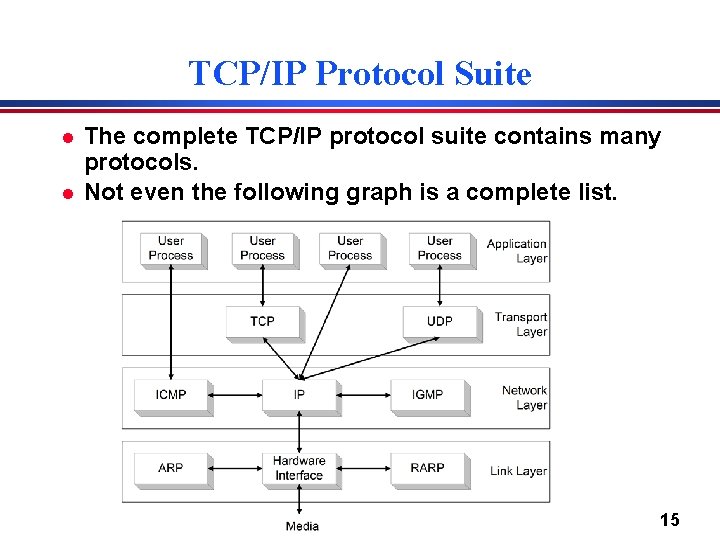
TCP/IP Protocol Suite l l The complete TCP/IP protocol suite contains many protocols. Not even the following graph is a complete list. 15
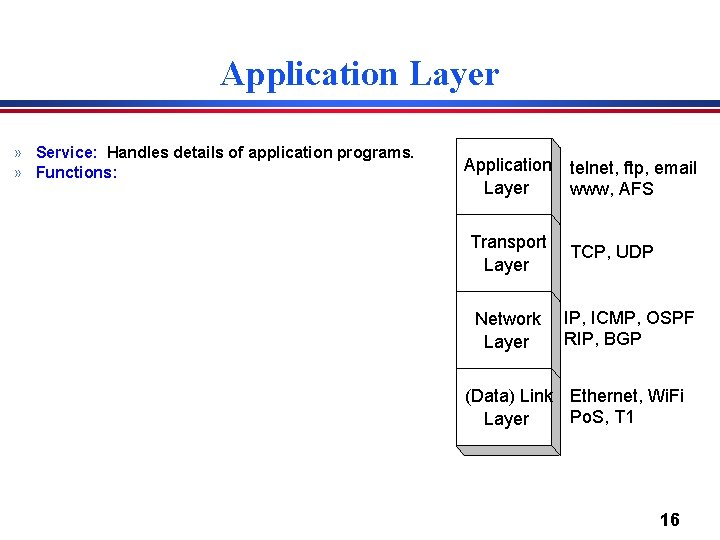
Application Layer » Service: Handles details of application programs. » Functions: Application telnet, ftp, email Layer www, AFS Transport Layer Network Layer TCP, UDP IP, ICMP, OSPF RIP, BGP (Data) Link Ethernet, Wi. Fi Po. S, T 1 Layer 16
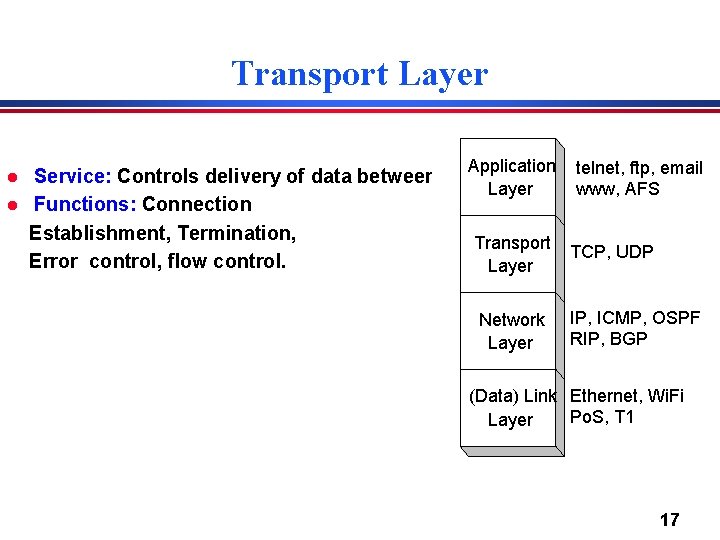
Transport Layer l l Application telnet, ftp, email Service: Controls delivery of data between hosts. Layer www, AFS Functions: Connection Establishment, Termination, Transport TCP, UDP Error control, flow control. Layer Network Layer IP, ICMP, OSPF RIP, BGP (Data) Link Ethernet, Wi. Fi Po. S, T 1 Layer 17
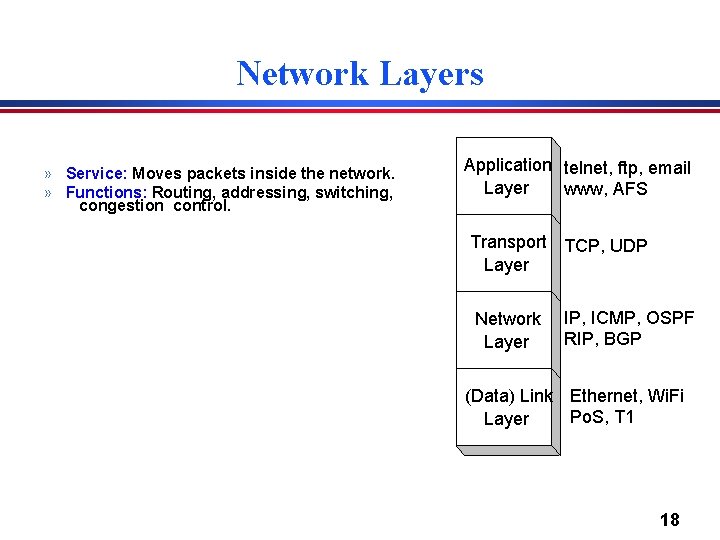
Network Layers » Service: Moves packets inside the network. » Functions: Routing, addressing, switching, congestion control. Application telnet, ftp, email Layer www, AFS Transport TCP, UDP Layer Network Layer IP, ICMP, OSPF RIP, BGP (Data) Link Ethernet, Wi. Fi Po. S, T 1 Layer 18
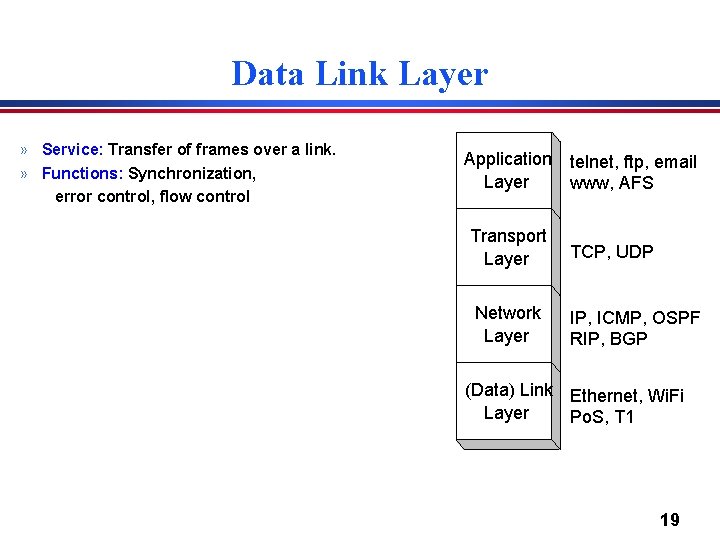
Data Link Layer » Service: Transfer of frames over a link. » Functions: Synchronization, error control, flow control Application telnet, ftp, email Layer www, AFS Transport Layer TCP, UDP Network Layer IP, ICMP, OSPF RIP, BGP (Data) Link Ethernet, Wi. Fi Layer Po. S, T 1 19
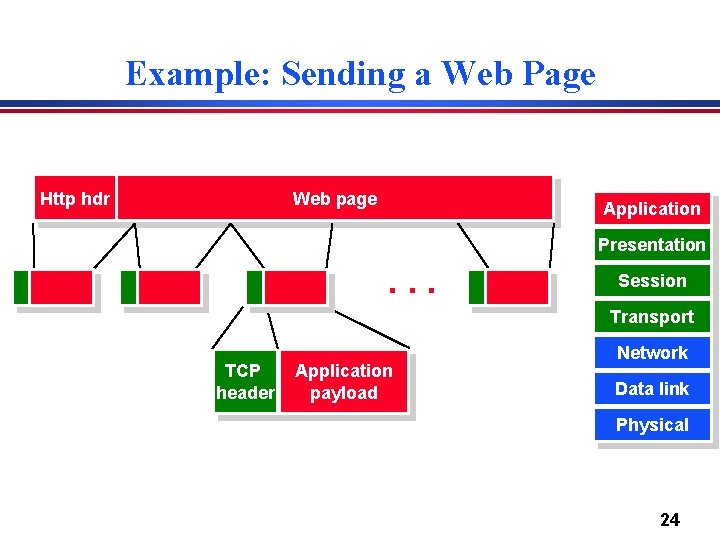
Encapsulation l As data is moving down the protocol stack, each protocol is adding layer-specific control information. 20
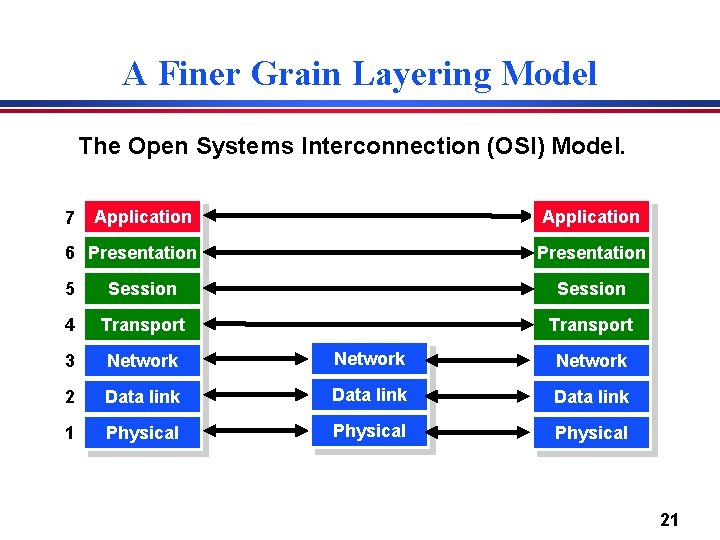
A Finer Grain Layering Model The Open Systems Interconnection (OSI) Model. 7 Application 6 Presentation 5 Session 4 Transport 3 Network 2 Data link 1 Physical 21
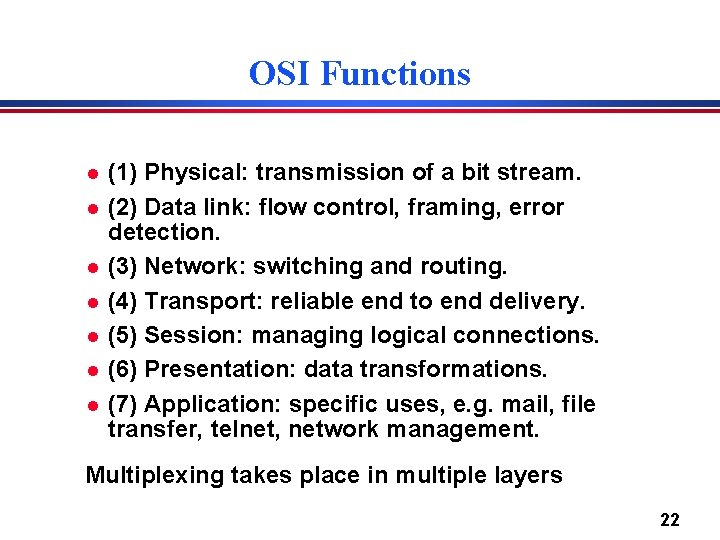
OSI Functions l l l l (1) Physical: transmission of a bit stream. (2) Data link: flow control, framing, error detection. (3) Network: switching and routing. (4) Transport: reliable end to end delivery. (5) Session: managing logical connections. (6) Presentation: data transformations. (7) Application: specific uses, e. g. mail, file transfer, telnet, network management. Multiplexing takes place in multiple layers 22
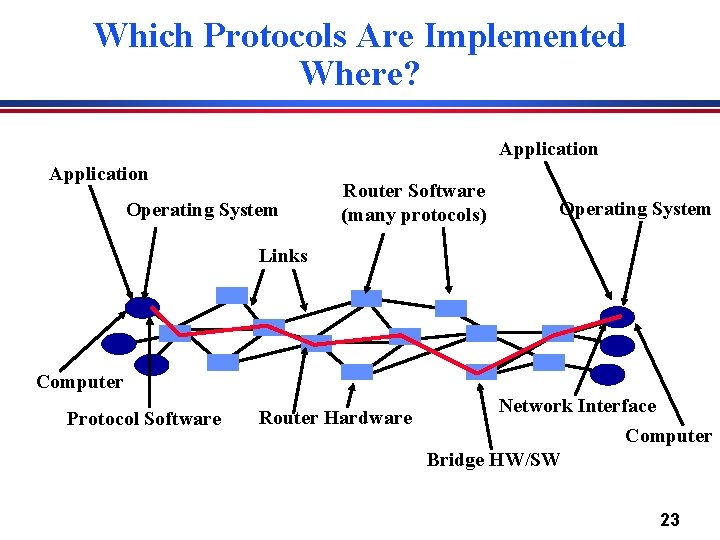
Which Protocols Are Implemented Where? Application Operating System Router Software (many protocols) Operating System Links Computer Protocol Software Router Hardware Network Interface Computer Bridge HW/SW 23
Example: Sending a Web Page Http hdr Web page Application Presentation . . . Session Transport TCP header Application payload Network Data link Physical 24
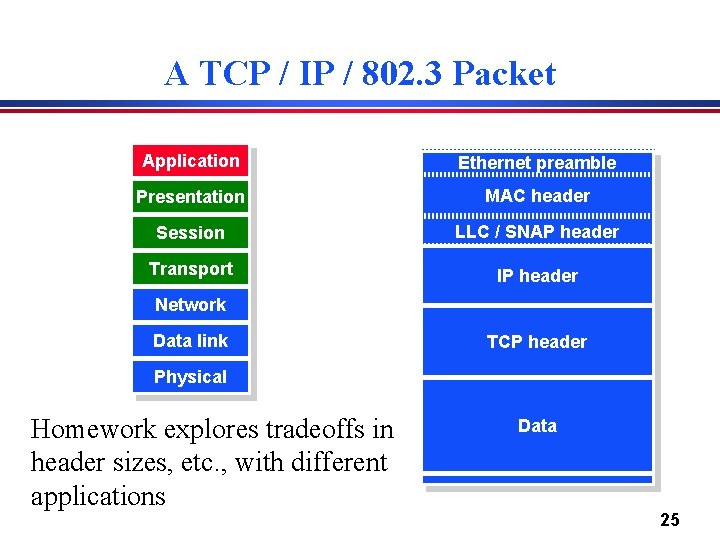
A TCP / IP / 802. 3 Packet Application Ethernet preamble Presentation MAC header Session LLC / SNAP header Transport IP header Network Data link TCP header Physical Homework explores tradeoffs in header sizes, etc. , with different applications Data 25
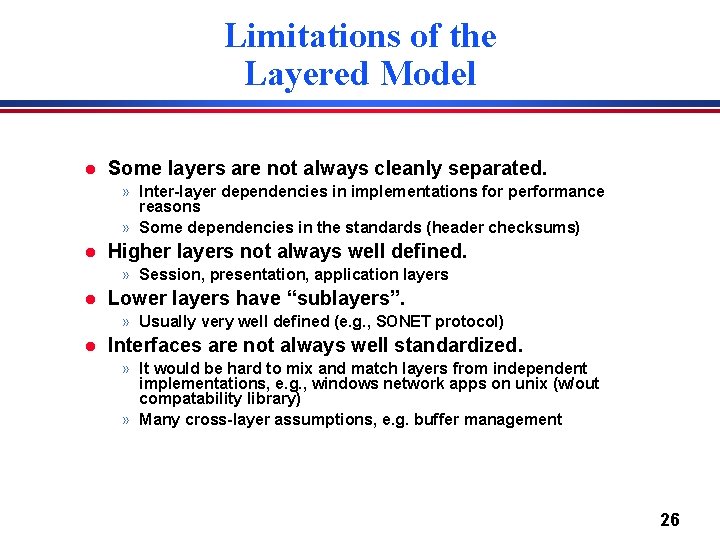
Limitations of the Layered Model l Some layers are not always cleanly separated. » Inter-layer dependencies in implementations for performance reasons » Some dependencies in the standards (header checksums) l Higher layers not always well defined. » Session, presentation, application layers l Lower layers have “sublayers”. » Usually very well defined (e. g. , SONET protocol) l Interfaces are not always well standardized. » It would be hard to mix and match layers from independent implementations, e. g. , windows network apps on unix (w/out compatability library) » Many cross-layer assumptions, e. g. buffer management 26
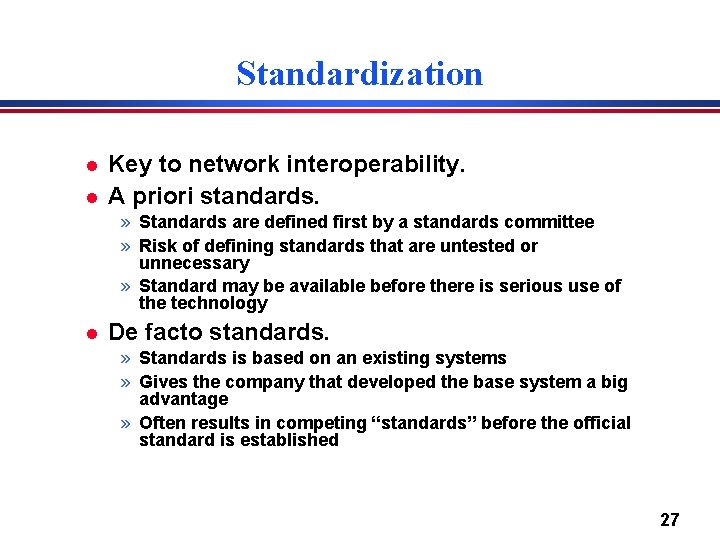
Standardization l l Key to network interoperability. A priori standards. » Standards are defined first by a standards committee » Risk of defining standards that are untested or unnecessary » Standard may be available before there is serious use of the technology l De facto standards. » Standards is based on an existing systems » Gives the company that developed the base system a big advantage » Often results in competing “standards” before the official standard is established 27
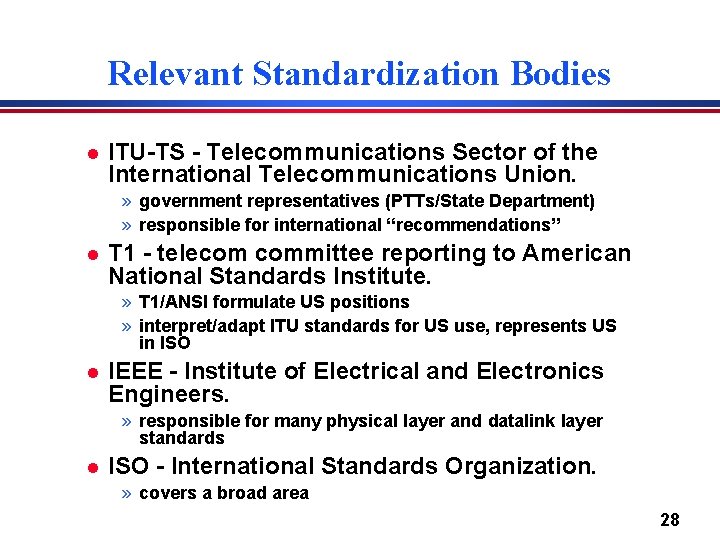
Relevant Standardization Bodies l ITU-TS - Telecommunications Sector of the International Telecommunications Union. » government representatives (PTTs/State Department) » responsible for international “recommendations” l T 1 - telecom committee reporting to American National Standards Institute. » T 1/ANSI formulate US positions » interpret/adapt ITU standards for US use, represents US in ISO l IEEE - Institute of Electrical and Electronics Engineers. » responsible for many physical layer and datalink layer standards l ISO - International Standards Organization. » covers a broad area 28
The Internet Engineering Task Force l The Internet society. » Oversees the operations of the Internet l Internet Engineering Task Force. » decides what technology will be used in the Internet » based on working groups that focus on specific issues » encourages wide participation l Request for Comments. » document that provides information or defines standard » requests feedback from the community » can be “promoted” to standard under certain conditions – consensus in the committee – interoperating implementations » Project 1 will look at the Internet Relay Chat (IRC) RFC 29
Higher Level Standards l Many session/application level operations are relevant to networks. » encoding: MPEG, encryption, . . . » services: electronic mail, newsgroups, HTTP, . . . » electronic commerce, . . l Standards are as important as for “lowerlevel” networks: interoperability. » defined by some of the same bodies as the low-level standards, e. g. IETF 30