
Lecture 3 Math Probability Background ch 1 2
Lecture 3 Math & Probability Background ch. 1 -2 of Machine Vision by Wesley E. Snyder & Hairong Qi Spring 2020 16 -725 (CMU RI) : Bio. E 2630 (Pitt) Dr. John Galeotti The content of these slides by John Galeotti, © 2012 - 2020 Carnegie Mellon University (CMU), was made possible in part by NIH NLM contract# HHSN 276201000580 P, and is licensed under a Creative Commons Attribution-Non. Commercial 3. 0 Unported License. To view a copy of this license, visit http: //creativecommons. org/licenses/by-nc/3. 0/ or send a letter to Creative Commons, 171 2 nd Street, Suite 300, San Francisco, California, 94105, USA. Permissions beyond the scope of this license may be available either from CMU or by emailing itk@galeotti. net. The most recent version of these slides may be accessed online via http: //itk. galeotti. net/
General notes about the book §The book is an overview of many concepts §Top quality design requires: § Reading the cited literature § Reading more literature § Experimentation & validation 2
Two themes §Consistency § A conceptual tool implemented in many/most algorithms § Often must fuse information from many local measurements and prior knowledge to make global conclusions about the image §Optimization § Mathematical mechanism § The “workhorse” of machine vision 3
Image Processing Topics §Enhancement §Coding § Compression §Restoration § “Fix” an image § Requires model of image degradation §Reconstruction 4
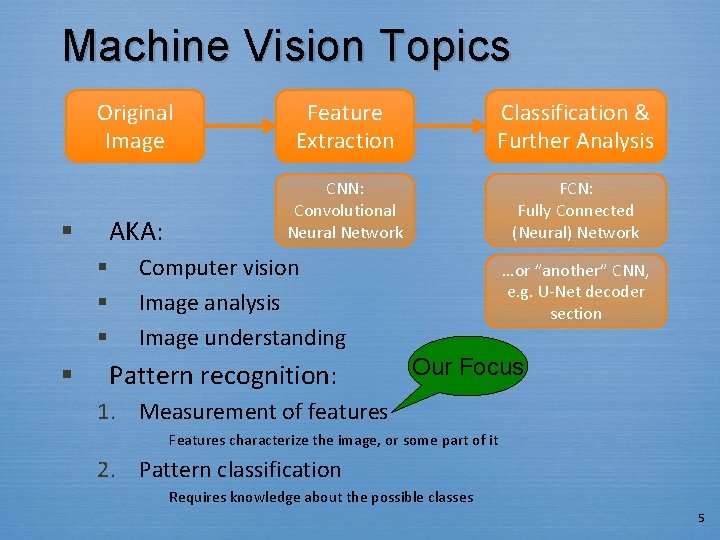
Machine Vision Topics Original Image Feature Extraction Classification & Further Analysis AKA: CNN: Convolutional Neural Network FCN: Fully Connected (Neural) Network § § § Computer vision Image analysis Image understanding Pattern recognition: …or ”another” CNN, e. g. U-Net decoder section Our Focus 1. Measurement of features Features characterize the image, or some part of it 2. Pattern classification Requires knowledge about the possible classes 5
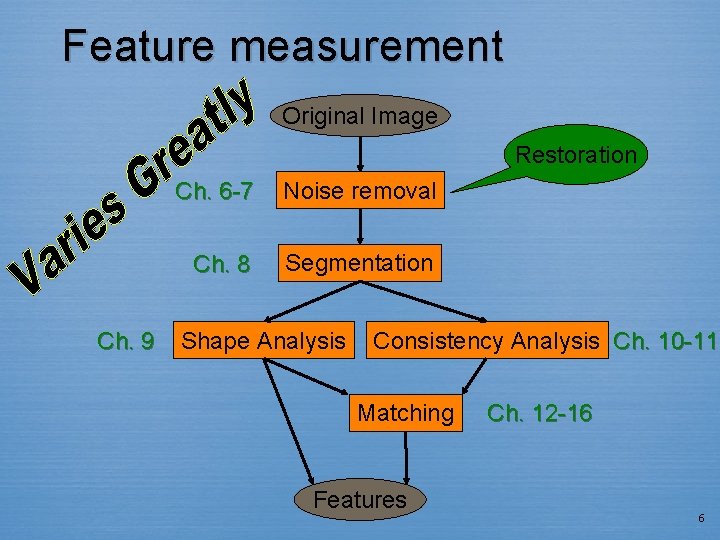
Feature measurement Original Image Restoration Ch. 9 Ch. 6 -7 Noise removal Ch. 8 Segmentation Shape Analysis Consistency Analysis Ch. 10 -11 Matching Features Ch. 12 -16 6
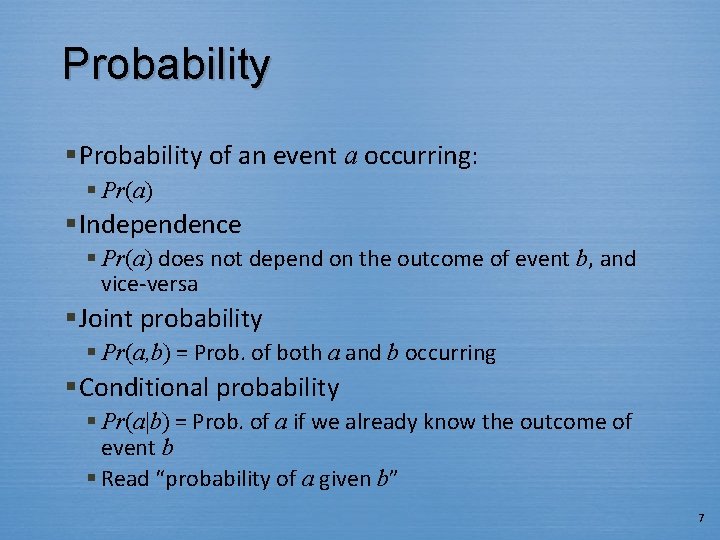
Probability § Probability of an event a occurring: § Pr(a) § Independence § Pr(a) does not depend on the outcome of event b, and vice-versa § Joint probability § Pr(a, b) = Prob. of both a and b occurring § Conditional probability § Pr(a|b) = Prob. of a if we already know the outcome of event b § Read “probability of a given b” 7
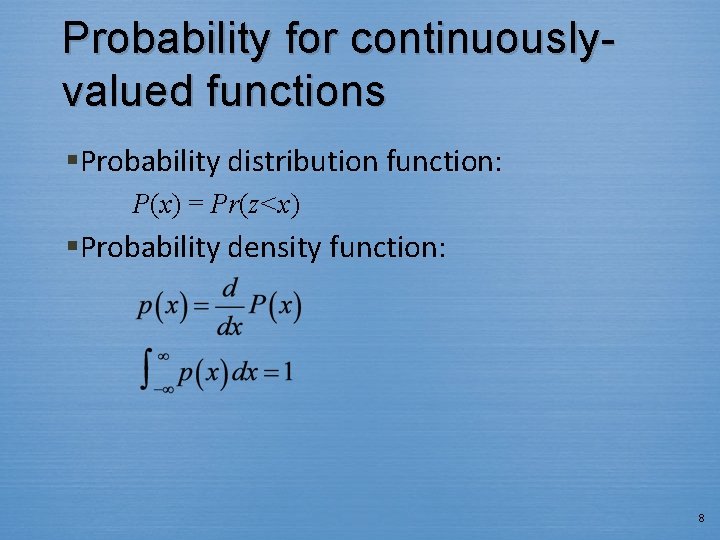
Probability for continuouslyvalued functions §Probability distribution function: P(x) = Pr(z<x) §Probability density function: 8
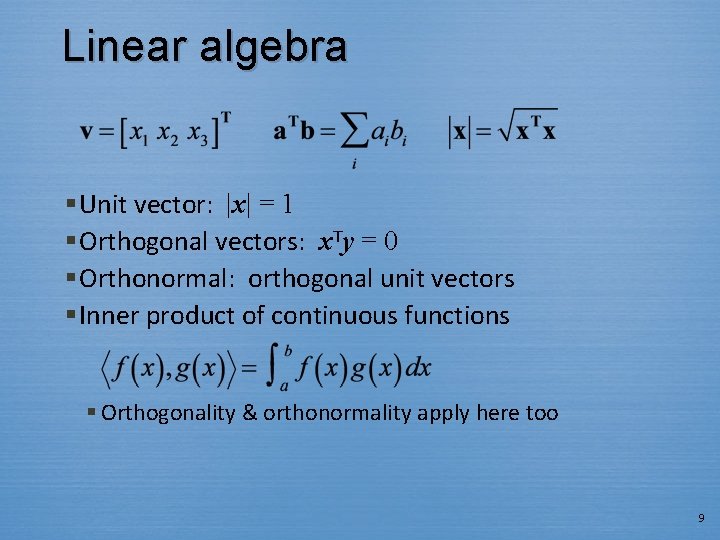
Linear algebra § Unit vector: |x| = 1 § Orthogonal vectors: x. Ty = 0 § Orthonormal: orthogonal unit vectors § Inner product of continuous functions § Orthogonality & orthonormality apply here too 9
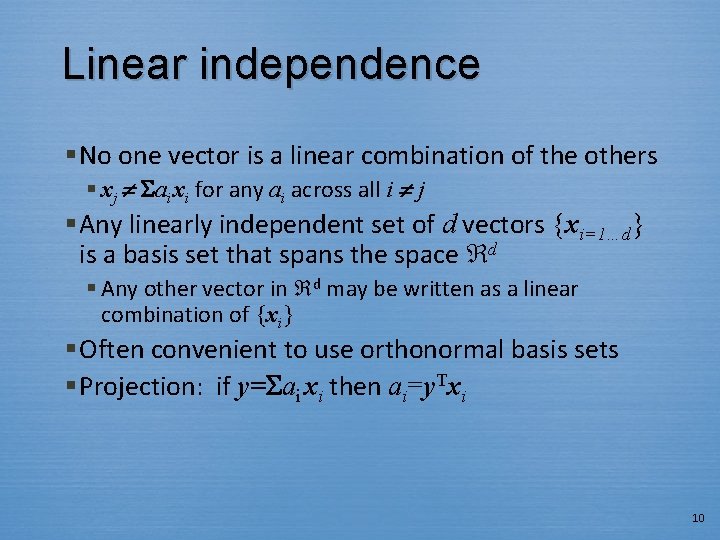
Linear independence § No one vector is a linear combination of the others § xj ai xi for any ai across all i j § Any linearly independent set of d vectors {xi=1…d} is a basis set that spans the space d § Any other vector in d may be written as a linear combination of {xi} § Often convenient to use orthonormal basis sets § Projection: if y= ai xi then ai=y. Txi 10
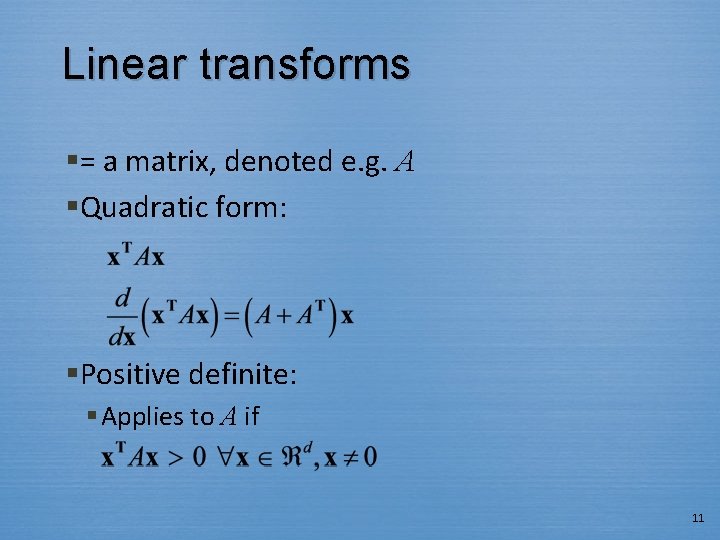
Linear transforms §= a matrix, denoted e. g. A §Quadratic form: §Positive definite: § Applies to A if 11
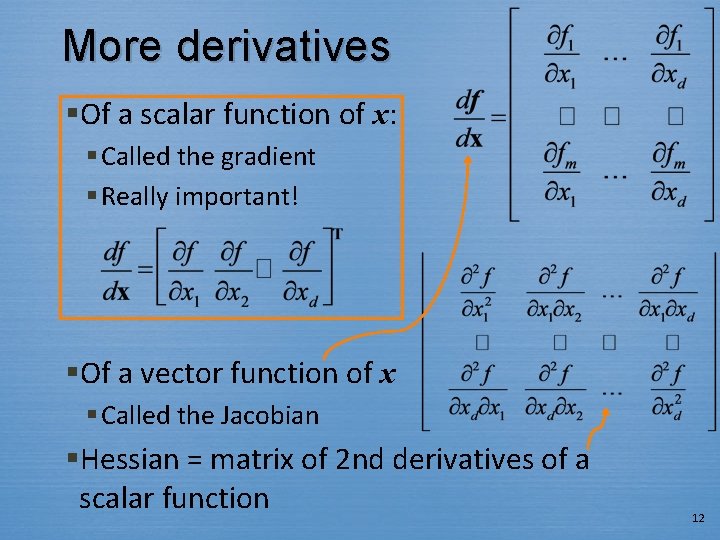
More derivatives §Of a scalar function of x: § Called the gradient § Really important! §Of a vector function of x § Called the Jacobian §Hessian = matrix of 2 nd derivatives of a scalar function 12
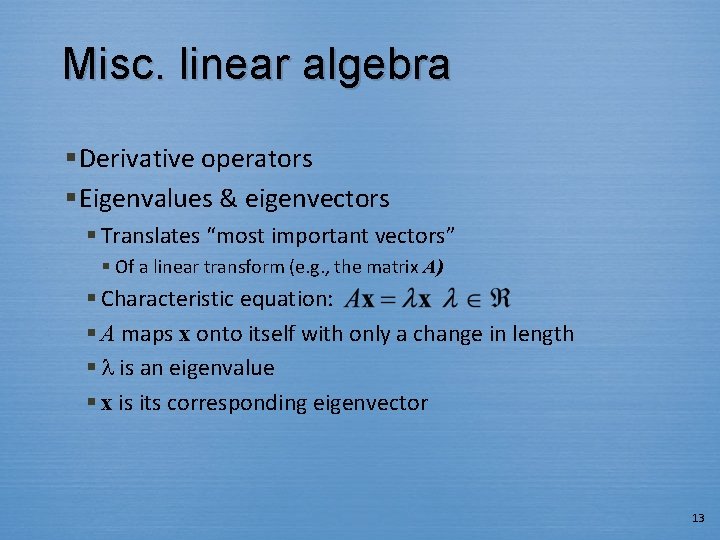
Misc. linear algebra § Derivative operators § Eigenvalues & eigenvectors § Translates “most important vectors” § Of a linear transform (e. g. , the matrix A) § Characteristic equation: § A maps x onto itself with only a change in length § is an eigenvalue § x is its corresponding eigenvector 13
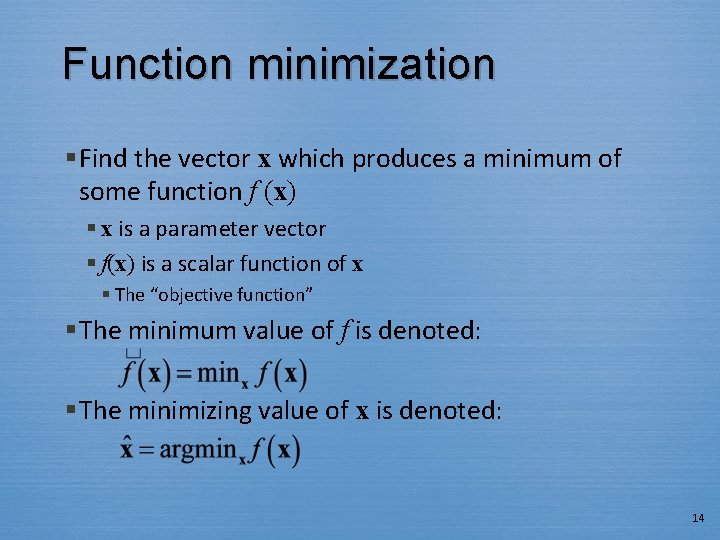
Function minimization § Find the vector x which produces a minimum of some function f (x) § x is a parameter vector § f(x) is a scalar function of x § The “objective function” § The minimum value of f is denoted: § The minimizing value of x is denoted: 14
Numerical minimization § Gradient descent § The derivative points away from the minimum § Take small steps, each one in the “down-hill” direction § Local vs. global minima § Combinatorial optimization: § Use simulated annealing § Image optimization: § Use mean field annealing § More recent improvements to gradient descent: § Momentum, changing step size § Training CNN: Grad. Desc. w/ Mom. or else ADAM 15
Markov models § For temporal processes: § The probability of something happening is dependent on a thing that just recently happened. § For spatial processes § The probability of something being in a certain state is dependent on the state of something nearby. § Example: The value of a pixel is dependent on the values of its neighboring pixels. 16
Markov chain § Simplest Markov model § Example: symbols transmitted one at a time § What is the probability that the next symbol will be w? § For a “simple” (i. e. first order) Markov chain: § “The probability conditioned on all of history is identical to the probability conditioned on the last symbol received. ” 17
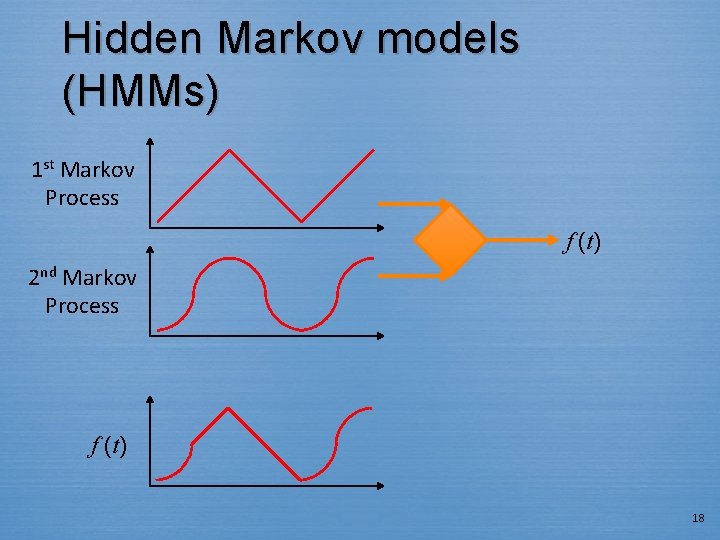
Hidden Markov models (HMMs) 1 st Markov Process f (t) 2 nd Markov Process f (t) 18
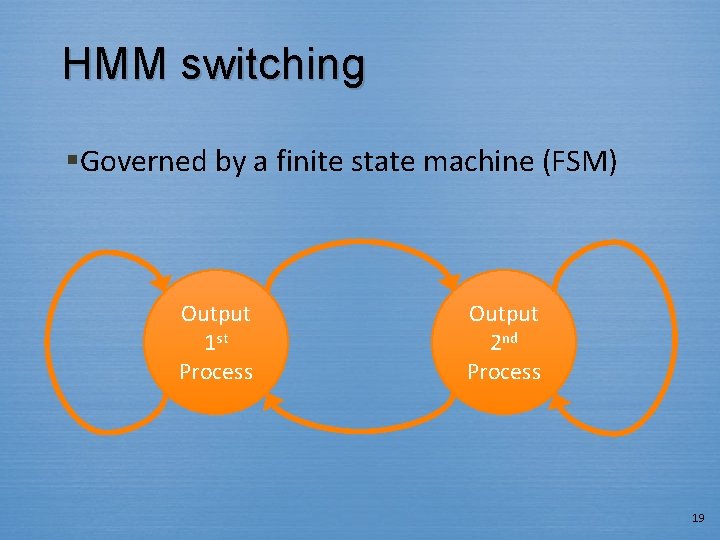
HMM switching §Governed by a finite state machine (FSM) Output 1 st Process Output 2 nd Process 19
The HMM Task § Given only the output f (t), determine: 1. The most likely state sequence of the switching FSM § Use the Viterbi algorithm (much better than brute force) § Computational Complexity of: § Viterbi: (# state values)2 * (# state changes) § Brute force: (# state values)(# state changes) 2. The parameters of each hidden Markov model § Use the iterative process in the book § Better, use someone else’s debugged code that they’ve shared 20
- Slides: 20