
Lecture 3 January 23 2006 In this lecture
- Slides: 70
Lecture 3 January 23, 2006
In this lecture n n Modeling of tanks Time period of tanks Sudhir K. Jain, IIT Kanpur E-Course on Seismic Design of Tanks/ January 2006 2
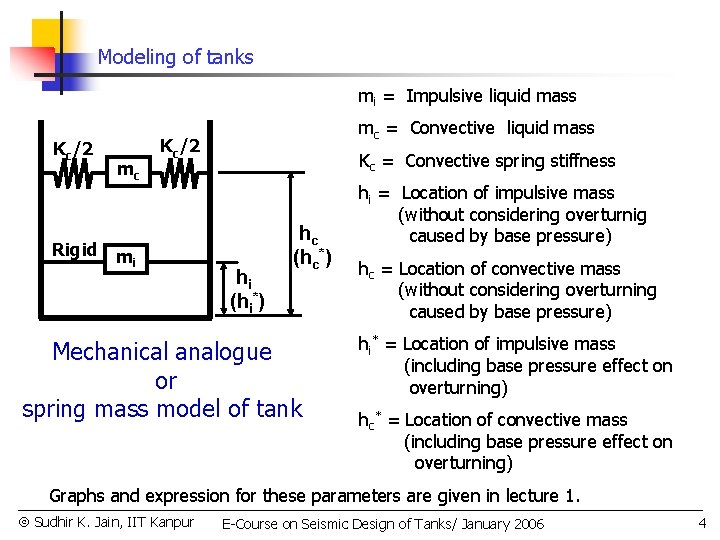
Modeling of tanks n As seen in Lecture 1 liquid may be replaced by impulsive and convective mass for calculation of hydrodynamic forces n See next slide for a quick review Sudhir K. Jain, IIT Kanpur E-Course on Seismic Design of Tanks/ January 2006 3
Modeling of tanks mi = Impulsive liquid mass Kc/2 mc mc = Convective liquid mass Kc/2 Rigid m i Kc = Convective spring stiffness hi (hi*) hc (hc*) Mechanical analogue or spring mass model of tank hi = Location of impulsive mass (without considering overturnig caused by base pressure) hc = Location of convective mass (without considering overturning caused by base pressure) hi* = Location of impulsive mass (including base pressure effect on overturning) hc* = Location of convective mass (including base pressure effect on overturning) Graphs and expression for these parameters are given in lecture 1. Sudhir K. Jain, IIT Kanpur E-Course on Seismic Design of Tanks/ January 2006 4
Approximation in modeling n Sometimes, summation of mi and mc may not be equal to total liquid mass, m n n This difference may be about 2 to 3 % Difference arises due to approximations in the derivation of these expressions n n More about it, later If this difference is of concern, then n n First, obtain mc from the graph or expression Obtain mi = m – mc Sudhir K. Jain, IIT Kanpur E-Course on Seismic Design of Tanks/ January 2006 5
Tanks of other shapes n For tank shapes such as Intze, funnel, etc. : n Consider equivalent circular tank of same volume, with diameter equal to diameter at the top level of liquid Sudhir K. Jain, IIT Kanpur E-Course on Seismic Design of Tanks/ January 2006 6
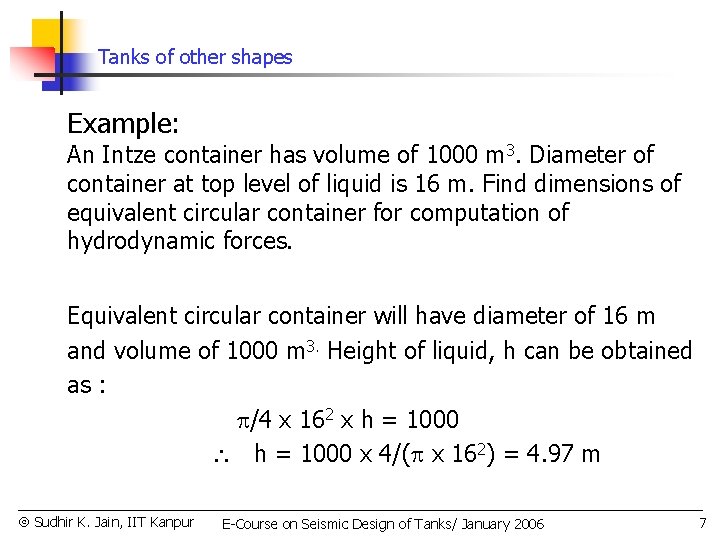
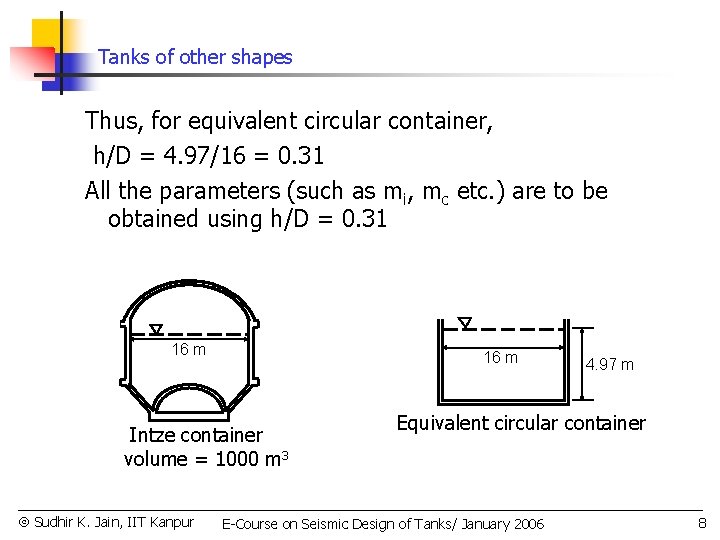
Tanks of other shapes Example: An Intze container has volume of 1000 m 3. Diameter of container at top level of liquid is 16 m. Find dimensions of equivalent circular container for computation of hydrodynamic forces. Equivalent circular container will have diameter of 16 m and volume of 1000 m 3. Height of liquid, h can be obtained as : /4 x 162 x h = 1000 x 4/( x 162) = 4. 97 m Sudhir K. Jain, IIT Kanpur E-Course on Seismic Design of Tanks/ January 2006 7
Tanks of other shapes Thus, for equivalent circular container, h/D = 4. 97/16 = 0. 31 All the parameters (such as mi, mc etc. ) are to be obtained using h/D = 0. 31 16 m Intze container volume = 1000 m 3 Sudhir K. Jain, IIT Kanpur 4. 97 m Equivalent circular container E-Course on Seismic Design of Tanks/ January 2006 8
Effect of obstructions inside tank n Container may have structural elements inside n n n For example: central shaft, columns supporting the roof slab, and baffle walls These elements cause obstruction to lateral motion of liquid This will affect impulsive and convective masses Sudhir K. Jain, IIT Kanpur E-Course on Seismic Design of Tanks/ January 2006 9
Effect of obstructions inside tank n Effect of these obstructions on impulsive and convective mass is not well studied n n A good research topic ! It is clear that these elements will reduce convective (or sloshing) mass n More liquid will act as impulsive mass Sudhir K. Jain, IIT Kanpur E-Course on Seismic Design of Tanks/ January 2006 10
Effect of obstructions inside tank n In the absence of detailed analysis, following approximation may be adopted: n n Consider a circular or a rectangular container of same height and without any internal elements Equate the volume of this container to net volume of original container n n This will give diameter or lateral dimensions of container Use this container to obtain h/D or h/L Sudhir K. Jain, IIT Kanpur E-Course on Seismic Design of Tanks/ January 2006 11
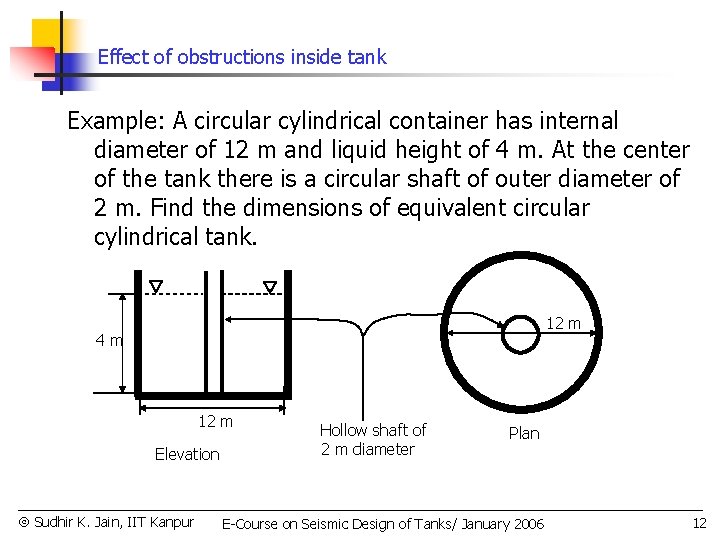
Effect of obstructions inside tank Example: A circular cylindrical container has internal diameter of 12 m and liquid height of 4 m. At the center of the tank there is a circular shaft of outer diameter of 2 m. Find the dimensions of equivalent circular cylindrical tank. 12 m 4 m 12 m Elevation Sudhir K. Jain, IIT Kanpur Hollow shaft of 2 m diameter Plan E-Course on Seismic Design of Tanks/ January 2006 12
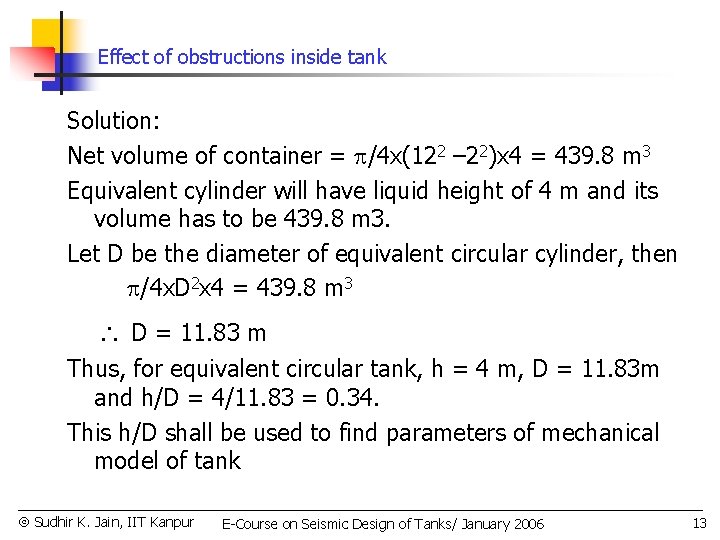
Effect of obstructions inside tank Solution: Net volume of container = /4 x(122 – 22)x 4 = 439. 8 m 3 Equivalent cylinder will have liquid height of 4 m and its volume has to be 439. 8 m 3. Let D be the diameter of equivalent circular cylinder, then /4 x. D 2 x 4 = 439. 8 m 3 D = 11. 83 m Thus, for equivalent circular tank, h = 4 m, D = 11. 83 m and h/D = 4/11. 83 = 0. 34. This h/D shall be used to find parameters of mechanical model of tank Sudhir K. Jain, IIT Kanpur E-Course on Seismic Design of Tanks/ January 2006 13
Effect of wall flexibility n Parameters mi, mc etc. are obtained assuming tank wall to be rigid n An assumption in the original work of Housner (1963 a) n n n Housner, G. W. , 1963 a, “Dynamic analysis of fluids in containers subjected to acceleration”, Nuclear Reactors and Earthquakes, Report No. TID 7024, U. S. Atomic Energy Commission, Washington D. C. RC tank walls are quite rigid Steel tank walls may be flexible n Particularly, in case of tall steel tanks Sudhir K. Jain, IIT Kanpur E-Course on Seismic Design of Tanks/ January 2006 14
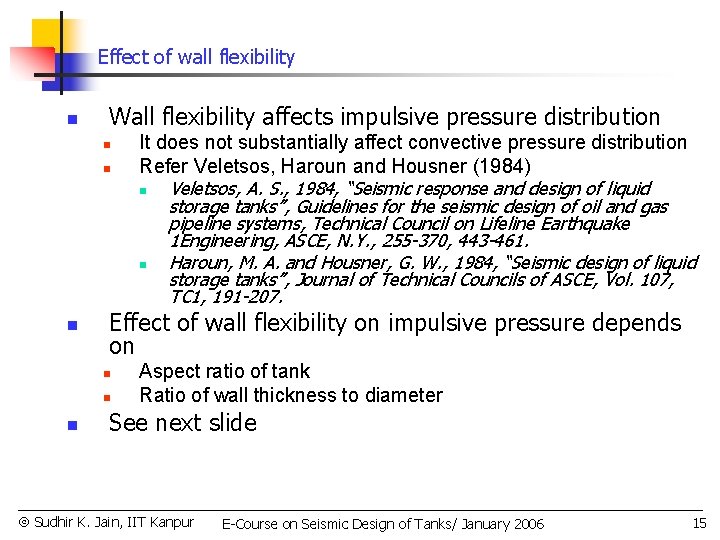
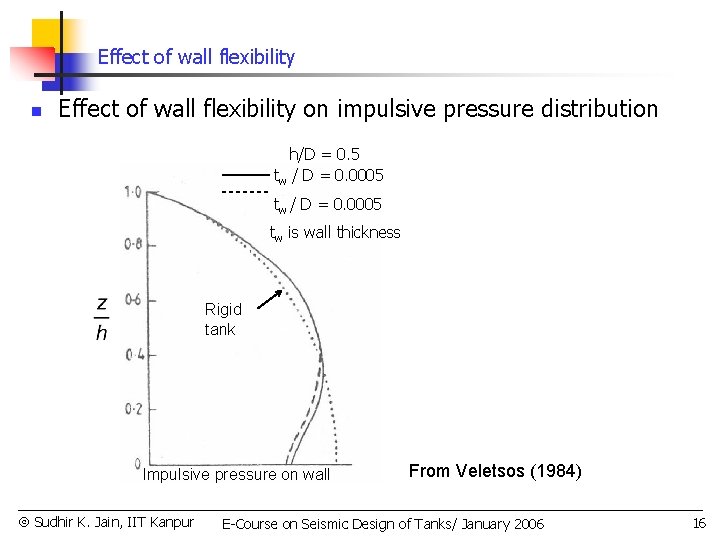
Effect of wall flexibility n Wall flexibility affects impulsive pressure distribution n Effect of wall flexibility on impulsive pressure depends on n It does not substantially affect convective pressure distribution Refer Veletsos, Haroun and Housner (1984) n Veletsos, A. S. , 1984, “Seismic response and design of liquid storage tanks”, Guidelines for the seismic design of oil and gas pipeline systems, Technical Council on Lifeline Earthquake 1 Engineering, ASCE, N. Y. , 255 -370, 443 -461. n Haroun, M. A. and Housner, G. W. , 1984, “Seismic design of liquid storage tanks”, Journal of Technical Councils of ASCE, Vol. 107, TC 1, 191 -207. Aspect ratio of tank Ratio of wall thickness to diameter See next slide Sudhir K. Jain, IIT Kanpur E-Course on Seismic Design of Tanks/ January 2006 15
Effect of wall flexibility n Effect of wall flexibility on impulsive pressure distribution h/D = 0. 5 tw / D = 0. 0005 tw is wall thickness Rigid tank Impulsive pressure on wall Sudhir K. Jain, IIT Kanpur From Veletsos (1984) E-Course on Seismic Design of Tanks/ January 2006 16
Effect of wall flexibility n n n If wall flexibility is included, then mechanical model of tank becomes more complicated Moreover, its inclusion does not change seismic forces appreciably Thus, mechanical model based on rigid wall assumption is considered adequate for design. Sudhir K. Jain, IIT Kanpur E-Course on Seismic Design of Tanks/ January 2006 17
Effect of wall flexibility n All international codes use rigid wall model for RC as well as steel tanks n Only exception is NZSEE recommendation (Priestley et al. , 1986) n n Priestley, M J N, et al. , 1986, “Seismic design of storage tanks”, Recommendations of a study group of the New Zealand National Society for Earthquake Engineering. American Petroleum Institute (API) standards, which are exclusively for steel tanks, also use mechanical model based on rigid wall assumption n API 650, 1998, “Welded storage tanks for oil storage”, American Petroleum Institute, Washington D. C. , USA. Sudhir K. Jain, IIT Kanpur E-Course on Seismic Design of Tanks/ January 2006 18
Effect of higher modes n mi and mc described in Lecture 1, correspond to first impulsive and convective modes n n For most tanks ( 0. 15 < h/D < 1. 5) the first impulsive and convective modes together account for 85 to 98% of total liquid mass Hence, higher modes are not included This is also one of the reasons for summation of mi and mc being not equal to total liquid mass For more information refer Veletsos (1984) and Malhotra (2000) n Malhotra, P. K. , Wenk, T. and Wieland, M. , 2000, “Simple procedure for seismic analysis of liquid-storage tanks”, Structural Engineering International, 197 -201. Sudhir K. Jain, IIT Kanpur E-Course on Seismic Design of Tanks/ January 2006 19
Modeling of ground supported tanks n Step 1: n n n Step 2: n n Obtain various parameters of mechanical model These include, mi, mc, Kc, hi, hc, hi* and hc* Calculate mass of tank wall (mw), mass of roof (mt) and mass of base slab (mb)of container This completes modeling of ground supported tanks Sudhir K. Jain, IIT Kanpur E-Course on Seismic Design of Tanks/ January 2006 20
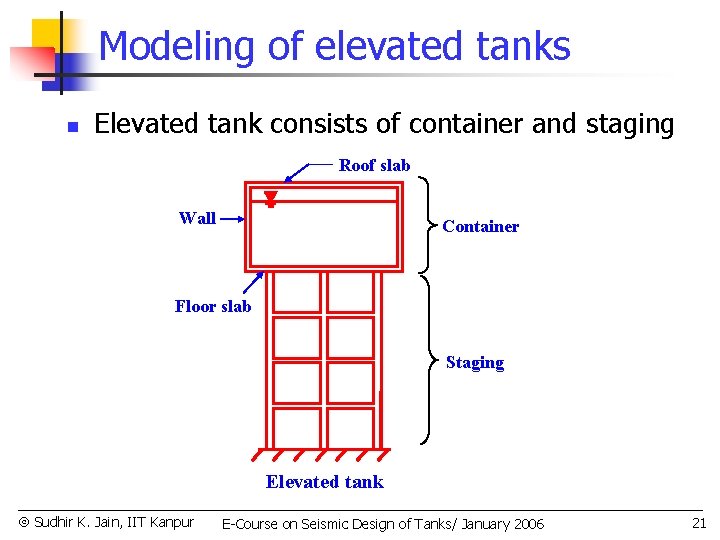
Modeling of elevated tanks n Elevated tank consists of container and staging Roof slab Wall Container Floor slab Staging Elevated tank Sudhir K. Jain, IIT Kanpur E-Course on Seismic Design of Tanks/ January 2006 21
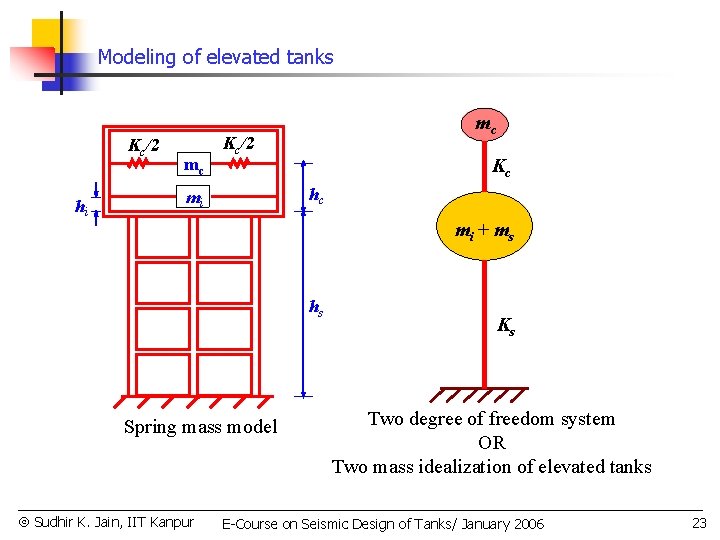
Modeling of elevated tanks n Liquid is replaced by impulsive and convective masses, mi and mc n n All other parameters such as hi, hc, etc, shall be obtained as described earlier Lateral stiffness, Ks, of staging must be considered n n This makes it a two-degree-of-freedom model Also called two mass idealization Sudhir K. Jain, IIT Kanpur E-Course on Seismic Design of Tanks/ January 2006 22
Modeling of elevated tanks Kc/2 hi mc mc Kc/2 Kc hc mi mi + m s hs Spring mass model Sudhir K. Jain, IIT Kanpur Ks Two degree of freedom system OR Two mass idealization of elevated tanks E-Course on Seismic Design of Tanks/ January 2006 23
Modeling of elevated tanks n ms is structural mass, which comprises of : n n n Mass of container, and One-third mass of staging Mass of container includes n n n Mass of roof slab Mass of wall Mass of floor slab and beams Sudhir K. Jain, IIT Kanpur E-Course on Seismic Design of Tanks/ January 2006 24
Two Degree of Freedom System n 2 -Do. F system requires solution of a 2 × 2 eigen value problem to obtain n n Two natural time periods Corresponding mode shapes See any standard text book on structural dynamics on how to solve 2 -Do. F system For most elevated tanks, the two natural time periods (T 1 and T 2) are well separated. n T 1 generally may exceed 2. 5 times T 2. Sudhir K. Jain, IIT Kanpur E-Course on Seismic Design of Tanks/ January 2006 25
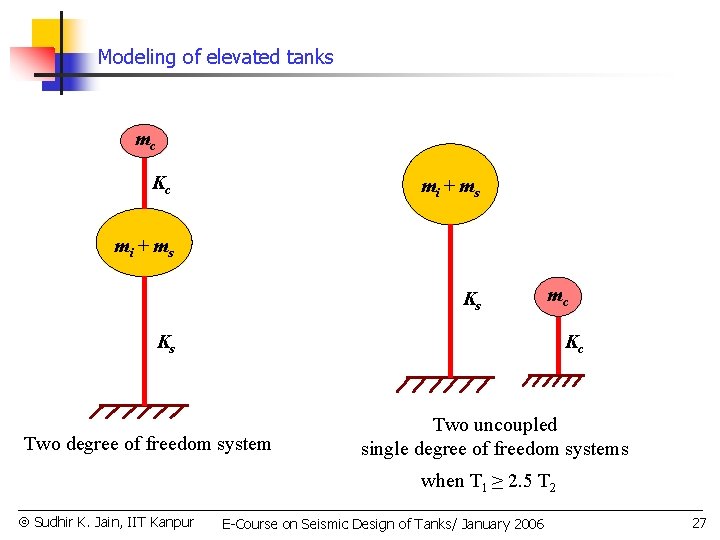
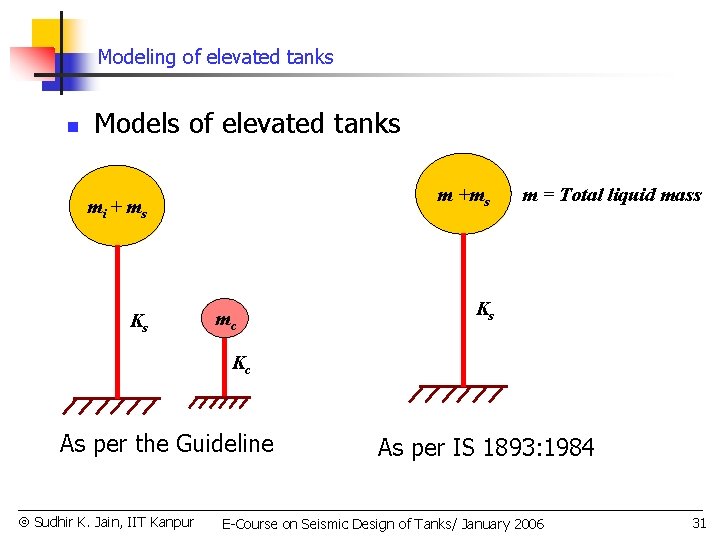
Two Degree of Freedom System n Hence the 2 -Do. F system can be treated as two uncoupled single degree of freedom systems n n One representing mi +ms and Ks Second representing mc and Kc Sudhir K. Jain, IIT Kanpur E-Course on Seismic Design of Tanks/ January 2006 26
Modeling of elevated tanks mc Kc mi + m s Ks mc Kc Ks Two degree of freedom system Two uncoupled single degree of freedom systems when T 1 ≥ 2. 5 T 2 Sudhir K. Jain, IIT Kanpur E-Course on Seismic Design of Tanks/ January 2006 27
Modeling of elevated tanks n n Priestley et al. (1986) suggested that this approximation is reasonable if ratio of two time periods exceeds 2. 5 Important to note that this approximation is done only for the purpose of calculating time periods n n This significantly simplifies time period calculation Otherwise, one can obtain time periods of 2 -Do. F system as per procedure of structural dynamics. Sudhir K. Jain, IIT Kanpur E-Course on Seismic Design of Tanks/ January 2006 28
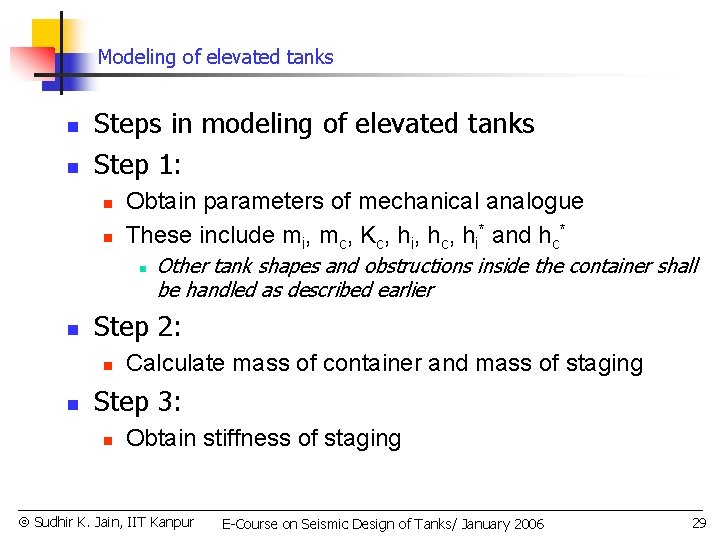
Modeling of elevated tanks n n Steps in modeling of elevated tanks Step 1: n n Obtain parameters of mechanical analogue These include mi, mc, Kc, hi, hc, hi* and hc* n n Step 2: n n Other tank shapes and obstructions inside the container shall be handled as described earlier Calculate mass of container and mass of staging Step 3: n Obtain stiffness of staging Sudhir K. Jain, IIT Kanpur E-Course on Seismic Design of Tanks/ January 2006 29
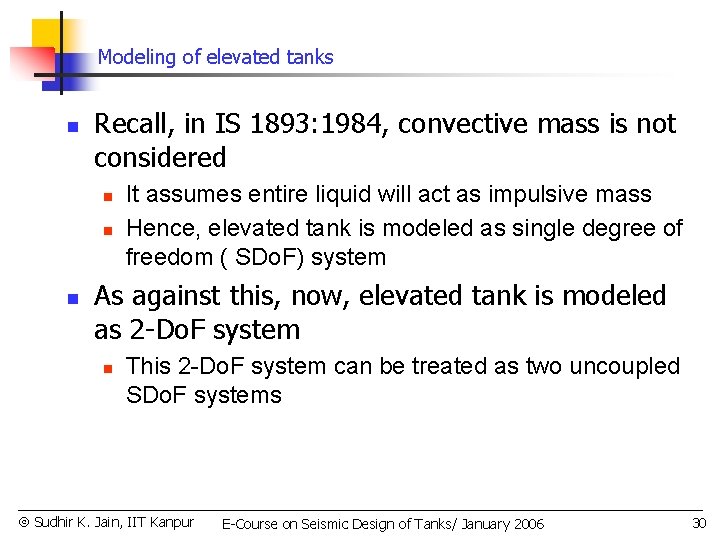
Modeling of elevated tanks n Recall, in IS 1893: 1984, convective mass is not considered n n n It assumes entire liquid will act as impulsive mass Hence, elevated tank is modeled as single degree of freedom ( SDo. F) system As against this, now, elevated tank is modeled as 2 -Do. F system n This 2 -Do. F system can be treated as two uncoupled SDo. F systems Sudhir K. Jain, IIT Kanpur E-Course on Seismic Design of Tanks/ January 2006 30
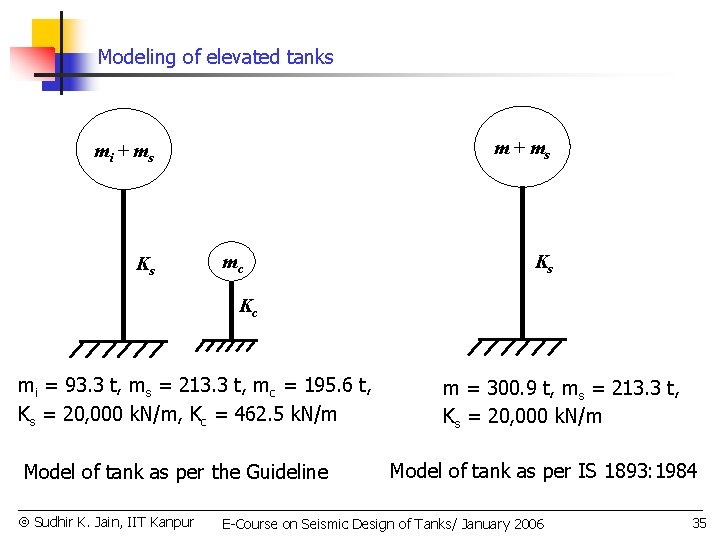
Modeling of elevated tanks n Models of elevated tanks m +ms mi + m s Ks mc m = Total liquid mass Ks Kc As per the Guideline Sudhir K. Jain, IIT Kanpur As per IS 1893: 1984 E-Course on Seismic Design of Tanks/ January 2006 31
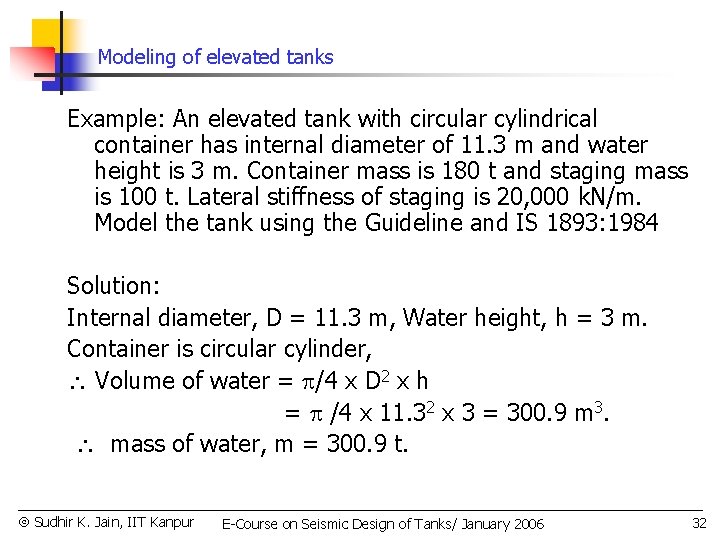
Modeling of elevated tanks Example: An elevated tank with circular cylindrical container has internal diameter of 11. 3 m and water height is 3 m. Container mass is 180 t and staging mass is 100 t. Lateral stiffness of staging is 20, 000 k. N/m. Model the tank using the Guideline and IS 1893: 1984 Solution: Internal diameter, D = 11. 3 m, Water height, h = 3 m. Container is circular cylinder, Volume of water = /4 x D 2 x h = /4 x 11. 32 x 3 = 300. 9 m 3. mass of water, m = 300. 9 t. Sudhir K. Jain, IIT Kanpur E-Course on Seismic Design of Tanks/ January 2006 32
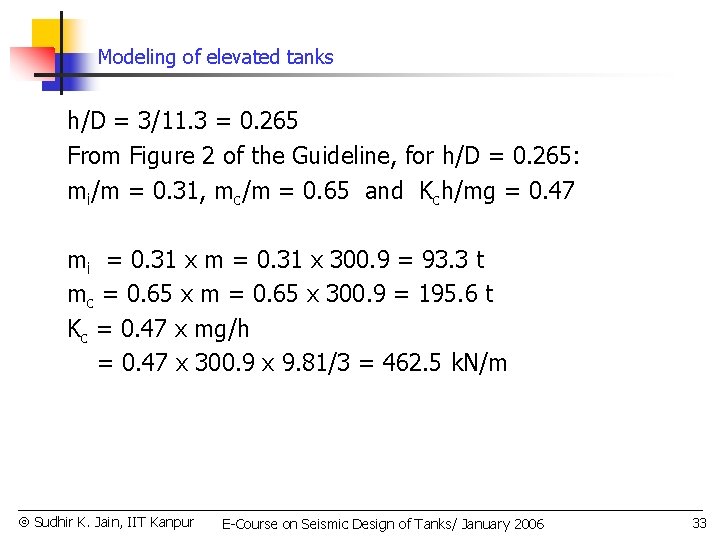
Modeling of elevated tanks h/D = 3/11. 3 = 0. 265 From Figure 2 of the Guideline, for h/D = 0. 265: mi/m = 0. 31, mc/m = 0. 65 and Kch/mg = 0. 47 mi = 0. 31 x m = 0. 31 x 300. 9 = 93. 3 t mc = 0. 65 x m = 0. 65 x 300. 9 = 195. 6 t Kc = 0. 47 x mg/h = 0. 47 x 300. 9 x 9. 81/3 = 462. 5 k. N/m Sudhir K. Jain, IIT Kanpur E-Course on Seismic Design of Tanks/ January 2006 33
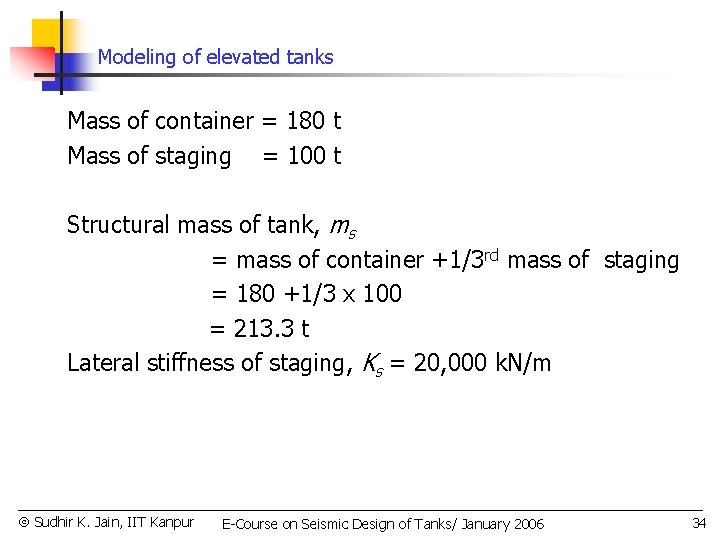
Modeling of elevated tanks Mass of container = 180 t Mass of staging = 100 t Structural mass of tank, ms = mass of container +1/3 rd mass of staging = 180 +1/3 x 100 = 213. 3 t Lateral stiffness of staging, Ks = 20, 000 k. N/m Sudhir K. Jain, IIT Kanpur E-Course on Seismic Design of Tanks/ January 2006 34
Modeling of elevated tanks m + ms mi + m s Ks mc Ks Kc mi = 93. 3 t, ms = 213. 3 t, mc = 195. 6 t, Ks = 20, 000 k. N/m, Kc = 462. 5 k. N/m Model of tank as per the Guideline Sudhir K. Jain, IIT Kanpur m = 300. 9 t, ms = 213. 3 t, Ks = 20, 000 k. N/m Model of tank as per IS 1893: 1984 E-Course on Seismic Design of Tanks/ January 2006 35
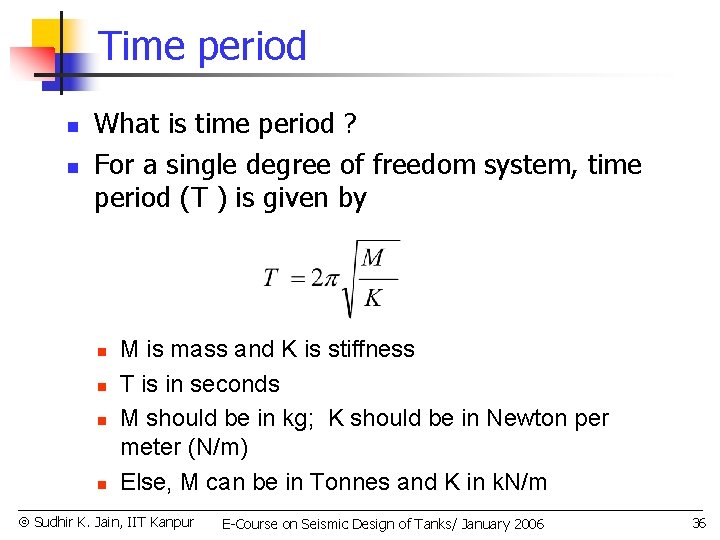
Time period n n What is time period ? For a single degree of freedom system, time period (T ) is given by n n M is mass and K is stiffness T is in seconds M should be in kg; K should be in Newton per meter (N/m) Else, M can be in Tonnes and K in k. N/m Sudhir K. Jain, IIT Kanpur E-Course on Seismic Design of Tanks/ January 2006 36
Time period n n Mathematical model of tank comprises of impulsive and convective components Hence, time periods of impulsive and convective mode are to be obtained Sudhir K. Jain, IIT Kanpur E-Course on Seismic Design of Tanks/ January 2006 37
Time period of impulsive mode n Procedure to obtain time period of impulsive mode (Ti) will be described for following three cases: n n n Ground supported circular tanks Ground supported rectangular tanks Elevated tanks Sudhir K. Jain, IIT Kanpur E-Course on Seismic Design of Tanks/ January 2006 38
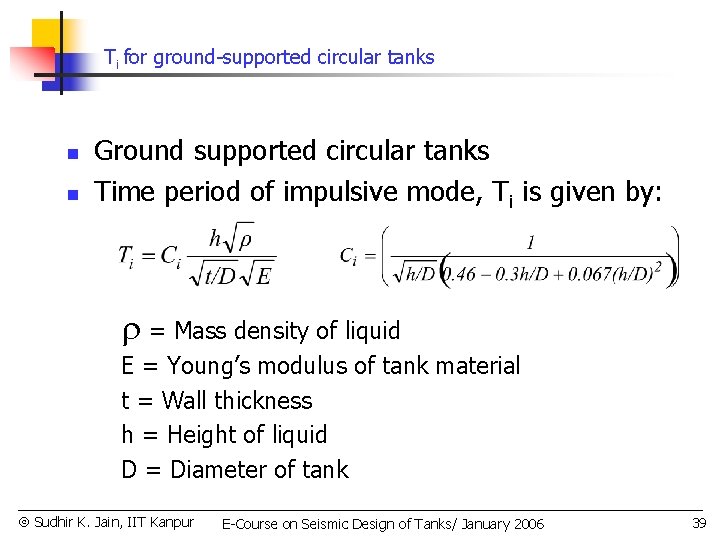
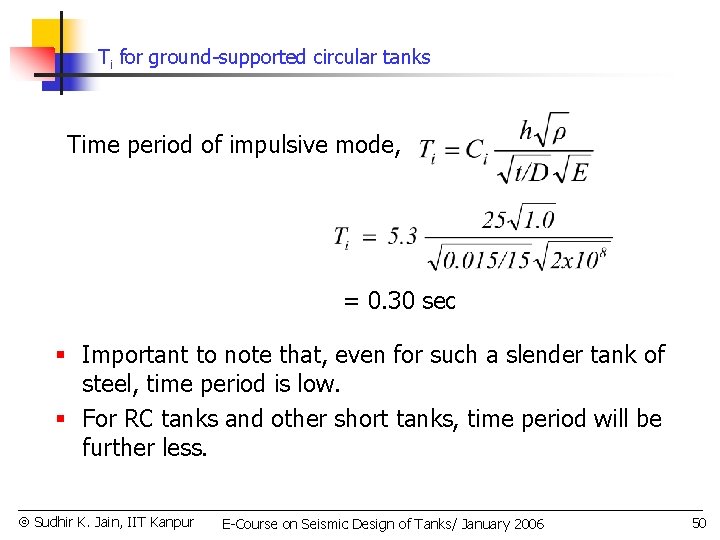
Ti for ground-supported circular tanks n n Ground supported circular tanks Time period of impulsive mode, Ti is given by: = Mass density of liquid E = Young’s modulus of tank material t = Wall thickness h = Height of liquid D = Diameter of tank Sudhir K. Jain, IIT Kanpur E-Course on Seismic Design of Tanks/ January 2006 39
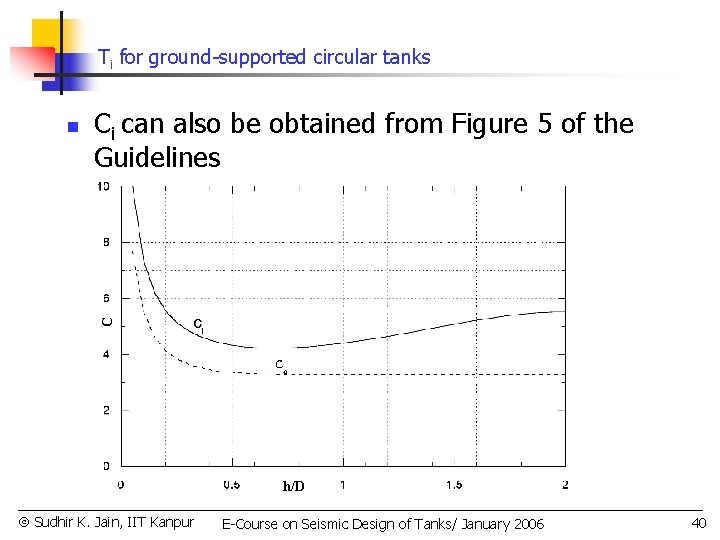
Ti for ground-supported circular tanks Ci can also be obtained from Figure 5 of the Guidelines C n h/D Sudhir K. Jain, IIT Kanpur E-Course on Seismic Design of Tanks/ January 2006 40
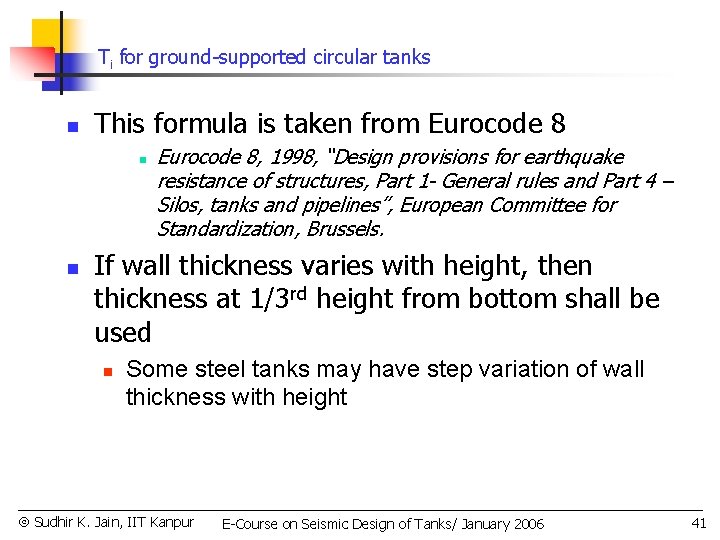
Ti for ground-supported circular tanks n This formula is taken from Eurocode 8 n n Eurocode 8, 1998, “Design provisions for earthquake resistance of structures, Part 1 - General rules and Part 4 – Silos, tanks and pipelines”, European Committee for Standardization, Brussels. If wall thickness varies with height, then thickness at 1/3 rd height from bottom shall be used n Some steel tanks may have step variation of wall thickness with height Sudhir K. Jain, IIT Kanpur E-Course on Seismic Design of Tanks/ January 2006 41
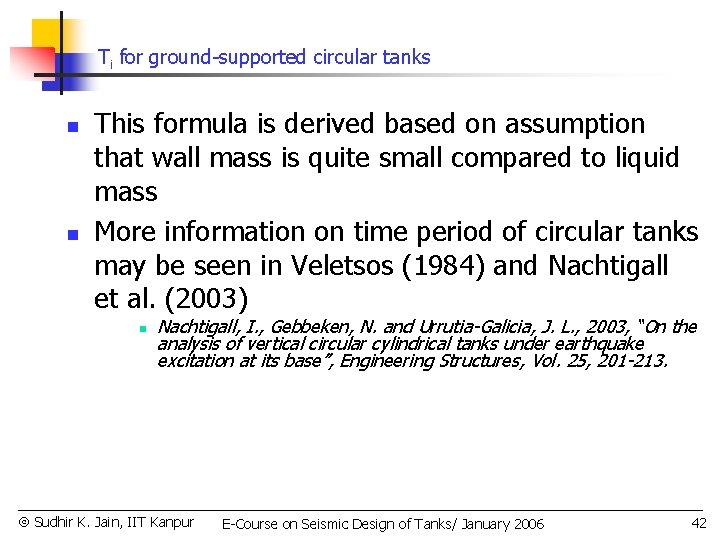
Ti for ground-supported circular tanks n n This formula is derived based on assumption that wall mass is quite small compared to liquid mass More information on time period of circular tanks may be seen in Veletsos (1984) and Nachtigall et al. (2003) n Nachtigall, I. , Gebbeken, N. and Urrutia-Galicia, J. L. , 2003, “On the analysis of vertical circular cylindrical tanks under earthquake excitation at its base”, Engineering Structures, Vol. 25, 201 -213. Sudhir K. Jain, IIT Kanpur E-Course on Seismic Design of Tanks/ January 2006 42
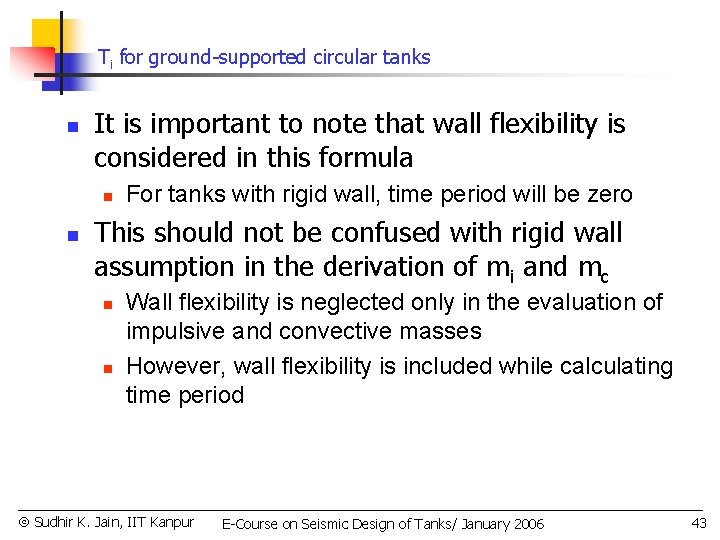
Ti for ground-supported circular tanks n It is important to note that wall flexibility is considered in this formula n n For tanks with rigid wall, time period will be zero This should not be confused with rigid wall assumption in the derivation of mi and mc n n Wall flexibility is neglected only in the evaluation of impulsive and convective masses However, wall flexibility is included while calculating time period Sudhir K. Jain, IIT Kanpur E-Course on Seismic Design of Tanks/ January 2006 43
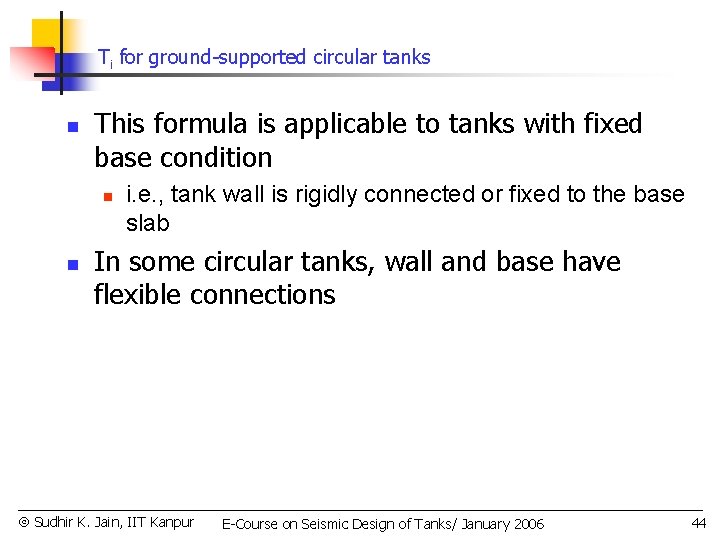
Ti for ground-supported circular tanks n This formula is applicable to tanks with fixed base condition n n i. e. , tank wall is rigidly connected or fixed to the base slab In some circular tanks, wall and base have flexible connections Sudhir K. Jain, IIT Kanpur E-Course on Seismic Design of Tanks/ January 2006 44
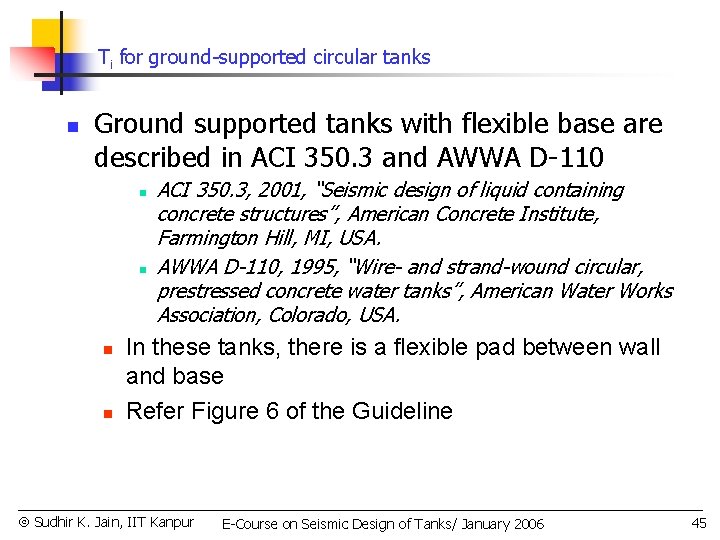
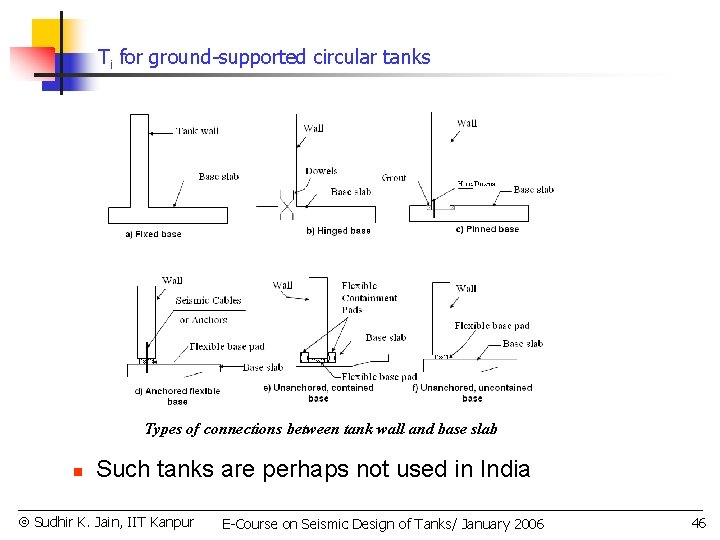
Ti for ground-supported circular tanks n Ground supported tanks with flexible base are described in ACI 350. 3 and AWWA D-110 n n ACI 350. 3, 2001, “Seismic design of liquid containing concrete structures”, American Concrete Institute, Farmington Hill, MI, USA. AWWA D-110, 1995, “Wire- and strand-wound circular, prestressed concrete water tanks”, American Water Works Association, Colorado, USA. In these tanks, there is a flexible pad between wall and base Refer Figure 6 of the Guideline Sudhir K. Jain, IIT Kanpur E-Course on Seismic Design of Tanks/ January 2006 45
Ti for ground-supported circular tanks Types of connections between tank wall and base slab n Such tanks are perhaps not used in India Sudhir K. Jain, IIT Kanpur E-Course on Seismic Design of Tanks/ January 2006 46
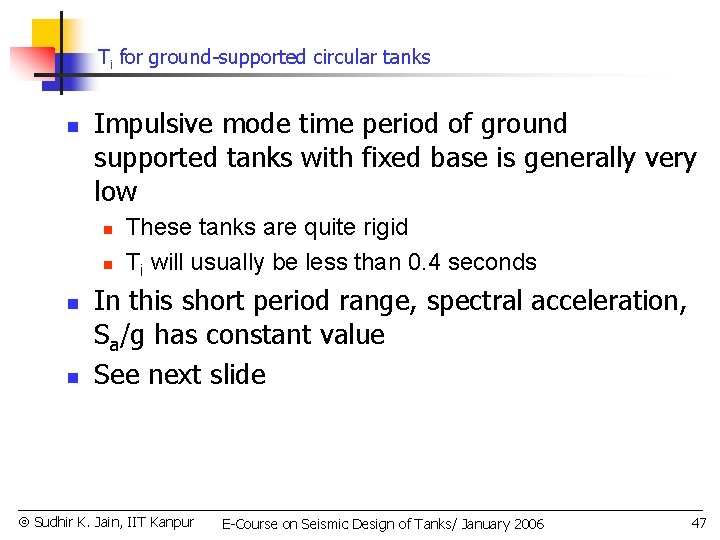
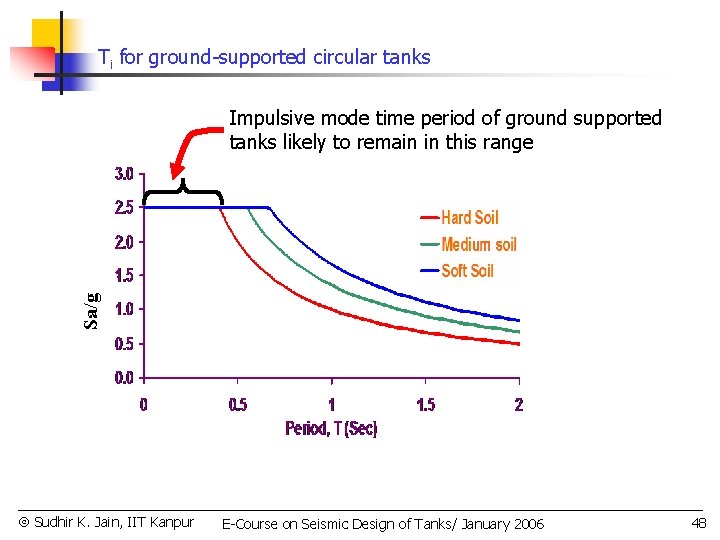
Ti for ground-supported circular tanks n Impulsive mode time period of ground supported tanks with fixed base is generally very low n n These tanks are quite rigid Ti will usually be less than 0. 4 seconds In this short period range, spectral acceleration, Sa/g has constant value See next slide Sudhir K. Jain, IIT Kanpur E-Course on Seismic Design of Tanks/ January 2006 47
Ti for ground-supported circular tanks Sa/g Impulsive mode time period of ground supported tanks likely to remain in this range Sudhir K. Jain, IIT Kanpur E-Course on Seismic Design of Tanks/ January 2006 48
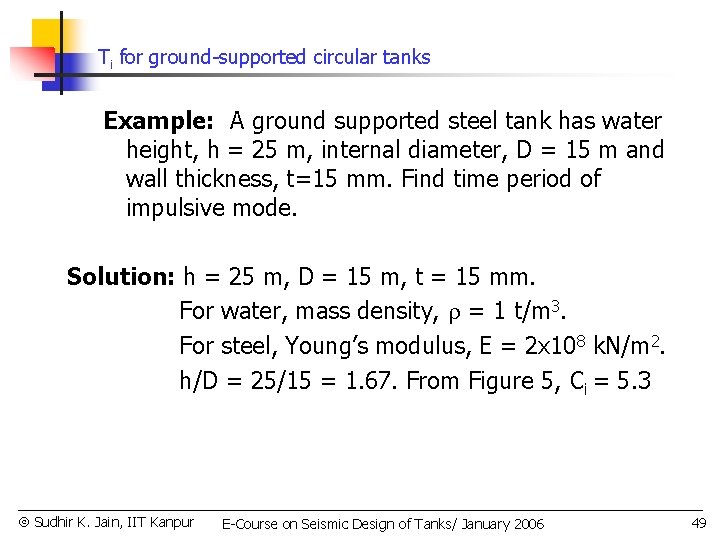
Ti for ground-supported circular tanks Example: A ground supported steel tank has water height, h = 25 m, internal diameter, D = 15 m and wall thickness, t=15 mm. Find time period of impulsive mode. Solution: h = 25 m, D = 15 m, t = 15 mm. For water, mass density, = 1 t/m 3. For steel, Young’s modulus, E = 2 x 10⁸ k. N/m 2. h/D = 25/15 = 1. 67. From Figure 5, Ci = 5. 3 Sudhir K. Jain, IIT Kanpur E-Course on Seismic Design of Tanks/ January 2006 49
Ti for ground-supported circular tanks Time period of impulsive mode, = 0. 30 sec § Important to note that, even for such a slender tank of steel, time period is low. § For RC tanks and other short tanks, time period will be further less. Sudhir K. Jain, IIT Kanpur E-Course on Seismic Design of Tanks/ January 2006 50
Ti for ground-supported circular tanks n n In view of this, no point in putting too much emphasis on evaluation of impulsive mode time period for ground supported tanks Recognizing this point, API standards have suggested a constant value of spectral acceleration for ground supported circular steel tanks n Thus, users of API standards need not find impulsive time period of ground supported tanks Sudhir K. Jain, IIT Kanpur E-Course on Seismic Design of Tanks/ January 2006 51
Ti for ground-supported rectangular tanks n n Ti for ground-supported rectangular tanks Procedure to find time period of impulsive mode is described in Clause no. 4. 3. 1. 2 of the Guidelines n n Time period is likely to be very low and Sa/g will remain constant n n This will not be repeated here As described earlier Hence, not much emphasis on time period evaluation Sudhir K. Jain, IIT Kanpur E-Course on Seismic Design of Tanks/ January 2006 52
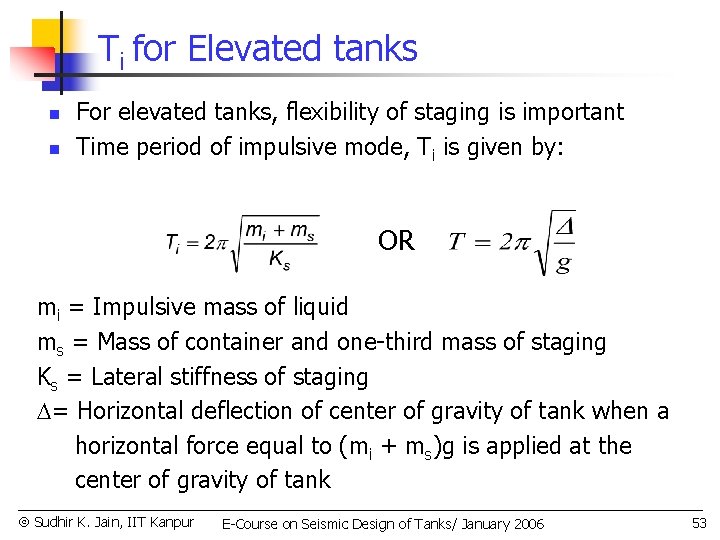
Ti for Elevated tanks n n For elevated tanks, flexibility of staging is important Time period of impulsive mode, Ti is given by: OR mi = Impulsive mass of liquid ms = Mass of container and one-third mass of staging Ks = Lateral stiffness of staging D= Horizontal deflection of center of gravity of tank when a horizontal force equal to (mi + ms)g is applied at the center of gravity of tank Sudhir K. Jain, IIT Kanpur E-Course on Seismic Design of Tanks/ January 2006 53
Ti for Elevated tanks n These two formulae are one and the same n n Expressed in terms of different quantities Center of gravity of tank refers to combined mass center of empty container plus impulsive mass of liquid Sudhir K. Jain, IIT Kanpur E-Course on Seismic Design of Tanks/ January 2006 54
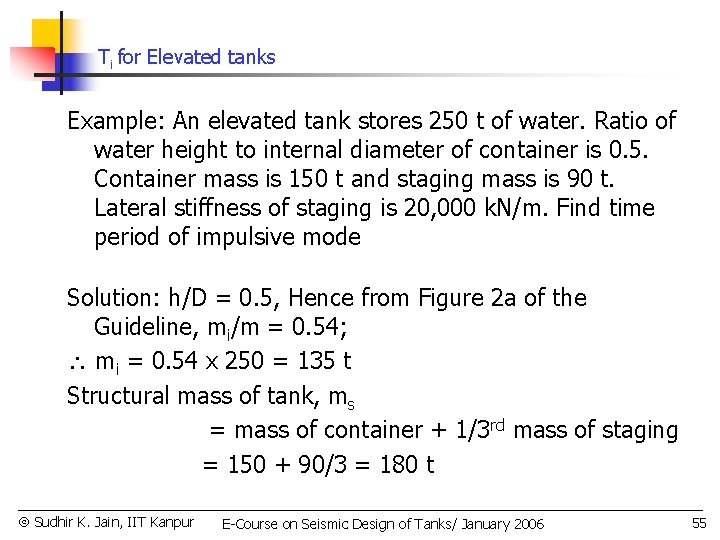
Ti for Elevated tanks Example: An elevated tank stores 250 t of water. Ratio of water height to internal diameter of container is 0. 5. Container mass is 150 t and staging mass is 90 t. Lateral stiffness of staging is 20, 000 k. N/m. Find time period of impulsive mode Solution: h/D = 0. 5, Hence from Figure 2 a of the Guideline, mi/m = 0. 54; mi = 0. 54 x 250 = 135 t Structural mass of tank, ms = mass of container + 1/3 rd mass of staging = 150 + 90/3 = 180 t Sudhir K. Jain, IIT Kanpur E-Course on Seismic Design of Tanks/ January 2006 55
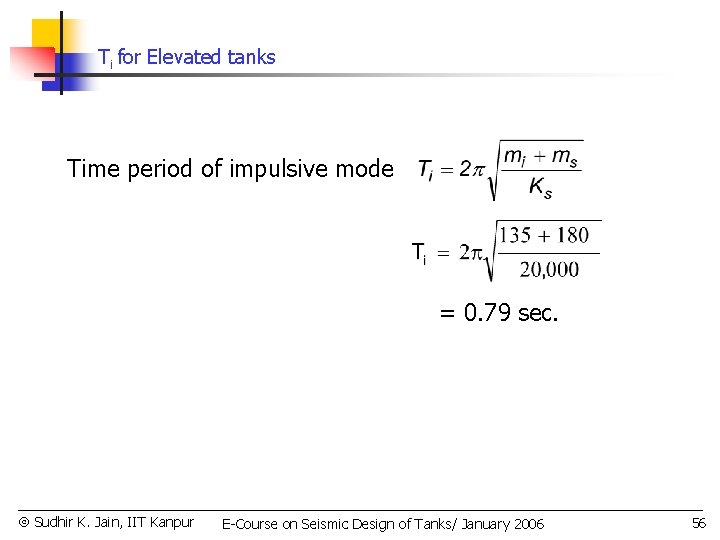
Ti for Elevated tanks Time period of impulsive mode = 0. 79 sec. Sudhir K. Jain, IIT Kanpur E-Course on Seismic Design of Tanks/ January 2006 56
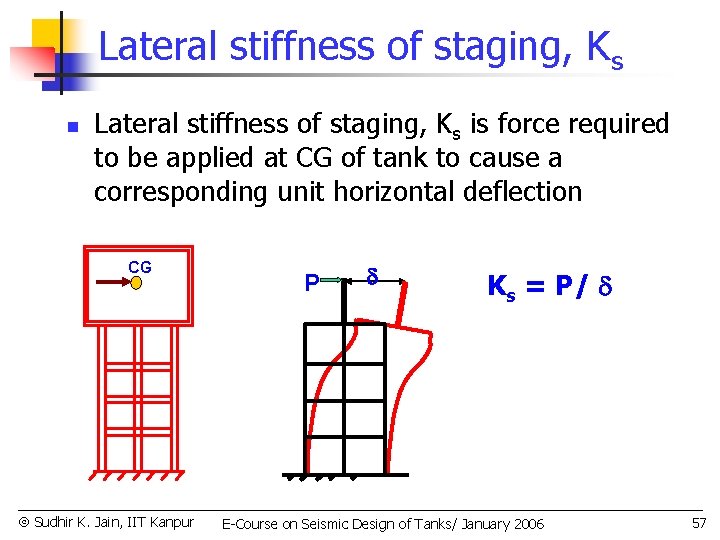
Lateral stiffness of staging, Ks n Lateral stiffness of staging, Ks is force required to be applied at CG of tank to cause a corresponding unit horizontal deflection CG Sudhir K. Jain, IIT Kanpur P Ks = P/ E-Course on Seismic Design of Tanks/ January 2006 57
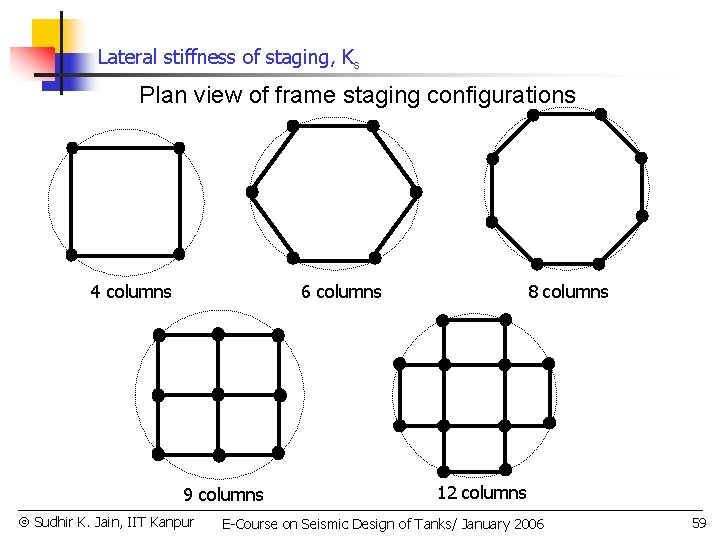
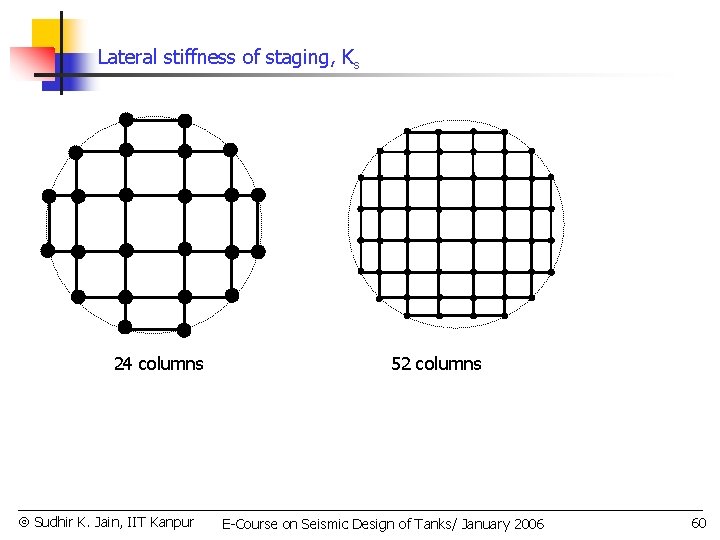
Lateral stiffness of staging, Ks n For frame type staging, lateral stiffness shall be obtained by suitably modeling columns and braces n More information can be seen in Sameer and Jain (1992, 1994) n n n Sameer, S. U. , and Jain, S. K. , 1992, “Approximate methods for determination of time period of water tank staging”, The Indian Concrete Journal, Vol. 66, No. 12, 691 -698. Sameer, S. U. , and Jain, S. K. , 1994, “Lateral load analysis of frame staging for elevated water tanks”, Journal of Structural Engineering, ASCE, Vol. 120, No. 5, 1375 -1393. Some commonly used frame type staging configurations are shown in next slide Sudhir K. Jain, IIT Kanpur E-Course on Seismic Design of Tanks/ January 2006 58
Lateral stiffness of staging, Ks Plan view of frame staging configurations 4 columns 6 columns 9 columns Sudhir K. Jain, IIT Kanpur 8 columns 12 columns E-Course on Seismic Design of Tanks/ January 2006 59
Lateral stiffness of staging, Ks 24 columns Sudhir K. Jain, IIT Kanpur 52 columns E-Course on Seismic Design of Tanks/ January 2006 60
Lateral stiffness of staging, Ks n Explanatory handbook, SP: 22 has considered braces as rigid beams n n n SP: 22 – 1982, Explanatory Handbook on Codes for Earthquake Engineering, Bureau of Indian Standards, New Delhi This is unrealistic modeling Leads to lower time period Hence, higher base shear coefficient This is another limitation of IS 1893: 1984 Using a standard structural analysis software, staging can be modeled analyzed to estimate lateral stiffness Sudhir K. Jain, IIT Kanpur E-Course on Seismic Design of Tanks/ January 2006 61
Lateral stiffness of staging, Ks n n Shaft type staging can be treated as a vertical cantilever fixed at base and free at top If flexural behavior is dominant, then n Its stiffness will be Ks = 3 EI/L 3 This will be a good approximation if height to diameter ratio is greater than two Otherwise, shear deformations of shaft would affect the stiffness and should be included. Sudhir K. Jain, IIT Kanpur E-Course on Seismic Design of Tanks/ January 2006 62
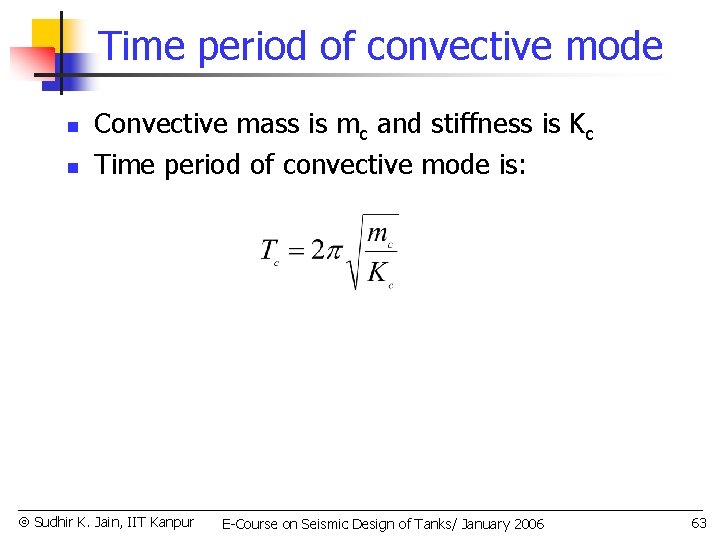
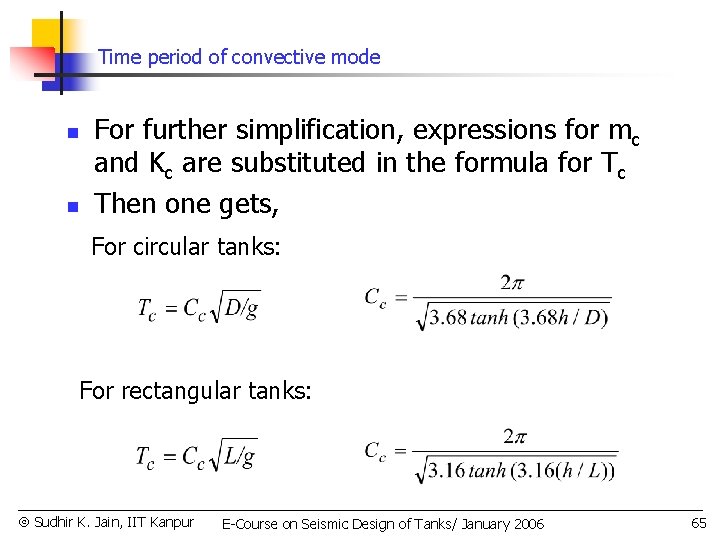
Time period of convective mode n n Convective mass is mc and stiffness is Kc Time period of convective mode is: Sudhir K. Jain, IIT Kanpur E-Course on Seismic Design of Tanks/ January 2006 63
Time period of convective mode n mc and Kc for circular and rectangular tanks can be obtained from graphs or expressions n n These are described in Lecture 1 Refer Figures 2 and 3 of the Guidelines Sudhir K. Jain, IIT Kanpur E-Course on Seismic Design of Tanks/ January 2006 64
Time period of convective mode n n For further simplification, expressions for mc and Kc are substituted in the formula for Tc Then one gets, For circular tanks: For rectangular tanks: Sudhir K. Jain, IIT Kanpur E-Course on Seismic Design of Tanks/ January 2006 65
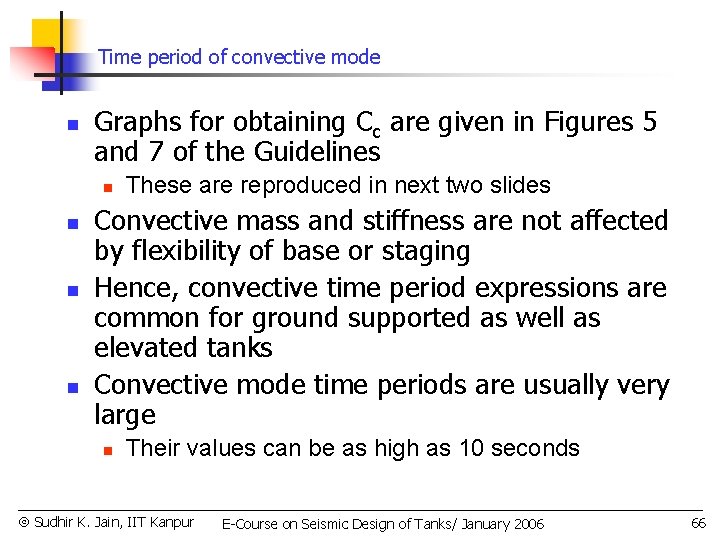
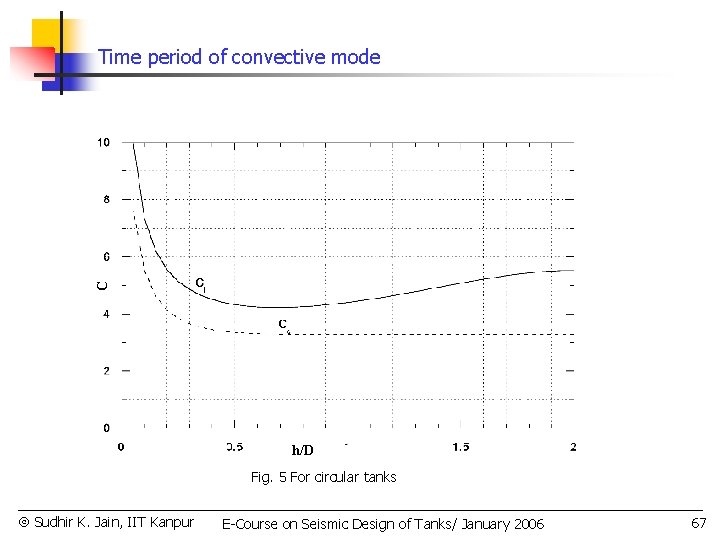
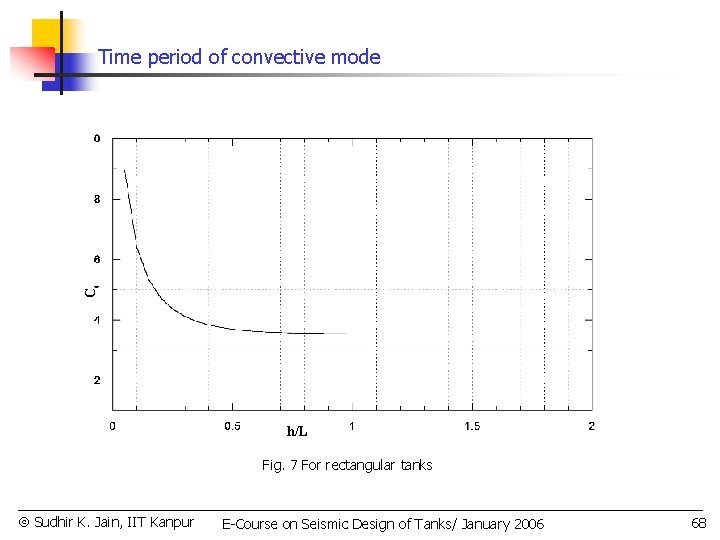
Time period of convective mode n Graphs for obtaining Cc are given in Figures 5 and 7 of the Guidelines n n These are reproduced in next two slides Convective mass and stiffness are not affected by flexibility of base or staging Hence, convective time period expressions are common for ground supported as well as elevated tanks Convective mode time periods are usually very large n Their values can be as high as 10 seconds Sudhir K. Jain, IIT Kanpur E-Course on Seismic Design of Tanks/ January 2006 66
C Time period of convective mode h/D Fig. 5 For circular tanks Sudhir K. Jain, IIT Kanpur E-Course on Seismic Design of Tanks/ January 2006 67
Cc Time period of convective mode h/L Fig. 7 For rectangular tanks Sudhir K. Jain, IIT Kanpur E-Course on Seismic Design of Tanks/ January 2006 68
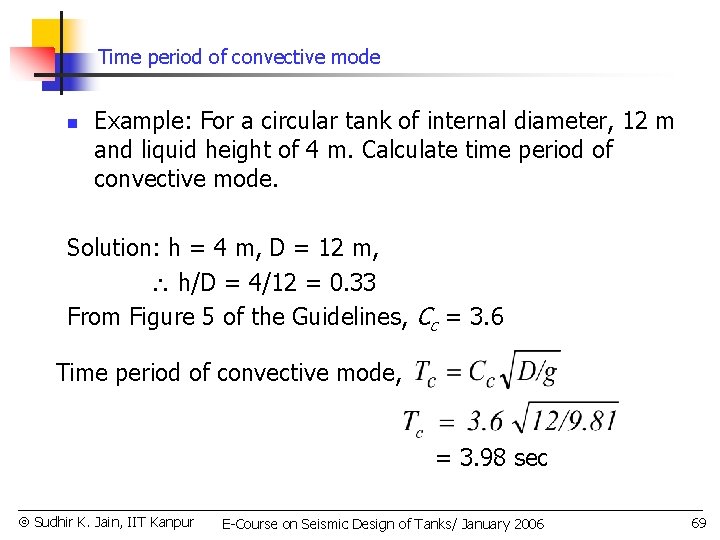
Time period of convective mode n Example: For a circular tank of internal diameter, 12 m and liquid height of 4 m. Calculate time period of convective mode. Solution: h = 4 m, D = 12 m, h/D = 4/12 = 0. 33 From Figure 5 of the Guidelines, Cc = 3. 6 Time period of convective mode, = 3. 98 sec Sudhir K. Jain, IIT Kanpur E-Course on Seismic Design of Tanks/ January 2006 69
At the end of Lecture 3 n n n Based on mechanical models, time period for impulsive and convective modes can be obtained for ground supported and elevated tanks For ground supported tanks, impulsive mode time period is likely to be very less Convective mode time period can be very large Sudhir K. Jain, IIT Kanpur E-Course on Seismic Design of Tanks/ January 2006 70